Kimberly Lewtas Hisham Osman
Mass balance budget for
© 2017 International Institute for Sustainable Development
Published by the International Institute for Sustainable Development
International Institute for Sustainable Development
The International Institute for Sustainable Development (IISD) is one of the world’s leading centres of research and innovation. The Institute provides practical solutions to the growing challenges and opportunities of integrating environmental and social priorities with economic development. We report on international negotiations and share knowledge gained through collaborative projects, resulting in more rigorous research, stronger global networks, and better engagement among researchers, citizens, businesses and policy-makers.IISD is registered as a charitable organization in Canada and has 501(c)(3) status in the United States. IISD receives core operating support from the Government of Canada, provided through the International Development Research Centre (IDRC) and from the Province of Manitoba. The Institute receives project funding from numerous governments inside and outside Canada, United Nations agencies, foundations, the private sector, and individuals.
Manitoba Prairie Lakes: Mass balance budget for nutrient management at Pelican Lake, Manitoba
Authors: Kimberly Lewtas, Hisham Osman, Geofrey Gunn and Dimple Roy
Review and Advisory: Dr. Nora Casson and Dr. Scott Higgins
Head Office
This report is part of a broader project of the International Institute for Sustainable Development (IISD), working in partnership with the Province of Manitoba. Previous and continuing work includes a review and assessment of in-lake remediation treatments and strategies, characterizing available lake chemistry and hydrological data for selected Manitoba prairie lakes, and the development of a remediation decision-support framework.
The Water Program of IISD would like to express its gratitude to our project partner, the Government of Manitoba, for providing funding and ongoing support throughout the process of this project. Thank you in particular to Cassie McLean, Elaine Page, Ronald Hempel and Graham Phipps, for enabling a strong collaborative efort in assembling data essential for this report.
The authors also wish to express their gratitude to several individuals for their insight, guidance and support in the
About this Report
This report is part of a broader project of the International Institute for Sustainable Development (IISD), working in partnership with the Province of Manitoba. Previous and continuing work includes a review and assessment of in-lake remediation treatments and strategies, characterizing available lake chemistry and hydrological data for selected Manitoba prairie lakes, and the development of a remediation decision-support framework.
The Water Program of IISD would like to express its gratitude to our project partner, the Government of Manitoba, for providing funding and ongoing support throughout the process of this project. Thank you in particular to Cassie McLean, Elaine Page, Ronald Hempel and Graham Phipps, for enabling a strong collaborative efort in assembling data essential for this report.
Executive Summary
Eutrophication is a well-documented phenomenon in many freshwater ecosystems in Manitoba and is a pervasive water quality issue afecting surface waters across Canada and internationally. Lake eutrophication is a natural process resulting from the gradual accumulation of nutrients, increased productivity and slow illing in of the basin with accumulated sediments, silt and organic matter from the watershed. Many lakes in Manitoba are susceptible to these natural eutrophication processes, irrespective of land use, due to high soil fertility, runof patterns and geology (Environment Canada & Manitoba Water Stewardship, 2011; Lewtas, Paterson, Venema, & Roy, 2015). However, human-induced cultural eutrophication occurs when nutrient, soil or organic matter loads to the lake dramatically increase, signiicantly shortening a lake’s lifespan. Cultural eutrophication is a signiicant problem in Manitoba, for Lake Winnipeg, and for many surface waters across the province—many lakes are experiencing algal blooms, degradation of water quality including, in some cases, elevated algal toxin concentrations, and reduction of the ecological services (e.g., recreation, irrigation, isheries) they provide to local communities and economies. While the water quality of many prairie lakes is monitored and the extent of the eutrophication—and associated negative consequences—generally understood, information on the speciic nutrient sources and in-lake processes is often insuicient to identify speciic management options.
This study sought to conduct a water and nutrient mass balance, identifying the variance and relative importance of diferent nutrient sources and internal lake processes for a lake that could be used as a general model for other prairie lakes. As with many other shallow prairie lakes, the eutrophication of Pelican Lake has become increasingly pronounced over recent years. Our results identiied:
1. That external nutrient luxes into the lake were strongly linked to surface hydrology, suggesting that increased rainfall associated with climate variability or climate change has strongly contributed to nutrient inputs to prairie lakes in recent years.
2. Variation in nutrient concentrations was high between the tributaries that drained the lakes sub-catchments, suggesting the potential for management of land use or morphology (e.g., hill slope stabilization) to reduce external nutrient loads.
3. Biological processes (i.e., N2 ixation), driven by elevated phosphorus (P) concentrations, appeared to be a signiicant component of the nitrogen (N) budget and causing the lake to become a net source of N to the surrounding environment (including groundwater).
4. Internal recycling (i.e., internal loading from the lake sediments) represented ~10 per cent of external P loads, and the sediments were a net source of P to the water column during the study period.
Table ES1. Summary of TP and TN budget components for Pelican Lake for the study period.
Budget component TP TN
Lake concentration (mean, mg L-1) 0.305 1.7
Inputs
Stream inflow (kg) 6,101 20,253
Diverted inflow (PL08A) (kg) 4,863 23,376
Precipitation (kg) 808 9,788
Outputs
Groundwater (net, kg) 1,180 103,007
Diverted outflow (PL08C) (kg) 1,698 7,667
Internal recycling processes (kg) 1,156 53,883
∆ water column 10,051 -3,374
Table of Contents
1.0 Introduction ...1
2.0 Methods ...3
2.1 Lake and Catchment Characteristics ...3
2.2 Sampling Method ... 6
2.3 Hydrology and Water Budgets ... 9
2.3.1 Lake Volume ... 9
2.3.2 Stream Flows and Direct Runoff ...10
2.3.3 Groundwater ...10
2.3.4 Precipitation ... 11
2.3.5 Evaporation ... 11
2.4 Chemical Analyses ...12
2.5 Phosphorus and Nitrogen Mass Loads ...12
2.5.1 Stream Inflow and Outflow ...12
2.5.2 Groundwater ...12
2.5.3 Precipitation ...12
2.5.4 Internal Loading Processes: Sediment and macrophyte reservoir ...13
2.5.5 Nutrient Retained in the Lake: Water column reservoir ...13
3.0 Results ... 14
3.1 Hydrology and Water Balance ... 14
3.2 Phosphorus Budget: Load transported to and from the lake ... 14
3.2.1 Streams ... 14
3.3 Nitrogen Budget: Load transported to and from the lake ...18
3.3.1 Streams ...18
3.3.2 Precipitation ...19
3.3.3 Groundwater ...19
3.3.4 Diverted Outflow ...20
3.3.5 Internal Recycling Processes ...20
3.3.6 Lake Water Column ...20
3.3.7 Nitrogen Budget ...20
4.0 Discussion ... 23
4.1 External Loads, Catchment Land Use Variation and the Importance of Sub-Catchment Scale Budget ...23
4.2 Flood Events on the Prairie Landscape and the Importance of Monitoring Spring Runoff Event ... 24
4.3 Internal Phosphorus Loading ... 24
4.4 Management Implications ... 25
5.0 Conclusion ...28
References ...29
APPENDIX ... 33
A.1 Stream water chemistry data by site and month ...33
1.0 Introduction
Eutrophication has become the primary water quality issue for many freshwater ecosystems around the world. Lake eutrophication is a natural process resulting from the gradual accumulation of nutrients, increased productivity and slow illing in of the basin with accumulated sediments, silt and organic matter from the watershed (Schauser, Lewandowski, & Hupfer, 2003; Waters & Webster-Brown, 2016). Many lakes in Manitoba would likely be
categorized as eutrophic even without development in the watershed, due to the province’s regional soil fertility, runof patterns and geology, which encourage natural eutrophic conditions (Environment Canada & Manitoba Water Stewardship, 2011; Lewtas et al., 2015). However, human-induced cultural eutrophication—where human activities greatly accelerate nutrient loading—can dramatically increase the rates at which natural eutrophication occurs and exacerbate problems in lakes even when considered naturally eutrophic. High loading of nutrients from anthropogenic sources can result in hypoxic or anoxic conditions in stratiied rivers, lakes, reservoirs, estuaries and coastal regions (Smith, 2003; Smith, Joye, & Howarth, 2006; Smith & Schindler, 2009). Of increasing concern are the symptoms of eutrophication, particularly algal blooms and the development of blooms that may include toxic algal species of cyanobacteria (Schindler et al., 2008).
Lake ecosystems represent a complex set of physical, chemical and biological factors and interactions that inluence their responsiveness to remediation and management eforts. These factors vary with lake origin, the regional setting and the watershed, and include hydrology, climate, watershed geology, soil fertility, hydraulic residence time, biological factors (such as the presence of ish taxa that increase rates of sediment and nutrient resuspension, or the presence of efective algal grazers), the presence or absence of thermal stratiication, and external and internal nutrient sources and rates. Solutions to eutrophication can be approached on diferent paths, and the success of a remediation management strategy varies greatly from lake to lake; however, it is generally agreed that these treatments are usually not worth considering unless external nutrient loads can also be reduced and controlled (Lewtas et al., 2015).
Water quality parameters, such as nutrient concentration, have complex relationships with external nutrient loads and in lake processes. Shallow eutrophic lakes can display complex nutrient dynamics, with processes such as sediment-water exchanges, playing a much greater role than in deep, dimictic lakes (Ishikawa & Tanaka, 1993; Goda & Matsukoa, 1986; Søndergaard Kristensen, & Jeppesen, 1992). With site-speciic lake and catchment hydrological characteristics, some lakes may also be relatively unresponsive to watershed nutrient management (Welch & Cooke, 1995).
Primary productivity in lake systems is strongly limited by nutrient availability, and the role of macronutrients nitrogen (N) and phosphorus (P) in controlling phytoplankton biomass is well established in the literature (Schindler et al., 2008). Phosphorus is considered to be the foremost nutrient in the limitation of primary productivity in most lakes, as it exists predominantly in forms that are not bioavailable (Schindler et al., 2008). Limiting primary production, attempts are often made to decrease the external P load (Schauser et al., 2003; Schindler et al., 2008). Phosphorus control is also more feasible than to of nitrogen because, unlike nitrogen, there is no atmospheric source of phosphorus that is bioavailable (Zamparas & Zacharias, 2014).
With awareness growing on the role that shallow inland lakes and wetlands play in water quality mitigation, an expanding number of policy interventions are being implemented to restore those ecosystems that have been afected by eutrophication. There is a need to share lessons in best practices and overarching principles for framing lake restoration and nutrient management projects due to growing uncertainties regarding in-lake remediation, and for enhancing overall eiciency and efectiveness in watershed management to alleviate growing water quality and security concerns.
a site-speciic study of a range of parameters afecting viability of the treatment applied, in connection with an assessment of the potential adverse efects on biotic and abiotic factors, and ecosystem and human health. In-lake remediation treatments are not a panacea, and their implementation should consist of a management approach as part of an integrated watershed management plan. The efectiveness and longevity of in-lake remediation treatments is reduced if managing external nutrient loads is not given the necessary importance in lake restoration (Zamparas & Zacharias, 2014).
2.0 Methods
2.1 Lake and Catchment Characteristics
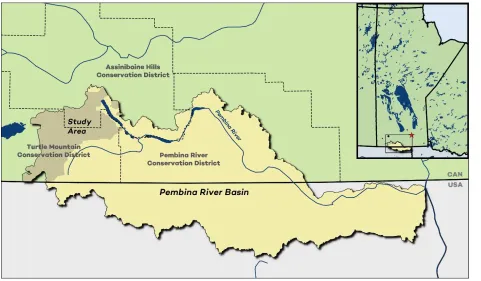
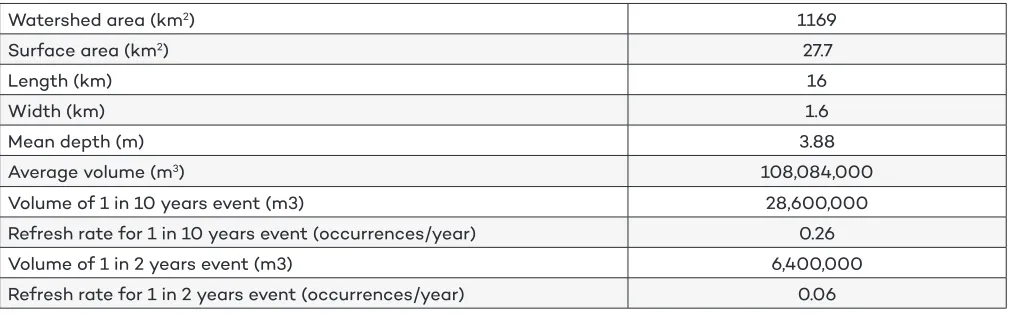
The Pelican Lake watershed is located in the southern region of Manitoba, and is one of several smaller, shallow lakes along the Pembina River. The Pembina River is a major watercourse located in south-central Manitoba, and is part of the larger Lake Winnipeg Basin (MAFRI, 2009). The calculated area of the Pelican Lake watershed is 1169 km2. The Pelican Lake watershed is located in the northwestern portion of the Pembina River basin (Figure 1).
Figure 1. Map and location of the study site, Pelican Lake, within Manitoba.
Source: Created by IISD (Geofrey Gunn) for this research. Land use GIS data obtained from the Government of Manitoba land use cover, 2006.
Table 1. Summary of Pelican Lake physical and hydrological characteristics
Volume of 1 in 10 years event (m3) 28,600,000
Refresh rate for 1 in 10 years event (occurrences/year) 0.26
Volume of 1 in 2 years event (m3) 6,400,000
Refresh rate for 1 in 2 years event (occurrences/year) 0.06
Source: Pellissier, Oliver, & Lowdon, 2014; Province of Manitoba, 2015.
The lake catchment is primarily lat and the predominant land use is agricultural, both crop production and livestock grazing. The area directly surrounding the shoreline is steep, and combined with forest and wetland loss in the region, the erosion of naturally phosphorus-rich soils has contributed to the lake’s water quality issues. A bathymetric survey conducted in 2014 indicated the presence of three main substrate classes in Pelican Lake (Pellissier et al., 2014):
• Soft clay comprised 51.2 per cent of bottom substrate, and was most abundant in deeper regions away from the shoreline.
• Silt or clay-silt mixtures comprised 44.5 per cent of bottom substrate and was mostly near shore and within the lake’s southern basin.
• The remaining 4.3 per cent of the bottom substrate consisted of sand or loose shale.
An aquatic vegetation survey was also conducted, where estimates of plant coverage and biovolume were
determined for the summer and fall of 2014 (Table 2). Submerged plant height and coverage were combined into a single measure of plant biovolume.
Table 2. Summary of submerged aquatic vegetation for Pelican Lake
June 2014 survey September 2014 survey
Mean biovolume (%) 0.13 0.13
Maximum biovolume (%) 24.2 19.0
Mean plant height (cm) 13.3 12.6
Maximum plant height (cm) 70.6 75.3
Whole lake plant coverage (%) 16.8 14.4
Source: Pellissier et al., 2014.
Figure 2. Land use for the load-contributing sub-catchments in the Pelican Lake watershed.
Table 3. Land use distribution for monitored sub-catchments of the Pelican Lake watershed
Sub-catchment
Land use, in km2 and percentage (%) of drainage area
Forest Grass Impervious Sand and gravel Water Wetland Agriculture Total drainage area
PL01 12.0 47.7 11.1 0.0 8.3 20.1 267.4 367 km
*Sub-catchment land use area estimates calculated from the Government of Manitoba GIS land cover data, 2006. Note: Figure 3 (next page) illustrates the location of all monitored sub-catchments in the Pelican Lake watershed.
2.2 Sampling Method
Figure 3. Water quality and stream flow velocity monitoring sites at Pelican Lake and their contributing catchment drainage area.
Source: Created by IISD (Geofrey Gunn) for this research. Land use GIS data obtained from the Government of Manitoba land use cover, 2006.
Sampling at Pelican Lake involved two components:
1. Stream flow sampling: These sites are referred to as PL01 – PL12, and at each site: a. Water sample was collected for water quality laboratory analysis.
b. Flow velocity measurements, using a hand-held low meter, were recorded.
2. In-lake sampling: Monthly in-lake water quality parameters were measured from May to October 2016 as part of the Province of Manitoba water quality monitoring program.
At stream sampling sites, a water sample was collected in polypropylene containers and analyzed at ALS Laboratories in Winnipeg, Manitoba. Flow velocity parameters were recorded with a hand-held Solinst levelogger low meter. In-lake water quality samples were collected mid-lake and monthly, whereas stream inlow site sampling was dependent on precipitation events and was variable between months.
2.3 Hydrology and Water Budgets
2.3.1 Lake Volume
The total lake volume of Pelican Lake is approx. 108,084,000 m3, at a lake water level of 412.09 m (Pellissier et al., 2014). The water volume and height of Pelican Lake are controlled by an inlet-outlet structure (dam) that limits the range of luctuation in water table height. Changes in level (and hence volume) during dam opening events were used in this research to quantify the volume lost during opening. For the period of this study (March to October 2016), the diference between the maximum and minimum water level was 35.5 cm. The assumption has been made that the relationship between the water level (WL) and lake volume (V) is linear:
The lake’s water budget balance is the diference between the hydrological inputs and outputs of any water system during a period of time and can be represented as equation (2).
The components of the inlows (dV/dt) typically include precipitation (Precip), surface runof (Qin) and groundwater inlow (Gin). The components of the outlows are represented by evaporation and evapotranspiration (E), surface outlows (Qout) and groundwater seepage (Gout). Therefore, equation (2) can be derived as:
In general, precipitation, surface runofs and change in volume can be measured directly, while groundwater and evaporation are more complex. However, there are various methods to quantify evaporation from open water, such as Penman Montieth (Food and Agriculture Organization of the United Nations [FAO], 1998; Blaney & Criddle 1962). In many water budget studies, the net groundwater low (GWnet - the deicit between Gin and Gout) is calculated as the residual term of the water balance equation (Swancar, Lee, & O’Hare, 2000):
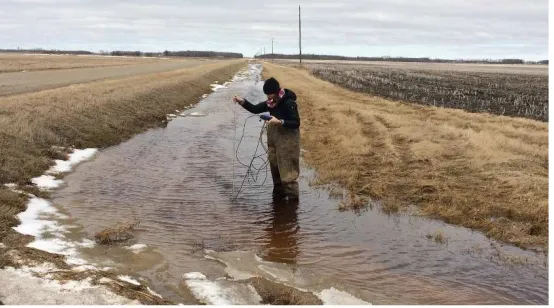
Figure 6. Stream sampling at Pelican Lake during March spring melt runoff.
(1)
(2)
2.3.2 Stream Flows and Direct Runoff
To estimate the sub-catchment runof component in Pelican Lake’s water budget, the Soil Conservation Service Curve Number (SCS-CN) method was used. The SCS-CN method was originally developed by the U.S.
Department of Agriculture to estimate direct runof from rainfall events on agricultural ields (Soulis & Valiantzas, 2012). The SCS-CN method is widely used in many hydrologic applications, such as water budgets models and lood designs. The SCS-CN method is based on the following empirical equation (Mockus, 2010):
Where:
Q = depth of runof, mm
P = depth of total rainfall, mm
Ia = initial abstraction, mm
S = maximum potential retention, mm
The initial abstraction (Ia) and maximum potential retention (S) are calculated using:
CN value is a representation for the soil types and land cover and its value ranges from 40 to 100 (impermeable surface). The value for CN can be determined by using the National Engineering Handbook (Land Cover Table 9-1, Part 360, Hydrology) by Mockus and Hjelmfelt (2004). The SCS-CN values commonly used in hydrologic practice assume that the initial abstraction rate is set constant at λ=0.2, in order that S (its transformation CN) remains the only free unknown parameter of the model (Soulis & Valiantzas, 2012). In the context of this study, the initial values for CN and λ were 75 and 0.2, respectively. However, these initial values were adjusted to 78 and 0.18 after the water balance model was calibrated using a chloride (a conservative element) mass budget.
The runof depth is calculated based on daily time step and then is summed to a monthly time step using Matlab (MATLAB 6.1, The MathWorks Inc., Natick, MA, 2000). To calculate the monthly volume of water that enters the lake from each stream, the following equation is used:
Areaiis the sub-catchment area that corresponds to tributary(i). Watersheds were delineated manually on ArcGIS using topographic vector data, near infrared satellite imagery, and provincial aerial photography (ESRI 2011. ArcGIS Desktop: Release 10. Redlands, CA: Environmental Systems Research Institute).
2.3.3 Groundwater
Groundwater exchange between lakes and aquifers can be a signiicant component in the water budget for individual months; therefore, it can play a great role in the chemical regulation of lakes (Gurrieri & Furniss, 2004; Swancar et al., 2000). Given that there was no available data to describe the groundwater interaction between Pelican Lake and the regional aquifer (such as groundwater tables and hydraulic conductivities) the
(5)
(6)
(7)
equation). This approach to estimating net groundwater component in lakes’ water balance is widely used in the literature when it is diicult to make independent estimates (Hood Roy, & Hayashi, 2006; Swancar et al., 2000; Sacks, Lee, & Swancar, 2014; Phelps & German, 1996). However, the limitation of the approach is that inlow and outlow cannot be separated, and it incorporates other budget components errors in the GWnet.
Winter (1981) estimates the overall uncertainty as the square root of the sum of the individual uncertainties squares as in the following equation:
Uncertainties in monthly water balance components are assumed as follows: precipitation (ePrecip) 5 per cent, evaporation (eE) 15 per cent, diverted lows (edeltaV) 10 per cent and tributary lows (eQ) 100 per cent.
2.3.4 Precipitation
The precipitation and temperature data used in this study were measured at Belmont weather station, which is located at 2.2 km east of Pelican Lake. The total volume of precipitation (P) that falls directly on Pelican Lake— measured in cubic meters—is calculated by the following equation,
where Arealake is the surface area (m2) of Pelican Lake as per the bathymetric survey report by Pellissier et al. (2014).
R is total rainfall depth for each month measured in meters.
2.3.5 Evaporation
The evaporation rates from Pelican Lake were calculated on daily basis using Matlab coding based on Penman Montieth method (Equation 11) as descried in FAO (1998) and Zotarelli et al., (2015). The required data for calculation were obtained from the NASA Langley Research Center POWER Project funded through the NASA Earth Science Directorate Applied Science Program.
where:
ETo = evaporation rate (mm day-1)
Δ = slope of the saturated vapour pressure; Rn = net radiation flux (MJ m-2 d-1);
G = sensible heat flux into the soil (MJ m-2 d-1);
u2 = wind speed, at 2 m above the ground (m s-1);
T = mean air temperature (°C);
es = saturation vapour pressure, kPa;
ea = actual vapour pressure, kPa;
γ = psychrometric constant, kPa °C-1
The monthly volumes (m3) of water that evaporate (E) from Pelican Lake were then calculated using the following relationship:
(9)
(10)
(11)
2.4 Chemical Analyses
Water quality parameters analyzed were based on nutrient model requirements and in lake- remediation treatments’ monitoring needs that would complement the provincial surface water monitoring program. Multiple nutrient species were monitored and analyzed to estimate their respective contributions from unmeasured stream inlows in the development of the nutrient budgets. These nutrient subspecies include:
• Phosphorus: Total P, total particulate P and total dissolved P
• Nitrogen: Total-N, nitrate, nitrite and total kjeldahl-N (TKN) and ammonia
Chloride (Cl) concentration was also analyzed to validate the water budget as a conservative tracer. Chloride concentration acts as a marker and by comparing the changes in mass of chloride within a water body to the net loads, the accuracy of the water budget can be determined (James, 2014).
2.5 Phosphorus and Nitrogen Mass Loads
2.5.1 Stream Inflow and Outflow
Stream nutrients loads are calculated on a daily basis and then aggregated for each month. The following steps were followed in calculating the stream nutrients loads from each sub-catchment:
1. The relationship between the nutrient concentration and stream discharge was deined. Matlab Statistical Toolbox was used for the regression analysis. In the cases of relationships between the nutrient concentration and stream discharge weren’t statistically signiicant, the median values of concentration were used.
2. The daily loads from each stream were then calculated using the following equation:
3. The total tributary monthly loading is then calculated by summing all daily loads from the contributing sub-catchments.
2.5.2 Groundwater
The groundwater loading is based on the calculated groundwater low component from the water budget. The assumption made here is if the groundwater is leaving the lake (negative value) then the nutrient concentration values given to calculate the mass is the concentration of the lake. Where the groundwater term is positive, then average concentration values for the nutrients from the regional aquifer were used in the calculations:
2.5.3 Precipitation
Monthly nutrient loading (Matm) from precipitation for each month was calculated as the percentage of the total precipitation during each month to the total annual precipitation, multiplied by the annual loading and Pelican Lake surface area.
Monthly loading for total phosphorus (TP) and total nitrogen (TN) was estimated from annual loading values (13)
(14)
2.5.4 Internal Loading Processes: Sediment and macrophyte reservoir
The internal processes component of the budget includes an estimate of the combined nutrient reservoirs from sediment and lake macrophyte. To derive TP concentrations in the sediment, the summation of all fraction concentrations during sequential extractions and sediment density igures obtained from sediment cores, and lake area, would be needed to calculate the nutrient reservoir in the sediment. Sediment cores were not collected, and although a macrophyte survey was conducted in 2014, nutrient concentrations in that biomass were not measured; therefore, a net internal nutrient load was determined by the diference between external nutrient inputs, output and the lake’s water column nutrient mass (nutrient mass retained in the water column; Equation 16).
2.5.5 Nutrient Retained in the Lake: Water column reservoir
The mass of P and N contained in the lake water column was derived from lake volume and the TP and TN concentrations observed in the lake. Nutrient concentrations were derived from samples collected and analyzed from the Government of Manitoba water monitoring data. Changes between sampling dates in the calculated mass of P and N, net inlow and outlow nutrient loads, were used to indicate luxes between sediment and macrophyte (internal processes), and the water column. The following mass balance equation is used to calculate the nutrient retention (S) in the lake.
(16)
3.0 Results
3.1 Hydrology and Water Balance
Nutrient mass (load) transported to the lake by stream lows, and the other contributing sources, was calculated by multiplying the volume of water inlows by nutrient concentrations. For stream nutrient concentrations, all loads were derived from relationships established between sampled stream water nutrient concentrations and simultaneous discharge. The modelled water balance for each potentially contributing input to the lake (streams, diverted inlow, precipitation and groundwater) and then output from the lake (evaporation, diverted outlow and groundwater) was used to calculate loading mass is illustrated in Table 4.
Table 4. Pelican Lake modelled water balance (million m3) presented by stream flows, diverted inflow,
groundwater, precipitation, evaporation and diverted outflow over the eight-month research period
Month
March 0.757 4.97 0.222 1.17 0.0 -2.35 2.43
April 0.489 1.54 1.43 2.12 0.0 0.94 2.24
May 2.194 0.11 1.10 3.09 0.0 3.72 3.90
June 8.263 2.16 5.82 2.47 0.731 -15.8 -3.28
July 2.352 0.0 5.73 1.25 6.23 1.14 1.41
August 0.004 0.0 1.16 0.37 0.0 -1.39 -0.582
September 0.256 0.0 2.21 0.62 0.0 -2.43 -0.562
October 0.165 0.0 0.84 0.68 0.148 -0.502 -0.310
Note: GW = groundwater; Δ volume = changes in lake volume.
Diverted inlow (PL08A-Inlet) and diverted outlow (PL08C-Outlet) is the volume of water entering or leaving the lake through a regulated dam at the south end of Pelican Lake. The dam’s inlet, allowing water from the Pembina River into Pelican Lake, was opened for 18 days (March 10–14 and 19–20, April 18–22 and May 31–June 5). The dam’s outlet was opened for three days at the end of June (28–30 June) and then for 29 days during July (July 1–29; Tables 4 and 11).
The water budget for Pelican Lake indicated that in the month of June, a signiicant amount of water left the lake, the change in lake volume was -3.28 million m3, and transferred to surrounding aquifers, -15.8 million m3. This month also corresponds to the highest lake level recorded during the study period.
3.2 Phosphorus Budget: Load transported to and from the lake
3.2.1 Streams
Table 5. Phosphorus load delivered to Pelican Lake by stream flow over the eight-month period.
Stream Inflow Total Dissolved P Total Particulate P Total Phosphorus (TP)
PL05 5041 252 5271
PL08A-Inlet 2680 2183 4863
PL09 252 58 310
PL10 439 82 520
Approximately 11,000 kg of P was transported into the lake from the stream inlets sampled over the eight-month research period (6,101 kg was transported from tributary stream sites and 4,863 kg was transport from diverted inlow [PL08C-inlet] [Tables 6 and 7]). Table 5 presents the P loads delivered as TP, particulate- P and dissolved P. Speciically, 77 per cent of the phosphorus load transported to the lake by streams in dissolved forms and the 23 per cent was in particulate forms.
Table 6. Phosphorus load (kg) presented by stream sites that contributed to the lake nutrient budget.
Load (kg) March April May June July August September October
PL05
Dissolved Total P 920 62.9 124.1 2,979 954 0.0 0.0 0.1
Total Particulate P 31.0 6.3 31.7 157 25.6 0.0 0.0 0.0
Total P 937 66.3 156 3,136 976 0.0 0.0 0.1
PL08 Inlet
Dissolved Total P 2,166 222 154 139 0.0 0.0 0.0 0.0
Total Particulate P 1,330 788 21.6 43.1 0.0 0.0 0.0 0.0
Total P 3,495 1,010 176 182 0.0 0.0 0.0 0.0
PL09
Dissolved Total P 61.5 3.9 13.3 124 49.9 0.0 0.0 0.0
Total Particulate P 14.5 1.3 3.2 31.9 6.8 0.0 0.0 0.0
Total P 76.0 5.2 16.5 155 56.6 0.0 0.0 0.0
PL10
Dissolved Total P 52.3 8.1 37.8 270 70.8 0.0 0.0 0.0
Total Particulate P 20.1 3.2 4.1 43.4 10.9 0.0 0.0 0.0
Total P 72.4 11.3 41.3 313 81.7 0.0 0.0 0.0
PL08C Outlet
Dissolved Total P 0.0 0.0 0.0 0.0 1292 0.0 0.0 0.0
Total Particulate P 0.0 0.0 0.0 0.0 405 0.0 0.0 0.0
Total P 0.0 0.0 0.0 0.0 1,698 0.0 0.0 0.0
Only four sites of the 11 sites sampled primarily contributed loading to the lake: PL05, PL08-Inlet, PL09 and PL10. Inlow site PL05, runof through a ditch during moderate-to-high rainfall events on the west side of the lake, delivered the greatest amount of TP to the lake (Table 6). However, when the inlet (PL08A) to the lake was open (inlow from the Pembina River occurred over 40 days during the study period) the waters from the Pembina River contributed a signiicant percentage of the phosphorus load to the lake (Tables 5 and 6). Stream lows and diverted inlow (PL08C) represent the largest input component or contribution of loading to Pelican Lake’s nutrient budget. The research period (March to November 2016) experienced unusually low precipitation for the region and
3.2.2 Precipitation
Precipitation was estimated to have delivered 808 kg of P to the lake over the eight-month study period (Table 7). The precipitation component of Pelican Lake’s nutrient budget is the smallest contributing load input.
3.2.3 Groundwater
The calculated load groundwater transported to the lake is -1,180 kg (Table 7); therefore, 1,180 kg of TP moved from the lake to groundwater aquifers, presented as a negative value. Due to the negative value from the model, groundwater was determined as an output budget component, rather than an input to Pelican Lake’s nutrient budget. Phosphorus load transported from the lake to groundwater aquifers accounted for 41 per cent of the total outlow P load.
3.2.4 Diverted Outflow
A total phosphorus load of 1,698 kg was calculated to have been transported out of the lake during the dam opening events (diverted outlow) that occurred over the eight-month period. The dam at the south end of Pelican Lake was opened for 3 days at the end of June (28-30 June) and then for 29 days during July (July 1–29; Tables 4 and 7). Phosphorus load transported from the lake via the dam connecting the Pembina River to Pelican Lake (PL08C) accounted for 59 per cent of the total outlow P load.
3.2.5 Internal Recycling Processes
The internal loading processes, including lake sediment and macrophyte, was estimated to contribute 1,156 kg of P to the lake over the eight-month study period (Table 7). Apparent increase in TP mass was observed, indicating Pelican Lake sediment and macrophyte were a source of phosphorus. Further research is required to more fully understand the dynamics of P in the sediment reservoir, and lux between sediment pore water and macrophyte.
3.2.6 Lake Water Column
Inlow and outlow P loads over the eight-month research period show that approximately 10,051 kg of P was retained in the lake water column.
3.2.6 Phosphorus Budget
Table 7. Pelican Lake phosphorus budget (TP, kg) by month for the eight-month study period.
March 1,086 3,495 9.7 0.0 -259 16,267 11,934
April 82.8 1,010 62.4 0.0 197 -11,198 -12,549
May 213.6 176 47.9 0.0 751 202 -987
June 3,604 182 254 0.0 -1,730 5,135 2,825
July 1,114 0.0 250 1,698 336 4,442 4,439
August 0.0 0.0 50.6 0.0 -152 8,288 8,390
September 0.0 0.0 96.5 0.0 -267 -3,337 -3,167
October 0.12 0.0 36.5 0.0 -55.1 -9,749 -9,730
Study period 6,101 4,863 808 1,698 -1,180 10,051 1,156
10,964
Note: GW = groundwater. Internal processes = change load (kg) due to the change in lake volume within the month.
Δ internal processes: Positive values indicate internal processes as a source of nutrients to the lake; negative values indicate nutrient sink. GW: Negative (-) value represents water leaving the lake; positive (+) values represents water entering the lake.
Figure 7. Pelican Lake phosphorus budget (TP, kg) for the eight-month study period.
External loading inputs = stream lows, diverted inlows and precipitation. Outputs = diverted outlow, groundwater.
Table 8. Pelican Lake phosphorus mass (kg) for the eight-month study period, presented by month
March April May June July August Sept Oct
Total Dissolved P 16,502 11,941 18,884 23,361 26,593 35,115 29,827 21,755
Total Particulate P 12,751 9,287 2,599 3,101 4,415 4,180 6,132 4,455
Total Phosphorus 32,426 21,228 21,430 26,565 31,007 39,295 35,958 26,210
3.3 Nitrogen Budget: Load transported to and from the lake
3.3.1 Streams
Tables 9 and 10 present the results of N loads transported to the lake from streams as calculated from the load estimation model, including N loads delivered by high rainfall events during this period. The highest concentration of TN recorded was 10.3 mg L-1 at PL05 in March. Similar to TP stream concentration, PL05 had signiicantly higher TN concentrations than any other load-contributing stream inlow site. For all contributing streams, TN concentrations measured in March were also higher relative to other months. The lowest recorded TN concentration was measured in April at 0.87 mg L-1 (PL10). Mean stream concentrations are presented in Appendix A, organized by nutrient (TKN, TN, ammonium, nitrite, nitrate, P-dissolved, P-particulate, TP), site and month.
Table 9. Nitrogen load (kg) delivered to Pelican Lake by stream flow over the eight-month research period.
Nitrogen Load (Kg) PL05 PL05B PL07 PL08A (Inlet) PL08C (Outlet) PL09 PL10
Ammonium 423 2.40 6.54 2,992 185 89.2 146
Nitrate and Nitrite 3,491 6.26 11.9 5,430 291 604 265
Nitrate 3,290 1.79 4.84 5,203 135 582 147
Nitrite 282 0.89 1.70 202 62.3 31.4 27.7
Total Kjeldahl Nitrogen 12,179 140 222 18,007 7,667 1,180 3,228
Total Nitrogen 15,143 140 222 23,376 7,667 1,785 3,325
Approximately 43,600 kg of N was transported into the lakes from the stream inlets sampled over the eight-month research period (20,253 kg was transported from tributary stream sites and 23,376 kg was transported from diverted inlow from the dam at site PL08). Tables 9 and 10 present the N loads delivered as ammonia, nitrate, nitrite, TKN and TN. Unlike phosphorous loads to Pelican Lake, the majority of the nitrogen load came from site PL08 (diverted inlet) and accounted for 45 per cent of TN load from streams. Site PL05 accounted for 30 per cent of TN load transported to the lake by streams.
Table 10. Nitrogen load (kg) presented by stream sites that contributed to the lake nutrient budget
Nitrogen load (kg) March April May June July August September October
PL05
Ammonium 130 2.6 29.2 222 39.0 0.0 0.0 0.0
Nitrate and Nitrite as N 2,675 293 137 325 61.2 0.0 0.0 0.0
Nitrate 2,597 293 124 252 23.3 0.0 0.0 0.0
Nitrite 78.1 4.4 62.1 126 11.7 0.0 0.0 0.0
Total Kjeldahl Nitrogen 1,398 233 1,272 7,718 1,559 0.0 0.0 0.3
Total Nitrogen 4,068 526 1,272 7,718 1,559 0.0 0.0 0.3
PL08 Inlet
Ammonium 1,446 198 1,327 20.5 0.0 0.0 0.0 0.0
Nitrate and Nitrite as N 4,393 597 12.5 428 0.0 0.0 0.0 0.0
Nitrate 4,242 543 11.3 407 0.0 0.0 0.0 0.0
Nitrite 151 23.2 5.7 20.5 0.0 0.0 0.0 0.0
Total Kjeldahl Nitrogen 10,395 4,532 1,690 1,390 0.0 0.0 0.0 0.0
Total Nitrogen 14,791 5,073 1,690 1,821 0.0 0.0 0.0 0.0
PL09
Ammonium 37.2 3.6 3.3 34.0 11.1 0.0 0.0 0.0
Nitrate and Nitrite as N 426 39.5 8.8 97.7 31.6 0.0 0.0 0.0
Nitrate 414 38.6 8.8 90.8 29.9 0.0 0.0 0.0
Nitrite 12.3 1.1 2.1 13.8 2.1 0.0 0.0 0.0
Total Kjeldahl Nitrogen 233 27.3 110 628 183 0.0 0.0 0.0
Total Nitrogen 659 66.9 118 727 215 0.0 0.0 0.0
PL10
Ammonium 83.8 8.3 9.1 37.5 7.4 0.0 0.0 0.0
Nitrate and Nitrite as N 76.2 20.7 20.5 119 28.9 0.0 0.0 0.0
Nitrate 73.4 20.1 5.9 38.3 9.6 0.0 0.0 0.0
Nitrite 2.7 0.9 2.9 17.0 4.1 0.0 0.0 0.0
Total Kjeldahl Nitrogen 325 182 346 1,933 442 0.0 0.0 0.1
Total Nitrogen 402 203 346 1,933 442 0.0 0.0 0.1
PL08
Total Kjeldahl Nitrogen 0.0 0.0 0.0 0.0 7,667 0.0 0.0 0.0
Total Nitrogen 0.0 0.0 0.0 0.0 7,667 0.0 0.0 0.0
3.3.2 Precipitation
Precipitation was estimated to have delivered 9,788 kg of N to the lake over the eight-month study period (Table 11). The precipitation component of Pelican Lake’s nutrient budget is the smallest external load source and contributor to the lake’s budget.
3.3.3 Groundwater
3.3.4 Diverted Outflow
A total nitrogen load of 7,667 kg was calculated to have been transported out of the lake during the artiicial (dam) opening events (diverted outlow) that occurred over the eight-month period. The dam at the south end of Pelican Lake was opened for three days at the end of June (June 29–30) and then for 29 days during July (July 1–29; Tables 4 and 11). Nitrogen load transported from the lake via the dam connecting the Pembina River to Pelican Lake by a dam accounted for 6.9 per cent of the total outlow N load.
3.3.5 Internal Recycling Processes
The internal loading processes, including lake sediment and macrophyte, constitutes a large reservoir of N relative to the water column and was estimated at -53,883 kg of N over the eight-month study period (Table 11). Apparent increase (i.e., negative retention) in TN mass was observed, indicating Pelican Lake sediment and macrophyte were a source of nitrogen.
3.3.6 Lake Water Column
Inlow and outlow nitrogen loads over the eight-month study period show that -3,374 kg of N was associated to the lake’s water column over this period (Table 11). The negative value expressed in Table 11 (-3,374 kg) indicates Pelican Lake may be a source of TN to downstream systems. The highest and lowest concentration of TN recorded in the lake during the period of research were 1.77 mg L-1 (early September) and 1.64 mg L-1 (early October), respectively. Mean TN concentration over the study period was approximately 1.7 mg L-1.
3.3.7 Nitrogen Budget
Biological processes, such as N2 ixation, driven by elevated P concentrations, appeared to be a signiicant component of the lake’s nitrogen budget and causing the lake to become a net source of N to the surrounding environment (including groundwater, see Table 11).
Table 11. Pelican Lake nitrogen budget (TN, kg) by month for the eight-month study period.
Month
March 5,128 14,791 118 0.0 -11,772 91,372 83,107
April 796 5,073 756 0.0 1,455 -107,475 -115,554
May 1,736 1,690 580 0.0 5,838 9,391 -454
June 10,378 1,821 3,079 0.0 -78,796 7,611 71,130
July 2,215 0.0 3,032 7,667 1,855 -2,845 -2,279
August 0.0 0.0 613 0.0 -6,942 7,381 13,710
September 0.0 0.0 1,169 0.0 -12,137 5,241 16,209
October 0.38 0.0 442 0.0 -2,508 -14,051 -11,986
Study period 20,253 23,376 9,788 7,667 -103,007 -3,374 53,883
10,964
Note: GW = groundwater. Internal processes = change load (kg) due to the change in lake volume within the month.
Figure 8. Pelican Lake nitrogen budget (TN, kg) for the eight-month study period.
External loading inputs = stream lows, diverted inlows, precipitation and delta volume (change in lake storage).
Outputs = diverted output and groundwater. Note: Nitrogen retention includes luxes to and from sediment and biological processes, such as N ixation and nitriication/denitriication.
Table 12. Pelican Lake’s in-lake nutrient mass (kg) for the eight-month study period by month.
Nitrogen mass (kg) March April May June July August Sept Oct
Ammonia 4,210 2,245 3,978 1,137 4,625 3,867 2,286 2,072
Nitrate and Nitrite - - - - 3,153 - -
-Nitrate - - -
-Nitrite - - -
-Total Kjeldahl Nitrogen 247,234 157,170 173,456 176,757 171,328 178,709 183,949 169,898
Total Nitrogen 264,645 157,170 166,561 174,173 171,328 178,709 183,949 169,898
3.4 Summary: TP and TN Budgets
A majority of the load inputs and outputs for Pelican Lake are captured in the mass budgets based on
Pelican Lake’s large external TP and TN loads and the limited outlows have resulted in high P and N retention in the lake (Table 13). Our results identiied:
1. External nutrient luxes into the lake were strongly linked to surface hydrology, suggesting that increased rainfall associated with climate variability or climate change has strongly contributed to nutrient inputs to prairie lakes in recent years.
2. Variation in nutrient concentrations was high between the tributaries that drained the lakes sub-catchments. 3. Biological processes (i.e., N2 ixation), driven by elevated P concentrations, appeared to be a signiicant
component of the N budget and causing the lake to become a net source of N to the surrounding environment (including groundwater).
4. Internal recycling (i.e., internal loading from the lake sediments) represented ~10 per cent of external P loads, and the sediments were a net source of P to the water column.
5. The lake was a net sink for P, retaining ~70 per cent of external inputs. Internal recycling and biological processes played signiicant roles in the mass balance.
Table 13. Summary of TP and TN budget components for Pelican Lake for the study period.
Budget component TP TN
Lake concentration (mean, mg L-1) 0.305 1.7
Inputs
Stream inflow (kg) 6,101 20,253
Diverted inflow (PL08A) (kg) 4,863 23,376
Precipitation (kg) 808 9,788
Outputs
Groundwater (net, kg) 1,180 103,007
Diverted outflow (PL08C) (kg) 1,698 7,667
Internal recycling processes (kg) 1,156
Source
53,883
Source
Δ water column 10,051 -3,374
4.0 Discussion
4.1 External Loads, Catchment Land Use Variation and the Importance of
Sub-Catchment Scale Budget
This study’s goal was to conduct a water and nutrient mass balance, identifying the variance and relative importance of diferent nutrient sources and internal lake processes. For the purpose of this study, Pelican Lake’s watershed was separated into multiple sub-catchments based on drainage and loading sources to the lake. The results identiied that external nutrient luxes into the lake were strongly linked to surface hydrology, and that variation in nutrient concentrations was high between the tributaries that drained the lake’s sub-catchments. Eleven sub-catchments were identiied as possible loading sources, and Table 16 presents an estimate of contributing catchment yields over the eight-month study period.
Catchment Area (km2) Percentage of Pelican
Lake watershed
TP TN
Catchment yield (kg·km2) Catchment yield (kg·km2)
PL05 25 2.1 211 606
PL08 700 60 81 34
PL09 5.2 0.5 60 343
PL10 16.9 1.5 31 197
Note: Catchment yield include stream inlow, diverted inlow and groundwater inputs.
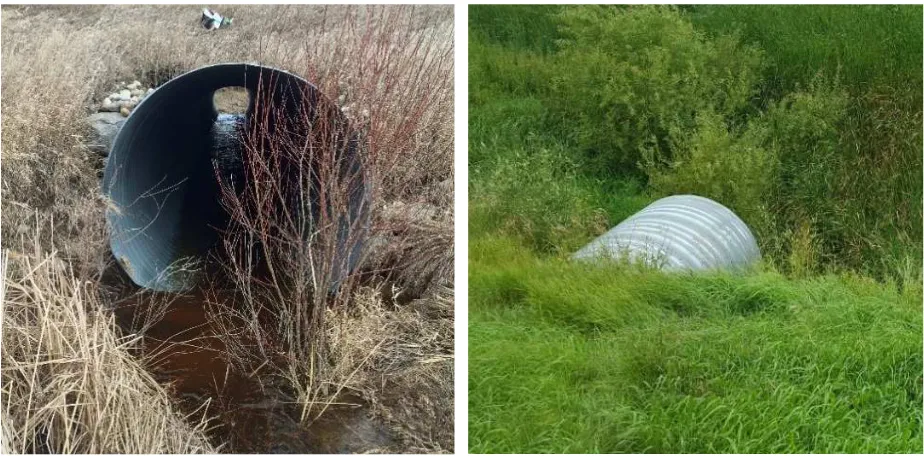
Identifying critical source areas (CSAs) as a tool is important for addressing the management of phosphorus eutrophication and nutrient enrichment water quality issues, and is well documented in the literature (Daniel, Sharley, & Lemunyon, 1998; McDowell, Biggs, Sharpley, & Nguyen, 2004; Waters & Webster-Brown, 2016). Sample site PL05 (and its catchment) was clearly the most signiicant contributor of external P load to Pelican Lake from March to October 2016, in both contributing load and yield (Table 14). Surprisingly, PL05 has a relatively small catchment area, 25 km2, compared to the other sites. For example, PL01 and PL08 have the largest catchment areas, 367 km2 and 700 km2, respectively. Input from PL08 is regulated by a dam, which would account for a lesser contribution; however, site PL01 low contributions were insigniicant to the lake’s mass balance, which could be explained by unusually low precipitation observed in the region during 2016. The reasons for the high yield at PL05 are likely to include both source factors such as soil types and artiicial P sources (fertilizer and agricultural practices), and transport factors such as runof intensity due to ditch-culvert patterns, hillslope
morphology, and erosion of hill slopes and stream banks (Waters & Webster-Brown, 2016). PL05, despite its relative smaller catchment area size (25 km2), has the largest percentage of agricultural land use (82 per cent; Table 3). In comparison to PL09 and PL10, agricultural land use accounts for approximately 71 per cent and 45 per cent, respectively.
Pelican Lake’s phosphorous budget clearly indicated that targeted measures to control P transport should focus on high-percentage agricultural land use catchment (PL05, PL09 and PL10) and lood-associated transported at PL08-dam. The budget also illustrates that catchment area is not necessarily the strongest precursor to load contribution and yield. The natural P-rich soils of the catchment and high agricultural land use suggest lake management should reduce stream and hill slope erosion, such as changes in soil, crop and stock management (Ekholm & Lehtoranta, 2012). A more detailed understanding of speciic agricultural land use practices would increase the eiciency of targeting these transport processes.
estimated for this study period are extrapolated as annual yields for comparison purposes to annual catchment yields found in the literature. Yields from North American mixed agricultural lands reported by Young et al. (1996) estimate 50–150 kg per km2 per year and 10–70 kg per km2 per year for south-east Australian pastures. Catchment yields are reported by Waters & Webster-Brown (2016) at 68–81 kg per km2 per year. Catchment yields for Pelican Lake are high, but several of the sites, such as PL09 and PL10, are not unusual for agricultural watersheds based on the literature.
In Pelican Lake, as in many prairie systems, the external loads of phosphorus and nitrogen are high and come mostly via tributaries. The highest loads of nutrients come not from the largest catchment by area, but rather from the catchment with the highest percentage of agricultural area. This research found that surface low dominated phosphorus inputs, and external inlux from each sub-catchment is strongly related to low. This result demonstrates the importance of variation in precipitation-related low associated with climate change variability and future climate scenarios. Highly variable low regimes afect waterbodies in many ways, including impacts on stratiication, turbidity, and P load, and potentially afecting rates of internal loading (North et al., 2015).
4.2 Flood Events on the Prairie Landscape and the Importance of Monitoring Spring
Runoff Event
In the Canadian prairies, looding is most common in the spring as the snowfall accumulated during the winter begins to melt and runof. One major factor that afects spring runof potential is the soil moisture at the time of freeze-up, and is largely determined by the accumulated summer and fall precipitation (Government of Manitoba, 2016).
Monitoring and modelling of nutrient sources in Pelican Lake indicate a trend in the temporal distribution of phosphorus and nitrogen transport in the sub-catchments, as well as the entire watershed. The peak low velocity and majority of nutrient transport to the lake was associated with high-precipitation events and diverted inlow at PL08 during spring runof. Approximately 45 per cent of the phosphorus load during the eight-month research period was delivered to the lake when PL08A-inlet dam was opened in March. Furthermore, the majority of P was transported to the lake as particulate associated March PL08A-inlet dam opening, allowing nutrient-rich spring runof water from the Pembina River to low into Pelican Lake (Table 5).
Peak low and modelled water balance-determined stream inlow and precipitation contribution was highest in June (8.26 million m3 and 5.82 million m3, respectively). The water budget for Pelican Lake indicated that in the month of June, a signiicant amount of water left the lake: the change in lake volume was -3.28 million m3, and transferred to surrounding aquifers, -15.8 million m3. This month also corresponds to the highest lake level recorded during the study period. The majority of the P and N load to Pelican Lake is also associated with transport during high-precipitation events. In comparison to the literature, a review of small Wisconsin catchment determined that 50–76 per cent of annual TP loads were associated with storm lows and a small number of storms dominating the load (Danz, Corsi, Graczyk, & Bannerman, 2010).
Furthermore, the majority of P and N retained in the water column was dissolved, which is commonly found in prairie streams (Table 8). Strong ainity for particulate and dissolved material, and the erosive inluence of surface low associated with low-frequency, high-intensity rainfall events explains the lood sensitivity of nutrient transport in contributing catchments of Pelican Lake (McDowell et al., 2004; Waters & Webster-Brown, 2016).
4.3 Internal Phosphorus Loading
documented in the literature and have been linked to poor responses to phosphorus management interventions and remediation treatments (Waters & Webster-Brown, 2016).
Eforts to manage eutrophication include the reduction of external nutrient loading with a focus on phosphorus (P), due to its control on primary producers (Schindler, 1977; 2012; Schindler et al., 2012; North et al., 2015). However, the historical catchment nutrient loading in a waterbody is retained in bottom sediment, and mobilization of this legacy P often causes signiicant delays in the recovery of lakes (Jeppesen et al., 2005). Since sedimentary P mobilization can lead to the production of algal toxins, it is important to better quantify sedimentary P cycling. This is particularly important—although understudied—in the Canadian prairies, because reported internal P loads into prairie lakes are often higher than other locations in North America, and this fact has been attributed to their hardwater characteristics (high sulphur and low iron content) (Loh et al., 2013; North et al., 2015).
For Pelican Lake, internal recycling (i.e., internal loading from the sediments) represented ~10 per cent of external phosphorus loads, and the sediments were a net source of P to the water column during the study period. What appears to be occurring is that rates of internal recycling are high (at least during the summer months) leading to the retention of P in the water column, fueling algal blooms. Biological processes (i.e., N2 ixation), were also driven by elevated phosphorus concentrations, and appeared to be a signiicant component of the nitrogen budget, causing the lake to become a net source of N to the surrounding environment (including groundwater). However, uncertainties in Pelican Lake’s nutrient budget include P reservoirs involved in the internal loading processes, such as the pore water reservoir, sediment reservoir and macrophyte reservoir. Knowledge on the role internal nutrient loading and nutrient resuspension have in Pelican Lake and other small, shallow, eutrophic prairie lakes is limited, with little information on the duration, frequency, magnitude and extent of these events. The internal loading component is likely to be of considerable importance to the nutrient balance given the potential for nutrient release during hypoxic condition, and the potential for resuspension of nutrients in shallow waters (Environment Canada & Manitoba Water Stewardship, 2011). Internal P loading from the sediment reservoir could be a dominant factor during low low summer months, and during signiicant changes in lake P conc. associated with cyanobacterial blooms (Waters & Webster-Brown, 2016).
The relux of phosphorus from the sediments represents a pathway that becomes increasingly important in these prairie ecosystem lakes. The estimate retained mass of phosphorus in the lake represents the collective external inputs; however, mechanisms of internal nutrient loading and recycling and the associated role of sediment characteristic was not examined in this research. The likelihood of substantial P luxes from the sediment has been discussed in the literature but this hypothesis has yet to be examined in the ield.
Internal P loading is common in lakes with signiicant sediment P reservoirs (Søndergaard et al., 1992) and accurate estimation of the internal loading rates, sediment P mass and mobility, of Pelican Lake could account for short-term luctuations in water column P concentrations. With the current data, it is impossible to separate the role of sediment resuspension. Appropriate in-lake remediation treatments should relect the lake-speciic dynamics that drive P release from the lake sediments. Added complexities, such as more biotic model components and chemical dynamics, can strengthen a realistic representation of the causal connection among exogenous nutrient loading, ambient nutrient concentrations and lower food web dynamics associated with eutrophication issues (Zhang et al., 2013).
4.4 Management Implications
nutrient luxes into the lake were strongly linked to surface hydrology, suggesting that increased rainfall associated with climate variability or climate change has strongly contributed to nutrient inputs to prairie lakes in recent years. The management of nutrient inputs to the lakes has the potential to signiicantly reduce eutrophication and cyanobacteria blooms due to nutrient over-enrichment (Waters & Webster-Brown, 2016); however, in-lake restoration has had mixed success in the literature (Lewtas et al., 2015).
For any particular lake, there may be several options for reducing algal blooms, and using more than one
remediation treatment can improve the prospects of getting to below the critical threshold (Hickey & Gibbs, 2009). The success of a remediation management strategy varies greatly from lake to lake, where it is generally agreed that these treatments are usually not worth considering unless external nutrient loads can also be reduced and controlled.
Identifying lake-speciic sources and processes that result in phosphorus loading will likely improve remediation results by providing guidance for more targeted interventions. The results of a simple mass balance phosphorus and nitrogen budget, such as that established in this study for Pelican Lake, provide clear guidance for catchment management. The management of Pelican Lake and its watershed should consider responding to the following nutrient loading issues:
• The transport of P from the Pembina River and regulation of the control structure-dam at the south shoreline of the lake. Regulation should consider not just lake level height and lood mitigation, but also the Pembina River nutrient load contribution potential.
• The transport of nutrients from sub-catchments, particularly agricultural ields on the east side of the lake, during high-intensity and low-frequency rain or lood events. Flood events that occur during the spring thaw/runof are of particular concern in the Manitoba agricultural landscape. The variation in nutrient concentration was high between the tributaries that drained the lake’s sub-catchments, suggesting the potential for management of land use or morphology (e.g., hill slope stabilization) to reduce external nutrient loads.
• The release of P from the large reservoir of P-binding lake sediment that can be recycled into the water column. Pelican Lake’s large external TP and TN loads and the limited outlows have resulted in very high P and N retention in the lake’s water column (Table 13).
Due to the high percentage of agricultural land use in the source catchments and entire watershed (58 per cent), a more detailed understanding of land-use practices, such as fertilizer application, would inform lake management strategies. If fertilizer applications are resulting in excess loading to the catchment, over and above crop
requirements, addressing transport mechanisms may result in a shift in the P legacy from the lake to the catchment soil (Waters & Webster-Brown, 2016).
The quantiication of Pelican Lake’s water and load budget also associated P load from lood-related events at PL08: during high rainfall events, speciically spring runof on 2016, the dam at the south end of Pelican Lake opens to divert water from the Pembina River into the lake. Remediation treatments such as constructed wetlands, are a suitable option for nutrient stripping and a sedimentation basin (Waters & Webster-Brown, 2016). However, the capacity of constructed wetlands is limited because the highest lood lows into the lake are usually diverted directly to the lake at PL08. Analysis of the eicacy of this management option for the smaller, high-yield catchments, such as PL05, could account for the large amounts of P transported during peak lows at uncontrolled inlow sources.
be conducted over a long enough timeframe to capture representative low variations and must include high-precipitation, runof events. The accuracy of a nutrient budget will be afected by sampling frequency: continuous monitoring enables stronger results by increasing the conidence in load estimations (Cassidy & Jordan, 2011). Uncertainties in P reservoirs present in Pelican Lake’s budget were a result of our inability to collect sediment core samples to determine P recycling and lux rates. Detailed analysis of chemical P fractions by examining sediment pore water can indicate the possible results of management strategies on internal loading, such as sediment capping. Successful remediation and management actions aimed at reducing eutrophication symptoms require a
5.0 Conclusion
Freshwater ecosystems are complex and interconnected with the landscape, particularly in regions of agricultural priority, such as in Manitoba. An integrated approach will ultimately prove most efective in inluencing the eutrophication of freshwater in the province. The eutrophication of Pelican Lake has become increasingly pronounced over recent years and is the main concern regarding the health of the lake.
The report demonstrates that for Pelican Lake, and most likely, many other shallow prairie systems, external nutrient luxes are high, primarily driven by surface low (tributaries) and there is signiicant variation in loads from diferent sub-catchments. External phosphorus was largely retained within the lake, primarily accumulating in the water column, suggesting that internal processes are particularly important in this system, and any remediation eforts at controlling eutrophication must consider these processes. This information demonstrates the sensitivity of these shallow lakes to variations in precipitation and runof associated with climatic variability and climate change, and that changes in land use could be efective in reducing nutrient loads.
References
Blaney, H. F., & Criddle, W. D. (1962). Determining consumptive use and irrigation water requirements (Technical Bulletin No. 1275). US Department of Agriculture. Retrieved from https://naldc.nal.usda.gov/naldc/download.xhtm l?id=CAT87201264&content=PDF
Daniel, T.C., Sharley, A.N., & Lemunyon, J.L. (1998). Agricultural phosphorus and eutrophication: A symposium overview. Journal of Environmental Quality, 27(2), 251–257. Retrieved from http://nature.berkeley.edu/classes/espm-120/Website/daniel1998.pdf
Danz, M.E., Corsi, S.R., Graczyk, D.J., & Bannerman, R.T. (2010). Characterization of suspended solids and total phosphorus loading from small watershed in Wisconsin (USGS Scientiic Investigations Report 2010-5039). Retrieved from https://pubs.usgs.gov/sir/2010/5039/pdf/sir20105039.pdf
Dillion, P.J. and Rigler, F.H. (1974). The phosphorus-chlorophyll relationship in lakes. Limnology and Oceanography, 17:5: 767-773.
Dodds, W.K., Bouska, W.W., Eitzmann, J.L., Pilgerm T.J., Pitts, K.L., Riley, A.J., . . . Thornbrugh, D.J. (2009). Eutrophication of US freshwaters: Analysis of potential economic damage. Environmental Science and Technology, 43(1), 12–19. Retrieved from https://www.owrb.ok.gov/quality/standards/pdf_standards/scenicrivers/Dodds%20 et%20al%202008.pdf
Eler, S.W., & Matthews, D.A. (2008). Implication of redox processes for the rehabilitation of an urban lake, Onondaga Lake, New York. Lake and Reservoir Management, 24(2), 122–138. Retrieved from http://www. tandfonline.com/doi/pdf/10.1080/07438140809354056
Ekholm, P., Lehtoranta, J. (2012). Does control of soil erosion inhibit aquatic eutrophication? J. Environ. Manage., 93, 140-146.
Environment Canada and Manitoba Water Stewardship (Government of Manitoba). (2011, June). State of Lake Winnipeg: 1999 to 2007. Government of Manitoba. Retrieved from https://www.gov.mb.ca/sd/waterstewardship/ water_quality/state_lk_winnipeg_report/index.html
European Commission (EC). (2000). Directive Establishing a Framework for Community Action in the Field of Water Policy (Water Framework Directive 2000/60/EC). European Commission. Retrieved from http://eur-lex.europa.eu/ resource.html?uri=cellar:5c835afb-2ec6-4577-bdf8-756d3d694eeb.0004.02/DOC_1&format=pdf
Food and Agriculture Organization of the United Nations (FAO). (1998). Crop evapotranspiration–Guidelines for computing crop water requirements (FAO Irrigation and Drainage Paper 56). Rome: FAO. Retrieved from http://www. fao.org/docrep/x0490e/x0490e06.htm
Goda, T., & Matsuko, Y. (1986). Synthesis and analysis of a comprehensive lake model—With the evaluation of diversity of ecosystems. Ecological Modelling, 31(1–4), 11–32.
Government of Manitoba. (2014, June). Towards sustainable drainage: A proposed new regulatory approach. Tomorrow Now – Manitoba’s Green Plan. Retrieved from http://www.gov.mb.ca/sd/waterstewardship/licensing/drainage/pdf/ towards_sustainable_drainage_june_2014.pdf.
Gurrieri, J. T., & Furniss, G. (2004). Estimation of groundwater exchange in alpine lakes using non-steady mass-balance methods. Journal of Hydrology, 297(1), 187–208.
Havens, K.E., Fukushima, T., Xie, P., Iwakuma, T., James, R.T., Takamura, N., Hanazato, T. & Yamamoto, T. (2001). Nutrient dynamics and the eutrophication of shallow lakes Kasumigaura (Japan), Donghu (PR China), and Okeechobee (USA). Environmental Pollution, 111, 263–272.
Hickey, C.W. & Gibbs, M.M. (2009). Lake sediment phosphorus release management—Decision support and risk assessment framework. New Zealand Journal of Marine and Freshwater Research, 43(3), 819–856.
Hood, J. L., Roy, J. W., & Hayashi, M. (2006). Importance of groundwater in the water balance of an alpine headwater lake. Geophysical Research Letters, 33(13). Retrieved from http://onlinelibrary.wiley.com/ doi/10.1029/2006GL026611/pdf
Ishikawa, T., Tanaka, M. (1993). Diurnal stratiication and its efects on wind-induced currents and water qualities in Lake Kasumigaura, Japan. Journal of Hydraulic Research, 31, 307–322.
James, T.R. (2014). Long-term water chloride and nutrient budgets for East Lake Tohopekaliga (WR-2014-002). South Florida Water Management District. Retrieved from https://www.sfwmd.gov/sites/default/iles/documents/wr-2014-002.pdf
Jeppesen, E., Søndergaard, M., Jensen, J.P., Havens, K.E., Anneville, O., Carvalho, L., Coveney, M.F., . . .
Winder,M., (2005). Lake responses to reduced nutrient loading - an analysis of contemporary long-term data from 35 case studies. Freshwater Biology 50(10), 1747–1771.
Jordan, P. and Cassidy, R. (2011). Technical Note: Assessing a 24/7 solution for monitoring water quality loads in small river catchments. Hydrology and Earth System Sciences, 15, 3093-3100.
Lewtas, K., Paterson, M., Venama, H., & Roy, D. (2015). Manitoba prairie lakes: Eutrophication and in-lake
remediation treatments. International Institute for Sustainable Development. Retrieved from http://www.iisd.org/library/ manitoba-prairie-lakes-eutrophication-and-lake-remediation-treatments-literature-review
Loh, P.S., Molot, L.A., Nürnberg, G.K.,Watson, S.B., & Ginn, B. (2013). Evaluating relationships between sediment chemistry and anoxic phosphorus and iron release across three diferent water bodies. Inland Waters, 3(1): 105–118. Retrieved from https://www.fba.org.uk/journals/index.php/IW/article/view/533/333
Manitoba Agriculture Food and Rural Initiatives (MAFRI). (2009, May 4). An analysis of agricultural land use and management in the Pembina River Watershed. Agriculture and Agri-Food Canada and Manitoba Agriculture Food and Rural Initiatives. Retrieved from http://www.pvcd.ca/AAFC-MAFRI.pdf
McCauley, E., Downing, J.A., Watson, S. (1989). Sigmoid relationships between nutrients and chlorophyll among lakes. Can. J. Fish Aquat Sci, 46:1171-1175.
McDowell, R.W., Biggs, B.J.F., Sharpley, A.N., & Nguyen, I., (2004). Connecting phosphorus loss from agricultural landscapes to surface water quality. Chemical Ecology, 20(1),1–40.
Mockus, V. (2010). Estimation of direct runof from storm rainfall. National Engineering Handbook, Section 4– Hydrology. United States Department of Agriculture. Natural Resources Conservation Service.