Management of bladder stones: the move towards non-invasive treatment
Keywords: Bladder stone, cystholithotripsy, ESWL, sectio alta
pISSN: 0853-1773 • eISSN: 2252-8083 • https://doi.org/10.13181/mji.v26i2.1602 • Med J Indones. 2017;26:128–33
• Received 06 Oct 2016 • Accepted 04 Mar 2017 Corresponding author: Ponco Birowo, [email protected]
Copyright @ 2017 Authors. This is an open access article distributed under the terms of the Creative Commons Attribution-NonCommercial 4.0 International License (http://creativecommons.org/licenses/by-nc/4.0/), which permits unrestricted non-commercial use, distribution, and reproduction in any medium, provided the original author and source are properly cited.
Isaac A. Deswanto,1 Ari Basukarno,1 Ponco Birowo,1,2 Nur Rasyid1,2
1 Department of Surgery, Faculty of Medicine, Universitas Indonesia, Cipto Mangunkusumo Hospital, Jakarta, Indonesia
2 Department of Urology, Cipto Mangunkusumo Hospital, Jakarta, Indonesia C l i n i c a l Re s e a rc h
ABSTRAK
Latar belakang: Batu buli merepresentasikan sekitar 5% dari semua kasus batu saluran kemih. Penanganan batu buli terus berkembang dari operasi terbuka, intracorporeal lithotripsy dan extracorporeal shock wave lithotripsy (ESWL). ESWL adalah sebuah modalitas yang menjanjikan dalam penanganan batu buli karena dapat ditoleransi dengan baik dan lebih sederhana. Penelitian ini dilakukan untuk mengumpulkan data yang dapat menggambarkan keamanan dan efektifitas dari ESWL dalam penanganan batu buli.
Metode: Studi ini merupakan sebuah studi retrospektif yang mengambil data dari rekam medis 92 pasien yang didiagnosa batu buli di Rumah Sakit Cipto Mangunkusumo (RSCM) dari Januari 2011 sampai April 2015. Data yang dikumpulkan meliputi usia pasien, jenis kelamin, jenis batu, prosedur yang dilakukan dan status disintegrasi batu, lama rawat dan komplikasi yang mungkin terjadi. Semua data dianalisis secara statistik menggunakan SPSS versi 20.
Hasil: Mayoritas pasien menjalani prosedur ESWL (49 dari 92, 53,3%). Angka bebas batu untuk tindakan ESWL, intracorporeal lithotripsy, dan sectio alta adalah 93,9%, 97,0% dan 100% secara berurutan. Salah satu pasien harus mengulang prosedur ESWL. Rerata ukuran batu ditemukan paling kecil pada kelompok ESWL bila dibandingkan dengan kelompok intracorporeal lithotripsy dan sectio alta (2,5 cm±2,0 cm vs 4,8 cm±3,7 cm vs 7,4 cm±5,4 cm secara berurutan). Prosedur ESWL dilakukan pada klinik rawat jalan.
Kesimpulan: ESWL dapat direkomendaasikan sebagai modalitas terapi yang efektif dan non-invasif dalam penanganan batu buli dengan angka bebas batu yang cukup baik (93,9%) Tindakan ESWL bisa dilakukan di poliklinik rawat jalan dengan komplikasi yang minimal.
ABSTRACT
Background: Bladder stone accounts for 5% of all cases of urolithiasis. Bladder stones management has evolved over the last decades from open bladder surgery (sectio alta) to intracorporeal cystholithotripsy as well as extracorporeal shock wave lithotripsy (ESWL). ESWL presents to be a promising modality in the management of bladder calculi due to its simplicity and well tolerability. This study is thus conducted to present data on the safety and effectiveness of ESWL in the management of bladder stone patients.
Methods: This is a retrospective study evaluating the medical records of 92 bladder calculi patients admitted to Cipto Mangunkusumo General Hospital (RSCM) from January 2011 to April 2015. Patient’s age, gender, type of stone and procedure being done, status of stone disintegration, length of hospital stay, and any complications that may occur are noted down and statistically analyzed using SPSS v. 20.
Results: Majority of the patients underwent ESWL (49 out of 92, 53.3%). The stone free rates for ESWL, intracorporeal lithotripsy, and sectio alta are 93.9%, 97.0% and 100% respectively. One patient had to repeat ESWL. The ESWL group had the smallest stone size average compared to the intracorporeal lithotripsy and section alta group (2.5 cm±2.0 cm vs 4.8 cm±3.7 cm vs 7.4 cm±5.4 cm respectively). The ESWL sessions were conducted in the outpatient clinic, and thus no hospital stay was required.
Conclusion: ESWL can be suggested as an effective non-invasive approach in the disintegration of bladder stone of
≤25 mm with a promisingly high stone-free rate (93.9%)
The advent of antimicrobial treatment and improvement in nutritional intake has played a significant role in reducing the incidence of bladder stones in the last couple of decades. Nowadays, bladder stones or calculi represent
approximately 5% of all cases of urolithiasis.1
Formations of bladder calculi are usually facilitated by the presence of bladder outlet obstruction, neurogenic voiding dysfunction,
infection, as well as foreign objects.2 Some
other additives, for example in melamine-containing milk, had also been reported to cause formation of melamine-uric acid vesical stone in a child.3
Management options for bladder calculi are varied, and novel approaches have been developed in the last decades. Nevertheless, an ideal single approach to achieve stone clearance remained debatable due to the variations in stone burden and patient
characteristics.2 In general, sectio alta is
usually reserved for pediatric bladder stone and evacuation of large calculi(stone size >4
cm).2 This approach may also be indicated in
hard stones that are refractory to endoscopic procedures. On the other hand, transurethral approach for bladder stone clearance provides an attractive alternative because it requires no incision (as it uses normal orifice) and permits the use of diverse tools for stone fragmentation. These include mechanical stone crusher, ultrasound, pneumatic and electrohydraulic lithotriptors, and combined ultrasonic/pneumatic lithotripsy device and laser energy sources, each of them with
its own advantages and disadvantages.2,4–6
Alternatively, extracorporeal shock wave lithotripsy (ESWL) also presents a promising management for bladder stones due to its simplicity and tolerability. It is especially indicated in high-risk patients who are poorly
tolerant to operative procedures.2 Additionally,
ESWL is usually performed on an outpatient basis, does not require anesthesia and avoids
prolonged urethral instrumentation.7,8 Many
previous studies presented promising data on its efficacy as a monotherapy in bladder
stone.9–11 Therefore, this retrospective
study is conducted to explore the safety and effectiveness ofbladder stone management in the Cipto Mangunkusumo General Hospital (RSCM) who underwent ESWL.
METHODS
This is a retrospective study evaluating the medical records of patients who were admitted at the Cipto Mangunkusumo General Hospital with the diagnosis of bladder stones from January 2011 to April 2015. The confidentiality of the subjects identities was guaranteed. Case of bladder stones were diagnosed radiographically either by plain radiography or ultrasonography. Data regarding patient’s age, gender, type of stone, type of procedure being done, status of stone disintegration, days of hospital stay, and any complications that may occur are noted down. The Ethics Committee of the Faculty of Medicine, University of Indonesia, with regards of the protection of human rights and welfare in medical research, has carefully reviewed and approved this study with Ethical Clearance (No. 446/UN2.F1/ETIK/2016).
Patients who underwent ESWL were treated on supine position using PiezoLith 3,000 Plus –Richard Wolf. The number of shocks delivered in each session ranges from 4,000 to 6,000 shocks. After undergoing ESWL, the patients were re-evaluated by ultrasonography or plain abdominal radiograph at two weeks interval. Second ESWL session was indicated or conducted
in the presence of significant stone fragment (>5
mm). Patients not undergoing ESWL underwent either intracorporeal lithotripsy procedure using electro-pneumatic lithotriptor (ELMED VIBROLITH) or cystolithotomy/sectio alta.
The data gathered in this study are analyzed using SPSS Statistics 20. The average age, stone size, and hospital stays in between different treatment groups (ESWL, intracorporeal lithotripsy, and sectio alta group) will be statistically analyzed using one way Anova to test whether there are
statistically significant difference in various
treatment groups in terms of average age, stone size, and duration of hospital stays. Post Hoc test will then be conducted to show the difference between treatment groups.
RESULTS
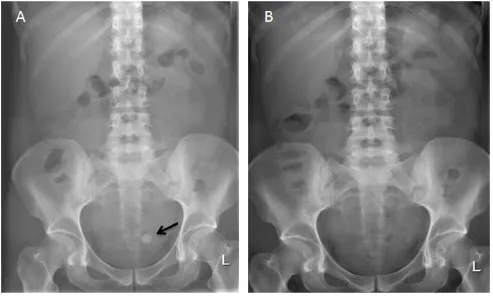
General hospital with diagnosis of bladder stone. They were mostly male patients (83 patients out of 92, 90.2%) with the average age around 51.3 (±14.4) years old. 78.3% (n=72) underwent plain abdominal imaging whereas only 8.7% (n=8) of them underwent ultrasonography (USG) examination. The rest of the patients underwent both radiographic examinations before being treated. The stones found from these patients are predominantly radiopaque (88 out of 92, 95.7%) and solitary in nature (84 out of 92, 91.3%) as shown in Table 1.
Majority of the patients admitted with bladder stone were managed by ESWL (49 out of 92, 53.3%) followed by intracorporeal lithotripsy (33 out of 92, 35.9%). Sectio alta was only performed in 10 out of 92 patients (10.9%). The stone free rate for ESWL, intracorporeal lithotripsy, and sectio alta are 93.9%, 97.0%, and 100% respectively (Table 2). Following the procedure, surgical site infection accompanied with fever was noted in one patient (1 out of 10, 10%) in sectio alta group (Table 3).
Demographic characteristics (n = 92) Patient’s age (years) 51.3±14.4 Gender
Male 83 (90.2%)
Female 9 (9.8%)
Radiologic examination
Plain radiograph 72 (78.3%)
USG 8 (8.7%)
Plain radiograph + USG 12 (13.0%) Type of stone
Radioopaque 88 (95.7%)
Radioluscent 4 (4.3%)
Number of stones
Single 84 (91.3%)
Multiple 8 (8.7%)
Status of stone fragmentation
Stone free 88 (95.7%)
Stone fragments present 4 (4.3%)
Table 1. Demographic characteristics
Overall, 49 patients out of 92 were treated with ESWL. One of these patients underwent ESWL
for more than one session due to the presence of residual stone fragments two weeks post ESWL. The remaining patients underwent either intracorporeal lithotripsy or cystolithotomy. In general the average age of patients in ESWL and intracorporeal lithotripsy treatment group are similar (53.4±10.8 and 53.2±2.6 years old, respectively) and older than patients undergoing sectio alta (36.9±22.9 years old). One way Anova test shows that the mean age in between these
three treatment groups are significantly different
(p=0.004). However, Post Hoc test results have been inconclusive.
The average stone size was found to be the largest in patients undergoing sectio alta and the smallest in the ESWL group (7.4±5.4 and 2.5±2.0
ESWL Intracorporeal lithotripsy Cystolithotomy/ sectio alta p
Patients (n) 49 32 10
-Age of patients (year) 53.4±10.3 53.2±12.5 33.5±22.8 0.004
Stone size (cm) 2.5±2.0 4.2±2.8 7.4±5.4 <0.001
Hospital stay (days) 0 4.8±3.3 10.9±8.2
-Table 4. Comparison between ESWL patients and patients from other treatment groups
ESWL=extracorporeal shockwave lithotripsy
respectively). Similarly, there was also significant
difference in the average stone size (cm) in between the three groups. Tamhane Post Hoc test
shows that this significant difference lies between
ESWL and Intracorporeal lithotripsy group
(2.5±2.0 vs 4.2±2.8 respectively, p=0.014).ESWL
was conducted in an outpatient setting therefore no hospital stay was required. On the contrary, the average days of hospitalization were 4.8±3.3 and 10.9±8.2 days for Intracorporeal lithotripsy and sectio alta group respectively. On the other hand,
however, Post Hoc test did not show significant
difference in the duration of hospital stay between intracorporeal lithotripsy and sectio alta group. In general, patients who underwent sectio alta had longer duration of hospital stay (Table 4).
DISCUSSION
Bladder calculi represents approximately 5% of all cases of urolithiasis1 with unique predisposing
factors in different age groups and gender.2,3,12–14 In the early days, bladder calculi was first
evacuated by open bladder surgery/sectio alta.15
Further development of endourology technique had also contributed greatly in the transurethral management of bladder stones (intracorporeal lithotripsy). Intracorporeal lithotripsy had also been commonly performed simultaneously with trans-urethral resection of prostate (TURP) in male patients of older population with history of bladder outlet obstruction caused by benign
enlargement of prostate glands.5 Nevertheless,
it is still being questioned whether performing TURP simultaneously with transurethral cystolitholapaxy is superior to medical therapy
for benign prostate hyperplasia (BPH) alone.16
Both sectio alta and transurethral approach of stone evacuation are more advantageous than ESWL in the fragmentation of larger bladder stones. Nevertheless, both procedures have
Type of procedure (n=92) Stone-free rate ESWL 49 (53.2%) 93.9% (46/49) Intracorporeal lithotripsy 33 (35.8%) 97.0% (32/33) Cystolithotomy/ sectio alta 10 (10.8%) 100.0% (10/10)
Table 2. Stone-free rate of each procedure
ESWL=extracorporeal shockwave lithotripsy
Complications ESWL (n=49)
Sectio alta (n=10)
Intracorporeal lithotripsy
(n=33) Fever 0(0.0%) 1(10.0%) 0(0.0%)
UTI 0(0.0%) 0(0.0%) 0(0.0%)
Urethral injury - 0(0.0%) 0(0.0%) Stone fragment
impaction
0(0.0%) 0(0.0%) 0(0.0%) Uncontrolled bleeding - 0(0.0%) 0(0.0%) Surgical site infection - 1(10.0%) -Bladder perforation - 0(0.0%) 0(0.0%)
Table 3. Procedural complications
also a number of disadvantages since they must be performed under anesthesia, and long tedious postoperative hospital stay is inevitable. Additionally, transurethral approach also has several additional disadvantages such as longer operating time, hematuria, risk of bladder perforation, and potential urethral injury as their
disadvantages.7,17 ESWL, on the contrary, is a
non-invasive modality that utilizes high energy acoustic pulses generated outside the body.18 The
effective applications of ESWL in disintegrating both radiopaque and radiolucent renal stones (e.g. uric acid stones) have been well described.19
Kostakopoulos et al,11 Al-ansari et al,20 and Telha
et al21 have also mentioned ESWL’s role as a
monotherapy in bladder stones fragmentation. The use of ESWL as a monotherapy in bladder stones, however, still has some controversial
issues to address. The first is the fact that the
recurrence rate of bladder stone after ESWL monotherapy is not well determined yet. This raises some debates on how long a patient needs to be followed up after an ESWL session.9 Secondly,
there has also been some controversies regarding the proper patient positioning during the ESWL session. Some authors suggested a prone
position17 while others recommended conducting
the session in a supine position.10 Some authors
prefered supine position because they assumed that in prone position, the sacrum might hinder
stone fragmentation to some extent.21
In this study, 49 out of 92 patients underwent ESWL with free rate of 93.9%. The stone-free rate observed in this study is comparable
to the results gathered by El-Halwagy et al8 and
Telha et al21 with stone-free rate of 96.6% and
95.5%.8,21 One case series of twenty patients with
bladder stone with concurrent paraplegia have demonstrated 100% stone-free rate after ESWL
session.22 The stone free rate of ESWL compared
favorably to patients who underwent either intracorporeal lithotripsy or sectio alta (stone-free-rate of 97% and 100% respectively). Both these studies mentioned above, included patients
in which ESWL is the first procedure performed for
bladder stone management. This provides some suggestions that ESWL may be recommended to
patient as the first line therapy before looking at
other more invasive approaches. In this study, the success of ESWL in bladder stone treatment may be affected by the stone diameter. Apparently, the stone diameter of patients who underwent
ESWL are significantly smaller than the patients
undergoing intracorporeal lithotripsy and sectio alta (2.5±2.0 vs 4.2±2.8 vs 7.4±5.4 respectively,
p=0.004). This finding in mean stone diameter
in patients undergoing ESWL was similar to the study conducted by El-Halwagy et al8 (2.6±1.0 cm)
and Kilciler et al22 (2.9±0.6). The smaller diameter
of bladder stone in patients undergoing ESWL may be one of the determinants in the success rate. Other possible factors that may play a role in successful stone fragmentation in ESWL include the presence of bladder outlet obstruction and
stone composition.2 Nevertheless, bladder outlet
obstruction has been proven to have limited effect
in ESWL’s success rate of stone fragmentation.8
Additionally, in this study, patients underwent ESWL on the outpatient basis, and thus no hospital stay was required. Moreover, after each ESWL session, clearance of stone fragments did not require any placement of urinary catheters.
This study, however, has a number of limitations. Firstly because this study is retrospective by nature. Confounding factors that may affect treatment’s success rate could not be minimized. Therefore, the impact of stone composition, urinary tract infection (UTI), stone burden, and presence of bladder outlet obstruction (BOO) on the treatment outcome could not be addressed. Secondly, this study also has a limitation in presenting the data of the recurrence rate of bladder stone after ESWL monotherapy. Additionally, this study also has limited data on the comorbidities in patients indicated to undergo ESWL treatment. These limitations can be tackled effectively if future studies in regards to ESWL monotherapy in bladder stone cases are conducted prospectively.
In summary, ESWL is a promising modality in the fragmentation of bladder stones. It provides a relatively high stone-free-rate (93.9%), can be done on an outpatient basis, and at the same time minimizes the need for anesthesia and urethral instrumentation with minimal complications.
Therefore, ESWL can be suggested as a definitive treatment in patients with bladder stone of ≤25
mm in size especially in those with high anesthetic complications.
Conflicts of interest
Acknowledgment
Much gratitude to all staffs of the Department of Urology, Cipto Mangunkusumo General Hospital in helping to make the construction of bladder stone patient’s database possible.
REFERENCES
1. Schwartz BF, Stoller ML. The vesical calculus. Urol Clin. 2000;27(2):333–46.
2. Papatsoris AG, Varkarakis I, Dellis A, Deliveliotis C. Bladder lithiasis: from open surgery to lithotripsy. Urol Res. 2006;34(3):163–7.
3. Grases F, Costa-Bauzá A, Gomila I, Serra-Trespalle S, Alonso-Sainz F, del Valle JM. Melamine Urinary Bladder Stone. Urology. 2009;73(6):1262–3.
4. Sofer M, Kaver I, Greenstein A, Bar Yosef Y, Mabjeesh
NJ, Chen J, et al. Refinements in treatment of
large bladder calculi: simultaneous percutaneous suprapubic and transurethral cystolithotripsy. Urology. 2004;64(4):651–4.
5. Shah HN, Hegde SS, Shah JN, Mahajan AP, Bansal MB. Simultaneous transurethral cystolithotripsy with holmium laser enucleation of the prostate: a prospective feasibility study and review of literature. BJU Int. 2007;99(3):595–600.
6. Kara C, Resorlu B, Cicekbilek I, Unsal A. Transurethral cystolithotripsy with holmium laser under local anesthesia in selected patients. Urology. 2009;74(5):1000–3.
7. Philippou P, Moraitis K, Masood J, Junaid I, Buchholz N. The management of bladder lithiasis in the modern era of endourology. Urology. 2012;79(5):980–6.
8. El-Halwagy S, Osman Y, Sheir KZ. Shock wave lithotripsy of vesical stones in patients with infravesical obstruction: an underused noninvasive approach. Urology. 2013;81(3):508–10.
9. Bhatia V, Biyani C. Extracorporeal shock wave
lithotripsy for vesical lithiasis : initial experience. Br J
Urol. 1993;71(6):695–9.
10. Husain I, el-Faqih SR, Shamsuddin A, Atassi R. Primary extracorporeal shockwave lithotripsy in management of large bladder calculi. J Endourol. 1994;8(3):183–6. 11. Kostakopoulos A, Stavropoulos NJ, Makrichoritis C,
Picramenos D, Deliveliotis C. Extracorporeal shock wave lithotripsy monotherapy for bladder stones. Int Urol Nephrol. 1996;28(2):157–61.
12. Sharma R, Dill CE, Gelman DY. Urinary bladder calculi. J Emerg Med. 2011;41(2):185–6.
13. Chen Y, DeVivo MJ, Lloyd LK. Bladder stone incidence in persons with spinal cord injury: determinants and trends, 1973-1996. Urology. 2001;58(5):665–70. 14. Benway BM, Bhayani SB. Lower urinary tract calculi.
Campbell-walsh urology. 10th ed. Philadelphia: Saunders. 2007. p. 2521–2527.
15. Sánchez-Martín FM, Hostalot AM, Santillana JM, Angerri O, Millán F, Villavicencio H. Extraction of a bladder stone in a child as described by the renaissance physician Cristóbal Méndez. Actas Urol Esp. 2014;38(7):476–82. Spanish.
16. Philippou P, Volanis D, Kariotis I, Serafetinidis E, Delakas D. Prospective comparative study of endoscopic management of bladder lithiasis: is prostate surgery a necessary adjunct? Urology. 2011;78(1):43–7.
17. Bhatia V, Biyani CS. A comparative study of
cystolithotfipsy and extracorporeal shock wave therapy
for bladder stones. Int Urol Nephrol. 1994;26(1):27–31. 18. McAteer JA, Evan AP. The acute and long-term adverse effects of shock wave lithotripsy. Semin Nephrol. 2010;28(2):200–13.
19. Sun XZ, Zhang ZW. Shock wave lithotripsy for uric acid stones. Asian J Surg. 2006;29(1):36–9.
20. ansari A, Shamsodini A, Younis N, Jaleel OA, Al-Rubaiai A, Shokeir AA. Extracorporeal shock wave lithotripsy monotherapy for treatment of patients with urethral and bladder stones presenting with acute urinary retention. Urology. 2005;66(6):1169–71. 21. Telha KA, Alkohlany K, Alnono I. Extracorporeal
shockwave lithotripsy monotherapy for treating patients with bladder stones. Arab J Urol. 2016;14(3):207–10. 22. Kilciler M, Sümer F, Bedir S, Ozgök Y, Erduran D.