‘Active Families’: Familization, Housing and Welfare
across Generations in East Asia
Misa Izuhara
aand Ray Forrest
baSchool for Policy Studies, University of Bristol, Bristol, UK
bDepartment of Social and Public Administration, City University of Hong Kong, Hong Kong
Abstract
Debates around welfare change have tended to concentrate on the balance between market and state provision. Although there is increasing reference to a mixed economy of welfare, this generally signifies a greater emphasis on a third sector of voluntary/community level provision. However, the family sphere has been, and still remains, an important and dynamic source of welfare provision across changing regimes and between generations. With this as background, the article addresses three particular questions. First, how has the role of families in the welfare mix changed over time? Second, how do family ‘strategies’ adapt to structural changes in order to maximize collective/ individual benefits in certain areas and how do these strategies evolve over generations? Third, is such family engagement in welfare influenced by policy shifts appropriately conceptualized as ‘re-familization’ or ‘de-familization’? These issues are explored in the comparative socio-economic and cultural contexts of China and Japan and draw on qualitative research with three generations of families in Shanghai and Tokyo.
Keywords
Welfare mix; Intergenerational relations; Housing; Familization; East Asia
Introduction
Narratives of welfare provision tend to focus on discontinuities and ruptures in relation to shifting ideologies, policy regimes and economic transformations and crises. There are periods of state ascendance in welfare provision, such as in many countries in the immediate postwar period; and there are periods where market processes are reasserted as in the neo-liberal s/s. Despite references to a mixed economy of welfare, in practice discussions are most typically focused on one dimension, the balance and the interactions between state and market. Occupational-based welfare, delivered directly or
Address for correspondence:Dr Misa Izuhara, School for Policy Studies, University of Bristol, Priory Road, Bristol BS TZ, UK. Email: [email protected]
DOI: 10.1111/spol.12002
VOL. 47, NO. 5, OCTOBER2013,PP. 520–541
indirectly, has also been an important additional element and has remained significant in some societies but now in decline under neo-liberal reforms.
Within this context, the family has tended to recede into the background and be seen as something of an anachronism in relation to welfare provision with the greater dominance of market- or state-based systems. In European societies, the development of welfare states was popularly assumed to have superseded the family as a primary source of welfare. However, Esping-Andersen’s () conception of welfare regimes reasserted the importance
inter alia of the family sphere in welfare provision. In subsequent work the interaction between changing family structures and welfare inputs and out-comes has become a progressively more prominent focus (see Esping-Andersen ). Moreover, neo-liberal policy changes have not only reinforced and reintroduced market mechanisms but have also made oppor-tunity structures more dependent on family resources – a process of
re-familizationas well as marketization (see, e.g. Forrest and Hirayama) has occurred, running quite contrary to Esping-Andersen’s prescription for
de-familization.
In East Asia, the story has been somewhat different. With some parallels with Southern Mediterranean societies, the role of the family is axiomatically assumed to have retained a more central position. Material and non-material assistance between and within generations and the family ethic of filial piety is rooted in the distinct traditional agricultural economy and patriarchal-feudal social systems (Sheng and Settles). However, growing individualism and commodification are eroding traditional norms and practices with shifting attitudes between the generations. Walker and Wong (), writing prior to the most recent global financial crisis, pointed to the growing vulnerability of East Asian welfare regimes to any serious disruption of economic growth. A fundamental tension was developing, they suggested, between the uneven and relatively limited investment in social welfare provision and a ‘traditional family-based welfare threatened by socio-demographic changes and shifts in values between generations’ (Walker and Wong : ). The prospects were therefore of the family domain being ‘stressed’ by the economic and social changes going on around it.
It is in this context of continuing debates about the contemporary role of the family that this article explores changing patterns of welfare across gen-erations. Specifically, the article is concerned with three questions. First, how has the role of families in the welfare mix changed over time? Second, how do family ‘strategies’ adapt to structural changes in order to maximize collective/ individual benefits in certain areas and how do these strategies evolve over generations? Third, is such family engagement in welfare influenced by policy shifts appropriately conceptualized as ‘re-familization’ or ‘de-familization’? These issues are explored in the comparative socio-economic and cultural contexts of China and Japan. The family is conceived as being less on the survival or otherwise of traditional family practices in the face of state, market or occupational-based provision and more on the interaction among the family and the other spheres. The central theme is one of creative and active engagement with the other sources of welfare provision and in forms of engagement which change over time. The family is not viewed as the domain
of tradition in opposition to rampant market or socialized provision but as an integral and dynamic element of welfare provision.
Existing familization/de-familization debates in comparative social policy typologies, derived from the feminist perspectives, are most typically con-cerned with gender relations, the position of women, in particular, in the family and the labour market, and focused largely on the field of care (Leitner ; Sainsbury ; Saxonberg ). In this article, however, it is the sphere of housing which is used as the primary lens through which to explore such interactions. Housing occupies a pivotal position in the shaping of life chances, social stratification and family relations. In East Asia, the growing and widespread commodification of housing and periods of substantial house price inflation combined with institutional factors have produced significant wealth divisions within and between families and generations. For many families, housing thus represents their principal platform of wealth accumu-lation which influences their social participation and access to increasingly privatized consumption and services. Prior to neo-liberal policy reforms, state assistance to home ownership also played an important role in supporting the position of the family in the welfare mix (Ronald and Doling). Moreover, it is not the context of (conjugal) gender relations but ‘intergenerational relationships’, in which there is a shift towards re/de-familization, that will be scrutinized in this article. Housing represents a particularly appropriate area for analysis because housing wealth transfers can be a source of both inter-generational solidarity and interinter-generational conflict.
The article draws on qualitative research undertaken in Shanghai and Tokyo to explore these arguments. China and Japan were selected as the dominant economies and cultures in the region. They are also societies which have experienced marked socio-economic changes in the postwar period, but for strikingly different reasons and with very different consequences. The temporal pattern of these transformations has also been highly contrasting. Notably, over the last two decades, many Japanese families have had to cope with the stresses and strains of recession and asset deflation. In China, however, families have been stressed by a combination of a less certain welfare mix but with greater opportunity and growing affluence (for some). These transformations have arguably been most acute in Tokyo as the overwhelm-ingly dominant metropolitan centre of Japan and in Shanghai at the forefront of China’s new market-oriented economy.
Following a brief discussion of the mixed economy of welfare in the com-parative context and the research methodology, the article pursues three themes: housing and active family engagements; care and the monetization of family support; and parallel policy outcomes of re-familization/de-familization. The article concludes with a discussion of the implications of the analysis for our understanding of welfare change in contemporary urban China and Japan.
The Mixed Economy of Welfare in Comparison
Since Esping-Andersen’s early work (), there have been ongoing debates about locating East Asian welfare regimes in the global picture – whether and
©John Wiley & Sons Ltd
how they are distinctive from the Western clusters (e.g. Finer-Jones ; Goodman et al.), and the extent to which their shared dominant char-acteristic is the subordination of social policy to economic development (see Holliday; Hudson and Kühner). Although the family domain as a private source of welfare as opposed to dependence on the state is emphasized and recognized as important in relation to welfare in the ‘productivist welfare capitalism’ thesis (Kwon and Holliday ), its role is often downplayed. Moreover, and significantly, much of the debate about welfare in East Asia preceded China’s re-emergence onto the world stage. China also sits awk-wardly in debates which tend to assume democratic capitalism as a prereq-uisite for the development of social policy. This is clearly a major problem in conceiving of a distinctly East Asian welfare model. An additional contribu-tion of this article, therefore, is to help bring China more fully into these debates.
Despite the distinctive and contrasting systems of the two societies – market socialism (or state capitalism) in China and the capitalist democracy found in Japan – some similar characteristics and trajectories can be observed in their welfare systems. In both China and Japan, the mixed economy of welfare (Powell) is highly evident in welfare delivery but the balance and volume of provision differ in different policy fields and have been shifting throughout the postwar period. As Powell () argues, it is important to examine each component of welfare not in isolation due to their likely interactions – such as the impact of privatization on other spheres. Also, when examining the mixed economy of welfare,meansneed to be distinguished fromendsas shifting state responsibility to the market can, for example, lead to increasing social divi-sions including gender inequalities.
First, both Japan and China are more typically welfare ‘societies’ rather than welfare ‘states’. The role of the state can be seen as performing a more regulatory function than involving generous and direct provision of welfare benefits and services (although the provision of welfare by state-owned enter-prises in pre-reform urban China can be broadly defined as state provision). In Japan, the postwar state welfare was based largely on social insurance schemes (e.g. pensions, healthcare) and had not been developed to replace the two sub-systems of the family/communities and companies, but to build upon and enclose existing resources within the state umbrella (Tamai ). The Chinese government, after the Communist Victory in, also strengthened the similar sub-systems of families/communities and ‘work units’ to provide low-level, universal welfare to its citizens (Chan et al. ). The Japanese welfare state gathered momentum when it joined the Organisation for Eco-nomic Development and Co-operation in the s with the promise of a widening scope of social policy. Theoil crisis, however, set back progress resulting in the government re-focusing on the traditional values symbolized as the ‘Japanese-style welfare state’ (Ichien).
Second, the role of the occupational sector in providing fringe benefits made those two societies unique in the comparative context although the Chinese system was more rigid and extreme (Naughton). Postwar welfare provision was established hand-in-hand with the strong corporate sector (‘cor-porate paternalism’) in Japan (Kumazawa; Osawa) and through a
unique form of social organization ‘danwei’ (work units)in China (He; Naughton ). In that sense, many systemic features around employment protection and occupational benefits as part of social policy could be seen as shared despite the fundamental ideological differences. There are, for example, some commonalities between Japan’s seniority-based system of life-long employment and Communist China’s ‘iron rice bowl’ of occupational welfare. A company/work unit acted like the family and the employees were loyal to their organization and formed a strong identify around it. Japanese companies typically provided a range of occupational benefits from pensions and healthcare, to housing (direct provision and loans), and leisure facilities – although the scale and extent of such provision depended on the size of a company and occupational status of the workers. The role of work units in China extended to even include the management of the household register, housing allocation and food supply as well as political education, policing and security, marriages and divorce, and entry to the Party (He). Individuals and families thus found it difficult to function without a work unit/company and the advantages were determined based on the rank of the organiza-tion and their posiorganiza-tion within it. Such strong labour protecorganiza-tion and employee benefits proved vulnerable to the waves of globalization and have been gradu-ally replaced by more flexible labour markets without such benefits.
Third, the family as an institution was traditionally an important source of welfare provision in all East Asian societies despite their very different devel-opmental paths. East Asian cultures have valued dependence, obligation and reciprocity in intergenerational relations, and debt and obligations often cemented their generational bonds (Izuhara , ). Family support offered the means of survival when resources were scarce, and families have always filled a gap between the state and occupational provision. For example, the Communist revolution criticized many Confucian ideologies such as ‘filial piety’, but children’s duty to care for their ageing parents was legalized and reinforced under both the Criminal Law and Marriage Law in China. Stockman (:–) stresses the continuities of urban family life in China as well as particular periods during the Cultural Revolution and the Great Leap Forward when the party-state attempted to achieve a greater degree of control over the private sphere of the family. In Japan, filial obli-gations are not legalized but the norm and practice still remain strong in social welfare. Thus families continue to provide the main source of support in many spheres of welfare, particularly in relation to care and accommodation.
There has, however, been relatively limited attention given to the role of the family in the context of social transition and social policy development. Most commentary has concentrated on the significant shifts towards more marketized and privatized systems of welfare provision which gathered increasing momentum throughout thes (Nolan). In China, the work unit system was progressively undermined as economic reforms gathered pace and the key formal welfare system based on it was replaced (Lee ). Housing is no longer ‘allocated’ from work units or the local government, but has become based on individual transaction in the market. In Japan, neolib-eral policies eventually brought de-regulation to the housing sector when the Housing Corporation (which provided subsidized rental housing) and the
©John Wiley & Sons Ltd
Government Housing Loan Corporation (which provided low cost loans to home purchase) were abolished in and, respectively (Forrest and Hirayama). Under the Long-Term Care Insurance Act, long-term care was ‘socialized’ inshifting away from the state-family nexus by creating a ‘quasi-market’ where a wider range of providers (both for-profit and non-profit) now exists.
In both societies, therefore, market ascendancy has been the dominant analytic pre-occupation. As many comparative analysts (Mishra; Esping-Andersen ) argue, however, total welfare is not necessarily the sum of different parts or functional equivalents. Since provision of each sector is not mutually substitutable, transfer of responsibility from the state to the market has significant impacts on others. Despite the claim of de-familization occur-ring in the process of policy development, the family sphere has been an important element of the welfare mix in both China and Japan – in terms of coping with, and facilitating, major ideological and policy shifts in provision.
Research Methodology
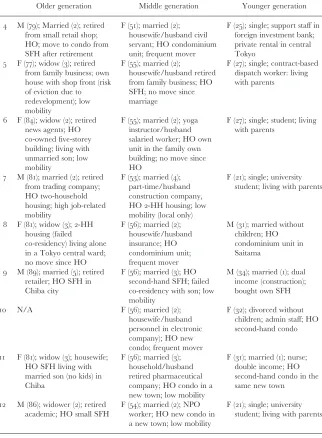
The empirical data were collected using a qualitative method in Shanghai and Tokyo in and . Semi-structured, in-depth interviews were con-ducted with adult members of three generations – one member each from grandparents, parents and adult children (grandchildren), from‘families’ in Shanghai and‘families’ in Tokyo. The total number of interviews wasin Shanghai andin Tokyo. The overall aims were to examine how work, entry to home ownership and asset accumulation played out over the life-course, and to understand the dynamics of intergenerational support relations within families in order to facilitate the processes cross-culturally.
Purposive sampling was used to select potential informants. As a sampling strategy, the age band of the pivot generation was set as–years old (born betweenand). This age band included the postwar baby boomers. They were young enough to have living older parent(s) but old enough to have grown-up children in their late s/earlys. The age of grandparents was flexible, but only adult children (those overyears) were included for this research. The sampling frame for the pivot generation included both men and women as long as they were themselves homeowners. Only nine out of respondents in Tokyo were male, while in Shanghaiout ofwere men. In order to reflect a variation in income and asset levels, we attempted to sample informants with housing assets/types falling into different price ranges from: for example, different neighbourhoods, different housing types (detached houses, second-hand flats, condominiums, etc.), and different periods of devel-opments (new commercial built, ex-work unit housing, etc.) (For the family profile, see the Appendix.)
With a few exceptions, only families from which all three generations agreed to participate were interviewed. Family members were interviewed individu-ally without the presence of other family members using a topic guide. We recruited families through a variety of means including advertising locally, personal contacts and contacting local institutions and resident committees. For analysis, each interview with family member was transcribed fully in the
original language and then translated into English. Analysis began with the production of summary profiles of respondents, followed by a close reading of every transcript. Emerging themes were categorized and sorted manually in the process, first at the city level and then comparatively. The next stage was to produce summary transcripts extracting verbatim material relevant to particular themes such as ‘the active family’ and ‘the shaping of housing histories’. These thematic extracts later form the part of quotes in publications. Most studies in this field have been limited to examining the linkages between two generations or have focused only on the experiences of nuclear families. Face-to-face interviews with members of three inter-connected gen-erations offer greater scope for understanding intergenerational dynamics and changing attitudes and practices in relation to shaping family support pro-vision and family wealth creation in contemporary East Asian societies. In this article, where empirical evidence is presented, individual informants are referred to by pseudonyms with ‘old’, ‘middle’ and ‘young’ indicating their generational position in the family, and also age, gender and fieldwork locations.
Housing and ‘Active Families’
There are striking contrasts between housing conditions and opportunities throughout most of the postwar period in Shanghai and Tokyo. From the devastation and poverty of the immediate postwar period, Tokyo emerged as a dynamic industrial city and Japan as one of the world’s leading economies. The Government Housing Loan Corporation Act was enacted inas the key means by which ‘mainstream families’ could gain access to long-term, low-interest loans for house purchase. Single-family homes had become the norm. The state remained insignificant in the direct provision of housing and an extensive system of ‘corporate paternalism’ provided the key sources of welfare and direct and indirect access to housing (Hirayama).
In China, the Communist Victory in occasioned the progressive transfer of private property into state control. Housing was provided mainly through the work unit system as were the other key elements of welfare. Shanghai was already a heavily overcrowded city and further waves of migra-tion exacerbated this situamigra-tion and led to deteriorating housing condimigra-tions, more sub-dividing of rooms and lower space standards (Denison and Ren ; White). In Shanghai, certainly until the lates, housing con-ditions continued to deteriorate whereas in Tokyo rising affluence had pro-duced progressively higher quality housing. There were, however, some similarities. Most notably, in both cities, space standards were low by inter-national standards. The exorbitant price of land in central Tokyo and well into the suburbs meant that plot sizes and dwellings were small. Nevertheless, for most Tokyo residents, housing experiences were far removed from the very difficult conditions which faced the majority of Shanghai residents. While the challenge for Tokyo households was affordability, for Shanghai residents it was a matter of negotiating the everyday hardships and the vagaries of the socialist housing system, in a situation of universally low levels of provision rather than one which was highly differentiated.
©John Wiley & Sons Ltd
At the end of the s, the contrast between the two cities began to diminish with regard to housing tenure and housing conditions. As Japan went into a long recession following the bursting of the bubble economy, China’s entry into the global economy gathered momentum. Shanghai’s urban morphology began to be transformed by a massive programme of urban regeneration, redevelopment and housing reforms, and the growth of commercial developments turned the housing system from one dominated by state/work unit provision into a city of home owners. At the turn of the century the level of home ownership in Shanghai, at aroundper cent, was some percentage points higher than in Tokyo (. per cent in ) (Ministry of Internal Affairs and Communications ). Aspiring home owners in Shanghai were by now also facing increasing problems of afford-ability (Chenet al.).
So where does the family come into this equation in relation to housing? Within the confines of this article, it is not possible to go into extended details from our intergenerational narratives but we can point to some particular areas in which family practices in housing interpenetrate the other spheres. In the case of Tokyo, land ownership and affordability challenges are key issues. In Shanghai, it is the negotiation of the socialist system and the new oppor-tunities and rules of the evolving market system which are the focal points. The common thread, however, is the way in which family relations and practices are a critical element in the welfare mix shaping housing opportu-nities and outcomes. As economic and social conditions change, the division of welfare also changes in terms of volume and balance. In the early postwar period, strong ‘familialism’ was evident in housing practices in both cities largely due to the lack of provision by the state and market.
In Shanghai, family housing activities in the s/s were concen-trated primarily on creating more space. Such conditions were experienced by all generations and certainly well into the s, and even members of our younger generation have memories of chronic overcrowding. These informal conversions and extensive self-build were critical for enabling the city to accommodate the expanding population at a time when officially deployed housing resources were woefully inadequate (White ). Our Shanghai narratives contain numerous examples of these family coping strategies (Forrest and Izuhara):
‘Because we were living on the ground floor, I uninstalled the attic, dug a bit and made the floor sink around.foot, and then re-installed the attic. Now I could stand up straight and it was for marriage use’.(Middle Ting,, male, Shanghai)
‘We eventually had three rooms, because both the workers who lived next to our room were transferred somewhere else to work, so my factory gave me all the rooms on that floor, we had about –m spaces totally, and I broke through the wall and
combined them into one room.’(Old Tang,, male, Shanghai)
As more work unit housing was built and distributed, there was considerable strategizing and manoeuvring around the allocations process. The vagaries and complexities of the allocation process involved families participating in
swaps, leasing and even keeping units empty. An apparently rational, if heavily constrained, process of allocation based on need andhukou registra-tion, was thus overlain with a layer of informal family arrangements and re-arrangements.
Market reforms in thes brought a certain degree of ‘de-familization’, defined by Lister () for example as ‘the degree to which individuals can uphold a socially acceptable standard of living independently of family rela-tions (through paid work or social security provision)’ since access to housing had now made possible through other means. However, some policy initia-tives under market reforms simply reinforced ‘familialism’ – a continuation of intergenerational practice in housing. A good example here is when compen-sation schemes were introduced for households displaced by demolition and urban redevelopment. Calculations were made about the potential amounts to be paid out and how they could be shared and deployed within the family. The research revealed many ‘family strategies’ – keepinghukouin their par-ticular address, swapping houses among wider family members, saving the compensation for different purposes – maximizing the benefits from the changing system:
‘I was thinking of two approaches and one option is I might get a better apartment from my work unit a few years later. In the old days, housing distribution was somehow based on the rule of exchange. People handed out their original small rooms[so that other families could move in] and moved into some bigger rooms previously occupied by others. But in my case, my family lived in the old Shikumen housing
which belonged to the state, instead of my or any particular work unit. So I couldn’t hand it out to exchange for something else. That’s why my work unit distributed me a room, not a real apartment. But I had to take it even though I didn’t move in, because I could exchange it with others during the next distribution . . .[The other option was] that many old dwellings in the inner city centre were demolished and the government had to relocate the residents by offering better housing for them. So it was very likely that we and other families living in the old Shikumen housing would come across such opportunity.’(Middle Li,, male, Shanghai)
He used his compensation to purchase a flat and, when the opportunity arose in the reform period, sold the leased property which he had been previously allocated to pay for the decorations of the new flat.
By both accident and design, and throughguanxi (connection) and Party position, some families in Shanghai emerged into the era of housing reform and marketization with multiple properties. Despite the ideal of the equal society, it highlights the importance of what they had in terms of housing allocation when the reform began influencing the outcomes. One of our families (Middle Huang), for example, was able to buy two flats in the com-mercial sector and converted them into one. This had been financed through a complex, cross-family transaction involving shared compensation, the sale of two properties acquired at high discount from the husband’s work unit and then an exchange of properties with the wife’s parents-in-law. In this context, Davis () has shown how the extent and timing of marketization,
©John Wiley & Sons Ltd
combined with path dependency, produced systematically unequal outcomes between blue collar workers and the managers and cadres.
One of the striking features of the Shanghai housing narratives is the evident learning process – how to make the most of what is available and how to negotiate and maximize the opportunities in relation to whatever policies and practices are prevalent in a particular era. For most families, for most of the temporal span of the narratives, the space for negotiation was limited and the advantages gained were marginal. Nonetheless, in their context, these gains were real and valued and experienced as such. The emergence of the market era, however, offered very different possibilities evidenced by the rapidly rising inequalities within cities and between urban and rural areas in China (He ; Longan et al. ). Here the experiences of the past of gaining first mover advantage and in negotiating between and around rules and regulations were quickly mobilized. Here is one of our middle generations reflecting on the new opportunities of the reform era:
‘I thought there would be a long trend in privatizing work unit housing and you must do it quick. In China, things always work in the same way – you have to run ahead of the others when some new policies come up, you take the risks while you get most benefits’. (Middle Ting,, male, Shanghai)
The Tokyo context was indeed very different as economic development gathered momentum earlier and families transcended the deprivations of the postwar period (see also Izuhara and Forrest). Overcrowding and a basic lack of adequate housing however similarly faced the older generation in Tokyo immediately after the Second World War and involved an intensity of family activity and interaction:
‘[Nine people lived in a small house].I had no free time. I had four in-laws above me [parents-in-law, brother-in-law and his wife]. Wherever I looked, there was always someone there. I was never able to be alone. I used to wake up at am, fed and changed my babies, and cooked for the whole family. The cooking area and toilet were outside.’(Older Yamashita,, female, Tokyo)
Such experiences were, however, largely confined to the older generation. Tokyo re-emerged as a leading international city with soaring housing prices, urban sprawl and long commuting times. In many ways, however, familism in housing remained more visible in terms of intergenerational relations and assistance; and more central to the housing system as a whole. There are two particular features: first, whereas in Shanghai, families shifted around to obtain more space, moved to newly allocated work unit housing or went through periods of division and reunion associated with the Cultural Revo-lution, low mobility characterizes the Tokyo housing system. Place (land) attachment is strong. The idea of the ‘family home’ is important across the generations, especially among those who were from Tokyo although it is perhaps diminishing among younger people:
‘I want to leave children[his current residence]and my mother’s house. Since these are properties passed down from my parents, I feel obliged to pass them down to my children . . . it depends on the family situation. Those who came from a regional city, for example, tend to have different attitudes – more focused on ‘one generation’ expecting their children to be[financially]independent as they have been. They bought a house and raised their children themselves and expect their children to do the same.’(Middle Takeda,, male, Tokyo)
Adjustments to obtain more space, accessing new sources of loan finance, modernizing living standards and lifestyles can be achieved through scrap and re-build on the same plot. Some aspects of housing policy such as ‘intergen-erational mortgages’ and inheritance tax relief for housing purposes are ‘explicitly’ familial (see Leitner) encouraging intergenerational transfer of housing assets.
This takes us to the second feature which relates to these modernized versions of multi-generational living arrangements and new intergenerational lending vehicles. In these arrangements, there is a fusion and mix of choice and constraint, of modern institutional arrangements embedded in more traditional family practices. External factors of economic change and housing price inflation rather than housing policyper semay have led to ‘familization’. There is clearly a relationship between these kinds of arrangements and the relatively low mobility of Japanese home (land) owners but there is also the constraint of affordability, particularly in the pre-bubble period up to when land prices in Tokyo were among the highest in the world:
‘It was lucky when we wanted to move [to gain more space for a growing family], my parents asked to build a two-household housing with us . . . My father provided the land and we shared the cost of building the house on top.’(Middle Sato, , female, Tokyo)
‘In this area along the Chuo Line where the land is very expensive, lots of my classmates have returned to live with their parents. Often older parents live downstairs and the younger family upstairs after they have their house re-built[on their parents’ plot of land]’(Middle Shiraishi,, female, Tokyo)
Family support has also become more ‘monetized’ in relation to accommo-dation. As is evident, sharing accommodation and thus sharing household resources was a common characteristic of family support in both Tokyo and Shanghai as a means of family ‘survival’ in the early postwar period. With social change and wealth created by economic growth and reform, family nuclearization has been taking place in both societies in different times and at a different pace. In Shanghai, common marriage housing for the middle generation then was either creating space within the already small parental home or receiving a housing allocation from their work unit. Over just one generation, however, it has increasingly become ‘purchasing a commercial apartment’. In Tokyo, on the other hand, parental responsibility appeared not to extend to the provision of a marital home – even for the middle generation, they tended to have made their own arrangements for renting a small apart-ment to start their marital life.
©John Wiley & Sons Ltd
Younger married/divorced homeowners in the Tokyo families, although small in number, received a substantial amount of money (¥– million: £,–,[£ =¥ in]) from their parents to put towards the
deposit. Among our Shanghai households it was not uncommon for parents with a son to prepare a ‘marriage home’. Middle Wong (, female) even made the great sacrifice of selling their ex-state-owned two-room-unit to fund their son’s (aged) commercial apartment purchase which was used to run his foreign language training centre. As a result, the parents had to live in a small privatized single-room unit of onlym. As new policy regimes evolve along social change, family practices also change with the times.
Care and the Monetization of Family Support Relations
The previous discussion of housing and accommodation takes us onto the more general issue of changing welfare mix and intergenerational support relations in the context of social and policy change. Families in East Asia have always provided a range of support to their members from sharing accommodation, personal care provision to financial support. However, both the Tokyo and Shanghai studies revealed that the types, levels and ideologies of family support have shifted from extensive direct provision of both practical and personal support (such as grandparents providing childcare in co-residency or parents accommodating newly married couples in their home), to more indirect, material or emotional types of support as provision in other sectors developed. In the transition to the market economy, an increased ‘monetization’ of support provision within family generations has been taking place.
Providing direct care to dependent family members has been a common feature of both cities. Compared to other welfare areas such as healthcare, the provision of such practical and personal support was sometimes extensive, especially in societies where alternative forms of provision have been limited. For example, the role of grandparents was highlighted in many Shanghai interviews. It was not uncommon for older parents to look after their only grandchild until the child reached school age, sometimes extensively as sub-stitute parents while both parents worked. The socialist system brought more equal work opportunities for husbands and wives of the current middle gen-eration captured in Mao’s slogan ‘women hold up half the sky’ (Tang and Parish). The extensive role of grandparents is the consequence of com-bined genderless labour market, early retirement age and low income/low state-market services in this area:
‘[My daughter’s ()]work place was quite near our house so we took care of her son after she had a baby. Her son was brought up by us. He stayed with us during weekdays and his parents took him back on weekends.’ (Older Lau, , male, Shanghai)
‘My son was taken care of by his grandmother[my mother]since he was young. He spent most of his time in his grandmother’s home and kindergarten. Teachers in his kindergarten had never seen me around and they thought that I was away in a different city. I seldom looked after him.’(Middle Chen,, male, Shanghai)
Regarding the welfare systems and thus childcare options, there are distinctive differences here between the two cities. Among the baby-boomer generation in Japan, the role of housewife had developed into a desirable role and status within the male-breadwinner family model which accompanied the early postwar economic growth period. Most children in suburban Tokyo, for example, unlike those in traditional farming families, were raised by full-time housewife mothers within a nuclear family (Sasagawa ). Apart from an early divorcee informant, whose sons were looked after by his older mother in co-residency, it was common for our Tokyo middle informants to have looked after their children themselves. In Tokyo, in contrast to the Shanghai families, attitudes to and practices in child care provision for working couples by their parents are often irregular and consist of ‘helping’ in emergencies rather than providing substitute care to parents although this could be related to changing patterns of geographical proximity which occurred through rapid urbaniza-tion in the first half of the postwar period:
‘When I was raising our children, my mother lived far away so she did not help me so much. She helped me when we were moving house or when I had to attend a wedding, for instance, but she did not help me on a daily basis.’(Middle Tanaka, , female, Tokyo)
The levels or volume of support flow have also been changing in both cities. With rising affluence and with the growing marketization of welfare, the volume of cash flow between family generations has increased while the extent of direct physical care provision has been diminishing. Ideological and cultural changes have combined with practical shifts to alter the traditionally strong social norms of family dependency. Family dependency continues to remain albeit in different forms and guises. Under the socialist system in China where everything from accommodation to food coupons used to be allocated by work units, parents were unable to offer any help other than practical support. In Shanghai, some parents used to send small sums of money to their children who were sent to the countryside in the s enabling them to buy some extra food or travel home. Now, however, it is common in both societies for parents (the middle generation) to invest heavily in their child(ren)’s education, such as paying for extra-curricular activities, education fees and accompanying expenses. Children have become expensive and high priority investments, a factor contributing to falling fertility rates:
‘My parents do not give me too much cash, onlyRMB a month, but would buy me top-up phone cards, travel cards, supermarket purchase cards, so it would be pretty much enough to cover my basic living cost. My tuition fees are expensive majoring in Cyber Art. Generally it charged,RMB annually for other students, but we have to pay,RMB. To complete the whole undergraduate programme,,RMB is needed. Other fees for textbooks, reading materials, accommodation (,RMB per annum), it gets even higher. Moreover, to fulfil the course work, we have to buy digital camera and a PC, otherwise coursework could not be done. It is awfully expensive.
©John Wiley & Sons Ltd
Everything needed to fulfil the course requirements, my father would buy for me. Besides, my father has reserved a sum for me in case I would like to pursue further study abroad.’(Younger Huang,, female, Shanghai)
Regarding care for older people, the mixed economy of care has been signifi-cantly transformed with wider ‘socialization’ of care agenda (‘explicitly’ de-familial) in both societies reflecting recent marketization and policy devel-opments, but location and funding of care differ and Japan has a much better resourced social insurance system in place. Until very recently it was common in both urban China and Japan for older people who needed long-term care to be looked after in their own home and by their own family members. At the beginning of this century, however, both societies are facing similar socio-economic and demographic pressures. Prolonged longevity is increasing demands for care; and low fertility and changing lifestyles mean there are fewer adult children in the family available to provide older parents with such intensive care. People’s attitudes towards long-term care have shifted away from mere family obligations in both societies. There are different responses to alternatives to family care within the state/market systems in the two societies. In Japan, under the new social insurance scheme on long-term care the role of the family has been shifting from the direct provision of care to more organizational and management roles of available resources as well as emotional support (Izuhara ; Hiraoka). In urban China, since the welfare reform of thes, there has been an opening up of market oppor-tunities for institutional care. Attitudes about institutional care have been gradually shifting from stigma to privilege or a better demonstration of ‘filial piety’ due to the high cost (and improved quality) of professional care in institutions (Zhanet al.). In this context, children do not need to provide direct long-term or nursing care; filial duty can be fulfilled by emotional and financial commitment by placing their older parents in a high-quality care institution (Zhanet al.):
‘Care should be provided professionally and the family can just visit and support emotionally. Some people complain “why does his family not come and do washing in the hospital?” but you can even out-source such services nowadays. Nurses can do nursing because it is not hours but only hours a day.’(Middle Fujii, , female, Tokyo)
‘We never expect to have our child look after us, we have residential homes for older people now, and we can live there if we have money. To be honest, thinking of relying on children when we get older is very unrealistic, he has his own job and family to cope with. If I have some money, I can hire a domestic nurse or move to an elderly residential home for better care. It only cost–,RMB per year now.’(Middle Tang, , male, Shanghai)
The Co-existence of De-familization and Familization
The transition in the welfare systems has had notable impacts on family generations. On the one hand, the affluence brought by economic growth
and accompanying policy developments helped each generation become increasingly independent from other generations. On the other hand, the prolonged precariousness in the labour market (Tokyo) and rapid inflation (Shanghai) have increased dependence of adult children (Yamada ). Familization and de-familization are thus dual outcomes of the era of neo-liberal policy. We can observe differentiated patterns of dependence and independence across these societies and across the cohorts and genera-tions as the demographic location of wealth differs. In Japan, the past tra-jectory of the economic growth, house price inflation and the pattern of state/occupational support for income and asset building mean that wealth is concentrated among the older and late middle baby-boom generation. Older parents have therefore become more independent especially where the current older cohort has benefited from the period of the great eco-nomic growth and the welfare ‘golden age’. In China, the process of market reforms and commercialization has produced a more uneven pattern of wealth accumulation among cohorts of both younger and older households (Forrest and Izuhara ). These differentiated patterns of (housing) wealth holdings will affect the extent and direction of support across gen-erations. The direction will usually be from richer to poorer generations to even out the inequality within the family and in some cases this may be from the younger to the older generation rather than the other way round.
While de-familization is evident among the older generation, there is also increasing dependence among the current younger generation (adult chil-dren) in both societies (Zhu ; Hirayama). Due partly to the wealth created by the middle generation, especially in Shanghai, and more com-petitive and precarious labour markets, parents continue to support their adult child(ren) in co-residency sometimes well into their s. Prolonged dependence regarding co-residency and increased financial support in various aspects of adult children’s life are new phenomena which add a different dimension to intergenerational dynamics, and the role of families, in the transitional welfare systems. While a ‘new middle class’ with greater financial independence has emerged in the Chinese market economy, many are still supported substantially by their parents’ newly created wealth, rather than through the state or the market:
‘The situation is the other way round. We are taken care of by our parents. My parents come here nearly every day or every other day to prepare all our dinner . . . We also give them some money but we do not feel good. They as our parents might think it is their responsibility to help children and we are their only child. But, as a child, we feel guilty and try to find a way to compensate them even little – to give them some money is simply what we can do now. What they have done for us is far more than this.’(Young Zhao,, female, married, Shanghai)
‘I want to leave my parental home by age. I do not give my parents any money. Although I do not receive pocket money from them, my mother cooks for me and does everything. I would like to repay the debts.’ (Young Yamashita, , female co-resident, Tokyo)
©John Wiley & Sons Ltd
Concluding Comments
There are four key conclusions from this research. First, in relation to welfare mix, the family is not an anachronistic sphere which has been superseded by market, state or institutionalized community provision. It is an integral and active ingredient. Family attachments and relations act to mediate sharp changes in economic or political conditions. But in that interaction with shifting policy regimes and with changes in market/state provision, the family domain adapts and is itself transformed. Second, it is not simply a reactive element, coping with unforeseen or adverse circumstances. That is certainly an important dimension of family assistance but it is equally valid to see the family domain as creative and engaged, actively seeking to maximize benefits and opportunities within varying economic conditions. Third, an understand-ing of the dynamics and extent of family support and its role in the social division of welfare requires a time frame which spans more than one genera-tion. Fourth, in the housing sphere at least we can observe coincident and interconnected processes of re-familization and de-familization.
These observations are relevant to all societies but have particular reso-nance in East Asia because of the pace and volatility of economic change, the evident tensions between modernity and tradition and the uneven develop-ment and inadequacy of welfare safety nets. Viewed from a dominant state-market perspective, Tokyo and Shanghai offer striking differences. From a family perspective, however, there are strong similarities in the way in which families cope and negotiate welfare transitions and wider economic transfor-mations. In the meantime, the traditional role of families remains more robust in China both ideologically and in practice as family support is still the dominant form of welfare provision.
In comparing the generations, the contrast between them is more profound between the older and the middle generation in Japan since the rapid eco-nomic growth of thes raised their real income and living standards; while in urban China the unprecedented pace and degree of transformation regard-ing housregard-ing, work and family has been experienced by the current middle generation. Thus, in Shanghai, the generational gap appeared to be wider between the middle generation and both the younger and older generations. Overall, social, demographic and economic change has been far more com-pressed in urban China, and the changes which have occurred over three generations in Tokyo seems to have taken place within just one dynamic generation of our Shanghai families.
In looking to the future, it would seem that families in Japan and China will be facing rather different pressures of adaptation and adjustment to changing economic and social conditions. There are specific contrasts such as the extremely high (and rapidly reached) level of home ownership in Shanghai compared with a stagnant or probably declining level in Tokyo. However, the more fundamental contrast is in the overall economic trajectories of the last two decades. This is most evident when one compares the younger genera-tions in our two cities. The -somethings in Tokyo reached adulthood as Japan slipped into its long recession when the economic bubble burst at the end of the s, the era of the ‘lost decade’ when the features of Japan’s
distinctive welfare capitalism – of job security, corporate paternalism and the male breadwinner model – began to be transformed by economic pressures. They entered a housing and labour market which was very different from that experienced by previous postwar generations, and which was put under further pressure by theAsian financial crisis. By contrast, in Shanghai, the same group experienced a dramatic transition of a very different kind – the progressive impact of market reforms and the opening up of new employ-ment opportunities, new lifestyles and a welfare system shifting from low quality but universal provision to one which is increasingly market- and cash-driven and more differentiated. It is among these younger groups that the tensions between tradition and modernity will be most acute. Moreover, it is also evident that in the highly contrasting economic contexts of China and Japan, the family will continue to be a critical actor as a provider of accom-modation and as means to access independent housing.
Overall, in analyzing vertical instead of horizontal (nuclear) family ties, this article has offered a different perspective from the mainstream feminist cri-tique on (de)familization effects of social policy developments. Examining the flow of assistance across generations, conflicting but interconnected trends of both familization and de-familization are evident in extended East Asian families. While socio-economic and policy change supported increasing inde-pendence of the older generations from their adult children, the recent eco-nomic crisis and house price inflation reinforced family dependence of the younger generation. The housing sphere will thus remain as a major focal point for the delicate negotiation of dependence and independence between the generations.
Appendix
Table A
Profile of Tokyo families
Older generation Middle generation Younger generation
F (); widow (); retired
Table A Continued
Older generation Middle generation Younger generation
M (); Married (); retired from small retail shop; HO; move to condo from SFH after retirement house with shop front (risk of eviction due to
F (); single; contract-based dispatch worker: living unit in the family own building; no move since in a Tokyo central ward; no move since HO married son (no kids) in Chiba
F (); married (); household/husband retired pharmaceutical company; HO condo in a new town; low mobility worker; HO new condo in a new town; low mobility
F (); single; university student; living with parents
Notes:
Gender (age); marital status (number of children); occupation/partner’s occupation; tenure and housing type.
HO=home ownership; SFH=single family home; HH=household.
Table A
Profile of Shanghai families
Older generation Middle generation Younger generation
F (); widow (); retired
F (); single; graduate junior project developer; living
F (); single; undergraduate student (Cyber Art); living with parents
F (); married (); used to work in family-run factory; tenant in one room work unit house cohabiting (); football player in state-owned ex-state apt but living with son
from running a salt store; privatized work unit
Gender (age); marital status (number of children); occupation/partner’s occupation; tenure and housing type.
HO=home ownership.
©John Wiley & Sons Ltd
Acknowledgement
This article draws on a research project ‘Housing assets and intergenerational dynamics in East Asian societies’, funded by the UK Economic and Social Research Council in–(RES---). All the recruitment, inter-views and translations of the interview scripts in the Shanghai fieldwork were carried out by Xiaohui Zhong.
Notes
. Work units in China are key social organizations including factories, shops, schools, hospitals, research institutes, cultural troupes and Party organs, etc. (Lu).
. Hukou is a household registration/residency permit system in the People’s
Republic of China. The Family registration system used to control the movement of residents between the urban and rural areas.
. Shikumen (stone gate) is an architectural style of residential housing in
Shanghai. They are often two or three-storey townhouses made of bricks with a stone arch entrance.
References
Chan, C-K., Ngok, K-L. and Phillips, D. (),Social Policy in China: Development and well-being, Bristol: Policy Press.
Chen, J., Hao, Q. and Turner, B. (),Housing Finance, Economic Development and Housing Affordability in China: A Case Study of Shanghai, paper given at the SSE-LSE-CCER Joint Conference, Stockholm, November.
Davis, D. S. (), From welfare benefit to capitalized asset: the re-commodification of residential space in urban China. In R. Forrest and J. Lee (eds),Housing and Social Change East/West Perspectives, London and New York, NY: Routledge.
Denison, E. and Ren, G. Y. (), Building Shanghai: The story of China’s gateway, Chichester: Wiley-Academy.
Esping-Andersen, G. (),The Three Worlds of Welfare Capitalism, Cambridge: Polity Press and Princeton, NJ: Princeton University Press.
Esping-Andersen, G. (),The Social Foundations of Postindustrial Economies, Oxford: Oxford University Press.
Esping-Andersen, G. (),The Incomplete Revolution: Adapting Welfare States to Women’s New Roles, Oxford: Wiley.
Finer-Jones, C. (), The Pacific challenge: Confucian welfare states. In C. Finer-Jones (ed.),New Perspectives on the Welfare State in Europe, London: Routledge, pp.
–.
Forrest, R. and Hirayama, Y. (), The uneven impact of Neo-liberalism on housing opportunities, International Journal of Urban and Regional Research, , :
–.
Forrest, R. and Izuhara, M. (), Exploring the demographic location of housing wealth in East Asian societies,Asian Public Policy,,:–.
Forrest, R. and Izuhara, M. (), The shaping of housing histories in Shanghai,
Housing Studies,,:–.
Goodman, R., White, G. and Kwon, H. (eds) (), The East Asian Welfare Model: Welfare Orientalism and the state, London: Routledge.
He, Q. (), China’s listing social structure, New Left Review, , Sept/Oct: –
.
He, X. (), People in the work unit. In Y. Shao (ed.),People and Prose, Guangzhou: Huachen Publishing House, pp.–.
Hiraoka, K. (), Kironi Tatsu Nihon no Kaigo Hoken [Long-term care insurance in Japan at a turning point]. In S. Takegawa and H-K. Lee (eds),Fukushi Reji-mu no Nikkan Hikaku: Shakai Hosho, Jyenda, Rodo Sijyo[Comparing Japanese and Korean Welfare Regimes], Tokyo: Tokyo University Press, pp.–(in Japanese).
Hirayama, Y. (), Housing policy and social inequality in Japan. In M. Izuhara (ed), Comparing Social Policies: Exploring new perspectives in Britain and Japan, Bristol: Policy Press, pp.–.
Hirayama, Y. (), Housing and generational fractures in Japan. In R. Forrest and N-M. Yip (eds),Young People and Housing: Transitions, trajectories and generational fractures, London: Routledge.
Holliday, I. (), East Asian social policy in the wake of the financial crisis: Farewell to productivism?,Policy & Politics,,:–.
Hudson, J. and Kühner, S. (), Towards productive welfare? A comparative analysis ofOECD countries,Journal of European Social Policy,:.
Ichien, M. (),Mizukara kizuku fukushi[Self-help welfare], Tokyo: Ministry of Finance Press.
Izuhara, M. (),Housing, Care and Inheritance, London: Routledge.
Izuhara, M. (ed) (),Ageing and Intergenerational Relations: Family reciprocity from a global perspective, Bristol: Policy Press.
Izuhara, M. and Forrest, R. (), Housing histories and intergenerational dynamics in Tokyo,Social Science Japan Journal,,:–.
Kwon, S. and Holliday, I. (), The Korean welfare state: A paradox of expansion in an era of globalisation and economic crisis,International Journal of Social Welfare,,
:–.
Kumazawa, M. (),Noryoku shugi to kigyo shakai[Ability-based company society], Tokyo: Iwanami.
Lee, C. K. (), From Organized Dependence to Disorganized Despotism: Chang-ing Labour Regimes in Chinese Factories,China Quarterly,,–.
Leitner, S. (), Varieties of Familialism. The caring function of the family in comparative perspective,European Societies,,:–.
Lister, R. (), ‘She Has Other Duties’ Women, citizenship and social security. In S. Baldwin and J. Falkingham (eds),Social Security and Social Change: New Challenges to the Beveridge Model, London and New York, NY: Harvester Wheatsheaf, pp.–
.
Longan, J. R., Bian, Y. and Bian, F. (), Housing inequality in urban China in the
s,International Journal of Urban and Regional Research,:–.
Lu, F. (), The Work Unit: A special form of social organisation, Chinese Social Sciences,:–.
Ministry of Internal Affairs and Communications, Japan (),TheHousing and Land Survey of Japan, Tokyo: Statistics Bureau.
Mishra, R. (),The Welfare State in Capitalist Society, Hemel Hempstead: Harvester Wheatsheaf.
Naughton, B. (),Danwei: The economic foundations of a unique institution. In X. Lu and E. J. Perry (eds),The Danwei: The changing Chinese workplace in historical and comparative perspective, New York, NY: M. E. Sharpe, pp.–.
Nolan, P. (),China at the Crossroads, Cambridge: Polity Press.
Osawa, M. (),Kigyo chusin shakai wo koete: gendai Nihon wo gender de yomu[Beyond the corporate-centred society: An examination of modern Japan from gender perspectives], Tokyo: Jiji Press (in Japanese).
Powell, M. ()Understanding the Mixed Economy of Welfare, Bristol: Policy Press
©John Wiley & Sons Ltd
Ronald, R. and Doling, J. (), Shifting East Asian approaches to home owner-ship and the housing welfare pillar,International Journal of Housing Policy,,:–
.
Sainsbury, D. (ed) (),Gendering Welfare States, London: Sage.
Sasagawa, A. (), Mother-rearing: the social world of mothers in a Japanese suburb. In M. Rebick and A. Takenaka (eds),The Changing Japanese Family, London: Routledge, pp.–.
Saxonberg, S. (), From Defamilialization to Degenderization: Toward a new welfare typology, Social Policy & Administration, DOI: ./j.-..
.x.
Sheng, X. and Settles, B. H. (), Intergenerational relationships and elderly care in China: a global perspective,Current Sociology,,:–.
Stockman, N. (),Understanding Chinese Society, Cambridge: Polity Press.
Tamai, K. (), seiki no fukusi sisutemu [Japanese welfare system in the th century],Shakai –seisaku Gakkai Shi[Journal of Social Policy and Labour Studiesi],:–. Tang, W. and Parish, W. (),Chinese Urban Life under Reform: The changing social
contract, Cambridge: Cambridge University Press.
Walker, A. and Wong, C-K. (),East Asian Welfare Regimes in Transition, Bristol: Policy Press
White, L. T. III (),Careers in Shanghai, Berkeley, CA: University of California Press. Yamada, M. (),Parasite Shakai no Yukue[The direction of the parasitic society], Tokyo:
Chikuma Shobo.
Zhan, H. J., Feng, X. and Luo, B. (), Placing elderly parents in institutions in urban China: a reinterpretation of filial piety,Research on Aging,:–. Zhu, Y. (), Youth Housing Problems in China. In R. Forrest and N-M. Yip (eds),
Young People and Housing: Transitions, trajectories and generational fractures, London: Routledge.