Cutting Microfinance
Interest Rates:
An Opportunity
Co-Creation Perspective
Sunny Li Sun
Junyon Im
Microfinance is a social innovation to alleviate poverty by providing small, unsecured loans to local indigent entrepreneurs. Many borrowers use microfinance loans to seed their small entrepreneurial businesses. However, high interest rates charged by microfinance institu-tions (MFIs) are likely to increase the financial burden of those borrowers. In this study, we adopt an opportunity co-creation perspective to analyze the factors that affect microfinance interest rates. We argue that new opportunities in a social venture could be co-created by multiple stakeholders, including MFIs, borrower communities, female borrowers, govern-ments, MFI managers, and employees. We tested our hypothese on interest rate setting of MFIs by using 4,187 organization-year observations from 2003 to 2011 across 93 countries, and the empirical results largely support the hypotheses. Our opportunity co-creation per-spective extends the current understanding on microfinance and provides important mana-gerial implications.
Introduction: Setting Microfinance Interest Rates
When the Mexican microfinance institution (MFI) Compartamos disclosed its initial public offering files in 2007, the public was shocked to learn that it was charging its clients—mostly the poor—an interest rate of 90% on microloans (Malkin, 2008). Muham-mad Yunus, a Nobel Peace Prize laureate, labels this kind of profit-driven company as a “loan shark” (Yunus, 2007). He called on the government to enforce an interest rate cap of 10–15% over the MFIs’ costs of funds (Yunus, 2011). Other critics argue that the excessively high interest rates could create debt traps for the poor (Taylor, 2011) and undermine the important role of MFIs in providing opportunities for small entrepreneurs. Interestingly, although practitioners have raised many questions regarding how MFIs set their interest rates on microloans, researchers have not devoted adequate effort to examine this issue, which is essential to reducing the financial burden of the poor at the bottom of the pyramid around the world.
Please send correspondence to: Sunny Li Sun, tel.: (816) 235-6070; e-mail: [email protected], and to Junyon Im at [email protected].
P
T
E
&
1042-2587
However, scholars have conducted many empirical studies to understand two sides of microfinance. On the borrower side, past studies have investigated the poor’s credit worthiness (Johnston & Morduch, 2008), peer screening, monitoring (Karlan, 2007), joint liability (Ahlin & Townsend, 2007), the empowerment of women (Hunt & Kasynathan, 2001), microfinance’s role in poverty reduction (Khandker, 2005), entrepreneurship (Bruton, Khavul, & Chavez, 2011), and so on. On the lender side, many scholars have applied agency theory to explore the relationship between ownership and performance (Mersland & Strøm, 2008), outreach and financial sustainability (Hartarska & Nadolnyak, 2007; Quayes, 2011), corporate governance (Mersland & Strøm, 2009), and cost effi-ciency (Caudill, Gropper, & Hartarska, 2009). While a few studies have examined the relationship between interest rates and MFI performance (Cull, Demirguc-Kunt, & Morduch, 2007; Dehejia, Montgomery, & Morduch, 2012), most research has paid undue attention to the interest of a single stakeholder (either the borrower or the lender), while ignoring the joint forces of other stakeholders, such as the government, managers, employees, and communities.
Based on the pioneering research on stakeholder theory (Donaldson & Preston, 1995; Freeman, 1984; Hart & Sharma, 2004) and entrepreneurship theory (Alvarez & Barney, 2014; Sarasvathy, 2001; Zahra, Newey, & Li, 2014), we develop an opportunity co-creation perspective and treat cutting microfinance interest rates as an opportunity co-creation process. Given the relationship between high interest rates and financial burdens on borrowers (Yunus, 2007), MFIs should create a way to lower the interest rate while they maintain financial sustainability to achieve both social and economic goals. We argue that the opportunity co-creation process is facilitated by the joint efforts of stake-holders to define and solve problems of poor borrowers. The stakestake-holders are individuals or groups with interests in the procedural and/or substantive aspects of microfinance activity. Through stakeholder involvement, engagement, and dialogue, each stakeholder can make a significant contribution to this social venture, especially in cutting the interest rate (Bebchuk, 2003; Cull, Demirgüç-Kunt, & Morduch, 2011). Thus, this study high-lights that new opportunities of MFIs are co-created by multiple stakeholders, including borrower communities, female borrowers, governments, MFI managers, and employees. We examine our hypotheses using a sample that consists of 4,187 organization-year observations from the Microfinance Information Exchange (MIX). This sample covers an accumulated $58.1 million worth of borrower activities from 1,154 MFIs across 93 countries over a 9-year period (2003–2011). The empirical results largely support our hypotheses that stakeholder interdependence generates intrinsic value in setting interest rates.
Our study makes several contributions. First, the opportunity co-creation perspective extends the current understanding of MFIs. Although agency theory can explain borrower and lender behaviors, including peer screening, monitoring, and joint liability (Stiglitz, 1990; Varian, 1990), it ignores other stakeholders’ efforts in cutting interest rates. This study suggests that opportunities are co-created while various stakeholders engage together in reducing interest rates under a shared social mission. Second, we highlight the importance of mutual selection and mutual construction among stakeholders in lowering interest rates. While traditional entrepreneurship theory focuses on the processes of discovery, evaluation, and exploitation of opportunities (Shane & Venkataraman, 2000),
this study emphasizes opportunity co-creationprocesses among stakeholders and could
An Opportunity Co-Creation Perspective
Opportunities are a critical component of entrepreneurship research (Shane & Venkataraman, 2000). Prior research defines opportunities as situations in which entre-preneurs can make profit by introducing new goods, services, and ways of combining resources (Shane & Venkataraman). Following recent entrepreneurship theory on oppor-tunities (Alvarez & Barney, 2007, 2010; Alvarez, Barney, & Anderson, 2013; Sarasvathy, 2001; Venkataraman, Sarasvathy, Dew, & Forster, 2012), we suggest that opportunities for social entrepreneurs can be created when they try to solve social problems by taking advantage of economic activities. In the case of the microfinance, opportunities may refer to situations in which MFIs alleviate poverty and make a moderate profit in a sustainable manner by providing financial services for the poor. Since interest rates significantly influence outreach of MFIs’ services for the poor and financial performance (Cull et al., 2007; Hermes & Lensink, 2007; Yunus, 2007), cutting interest rates without hurting financial sustainability can be one of the ways for MFIs to create opportunities (Khavul, 2010). This effect could involve multiple stakeholders. Freeman defines stakeholders as “any group or individual who can affect or is affected by the achievement of the organi-zation’s objectives” (1984, p. 46). Stakeholder theory suggests that organizations can achieve better performance when they allocate resources to satisfy the needs of various stakeholders and include the stakeholders in their decision-making processes (Freeman, Harrison, & Wicks, 2007; Hargrave & Van De Ven, 2006).
Integrating the emerging entrepreneurship theory and stakeholder theory, we propose an opportunity co-creation perspective on social ventures like MFIs. We define the opportunity co-creation as the process in which multiple stakeholders jointly define and solve social problems by mutually selecting and constructing resources to generate both social and economic values. These stakeholders could include beneficiaries, customers, employees, donors, governments, investors, and so on (Alvarez & Barney, 2014).
Following Donaldson and Preston (1995), we delineate three aspects of opportunity co-creation in the context of microfinance. First, in the descriptive aspect, opportu-nity co-creation is the process in which numerous diverse participants jointly define and solve social problems. The concept of co-creation was originally built by Prahalad and Ramaswamy (2004) on the joint creation of value between the firm and the customer. We extend this relationship to other stakeholders who could contribute to alleviating poverty issues under a shared social mission (Miller, Grimes, McMullen, & Vogus, 2012). Through stakeholder involvement, engagement, and dialogue, an MFI can find a better way to mobilize supporters and cut interest rates, which allows them to better serve the poor (Battilana & Dorado, 2010). In fact, simply cutting the dividend to investors or interest rates to creditors cannot be a solution because the high operating cost of delivering small loans is one of the main drivers of high microfinance interest rates (Gonzalez, 2011). Rather, MFIs need to improve management efficiency and cooperation between stake-holders, including managers and employees. For example, after stakeholders worked together to improve efficiencies, Compartamos passed the savings to its customers, which resulted in cutting the interest rate by 30% over the subsequent 5 years.1
Second, in the instrumental aspect, opportunity co-creation is an avenue for stakeholder mutual selection and mutual construction. In a selection process, some stake-holders may share the same interest in serving the poorest in a distant community, while
other stakeholders may work together to focus on helping women entrepreneurs. Sarasvathy, Kumar, York, and Bhagavatula (2014, p. 74) argue that “(i)n the effectual process, stakeholders put ‘skin in the game’ because they see opportunity in co-creating the venture.” Although multiple stakeholders might have competing interests, they can negotiate, moderate, and finally construct new benefits and interests (Prahalad & Ramaswamy, 2004). Indeed, “the effectual process involves several cycles of interactions between stakeholders” (Sarasvathy et al., p. 80). In this iterative processes, new markets may be generated, and new knowledge—both technical and social—may be transferred and learned by stakeholders “who adopt the new opportunity to enable its use, resulting in new behaviors and routines by both those forming the opportunity and those adopting the opportunity” (Alvarez & Barney, 2014, p. 164). Therefore, in building these effectual partnerships (Sarasvathy et al., p. 74), social ventures like MFIs could adapt a pro-social cost–benefit analysis to set key performance measures (such as the interest rate and outreach in social impact assessments) and evaluate the roles played by various stake-holders (Alvarez & Barney; Sarasvathy, 2001; Zahra et al., 2014). For example, Grameen Bank elected its group leaders and even board members from its borrowers in Bangladesh. The experience of the leader positions provided these borrowers with a launching pad for their roles in public office. In 2003, in a local government (Union Porishad) election, 7,442 Grameen members ran for seats that were reserved for women, and 3,059 members were successfully elected (Grameen Bank, 2010). In this mutual selection and learning process, opportunity co-creation not only provides empowering avenues for women and the local community but also develops dense operating networks for MFIs (Bruton et al., 2011).
Third, in a normative aspect, opportunity co-creation generates an intrinsic value for every group of stakeholders (Donaldson & Preston, 1995). Alvarez and Barney (2014, p. 164) propose that “once the opportunity and the market are co-created, the entrepreneur will endeavor to capture as much value as possible.” If one group of stakeholders does not take undue advantage of the others and follows opportunity co-creation logic in “trade-offs” of interests with other stakeholders, every stakeholder could, like the entre-preneur, capture and share the value and benefit (Wheeler, Colbert, & Freeman, 2003). For example, MFIs can empower women to fight against poverty and promote gender equality (e.g., the practice of Grameen). The process is then likely to engage another stakeholder— the government—in adopting more supportive regulations for women. These interlocking effects could lead to a reduction in the microfinance interest rates and improvement of the financial environment for women. Therefore, stakeholder negotiation and consensus in opportunity co-creation could build a sustainable economic and social foundation for microfinance over time (Kochan & Rubinstein, 2000).
caring and compassionate feelings about them and pursue new means and ends for social justice and fairness (Hart & Sharma, 2004; Sarasvathy, 2001). To explain the phenomenon of microfinance, we believe that these “different assumptions can be set aside” (Mayer & Sparrowe, 2013, p. 918), since one stakeholder, even if motivated only by self-interest, could engage other stakeholders to build a mutual selection and construction relationship and pursue the intrinsic value. By combining stakeholder theory and entrepreneurship theory, we could better understand the relationships among multiple stakeholders who affect microfinance interest rate setting.
Key Stakeholders in Opportunity Co-Creation
In a microfinance setting, relevant stakeholders include governments, clients, donors, nongovernmental organizations, investors, managers, employees, communities, among others. For example, Compartamos, in its annual and sustainable report, lists “customers, employees, suppliers, authorities, the community, civil organizations, competitors, investors, and the future generation” as its important stakeholders (Compartamentos, 2011, p. 8).
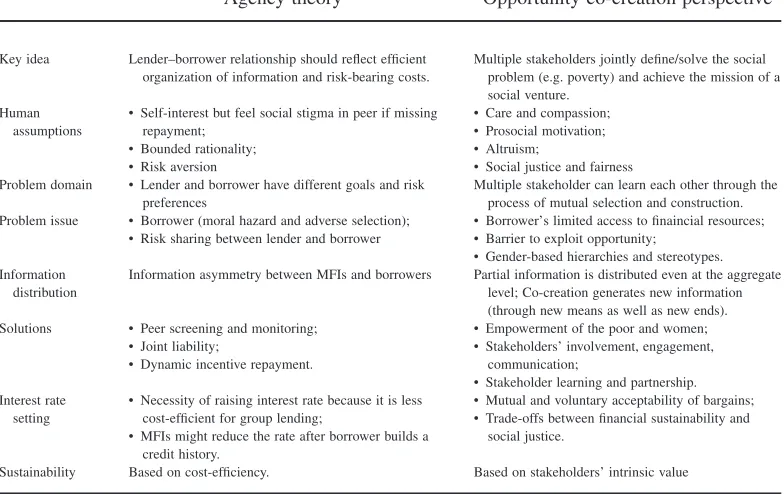
Among the various stakeholders, our study focuses on female borrowers, borrower communities, managers, employees, and governments. They are key stakeholders in terms Table 1
A Comparison of Theoretical Foundations on Microfinance Between Agency Theory and Opportunity Co-Creation Perspective
Agency theory Opportunity co-creation perspective
Key idea Lender–borrower relationship should reflect efficient organization of information and risk-bearing costs.
Multiple stakeholders jointly define/solve the social problem (e.g. poverty) and achieve the mission of a social venture.
Human assumptions
• Self-interest but feel social stigma in peer if missing repayment; Problem domain • Lender and borrower have different goals and risk
preferences
Multiple stakeholder can learn each other through the process of mutual selection and construction. Problem issue • Borrower (moral hazard and adverse selection);
• Risk sharing between lender and borrower
• Borrower’s limited access to finaincial resources; • Barrier to exploit opportunity;
• Gender-based hierarchies and stereotypes. Information
distribution
Information asymmetry between MFIs and borrowers Partial information is distributed even at the aggregate level; Co-creation generates new information (through new means as well as new ends). Solutions • Peer screening and monitoring;
• Joint liability;
• Dynamic incentive repayment.
• Empowerment of the poor and women; • Stakeholders’ involvement, engagement,
communication;
• Stakeholder learning and partnership. Interest rate
setting
• Necessity of raising interest rate because it is less cost-efficient for group lending;
• MFIs might reduce the rate after borrower builds a credit history.
• Mutual and voluntary acceptability of bargains; • Trade-offs between financial sustainability and
social justice.
Sustainability Based on cost-efficiency. Based on stakeholders’ intrinsic value
of urgency, power, and legitimacy (Mitchell, Agle, & Wood, 1997), and their supports are critical for the survival of MFIs (Harrison, Bosse, & Phillips, 2010). Since they can provide necessary resources, including new knowledge, environments, and sufficient trust or power to construct partnership (Dess, Ireland, & Hitt, 1990; Freeman, 1984), their involvements and contributions would facilitate the process of opportunity co-creation.
Co-Creating Opportunities Among Stakeholders
Opportunity Co-Creation Between MFIs and Borrower Community
MFIs usually set their social mission as reaching the poor at the bottom of the pyramid with small loans (Mersland & Strøm, 2010), but they may need to charge a high interest rate on these loans. First, smaller loans are associated with higher transaction costs than larger loans (Mersland & Strøm) because it is difficult for MFIs to maintain a reasonable fee structure and practices (Johnston & Morduch, 2008). Second, poor borrowers often face multitudes of barriers to taking advantage of the loans and exploring entrepreneurial opportunities, which can hinder their ability to pay back the loans (Alvarez & Barney, 2014). Third, because poor borrowers generally do not have a credit history or collateral, MFIs have difficulty assessing credit worthiness of the borrowers. The high costs asso-ciated with providing small loans, the potentially high delinquency rates, and the moral hazard caused by information asymmetry could lead MFIs to charge higher interest rates to poor borrowers (Cull et al., 2007; Hermes, Lensink, & Meesters, 2011).
An opportunity co-creation perspective suggests that MFIs and the borrowers in a borrower community can jointly define and solve this problem of information asymmetry and create opportunities to serve poor borrowers with lower interest rates while pursuing moderate levels of profit. As explained above, MFIs should obtain specific information on potential and existing borrowers (e.g., ability to repay the loan and wealth) to better target and manage their loans. However, it is costly to do so. MFIs can address this problem by taking advantage of a large borrower community. When such a community is clearly identified, MFIs are able to mobilize and acquire information and knowledge about borrowers more efficiently by encouraging information exchange (Conning & Kevane, 2002; Rai, 2002). With the acquired knowledge, MFIs can control some part of the risk with regard to borrowers and reduce the costs of targeting and managing loans. These benefits help them lower interest rates.
A large borrower community characterized by geographical proximity, interaction, and identity is beneficial for borrowers as well (Dunham, Freeman, & Liedtka, 2006). They can learn the means of exploiting loans by observing and communicating with other borrowers in the community because spatial proximity and social linkage increase infor-mation flows (Pierce & Aguinis, 2013). In addition, a well-developed community enables the poor to gain access to bank information on market prices and loan opportunities (Uzzi, 1999) and to share their values and experiences in repaying loans and building credit (Dunham et al.). This type of learning not only reduces the delinquency rates of the microloans but also reduces information asymmetry between MFIs and the poor. The learning also improves the confidence of borrowers in controlling their financial plans and repayment obligations and increases their bargaining power with lenders. Last, the learn-ing effects could be diffused further and deeper as the borrower community grows (Ferrary & Granovetter, 2009).
MFIs (Alvarez & Barney, 2014). This cooperative process can lead to opportunity co-creation, which reduces risks for MFIs and interest rates for borrowers. Therefore, we argue:
Hypothesis 1: An MFI has a lower interest rate in a larger borrower community.
Stakeholder Relationship Between MFIs and Women
As seen in the case of Grameen Bank, which invests 94% of its assets in loans for women (Yunus, 2007), many MFIs emphasize financial services for women. Indeed, they seem to be a good target because they are more willing than male borrowers to invest loans in productive activities and repay the loans (Brau & Woller, 2004; Yunus, Moingeon, & Lehmann-Ortega, 2010). Also, they are eager to fight against poverty and increase social status of their families by exploiting loans from MFIs. These suggest that female borrowers may contribute to opportunity co-creation activities of MFIs.
However, women have some disadvantages in this mutual selection process in com-parison with men and have limitations in participating in the opportunity co-creation process. First, gender-based hierarchies in many developing economies where most MFIs operate inhibit women from gaining access to material, human, and social resources (Cheston & Kuhn, 2002). Gender stereotypes and the traditional division of labor at home (e.g., domestic and child care responsibilities) constrain women’s choices for income generation, thus making it more difficult for them to make weekly loan repayments than men (Milgram, 2001). Second, gender-based hierarchies give women little power in a financial-contract negotiation. In most developing economies, men dominate and control the resources of credit, money, and social capital. Also, male lending officers may have some difficulty understanding women’s businesses and spending modes, which are dif-ferent from those of their male counterparts (Bruton et al., 2011). Third, because women borrowers generally have less education and knowledge of financial contracts than male borrowers, they may end up paying higher interest rates than men even though some have argued that female borrowers have better records of repayment than men (Cull et al., 2007; Hermes & Lensink, 2007; Yunus, 2007). In-depth interviews conducted by Bruton et al.) show that some women were still unable to explain the terms of their loans even after they received loans from loan officers. Therefore, we suggest:
Hypothesis 2a: The proportion of women borrowers of a MFI is positively related to the interest rate.
Opportunity Co-Creation Among MFIs, Women, and Government
First, the rule of law that facilitates women’s rights and opportunities could help women to challenge gender-based hierarchies and stereotypes (Cheston & Kuhn, 2002; Hunt & Kasynathan, 2001) and encourage them to participate in more entrepreneurial activities (Jullien, 2004). Second, the rule of law that promotes client protection in areas such as effective dispute-resolution procedures (Cheston & Kuhn, 2002) gives women more bargaining power and rights in contract negotiation. Third, the rule of law that requires transparency in pricing and accounting protects women borrowers who do not have education and knowledge to request and understand financial terms. The benefits of the rule of law for women, such as increased rights, fair legal procedures, and transparent information on MFIs, could help female borrowers to engage in productive activities to repay their loans (Prahalad & Ramaswamy, 2004) and to join the opportunity co-creation process. The rule of law also encourages MFIs to provide at least equal service for female borrowers. Therefore, we propose:
Hypothesis 2b: The rule of law moderates the relationship between the proportion of women borrowers of an MFI and the interest rate such that the positive effect of the proportion of women borrowers of an MFI on the interest rate becomes weaker in a country with a stronger rule of law.
Opportunity Co-Creation Between MFI Managers and Borrowers
MFI managers can influence various decisions on loan management such as delin-quency rate. They manage MFIs’ risks and contracts with borrowers. We argue that MFI managers and borrowers could be mutually selected into the opportunity co-creation process. For commercial banks, default risk in loan portfolio management is related to increased interest rates (Angbazo, 1997). However, portfolio risk of MFIs, defined as a 90-day late payment in this study, is different. Most of the loans offered by MFIs are based on short-term contracts and require quick and frequent loan repayment. When a loan is behind its repayment schedule, MFIs can choose to write off the loan as being in default, but in such cases, MFIs are likely to incur a loss because microfinance loans often do not have collateral to recoup the loan loss.
Alternatively, MFIs can choose to keep the loan active and help the borrowers to repay the loan by extending the payment period and reducing the interest rate subsequently
charged on the loan.2
MFIs can charge lower interest rates to borrowers behind the payment schedule particularly when they are engaged in iterative interaction processes with the borrowers. Through this relationship, they can obtain latest and accurate infor-mation about the borrowers, including willingness for repayment, and can adjust previous policies on payment schedule and interest rates (Alvarez & Barney, 2014). Indeed, there are increasing needs for flexible decision making on payment schedule and interest rate (Meyer, 2002) because the flexibility allows borrowers to have more time to exploit their loans and improve repayment ability, reducing a loan default risk (Ahlin & Townsend,
2007; Field & Pande, 2008).3 For example, in the evolving Grameen II system, if a
2. We should differentiate betweenex anteandex postcharges on the interest rate here. In this section, the fact that MFIs subsequently lower the interest payments for the potential default borrower belongs to the case of the latter. We thank one reviewer for pointing this out.
borrower’s repayment is 6 months behind the schedule, managers will take it as an early warning signal and convert the borrowers’ loan from a fixed schedule to a flexible payment loan that may even give the borrower up to 20 years to repay the loan, setting the maximum penalty to the size of the loan and maximum interest collection to the original principal (Armendáriz de Aghion & Morduch, 2005; Yunus, 2007). Therefore, MFI managers and borrowers jointly create opportunities by addressing the default risk. Overall, we suggest:
Hypothesis 3a: An MFI’s loan portfolio 90-day delinquency rate is negatively related to the interest rate that it charges subsequently.
Opportunity Co-Creation Among MFI Managers, Borrowers, and Government
Although some true poor borrowers can benefit from a lower interest rate when they struggle to repay the loans, it could raise potential moral hazard issues and damage normal relationships between MFI managers and borrowers (Armendáriz de Aghion & Morduch, 2005; Khavul, 2010). In this case, the rule of law could serve as an antidote and help MFIs to build a cooperative, long-term, and trusting relationship with borrowers in evaluating client credit, designing repayment contracts, and implementing collateral substitutes (Morduch, 1999; North, 2005; Peng, Sun, Pinkham, & Chen, 2009). On the one hand, the rule of law as a formal institution can make MFIs reduce their transaction costs and the uncertainty associated with the relationship with borrowers. On the other hand, however, formal rules can also undermine a manager’s ability to implement case-based renegotiation. For example, some laws may prevent managers from offering a particular clientele extensions or a reduced interest rate (Canales, 2014) because if the MFI’s loan portfolio is at risk, the formal institution of the rule of law replaces the old solution based on informal stakeholder cooperation (e.g., group screening, monitoring, and joint liability) (Peng et al., 2009).
In addition, well-codified legal systems and enforcing mechanisms facilitate the opportunity co-creation by protecting the rights of creditors, lenders, and borrowers and helping managers to fairly enforce repayment and group lending obligations (Alvarez & Barney, 2014; Economist Intelligence Unit, 2012). MFI managers in a country with a better rule of law may have less incentive to develop a case-based approach and may depend more heavily on the rule of law to select their customers and reinforce the loan payment schedule than MFI managers in countries with a worse rule of law. The better rule of law could balance the cooperation between MFI managers and borrowers, making their relationship sustainable and productive (Canales, 2014). Therefore, we suggest:
Hypothesis 3b: The rule of law moderates the relationship between an MFI’s loan portfolio 90-day delinquency rate and the interest rate such that the negative effect of
an MFI’s loan portfolio 90-day delinquency rate on the interest rate becomes weaker in a country with a stronger rule of law.
Opportunity Co-Creation Between Loan Officers and Employees
Given that social ventures have relatively limited access to resources (Austin, Stevenson, & Wei-Skillern, 2006), MFIs should efficiently exploit existing resources. In particular, they should focus on human capital because skills and experiences of loan officers and employees are crucial for MFIs to increase efficiency and reduce costs associated with their services for the poor (Battilana & Dorado, 2010). The increased efficiency and cost reduction allow MFIs to lower interest rates. We argue that this opportunity can be co-created by loan officers and employees.
Loan officers sometimes take full responsibility for MFIs’ activities regarding loans (Battilana & Dorado, 2010; Bruton et al., 2011), including marketing loans, evaluating clients, structuring loan terms (such as loan size and joint liability), and recouping defaulted loans (Canales, 2014). However, relying too much on them could weaken engagement and contributions of other employees to loan activities and customer ser-vices. Since employees influence MFIs by investing their human and intellectual capital (Ashta & Hudon, 2009; Hossain, 2013) and their impact can vary depending on how much they are empowered (Harrison et al., 2010), MFIs need to provide incentives and training to empower employees (Battilana & Dorado; Epstein & Crane, 2007). Yunus suggests that it is important for MFI employees to receive “market wages with better working conditions” and “do it with joy” (Kickul, Terjesen, Bacq, & Griffiths, 2012, p. 454). A decentralized organizational structure can be another productive way to empower employees.
A decentralized structure disperses decision-making authority throughout the organi-zation, especially from loan officers (Dalton, Todor, Spendolini, Gordon, & Porter, 1980). This type of bottom-up structure motivates employees to improve knowledge about clients and effective communication skills and to maximize their contribution (Holcomb, Combs, Sirmon, & Sexton, 2010; Peterson, Arregle, & Martin, 2012). Thus, employees can participate in customer analysis and services (Herrenkohl, Judson, & Heffner, 1999) while only a few loan officers are fully responsible for lending activities. Also, under the decentralized structure, employees can share a vision of poverty alleviation with loan officers (Herrenkohl et al., 1999). Therefore, the loan officers and employees can have more chances to collaborate for opportunity co-creation.
In addition, MFIs with a decentralized structure can reduce the effects of loan officers’ individual arbitrage and manipulation in loan activities. Based on agency theory, frontline loan officers as agents could maximize their own personal interests by charging high interest rates for a bonus when a top manager, as principal, has limited customer information (Eisenhardt, 1989). Loan officers could also transfer their respon-sibility and burden to the borrower group, which sometimes increases the interest rate and the likelihood of collusion or default (Armendáriz de Aghion & Morduch, 2005). However, our opportunity co-creation perspective suggests that active interactions between loan officers and employees in the decentralized structure could reduce the information asymmetries among these stakeholders (Sarasvathy et al., 2014). Therefore, we suggest:
Data and Methods
Sample
We collected MFI data from the MIX. One of the strong features of the MIX data is that the numbers are adjusted by international accounting standards (Cull, Demirguc-Kunt, & Morduch, 2009). In addition, the data provide not only financial information but also information on the proportion of female borrowers, as well as the legal status of MFIs and their target markets. Although there might be concerns regarding a self-selection bias with the database because MFIs voluntarily report information regarding their activities, the data present leading MFIs’ activities with rigorous reporting standards (Cull et al.; Krauss & Walter, 2009). Therefore, the MIX data are currently a popular data source on MFIs (Hermes et al., 2011).
Although the original MIX data set contains information about MFIs from 1995, we focus on a period of 9 years from 2003 to 2011 (inclusive) because of the data availability on the variables in our study. After a lag of one year for all independent variables, our final sample consists of 4,187 organization-year observations from 1,154 MFIs over 8 years across 93 countries. The total asset and equity (shareholder investment) of these MFIs at the end of 2011 are $12.02 billion and $2.34 billion, respectively. We also collect Hofstede’s cultural scores (Hofstede, Hofstede, & Minkov, 2010) and Worldwide Gover-nance Indicators data from the World Bank (Kaufmann, Kraay, & Mastruzzi, 2011).
As Figure 1 shows, the number of active borrowers increased dramatically during the research period, suggesting the important roles that MFIs have played. The cumulative active-borrower number is 58.1 million. In particular, South Asia has experienced a significant increase in the total number of active borrowers, which exceeds that of other regions. The success of the Grameen Bank, the most prominent MFI (Bruton et al., 2011), may explain the popularity of MFIs in South Asia. However, we also find that there is a big decline between 2010 and 2011, which could contribute to the overall drop in the number of active borrowers from 2010 to 2011. The reason could be the MFI collapse events that have occurred since 2010, especially in India (Polgreen & Bajaj, 2010).
We find that the average proportion of female borrowers in microfinance programs is 64.7% during the research period. This suggests that the majority of MFI customers are women. Like that of active borrowers, the proportion of women borrowers differs by region (Figure 2). For example, the portion is largest in South Asia, where female borrowers represent more than 80% of all borrowers. It indicates that mutual selection of the partnership between MFIs and female borrowers vary across the countries.
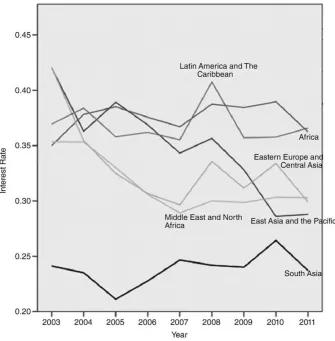
For our dependent variable, interest rates, although there was a moderate increase between 2007 and 2008, the overall trend shows that interest rates have been going down. In particular, the interest rates of MFIs in the East Asia and Pacific regions have decreased the most (Figure 3).
Measures
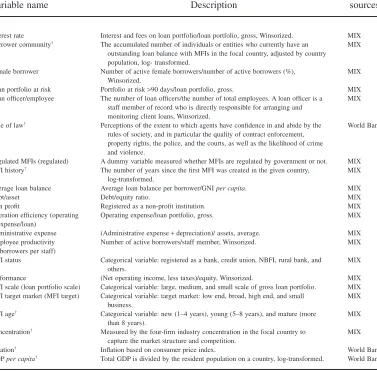
We summarize all variables’ definitions in Table 2.
Independent Variables. Our independent variables include both MFI-level variables and country-level variables. (1)Borrower communityis a country-level variable that captures the number of borrowers in a given country. It is measured by the ratio of the number of active borrowers in a given country to its total population. Higher values for this measure signify that
the country has a larger borrower community relative to the overall population. (2)Female
borrowers is an MFI-level variable that represents the ratio of the number of active female borrowers to the total number of active borrowers. (3)Loan portfolio at riskis an MFI-level variable measured by the outstanding balance of loans in which repayments are more than 90 days behind schedule divided by the gross loan portfolio. Although this is not default risk, it
can be a good warning sign of impending default (Cull et al., 2009). (4) Loan officer/
employeeis an MFI-level variable that represents the number of loan officers relative to the total number of employees, with loan officers being defined as personnel who mainly manage loan portfolios (Galaskiewicz & Wasserman, 1989).
Moderator Variable. Rule of law is a country-level variable, measured by the World Governance Indicators developed by Kaufmann et al. (2009). Several country-level Figure 1
variables obtained from 31 data sources were aggregated and normalized to produce six composite indicators of institutional dimensions (Kaufmann et al., 2011). The rule of law reflects “perceptions of the extent to which agents have confidence in and abide by the rules of society, and in particular the quality of contract enforcement, property rights, the police, and the courts, as well as the likelihood of crime and violence” (Kaufmann et al., 2009, p. 8). This measure ranges from−2.5 to 2.5.
Control Variables. We control for regulated MFIs, MFI history, average loan balance
(adjusted by gross national income [GNI] per capita), debt-to-asset ratio, nonprofit
dummy, operation efficiency, administrative costs, employee productivity, GDP per
capita, performance, inflation, concentration, MFI status, MFI scale, MFI target, and
MFI age, following previous research (Cull et al., 2007; Galaskiewicz & Wasserman, 1989; Krauss & Walter, 2009; Lamin, 2013).
Analysis and Model Estimation Strategy. Multilevel quantitative research has gained wide
attention in the field of management research (e.g., special issues in the Academy of
Figure 2
Management Reviewand theAcademy of Management Journal) and international business
(e.g., special issues in the Journal of International Business Studies) (Hitt, Beamish,
Jackson, & Mathieu, 2007; Klein, Tosi, & Cannella, 1999; Peterson et al., 2012). Multilevel quantitative research has the advantage of accurately modeling higher-level context constructs and lower-level theoretical variables (Holcomb et al., 2010; Peterson et al., 2012). In this study, we have a three-level nested data structure. Specifically, hypothesis 2a, hypothesis 3a, and hypothesis 4 focus on the firm-level variables, and hypothesis 2b and hypothesis 3b are related to interactions between firm level and country level. MFIs nested within a country share similar institutional structures, regulation environments, economic development stages, and cultures (Caudill et al., 2009). The common practices, such as peer screening, monitoring, joint liability, and local sanctions, are all deeply embedded in local culture (Ahlin & Townsend, 2007). Therefore, the microfinance interest rate in the same year or in the same country may be more similar than firms from different years and different countries. Cross-year, cross-country, and within-country similarities can potentially lead to intraclass (or intracountry) correlations. In other words, our 8-year, longitudinal cross-country data can lead to intratemporal and intracountry correlations.
Figure 3
Methodologically, addressing the existence of an intracountry correlation is necessary because it changes the error variance in traditional linear regression models and violates the assumption of observation independence, thus increasing the probability of type I and type II errors (Hox, 2010; Kreft & Leeuw, 1998). Our sample shows an intraclass correlation of 0.110, suggesting that 11.0% of the variation of interest rate is explained by the intra-country correlation.4
4. An intraclass correlation value above 0.10 indicates the importance of such correlations and necessitates multilevel analysis (Bliese & Ployhart, 2002).
Table 2
Variable Definitions
Variable name Description
Data sources
Interest rate Interest and fees on loan portfolio/loan portfolio, gross, Winsorized. MIX Borrower community† The accumulated number of individuals or entities who currently have an
outstanding loan balance with MFIs in the focal country, adjusted by country population, log- transformed.
MIX Female borrower Number of active female borrowers/number of active borrowers (%),
Winsorized.
MIX Loan portfolio at risk Portfolio at risk>90 days/loan portfolio, gross. MIX Loan officer/employee The number of loan officers/the number of total employees. A loan officer is a
staff member of record who is directly responsible for arranging and monitoring client loans, Winsorized.
MIX Rule of law† Perceptions of the extent to which agents have confidence in and abide by the
rules of society, and in particular the quality of contract enforcement, property rights, the police, and the courts, as well as the likelihood of crime and violence.
World Bank
Regulated MFIs (regulated) A dummy variable measured whether MFIs are regulated by government or not. MIX MFI history† The number of years since the first MFI was created in the given country,
log-transformed.
MIX Average loan balance Average loan balance per borrower/GNIper capita. MIX
Debt/asset Debt/equity ratio. MIX
Non profit Registered as a non-profit institution. MIX Operation efficiency (operating
expense/loan)
Operating expense/loan portfolio, gross. MIX Administrative expense (Administrative expense+depreciation)/ assets, average. MIX Employee productivity
(borrowers per staff)
Number of active borrowers/staff member, Winsorized. MIX MFI status Categorical variable: registered as a bank, credit union, NBFI, rural bank, and
others.
MIX Performance (Net operating income, less taxes)/equity, Winsorized. MIX MFI scale (loan portfolio scale) Categorical variable: large, medium, and small scale of gross loan portfolio. MIX MFI target market (MFI target) Categorical variable: target market: low end, broad, high end, and small
business.
MIX MFI age† Categorical variable: new (1–4 years), young (5–8 years), and mature (more
than 8 years).
MIX Concentration† Measured by the four-firm industry concentration in the focal country to
capture the market structure and competition.
MIX Inflation† Inflation based on consumer price index. World Bank
GDPper capita† Total GDP is divided by the resident population on a country, log-transformed. World Bank
To control for cross-year, intra-country correlation, as well as cross-country variation, we build and estimate a series of multilevel mixed models with the “xtmixed” command in Stata version 10 (Holcomb et al., 2010; Rabe-Hesketh & Skrondal, 2008). Specifi-cally, level 1 is within MFIs across time periods, level 2 is within MFIs across countries, and level 3 is within MFIs intra-countries.
Findings
To reduce the effect of possible spurious outliers, we winsorize the highest value
(99.5%) and the lowest value (0.5%) of theinterest rate,female borrower,loan officer/
employee, and performance (return on equity [ROE]), and replace them with the next value counting inwards from the extremes. Descriptive statistics are presented in Table 3. The mean for the interest rate of all MFIs is 33.7% between 2003 and
2011. The standard deviations of some variables, such as borrowers per staff, are
very high, indicating the highly unbalanced distribution of mutual selection between MFIs and borrowers. In addition, governments regulate a majority of MFIs, and approximately 63% of all MFIs are made up of nonprofit organizations. The table also shows that, on average, MFIs have approximately 10 years of history at the country level. We further test the variation inflation factor (VIF) in the regression with the main and control variables. The highest VIF of all variables is 9.04, with the average being 2.05.
Table 4 displays our multilevel mixed-model estimations on the nominal interest rate. Model 1, as the baseline model, includes all control variables. Step-by-step, we add
borrower communityin model 2, female borrowersin model 3, loan portfolio at riskin
model 4, andloan officer/employee to present the decentralized organizational structure
in model 5. An interaction betweenfemale borrowersandrule of lawis included in model
6, and an interaction betweenloan portfolio at riskandrule of lawis included separately in model 7. Model 8 is the full model.
As shown in Table 4, the results pertaining to most of the hypotheses are robust across all models. Model 1 reveals that several control variables have a significant
relationship with an MFI’s interest rate. For example, the coefficient for average loan
balance is negatively significant at p<.01. This implies that MFIs increase the interest
rate when they serve low-amount borrowers. Debt/assethas a significant negative
rela-tionship with the interest rate. We also find that MFIs’ operation efficiency measures,
operating expense/loan, administrative expense, and borrowers per staff, have a very significant relationship with the interest rate. Although MFI performance significantly affects the interest rate, the significant level of estimations regarding various
stakehold-ers—e.g., government (regulated), clients (the poor and women), creditors, owners
(debt/asset), managers (operating expense/loan, administrative expense), employees (borrowers per staff), and different banks (e.g., community-based rural bank)— indicates that MFI stakeholders can also play an important role in cutting interest rates for the poor.
Hypothesis 1 suggests that borrowers in larger borrower communities will have
lower interest rates. The results of model 2 indicate that the coefficient of borrower
community is significantly negative on the interest rate (β = −.0674; p<.001). There-fore, hypothesis 1 is strongly supported. For every 1% increase in the size of the bor-rower community, the interest rate of the following year decreases by 0.0674%.
Table 3
Descriptive Statistics and Correlation
1 2 3 4 5 6 7 8 9 10 11 12 13 14 15 16 17 18
1. Interest rate 1.000
2. Borrower community −0.123 1.000
3. Female borrower 0.237 0.062 1.000
4. Loan portfolio at risk −0.107 0.003 −0.090 1.000 5. Loan officer/ employee 0.113 −0.016 0.279 −0.074 1.000 6. Rule of law −0.016 −0.126 0.078 −0.005 0.149 1.000 7. Regulated −0.160 −0.025 −0.187 −0.051 −0.056 −0.070 1.000
8. MFI history −0.086 0.383 0.189 0.067 −0.092 0.089 −0.082 1.000
9. Average loan balance −0.153 −0.022 −0.295 0.038 −0.199 −0.145 0.176 −0.112 1.000
10. Debt/asset −0.184 0.093 0.007 0.051 −0.027 −0.037 0.177 0.204 0.057 1.000
11. Non profit −0.109 0.054 0.078 0.021 0.034 0.007 −0.462 −0.028 −0.115 −0.151 1.000 12. Operating expense/loan 0.549 −0.149 0.166 0.010 0.066 −0.007 −0.133 −0.137 −0.115 −0.156 −0.023 1.000 13. Administrative expense 0.559 −0.142 0.133 0.006 0.048 −0.002 −0.132 −0.145 −0.108 −0.106 −0.028 0.802 1.000
14. Borrowers per staff −0.077 −0.011 0.205 0.020 0.191 0.135 −0.009 0.069 −0.163 0.036 −0.002 −0.066 −0.033 1.000 15. GDPper capita 0.115 0.031 −0.168 −0.035 −0.124 0.310 −0.219 0.152 −0.170 −0.083 0.081 −0.022 0.005 −0.069 1.000
16. Performance −0.041 0.023 0.006 −0.074 0.024 0.008 0.060 0.054 0.018 0.066 −0.035 −0.229 −0.238 0.013 0.022 1.000
17. Inflation 0.041 −0.124 0.000 −0.032 −0.053 −0.127 0.088 −0.093 0.055 0.031 −0.065 0.025 0.014 −0.013 −0.199 0.012 1.000 18. Concentration 0.002 −0.218 −0.188 0.003 −0.032 0.140 0.066 −0.404 0.081 −0.197 0.010 0.085 0.089 −0.062 0.015 −0.084 0.025 1.000
Mean 0.337 0.033 0.647 0.041 0.510 −0.610 0.549 9.807 0.594 0.667 0.626 0.274 0.084 140.592 7.505 0.078 0.073 0.096
Standard deviation 0.174 0.032 0.260 0.071 0.181 0.447 0.498 2.745 1.189 0.256 0.484 0.291 0.075 167.765 0.995 0.668 0.057 0.082
Minimum 0.041 0.000 0.000 0.000 0.044 −2.110 0.000 1.000 0.001 0.000 0.000 0.009 0.000 2.000 4.795 −4.767 −0.132 0.021
Maximum 1.121 0.162 1.000 0.965 1.000 1.370 1.000 15.000 33.926 2.146 1.000 6.702 1.179 7578.000 9.539 4.655 0.534 0.648
Correlations above |.20| and significant at the .05 level are in bold.
117
Januar
y,
Table 4
Results of Multilevel Mixed Models on Interest Rates
Model 1 Model 2 Model 3 Model 4 Model 5 Model 6 Model 7 Model 8
Independent
Borrower community (hypothesis 1) −0.674*** (0.158) −0.695*** (0.160) −0.708*** (0.159) −0.705*** (0.159) −0.707*** (0.158) −0.707*** (0.159) −0.708*** (0.158) Female borrower (hypothesis 2a) 0.086*** (0.009) 0.080*** (0.009) 0.077*** (0.009) 0.036** (0.014) 0.076*** (0.009) 0.037** (0.014) Loan portfolio at risk (hypothesis 3a) −0.178*** (0.024) −0.175*** (0.024) −0.172*** (0.024) −0.109** (0.039) −0.116** (0.039)
Loan officer/employee (hypothesis 4) 0.046*** (0.011) 0.047*** (0.011) 0.046*** (0.011) 0.047*** (0.011)
Interaction
Female borrower×rule of law (hypothesis 2b)
−0.067*** (0.016) −0.064*** (0.016)
Loan portfolio at risk×rule of law (hypothesis 3b) MFI history 0.000 (0.002) 0.003 (0.002) 0.003 (0.002) 0.002 (0.002) 0.001 (0.002) 0.002 (0.002) 0.002 (0.002) 0.002 (0.002) Average loan balance −0.007** (0.002) −0.007** (0.002) −0.006* (0.002) −0.006* (0.002) −0.005* (0.002) −0.005* (0.002) −0.005* (0.002) −0.005* (0.002) Debt/asset −0.029*** (0.007) −0.029*** (0.007) −0.029*** (0.008) −0.027*** (0.008) −0.028*** (0.008) −0.029*** (0.008) −0.027*** (0.008) −0.028*** (0.008) Non-profit −0.038*** (0.006) −0.038*** (0.006) −0.035*** (0.007) −0.033*** (0.007) −0.033*** (0.007) −0.032*** (0.007) −0.033*** (0.007) −0.032*** (0.007) Operating expense/loan 0.119*** (0.010) 0.118*** (0.010) 0.108*** (0.010) 0.107*** (0.010) 0.107*** (0.010) 0.106*** (0.010) 0.107*** (0.010) 0.106*** (0.010) Administrative expense 0.420*** (0.037) 0.418*** (0.037) 0.419*** (0.038) 0.448*** (0.039) 0.457*** (0.039) 0.463*** (0.039) 0.459*** (0.039) 0.464*** (0.039) Borrowers per staff 0.000*** (0.000) 0.000*** (0.000) 0.000*** (0.000) 0.000*** (0.000) 0.000*** (0.000) 0.000*** (0.000) 0.000*** (0.000) 0.000*** (0.000) GDPper capita −0.004 (0.005) −0.004 (0.005) 0.004 (0.005) 0.004 (0.005) 0.005 (0.005) 0.005 (0.005) 0.005 (0.005) 0.004 (0.005) Performance 0.016*** (0.002) 0.016*** (0.002) 0.013*** (0.002) 0.013*** (0.002) 0.014*** (0.003) 0.014*** (0.003) 0.014*** (0.003) 0.014*** (0.003) Inflation 0.328*** (0.075) 0.308*** (0.074) 0.329*** (0.075) 0.335*** (0.074) 0.349*** (0.074) 0.342*** (0.074) 0.345*** (0.074) 0.339*** (0.074) Concentration −0.035 (0.040) −0.041 (0.039) −0.030 (0.041) −0.046 (0.041) −0.050 (0.041) −0.056 (0.041) −0.049 (0.041) −0.055 (0.041)
MFIs type Controlled Controlled Controlled Controlled Controlled Controlled Controlled Controlled
MFIs scale Controlled Controlled Controlled Controlled Controlled Controlled Controlled Controlled
MFIs target Controlled Controlled Controlled Controlled Controlled Controlled Controlled Controlled
MFIs age Controlled Controlled Controlled Controlled Controlled Controlled Controlled Controlled
Year effects Controlled Controlled Controlled Controlled Controlled Controlled Controlled Controlled
Constant 0.292*** (0.052) 0.280*** (0.051) 0.194*** (0.052) 0.213*** (0.052) 0.191*** (0.053) 0.220*** (0.053) 0.190*** (0.053) 0.218*** (0.053)
N 4817 4817 4290 4232 4187 4187 4187 4187
Group-Year 8 8 8 8 8 8 8 8
Group-Country 93 93 93 93 93 93 93 93
Waldχ2 2567.600 2601.170 2262.860 2392.710 2420.880 2448.640 2428.450 2454.090
Log likelihood 3619.192 3628.167 3278.881 3286.555 3258.659 3267.085 3261.062 3268.842
positively related to the interest rate. In model 3, the coefficient of female borrowersis
positive and significant (β =.086; p<.001) and supports the hypothesis. Thus, MFIs
increase the interest rate by 0.086% for every 1% increase in the proportion of female
borrowers they serve. Hypothesis 2b argues that the interaction between women
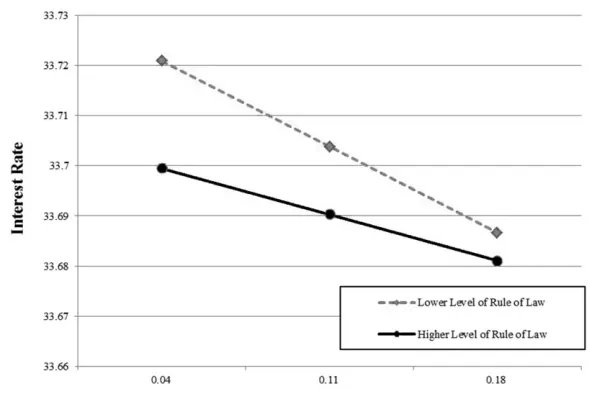
bor-rowersandrule of lawwill be negatively related to the interest rate. As shown in model 6, the coefficient for the interaction term is significantly negative (β = −.067; p<.001), which implies that the relationship between interest rates and female borrowers depends on the country’s rule of law. Although MFIs serving more female borrowers charge higher interest rates than those serving fewer women borrowers, the differences are smaller in the countries with stronger rule of law than in countries with weaker rule of law. Figure 4 depicts this interaction effect.
Hypothesis 3a, predicting a negative relationship betweenloan portfolio at riskand
the interest rate, is supported in model 4 (β = −.178;p<.001). Every 1% increase in the 90-day delinquency rate is associated with a 0.178% decrease in interest rates.
Hypoth-esis 3b suggests a positive effect of the interaction between loan portfolio at risk and
rule of law on the interest rate, and as model 7 shows, the prediction is supported (β =.124;p<.05). The interaction effect is presented in Figure 5. Model 8 includes two interaction terms, and the results are robust to support both hypothesis 2b and hypoth-esis 3b.
Hypothesis 4 suggests a positive relationship between the loan officer/employee ratio and the interest rate. The coefficient for the ratio of loan officer/employee is posi-tive and significant (β =.046;p<.001) in model 5. It suggests that if an MFI hires loan officers 1% more than employees, it will increase the interest rate by 0.046% in the
next year. Because lower values for the ratio of loan officer/employee indicate that
MFIs have a more bottom-up structure, the positive coefficient shows that hypothesis Figure 4
4 is supported. We run some robustness tests, and these hypotheses are still supported.5
Discussion
Contributions
Our study makes several contributions. First, we propose an opportunity co-creation perspective to explain interest-rate setting of MFIs. This approach, which presents a holistic view of the world, embraces the importance of every stakeholder’s role in achieving a shared mission—alleviating poverty. As we find in the empirical results, all stakeholders can jointly define and solve social problems, which result in cutting the interest rate for the poor. Our opportunity co-creation approach complements agency theory, which previous studies have applied to explain the peer screening, monitoring, and joint liability between lenders and borrowers (Stiglitz, 1990; Varian, 1990). However, agency theory ignores other stakeholders’ efforts in cutting interest rates. We believe that our opportunity co-creation perspective, drawn from stakeholder theory and entrepreneur-ship theory, can help to capture the holistic complexity of such social ventures and lead to novel insights (Eisenhardt, 1989). We highlight the evident disparities between the two
5. Our robustness tests (1) controlled for the women’s equality level (measured by the Gender Inequality Index) to capture human development in the focal country and (2) applied two-stage least squares (2SLS) multilevel, mixed, instrumental variable regressions to further test the endogenous issue, using masculinity or uncertainty avoidance in Hofstede’s cultural dimension and the female labor force from the World Bank as instrument variables. The detailed results are available upon request.
Figure 5
theories, and an integration of the two could lead to a more complete picture of the microfinance phenomenon (Mayer & Sparrowe, 2013).
Second, our opportunity co-creation perspective highlights the importance of mutual selection and mutual construction among stakeholders in a social venture. For example, hypothesis 1 suggests that borrowers could mutually learn and build social capital together and that countries could build borrower communities to reduce the transaction costs involved in microfinance. This supports Yunus’s (2007, p. 58) argument on the power of community to “encourage people to achieve things they might otherwise find impossible.” Hypothesis 4 suggests that managers and employees can actively interact with each other through a decentralized structure, which leads to improved efficiency and coverage under a mutual construction. While agency theory focuses on how powerful actors (e.g., man-agers and investors) protect their interests (Stiglitz, 1990; Varian, 1990), our opportunity co-creation perspective explores the contributions and joint effects of other important but less known stakeholders (e.g., female borrowers and employees) (Hart & Sharma, 2004). Our findings on hypothesis 1 and hypothesis 2b strongly indicate that if these “fringe” stakeholders are empowered by supportive institutions, community, and social infrastruc-ture, they could understand financial tools, actively manage the relationships with MFIs, and gain more power in bargaining over interest rates (Bruton et al., 2011). Therefore, as shown in Table 1, setting the interest rate is based on mutual selection and mutual
construction among stakeholders.6 In this process, a social venture needs to “persuade,
incentivize, and guide the ecosystem stakeholders through a process of change” (Zahra et al., 2014, p. 144).
Third, we contribute to the growing multilevel quantitative research in entrepreneur-ship literature (Hitt et al., 2007; Holcomb et al., 2010; Klein et al., 1999; Peterson et al., 2012). Our multilevel mixed models are more effective at mapping out the effects at the time, country, and firm levels, as well as their interactions than previous research focusing solely on the firm level (Cull et al., 2007, 2009; Mersland & Strøm, 2009, 2010). These models are linked together by a high-level model, in which the regression coefficients of the low-level models are regressed on high-level explanatory variables. As such, we can more robustly describe how multiple stakeholder relationships in setting interest rates varies across countries over time (Holcomb et al.), especially for the moderating effect of the rule of law.
Fourth, our study offers significant managerial implications. For example, govern-ments can help MFIs to cut interest rates by building MFI communities and social infrastructure and improving the rule of law. In particular, the rule of law alleviates problems faced by female borrowers and provides a more favorable environment for them. Also, it enables MFI managers to better deal with risks. In rule-based countries, well-codified legal systems and enforcement of laws reduce uncertainty regarding microfinance transactions and build cooperative, long-term, trusting relationships among stakeholders. Well-specified loan contracts in these countries could protect female bor-rowers’ and lenders’ rights and reduce the risk of adverse selection, thereby encouraging cooperation and trust between stakeholders (Poppo & Zenger, 2002). In contrast, to develop a co-creation stakeholder relationship in a country with a weak legal system, all stakeholders face high transaction costs and uncertainty, even with a strong social mission (Alvarez & Barney, 2014). Social ties and group lending could help avoid an exchange hazard, but they also cause costs for group monitoring and possible risks
arising from the joint liability (Peng et al., 2009). Our hypothesis 2b and hypothesis 3b promote the proposition that government’s effect on the rule of law could relieve the interest rate burden on both women and MFIs.
We also recognize the stakes and demand of specific stakeholders in the microfin-ance ecosystem. Our opportunity co-creation perspective can help every stakeholder in microfinance to (1) identify the actual or potential harm and the benefits of their actions for other stakeholders, (2) consider the joint effects with other stakeholders, and (3) create new opportunities under a shared social mission.
Future Directions
To the best of our knowledge, this is the first study that explores MFIs’ interest rate setting under the opportunity co-creation perspective. Our study opens many doors for future research, including the following research questions. What is the best way to empower borrowers with regard to bargaining for lower interest rates? How do different formal or informal institutions help borrowers to gain access to loans and manage entre-preneurial businesses? How do MFIs structure loan contracts and payment schedules to reduce default risks? MFI management teams, boards, government policies, and bor-rower group dynamics are also potential research topics. We also should note that our sample is on the firm level, so future research that uses individual-level data could further identify multiple-stakeholder relationships and verify our findings.
With regard to the debate on MFIs’ self-sustainability, our opportunity co-creation perspective suggests balancing financial sustainability and social justice. On the one hand, MFIs that place too much emphasis on financial sustainability and the interest of single stakeholder (i.e., financial investors) might hurt their social mission and block contributions of other stakeholders, such as social investors and poor borrowers, in the opportunity creation (Taylor, 2011). From the MIX data, we find a significant decline in the number of active borrowers between 2010 and 2011 (Figure 1), which could be the result of the collapse of MFIs in South Asia (Polgreen & Bajaj, 2010). On the other hand, MFIs that put too much stress on their products may not be able to attract enough financial resources (Cull et al., 2009). The topic of how to balance MFIs’ sustainability and social mission in opportunity co-creation is worth further exploration (Battilana & Dorado, 2010).
Finally, supporters of MFI commercialization argue that the poor are not sensitive to interest rates. However, many cases show an opposite story (Taylor, 2011). We encour-age future researchers to examine how microfinance interest rates relate to the depth and outreach of the services and how the rates, as well as repayment schedules, affect opportunity co-creation, such as borrower’s ability to start and run a sustainable business. A multilevel quantitative method, combining country- or regional-level data, could provide a better explanation about depth and outreach of MFIs or their collapse.
Conclusion
REFERENCES
Ahlin, C. & Townsend, R.M. (2007). Using repayment data to test across models of joint liability lending.
Economic Journal,117(517), F11–F51.
Alvarez, S.A. & Barney, J.B. (2007). Discovery and creation: Alternative theories of entrepreneurial action.
Strategic Entrepreneurship Journal,1(1–2), 11–26.
Alvarez, S.A. & Barney, J.B. (2010). Entrepreneurship and epistemology: The philosophical underpinnings of the study of entrepreneurial opportunities.Academy of Management Annals,4(1), 557–583.
Alvarez, S.A. & Barney, J.B. (2014). Entrepreneurial opportunities and poverty alleviation.Entrepreneurship Theory and Practice,38(1), 159–184.
Alvarez, S.A., Barney, J.B., & Anderson, P. (2013). Forming and exploiting opportunities: The implications of discovery and creation processes for entrepreneurial and organizational research.Organization Science,
24(1), 301–317.
Angbazo, L. (1997). Commercial bank net interest margins, default risk, interest-rate risk, and off-balance sheet banking.Journal of Banking & Finance,21(1), 55–87.
Armendáriz de Aghion, B. & Morduch, J. (2005).The economics of microfiance. Cambridge, MA: MIT Press.
Ashta, A. & Hudon, M. (2009).To whom should we be fair? Ethical issues in balancing stakeholder interests from Banco Compartamos case study. CEB Working Paper 09/036. Available at http://ssrn.com/ abstract=1470643, accessed 3 July 2014.
Austin, J., Stevenson, H., & Wei-Skillern, J. (2006). Social and commercial entrepreneurship: Same, different, or both?Entrepreneurship Theory and Practice,30(1), 1–22.
Battilana, J. & Dorado, S. (2010). Building sustainable hybrid organizations: The case of commercial microfinance organizations.Academy of Management Journal,53(6), 1419–1440.
Bebchuk, L. (2003). The case for increasing shareholder power.Harvard Law Review,118(3), 833–914.
Bliese, P.D. & Ployhart, R.E. (2002). Growth modeling using random coefficient models: Model building, testing, and illustrations.Organizational Research Methods,5(4), 362–387.
Brau, J.C. & Woller, G.M. (2004). Microfinance: A comprehensive review of the existing literature.Journal of Entrepreneurial Finance,9(1), 1–27.
Bruton, G.D., Khavul, S., & Chavez, H. (2011). Microlending in emerging economies: Building a new line of inquiry from the ground up.Journal of International Business Studies,42(5), 718–739.
Canales, R. (2014). Weaving straw into gold: Managing organizational tensions between standardization and flexibility in microfinance.Organization Science,25(1), 1–28.
Caudill, S.B., Gropper, D.M., & Hartarska, V. (2009). Which microfinance institutions are becoming more cost effective with time? Evidence from a mixture model. Journal of Money, Credit and Banking, 41(4), 651–672.
Cheston, S. & Kuhn, L. (2002).Empowering women through microfinance. New York: UNIFEM.
Compartamos. (2011). Annual and Sustainable Report. Available at http://www.compartamos.com/wps/ portal/InvestorsRelationsBank/FinancialInformation, accessed 3 July 2014.
Cull, R., Demirguc-Kunt, A., & Morduch, J. (2007). Financial performance and outreach: A global analysis of leading microbanks.Economic Journal,117(517), 107–133.
Cull, R., Demirguc-Kunt, A., & Morduch, J. (2009). Microfinance meets the market. In T.A. Watkins & K. Hicks (Eds.),Moving beyond storytelling: Emerging research in microfinance (contemporary studies in economic and financial analysis, Vol. 92)(pp. 1–30). Bingley, UK: Emerald.
Cull, R., Demirgüç-Kunt, A., & Morduch, J. (2011). Does regulatory supervision curtail microfinance profitability and outreach?World Development,39(6), 949–965.
Dalton, D.R., Todor, W.D., Spendolini, M.J., Gordon, J.F., & Porter, L.W. (1980). Organization structure and performance: A critical review.Academy of Management Review,5(1), 49–64.
Dehejia, R., Montgomery, H., & Morduch, J. (2012). Do interest rates matter? Credit demand in the Dhaka slums.Journal of Development Economics,97(2), 437–449.
Dess, G.G., Ireland, R.D., & Hitt, M.A. (1990). Industry effects and strategic management research.Journal of Management,16(1), 7–27.
Donaldson, T. & Preston, L.E. (1995). The stakeholder theory of the modern corporation: Concepts, evidence and implications.Academy of Management Review,20(1), 65–91.
Dunham, L., Freeman, R.E., & Liedtka, J. (2006). Enhancing stakeholder practice: A particularized explora-tion of community.Business Ethics Quarterly,16(1), 23–42.
Economist Intelligence Unit. (2012). Global microscope on the microfinance business environment. New York: Author.
Eisenhardt, K.M. (1989). Agency theory: An assessment and review.Academy of Management Review,14(1), 57–74.
Epstein, M.J. & Crane, C.A. (2007). Alleviating global poverty through microfinance: Factors and measures of financial, economic and social performance. In V.K. Rangan, J.A. Quelsh, G. Herrero, & B. Barton (Eds.),
Business solutions for the global poor: Creating social and economic value(pp. 321–334). San Francisco, CA: Jossey-Bass.
Ferrary, M. & Granovetter, M. (2009). The role of venture capital firms in Silicon Valley’s complex innovation network.Economy and Society,38(2), 326–359.
Field, E. & Pande, R. (2008). Repayment frequency and default in microfinance: Evidence from india.Journal of the European Economic Association,6(2–3), 501–509.
Freeman, R.E. (1984).Strategic management: A stakeholder approach. Boston: Pitman.
Freeman, R.E., Harrison, J.S., & Wicks, A.C. (2007).Managing for stakeholders: Survival, reputation, and success. New Haven, CT: Yale University Press.
Funk, R.J. (2014). Making the most of where you are: Geography, networks, and innovation in organizations.
Academy of Management Journal,57(1), 193–222.
Galaskiewicz, J. & Wasserman, S. (1989). Mimetic processes within an interorganizational field: An empirical test.Administrative Science Quarterly,34(3), 454–479.
Gonzalez, A. (2011). Sacrificing microcredit for unrealistic goals.Microbanking Bulletin, 1, Microfinance Information Exchange. Available at http://www.themix.org/publications/microbanking-bulletin/2011/2001/ sacrificing-microcredit-unrealistic-goals, accessed 3 July 2014.
Hargrave, T.J. & Van De Ven, A.H. (2006). A collective action model of institutional innovation.Academy of Management Review,31(4), 864–888.
Harrison, J.S., Bosse, D.A., & Phillips, R.A. (2010). Managing for stakeholders, stakeholder utility functions, and competitive advantage.Strategic Management Journal,31(1), 58–74.
Hart, S.L. & Sharma, S. (2004). Engaging fringe stakeholders for competitive imagination. Academy of Management Executive,18(1), 7–18.
Hartarska, V. & Nadolnyak, D. (2007). Do regulated microfinance institutions achieve better sustainability and outreach? Cross-country evidence.Applied Economics,39(10), 1207–1222.
Hermes, N. & Lensink, R. (2007). The empirics of microfinance: What do we know?Economic Journal,
117(517), F1–F10.
Hermes, N., Lensink, R., & Meesters, A. (2011). Outreach and efficiency of microfinance institutions.World Development,39(6), 938–948.
Herrenkohl, R.C., Judson, G.T., & Heffner, J.A. (1999). Defining and measuring employee empowerment.
Journal of Applied Behavioral Science,35(3), 373–389.
Hitt, M.A., Beamish, P.W., Jackson, S.E., & Mathieu, J.E. (2007). Building theoretical and empirical bridges across levels: Multilevel research in management.Academy of Management Journal,50(6), 1385–1399.
Hofstede, G., Hofstede, G.J., & Minkov, M. (2010).Cultures and organizations: Software of the mind(3rd ed.). New York: McGraw Hill Professional.
Holcomb, T.R., Combs, J.G., Sirmon, D.G., & Sexton, J. (2010). Modeling levels and time in entrepreneurship research: An illustration with growth strategies and post-IPO performance.Organizational Research Methods,
13(2), 348–389.
Hossain, S. (2013). Does external stakeholder orientation in corporate governance influence in sustainability and outreach of microfinance institutions?Research Journal of Finance and Accounting,4(14), 25–33.
Hox, J.J. (2010).Multilevel analysis: Techniques and applications. New York: Taylor & Francis.
Hunt, J. & Kasynathan, N. (2001). Pathways to empowerment? Reflections on microfinance and transforma-tion in gender relatransforma-tions in South Asia.Gender and Development,9(1), 42–52.
Johnston, D. & Morduch, J. (2008). The unbanked: Evidence from Indonesia.World Bank Economic Review,
22(3), 517–537.
Jullien, F. (2004).A treatise on efficacy: Between Western and Chinese thinking. Honolulu, HI: University of Hawaii Press.
Karlan, D.S. (2007). Social connections and group banking.The Economic Journal,117(517), F52–F84.
Kaufmann, D., Kraay, A., & Mastruzzi, M. (2009). Governance matters VIII: Aggregate and individual governance indicators, 1996–2008. World Bank Policy Research Working Paper No. 4978. Available at http://ssrn.com/abstract=1424591, accessed 3 July 2014.
Kaufmann, D., Kraay, A., & Mastruzzi, M. (2011). The worldwide governance indicators: Methodology and analytical issues.Hague Journal on the Rule of Law,3(2), 220–246.
Khandker, S.R. (2005). Microfinance and poverty: Evidence using panel data from Bangladesh.World Bank Economic Review,19(2), 263–286.
Khavul, S. (2010). Microfinance: Creating opportunities for the poor?Academy of Management Perspectives,