PISA 2012 MATHEMATICS FRAMEWORK
TO OECD, NOVEMBER 30, 2010
TABLE OF CONTENTS
TABLE OF CONTENTS ... 2
INTRODUCTION ... 3
DEFINITION OF MATHEMATICAL LITERACY ... 3
PISA 2012: A View of Students as Active Problem Solvers ... 4
PISA 2012: An Explicit Link to a Variety of Contexts for Problems ... 7
PISA 2012: A Visible Role for Mathematical Tools, Including Technology ... 7
ORGANISATION OF THE DOMAIN ... 7
Mathematical Content Knowledge ... 8
Change and relationships ... 10
Space and shape ... 11
Quantity ... 11
Uncertainty and data ... 12
Content Topics for Guiding the Assessment of Mathematical Literacy for 15-year-old Students ... 13
Mathematical Processes and the Underlying Mathematical Capabilities ... 14
Mathematical processes ... 14
Formulating situations mathematically ... 15
Employing mathematical concepts, facts, procedures and reasoning ... 16
Interpreting, applying and evaluating mathematical outcomes ... 17
Fundamental Mathematical Capabilities Underlying the Mathematical Processes ... 17
Contexts ... 21
ASSESSING MATHEMATICAL LITERACY ... 23
Structure of the PISA 2012 Mathematics Assessment ... 23
Desired distribution of score points by content category ... 23
Desired distribution of score points by mathematical process ... 24
Desired distribution of score points by context category ... 24
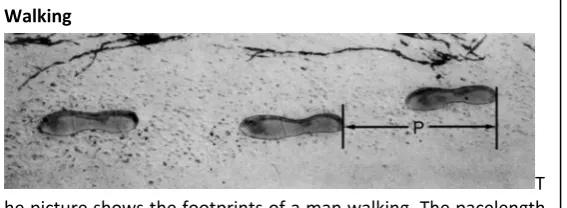
A range of item difficulties ... 25
Structure of the survey instrument ... 25
Design of the PISA 2012 mathematics items ... 25
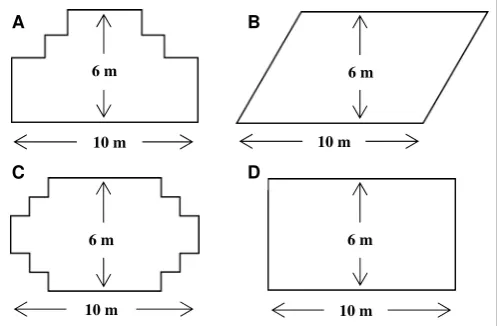
Mathematical tools ... 26
Item scoring ... 27
Reporting Proficiency in Mathematics ... 27
Attitudes towards mathematics ... 28
Optional computer-based assessment of mathematics ... 30
SUMMARY ... 31
ADDENDA ... 32
Addendum 1: Fundamental mathematical capabilities and their relationship to item difficulty ... 32
Addendum 2: Illustrative PISA Items ... 34
Pizzas ... 34
Litter ... 36
Rock Concert ... 37
Walking ... 38
Carpenter ... 40
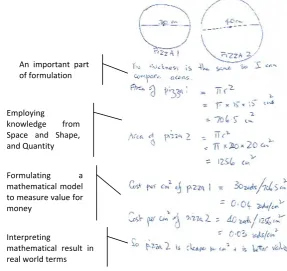
INTRODUCTION
1. The assessment of mathematics has particular significance for PISA 2012, as mathematics is the major domain assessed. Although mathematics was assessed by PISA in 2000, 2003, 2006, and 2009, the domain was the area of focus only in 2003.
2. The return of mathematics as the major domain in PISA 2012 provides the opportunity to make comparisons in student performance over time, but it also provides the opportunity to re-examine what is assessed in light of changes that have occurred in the field and in instructional policies and practices. An inherent challenge is developing an updated, state-of-the-art mathematics framework while retaining psychometric links to past mathematics assessments through a forward-looking and backward-looking trend line. The PISA 2012 framework is designed to make the mathematics relevant to 15-year-old students more clear and explicit, while ensuring that the items developed remain set in meaningful and authentic contexts. The mathematical modelling cycle, used in earlier frameworks to describe the stages individuals go through in solving contextualised problems, remains a key feature of the PISA 2012 framework. It is used to help define the mathematical processes in which students engage as they solve problems—processes that are being used for the first time in 2012 as a primary reporting dimension. A new optional computer-based assessment of mathematics (CBAM) is also being made available to countries in 2012.
3. The PISA 2012 mathematics framework is organised into several major sections. The first section, “Definition of Mathematical Literacy,” explains the theoretical underpinnings of the PISA mathematics assessment, including the formal definition of the mathematical literacy construct. The second section, “Organising the Domain,” describes the way mathematical content knowledge is organised in the PISA 2012 framework, and the content knowledge that is relevant to an assessment of 15-year-old students. This section also describes the mathematical processes, and the fundamental mathematical capabilities (in previous frameworks the “competencies”) underlying those processes. Sub-scores are being reported for both the three mathematical process categories and the four mathematical content categories. This section also describes the contexts in which students will face mathematical challenges. The third section, “Assessing Mathematical Literacy,” outlines structural issues about the assessment, including a test blueprint and other technical information. The several addenda include further description of the fundamental mathematical capabilities, several illustrative PISA items, and a reference list.
4. This framework was written under the guidance of the Mathematics Expert Group (MEG), a body appointed by the main PISA contractors with the approval of the PISA Governing Board (PGB). The ten MEG members include mathematicians, mathematics educators, and experts in assessment, technology, and education research from a range of countries. In addition, to secure more extensive input and review, a draft of the PISA 2012 mathematics framework was circulated for feedback to over 170 mathematics experts from over 40 countries. Achieve and the Australian Council for Educational Research (ACER), the two organisations contracted by the Organisation for Economic Co-operation and Development (OECD) to manage framework development, also conducted various research efforts to inform and support development work. Framework development and the PISA program generally have been supported and informed by the ongoing work of participating countries (e.g., the research described in the 2010 OECD publication Pathways to Success: How knowledge and skills at age 15 shape future lives in Canada).
DEFINITION OF MATHEMATICAL LITERACY
5. An understanding of mathematics is central to a young person’s preparedness for life in modern society. A growing proportion of problems and situations encountered in daily life, including in professional contexts, require some level of understanding of mathematics, mathematical reasoning and mathematical tools, before they can be fully understood and addressed. Mathematics is a critical tool for
young people as they confront issues and challenges in the personal, occupational, societal, and scientific aspects of their lives. It is thus important to have an understanding of the degree to which young people emerging from school are adequately prepared to apply mathematics to understanding important issues and solving meaningful problems. An assessment at age 15 provides an early indication of how individuals may respond in later life to the diverse array of situations they will encounter that involve mathematics. 6. As the basis for an international assessment of 15-year-old students, it is reasonable to ask: “What is important for citizens to know and be able to do in situations that involve mathematics?” More specifically, what does competency in mathematics mean for a 15-year-old, who may be emerging from school or preparing to pursue more specialised training for a career or university admission? It is important that the construct of mathematical literacy, which is used in this document to denote the capacity of individuals to formulate, employ, and interpret mathematics in a variety of contexts, not be perceived as synonymous with minimal, or low-level, knowledge and skills. Rather, it is intended to describe the capacities of individuals to reason mathematically and use mathematical concepts, procedures, facts, and tools to describe, explain, and predict phenomena. This conception of mathematical literacy supports both the importance of students developing a strong understanding of concepts of pure mathematics and the benefits of them being engaged in explorations in the abstract world of mathematics. The construct of
mathematical literacy, as defined for PISA, emphasises the need to develop within students the capacity to use mathematics in context, and it is important that they have rich experiences in their mathematics classrooms to accomplish this. This is true for those 15-year-old students who are close to the end of their formal mathematics training, as well as those who will continue with the formal study of mathematics. In addition, it can be argued that for almost all students, motivation to learn mathematics is increased when they see the relevance of what they are learning to the world outside the classroom and to other subjects. 7. Mathematical literacy naturally transcends age boundaries. However, its assessment for 15-year-olds must take into account relevant characteristics of these students; hence, there is a need to identify age-appropriate content, language and contexts. This framework distinguishes between broad categories of content that are important to mathematical literacy for individuals generally, and the specific content topics that are appropriate for 15-year-old students. Mathematical literacy is not an attribute that an individual either has or does not have. Rather, mathematical literacy is an attribute that is on a continuum, with some individuals being more mathematically literate than others—and with the potential for growth always present.
8. For the purposes of PISA 2012, mathematical literacy is defined as follows:
PISA 2012 Definition of Mathematical Literacy: Mathematical literacy is an individual’scapacity to formulate, employ, and interpret mathematics in a variety of contexts. It includes reasoning mathematically and using mathematical concepts, procedures, facts, and tools to describe, explain, and predict phenomena. It assists individuals to recognise the role that mathematics plays in the world and to make the well-founded judgments and decisions needed by constructive, engaged and reflective citizens.
Some explanatory remarks are provided below to highlight and clarify aspects of the definition that are particularly important.
PISA 2012: A View of Students as Active Problem Solvers
9. The focus of the language in the definition of mathematical literacy is on active engagement in mathematics, and is intended to encompass reasoning mathematically and using mathematical concepts, procedures, facts, and tools in describing, explaining and predicting phenomena. In particular, the verbs ‘formulate,’ ‘employ,’ and ‘interpret’ point to the three processes in which students as active problem solvers will engage. Formulating mathematics involves identifying opportunities to apply and use mathematics – seeing that mathematics can be applied to understand or resolve some problem, or
challenge, presented. It includes being able to take a situation as presented and transform it into a form amenable to mathematical treatment, providing mathematical structure and representations, identifying variables and making simplifying assumptions to help solve the problem or meet the challenge. Employing
mathematicsinvolves applying mathematical reasoning and using mathematical concepts, procedures, facts and tools to derive a mathematical solution. It includes performing calculations, manipulating algebraic expressions and equations or other mathematical models, analysing information in a mathematical manner from mathematical diagrams and graphs, developing mathematical descriptions and explanations and using mathematical tools to solve problems. Interpreting mathematics involves reflecting upon mathematical solutions or results and interpreting them in the context of a problem or challenge. It includes evaluating mathematical solutions or reasoning in relation to the context of the problem and determining whether the results are reasonable and make sense in the situation.
10. The language of the definition is also intended to integrate the notion of mathematical modelling, which has historically been a cornerstone of the PISA framework for mathematics, into the PISA 2012 definition of mathematical literacy. As individuals use mathematics and mathematical tools to solve problems in contexts, their work progresses through a series of stages. Figure 1 shows an overview of the major constructs of this framework and indicates how they relate to each other.
• The outer-most box in Figure 1 shows that mathematical literacy takes place in the context of a challenge or problem that arises in the real world. In this framework, these challenges are characterised in two ways. The context categories, which will be described in detail later in this document, identify the areas of life from which the problem arises. The context may be of a
personal nature, involving problems or challenges that might confront an individual or one’s family or peer group. The problem might instead be set in a societal context (focusing on one’s community—whether it be local, national, or global), an occupational context (centred on the world of work), or a scientific context (relating to the application of mathematics to the natural world, including science and technology). Problems are also characterised by the nature of the mathematical phenomenon that underlies the challenge. The four mathematical content categories identify broad classes of phenomena that mathematics has been created to analyse. These mathematical content categories (Quantity, Uncertainty and data, Change and relationships, and
Space and shape) are also identified in the outer-most box of Figure 1.
• To solve such contextualised problems, individuals must apply mathematical thought and action to the challenge, and the framework characterises this in three different ways. First, Figure 1 acknowledges the need of the individual to draw upon a variety of mathematical concepts, knowledge and skills during the work. This mathematical knowledge is drawn upon as the individual represents and communicates mathematics, devises strategies, reasons and makes arguments, and so forth. These mathematical actions are characterised in the framework in terms of seven fundamental mathematical capabilities which are listed in Figure 1 and described in detail later in the document. As an individual works on the problem- which may require problem formulation, employing mathematical concepts or procedures, or interpretation of a mathematical solution—the fundamental mathematical capabilities are activated successively and simultaneously, drawing on mathematical content from appropriate topics, to create a solution.
• The visual depiction of the mathematical modelling cycle in the inner-most box of Figure 1 portrays an idealised and simplified version of the stages through which a problem solver moves when exhibiting mathematical literacy. It shows an idealised series of stages that begin with the “problem in context.” The problem solver tries to identify the relevant mathematics in the problem situation and formulates the situation mathematically according to the concepts and relationships identified and simplifying assumptions made. The problem solver thus transforms the “problem in context” into a “mathematical problem” amenable to mathematical treatment. The
pointing arrow in Figure 1 depicts the work undertaken as the problem solver employs
mathematical concepts, procedures, facts, and tools to obtain the “mathematical results.” This stage typically involves mathematical reasoning, manipulation, transformation and computation. Next, the “mathematical results” need to be interpreted in terms of the original problem (“results in context”). This involves the problem solver interpreting, applying, and evaluating mathematical outcomes and their reasonableness in the context of a real-world-based problem. These processes of formulating, employing, and interpreting mathematics are key components of the mathematical modelling cycle and also key components of the definition of mathematical literacy. These three processes each draw on the fundamental mathematical capabilities, which in turn draw on the problem solver’s detailed mathematical knowledge about individual topics.
Figure 1. A model of mathematical literacy in practice
11. The modelling cycle is a central aspect of the PISA conception of students as active problem solvers; however, it is often not necessary to engage in every stage of the modelling cycle, especially in the context of an assessment (Blum, Galbraith, Henn & Niss 2007). It is often the case that significant parts of the mathematical modelling cycle have been undertaken by others, and the end user carries out some of the steps of the modelling cycle, but not all of them. For example, in some cases, mathematical representations, such as graphs or equations, are given that can be directly manipulated in order to answer some question or to draw some conclusion. For this reason, many PISA items involve only parts of the modelling cycle. In reality, the problem solver may also sometimes oscillate between the processes, returning to revisit earlier decisions and assumptions. Each of the processes may present considerable challenges, and several iterations around the whole cycle may be required.
PISA 2012: An Explicit Link to a Variety of Contexts for Problems
12. The reference to “a variety of contexts” in the definition of mathematical literacy is purposeful and intended as a way to link to the specific contexts that are described and exemplified more fully later in this framework. The specific contexts themselves are not so important, but the four categories selected for use here (personal, occupational, societal, and scientific) do reflect a wide range of situations in which individuals may meet mathematical opportunities. The definition also acknowledges that mathematical literacy helps individuals recognise the role that mathematics plays in the world and in helping them make the kinds of well-founded judgments and decisions required of constructive, engaged, and reflective citizens.
PISA 2012: A Visible Role for Mathematical Tools, Including Technology
13. The definition of mathematical literacy explicitly includes the use of mathematical tools. These tools are physical and digital equipment, software, and calculation devices.1 Computer-based mathematical tools are in common use in workplaces of the 21st century, and will be increasingly more prevalent as the century progresses. The nature of work-related problems and logical reasoning has expanded with these new opportunities—creating enhanced expectations for mathematical literacy.
14. A computer-based assessment of mathematics is an area for innovation within the PISA 2012 survey, and is being offered as an option to participating countries. Reference to mathematical tools in the definition of mathematical literacy is, therefore, particularly appropriate. The use of calculators has been permitted in all PISA mathematics surveys to date, where consistent with the policy of the participating country. While previous PISA mathematics items have been developed to be as ‘calculator neutral’ as possible, for some of the paper-based items presented to students in 2012, a calculator may be of assistance; and for the optional computer-based survey component, mathematical tools such as an online calculator will be included as part of the computer-based test material provided for some questions. Since PISA items reflect problems that arise in personal, occupational, societal, and scientific contexts, and calculators are used in all of these settings, a calculator is of assistance in some PISA items. A computer-based assessment will provide the opportunity to include a wider range of mathematics tools—such as statistical software, geometric construction and visualisation utilities, and virtual measuring instruments— into the assessment items. This will reflect the medium that increasingly more individuals use for interfacing with their world and for solving problems, and it also will provide the opportunity to assess some aspects of mathematical literacy that are not easily assessed via traditional paper-based tests.
ORGANISATION OF THE DOMAIN
15. The PISA mathematics framework defines the domain of mathematics for the PISA survey and describes an approach to the assessment of the mathematical literacy of 15-year-olds. That is, PISA assesses the extent to which 15-year-old students can handle mathematics adeptly when confronted with situations and problems – the majority of which are presented in real-world contexts.
16. For purposes of assessment, the PISA 2012 definition of mathematical literacy can be analysed in terms of three interrelated aspects:
1
In some countries, “mathematical tools” can also refer to established mathematical procedures such as algorithms. For the purposes of the PISA framework, “mathematical tools” refers only to the physical and digital tools described in this section.
• The mathematical content that is targeted for use in the assessment items,
• The mathematical processes that describe what individuals do to connect the context for the problem with the mathematics and thus solve the problem, and the capabilities that underlie those processes, and
• The contexts in which the assessment items are located.
17. The following sections elaborate these aspects. In highlighting these aspects of the domain, the PISA 2012 mathematics framework helps ensure that assessment items developed for the survey reflect a range of content, processes, and contexts, so that, considered as a whole, the set of assessment items effectively operationalises what this framework defines as mathematical literacy. Several questions, based on the PISA 2012 definition of mathematical literacy lie behind the organisation of this section of the framework. They are:
• What mathematical content knowledge can we expect of individuals—and of 15-year-old students in particular?
• What processes do individuals engage in when solving contextual mathematical problems, and what capabilities do we expect individuals to be able to demonstrate as their mathematical literacy grows?
• In what contexts is mathematical literacy able to be observed and assessed? Mathematical Content Knowledge
18. An understanding of mathematical content—and the ability to apply that knowledge to the solution of meaningful contextualised problems—is important for citizens in the modern world. That is, to solve problems and interpret situations in personal, occupational, societal, and scientific contexts, there is a need to draw upon certain mathematical knowledge and understandings.
19. Mathematical structures have been developed over time as a means to understand and interpret natural and social phenomena. In schools, the mathematics curriculum is typically organised around content strands (e.g., number, algebra, and geometry) and detailed topic lists that reflect historically well-established branches of mathematics and that help in defining a structured curriculum. However, outside the mathematics classroom, a challenge or situation that arises is usually not accompanied by a set of rules and prescriptions that shows how the challenge can be met. Rather it typically requires some creative thought in seeing the possibilities of bringing mathematics to bear on the situation and in formulating it mathematically. Often a situation can be addressed in different ways drawing on different mathematical concepts, procedures, facts, or tools.
20. Since the goal of PISA is to assess mathematical literacy, an organisational structure for mathematical content knowledge is proposed based on the mathematical phenomena that underlie broad classes of problems and which have motivated the development of specific mathematical concepts and procedures. For example, mathematical phenomena such as uncertainty and change underlie many commonly occurring situations, and mathematical strategies and tools have been developed to analyse such situations. Such an organisation for content is not new, as exemplified by two well-known publications:
On the Shoulders of Giants: New approaches to numeracy (Steen, 1990) and Mathematics: The science of patterns (Devlin, 1994).
21. Because national mathematics curricula are typically designed to equip students with knowledge and skills that address these same underlying mathematical phenomena, the outcome is that the range of content arising from organising content this way is closely aligned with that typically found in national mathematics curricula. For guidance to item writers, this framework also lists some content topics appropriate for assessing the mathematical literacy of 15-year-old students, based on analyses of national standards from eleven countries.2
22. To organise the domain of mathematics for purposes of assessing mathematical literacy, it is important to select a structure that grows out of historical developments in mathematics, that encompasses sufficient variety and depth to reveal the essentials of mathematics, and that also represents, or includes, the conventional mathematical strands in an acceptable way. Historically, with the 17th century invention of analytic geometry and calculus, mathematics became an integrated study of number, shape, change, and relationships; analysis of such phenomena as randomness and indeterminacy became instrumental to problem solving in the 19th and 20th centuries. Thus, a set of content categories that reflects the range of underlying mathematical phenomena was selected for the PISA 2012 framework, consistent with the categories used for previous PISA surveys.
23. The following list of content categories, therefore, is used in PISA 2012 to meet the requirements of historical development, coverage of the domain of mathematics and the underlying phenomena which motivate its development, and reflection of the major strands of school curricula. These four categories characterise the range of mathematical content that is central to the discipline and illustrate the broad areas of content that guide development of test items for PISA 2012:
• Change and relationships
• Space and shape
• Quantity
• Uncertainty and data3
24. With these four categories, the mathematical domain can be organised in a way that ensures a spread of items across the domain and focuses on important mathematical phenomena, but at the same time, avoids a too fine division that would work against a focus on rich and challenging mathematical problems based in real situations. While categorisation by content category is important for item development and selection, and for reporting of assessment results, it is important to note that some specific content topics may materialise in more than one content category. For example, a released PISA item called Pizzas involves determining which of two round pizzas, with different diameters and different costs but the same thickness, is the better value (see Addendum 2 to view this item and an analysis of its attributes). This item draws on several areas of mathematics, including measurement, quantification (in terms of the value of money, proportional reasoning, and arithmetic calculations), and change and relationships (in terms of relationships among the variables and how relevant properties change from the
2
The standards for two sets of countries were analyzed. The sets were nine OECD countries (Australia [New South Wales], [Flemish] Belgium, Canada [Alberta], Finland, Ireland, Japan, Korea, New Zealand, and the United Kingdom) and six high-performing countries ([Flemish] Belgium, Canada [Alberta], Chinese Taipei, Finland, Korea, and Singapore). A constraint of the analysis was that standards had to be available in English.
3
Those familiar with earlier frameworks will note that the category Uncertainty is now called Uncertainty and data. This name change is intended only to describe the category more clearly, and is not a fundamental change to the category itself.
smaller pizza to the larger one.) This item was ultimately categorised as a Change and relationships item since the key to the problem lies in students being able to relate the change in areas of the two pizzas, given a change in diameter and a corresponding change of price. Clearly, a different item involving circle area might be classified as a Space and shape item. Connections between aspects of content that span these four content categories contribute to the coherence of mathematics as a discipline and are apparent in some of the assessment items selected for the PISA 2012 assessment.
25. The broad mathematical content categories and the more specific content topics appropriate for 15-year-old students described later in this section reflect the level and breadth of content that is eligible for inclusion on the PISA 2012 survey. Narrative descriptions of each content category and the relevance of each to solving meaningful problems are provided first, followed by more specific definition of the kinds of content that are appropriate for inclusion in an assessment of mathematical literacy of 15-year-old students. These specific topics reflect commonalities found in the expectations set by a range of countries and educational jurisdictions. The standards examined to identify these content topics are viewed as evidence not only of what is taught in mathematics classrooms in these countries but also as indicators of what countries view as important knowledge and skills for preparing students of this age to become constructive, engaged, and reflective citizens.
26. Descriptions of the mathematical content knowledge that characterise each of the four categories—
Change and relationships, Space and shape, Quantity, and Uncertainty and data—are provided below. Change and relationships
27. The natural and designed worlds display a multitude of temporary and permanent relationships among objects and circumstances, where changes occur within systems of interrelated objects or in circumstances where the elements influence one another. In many cases these changes occur over time, and in other cases changes in one object or quantity are related to changes in another. Some of these situations involve discrete change; others change continuously. Some relationships are of a permanent, or invariant, nature. Being more literate about change and relationships involves understanding fundamental types of change and recognising when they occur in order to use suitable mathematical models to describe and predict change. Mathematically this means modelling the change and the relationships with appropriate functions and equations, as well as creating, interpreting, and translating among symbolic and graphical representations of relationships.
28. Change and relationships is evident in such diverse settings as growth of organisms, music, the cycle of seasons, weather patterns, employment levels, and economic conditions. Aspects of the traditional mathematical content of functions and algebra, including algebraic expressions, equations and inequalities, tabular and graphical representations, are central in describing, modelling, and interpreting change phenomena. For example, the released PISA unit Walking (see Addendum 2) contains two items that exemplify the Change and relationships category since the focus is on the algebraic relationships between two variables, requiring students to activate their algebraic knowledge and skills. Students are required to employ a given formula for pace length—a formula expressed in algebraic form—to determine pace length in one item and walking speed in the other. Representations of data and relationships described using statistics also are often used to portray and interpret change and relationships, and a firm grounding in the basics of number and units is also essential to defining and interpreting Change and relationships. Some interesting relationships arise from geometric measurement, such as the way that changes in perimeter of a family of shapes might relate to changes in area, or the relationships among lengths of the sides of triangles. The released PISA item Pizzas (see Addendum 2) exemplifies Change and relationships.
29. The optional computer-based assessment of mathematics in 2012 makes it possible to present students with dynamic images, multiple representations that are dynamically linked, and the opportunity to
manipulate functions. For example, change over time (e.g., growth or movement) can be directly depicted in animations and simulations, and represented by linked functions, graphs, and tables of data. Finding and using mathematical models of change is enhanced when individuals can explore and describe change by working with software that can graph functions, manipulate parameters, produce tables of values, experiment with geometric relationships, organise and plot data, and calculate with formulas. The capability of spreadsheets and graphing utilities to work with formulas and plot data is especially relevant. Space and shape
30. Space and shape encompasses a wide range of phenomena that are encountered everywhere in our visual world: patterns, properties of objects, positions and orientations, representations of objects, decoding and encoding of visual information, navigation, and dynamic interaction with real shapes as well as with representations. Geometry serves as an essential foundation for Space and shape, but the category extends beyond traditional geometry in content, meaning, and method, drawing on elements of other mathematical areas such as spatial visualisation, measurement, and algebra. For instance, shapes can change, and a point can move along a locus, thus requiring a sense of function concepts. Measurement formulas are central in this area. The manipulation and interpretation of shapes in settings that call for tools ranging from dynamic geometry software to Global Positioning System (GPS) software are included in this content category. 31. PISA assumes that understanding of a set of core concepts and skills is important to mathematical literacy relative to Space and shape. Mathematical literacy in the area of Space and shape involves a range of activities such as understanding perspective (for example in paintings), creating and reading maps, transforming shapes with and without technology, interpreting views of three-dimensional scenes from various perspectives, and constructing representations of shapes. The released PISA item Carpenter (see Addendum 2) belongs to this category since it deals with another key aspect of Space and shape— properties of shapes. In this complex multiple-choice item, students are presented with four different designs for a garden bed and asked which one(s) can be made with 32 metres of timber. This item requires the application of geometrical knowledge and reasoning. Enough information is given to enable direct calculation of the exact perimeter for three of the designs; however, inexact information is given for one design, meaning that students need to employ geometric reasoning skills.
32. Computer-based assessment provides students with the opportunity to manipulate dynamic representations of shapes and explore relationships within and among geometrical objects in three dimensions, which can be virtually rotated to promote an accurate mental image. Students can work with maps where zooming and rotation are possible to build up a mental picture of a place and use such tools to assist in planning routes. They can choose and use virtual tools to make measurements (e.g., of angles and line segments) on plans, images, and models and use the data in calculations. Technology allows students to integrate knowledge of geometry with visual information to build an accurate mental model. For example, to find the volume of a cup, an individual might manipulate the image to identify that it is a truncated cone, to identify the perpendicular height and where it may be measured, and to ascertain that what might look like ellipses at the top and bottom in a two-dimensional picture are actually circles in three-dimensional space.
Quantity
33. The notion of Quantity may be the most pervasive and essential mathematical aspect of engaging with, and functioning in, our world. It incorporates the quantification of attributes of objects, relationships, situations, and entities in the world, understanding various representations of those quantifications, and judging interpretations and arguments based on quantity. To engage with the quantification of the world involves understanding measurements, counts, magnitudes, units, indicators, relative size, and numerical trends and patterns. Aspects of quantitative reasoning—such as number sense, multiple representations of
numbers, elegance in computation, mental calculation, estimation, and assessment of reasonableness of results—are the essence of mathematical literacy relative to Quantity.
34. Quantification is a primary method for describing and measuring a vast set of attributes of aspects of the world. It allows for the modelling of situations, for the examination of change and relationships, for the description and manipulation of space and shape, for organising and interpreting data, and for the measurement and assessment of uncertainty. Thus mathematical literacy in the area of Quantity applies knowledge of number and number operations in a wide variety of settings. The released PISA item Rock Concert (see Addendum 2) is an item exemplifying the Quantity category. This item asks students to estimate the total number of people attending a concert, given the dimensions of the rectangular field reserved for the concert. While this item also has some elements that relate to the Space and shape
category, its primary demand comes from postulating a reasonable area for each person and using the total area available to calculate an estimated number of people attending. Alternately, given that this item is multiple-choice, students might work backwards using the area of the field and each of the response options to calculate the corresponding space per person, determining which provides the most reasonable result. Since response options are provided in terms of thousands (e.g., 2000, 5000) this item also calls on students’ estimation skills.
35. Computer-based assessment provides students with the opportunity to take advantage of the vast computational power of modern technology. It is important to note that while technology can relieve the burden of computation from individuals and free some cognitive resources to focus on meaning and strategy when solving problems, this does not remove the need for mathematically literate individuals to have a deep understanding of mathematics. An individual without such an understanding can at best use technology for routine tasks only, which is not consistent with the PISA 2012 definition of mathematical literacy. Moreover, integration of technology into the optional computer-based assessment allows for the inclusion of items that call for levels of numeric and statistical calculation that are unmanageable in the paper-based assessment.
Uncertainty and data
36. In science, technology, and everyday life, uncertainty is a given. Uncertainty is therefore a phenomenon at the heart of the mathematical analysis of many problem situations, and the theory of probability and statistics as well as techniques of data representation and description have been established to deal with it. The Uncertainty and data content category includes recognising the place of variation in processes, having a sense of the quantification of that variation, acknowledging uncertainty and error in measurement, and knowing about chance. It also includes forming, interpreting, and evaluating conclusions drawn in situations where uncertainty is central. The presentation and interpretation of data are key concepts in this category (Moore, 1997).
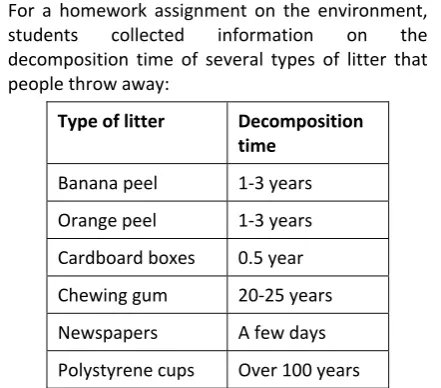
37. There is uncertainty in scientific predictions, poll results, weather forecasts, and economic models. There is variation in manufacturing processes, test scores, and survey findings, and chance is fundamental to many recreational activities enjoyed by individuals. The traditional curricular areas of probability and statistics provide formal means of describing, modelling, and interpreting a certain class of uncertainty phenomena, and for making inferences. In addition, knowledge of number and of aspects of algebra such as graphs and symbolic representation contribute to facility in engaging in problems in this content category. The released PISA item Litter (see Addendum 2) is categorised as dealing with Uncertainty and data. This item requires students to examine data presented in a table and explain why a bar graph is not suitable for displaying these data. The focus on the interpretation and presentation of data is an important aspect of the Uncertainty and data category.
38. Computer-based assessment gives students the opportunity to work with larger data sets and provides the computational power and data handling capacities they need to work with such sets. Students are given the opportunity to choose appropriate tools to manipulate, analyse, and represent data, and to sample from data populations. Linked representations allow students to examine and describe such data in different ways. The capacity to generate random outcomes, including numbers, enables probabilistic situations to be explored using simulations, such as the empirical likelihood of events and properties of samples.
Content Topics for Guiding the Assessment of Mathematical Literacy for 15-year-old Students
39. To effectively understand and solve contextualised problems involving Change and relationships, Space and shape, Quantity, and Uncertainty and data requires drawing upon a variety of mathematical concepts, procedures, facts, and tools at an appropriate level of depth and sophistication. As an assessment of mathematical literacy, PISA strives to assess the levels and types of mathematics that are appropriate for 15-year-old students on a trajectory to become constructive, engaged and reflective citizens able to make well-founded judgments and decisions. It is also the case that PISA, while not designed or intended to be a curriculum-driven assessment, strives to reflect the mathematics that students have likely had the opportunity to learn by the time they are 15 years of age.
40. With an eye toward developing an assessment that is both forward-thinking yet reflective of the mathematics that 15-year-old students have likely had the opportunity to learn, analyses were conducted of a sample of mathematics standards from eleven countries to determine both what is being taught to students in classrooms around the world and also what countries deem realistic and as important preparation for students as they approach entry into the workplace or admission into an institution of higher education. Based on commonalities identified in these analyses, coupled with the judgment of mathematics experts, content deemed appropriate for inclusion in the assessment of mathematical literacy
of 15-year-old students on PISA 2012 is described below.
41. The four content categories of Change and relationships, Space and shape, Quantity, and
Uncertainty and data serve as the foundation for identifying this range of content, yet there is not a one-to-one mapping of content topics to these categories. For example, proportional reasoning comes into play in such varied contexts as making measurement conversions, analysing linear relationships, calculating probabilities, and examining the lengths of sides in similar shapes. The content described below is intended to reflect the centrality of many of these concepts to all four content categories and reinforce the coherence of mathematics as a discipline. What follows is intended to be illustrative of the content topics included in PISA 2012, rather than an exhaustive listing:
Functions: The concept of function, emphasising but not limited to linear functions, their properties, and a variety of descriptions and representations of them. Commonly used representations are verbal, symbolic, tabular, and graphical.
Algebraic expressions: Verbal interpretation of and manipulation with algebraic expressions, involving numbers, symbols, arithmetic operations, powers and simple roots
Equations and inequalities: Linear and related equations and inequalities, simple second-degree equations, and analytic and non-analytic solution methods
Coordinate systems: Representation and description of data, position and relationships
Relationships within and among geometrical objects in two and three dimensions: Static relationships such as algebraic connections among elements of figures (e.g., the Pythagorean
Theorem as defining the relationship between the lengths of the sides of a right triangle), relative position, similarity and congruence, and dynamic relationships involving transformation and motion of objects, as well as correspondences between two- and three-dimensional objects
Measurement: Quantification of features of and among shapes and objects, such as angle measures, distance, length, perimeter, circumference, area, and volume
Numbers and units: Concepts, representations of numbers, and number systems, including properties of integer and rational numbers, relevant aspects of irrational numbers, as well as quantities and units referring to phenomena such as time, money, weight, temperature, distance, area, and volume, and derived quantities and their numerical description
Arithmetic operations: The nature and properties of these operations and related notational conventions
Percents, ratios, and proportions: Numerical description of relative magnitude and the application of proportions and proportional reasoning to solve problems
Counting principles: Simple combinations and permutations
Estimation: Purpose-driven approximation of quantities and numerical expressions, including significant digits and rounding
Data collection, representation, and interpretation: Nature, genesis, and collection of various types of data, and the different ways to represent and interpret them
Data variability and its description: Concepts such as variability, distribution, and central tendency of data sets, and ways to describe and interpret these in quantitative terms
Samples and sampling: Concepts of sampling and sampling from data populations, including simple inferences based on properties of samples
Chance and probability: Notion of random events, random variation and its representation, chance and frequency of events, and basic aspects of the concept of probability
Mathematical Processes and the Underlying Mathematical Capabilities
Mathematical processes
42. The definition of mathematical literacy refers to an individual’s capacity to formulate, employ, and
interpret mathematics, and this language provides a useful and meaningful structure for organising the mathematical processes that describe what individuals do to connect the context of a problem with the mathematics and thus solve the problem. The PISA 2012 mathematics survey will, for the first time, report results according to these mathematical processes, and this structure will provide useful and policy-relevant categories for reporting of results. The categories to be used for reporting are as follows:
• Formulating situations mathematically
• Employing mathematical concepts, facts, procedures, and reasoning
• Interpreting, applying and evaluating mathematical outcomes
43. It is important for both policy makers and those engaged more closely in the day-to-day education of students to know how effectively students are able to engage in each of these processes. The results of the PISA survey for the formulating process indicate how effectively students are able to recognise and identify opportunities to use mathematics in problem situations and then provide the necessary mathematical structure needed to formulate that contextualised problem into a mathematical form. The results of the PISA survey for the employing process indicate how well students are able to perform computations and manipulations and apply the concepts and facts they know to arrive at a mathematical solution to a problem formulated mathematically. The results of the PISA survey for the interpreting process indicate how effectively students are able to reflect upon mathematical solutions or conclusions, interpret them in the context of a real-world problem, and determine whether the results or conclusions are reasonable. Students’ facility at applying mathematics to problems and situations is dependent on skills inherent in all three of these processes, and an understanding of their effectiveness in each category can help inform both policy-level discussions and decisions being made closer to the classroom level.
Formulating situations mathematically
44. The word formulate in the mathematical literacy definition refers to individuals being able to recognise and identify opportunities to use mathematics and then provide mathematical structure to a problem presented in some contextualised form. In the process of formulating situations mathematically, individuals determine where they can extract the essential mathematics to analyse, set up, and solve the problem. They translate from a real-world setting to the domain of mathematics and provide the real-world problem with mathematical structure, representations, and specificity. They reason about and make sense of constraints and assumptions in the problem. Specifically, this process of formulating situations mathematically includes activities such as the following:
• Identifying the mathematical aspects of a problem situated in a real-world context and identifying the significant variables
• Recognising mathematical structure (including regularities, relationships, and patterns) in problems or situations
• Simplifying a situation or problem in order to make it amenable to mathematical analysis
• Identifying constraints and assumptions behind any mathematical modelling and simplifications gleaned from the context
• Representing a situation mathematically, using appropriate variables, symbols, diagrams, and standard models
• Representing a problem in a different way, including organising it according to mathematical concepts and making appropriate assumptions
• Understanding and explaining the relationships between the context-specific language of a problem and the symbolic and formal language needed to represent it mathematically
• Translating a problem into mathematical language or a representation, i.e., to a standard mathematical model
• Recognising aspects of a problem that correspond with known problems or mathematical concepts, facts, or procedures
• Using technology (such as a spreadsheet or the list facility on a graphing calculator) to portray a mathematical relationship inherent in a contextualised problem
45. The released PISA item Pizzas (see Addendum 2) calls most heavily on students’ abilities to formulate a situation mathematically. While it is indeed the case that students are also called upon to perform calculations as they solve the problem and make sense of the results of their calculations by identifying which pizza is the better value for the money, the real cognitive challenge of this item lies in being able to formulate a mathematical model that encapsulates the concept of value for money. The problem solver must recognise that because the pizzas have the same thickness but different diameters, the focus of the analysis can be on the area of the circular surface of the pizza. The relationship between amount of pizza and amount of money is then captured in the concept of value for money, modelled as cost per unit of area. Variations, such as area per unit cost, are also possible. The released PISA item Rock Concert (see Addendum 2) is another example of an item that relies most heavily on students’ abilities to formulate a situation mathematically, as it calls on students to make sense of the contextual information provided (e.g., field size and shape, the fact that the rock concert is full, and the fact that fans are standing) and translate that information into a useful mathematical form in order to estimate the number of people attending the concert.
Employing mathematical concepts, facts, procedures and reasoning
46. The word employ in the mathematical literacy definition refers to individuals being able to apply mathematical concepts, facts, procedures, and reasoning to solve mathematically-formulated problems to obtain mathematical conclusions. In the process of employing mathematical concepts, facts, procedures and reasoning to solve problems, individuals perform the mathematical procedures needed to derive results and find a mathematical solution (e.g., performing arithmetic computations, solving equations, making logical deductions from mathematical assumptions, performing symbolic manipulations, extracting mathematical information from tables and graphs, representing and manipulating shapes in space, and analysing data). They work on a model of the problem situation, establish regularities, identify connections between mathematical entities, and create mathematical arguments. Specifically, this process of employing mathematical concepts, facts, procedures, and reasoning includes activities such as:
• Devising and implementing strategies for finding mathematical solutions
• Using mathematical tools, including technology, to help find or approximate solutions
• Applying mathematical facts, rules, algorithms, and structures when finding solutions
• Manipulating numbers, graphical and statistical data and information, algebraic expressions and equations, and geometric representations
• Making mathematical diagrams, graphs, and constructions and extracting mathematical information from them
• Using and switching between different representations in the process of finding solutions
• Making generalisations based on the results of applying mathematical procedures to find solutions
• Reflecting on mathematical arguments and explaining and justifying mathematical results
47. The released PISA unit Walking (see Addendum 2) exemplifies items that rely most heavily on students’ abilities for employing mathematical concepts, facts, procedures, and reasoning. Both items in
this unit depend upon employing a given model—a formula—to determine either the pace length (Question 1) or walking speed (Question 2). Both questions have been expressed in terms that already have mathematical structure, and students are required to perform algebraic manipulations and calculations in order to derive solutions. Similarly, the released PISA item Carpenter (see Addendum 2) relies most heavily on students employing mathematical concepts, facts, procedures, and reasoning. The major cognitive challenge is to devise a strategy to find information about the total length of line segments of individually unknown length and to reason about the comparative lengths. Individuals also have to relate the diagrams to the gardens and the perimeters to the amount of timber available, but this process of formulating is considerably less demanding than the process of reasoning about the perimeter lengths. Interpreting, applying and evaluating mathematical outcomes
48. The word interpret used in the mathematical literacy definition focuses on the abilities of individuals to reflect upon mathematical solutions, results, or conclusions and interpret them in the context of real-life problems. This involves translating mathematical solutions or reasoning back into the context of a problem and determining whether the results are reasonable and make sense in the context of the problem. This mathematical process category encompasses both the “interpret” and “evaluate” arrows noted in the previously defined model of mathematical literacy in practice (see Figure 1). Individuals engaged in this process may be called upon to construct and communicate explanations and arguments in the context of the problem, reflecting on both the modelling process and its results. Specifically, this process of interpreting, applying, and evaluating mathematical outcomes includes activities such as:
• Interpreting a mathematical result back into the real world context
• Evaluating the reasonableness of a mathematical solution in the context of a real-world problem
• Understanding how the real world impacts the outcomes and calculations of a mathematical procedure or model in order to make contextual judgments about how the results should be adjusted or applied
• Explaining why a mathematical result or conclusion does, or does not, make sense given the context of a problem
• Understanding the extent and limits of mathematical concepts and mathematical solutions
• Critiquing and identifying the limits of the model used to solve a problem
49. The released PISA item Litter (see Addendum 2) is an item that calls most heavily on students’ capacity for interpreting, applying, and evaluating mathematical outcomes. The focus of this item is on evaluating the effectiveness of the mathematical outcome—in this case an imagined or sketched bar graph—in portraying the data presented in the item on the decomposition time of several types of litter. The item involves reasoning about the data presented, thinking mathematically about the relationship between the data and their presentation, and evaluating the result. The problem solver must recognise that these data would be difficult to present well in a bar graph and provide a reason why such a data display is unsuitable for displaying the provided data.
Fundamental Mathematical Capabilities Underlying the Mathematical Processes
50. A decade of experience in developing PISA items and analysing the ways in which students respond to items has revealed that there is a set of fundamental mathematical capabilities that underpins each of these reported processes —and that also underpins mathematical literacy in practice. The work of
Mogens Niss and his Danish colleagues (Niss, 2003 and Niss & Jensen, 2002) identified eight capabilities — referred to as “competencies” by Niss and in the 2003 framework —that are instrumental to mathematical behaviour. The PISA 2012 framework uses a modified formulation of this set of capabilities, which condenses the number from eight to seven based on the MEG’s investigation of the operation of the competencies through previously administered PISA items (Turner, 2011). There is wide recognition of the need to identify such a set of general mathematical capabilities, to complement the role of specific mathematical content knowledge in mathematics learning. Prominent examples include the eight mathematical practices of the Common Core State Standards in the USA, the four key processes (representing, analysing, interpreting and evaluating, and communicating and reflecting) of the UK’s Mathematics National Curriculum, and the process standards in the NCTM Principles and Standards for School Mathematics. These cognitive capabilities are available to or learnable by individuals in order to understand and engage with the world in a mathematical way, or to solve problems. As the level of
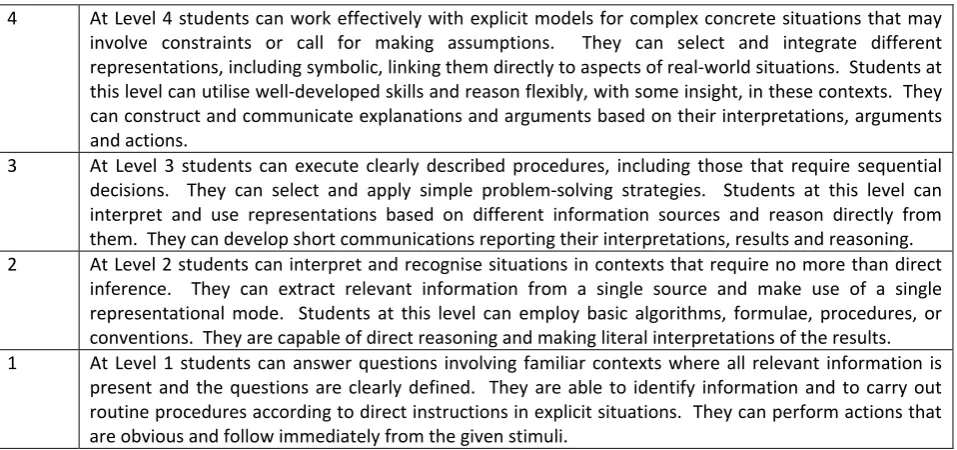
mathematical literacy possessed by an individual increases, that individual is able to draw to an increasing degree on the fundamental mathematical capabilities (Watson and Callingham, 2003). Thus, increasing activation of the fundamental mathematical capabilities is associated with increasing item difficulty. This observation has been used as the basis of the descriptions of different proficiency levels of mathematical literacy reported in previous PISA surveys and discussed later in this framework.
51. The seven fundamental mathematical capabilities used in this framework are as follows:
• Communication: Mathematical literacy involves communication. The individual perceives the
existence of some challenge and is stimulated to recognise and understand a problem situation. Reading, decoding and interpreting statements, questions, tasks or objects enables the individual to form a mental model of the situation, which is an important step in understanding, clarifying and formulating a problem. During the solution process, intermediate results may need to be summarised and presented. Later on, once a solution has been found, the problem solver may need to present the solution, and perhaps an explanation or justification, to others.
• Mathematising: Mathematical literacy can involve transforming a problem defined in the real
world to a strictly mathematical form (which can include structuring, conceptualising, making assumptions, and/or formulating a model), or interpreting or evaluating a mathematical outcome or a mathematical model in relation to the original problem. The term mathematising is used to describe the fundamental mathematical activities involved.
• Representation: Mathematical literacy very frequently involves representations of mathematical
objects and situations. This can entail selecting, interpreting, translating between, and using a variety of representations to capture a situation, interact with a problem, or to present one’s work. The representations referred to include graphs, tables, diagrams, pictures, equations, formulae, textual descriptions, and concrete materials.
• Reasoning and argument: A mathematical ability that is called on throughout the different stages
and activities associated with mathematical literacy is referred to as Reasoning and argument. This capability involves logically rooted thought processes that explore and link problem elements so as to make inferences from them, check a justification that is given, or provide a justification of statements or solutions to problems.
• Devising strategies for solving problems: Mathematical literacy frequently requires Devising
strategies for solving problems mathematically. This involves a set of critical control processes that guide an individual to effectively recognise, formulate and solve problems. This skill is characterised as selecting or devising a plan or strategy to use mathematics to solve problems
arising from a task or context, as well as guiding its implementation. This mathematical capability can be demanded at any of the stages of the problem solving process.
• Using symbolic, formal and technical language and operations: Mathematical literacy requires
Using symbolic, formal and technical language and operations. This involves understanding, interpreting, manipulating, and making use of symbolic expressions within a mathematical context (including arithmetic expressions and operations) governed by mathematical conventions and rules. It also involves understanding and utilising formal constructs based on definitions, rules and formal systems and also using algorithms with these entities. The symbols, rules and systems used will vary according to what particular mathematical content knowledge is needed for a specific task to formulate, solve or interpret the mathematics.
• Using mathematical tools: The final mathematical capability that underpins mathematical literacy
in practice is Using mathematical tools. Mathematical tools encompass physical tools such as measuring instruments, as well as calculators and computer-based tools that are becoming more widely available. This ability involves knowing about and being able to make use of various tools that may assist mathematical activity, and knowing about the limitations of such tools. Mathematical tools can also have an important role in communicating results. Previously it has been possible to include the use of tools in paper-based PISA surveys in only a very minor way. The optional computer-based component of the PISA 2012 mathematics assessment will provide more opportunities for students to use mathematical tools and to include observations about the way tools are used as part of the assessment.
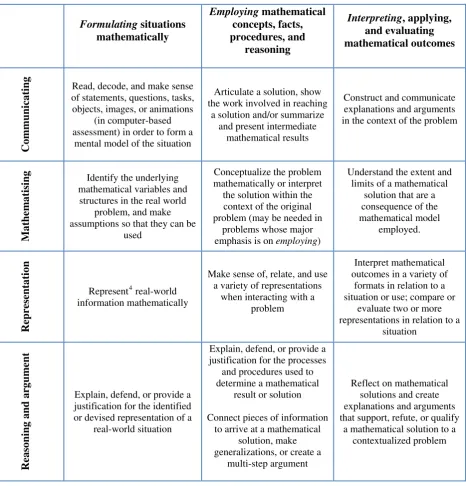
These capabilities are evident to varying degrees in each of the three mathematical processes to be used for reporting purposes. The ways in which these capabilities manifest themselves within the three processes are described in Figure 2 below. More detail on these capabilities, particularly as they relate to item difficulty, can be found in Addendum 1. In addition, each of the illustrative examples provided in Addendum 2 describes how the capabilities might be activated by students solving that particular problem.
Figure 2. Relationship between mathematical processes (top horizontal row) and fundamental mathematical assessment) in order to form a
mental model of the situation in the context of the problem
Mathem assumptions so that they can be
used
Make sense of, relate, and use a variety of representations
Representations include graphs, tables, diagrams, equations, formulas, textual descriptions and concrete materials.
Formulating situations
Select or devise a plan or strategy to mathematically
Using symbolic, formal and technical language
and operations
Use mathematical tools5 in order to recognize
52. An important aspect of mathematical literacy is that mathematics is engaged in solving a problem set in a context. The context is the aspect of an individual’s world in which the problems are placed. The choice of appropriate mathematical strategies and representations is often dependent on the context in which a problem arises. For the PISA survey, it is important that a wide variety of contexts are used. This offers the possibility of connecting with the broadest possible range of individual interests and with the range of situations in which individuals operate in the 21st century.
53. For purposes of the PISA 2012 mathematics framework, four context categories have been defined and are used to classify assessment items developed for the PISA survey:
• Personal – Problems classified in the personal context category focus on activities of one’s self, one’s family or one’s peer group. The kinds of contexts that may be considered personal include (but are not limited to) those involving food preparation, shopping, games, personal health,
5
Mathematical tools encompass physical tools such as measuring instruments, as well as calculators and computer-based tools.
personal transportation, sports, travel, and personal scheduling and personal finance. The released PISA item Pizzas (see Addendum 2) is set in a personal context since the question posed by the item is which pizza provides the purchaser with the better value for the money. Similarly, the released PISA unit Walking (see Addendum 2) contains two items that reflect a personal context. The first item involves applying a mathematical formula to determination of an individual’s pace length, while the second item involves application of the same formula to determination of another individual’s walking speed.
• Occupational – Problems classified in the occupational context category are centred on the world of work. Items categorised as occupational may involve (but are not limited to) such things as measuring, costing and ordering materials for building, payroll/accounting, quality control, scheduling/inventory, design/architecture, and job-related decision making. Occupational contexts may relate to any level of the workforce, from unskilled work to the highest levels of professional work, although items in the PISA survey must be accessible to 15-year-old students. The released PISA item Carpenter (see Addendum 2) is categorised as occupational as it deals with a work task of a carpenter to construct a border around a garden bed. An item requiring similar mathematical analysis to the Pizza item discussed earlier, which presented the situation from the point of view of the pizza seller instead of the purchaser, would be placed in the occupational category.
• Societal – Problems classified in the societal context category focus on one’s community (whether local, national or global). They may involve (but are not limited to) such things as voting systems, public transport, government, public policies, demographics, advertising, national statistics and economics. Although individuals are involved in all of these things in a personal way, in the societal context category the focus of problems is on the community perspective. The released PISA item Rock Concert (see Addendum 2) is an example of an item categorised as societal since it is set at the level of the rock concert organisation, even though it draws on the personal experience of being in crowds.
• Scientific – Problems classified in the scientific category relate to the application of mathematics to the natural world and issues and topics related to science and technology. Particular contexts might include (but are not limited to) such areas as weather or climate, ecology, medicine, space science, genetics, measurement, and the world of mathematics itself. The released PISA item Litter (see Addendum 2) is an example of an item set in a scientific context, since its focus is related to scientific issues pertaining to the environment, and specifically to data on decomposition time. Items that are intramathematical, where all the elements involved belong in the world of mathematics, fall within the scientific context.
54. PISA assessment items are arranged in units that share stimulus material. It is therefore usually the case that all items in the same unit belong to the same context category. Exceptions do arise; for example stimulus material may be examined from a personal point of view in one item and a societal point of view in another. When an item involves only mathematical constructs without reference to the contextual elements of the unit within which it is located, it will be allocated to the context category of the unit. In the unusual case of a unit involving only mathematical constructs and being without reference to any context outside of mathematics, the unit will be assigned to the scientific context category.
55. Using these context categories provides the basis for selecting a mix of item contexts and ensures that the assessment reflects a broad range of uses of mathematics, ranging from everyday personal uses to the scientific demands of global problems. Moreover it is important that each context category be populated with assessment items having a broad range of item difficulties. Given that the major purpose of these context categories is to challenge students in a broad range of problem contexts, each category should