Inheritance of Kernel Color in Corn:
Explanations & Investigations
Rosemary H. Ford
V
ARIATIONS in the color of corn kernels (Zeamays L.) have attracted geneticists since the early 1900s when studies on the inheritance patterns of kernel color helped validate classical genetics. Even now, research scientists investigate the molecular genetics of these characteristics, and students in introductory biology and genetics courses learn more about monohybrid and dihybrid crosses by studying the inheritance of kernel colors. The reasons for introducing corn genetics in the classroom are obvious—a single ear holds a large number of progeny and a variety of ears are available that represent basic inheritance patterns, such as the monohybrid cross (3:1), the dihybrid cross (9:3:3:1), and more complex genetic patterns illustrating gene interactions (12:3:1; 9:3:4, 13:3; 9:7, etc.). In addition, these ears are obtained readily from several biological supply houses and are relatively inexpensive, espe-cially since students can use them for several years. Students usually confirm different phenotypic ratios of the F2 generation by first counting kernels,
then performing chi-square analyses to test their data. However, their experience can be enriched by introducing explanations about the nature of each gene and its mutations, the related metabolic path-ways, and their locations within the kernel. I have included information in this review that would be appropriate at different levels—from high school biol-ogy to introductory genetics at the college level. The purpose is the same. By exploring these areas, stu-dents more fully understand how these simple pheno-typic ratios and variations are derived.
Four Kernel Colors, Four Genes
Three of the four kernel colors—yellow, red and purple—are produced by pigments synthesized from one of two metabolic pathways, the carotenoid (yel-low pigments) or the anthocyanin (red and purple pigments) pathway. White, the fourth color, results from the lack of pigments produced from either pathway. The synthesis of each pigment requires
Rosemary H. Fordis Associate Professor of Biology at Wash-ington College, Chestertown, MD 21620.
numerous genes, including those that are structural (coding for enzymes) and regulatory (called transcrip-tion activators and coding for proteins that control the transcription of structural genes). The four genes,
Pr1, C1, R1 and Y1, described in this paper include both types (Table 1). Having been described in 1901,
Y1was one of the first maize color genes documented in the literature; the other three, all relating to the anthocyanin pathway, were described later in 1911 (see Coe et al. 1988 for review). At that time the role of each gene was unknown.
Although these genes are commonly called ‘‘color genes,’’ the names used by maize geneticists, as included in the Maize Genome Database, are more descriptive. For example, Red Aleurone1 (Pr1) describes the kernel color associated with the reces-sive phenotype and identifies a specific structure of the seed involved in its expression, the aleurone. This structural gene codes for the protein flavonoid 3’-hydroxylase, an enzyme that is responsible for the purple color produced in the anthocyanin pathway. Another gene, White1 or (Y1), is another structural gene whose name also describes its recessive pheno-type. It codes for phytoene synthetase, an enzyme in the carotenoid pathway. Although the names of the other two genes, Colored Aleurone1 (C1) and Colored1 (R1), are similar, their names and symbols are different. Both encode transcription activators that interact to influence the regulation of several structural genes within the anthocyanin pathway.
Table 1. Summary of the four genes,Pr1,R1,C1andY1, influencing kernel color.
Biological Supply1 Maize Database2
Biochemical Metabolic Chromosomal
Gene Name Symbol Gene Name Symbol Phenotype Pathway Protein Role Protein Name Location3
Color gene Pr Red Pr1 Purple aleurone4 Anthocyanin Structural Flavonoid 3’- 5L
pr Aleurone1 pr1 Red aleurone hydroxylase
Color gene R Colored1 R1 (R-r) Colored aleurone4 Anthocyanin Regulatory Transcription factor 10L
r r1 (r-r) Colorless aleurone5
Color gene CI Colored C1-I Colorless aleurone5 Anthocyanin Regulatory Transcription factor 9S
C Aleurone1 C1 Colored aleurone4
c c1 Colorless aleurone5
Color gene Y White1 Y1 Yellow endosperm6 Carotenoid Structural Phytoene synthetase 6L
y y1 White endosperm6
1Carolina Biological Supply.
2The Maize Genome Database Project. 3Chromosome arm designations: S
⳱short arm; L⳱long arm.
4Kernel color depends on the genetic background or the sum total of all genes affecting the anthocyanin pathway (e.gR1,
C1andPr).
5Kernel color depends on the color of starchy endosperm (white or yellow). 6Yellow and white kernels have a colorless aleurone.
Kernel Structure, Gene Dosage &
Imprinting
Although the embryo and endosperm represent the same generation within the kernel, it is the color of the endosperm rather than the embryo that is usually described (Figure 1). This is because the embryo is small—about 15% of the kernel weight (Poethig 1982), located on the broad side of the kernel, and is, therefore, not easily seen without removing the kernels from the cob. Within the endo-sperm the carotenoids and anthocyanins are synthe-sized in different regions. The carotenoids are pro-duced in the starchy endosperm, the inner region of the endosperm, while anthocyanins are found only in the aleurone, the outermost layer surrounding the starchy endosperm. Because anthocyanins produce
Figure 1. Kernel structure.
an intense color in the aleurone, the yellow or white colors of the starchy endosperm are seen only when the aleurone layer is colorless.
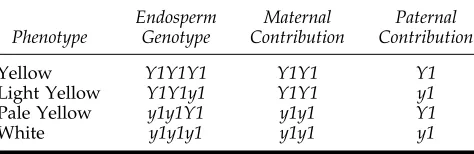
The endosperm and the embryo have different genetic compositions—the embryo is diploid and the endosperm is triploid. This difference results from fusion of the two polar nuclei in the embryo sac (female gametophyte) and one sperm nucleus from the pollen (male gametophyte). Therefore, in the heterozygote, the endosperm has one of two geno-types—either two dominant or two recessive alleles— depending on the allele contributed by the maternal parent (Table 2). These genetic dissimilarities may result in phenotypic differences. For example, in the monohybrid cross for Y1, the endosperm can be one of four possible genotypes that produce variation the intensity of yellow (Simcox et al. 1987). These color differences correspond to the amount of carotene in the endosperm and reflect the concentration of phytoene synthetase within this tissue. This phenome-non of equating gene product with the number of alleles in the cells is called the gene dosage effect. Of the four genes discussed in this review, only Y1
exhibits the effect of gene dosage.
Another variation observed in kernel coloration of heterozygotes is purple mottling; that is, the seeds
Table 2. Phenotype and gene dosage ofY1in the starchy endosperm.
Endosperm Maternal Paternal Phenotype Genotype Contribution Contribution
Yellow Y1Y1Y1 Y1Y1 Y1
Light Yellow Y1Y1y1 Y1Y1 y1
Pale Yellow y1y1Y1 y1y1 Y1
exhibit an irregular distribution of seed pigmentation. The mottled kernels are r1r1R1; whereas kernels for the other hybrid,R1R1r1, are solid. Further investiga-tions using the genotypes R1R1r1r1 and r1r1R1R1, ones with the same gene dosage but with the alleles originating from opposite parents, did not produce similar phenotypes, suggesting that mottling is associ-ated when the recessive allele comes from the mater-nal parent. In this case the matermater-nal allele acts as a dominant allele; hence, the kernels are mottled. Imprinting, as this phenomenon is called, describes a difference in the activity of a gene based on its parental origin (Kermicle 1978). It is attributed to the loss of the activity of a gene from a parent because of methylation of the bases, and thus a gene is changed from an active state to an inactive state (Lewin 1997).
Classical Inheritance Patterns, Kernel
Color & Epistasis
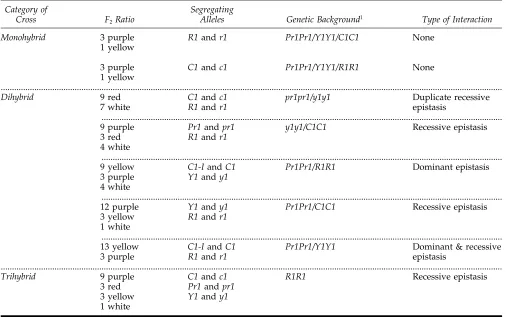
In the classroom a discussion of monohybrid cross—purple and yellow kernels—provides an intro-duction to explain the influence of genetic background on phenotype (Table 3). For example, the phenotypic ratio of 3 purple: 1 yellow for the segregation of R1
Table 3. Phenotypic ratios of eight crosses illustrating inheritance of kernel color in corn including the genetic background and type of interaction.
Category of Segregating
Cross F2Ratio Alleles Genetic Background1 Type of Interaction
Monohybrid 3 purple R1andr1 Pr1Pr1/Y1Y1/C1C1 None
1 yellow
3 purple C1andc1 Pr1Pr1/Y1Y1/R1R1 None 1 yellow
...
Dihybrid 9 red C1andc1 pr1pr1/y1y1 Duplicate recessive
7 white R1andr1 epistasis
... 9 purple Pr1andpr1 y1y1/C1C1 Recessive epistasis 3 red R1andr1
4 white
... 9 yellow C1-IandC1 Pr1Pr1/R1R1 Dominant epistasis 3 purple Y1andy1
4 white
... 12 purple Y1andy1 Pr1Pr1/C1C1 Recessive epistasis 3 yellow R1andr1
1 white
... 13 yellow C1-IandC1 Pr1Pr1/Y1Y1 Dominant & recessive
3 purple R1andr1 epistasis
...
Trihybrid 9 purple C1andc1 R1R1 Recessive epistasis
3 red Pr1andpr1
3 yellow Y1andy1
1 white
1The genetic background includes other genes that influence the phenotypic ratio.
depends on the presence ofPr1,C1andY1in addition to R1. Since the kernels are homozygous for the dominant alleles for the other two genes (Pr1 and
C1) in the anthocyanin pathway, the purple pigment is synthesized only when R1 is present. Otherwise, the aleurone is colorless and the starchy endosperm’s yellow pigment, which is present in all kernels includ-ing the purple ones, is observed. Since the yellow endosperm is present whether or not the anthocyanin is produced, the phenotypic ratio for this cross is expressed more precisely as 3 colored: 1 noncol-ored aleurone.
Epistasis in these examples can be attributed to the blocking of the biochemical pathway for a particular pigment because enzymes critical to the pathway are either missing or nonfunctional.
Each allele can be assigned a mechanism of action for its epistasis effect, either dominant or recessive. The two mutant alleles of C1 (C1-I and c1) exhibit different types of epistasis yet produce the same phenotype (colorless aleurone). The C1-I allele, illus-trating dominant epistasis, is dominant toC1because the C1-I mutant protein competes with the C1 wild-type protein for the regulatory sites of structural genes associated with the pathway, thereby blocking synthesis of the corresponding enzymes required for pigment production synthesis (Paz-Ares et al. 1990). In contrast, the gene (c1) corresponding to recessive epistasis is not transcribed (Scheffler et al. 1994), and in heterozygotes (C1c1), one copy of the wildtype gene is sufficient for producing enough regulatory protein to produce the purple color.
Anthocyanin Structure, Synthesis & Roles
of Pr
,
C1
&
R1
Anthocyanins are phenolic compounds having a common structural unit of the flavone C15 skeleton (Figure 2). These water-soluble pigments accumulate in the vacuoles of aleurone cells late during develop-ment of the kernel after abscisic acid, a plant hormone, activates this biosynthetic pathway. Many genes and their associated proteins required for synthesis of these pigments are well understood (see Figure 3 for a simplified pathway). Besides the three genes described in this paper, more than 20 genes, which comprise the genetic background and include struc-tural and regulatory ones, must be present in at least one dose of the dominant allele for synthesis of these pigments (Coe et al. 1988).
Pr1:Red Aleurone1
The Pr1 allele encodes the enzyme, flavonoid 3’-hydroxylase, which is required for production of cyanidin-glycoside, the purple pigment (Donner et al. 1991). This enzyme functions early in the flavonoid pathway by adding a hydroxyl group to the ring structure. When this enzyme is absent (i.e. in the presence of thepr1allele), the red pigment, pelargoni-din-glycoside, is produced. One copy of the Pr1
allele is sufficient to produce purple kernels, thus heterozygotes (e.g.Pr1Pr1pr1orpr1pr1Pr1) are purple. At this time the mutation within the pr1allele is not known. However, it is a common marker for maize geneticists and often used in tester stocks, ones that are used to analyze mutations, including deletions and transpositions.
C1:Colored Aleurone1
Unlike Pr1 that is active in tissues of the plant other than the seed, C1 is restricted to the kernel.
C1, a member of the C1/P1 family of genes, codes for a nuclear transcriptional activator that, along with the gene product of R1, regulates structural genes in the anthocyanin pathway (Styles & Ceska 1977). Of the three control points within the anthocyanin pathway, one occurs in a gene required at the begin-ning of the pathway and two are for genes whose enzymes occur near the end of the pathway, thus insuring no anthocyanins are produced. To initiate transcription of the target genes, the C1 protein together withR1protein bind to the promoter region of target genes allowing transcription to occur.
Both the promoter and coding regions of the C1
locus are well characterized (Figure 4). It encodes a protein, 273 amino acids in length, having regions that are homologous to the DNA-binding domains found in many transcriptional regulatory proteins (Paz-Ares et al. 1990).
The allele, C1-I, has two mutations—one in the promoter region that increases the rate of transcrip-tion and a second in the coding sequence that pro-duces a site for premature termination of translation that produces the shorter polypeptide. The faulty protein is 252 amino acids in length and is present in the cells at a higher concentration than that of the wildtype protein; thus the allele is dominant. The mutant protein is believed to bind to the DNA but lacks the region to bind to the RNA polymerase. With thec1allele, no protein is produced because of a mutation within the promoter region that prevents transcription.
R1:Colored1
Like C1, R1 belongs to a small multigene family of genes (R1/B1) producing similar proteins that are tissue-specific activators of transcription. The locus for
R1 is compound, consisting of two similar functional sequences positioned in an inverted head-to-head orientation with a common promoter (Figure 5) (Walker et al. 1995). The loss of seed color associated with the recessive allele has been attributed to a deletion in this shared promoter region, thereby blocking transcription from both coding regions.
Carotenes, Pathway of Synthesis & Role
of Y1
Figure 2. Structure of pigments. Pelargonium and cyanidin are the red and purple glycosylated anthocyanins found in the aleurone layer of the endosperm. B-carotene, a major carotenoid, is synthesized in the starchy endosperm.
and functioning, in part, as the precursor for the synthesis of abscisic acid.
The carotenoid biosynthetic pathway begins in the cytoplasm with the formation of 6-carbon precursors from three molecules of acetyl-Coenzyme A, interme-diates in the respiratory breakdown of carbohydrate and fatty acid metabolism. These precursors are trans-ported into chromoplasts, where, through successive condensations, carotenes and xanthophylls are syn-thesized (see Figure 6 for a simplified pathway).
Y:1Yellow1
Kernels with white endosperms(y1y1y1) lack phy-toene synthase, an enzyme required early in the biosynthetic pathway for the synthesis of phytoene. The precursors that accumulate in these kernels are colorless, so the endosperms appear white. Surpris-ingly, the embryo is still yellow, having the same carotenoid content as in kernels having a dominant
Y1, and the photosynthetic regions of the plant also produce carotenes and xanthophylls, accessory pig-ments that prevent the photooxidation of chlorophyll. This difference in pigment production within the kernel suggests that y1is developmentally regulated or that tissue-specific isozymes of Y1 are present (Buckner et al. 1996). The mutation of y1 in the promoter region blocks transcription; hence, no enzyme is present in the endosperm tissue.
Suggested Projects: Lab Exercises &
Questions for Critical Thinking
Figure 3. Simplified pathway for synthesis of anthocyanin.
Figure 4. The three alleles of theC1gene locus:C1, C1-Iandc1.
Figure 5. CompoundR1locus.
hands-on projects (A, B, C and D); one is a ‘‘thinking’’ project in which students work in small groups to propose solutions to the questions (E).
A. Masking of the starchy endosperm by the aleurone.
This is a simple experiment to illustrate epistasis attributed to the colored aleurone masking the starchy endosperm. Colorful ears of corn, known as Indian corn, are available at minimal cost from grocery stores and other stores during the fall. These kernels can be dissected to observe the difference in color of the aleurone and the starchy endosperm. The following procedure can be used to dissect these kernels:
colored layer of the starchy endosperm is revealed once the aleurone is removed. The starchy endosperm remains solid and hard dur-ing this short hydration period.
B. Predicting phenotypes and genotypes for specific crosses.
Students are provided with the phenotypes and genotypes of the parental generation and are asked to predict the phenotypes and genotypes of the F1
and F2 generations. Students must understand the
concepts of dominant and recessive epistasis to accu-rately predict the outcomes. Examples of parental crosses might include:
1. Yellow (Pr1Pr1/Y1Y1/r1r1/C1C1) x Purple (Pr1Pr1/Y1Y1/R1R1/C1C1) 2. Yellow (Pr1Pr1/Y1Y1/R1R1/C1-IC1-I) x
Purple (Pr1Pr1/y1y1/R1R1/C1C1) 3. Yellow (Pr1Pr1/Y1Y1/r1r1/C1C1) x
Yellow (Pr1Pr1/Y1Y1/R1R1/c1c1) 4. Yellow (Pr1Pr1/Y1Y1/R1R1/C1-IC1-I) x
Yellow (Pr1Pr1/Y1Y1/r1r1/C1C1)
C. Calculating and interpreting chi-square analyses for ears of corn exhibiting gene interactions.
Students perform chi-square analyses on ears illus-trating gene interactions, then explain these variations based on the 9:3:3:1 ratios expected from dihybrid crosses demonstrating no gene interactions. Students are given ears with known genes that are segregating
Figure 6. Simplified pathway for synthesis of carotenoids.
and represent gene interaction. The following proce-dures can be used in class:
1. Categorize kernels on a single cob by placing them in phenotypic classes, then formulate a hypothesis (9:3:4; 13:3; 9:7, etc.) to predict the inheritance pattern observed.
2. Perform the chi-square analysis to test the hypotheses.
3. Explain the gene interaction occurring in each cross using information such as molecular genet-ics, biochemistry and kernel anatomy.
D. Researching the color genes using online gene banks.
Students are asked to write reports on the color genes from information obtained from the online gene banks for maize (http://www.agron.missouri.edu).
E. Constructing hypothetical evolutionary events for the C1 and R1 genes.
Students are asked to construct a model that explains the events which may have occurred in the evolution of the C1 and R1 genes in corn given the following information:
1. Purple kernels are common in many domestic varieties of corn but unknown in the wild ances-tor of maize, teosinte. Yet teosinte carries the dominant alleles for the structural genes for the anthocyanin synthesis (Hanson et al. 1996). Speculate how these regulatory genes evolved to be tissue specific and include production of anthocyanin in the kernel.
Hanson et al. (1996) suggest that the evolution of purple kernels resulted from changes in the regulatory elements ofC1so that these transcription factors are produced in the late developmental stage of kernels.
2. In addition to the duplicate loci ofR1on chromo-some 10, three others that are similar are located close by. Speculate how these very similar loci evolved.
Walker et al. (1995) suggest that the family of
R1-like genes on chromosome 10 evolved from an ancestor gene by duplication from unequal crossing over from a synapsis that was not perfectly aligned.
Gene duplications in maize that involve large chromosomal segments are common. The nature of these duplications may be attributed to a hybrid-ization occurring between two species resulting in the ancestor of corn: each ancestor donating one
R1/B1family and oneC1/P1family of genes (Helen-tjaris et al. 1988).
References
Bartley, G.E. & Scolnik, P.A. (1994). Molecular biology of carotenoid biosynthesis in plants.Annual Review of Plant Physiology and Plant Molecular Biology, 45,287–301. Buckner, B., San Miguel, P., Janick-Buckner, D. & Bennetzen,
J.L. (1996). The y1 gene of maize codes for phytoene synthase. Genetics, 143, 479–488.
Coe, E.H., Neuffer, M.G. & Hoisington, D.A. (1988). In G.F. Sprague & J.W. Dudley (Eds.),Corn and Corn Improve-ment (pp. 81–258). Madison, WI: American Society of Agronomy.
Donner, H.K., Robbins, T.P. & Jorgensen. R.A. (1991). Genetic and developmental control of anthocyanin bio-synthesis. Annual Review of Genetics, 25, 173–199. Hanson, M., Gaut, B.S., Stec, A.O., Fuerstenberg, S.I.,
Good-man, M.M., Coe, E.H. & Doebley, J.F. (1996). Evolution of anthocyanin biosynthesis in maize kernels: The role of regulatory and enzymatic loci.Genetics, 143,1395–1407. Helentjaris, T., Weber., D. & Wright, S. (1988). Identification of the genomic locations of duplicate nucleotide sequences
NATIONAL ANTI-VIVISECTION here
in maize by analysis of restriction fragment length poly-morphisms. Genetics, 118, 353–363.
Kermicle, J.L. (1978). Imprinting of gene action in maize endosperm. In D.B. Walden (Ed.)., Maize Breeding and Genetics(pp. 357–371). New York: John Wiley and Sons Lewin, B. (1997). Genes VI, pp. 878–880. Oxford: Oxford
University Press.
Maize DB: A Maize Genome Database. Online. Internet. Available: http://www.agron.missouri.edu.
Paz-Ares, J., Ghosal, D. & Saedler, H. (1990). Molecular analysis of the C1-I allele from Zea mays: A dominant mutant of the regulatory C1 locus. The EMBO Journal, 9, 315–321.
Poethig, R.S. (1982). Maize—The plant and its parts. In W.F. Sheridan (Ed.), Maize for Biological Research. Grand Forks, ND: University Press.
Scheffler, B., Franken, P., Schu¨tt, E., Schrell, A., Saedler, H. & Wienand, U. (1994). Molecular analysis ofC1alleles in Zea mays defines regions involved in the expression of this regulatory gene. Molecular and General Genetics, 242,40–48.
Simcox, K.D., Shadley, J.D. & Weber, D.F. (1987). Detection of the time of occurrence of nondisjunction induced by the r-x1 deficiency in Zea mays L. Genome 29, 782–785. Styles, E.D. & Ceska, O. (1977). The genetic control of flavonoid synthesis in maize.Canadian Journal of Genetics and Cytology, 19, 289–302.