A THESIS
Presented as Partial Fulfillment of the Requirements
for the Attainment of a Sarjana Sastra Degree in English Literature
Egie Danarko
(11211144023)
ENGLISH LITERATURE STUDY PROGRAM
ENGLISH EDUCATION DEPARTMENT
FACULTY OF LANGUAGES AND ARTS
YOGYAKARTA STATE UNIVERSITY
v
vi
- “Only through the hottest fires can purification be achieved, only through the harshest tests God’s chosen will rise.”
Anthony Doerr
vii
this research. A deep and sincere gratitude is also given to these individuals whose presence always there during my ups and downs in conducting the research;
1. Dr. Widyastuti Purbani, M. A. and Nandy Intan Kurnia, M, Hum. for their continuous supports, patience, cares and evaluations that let the completion of this research possible,
2. my father Pak Koesbani and my mother Bu Surip for everything, 3. my best friends Jeje, Adit, and all my classmates for the lively years,
4. my teammates and family in English Debating Society YSU for the joy and pain to survive in debating tournaments and learning together,
5. my seniors and friends both in International Office and Partnership YSU as well as Self Access Learning Access Center YSU for the lessons and togetherness during my work as a volunteer.
Finally, this research is open to flaws. Thus, any criticisms are welcomed and appreciated as knowledge is good accompanied by critics.
Yogyakarta, March 23rd 2017
viii
RATIFICATION ... iii
PERNYATAAN ... iv
DEDICATION ... v
MOTTO ... vi
ACKNOWLEDGEMENTS ... vii
TABLE OF CONTENTS ... viii
LIST OF FIGURES ... xi
LIST OF TABLES ... xii
ABSTRACT ... xiii
CHAPTER I INTRODUCTION A. Background of the Study ... 1
B. Research Focus ... 8
C. Research Questions ... 10
D. Research Objectives ... 11
E. The Significance of the Study ... 12
CHAPTER II LITERATURE REVIEW A. Narratology ... 13
ix
a. Representation of Gender ... 25
b. Oppression towards Women ... 26
2. War ... 28
a. The Constructed War Concept ... 28
b. The Dead of Heroine ... 31
C. American Literature and War ... 32
D. Previous Research Findings ... 34
E. Analytical Construct ... 36
CHAPTER III RESEARCH METHOD A. Research Approach ... 37
B. Sources and Type of Data ... 38
C. Data Collection ... 39
D. Research Instrument ... 43
E. Data Analysis ... 44
F. Data Trustworthiness ... 45
CHAPTER IV FINDINGS AND DISCUSSION A. The Narrations of Female Subordination ... 50
x
B. The Narrations of Male Domination ... 77
1. Power ... 78
2. Bravery ... 82
3. Rationality and Intellectuality ... 86
4. Heroism ... 91
C. The Framework of Binary Gender Construction Attained from the Gender Narratives in Anthony Doerr’s All the Light We Cannot See ... 97
CHAPTER V CONCLUSION ... 100
REFERENCES ... 102
xi
xiii 11211144023
ABSTRACT
This research is aimed to prove and explain how (1) female subordination and (2) male domination in Anthony Doerr’s All the Light We Cannot See are narrated by identifying the novel’s gender narratives. The theory of poststructuralist narratology and feminist criticism on gender and war are employed to analyze the problem.
It is a qualitative research. It employed textual analysis which focused on the narrative of the text. The main source of data was Doerr’s All the Light We Cannot See. The data were in the forms of words, phrases, clauses, sentences, and paragraphs depicting or implying gender narratives. The researcher used five steps in analyzing the data. The data were gathered from reading and re-reading the text, identifying those which embody gender narratives, categorizing them based on the research’s objectives, comparing them to the analytical constructs, and lastly interpreting them by using feminist narratology. The researcher used triangulation and peer debriefing to obtain trustworthiness.
The results show that female subordination and male domination are found in the narratives of gender. Females are narrated as figures embodying vulnerability, fear, irrationality, emotional instability and submissive characteristic. Meanwhile, males are narrated as figures embodying power, bravery, rationality, intellectuality and heroic behavior. Those qualities embody the polarized gender narratives of men and women that endorse a patriarchal order and hierarchy. Females are seen as inferiors from the beginning of their gender creation. The construction of this dualistic gender shows the binary thought of patriarchal society. These findings conclude that gender subordination is embedded in the novel.
CHAPTER I INTRODUCTION
A. BACKGROUND OF THE STUDY
Most people yearn a fair world to live. Yet, the world is far from being fair. The reality does not give people fairness for free. People have to fight for their causes to find justices. The world is surely unkind and unjust. For millennia, stories of quarrelling interests have defined the world. The result is history has summarized itself as a series of conflicts; a series of war. Conflicts have been living as old as human’s civilization from ancient times to today. Ones need to struggle to keep
surviving. Consequently, a game of survival that runs under the nature’s law has emerged. That is how, at least, the world has been narrated. To live means to fight, question, and accept the reality.
narrations from both oral and textual often times culminate into the creation of social norms and values. The problem is the narrations about the less dominant sex are almost far from being fair. Most of the narrations have marginalized them to be the second sex. For centuries, oppression to this sex occurs and the tales go on.
Females are these less dominant sexes that are going to be discussed in this research. Their lives are bounded to the story of “women”. These sexes have to endure the unfair narrations addressed to them. Stories are no longer stories, but they turn into myths embedded in people’s heads. Honor killing in Pakistan is an example of long lasted marginalization (evolved into violence) towards them inspired by irresponsible narratives. The highly patriarchal society of Pakistan supported by extreme religious ideology had oppressed its female members horribly. In 2014, it was even reported that a pregnant woman was stoned to death because she married a man who did not get her family’s consent. This was done asserted by her family as a way to save the honor of the family. When in Pakistan it was almost impossible for females to speak, Pussy Riot in Russia was probably lucky to be able to speak up the rights of them. However, Putin’s government was criticized to be no different from other patriarchal society. It had taken the females’ freedom by creating controversial and discriminative policy on women. This female protester group was arrested by the security officials. All lead to prove how powerful an established narrative is.
social construction for granted can be harmful and problematic. Time changes, so do people. A critical tradition in viewing things must be disseminated in order to fertilize a healthy thinking and achieve a greater social progress. Unfortunately, the history of females particularly in text is still male centric due to the influence of male dominance. Hester (1992: 1-2) even believes that the naturalistic character of male domination is actually made on purpose by male’s intent. It is sure that narration is matter.
Discussing issues about female means dealing with how women as the representation of female’s gender are being represented. Gender is basically narrated
and dynamic since it varies from culture to culture. Inferring to Teresa de Lauretis’ definition of gender, gender refers to the social construction of what male and female are (Lieske in Wallace, 2009:252). In the old time society, men and women are associated into their own roles usually because of their capacity as an individual. The traditional concept of living influenced by war culture has endorsed a shallow definition of men and women. The paradigm toward them has forced the weaker sex (on the basis of physical capacity) to accept its specific roles in society. While the stronger remains, its roles are also defined. As a result, it raises a common perception between men and women, a general conception of gender roles. Separation between roles of the sexes begins as time passes by. In male dominated society, patriarchal society is born.
cut the vicious cycle of oppression to females, new paradigm in seeing them must be introduced to deconstruct the institutionalized patriarchal system.
On the relation to the above historical elaboration, it can be concluded that the problem which affects females is obviously about narrative. The male centered narrative as a result of patriarchal ideology is the culprit of how oppression towards females may still survive to today. To fight the oppression means to demand a fair and responsible narrative about females. However, Herman (2005:17) argues that the level of credibility of a narrator is subjective and dependent on the reader’s view about what credibility comprises of. This implies meaning that there are two factors that constitute people’s perception on how responsible narrative is. Those are the
reader (when it comes to text) or the receiver and his or her knowledge to judge whether a narrative is reliable or not. This argument proves why there are still many people who accept the constructed values while some others do not. It is because people are varies from head to head and their knowledge upon things affect them to view things differently. Campaigning for a better awareness is certainly needed.
proliferated. Simone de Beauvoir’s call that says “One is not born, but rather becomes a woman”, summarized by Postal in Wallace (2009: 57) as the liberation of women from any determinant on what defines women in society is necessary to educate a society on issues about women and females.
Literature is a promising text that can be used as a curative material to deconstruct the deeply rooted patriarchal ideology in society. Socrates’ mimesis about Plato’s Republic that posits literature as a reflection of society is a good start (Kenan,
2002: 109). Literature is a society in words. It is the mirror of human civilization. Yet, war literature is susceptible to patriarchal narrations. This is due to the fact that this literature exploits war in building its story. The representation of gender in war literature can be problematic. War constitutes significantly in creating gender narratives in society. Patriarchal values accumulated from war may authorize the creation of gender. War literature, then, can be so patriarchal in nature. Strong male dominance in war themes is one of the causes which catalysts these patriarchal narrations. From those reasons, this research is interested in analyzing this literature as a textual artifact of civilization that is prone to patriarchy. American literary narrative of war as a popular literature is chosen as the focus of this research.
mimic certain condition at the past. As a historical fiction about war which is fictive in nature, its story might be found sensitive to any community or reader which has an affiliation with the history. Nonetheless, aside from that, Adamson (1994: xix) addresses that the artistic substances which come from the author’s imagination to the story is equally important to give a soul to the text so that it can be intellectually stimulating to the readers. It means that the fictive part is also significant in creating the whole story and attracting the readers as well. This fictive part is under the authority of the author to define and tell. This is where his or her fantasy works and manifests. This is also where the author’s knowledge, values, and ideology might reside and influence.
There is a stereotype in society about historical fiction saying it must portray the precise reality of the historical settings being used in the story. It is also why Doerr’s All the Lights We Cannot See is an appealing material to study according to
the researcher. The reality demanded is basically also a mere generalization of what happened at the past. That is because the condition revealed is also based on the author’s perception of the past which is probably structured by historical books or
to even bring a misleading message to society. This is in line with a view that states reality is sadly formed by society (Simmon, 2006:20).
Thus, this research aims to analyze the narratives of gender being used by the author in portraying women in his novel. The researcher believes the author may consciously or unconsciously be influenced by a patriarchal ideology in telling the story of women in war. Gender narratives in text are important in shaping women in society. The theory of poststructuralist or postmodern narratology and feminist criticism on gender and war will be used to uncover these narratives. Gender narratives have a power in constructing the readers’ paradigm on women. The existence of male domination and female subordination in the novel as the probable effect of patriarchal values is managed to be proved by the researcher. As a reader belongs to a society, the more readers read the novel means the more power to build a stigmatization. In turn, this stigmatization can later on be seen as a normal thing in society. Misleading narrative like this is harmful and need to be addressed.
B. RESEARCH FOCUS
American war literature still remains susceptible to male oriented narrative resulted from previous patriarchal background of America. Patriarchy is not something that is easily changed. If previously feminism has been successful in moving women to fight for justice, it does not mean that it has also successfully moved those who affirm the previous establishment to acknowledge justice. War literature is problematic since it establishes a prejudice of war. To be precise, this literature exploits it to make the story, has a strong relation with male heroism and unavoidably defines women on those patriarchal settings.
American war literature is produced by American authors and mainly tells on wars their nation involved in. The wars are utilized to narrate the horrific and the heroic condition about the people. This war setting may perpetuate a system of warring society in the story making. An established concept of it, then, may be used to portray the condition. Gendered society caused by war will be more likely regarded as a normal thing in this sense. In war, the dominant is the fighter or the soldier. Meanwhile, the general concept in society when they relate to soldier is men. That is because people have been habituated this way.
popular culture is more likely the effects of this culture. Unfortunately, heroism is mostly characterized as a male field. Females’ participation is hardly recognized and their identity is commonly jeopardized.
The making of war literature unavoidably defines women on those patriarchal settings. Recently published novels or other literary works are under criticisms and demands to provide more constructive endorsements to issues about women. In the context of gender representation, it is demanded to provide fairer or more empowering narratives. Nevertheless, subjectivity is still an absolute authority to narrate a story according to the authors’ preferences.
In brief, this research managed to focus on the gender narratives residing in modern American war literature because of those aforementioned issues. Doerr’s All the Light We Cannot See as the object of this research is published in 2014. The novel
has gained Pulitzer Prize in 2015, a famous and highest award for literary work in America. Using this novel, the researcher questions how Doerr narrates women through their gender narratives.
C. RESEARCH QUESTIONS
at the time of war. It means fair gender narratives are worth mentioned as an attempt either to objectify war or inspire women. The traditional narration of women that implicitly shows women’s submission is dangerous to be kept. A narration is
important to form a reality. Decades ago was a reality, today is reality and the future is also reality. Reality is how people manage to construct the world and every drop of sweat to fight an unfair established reality is worth to mention and be valued.
Thus, an equal gender narrative is encouraged to challenge the historical process of generalized and stereotyped paradigm on gender. It is important to portray fair imagery when it comes to gender. The struggle has not ended and will never end. Finally, under this research, the researcher finds it is crucial to dig up the way the author represents it in his novel due to the probable patriarchal legacy’s influence. The questions are, then, concluded as follow:
1. How is female subordination narrated in Doerr’s All the Light We Cannot See? 2. How is contrastively male domination narrated in Doerr’s All the Light We
Cannot See?
D. RESEARCH OBJECTIVES The objectives are:
1. to prove and explain how the presence of female subordination narrated in All the Light We Cannot See.
E. THE SIGNIFICANCE OF THE STUDY
The significance of this study is to enrich the research on war literature and women. It is also hoped that this research will encourage readers to be more aware and critical towards gender narratives. Gender narratives are important to be addressed to avoid any continuing misleading patriarchal doctrines. This research will also remind that famous and prized novel does also fall to criticism.
CHAPTER II LITERATURE REVIEW
A. Narratology
The narration of the world consists of the stories narrated by people. Each person has his or her own story, a narrative in seeing the world. Narratives shape almost everything in life unexceptionally. However, what is actually narrative? Why do people need to bother with it? There are many stories about the meaning of narrative. In the study of narrative, the meaning of narrative has changed through times from the development of its study. It may sound simple and trivial when people hear the word “story” or even “narrative”. Yet, it is a complex concept. Narrative,
referring to Herman and Vervaeck‟s understanding inspired by Susan Onega and Jose
Angel Garcia Landa‟s definition, is “the semiotic representation of a series of events
the differing views on how to see and analyze a narrative. Classical structuralist tends to see narrative from a structure based analysis while postclassical paradigm does not endorse and base its analysis merely on structure, but also it can go beyond that. Due to this entanglement, Herman and Vervaeck claim that postclassical narratology also never leaves structuralism completely (2005: 103).
are many grand narratives among topics. Most of them are the source of today happenings.
Postclassical or poststructuralist narratology is not bounded to the structuralist‟s definition which says narrative is a sequence of events. It covers that
1. Gender in Narrative
Gender is unable to be disconnected from the study of narrative. Every narrative can be seen from the lens of gender since gender is integral to human beings. Previously gender, sex, and sexuality do not get any room and flexibility in structuralist‟s paradigm of narrative. The discussion of narrative in structuralism is
limited to its narrow definition of structure based analysis. Narrative is about time, characterization, and focalization according to structuralist narratology (Herman and Vervaeck, 2005: 59). While in post structuralist narratology, narrative is free from that kind of method of analysis. Narrative is seen as the overall message a sender gives to a reader. Its analysis, thus, should not be reduced to small scope of reading.
Gender is not the result of sex, but it is cultural constructs attached to people (Butler, 1990: 8). It originally departs from a social fabrication that force people to adopt certain prescribed values according to their sex. For example, men should be breadwinners and women should be housewives. These values are systematized and institutionalized in society as an ideal way of life. This idealism turned as the normal standard for people in society. Anyone who deviates from the standard most likely will be scrutinized or even be labeled as abnormal. There is nowhere to run from gender roles establishment as long as a person is present in society.
one which create today gender establishment or both. Which one is true? Which one comes first? To explain the matter, the following explanation about the relationship among text, narrative, and gender made by the researcher inspired from Herman and Vervaeck‟s response to Warhol‟s remark on gender and text may help to answer the questions. It starts initially with Herman and Vervaeck„s attempt to question Warhol‟s idea that gender shapes text by using current criticism stating text shapes
gender. Herman (2005: 133) states
Warhol says that the first feminist narratologists accepted gender as a category that precedes the text, while recent approaches argue that the narrative text shapes gender.
It can be seen from the above statement that there is an inconsistency of term used by Herman and Vervaeck to address text. The first term is “the text” while the later is “narrative text”. Basically, the word “text” can be interpreted in many ways. In structuralism canonical beliefs, text is regarded as everything. To make it even more clear, overlaps in addressing text as an actual text with text as an abstract concept can occur frequently in practice. These overlaps in narratology sometimes create blunder in understanding the bigger concept of text and narrative. On that statement above, Herman and Vervaeck actually elaborates text as a narrative text which means an actual text that contains narrative. It is different from Warhol‟s original statement which is paraphrased and responded by Herman and Vervaeck through the above statement. Warhol‟s original statement is
On Herman and Vervaeck‟s response mentioned previously, there is an addition to the word “text” with “narrative”. From this point, it can be said that Herman and Vervaeck managed to direct the discussion to an actual text. This discussion, then, implies that the narratives which do not reside in the actual text are not included. Meanwhile, in reality oral narratives also take part in shaping gender. It is true that textual tradition shapes gender, but so does oral tradition. These two basic ways of telling are left in Herman and Vervaeck‟s discussion above. These two ways actually entail a bigger conclusion that sways the above discussion‟s paradigm to the concept of narrative. It is obviously no longer a problem or not the problem about which one that comes first or true or even simply directing the burden of discussion on text. However, it is obvious that the problem regarding gender is essentially about “narrative”. Gender is constructed through narrative regardless textual or oral. Thus,
the above question can be answered by saying that narrative (of gender) is the big bang of gender creation and establishment.
Gender establishment in patriarchal society is very rigid and authoritarian. This establishment is nurtured through narrations.
The cycle of continuing narrations on women fertilizes oppression and imprisonment to women. Every parent keeps telling their daughter how to be a woman, so do the society. This is done intentionally or unintentionally through narratives over times. The effect is a feeling of naturalness towards narratives on women. This naturalism process is dangerous when misleading narratives are poured on women. Women will have no independency anymore if their individual autonomy is not narrated as well. Feminist narratology is a good attempt in combating the problem of misleading narratives about women. This narratological paradigm gives more choices to those who are females to define themselves. The long standing history and cycle of women narration will only be able to be neutralized by a feminist narratology.
2. Consciousness in Narrative
Reading literary works means reading narrative mediated through textual mode. Literature is one of human greatest achievements since its inception. It has been able to preserve human‟s feeling and experience in a piece of book. It is also
something can be very subjective from a person to another. Individuality, beliefs, and ideologies constitute a lot in influencing a narrative. There are many narratives overflowing literature and beyond literature‟s boundaries. Some of them are invigorating while the rest might not always be found compelling. Misleading narratives are common and distinctly toxic and corrosive for human development. Yet, it is dependent on the individual to classify whether a particular narrative is misleading or not.
Rationality is a clear tool to filter and guide people from misleading narratives. Heikes (2010: 4-5) believes that rationality concerns a person‟s essence and its definition dates back to the ancient Aristotle‟s theory of logical thought in
making judgment. Rationality is never far from a person and his or her logical reasoning. To accept certain narrative, rationality is a prerequisite to criticize it before it is adopted or embraced as a common sense. Consciousness upon individuals is an important element to remain them awake and rational. Without proper consciousness, a good understanding is futile.
B. Feminist Criticism on Gender and War
their boundaries and went protesting the establishment. Today seemingly comfortable zone and less depressive society is an accumulation of long discourses and struggles from feminist movements. Yet, its struggle is actually far from over. Patriarchy has its new form. It is very integrated to today modern complex society. However, it remains salient and distinctive. Modernity has changed people. Some feminists may explicitly say postmodern feminism betray feminism for making contradictory remarks (Mann, 2010: 75). Meanwhile, truthfully the problem does not lay in postmodernism, but rather in individual‟s submission to traditionalist convention.
On the relation among gender, war, and feminism, there are only few and almost rare discussions. Feminism is usually studied independently and focuses its analysis merely on women and their problems. Factually, it is rather dismissive to study feminism without linking it to other disciplines. The ultimate proliferation of feminism will be achieved if it always notes its surrounding worlds. Red lines connecting gender, war, and women are rarely concerned by people. Through this research, the theory of gender, war, and feminism as well as narratology are employed in order to analyze the gender narratives in Doerr‟s All the Light We Cannot See that represents a war literature. Feminist criticism on gender and war are
1. Gender
The creation of today gender is in the same direction with patriarchal tradition. It means the current gender establishment is still patriarchal based. Patriarchy is proven shatterproof to any criticism. Many ideological beliefs in favor of patriarchy are likely the reason why patriarchy is so durable. Lerner (1987: 212) emphasizes that gender establishment in society is filled with appropriation. This certainly reflects today society that appropriation is always used to address gender roles. Appropriation is the manifestation of patriarchal dominance in directing the normality to a patriarchal way.
Gender has a broad meaning and social implication. In recent feminist theory, gender is seen as “less as a descriptive term and more as a complex category of
Thus, to say gender identity or gender stereotype or even gender roles does not make sense anymore if its foundation is based on stigmatization. It will eventually create a blunder. This idea also prevails to any other forms of notion which is doomed as socially constructed.
The problem is, according to the researcher, there is no exact and same point of departure in thinking to signify in mind and direct every individual‟s mind when
preferably used because people might find it easier to relate and signify. This justifies that people are theoretically dictated by patriarchy.
This social dependent definition of gender never lends a thought of what an individual wants to be regardless the social constricts. It never gives a person freedom in determining it. The freedom can only be achieved by emphasizing the individuality of a person in determining his or her gender. Every person basically has different gender. This idea is, thus, partially in line with Joan Scott attempts to define gender then simply as “knowledge of sexual difference” as it is summarized by Lieske (in Wallace, 2009: 252). Even though this definition is actually determined by sexes or reflects the patriarchal paradigm, this definition still gives more spaces to talk gender as not merely a construction of society. It is because gender is defined simply as knowledge. Thus, the creation of individual is also possible to be included. The explanation above may redefine the basis definition of current gender. Furthermore, Butler (1990: 34) also introduces that gender is performed. It means gender has performative characteristics. Gender can go beyond cultural constructs and synthesizes itself as a self actualization of individual. Aside from those complexities, gender is still a relevant concept to be used to analyze cultural constructs of behavior of human sexes. Expected behaviors among sexes are products of social constructs.
time passed by. It is able to adapt with its environment to sustain patriarchal beliefs. The only way to exit from this unending crisis is by constructively criticizing status quo establishment. Feminist criticism on gender would be a strategic apparatus in combating inequality and injustice.
a. Representation of Gender
Misrepresented women in literature or other narrative is common. Generalization and stereotyping towards women are normal as a product of prejudice. Coerced narratives to women also play roles in constructing people‟s opinion. Being perceived as fragile beings is just an example of misrepresentation of women in its narrative. Gender representation of women should portray the complexities of women. Generalization will only strengthen the stereotype about women‟s gender.
Emphasis on rationality and choice is compulsory in representing gender. Gender would not be properly represented if in the way it is presented does not uphold rationality and choice. A bias in the making or narrating a gender representation would reinforce the current stigma on gender. Thus, it would only hamper the objectivity of a narrator. Glorifying the diversity of “identity‟s making of” upon certain individual is applauded as an effort to affirm equity and equality.
b. Oppression towards Women
Patriarchy is identical with androcentrism. It is the state of making males to be the center of discourse and attention. Male figures have more power in the society submitting to this ideological concept of patriarchy. They are the spotlights and sources of virtues for all the members of the society. Males are regarded as having better qualities compared to females in many kinds of spectrums. Females, then, are seen as less compelling figures in the society. This characterization of figures creates the superiority of males and inferiority of females. There is an equal distribution of rights and responsibilities because of this paradigm on sexual differences. The creation of roles among sexes is the result from this worldview. Therefore, males are always idolized by people for their upper hand statuses in society. This, in turn, constructs the domination of males in society directly and indirectly.
women becomes common, a new branch of normalization through stereotyping exists. This normalization is a normalization of thought on oppression. Oppression towards women is not seen as a violation to women‟s rights, but it is seen as a natural occurence. Thus, the oppression is no longer believed as oppression. Braddick and Walter (2001: 17-8) once says that viewing gender relationships on domination and subordination is old fashioned. Yet, paradoxically male domination and female subordination are undeniably two products of hierarchical oppression of binary opposition that it is still relevant to even today discourse.
Male domination in society configures power relation between men and women. The verb “dominate” is defined as controlling over something (Hornby, 1995: 345). In this context, male domination is achieved by maintaining patriarchal values that uphold male power. Men are associated as the source of power in society. Its power is authoritative and knows no bounds. Male domination constructs roles among sexes. This domination is also affirmed by women who submit to the constructions. Engendering is the process of this patriarchal appropriation that splits roles of the sexes. Gender, thus, is dominated under a male realm with the consents of females who believe so.
domination already constructed. It reinforces the leveled structure of men and women in society. This makes those subordinated are perceived as lesser figures of importance. This means females are seen as inferior entities in a society. This inferiority stereotyping will then catalyze oppressions from those who are superior to them. It will construct a hierarchy in a society and let the flow of oppressions towards females continues.
Female subordination differs from male domination that aggressively constructs male power. Subordination lies on how women are being perceived and positioned. Any attempt to cripple women‟s power is an act of subordination. This subordination is caused by many factors and all of them need to be carefully identified in order to locate the real problem. According to Jaggar and Rothenberg (1993: 114), female subordination can only be completely removed by uprooting the core problem of it. Without proper knowledge on the factors of how women are subordinated, it will be impossible to uproot the core problem. Thus, readjusting the position of subordinated women is only a dream. In the practices, subordinations to women range in many forms. They can be in a form of a common conservative idea of biological determinism into broader social context based subordination.
2. War
a. The Constructed War Concept
scrutinized, and glorified as morally right or wrong. It is feared yet it is celebrated. War gives people irreplaceable tales continuously told from generation to generation. The myth of war contributes in shaping people today in many aspects of life. Molesey
(2010: 13) explains war as “the use of physical weapons and forces in a conflict that
may be expressed without the use of such weapons and forces”. It is a conflict with or without weapons. Meanwhile, Goldstein (2005: 3) prefers to define war as “lethal
intergroup violence”. From both definitions, it can be taken two important matters i.e.
conflict and violence. War is deeply constituted by these two factors.
as it is described by Clarke (in Wallace, 2009: 597). This happens because people submit to traditional way of thinking.
The polarization and gendering of war create power gap between men and women. These processes codify male superiority and female inferiority. In the other words, they construct male domination and female subordination in society. This means patriarchal society is made through these processes. It is disappointing that a whole life of women is decided by a failure to grasp the broader meaning of war. Lerner (1987: 18) regrets that “biological determinism” then becomes a scientific
justification for women‟s inferiority. War remains unreachable for women since it is
narrowly defined as physical based. Unequal power distribution resulted from this division of patriarchy has affected women‟s political power as well. The concept of war should be redirected to its actual point to normalize women‟s position either in war or in society.
War becomes a field of manhood among men since conflict and violence are attributed to men. A spirit to conquer war has motivated men to prove their bravery. This is in line with Goldstein‟s claim that states joining war evaluates men‟s
On the other hand, peacefulness and tenderness are seen as female‟s attributes contrasting a social construction of male‟s attributes. This implies women are always peaceful and tender beings. In turn, women‟s femininity is associated as not far from those qualities. Those qualities are dependent to male‟s attributes of masculinity to satisfy the binary opposition of thought. Therefore, both masculinity and femininity can be summarized as the products of male dominance affirming to MacKinnon‟s view of sexual relation (in Gardiner, 2002: 90). It is so because men have more power to define in society.
b. The Dead of Heroine
Heroism is essential in creating a sense of victory and happiness. In heroism, its doer is usually called a hero or a heroine (for its female counterpart). Hero and heroine are admired individuals in society because their actions. That division is basically problematic in its very establishment due to its sexist nature to sort human‟s role in binary. Hero is defined as somebody who has been able to overcome any limitations which commonly people had (Campbell, 2004: 18). In literature, stories with heroic actions are usually gained more attention from its readers. It helps people to pamper their probable inadequacies or weaknesses to cope with difficult things. That is why heroes are adored. Heroism can give a secure feeling to people‟s subconscious or simply inspire them.
aside of admiring them can only be found in a field of war. Ironically, heroism is full of domination in its nature (Hourihan, 2005: 57). This concept of domination goes in line with the male domination concept that can be found in war. Men dominate in building today patriarchal concept of war. They are always superior in war. That is what it makes rare to find heroines on wars compared to male heroism. Women in war are generally perceived only as supporters. This causes heroines never make an echo.
Heroines in popular culture are only represented as women empowerment or to balance the abundant number of heroes. It is rarely seen as a natural phenomenon which constitutes reality. People‟s negative view of war has impacted on so many levels of life. War that shallowly defined as a male field and full of horrors will only perpetuates the exclusion of women in war. War should not be defined as only a physical war, but also a mental war in order to include women and avoid biological deterministic justification towards women in war. This is done to relive the dead heroines in war and society as a whole.
C. American Literature and War
yet insightful to many people in the world. People are able to appreciate life and humanity through war literature. Ironically, the growing political tensions among countries in the world as well as the rising terrorist activism have taken part in fuelling fear among people regarding security and a possibility of war. Modern war is completely different from old days. It has evolved into new level of war. Today proxy wars in Middle East are factual evidences that war is real and only changes its form.
Literature has a fundamental function in rethinking society‟s myths. Eagleton (1990: 103) stresses that literature functions performatively. It means literature has effects to people differently. It depends a lot on the power of the work itself and its reader capability to take something after reading. Yet, literature cannot be denied as affecting. In this context, American literature has become a tool to change reality. It continues to be a social movement which works under the lines of words. The abolition of slavery is an example of how literature can be so powerful to shake a strong authority.
The identity of America as a nation cannot be detached from its literature about war. Literature has a significant power to shape a nation‟s identity (Eagleton, 1990: 24). Stephen Crane‟s Red Badge of Courage and Hemingway‟s A Farewell to Arms are some of prominent American war literatures which become its iconic
American war literature is obviously potential to be a political tool to criticize society gestures towards war and women particularly. These concerns are not merely a theoretical discourse. It is true that literature can be a good start to communicate displeasing phenomena affected American people. In addition, it is too early to say that patriarchal values are no where can be found in America. Moreover, war culture is still so deeply glorified by America as a nation. This culture provides more chance for patriarchal values domination in society.
D. Previous Research Findings
Three literature researches on gender narratives and its relation to women are found. Fonchingong‟s research entitled “Unbending Gender Narratives in African Literature” published in Journal of International Women‟s Studies analyses gender inequality in African Literature using theory of literary narrative. Some of African
literature‟s writers are accused of bringing deeply patriarchal embodiment. The result
of the research shows there are some other writers of African literature managed to balance the patriarchal narratives in African literature with its counter narratives.
Rosental‟s book entitled “Narrative Deconstruction of Gender in Works by Audrey
society. Both of those researches mainly concern dominant narratives of gender in society while manage to highlight the importance of narrative in shaping people paradigm. The last research is Wade‟s dissertation entitled “Gender and National Identity in the American War Narrative”. Wade‟s dissertation is somewhat different from the two previous researches. When the two previous researches focus on gender
narratives and its effect to women, Wade‟s dissertation tends to focus on the
intersection of gender and genre of American War narratives. It analyzes the effect of
women‟s incorporation into the American military to American masculinity. The
result is heteronormativity as accumulated from traditional sexuality is prominent and contributes to a national identity in American War narratives. This may be the result of politics of sexuality enforced in American military before 2011. This normativity in turn closes the possibility of unconventional gender identity in literature.
Meanwhile, this research specifically analyzes gender narratives in Doerr‟s All The Light We Cannot See through its relation with war narratives evoked in the
E. Analytical Construct
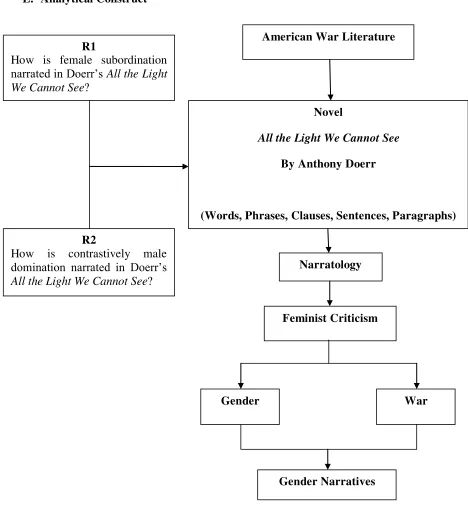
Figure 1. Analytical Construct
American War Literature
Novel
All the Light We Cannot See By Anthony Doerr
(Words, Phrases, Clauses, Sentences, Paragraphs) R1
How is female subordination
narrated in Doerr‟s All the Light
We Cannot See?
Gender Narratives Narratology
Feminist Criticism
Gender War
R2
CHAPTER III RESEARCH METHOD
A. Research Approach
The problem arisen under this research is about narratives of gender exist in Doerr’s All The Lights We Cannot See. It is, in specific, about the gender narratives
found in the novel. The data are the textual descriptions or narrations found in the novel. Qualitative research was used to approach the problem of gender narratives in the novel as well as its relation to its social context. The acquired data were, then, studied.
Qualitative research is commonly used in social sciences. It is usually used to study social issues and human related behaviors. Qualitative research is strongly determinant and bases its research on logic (Goertz and Mahoney, 2012: 2). Logic has a fundamental task in conducting a qualitative research. In this research, logic was also used as guidance in examining the problem being presented in the work. Further, Goertz and Mahoney (2012: 17) also add that logic is the mathematical tool of qualitative research which shows how equal it is actually with quantitative research viewed from calculation perspective. Therefore, there should be no worries to question qualitative approach’s power and its quality as a research theoretically. It is
Textual analysis was employed under this research. According to Vanderstoep and Johnston (2009: 210), textual analysis is an analysis which identifies and interprets signs. He also regards narrative analysis as a branch of method in this textual mode of study. Vanderstoep and Johnston (2009: 213) explain that narrative analysis focuses the analysis on how a story is told and how it functions as a constructive material to society. This research about Doerr’s All the Light We Cannot See employed narrative analysis in studying the novel’s story. The way the story was narrated is examined carefully under this research. The problem of gender narratives encountered in the novel is indeed best fitted to be analyzed using this mode of study.
B. Source and Type of Data
The data were taken from Doerr’s All the Light We Cannot See. The novel was published in 2014 by Fourth Estate. It has 178 chapters and 544 pages. Generally, the data of qualitative research has no relation with number and usually in the form of written materials (Saldana, 2011: 3-4). In this research, the story from the novel became the main source of the data.
Trouble (Butler, 1990), War and Gender (Goldstein, 2001) and some other books to
support the above theories.
The type of data acquired was in the form of words, phrases, clauses, sentences, as well as paragraphs which embody the story. The data were only those which depicted or implied gender narratives. Those data were then identified, categorized, and interpreted.
C. Data Collection
To obtain the data for this research, there were at least four fundamental steps. Those steps were reading, taking notes, categorizing, and interpreting the data. Reading was the first step to begin collecting the data. There should be a close reading to the novel as the main source of data. Rereading was necessary to achieve the better result. Next step was taking notes. After reading the novel, the researcher took notes on the novel that describes the gender narratives. Then, he categorized those gender narratives found in the novel. Lastly, the categorizations among narratives were categorized again into two main thematic categories i.e. female subordination and male domination before they were interpreted as suggestive values to women.
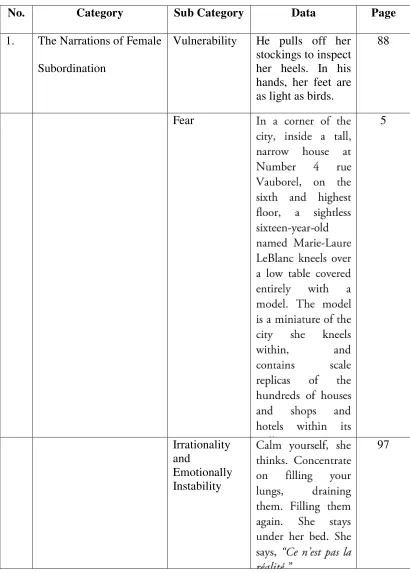
Table 1. The Form of Datasheet
No. Category Sub Category Data Page
1. The Narrations of Female Subordination
Vulnerability He pulls off her stockings to inspect her heels. In his hands, her feet are as light as birds.
88
Fear 5
Irrationality and
Emotionally Instability
thoroughly and rereading it again carefully to strengthen his understanding about the work. Then, he identified the possible data of gender narratives continued by categorizing those identified data. The final task of the researcher was then to interpret those categorized data. He interpreted the gender narratives found in the novel as the salient findings of the research.
E. Data Analysis
Narrative analysis was used to analyze the data from this research. Research on literary narrative emerges as dissatisfaction from commonly found views of literary impressiveness in order to gain an objective view in viewing literary works (Pavel in van Dijk, 1985: 85). Literature is closely connected with narratology. Herman and Vervaeck (2005: 109) assert that the methodology of postmodern narrative analysis is dependent on the researcher’s thoughts in criticizing the text. This was caused by the fact that the study of postmodern or postructuralist narrative is no longer centralized to the study of structure. It tends to emphasize the contextual study of text which relates to many theoretical narrative discourses. Thus, the data analysis on this research started from the researcher’s point of view on feminist narratology. Feminism was used as the central point of guidance in analyzing the text or the data.
1. The first was reading the novel of Doerr, All the Light We Cannot See, as part of collecting the data.
2. The second was identifying which text (words, phrases, clauses, sentences, and paragraphs) belongs to the narratives of gender in the novel.
3. The third was categorizing those identified data into thematic based in accordance with the objectives of this research.
4. The fourth was examining those categorized data by comparing them to major theoretical narratives of feminism.
5. The fifth was interpreting those comparisons by relating them to feminist narratology on how women should be represented.
F. Data Trustworthiness
Keeping the data as trustworthy as possible is an important element in conducting research aimed to gain trustable findings. The measurement method to control the credibility of research is one of the determinant factors in deciding research is good or not. Moreover, it will also show how objective research is. Neuman (2007: 115) says that reliability and validity are inherently essential to the measurement process.
defined as a merely consistency of results rather it is also emphasized on its close relation with reality or truth in social life which cannot be measured by simply rigid method of demanding consistency (Neuman, 2007: 120). It means qualitative research can be held reliable from its ability to offer an authentic description of reality. In this research, the researcher employed analytical constructs in order to examine the collected data logically. The analytical constructs were theoretical concepts directed from the fundamental inquiries of popular social problems integrated in the objectives of this research. The step was started by explaining the definition of every construct being used in the research as clear as possible using a specific point of view hold by the researcher. The researcher used feminist narratological point of view on women equality to start conducting this research. The data acquired were then read and re-read closely and carefully to match with the analytical constructs explained previously. Checking and rechecking those matched data were done to evaluate the certainty and consistency of the analysis. These steps were hoped to achieve an optimum accuracy in interpreting the data.
capability to portray the truth found in social life by offering an authenticity of individuals’ experience. Nevertheless, to make it more trustworthy, the researcher also used Cresswell’s theory of peer debriefing and triangulation to check the
CHAPTER IV
FINDINGS AND DISCUSSIONS
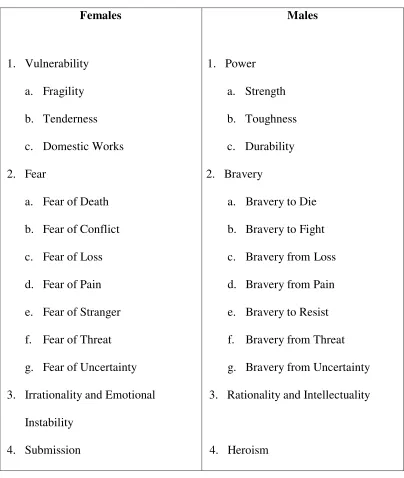
This chapter consists of three main parts. The two parts are the answers of the questions in this research regarding the gender narratives in Anthony Doerr’s All the Light We Cannot See. The last part is the synthesized framework of binary gender
construction attained from the findings. The first part of this chapter discusses how females in Doerr’s All the Light We Cannot See are being subordinated through the construction of their gender. The second part of this chapter discusses how contrastively the engulfing domination of males is narrated also through the construction of their gender. Meanwhile, the last part shows the map of the gender narratives found in the novel and how they create the phenomena of binary gender in society. Gender narratives are key elements to the establishment of a patriarchal society. Female subordination and male domination are usually practiced as the manifestation of gender hierarchy.
Doerr’s All the Light We Cannot See is a historical novel about war. The
This research analyzed the novel from the construction of the characters’ gender through the representation of gender narratives inside the text. The narratives of women and men in the novel are examined. Narrating characters can be in many ways. There are no limits or didactic and authoritative rules for every author in this matter. A story teller has his or her freedom to tell a story. A person then can be narrated from his or her physical, mental or behaviors or else. All goes in the hand of the narrator. Yet, those narrations from various perspectives, which become parts of the novel’s story, consequently may give particular narratives regarding the
characters being narrated. Under this research, those narratives were scrutinized. It was found out that from all the narratives of gender in Doerr’s All the Light We Cannot See, all of them tend to glorify male superiority through the narrations of dominant male figures. Thus, in effect, they clouded the presence of the women in the novel. Being analyzed from the perspective of gender, those narrations were concluded as the reflection of gender embodiment between male and female in the novel. It was found that the gender narratives from the story were patriarchal based. The narrations among the sexes in the story portrayed the subordination of females and the domination of males.
A. The Narrations of Female Subordination
This research managed to view the subordination from the perspective of sex that sees women as females. This sexual based perspective is important because it can locate the gender embodiment of “women” from the point of view of sexual discourse. The narratives of gender on females are commonly constructed through the influence of patriarchal paradigm. These narratives about females may then construct their gender identity. This identity is dangerous because a person’s identity should not be generalized. The generalization of female’s gender identity will only kill the autonomy of every woman to build their own desired identity. This research found that the subordinations of women in the novel are in a form of gender narratives. The construction of females’ gender is manifested through the narration of their
vulnerability, fear, irrationality and emotional instability as well as their submissive characteristic.
1. Vulnerability
There are three kinds of narratives under this research which are associated with vulnerability. Those three are fragility, tenderness, and domestic works. The type of female’s fragility in the novel is mostly characterized by the traditional assumption of female’s bodily fragile state. Female’s body is seen as fragile and
vulnerability with feminine values (Ganteau, 2015:6). Actually, viewing women as vulnerable beings is very dangerous. It can impact enormously in many spectrums of life. This view obviously creates problems. Vulnerability, according to Ganteau (2015:6), implies “the absence of protection”. This means a vulnerable being must be a being which has no or limited capacity to protect itself. However, does this premise inherently exist in female beings? This question must be answered to show the substantial position of women in this matter.
To begin with the analyses, an explanation from the relation of vulnerability with fragility, a tenderness quality, and domestic works is discussed to create a synchronized understanding. Vulnerability relates to the traditional assumption of female’s body fragility because of biological reasons that say females have inferior
Anthony Doerr in his All the Light We Cannot See portrays a number of narrations which depicts the fragility of women. These narrations were found sporadically. An example of the narrations is this phrase below.
He pulls off her stockings to inspect her heels. In his hands, her feet are as light as birds. (Doerr, 2014: 88)
That statement above shows how fragile a female body is by comparing the feet of a girl with the lightness of birds. Birds are generally creatures with very light body and thin feet. On the above statements, Marie Laure’ father is depicted as carrying her when they search for protection during the invasion. Her father treats her very gently. He sees her as a merely fragile child who knows nothing. Yet, her head is full of questions regarding the chaotic world they are in. He, then, inspects his daughter feet if it gets hurt. There is also another example how the fragility of female’s body is objectified and derogated by using a simile. Below is the paragraph
which describes the derogative objectification of female’s body.
In April 1944 the Opel rattles into a white city full of empty windows. “Vienna,” says Volkheimer, and Neumann Two fulminates about Hapsburg palaces and Wiener schnitzel and girls whose vulvas taste like apple strudel. They sleep in a once stately Old World suite with the furniture shored up against the walls and chicken feathers clogging the marble sinks and newspapers tacked clumsily across the windows. (Doerr, 2014: 364)
female’s body. It shows how the girls’ vulvas are being compared to apple strudel, a kind of cake. This comparison is an explicit attempt to objectify female’s body as a vulnerable entity which can be enjoyed like a piece of cake. This is done by equalizing it with apple strudel. This narration is intentionally used as a slur. Slur is derogative word aimed to degrade others. Vulva as female genital has a significant meaning to female’s sexuality. The narration above shows the subjugation of female
sexualities by males. This subjugation is narrated through the objectification of female’s body in a slur. This comparison to an inanimate object shows the stereotype of female’s vulnerability in society.
The narration of female’s vulnerability is also depicted explicitly by stating that female’s body is indeed vulnerable. This paragraph below shows the narration of
Marie Laure’s fragile body in the novel.
The girl emerges from the bakery, steps neatly off the curbstone, and makes straight for him. The poodle squats to relieve itself on the cobbles, and the girl veers neatly to her left to skirt it. She approaches Werner for a second time, her lips working softly, counting to herself— deux trois quatre—coming so close he can count the freckles on her nose, smell the loaf of bread in her knapsack. A million droplets of fog bead up on the fuzz of her wool dress and along the warp of her hair, and the light outlines her in silver. He stands riveted. Her long pale neck seems to him, as it passes, incredibly vulnerable (Doerr, 2014: 412)
It is said that Marie Laure emerges from the bakery to go back to Etienne’s
“incredibly” in the passage above also shows the level of fragility which Marie has.
This narration shows how a female’s body has been narrated as fragile not only once. Tenderness is also an example of the elements which constructs female’s gender and reflects the vulnerability of women. The tenderness which is commonly associated to women by society is the soft gesture of female’s hospitality and kindness. These behaviors show the soft side of human beings. There is nothing wrong to be a tender being. However, constantly associating females to tender behaviors is a different matter. It will create a problem if tenderness in females is equalized with their inability to be tough individuals. Females can also be tough figures with determination. An example of how tenderness is constructed can be seen from this narration below. This narration reflects the warm side of a human.
Eggs crack. Butter pops in a hot pan. Her father is telling an abridged story of their flight, train stations, fearful crowds, omitting the stop in Evreux, but soon all of Marie-Laure’s attention is absorbed by the smells blooming around her: egg, spinach, melting cheese. An omelet arrives. She positions her face over its steam. “May I please have a fork?” The old woman laughs: a laugh Marie-Laure warms to immediately. In an instant a fork is fitted into her hand. The eggs taste like clouds. Like spun gold. Madame Manec says, “I think she likes it,” and laughs again. (Doerr, 2014: 121)
This narration tells the kindness of Madame Manec to Marie Laure and her father as guests. Madame Manec voluntarily services them by cooking foods and continually laughs. Madame Manec’s laughs become symbolical in the novel because
is, then, it is only females who can produce soft and nurturing behaviors. Below narration about the women’s responses to war might also help to explain.
To hear so many of them in a room together confuses and excites Marie Laure: they are giddy when they should be serious, somber after jokes; Madame Hébrard cries over the nonavailability of Demerara sugar; another woman‟s complaint about tobacco disintegrates midsentence into hysterics about the phenomenal size of the perfumer‟s backside. They smell of stale bread, of stuffy living rooms crammed with dark titanic Breton furnishings. (Doerr, 2014: 248)
This paragraph tells the fragility of feelings and the tenderness of Madame Hebrard and other women’s. Madame Hebrard is shown as crying over a merely kind of sugar. The others are also depicted as people who engage in trivial things and are easy to be emotionally distracted by them. These women are associated to be emotionally sensitive and tender. The narration shows how mentally vulnerable they are in that condition. They are not described as having any toughness quality to face the complex problems because of their tender and fragile states as women.
Many women in the novel are also depicted as kind people who love to help others. The narrations about them embody the quality of female beings as tender beings. There is a strong sense of softness in their behaviors. This passage below may also show how tender they are.
brings jam. Madame Ruelle, somehow, has baked a crumb cake. (Doerr, 2014: 320)
The passage elaborates the hospitality of female figures in the novel following the death of Madame Manec. Those women are narrated as giving so much help to Etienne and Marie Laure during their hardships. However, this help is narrated as stuffs related to domestic works only. It is narrated that those women voluntarily support Etienne and Marie Laure with foods as well as accompanying Marie Laure for Madame Manec’s memorial. It is as if after the death of Madame Manec there is
no one who can give any tenderness to the family except them. This conclusion is clearly narrated on the above depiction. Furthermore, the unavailability of narration depicting the help from the male figures during their lowest phase also strengthens the conclusion.
Another depiction of women’s vulnerability found in the novel is their jobs as domestic workers. The novel continually narrates that women’s jobs are related to their tender characteristic. Being domestic workers are the common description of their jobs. Most women are depicted as domestic workers although at the end of the story Marie Laure is depicted as an intellectual woman working in the museum and Jutta as a teacher. These later descriptions still do not answer the women’s vulnerability problem. To start explaining the matter, below is an example of the narrations.