ORIGINAL ARTICLES
Association of opportunistic infections with HIV-RNA
and CD4 cell count in pre ARV and ARV failure at the
care support treatment clinic of Sanglah hospital, Bali
Made Susila Utama∗, Tuti Parwati Merati
Division of Tropic and Infectious Diseases, Department of Internal Medicine, Faculty of Medicine, Udayana University/Sanglah General Hospital, Denpasar, Bali, Indonesia
Received:September 13, 2015 Accepted:November 14, 2015 Online Published:December 14, 2015 DOI:10.5430/jer.v2n2p13 URL:http://dx.doi.org/10.5430/jer.v2n2p13
ABSTRACT
An examination for HIV RNA (viral load) prior to Antiretroviral (ARV) administration is necessary to assess the level of virus in the serum, which has an impact on how rapidly the disease will progress. HIV RNA measurements are also important to detect early therapy failure. To date, HIV RNA examination has not been performed for both pre-ARV and ARV failure patients in Indonesia. Therefore, we performed a study to assess the level of HIV RNA in pre-ARV and ARV failure patients, and evaluated the association between HIV RNA level, CD4 count, and the types of opportunistic infections. This is a cross sectional study of 40 pre-ARV and 35 ARV failure patients. In these pre-ARV and ARV failure patients, the mean level of HIV RNA were 389,394 (SD287,913) and 163,705 (SD218,681) copies/ml, while the CD4 counts were 73 (SD97) and 50 (SD94) cells/mm3respectively.
In pre-ARV patients, the mean CD4 count in subject with TB and without TB was significantly different (14 [SD12]vs.92 [SD
105] cells/mm3). The HIV RNA level in pre-ARV patients with wasting syndrome is higher than that of patients without wasting syndrome (556 [SD286]vs.340 [SD274] copies/mm3), while in the ARV failure patients, HIV RNA level is higher in subject with toxoplasma infections than those without wasting syndrome (525 [SD255]vs.129 [SD185] copies/mm3). There was an association between few opportunistic infections and HIV-RNA level and CD4 cell count in patients at the clinic of Sanglah Hospital, Bali.
Key Words:HIV RNA, Viral load, CD4, Opportunistic infection, Bali
1. INTRODUCTION
Antiretroviral (ARV) therapy has revolutionized the treat-ment of people living with HIV/AIDS. CD4 lymphocyte count examination is one of the requirements before starting ARV therapy (if available) because HIV directly infects and kills CD4 lymphocytes and the CD4 count reflects the abil-ity to resist certain opportunistic infections. The high virus replication rate reflects the viral load (HIV RNA level). HIV
RNA level reflects the number of HIV viruses detected in the serum, the likelihood of progression of the disease and the risk of death. ARV failure can be defined clinically by assessing the progression of a disease, immunologically by CD4 count, and virologically by measuring the viral load (HIV RNA level).
Due to its high cost, the Indonesian Ministry of Health has not established HIV RNA examination as one of the
require-∗Correspondence: Made Susila Utama; Email: [email protected]; Address: Department of Internal Medicine, Faculty of Medicine,
ments to start ARV.[1]However, this information is useful when starting ARV in order to acquire the data regarding the viral replication rate prior to therapy and to monitor drug resistance. Likewise, assessment of ARV failure should be accompanied by HIV RNA examination.[2]However, ARV indication is only assessed clinically or only by CD4 count criteria in developing countries. There is a possibility that mutation of a resistant virus strain may have already occurred years before clinical manifestation. By early detection, we can provide more timely management including substituting ARV regimens to prevent further resistance.
The objective of this study to understand the relationship between the level of HIV RNA, the types of opportunistic infections and CD4 counts in pre-ARV and ARV failure among HIV patients in CST (Care Support Treatment) Clinic of Sanglah General Hospital. The results of this study may help to determine the proper timing of ARV initiation and to evaluate and monitor ARV therapy among HIV patients in Indonesia. The result may also help the detection of therapy failure earlier than by clinical criteria or CD4 count.
2. M
ETHODSThe study is an analytic cross sectional study. The subjects were either HIV/AIDS patients in the CST outpatient clinic of Sanglah General Hospital about to start ARV therapy or patients on ARV who were suspected of having ther-apy failure according to clinical and immunologic crite-ria. Pre-ARV subjects were ages older than 12 years old, fulfilled the requirements to start ARV and were willing to participate in the study. Subjects under 18 years old signed an assent for participation in this study along with parental/guardian signed the informed consent, while older subject signed the informed consent by themselves. Ethi-cal approval for this study was obtained from Research and Development Unit of Medical Faculty, Udayana University number 73/UN.14.2/Litbang/II/2012.
The study was conducted over a one-year period (12 months) from November 2011 to October 2012, and included 75 sub-jects (40 pre-ARV patients and 35 ARV failure patients).
Pre-ARV subjects were obtained from HIV patients in the CST clinic who fulfilled the requirements to start ARV. ARV failure patients were defined by clinical failure (new oppor-tunistic infections and decrease of CD4 on ARV treatment). HIV RNA level is defined as the number of type 1 HIV virus particles in the plasma, counted using real time PCR as copies/ml. CD4 count is the number of CD4 lymphocytes in the plasma, which is presented quantitatively in cells/ml us-ing the methods of flow-cytometry. Opportunistic infections were assessed clinically and immunologically as infections that arise when the immune function is decreased, which is when the patient is diagnosed with HIV infection in pre-ARV subjects or infection that arise when the patient was stated to have therapy failure.
3. RESULTS
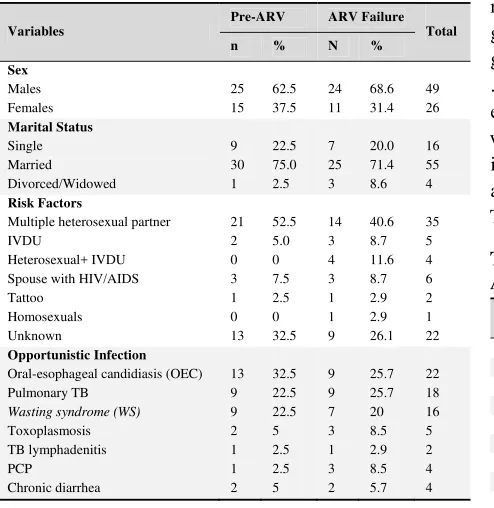
The study included 75 subjects, including 40 pre-ARV sub-jects and 35 ARV failure subsub-jects. The mean age of subsub-jects in the pre-ARV and ARV failure group was 32.9 and 34.5 years old, respectively. More than 60% of subjects in this study were males, both in pre-ARV and ARV failure group and most were married. The most commonly reported risk factor of HIV infection in both pre-ARV and ARV failure groups was multiple heterosexual partners (see Table 1). In pre-ARV subjects, the most frequently reported opportunis-tic infections included oral-esophageal candidiasis (OEC), pulmonary tuberculosis (PTB), wasting syndrome, and tox-oplasmosis. The most frequently reported infections in the ARV failure group were oral-esophageal candidiasis, pul-monary TB, wasting syndrome, toxoplasmosis, PCP, chronic diarrhea, and TB lymphadenitis (see Table 1). The oppor-tunistic infection in ARV failure group changed before and after treatment. Although the number of opportunistic infec-tion is too many and the number of patients is too few to be analyze statistically but we could see that there are no CAP, herpes zoster and condyluma acuminata and new chronic diarrhea after ARV treatment (see Table 2).
The most common initial ARV regimen in ARV failure subjects was AZT/3TC/NVP, the other regimens were d4T/3TC/NVP and AZT/3TC/EFV. The mean duration of ARV therapy in study subjects until declared as having ARV failure was 40.27 (SD20.3) months (see Table 2). The mean HIV RNA level in pre-ARV subjects was 389,394 (SD287,913) copies/ml, while in ARV failure group, the mean HIV RNA level was relatively lower at 163,705 (SD
Table 1.Characteristics of subjects
Variables
Pre-ARV ARV Failure Total
Multiple heterosexual partner IVDU
Heterosexual+ IVDU Spouse with HIV/AIDS Tattoo
Oral-esophageal candidiasis (OEC) Pulmonary TB
Wasting syndrome (WS)
Toxoplasmosis
After the analysis of HIV RNA levels and CD4 counts and
Pearson correlation was performed, an inverse significant cor-relation was found (r= 0.-0.377,p-value = .016) in pre-ARV group. An inverse correlation was also found in ARV failure group, although it was not significant (r= -0.023,p-value = .210). Significant difference among the mean HIV RNA lev-els was found in several opportunistic infections, including wasting syndrome in pre ARV subjects, and toxoplasmosis in ARV failure subjects (see Table 4). There was significant a difference in CD4 counts in pre ARV subjects with TB (see Table 4).
Table 2.Opportunistic infections before and after ARV in ARV failure group
Opportunistic infection Before ARV treatment n(%)
After ARV treatment n(%)
Oroesofageal candidiasis 11(28.9) 9(25.7) Pulmonary TB 8(21.2) 9(25.7) Wasting syndrome 7(18.4) 7(20) Cerebral toxoplasmosis 3(7.9) 3(8.5)
PCP 3(7.9) 3(8.5) CAP 3(7.9) -
Lymphadenitis TB 1(2.6) 1(2.9) Chronic diarrhea - 2(5.7) Herpes zoster 1(2.6) - Condyloma acuminata 1(2.6) -
Total 38 34
Table 3.Duration using ARV until declared as having ARV failure
Duration (months) n(%) Opportunistic infections Mean (SD) CD4 (cells/µl)
Table 4.Relationship of opportunistic infections with HIV RNA and CD4 in pre ARV and ARV failure
Opportunistic infections
Non wasting syndrome
556(286)
In Indonesia, the level of HIV RNA is not required to be obtained prior to ARV initiation due to the high cost of the examination despite the importance of knowing HIV RNA level to assess the level of HIV replication. If the level is high, ARV initiation should be prompted as soon as possible. The examination is recommended for suspected clinical and
very important for clinicians to determine their approach and immediately change the regimen to second line ARV. In ARV failures, the first failure that occurs was virological failure, followed by immunologic failure and in some cases, clinical failure. If HIV RNA is not examined while confirming ARV failure, it is actually already late to determine to change ARV because mutation of HIV virus already occurred prior to the change.
Examination of CD4 count is recommended for all HIV cases to acquire the immunological status of the patient and the ex-amination is influencing the decision to initiate ARV. In 2010, WHO recommended to start ARV therapy in all patients with CD4 counts under 350 cells/mm3without considering their clinical stages.[5, 6]The recommendation was subsequently adopted by the Indonesian Ministry of Health. In cases suspected with therapy failure, CD4 count examination is also important to confirm therapy failure and determine pa-tients’ immunological status.[1] In this study, pre-ARV CD4 count was very low (mean 73 cells/mm3), meaning that when ARV was initiated, the patients had a very poor immunolog-ical status. This also related with the delay of people with HIV/AIDS to seek medical treatment or the delay of HIV diagnosis. These delays influenced the results of therapy because in a patient with low CD4 count, several severe op-portunistic infections may have occurred and thus result in further delay of ARV initiation because the opportunistic infection should be treated first.
In high HIV RNA level, a more severe immune deficiency would occur. This is proven in this study, where there was a significant inverse correlation (p-value = .016) between the level of HIV RNA and CD4 count in pre-ARV subjects, it means that the higher HIV RNA level, the lower the CD4 count would be. This inverse correlation was also found in ARV failure group, although the correlation was not signifi-cant. This could be explained because in subjects with ARV failure who still receive ARV, suppression of HIV replication persists although resistance has developed.
CD4 count roughly reflects the degree of immunological competence of the individual, as manifested by the oppor-tunistic infection occurring appropriate with the level of CD4 count.[7–9] In this study, the mean CD4 count was lower in subjects with opportunistic infections like TB,
oral-esophageal candidiasis, wasting syndrome and toxoplasmo-sis. This result is in accordance with the association between opportunistic infections and CD4 counts below 200 although it is also significant in TB infection.
The level of HIV RNA is rarely directly associated with the type of opportunistic infection.[10–14] In this study, there is a significant correlation of HIV RNA level with wasting syn-drome in pre-ARV subjects, where the level of HIV RNA of subjects with wasting syndrome were significantly higher than those without the condition. Meanwhile in ARV failure group, subjects with toxoplasmosis had a significantly higher HIV RNA level compared to those without this opportunistic infection. The ARV failure group have low CD4 count after ARV treatment, although still higher than pre-ARV group, but interestingly they also have lower mean HIV RNA level. Our result is similar to Prabhakar, 2011, where 13.59% of their patients developed immulogical failure although those patients had virological suppression. Our result supports Prabhakar’s suggestion that detection of ARV failure only based on immunological evaluation, without virological eval-uation might lead to unnecessary switches to second line therapy.[15]
In conclusion of this study were the level of HIV RNA in HIV-infected patients with pre-ARV period and ARV failure is considered high, mean HIV RNA level in pre-ARV HIV subjects with wasting syndrome was significantly higher than those without wasting syndrome, mean HIV RNA level in ARV failure subjects with toxoplasmosis infection was sig-nificantly higher than subjects without toxoplasmosis and mean CD4 count in pre-ARV subjects with TB infection was significantly lower than non-TB subjects. We suggest that HIV RNA examination should be performed prior to ARV initiation to find out the most appropriate time to start the regimen and to monitor the results of therapy with ARV. The limitations of this study was relatively small numbers of patients analyzed.
ACKNOWLEDGEMENTS
This study was funded by HPEQ Medical Faculty of Udayana University, Indonesia. We also acknowledge the support of the INA-RESPOND (Indonesia Research Partnership on In-fectious Disease) for reviewing and editing the manuscript.
REFERENCES
[1] Ministry of Health, Republic of Indonesia. General Directorate of Disease Control and Environmental Health. National Guideline for Antiretroviral Therapy. 2011.
[2] French R, Stewart GJ, Peny R,et al. How HIV produces immune
deficiency. In Graeme Stewart, editor. Managing HIV. Australasian Medical Publishing Company Limited. 1997: 22-27.
[4] Barlett JG. The stage and natural history of HIV infection. Update HIV. 2010.
[5] WHO. AIDS Info. HIV and its treatment: What you should know? HIV Treatment Failure. 2009.
[6] WHO. Anti retro viral therapy for HIV infections in adult and adoles-cent. Recommendations for a public health approach 2010 revision.
[7] Ekwaru JP, Campbell J, Malamba S,et al. The effect of oppor-tunistic illness on HIV RNA viral load and CD4 T cell count among HIV-positive adults taking antiretroviral therapy. Journal of the International AIDS Society. 2013; 16: 17355. PMid:23547778
http://dx.doi.org/10.7448/IAS.16.1.17355
[8] Brambilla AM, Castagna A, Nocita B,et al. Relation between CD4 cell count and HIVRNA level at onset of opportunistic infections. JAIDS. 2001; 27: 44-48. PMid:11404519http://dx.doi.org/1 0.1097/00126334-200105010-00008
[9] Korenromp EL, William BG, Schmid GP,et al. Clinical prognos-tic value of RNA viral load and CD4 cell counts during untreated HIV-1 infection-A quantitative review. Plos ONE. 2009; 4: e5950. PMid:19536329http://dx.doi.org/10.1371/journal.pone. 0005950
[10] Grant A. Clinical features of HIV disease in developing countries. Lepr Rev. 2002; 73: 197-205. PMid:12192976
[11] Kimmel AD, Goldie SJ, Walensky RP,et al. Optimal frequency of CD4 cell count and HIV RNA monitoring prior to initiation of an-tiretroviral therapy in HIV-infected patients. Antiviral Therapy. 2005; 10: 41-52. PMid:15751762
[12] Rodriguez B, Sethi AK, Cheruvu VK,et al. Predictive value of plasma HIV RNA level on rate of CD4 T-cell decline in untreated HIV infection. JAMA. 2006; 296: 1498-1506. PMid:17003398
http://dx.doi.org/10.1001/jama.296.12.1498
[13] Sabin, Caroline A, Phillips,et al. Should HIV therapy be started at a CD4 cell count above 350 cells/uL in asymptomatic HIV-1 infected patients? (Special commentary). Current Opinion in Infectious Diseases. 2009; 22: 191-197. PMid:19283914http: //dx.doi.org/10.1097/QCO.0b013e328326cd34
[14] The Strategies for Management of Antiretroviral Therapy (SMART) Study Group. Inferior clinical outcome of the CD4 cell count-guided antiretroviral treatment interruption strategy in SMART Study: Role of CD4 cell counts and HIV RNA level during follow-up. JID. 2008; 197: 1145-55. PMid:18476293http://dx.doi.org/10.1086/5 29523