ISSN 1549-3652
© 2006 Science Publications
Corresponding Author: Assoc. Prof. Dr. Raduan Che Rose, Graduate School of Management, University Putra Malaysia, Fax: +60-603-8943-4019
Entrepreneurs Success Factors and Escalation of Small and
Medium-sized Enterprises in Malaysia
Raduan Che Rose, Naresh Kumar and Lim Li Yen
Graduate School of Management, University Putra Malaysia
Abstract: This research aims to identify the success factors of founding entrepreneurs in Malaysia contributing to their companies’ venture growth. Specifically this study was initiated to examine the relationship between venture growth and the following factors, namely personal initiative, human capital, areas of focus on competency and government support programs. From this research, it has been made clear that a large number of entrepreneurs affirmed personal initiative as one of the major key to success. Entrepreneurs with high personal initiative will naturally overcome the disadvantages or weaknesses in them with their self-starting and proactive attitude. The study found that the entrepreneurs’ education level, working experience and whether their parents own business have a positive relationship with their success. The research has also provided a clear indication as to which area of competency the entrepreneurs should focus on. On the whole the findings of this study serve as a guideline for founding entrepreneurs to succeed in their attempt to achieve superior venture growth.
Key words: Entrepreneur, personal initiative, human capital, competency, government support programs, venture capital, Malaysia
INTRODUCTION
Small and medium enterprises (SMEs) are important to the development of Malaysia’s economy and unemployment issue. According to Dun and Bradstreet[1], SMEs should be the main focus for developing nations. The 2000 Census by the Malaysian Department of Statistics (DOS) enumerated 89.8% of the 20,455 establishments in the manufacturing sector and 96.8% of the 192,527 establishments in the services sector were SMEs. There is a shift from a managerial to an entrepreneurial economy as thousands of new businesses being created each year hoping to grow into large enterprises[2]. Therefore, ensuring the survival and venture growth (VG) of the Malaysian SMEs is crucial. Many studies have been done on SMEs’ growth and the key success factors contributing to VG, yet only 10% of these start-ups survived beyond the 10 years mark. 79,310 businesses discontinued in Malaysia during the year 2002[3], as most were unable to cope with the transition from an entrepreneurial style of management to an organized, professionally managed workforce and as a result, not being able to capitalize on further market opportunities[4].
Several studies found that founding entrepreneurs should be replaced by professional managers, whom are able to manage organizational growth better[5]. On the contrary, Willard, Krueger and Freeser[6] found that founding entrepreneurs could have the competencies to perform equally well as professional managers. Entrepreneurs who have the necessary competencies
especially in the area of operations, finance, marketing, human resources and management skills required for the business are more likely to be successful at start-up[7-9]. Bruno, Leidecker and Harder[10] showed that a major reason business venture fall short was managerial problems and this view was supported by Ibrahim and Ellis[11] and Landesberg and Edmunds[12] who attribute the vast majority of business failures in the formative years to managerial shortcomings. Literatures revealed that competency are positively related to companies at VG, nevertheless such studies have been greatly researched mostly developed countries and not extensive in developing countries, furthermore, none was found pertaining Malaysia. From the literatures review on factors such as personal initiative (PI), human capital (HC), competency, social networking skill and government support (GS) in relation to VG, this research aims to examine the following questions:
* Does the high PI factor of successful founding entrepreneurs contribute to their success in VG? * Does the high level HC of the successful founding
entrepreneurs contribute to their success in VG? * Do successful founding entrepreneurs focus on
different area of competencies in order to successfully manage their companies at VG? * Are successful Malaysian entrepreneurs of growing
Research method: The target population for this study is Malaysia E-50 winners for the year 1997 to 2003. Enterprise 50 (E-50) is an annual award program organized by the Small and Medium Industries Development Corporation (SMIDEC), Malaysia[13]. This award recognizes the achievements of Malaysia’s enterprising homegrown companies which are well positioned for the future. 50 winners are selected from among the nominations received and the evaluation is based on the companies’ management and financial performance. From the 350 winners in the Enterprise 50 list, there are only 252 unique companies as they are repeated winners. A letter was sent to all 252 founding CEOs requesting for their participation. However, only 100 of them managed to participate in this study. Interviews and self completion questionnaire was utilized to collected data for this study. Interviews were conducted with all the participants particularly to collect information pertaining to personal initiative. The interviewer has a standard category for the answers as per the original study of personal initiative proposed by Frese and Fay[14] and Frese et al.[15,16].
Questionnaires were delivered to all participants prior to accomplishing the interviews. Literature review and feedback from the panel of experts provides inputs for the development of research questionnaire. The pilot study further refines the questionnaire prior to finalization. The Cronbach’s Alpha values for all the items were well above the commonly acceptable value of .70. The questionnaire was divided into five sections. The first section collected data pertaining to human capital, whereby the participants were asked to indicate their level of education, whether family owned the business, length of work experience prior to owning business and length of managerial experiences prior to starting the business. The second section measures competencies which are divided into two types: functional competencies and interpersonal competency. There are four functional competencies - finance, operations, marketing and human resources. Interpersonal competency is specifically associated to social network support. Participants were asked to respond on a five-point scale; (1) being no emphasis and (5) being major and constant emphasis for each of the five competencies they focused while managing growth. The questions are similar to Lussier and Pfeifer[17] and Yusuf[18]; however, for the purpose of this study additional questions relevant to the various competencies were added. The third section focused on government support programs. Questions asked were whether the entrepreneurs are aware of the availability of such programs and if so, are they utilizing these programs and whether there are any difficulties faced in obtaining assistance of these programs. Dichotomous ‘yes’ or ‘no’, multiple choices and open ended questions were used in this section.
The dependent variable is the venture growth level. Venture growth is measured by annual sales growth. To
measure sales growth, the participants were asked about the company sales for the past three years (2002 – 2004). Compound Annual Growth Rate or CAGR was used to calculate the growth rate. Finally in the last section, respondents’ background information was collected.
RESULTS AND DISCUSSION
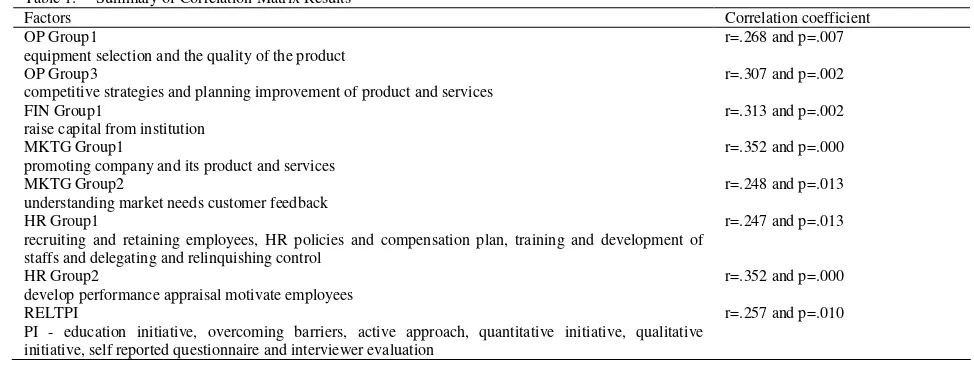
Quantitative analysis: Since the data were not normally distributed, Spearman’s Rho (Spearman R) correlation was used to measure the ordinal scales of the variables. Based on the correlation matrix, VG is not significantly related to the following factors: education level, working experience prior owning business, management experience prior owning business, parents owning business, day to day operations, production scheduling and planning, record keeping and financial control, budget planning and cash flow management, market analysis, formal and informal social network support and lastly government support programs. The factors that have significant relationship with VG, having the correlation coefficient range from r=.247 to r=.352 and the p value from p=.000 to p=.013 are shown in Table 1
One of the main research areas of this study was PI and the research found significant relationship between RELTPI (group of PI variables after factoring) and VG. Among the competency variables (which were separated into 5 categories); operations, finance, marketing, human resources and social network support and the following factors from the 5 categories were found positively related to VG. In operations OP Group1 and OP Group3 were positively related to VG. Whilst for finance only FIN Group1 was positively related to VG. All marketing variables except one were positively related to VG, the variables were MKTG Group1 and MKTG Group2. And as for human resource, all of them; HR Group1 and HR Group2 were related to VG. As for social network support, the study showed no relation between the variable and VG. Finally, as for GS, it was also found to have no correlation value with VG.
Table 1: Summary of Correlation Matrix Results
Factors Correlation coefficient
OP Group1
equipment selection and the quality of the product
r=.268 and p=.007
OP Group3
competitive strategies and planning improvement of product and services
r=.307 and p=.002
FIN Group1
raise capital from institution
r=.313 and p=.002
MKTG Group1
promoting company and its product and services
r=.352 and p=.000
MKTG Group2
understanding market needs customer feedback
r=.248 and p=.013
HR Group1
recruiting and retaining employees, HR policies and compensation plan, training and development of staffs and delegating and relinquishing control
r=.247 and p=.013
HR Group2
develop performance appraisal motivate employees
r=.352 and p=.000
RELTPI
PI - education initiative, overcoming barriers, active approach, quantitative initiative, qualitative initiative, self reported questionnaire and interviewer evaluation
r=.257 and p=.010
situation. This study found that many founding CEOs with tertiary education expressed satisfaction, while founding CEOs without tertiary education agree to the importance of education and are either in the midst of completing a distance learning or planning to pursue further education and yet they are among the most successful entrepreneurs in Malaysia. This study observed the actual factor that contributes to success is the eagerness and willingness to pursue knowledge rather than education per se.
During the interview, CEOs were given 4 scenarios of various barriers to solve immediately. This was designed to measure the CEOs’ persistency. Each time the CEOs gave a solution; the interviewer asked what if the solution given did not work and this will go on for four times and most CEOs gave at least five solutions for each barrier. The first scenario was to have the CEOs pretend for a moment that they were, out of money to purchase the necessary supplies. The common answers given are: borrow from financial institutions, friends, family and get credit terms from suppliers. Many of CEOs, after providing the few mentioned common sense solutions, were very creative and persistence in solving the problem. The second scenario is that a particular production machine broke down, barriers then given were; supplier can’t help, no in-house engineer has the know-how and no manual was available. Immediately, majority of the CEOs gave many solutions, to some extend they even gave themselves a barrier right after they have given a solution and continued attempting to give another solution thereafter. The third scenario, a supplier for a certain item went out of business and the CEOs were under high pressure to deliver the items to the customers. For this scenario, the interviewers are prepared to counter that with more barriers such as the customer do not entertain delays, the design cannot be changed and no substitute can be accepted. Almost all the CEOs affirmed that they will be honest and speak up with the customer to jointly work out for a solution.
Indeed they claim to assist customers to look for an equally quality products or services, and perhaps even engage the customers with other suppliers. Assuring customers that they are well cared is vital for a long term business relationship. The last scenario, the CEOs were asked to pretend that they were told to move out of the premises by the landlord in two weeks time and what would they do? The common answers were move to new premises; look for a lawyer, to negotiate with the landlord. The interviewer further questioned: what can be done if they can’t afford the new premises, not enough time to look for new place, no money to hire a lawyer and landlord do not wish to negotiate. The CEOs generally voice out that they will seek help and move the business to their associate’s premises temporary. This clearly gives an idea on how essential networking among business entrepreneurs.
Lastly, the interview aimed to assess specific acts of past initiative at work. These are not scenarios but actual situations. The interviewers were instructed to prompt whether the action taken by the CEOs were part of the job or out of initiative? Do the CEOs’ colleagues and other CEOs of similar industry do the same thing? And lastly whether they take action based on someone else request? The questions were pertaining to new ideas thought of by the CEOs that’s have added value to the business. The interview examined the level of quantitative and qualitative initiative of the CEOs and how active they would approach the situation. The questions asked were as follow:
* During the last year, did you implement new ideas to improve the company’s products or service? * During the last year, did you consult advisors
because of the problems encountered at work? Was it your own or someone else problem?
* Have you introduced changes in your work during the last year? (the sequence of activities, added other activities).
Majority of the CEOs were almost always consistently improving the products or services. They understand that customer is the core of their business. They have associates or mentors to seek advice and ideas from. Many are also in associations where these founding CEOs share their experiences and problems and help each other to grow their companies. Creativity is a similar trade all across the CEOs, they actively thought of any possible new problems that may occur and already have solutions and alternative standing by. If they encounter any issues, they would ensure that they find the root cause of the problems before it jeopardize the long term and survival of the business. They would also constantly converse with staffs from the ground to understand the smallest potential obstacles and suggest committee to be formed at different levels to ensure efficiency and effectiveness of the production.
The study found that the entrepreneurs’ HC do not have any relationship with VG. This could be explained by the fact that these entrepreneurs have high PI, thus the education initiative that has been consistently found in all of them indicated that their knowledge and skills were learned. In addition, the assumption of self-learned skills could be supported by the fact that 88% of the participants is above the age of 40 and during their younger years, non-institutionalized education was normal as the nation was at beginning stage of development. This also implied and supports the fact that PI is far more important than education when comes to aim of growing the company successfully.
There is no relation between VG and their working and managerial experience. Kemelgor[19] found that individuals who have succeeded in their small business venture were less reliant upon their previous business skills, seemed more open to growth and change, planned for that change through delegation and strategic planning and sought to learn or use general business skills. Similarly, entrepreneur with parents owned businesses showed no relation to VG. Most of these successful entrepreneurs were brought up from lower income or poor families, yet great determination to learn and succeed can be found in them.
This research has identified the individual areas of the different competencies where VG entrepreneurs would still be hands-on and put greater emphasis on. The research showed that entrepreneurs no longer involve in equipment selection, day-to-day operations and production scheduling and planning, as these processes are tedious and time consuming, though they are crucial as slight mistake may cost unnecessarily time and financial lost. Nevertheless there are professional managers that are skilled and able to make sound decision that can be hired for it. Hence, this
would relief the entrepreneurs to more important responsibilities.
Among the operation tasks, entrepreneurs were found to still have great interest in controlling the quality of their companies’ products or services, which make a lot of sense, as the products or the services would always be the heart of the business and quality should be the prime concern and not become complacent but strive to further product development[20]. The entrepreneurs would eventually want to know more about the competitors, as 94% of the entrepreneurs put more emphasis on competitive and strategies planning. This would allow the entrepreneurs to ensure that the products or services will have the competitive advantage. Hence, 84% of the entrepreneurs also placed more emphasis in improving the products and or services. Our study supports Herbert[21] comments, which state that, these successful entrepreneurs succeeded because they identified a good product, were able to secure markets based on quality and competitive pricing, obtained favorable finding and capitalized on these strategies. In addition, it also supports the findings of Lin[22], excellence in quality and continuous improvement of product has been the hallmark of the operational success.
As for the areas of competency, the research showed no relationship between VG and the record keeping, financial control, budget planning and cash flow management. Most entrepreneurs hire accountants and delegate such tasks to them, as study shown that accounting was being delegated by almost two-thirds of the ventures[23]. The research identified that successful entrepreneurs managing growing organizations emphasized on raising capital and constantly seek and ensure funds are sufficient, because when a company is growing or at growth stage, it is usually supported by external sources of funds[24]. Although, literature review supported that cash flow management is important during business start-up, the findings did not show any significant relationship between cash flow and VG. This non-significant relationship is explained by Teutenberg[25] when he found that cash flow generally post as a concern and problem for smaller businesses rather than larger organizations, this is due to the fact that larger companies have greater access to people to train executives to manage and plan for it. This is true in the case of the participants in this study that cash flow should not post as a problem as it is already part of their long-term business plan.
study based on four E-50 companies in Singapore found that ‘focus on customer satisfaction’ is a key success factor. Understanding that globalization is taking effect and will affect smaller player, thus effective marketing planning and implementation are critical for entrepreneurs to look into other products and channel opportunities in differentiated ways to meet the challenges[27].
This would again confirmed that the products and or services are indeed the core of the business, the correlation matrix also showed a high positive relationship between these ‘marketing’ elements with entrepreneurs’ emphasis on product and or services in operation. Whilst market analysis did not show any relationship with VG, this could be due to the fact that for certain industry, the market analysis has been done prior to VG, thus no or minimal emphasis was place on it. Another possible explanation could be that the cost of market analysis can be quite high in Malaysia and also to obtain market information maybe not be easy in Malaysia, in addition could be time consuming and tedious. Therefore, these founding CEOs would not want to wait and most of them with their experiences; understand the market condition and the trend of the industry they are in.
There were six HR elements examined for correlation with VG and all were found to have significant relationship with VG, namely recruiting and retaining employees, HR policies and compensation plan, training and development of staffs, delegating and relinquishing control, develop performance appraisal and motivate employees. This finding seemed universal and it is expected that entrepreneurs delegate many of the important tasks to trustworthy and skilled professional employees, thus they would be involved in recruiting and retaining employees, especially high levels staffs. Our study supports Lavarack’s[28] argument that the ability to recruit extra staff and delegate some responsibility to them is one of the most important skills for business growth. This also supports Temtime and Pansiri[29] research findings that although attracting, developing and maintaining successful individuals are a critical success factor, recruiting new employee is one of the biggest challenges facing small firms and a key component of organizational success.
However, a whole new set of problems arises as these new people were added to perform some of the functions and this required human resources development activities[23]. Our study found that successful entrepreneurs at VG have greater involvement with training and developing staffs and entrepreneurs do play a role in motivating their staffs. This confirms Trulsson’s[20] findings that seeing the value of having a well trained and committed staff, larger enterprises are also more prone to invest in the development of employee skills these days. Therefore, choosing the right people, ensuring the staffs get the right incentives and maintain adequate control is
crucial[20] and this again confirmed developing good performance appraisal and compensation plan and delegating and relinquishing control is positively related to VG.
Overall, human resources are essentially important and an optimal utilization of skills and knowledge increases small business growth. Thus, one can improve the probability of success by increasing HC in a firm and by developing and utilizing human resources[30]. The research did not show any significant relationship between VG and social network support. The numerous types of industries in the research sample can explain this, as certain industry depends on only a small number of major growing customers, whilst some depend greatly on new market segments all the time. Hence, social network support may be significant if the study is done on a specific industry, finding a strong positive or negative relationship between the social network support and VG could be possible.
Another reason for the non-significant relationship between social network support and VG could be because this research examined VG companies and network support is more important during start-up as oppose to growing companies. This argument is supported by Eisenhardt and Schoonhoven[31], when they confirmed that network support is important during early stages of a venture development, because alliance behavior was greater during the early stages of a market’s development compared to later mature, market stages. In addition, little conclusive evidence has come forth as to the potential personal networks in stimulating growth[32]. In conclusion, due to the mixed findings revealed from previous research, no result was able to link networks and networking behavior to performance consistently and perhaps a network process research will need a longitudinal study design in order to make stronger claims for the existence for the developmental patterns[33].
CONCLUSION
From this research, it has been made clear that a large number of entrepreneurs affirmed personal initiative as one of the major key to success. It has also illustrated that entrepreneurs with high personal initiative will further enhance their management, improve business operation skills and embark in a continuous learning and development attitude. Human resource is a clear distinction to be focused on, as all areas of HR are found to have significant relationship with venture growth. As the company grows, the founding entrepreneurs must be attuned to promoting company and its product and services, understanding market needs and customer feedback. Knowing the trends and what comes next as accurately as possible will allow long term continuation for the business. Founding entrepreneurs must also be involved in strategic planning pertaining to competition, because this ensures the future and the survival of the company.
Limitations and suggest for future research: Despite all the significant findings and the constructive recommendations in the research, limitations are inevitable. The following are recommendations and suggestions to be taken into consideration.
This research only focuses on Malaysian entrepreneurs. Thus, it makes it difficult to generalize the findings to the total population. Therefore, similar studies across other Asia Pacific and other developing countries are recommended. A longitudinal study should be conducted to follow the performance of the entrepreneurial CEOs and evaluate the competencies acquired during the different stages, from start-up to growth-stage. By doing so, it will be much easier for the entrepreneurial CEOs to identify the competencies he/she needs as he/she can immediately relate to the challenges faced and confirms the findings of this study. Future research should investigate and compare the different competencies required of the entrepreneurial leaders for a privately funded company and a publicly traded company between organizations in start-up stage and growth-stage.
REFERENCES
1. Timmons, J.A., 1994. New Venture Creation. 4th Edn. Homewood, IL. Irwin.
2. Drucker, P.F., 1985. Innovation and Entrepreneurship. New York: Harper.
3. Companies Commission of Malaysia (CCM), 2002. Statistics of Insolvency Completed. Retreived 2003, From http://www.ssm.com.my/
4. Hofer, C.W. and R. Charan, 1996. The transition to professional management: Mission impossible? Am. J. Small Business, 9: 1-11.
5. Chandler, G.N. and E. Jansen, 1992. The founder’s self-assessed competence and venture performance. J. Business Venturing, pp: 223-236.
6. Willard, G.E., D. Krueger and H. Feeser, 1992. In order to grow, must the founder go: A comparison of performance between founder and non-founder managed high-growth manufacturing firms. J. Business Venturing, 7: 181-194.
7. Peterson, R.A., G. Kozmetsky and N. Ridgway, 1983. Perceived causes of small business failures: A research note. Am. J. Small Business, 8: 15-51. 8. Prahalad, C.K. and G. Hamel, 1990. The core
competence of the corporation. Harvard Business Rev., 68: 79-91.
9. Swiercz, P. and B. Spencer, 1992. HRM and sustainable competitive advantage: Lessons from delta air lines. Human Res. Plann., 15: 35-46. 10. Bruno, A.V., J. Leidecker and J. Harder, 1987.
Why firms fail. J. Manag., 7: 50-58.
11. Ibrahim, A.B. and W. Ellis, 1987. An empirical investigation of causes of failure in small business and strategies to reduce it. J. Small Business and Entrepreneurship, 4: 50-58.
12. Landesberg, Z. and R. Edmunds, 1983. Business failures: Some disturbing research. CA Mag. (Aug.), pp: 115-117.
13. Small and Medium Industries Development Corporation (SMIDEC), 2004. Enterprise 50: An Introduction. Retrieved 2004, From http://www.smidec.gov.my/E50/introduction.htm 14. Frese, M. and D. Fay, 2001. Personal initiative: An
active performance concept for work in the 21st century. Research in Organizational Behavior, 23: 133-187.
15. Frese, M., W. Kring, A. Soose and J. Zempel, 1996. Personal initiative at work: Differences between East and West Germany. The Acad. Manag. J., 39: 37-63.
16. Frese, M., D. Fay, T. Hilburger, K. Leng and A. Tag, 1997. The concept of personal initiative: Operationalization, reliability and validity in two German samples. J. Organ. Occupat. Psychol., 70: 139-161.
17. Lussiers, R.N. and S. Pfeifer, 2001. A crossnational prediction model for business success. J. Small Business Manag., 30: 228-239.
18. Yusuf, A., 1995. Critical success factors for small business: Perceptions of South Pacific entrepreneurs. J. Small Business Manag., 33: 68-73.
19. Kemelgor, B.H., 1985. A longitudinal analysis of the transition from 'organization man' to entrepreneur. Acad. Manag. Proc., pp: 67-70. 20. Trulsson, P., 2002. Constraints of growth oriented
21. Herbert, C.F., 1997. The need for entrepreneurship in management: Lessons for Malaysian Managers. Malaysian Management Rev., 32: 7 – 14.
22. Lin, C.Y., 1998. Success factors of small and medium-sized enterprises in Taiwan: An analysis of cases. J. Small Business Manag., 36: 43-56. 23. Ardishvili, A., R. Cardoza, B. Harmon and S.
Vadakath, 1998. Towards a Theory of New Venture Growth. In P.D. Reynolds, W.D. Bygrave, N.M. Carter, S. Manigart, C.M. Mason, G.D. Meyer, & K.S.
24. Dunn, P., L. Cheatham and C. Cheatham, 1992. Practicing accountants, entrepreneurs and small business finance strategy in start-up situations: A national study. Proc. Small Business Consulting Conf., Natl. Conf. Small Business Institute Directors Association, Washington, D.C.
25. Teutenberg, P., 1997. NZ Business, 11: 22.
26. Siew, T.F. and D. Allampalli, 2001. Enterprise 50: Successful growing enterprises (SGEs) of Singapore: An exploratory study of success factors. Intl. J. Entrepreneurship and Innovation Manag., 1: 299-316.
27. Lau, T., K. Chan and R. Ho, 2004. Cross-border entrepreneurs-A study of the changing strategies and competencies of Hong Kong entrepreneurs upon exposure to the emerging market of China. J. Enterprising Culture, 12: 165-193.
28. Lavarack, D., 1995. Unlocking the small business. Training Tomorrow, 9: 27-8.
29. Temtime, Z.T. and J. Pansiri, 2005. Managerial competency and organizational flexibility in small and medium enterprises in Botswana. Problems & Perspectives in Management, 1: 25-36.
30. Rauch, A. and M. Frese, 2005. Effects of human capital and long-term human resources development and utilization on employment growth of small-scale businesses: A causal analysis. Entrepreneurship: Theory & Practice, 29: 681-698.
31. Eisenhardt, K. and C. Schoonhoven, 1996. Resource-based view of strategic alliance formation: Strategic and social effects in entrepreneurial firms. Organ. Sci., 7: 136-150. 32. Ostgaard, T.A. and S. Birley, 1996. New venture
growth and personal networks. J. Business Res., 36: 37-50.
33. Hansen, E.L., 2000. Resource Acquisitions as a Start-up Process: Initial Stocks of Social Capital and Organizational Foundings. In Reynolds, P. D., Autio, E., Brush, C. G., Bygrave, W. D., Manigart, S., Sapienza, H.J. and Shaver, K.G. (Eds.), Frontiers of Entrepreneurship Research. Wellesley, MA: Babson College, pp: 111–120.