Flight hours within 7 days and risk of fatigue on the civilian pilots in Indonesia
DOI: 10.22435/hsji.v8i1.6804.
Febi Arya,
1Indah Suci Widyahening,
2Ferdi Afian
2,
Bastaman Basuki
21 Aviation Medicine Program, Department of Community Medicine, Faculty of Medicine University of Indonesia
2 Department of Community Medicine, Faculty of Medicine, University of Indonesia
Corresponding address: dr. Indah Suci Widyahening, MS, MSc, CMFM, PhD Email: [email protected]
Received: May 24, 2017; Revised: June 12, 2017; Accepted: June 21, 2017
Abstrak
Latar Belakang: Dalam dunia penerbangan, fatigue dapat menyebabkan inkapasitasi pilot dan mengakibatkan kecelakaan pesawat. Jam terbang merupakan salah satu faktor yang berhubungan dengan risiko fatigue. Tujuan dari penelitian ini adalah untuk mengidentifikasi hubungan jam terbang 7 hari dan beberapa faktor lain terhadap risiko fatigue pada pilot sipil di Indonesia.
Metode: Sebuah studi cross sectional dengan consecutive sampling dilakukan pada pilot sipil yang sedang melakukan medical check-up di Balai Kesehatan Penerbangan di Jakarta pada Juni 2016. Karakteristik demografi, pekerjaan, kebiasaan dan jam terbang diperoleh melalui kuesioner dan wawancara. Data fatigue diperoleh melalui pengisian self-questionnaire fatigue dan dihitung dengan Fatigue Severity Scale (FSS) yang telah divalidasi. Fatigue dikategorikan menjadi “Tidak Fatigue” (skor FSS <36) dan “Fatigue” (skor FSS ≥36). Analisis menggunakan risiko relatif dengan regresi Cox dan waktu yang konstan.
Hasil:Penelitian ini mencakup 542 pilot, 50,2% mengalami fatigue. Subyek yang memiliki jam terbang lebih dari 30 jam dalam 7 hari dibandingkan dengan yang kurang atau sama dengan 30 jam dalam 7 hari, memiliki risiko fatigue 1.37 kali lebih tinggi [risiko relatif disesuaikan (Relative Risk adjusted= 1,37; CI=1,14-1,65; p = 0,001]. Subjek yang memiliki lisensi tipe Air Transport Pilot License dibandingkan dengan yang Commercial Pilot License memiliki risiko fatigue 1,31 kali lebih tinggi (RRa=1,31; CI=1,11-1,54; p= 0,001).
Kesimpulan: Pilot sipil di Indonesia yang memiliki jam terbang lebih dari 30 jam dalam 7 hari dan pilot dengan
lisensi tipe ATPL mengalami peningkatan risiko fatigue. (Health Science Journal of Indonesia 2017;8(1):53-58) Kata kunci: fatigue, jam terbang, pilot sipil, Indonesia
Abstract
Background: In aviation world, fatigue may cause incapacitation among pilot which can lead to aircraft accidents. Flight hours is believed to be one of the factors related to the risk of fatigue. The purpose of this study is to identify relationship between flight hours in seven day and other factors to the risk of fatigue among civilian pilot in Indonesia.
Methods: A cross sectional study with consecutive sampling was conducted among civilian pilots who attended medical check-up at Aviation Medical Center in Jakarta on June 2016. Demographic characteristics, employment related factors, habits and flight hours were obtained through questionnaire and interviews. Fatigue data were obtained through fatigue self-questionnaire form and measured with Fatigue Severity Scale which had been validated. Fatigue was categorized into non-fatigue (FSS score <36) and fatigue (FSS score ≥36). Relative risk was computed using Cox regression with a constant time.
Results: This study included 542 pilots among which 50.2% had fatigue. The subjects who have flight
hours >30 hours/week compared to ≤30 hours/week, had 1.37-fold higher risk of fatigue [adjusted relative risk [RRa=1.37; CI=1.14-1.65; p=0.001]. The subject with ATPL license compared to CPL license had
1.28-fold higher risk of fatigue [RRa=1.31; CI=1.11-1.54; p=0.001).
Conclusions: Civilian pilots in Indonesia who had more than 30 hours flight time in 7 days and ATPL type pilots have an increased risk of fatigue. (Health Science Journal of Indonesia 2017;8(1):53-58)
Fatigue is a physiological condition caused by prolonged sleep or wakefulness due to changes in circadian rhythm and aviation workloads such as flight hours and the number of sectors undertaken.1 Factors related to fatigue include physical factors. occupational factors and individual factors.2 Fatigue can cause negative impacts and affect a person’s ability to perform tasks. The mental state that requires continuous concentration while working can exert a fatigue effect that results in an individual not able to work normally.2
Important factors in aviation-related fatigue such as lack of sleep, long duty cycle and shift work can cause pilots to become negligent, careless and inefficient.3
Data obtained from NASA’s flight safety report shows that 21% of reported flight incidents are related to the fatigue factor.4 Fatigue has been cited as the cause of many aviation accidents and is an ongoing problem faced by the crews of all types aircrafts.5
Fatigue is a common phenomenon in airline pilots. Two different surveys conducted using the Fatigue Severity Scale (FSS) questionnaire among Portuguese airline pilots found a fatigue prevalence of 89.3% and 90.6%.6 Another study conducted on an airline in the Netherland found 29.5% of the pilots were classified as being fatigue through Checklist Individual Strength (CIS) questionnaire.7 A study conducted by Yuliawaty at the Aviation Medical Center in Jakarta in 2015 found that 21% of pilots who underwent an off-the-fly flight had a fatigue risk increased by 5.7 times.8 The rapid growth of the aviation industry marked by the emergence of new operators, the increasing number of passengers in the aircraft, and the tight competition in the aviation industry, gives airlines and pilots a gap to work beyond the allowed flight limits.9 This study aims
to examine the relationship of flight hours, types of flight, aircraft types as well as some demographic factors including age and habit with the risk of fatigue among civilian pilot populations in Indonesia.
METHODS
The subjects for this cross-sectional study consisted of consecutively selected civilian pilots who
underwent periodic medical check-ups on 18 to 29 June 2016 at the Indonesian Aviation Medical Center
(Balai Kesehatan Penerbangan). Data were obtained from interviews using a standardized questionnaire and interview. The inclu sion criteria were active civilian pilots who is willing to be interviewed and fill out the questionnaire. The exclusion criteria were active civilian pilots holding a Private Pilot License (PPL) or Student Pilot License (SPL).
Subjects who were willing to participate signed an informed consent letter. They were asked to fill a self-reporting questionnaire regarding demographics, job related factors, habits and fatigue experience in the last week. Fatigue was measured using Fatigue Severity Scale (FSS) that consisted of nine questions related to fatigue and its impact on functioning and behavioral aspects in the past week. The FSS questions were: (1) my motivation is lower when I am fatigued; (2) exercise brings on my fatigue; (3) I am easily fatigued; (4) fatigue interferes with my physical functioning; (5) fatigue causes frequent problem for me; (6) my fatigue prevents sustained physical functioning; (7) fatigue interferes with carrying out certain duties and responsibilities; (8) fatigue is among my most disabling symptoms; and (9) fatigue interferes with my work. family or social life. Subjects answered the questions on a scale of “1” indicating agrees to and “7” indicating disagrees to. The subject is classified as fatigue if the FSS score is ≥36 and non-fatigue if the FSS score is <36.10
The risk factors being measured were total flight hours. type of flight. type of aircraft, age, race, marital status. frequency of physical exercise and smoking habits. Total flight hours were inquired for the last 7 days and the last 30 days. According to CASR (Civil Aviation Safety Regulation) 121, each flying hour has limits. For flights with two pilots the limits are 110 hours per month (30 consecutive days) and 30 hours for 7 consecutive days.11
exposure of vibrations experienced by pilots of rotary wing tends to be greater than the exposure of vibrations experienced by fixed wing pilots.12
Age of subject is grouped into under 40 years and more or equal to 40 years.13 Race is grouped into
Asia and others, gender is classified into male and female and marital status is differentiated into single, married and divorced.13 Physical exercises is grouped
into adequate and inadequate.14 Smoking habits were categorized into ever smoking. still smoking and never smoking.15
Ethical clearance was granted from the Research Ethic Commission of the Faculty of Medicine Universitas Indonesia and data collection was approved by the Head of the Civil Aviation Medical Center. Cox regression was used to identify dominant risk because prevalence of fatigue are expected to be more than 10% and computed using Stata Released®10.16 Multivariable Cox regression was conducted to independent variables which p-value<0.2 during bivariable analysis.
RESULTS
In the 12-day data collection period. there were 644 pilots taking medical examination and willing to participate. There were 66 of the subjects excluded because of holding Student Pilot License (8 person) and Private Pilot License (58 person). At the end. 542 pilots remain in this study.
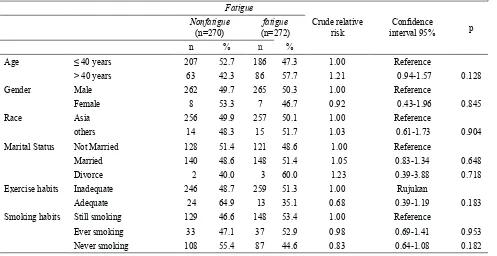
Table 1 presents bivariable relationship between several demographic factors and habits with risk of fatigue. Age of more than 40 years old seem to moderately increase the risk of fatigue (RR=1.21; 95% confidence interval (CI) 0.94-1.57) while adequate exercise (RR=0.68; 95% CI 0.39-3.88) and never smoking (RR=0.83; 95% CI 0.64-1.08) seems to moderately prevent the risk of fatigue.
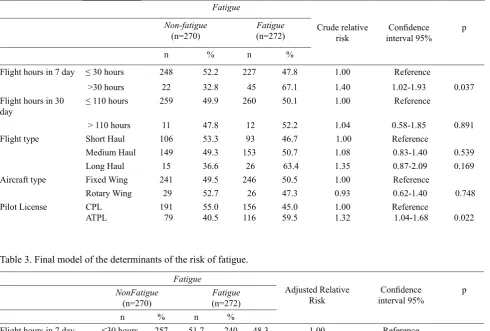
Table 2 shows the bivariable relationship between job characteristics and the risk of fatigue. Pilots who have total flight hours in 7 day exceeding 30 hours and holding ATPL license are at a significantly higher risk of fatigue. Pilots with long haul flight are also compared with medium haul and short haul flight more likely had an increased risk to be fatigue.
Tabel 1. Relationship between several demographic factors and habits with risk of fatigue
Fatigue
Crude relative risk
Confidence
interval 95% p
Nonfatigue
(n=270) (n=272)fatigue
n % n %
Age ≤ 40 years 207 52.7 186 47.3 1.00 Reference
> 40 years 63 42.3 86 57.7 1.21 0.94-1.57 0.128
Gender Male 262 49.7 265 50.3 1.00 Reference
Female 8 53.3 7 46.7 0.92 0.43-1.96 0.845
Race Asia 256 49.9 257 50.1 1.00 Reference
others 14 48.3 15 51.7 1.03 0.61-1.73 0.904
Marital Status Not Married 128 51.4 121 48.6 1.00 Reference
Married 140 48.6 148 51.4 1.05 0.83-1.34 0.648
Divorce 2 40.0 3 60.0 1.23 0.39-3.88 0.718
Exercise habits Inadequate 246 48.7 259 51.3 1.00 Rujukan
Adequate 24 64.9 13 35.1 0.68 0.39-1.19 0.183
Smoking habits Still smoking 129 46.6 148 53.4 1.00 Reference
Ever smoking 33 47.1 37 52.9 0.98 0.69-1.41 0.953
Table 3 shows that three dominant factors (flight hours in 7 days. pilot license and exercise habits) which were related to the risk of fatigue. Compared to those who had flight hours in seven day 30 hours and less. those with flight hours more than 30 hours in seven days had 37% increased risk to be fatigue. Pilots who had ATPL compared with CPL increased 31% the risk of fatigue. Appropriate exercise compared with inappropriate exercise decreased 32% risk of fatigue.
DISCUSSION
This study found a 50.2% risk of fatigue among Indonesian civilian pilots. Flight hours in 7 days, pilot license and exercise habits were the three
dominant factors related to it. There were several limitations of this study. Cross sectional design was not the strongest study design to establish causal relationship, yet it was selected due to its practicality. The fatigue scale is obtained through a self-administered questionnaire and it is subjectively measured. Nevertheless, FSS is a widely used self-reporting questionnaire related to fatigue and its impact on functioning and behavioral aspects in the past week. FSS has good reliability and validity with Cronbach α= 0.85.10 Our study was conducted in the Indonesian Aviation Medical Center, as the only medical center authorized to conduct annual health assessment to pilots in Indonesia. Currently there are more than 7000 civilian pilots based in Indonesia and our study involved a considerable number of them.
Table 3. Final model of the determinants of the risk of fatigue.
Fatigue
Flight hours in 7 day ≤30 hours 257 51.7 240 48.3 1.00 Reference
>30 hours 23 31.1 51 68.9 1.37 1.14-1.65 0.001
Exercise habit was retained in the final model with an Adj RR= 0.68 (95% CI 0.39-1.19; p=0.183) Tabel 2. Relationship between job characteristic with the risk of fatigue
Fatigue
Flight hours in 30 day
≤ 110 hours 259 49.9 260 50.1 1.00 Reference
> 110 hours 11 47.8 12 52.2 1.04 0.58-1.85 0.891
Flight type Short Haul 106 53.3 93 46.7 1.00 Reference
Medium Haul 149 49.3 153 50.7 1.08 0.83-1.40 0.539
Long Haul 15 36.6 26 63.4 1.35 0.87-2.09 0.169
Aircraft type Fixed Wing 241 49.5 246 50.5 1.00 Reference
The percentage of fatigue (Fatigue Severity Scale ≥36) on civilian pilots in this study is higher than previous study by Yuliawaty because this study involved pilots from whole types of flight (short, medium and long haul) mean while Yuliawaty only took the short haul ones. Pilot who had flying hour more than 30 hours in seven days had an increased risk of fatigue (37% higher). These results were similar with the study by Bourgeois-Bougrine in France which revealed that the fatigue scale has increased significantly with an increase in flying hours during the 3 – 4 days flight task.17
ATPL pilots had higher risk of fatigue than CPL (31% higher). These conditions may explain the condition of pilots who had exposure by cosmic radiation. The condition that caused by solar activity and pilot got the radiation continuously because of routinely flight duty.18
Although not statistically significant, appropriate exercise had decreased risk of fatigue (32% lower). This condition may explain the physical fitness of pilots. Exercise might play an important role for cardiorespiratory endurance to achieve the physical fitness that pilots need when working in an environment exposed to intermittent hypoxia during flight periods.7
In conclusion, flying hour more than 30 hours in seven days and holding ATPL license increased the risk of fatigue among civilian pilots in Indonesia.
Acknowledgments
The authors sincerely thank to The Director General of Civil Aviation, Ministry of Transportation for facilitating this study and to all commercial pilots who willingly took time to participate and contribute invaluably in this study.
REFERENCES
1. Doc 9966. Fatigue risk Management System.
Manual for regulators. First Edition. Montreal: ICAO 2012; (1):1-2(2)1-18.
2. Salaazar GJ. Fatigue in Aviation. FAA. Available from: https://www.faa.gov/pilots/safety/pilotsafetybrochures/ media/Fatigue_Aviation.pdf.
3. Caldwell JA. Fatigue in the aviation environment: an overview of the causes and effects as well as recommended countermeasures. Aviat Space Environ Med. 1997;68: 931–937.
4. Fatigue in aviation. Air Line Pilot. NASA Ames Research Centre Human Factors.1994; Nov:22. 5. Printup MB. The effects of fatigue on performance
and safety. http://www.airlinesafety.com (12 August 2005. date last accessed).
6. Reis C, Mestre C, Canhão H. Prevalence of Fatigue in a Group of Airline Pilots. Aviation, Space, and Environmental Medicine. 2013;84(8):828-833. 7. Van Drongelen A, Boot C, Hlobil H, Smid T, van
der Beek A. Risk factors for fatigue among airline pilots. International Archives of Occupational and Environmental Health. 2016;90(1):39-47.
8. Yuliawaty I. Hasil kajian Fatigue Risk Management System: Executive Summary. Balai Kesehatan Penerbangan. Jakarta. 2015
9. Caldwell J, Mallis M,. Caldwell J, Paul M, Miller J, Neri D. Fatigue Countermeasures in Aviation. Aviation. Space. and Environmental Medicine [Internet]. 2009 [cited 8 September 2016];80(1):29-59. Available from: https://www.asma.org/asma/ media/asma/pdf-policy/2009/fatigue-counters.pdf 10. Inne Y, Siagian M, Abudi T, Basuki B. The number
of sectors and other risk factors related to fatigue among shorthaul commercial pilots in Indonesia. journallitbangdepkesgoid [Internet]. 2016 [cited 16 April 2016];6(2):70-71. Availablefrom:http:// ejournal.litbang.depkes.go.id/index.php/HSJI/ article/view/4762/4219.
11. Civil Aviation Safety Regulation 121. Certification and operating requirements: domestic. flag. and supplemental carriers. Jakarta: Republic Indonesia Ministry of Transportation; July 2015. ;13(10 Pt 121). 12. Wasserman DE. International Encyclopedia of
Ergonomics and Human Factors. Human exposure to vibration. 2001;(15)1009-1008.
13. Eraliesa F. Hubungan faktor individu dengan kelelahan kerja pada tenaga bongkar muat
pelabuhan tapak tuan. 2008;(5):51-50.
14. American Heart Association Recommendation for physical activity in adults. Available from http:// www.heart.org/HEARTORG/HealthyLiving/ PhysicalActivity/FitnessBasics/American-Heart- Association-Recommendations-for-Physical-Activity-in-Adults_UCM_307976_Article.jsp#. WQ30_PnyjIW/
15. Bustan M. Epidemiologi penyakit tidak menular. PT Rineka Cipta. Jakarta. 2000.
comparison of models that directly estimate the prevalence ratio. BMC Med Res Methodology. 2003;3(21).
17. Bourgeois-bougrine S, Carbon P, Gounelle C, Mollard R, Coblentz A. Perceived fatigue for short and longhaul flight: A survey of 739 airline pilot. Aviation space environ med. 2003;74(10):1072-7.