Clinical handover: An audit from Australia
Heather Pascoe, Stephen D Gill, Andrew Hughes, Martin McCall-White
Geelong Hospital, Barwon Health
RESEARCH
Please cite this paper as: Pascoe H, Gill SD, Hughes A, McCall-White M. Clinical handover: An audit from Australia.
AMJ 2014;7(9):363–371.
http//dx.doi.org/10.4066/AMJ.2014.2060
Corresponding Author: Dr Heather Pascoe Radiology Department Royal Melbourne Hospital
Corner Grattan Street and Royal Parade, Parkville, Victoria, 3050, Australia Email: [email protected]
ABSTRACT
Background
The Australian National Safety and Quality Health Service (NHQHS) Standards (the “Standards”) provide external criteria for hospitals to assess their practices. Since the introduction of the Standards, no Australian hospital has published a report on how its handover practices compare to these Standards.
Aims
To evaluate house medical officer (HMO) shift-to-shift handover practices against the Standards at a large regional hospital.
Method
All HMOs employed by Barwon Health were invited to participate in our qualitative and quantitative study by completing an online questionnaire and taking part in a focus group.
Results
Of the 100 HMOs, 61 completed the questionnaire and 11 HMOs participated in focus groups. Questionnaire results revealed that HMOs were concerned about the quality of shift-to-shift handovers. Fifty-three per cent reported that current shift-to-shift handover practices could be putting patients at risk of adverse events. Ninety-eight per cent
indicated that the handover processes could be improved. One hundred per cent of the HMOs stated that the quality of handover varies according to the doctors involved. In the focus groups, issues were raised about current handover structure, documentation, attendance, content, and training.
Conclusion
HMOs in the current study identified multiple deficiencies in handover practice with regard to structure, documentation, attendance, content, and training. The primary methods to improve handover include making it more structured and standardised, and to provide HMOs with handover training.
Key Words
Handover, House Medical Officer, Shift-to-shift, Communication, Accreditation
What this study adds:
1. What is known about this subject?
Clinical handover between doctors is a high-risk activity for patient safety. With the reduction in HMO hours to comply with safe working hours, the number of handovers occurring between HMOs has increased. Given this increase, the importance of having a robust handover practice is extremely important. Several international studies have shown that many hospitals do not have clearly defined handover policies and procedures and their practices fall short of those recommended.
2. What new information is offered in this study?
The Australian Commission on Safety and Quality in Health
Care’s (ACSQHC) National Safety and Quality Health Service (NSQHS) Standards (the “Standards”) took effect on 1 January 2013. Since the introduction of these Standards, no Australian hospital has published a report on how their handover practices compare to the NSQHS Standards. This paper is the first to report on HMO shift-to-shift clinical handover practices at a tertiary hospital relative to the NSQHS Standards.
The NSQHS Standards form part of a national safety and quality accreditation scheme for healthcare organisations. Clinical handover should be a quality improvement priority for healthcare services. Based on the findings of the current study, and consistent with the NSQHS Standards, key methods to maximise the safety and effectiveness of handover include:
1. Have specified times and location/s for handover. 2. Have structured and standardised handover
documentation.
3. Develop and teach criteria for “who and what” must be handed over.
4. Set clear and consistent expectations for handover. 5. Provide handover training throughout the clinical
year.
6. Perform handover at the bedside for unstable patients.
Background
Clinical handover is “the transfer of professional
responsibility and accountability for some or all aspects of care for a patient, or group of patients, to another person or
professional group on a temporary or permanent basis”.1 Handovers are vital for safe and effective continuance of care. Clinical handover between doctors is a high-risk activity for patient safety due to the potential for communication errors. Effective clinical handovers can reduce communication errors.2
The Australian Commission on Safety and Quality in Health
Care’s (ACSQHC) National Safety and Quality Health Service
(NSQHS) Standards (the “Standards”)3 took effect on 1 January 2013. The 10 Standards focus on areas considered essential to safe quality care.3 Standard 6 addresses clinical handover and considers three broad areas: governance, practice and processes, and consumer involvement.4 For the first time, the Standards create a national safety and quality accreditation scheme for healthcare organisations.
After-hours house medical officers (HMOs) are usually responsible for managing all ward patients, including patients they are not familiar with. Handovers from the HMOs on the day teams caring for patients to the after-hours HMOs are vital to ensure the latter have the knowledge to safely assume responsibility of patient care. With the reduction in HMO hours to reduce the risk of fatigue-related medical errors as recommended by the Australian Medical Association (AMA), the number of handovers has inevitably increased.5,6 Given this increase, the importance of having robust handover practices is ever
more important and is emphasised by both the AMA and the ACSQHC (in the Standards and the OSSIE Guide to
Clinical Handover Improvement) publishing guides on
clinical handover.2,5,7 Several international studies have shown that many hospitals do not have clearly defined handover policies and procedures,7 and their practices fall short of those recommended.8–14
Since the introduction of NSQHS Standards, and despite much work being done by health services for the purpose of accreditation, no Australian health service has published a report in a peer-reviewed journal on how its handover practices compare to Standard 6. It is likely that all Australian health services will need to make significant changes to their handover practices based on the new national Standards and that lessons learned at one health service could be useful to others. The current study aimed to evaluate “HMO shift-to-shift” clinical handover practices by using the Standards and the OSSIE Guide, in a regional tertiary hospital.
Method
Setting
The study was conducted at a 432-bed regional Victorian teaching hospital, which provides a full range of inpatient and outpatient services apart from transplantation and neurosurgery to around 500,000 people.15 In 2013, 100 HMOs (defined as medical officers completing a prevocational training program) were employed in more than 30 specialties.
On weekdays there are three HMO shifts: day, evening, and night. Day medical and surgical speciality teams hand over to six evening HMOs, who hand over to three night HMOs. On weekends there are only day and night shifts. There is a rostered 30-minute shift overlap at all shift changes.
Interns attend a one-week orientation session at the start of their employment that includes basic information on how and when to hand over, including ISBAR (Identify, Situation, Background, Assessment and Recommendation), an internationally recognised verbal handover tool,16 and Blue BARRWUE (Background, Alerts, Resuscitation status, Requests, Who to do what and when, Updates and Executable discharge plan), a locally developed electronic handover tool.17 Other doctors that are new to Barwon Health attend a one-day orientation session during which the same handover information is also provided.
Participants
invited to participate in the study (n=100).
Data collection
HMOs were invited via email to: 1) complete an online questionnaire; and 2) participate in a focus group. The study focused only on HMO medical and surgical shift-to-shift handovers. It did not include handovers between the emergency department and the ward, or within obstetrics and gynaecology, because these areas use handover practices unique to their units or the handovers are not shift-to-shift. Referrals to the medical imaging department were excluded.
Questionnaire
Two of this study’s authors, Heather Pascoe (HP) and Stephen Gill (SG), developed the questionnaire to capture
HMOs’ views of current handover practices within Barwon Health. The ACSQHC’s OSSIE Guide to Clinical Handover
Improvement includes methods to evaluate an
organisation’s clinical handover practices, and was used to
help design the questionnaire. The questionnaire was pilot tested for face validity, structure, and comprehensibility by three senior clinical staff (Director of General Medicine, Professor of Nursing, and the Director of Service Reform & Innovation) and three HMOs. Feedback was used to modify the questionnaire. Completion of the questionnaire was voluntary and anonymous.
Focus groups
Semi-scripted focus groups were held after HMOs had completed the questionnaire. The focus groups explored the questionnaire findings and discussed: handover governance; the strengths and weaknesses of current handover practices; consumer involvement; and what an ideal handover process would entail. Discussions were led by SG, who had experience conducting focus groups, and facilitated by HP, who scribed during the sessions to capture non-verbal communication and group interactions such as
group agreement to an individual’s comment. Sessions were
audio recorded. Focus group participants provided written consent.
Data analysis
Questionnaire data was analysed with descriptive statistics using Microsoft Excel. Focus group data were anonymised and transcribed verbatim. Transcripts were read independently, line-by-line, by the authors (HP, SG) to identify concepts and ideas. The ideas were then grouped into categories of related information using the principles of thematic analysis.18 A written summary of the researchers’ interpretations was then emailed to all participants to check
that it accurately reflected participants’ views—all participants agreed that it did.
Results
Questionnaire
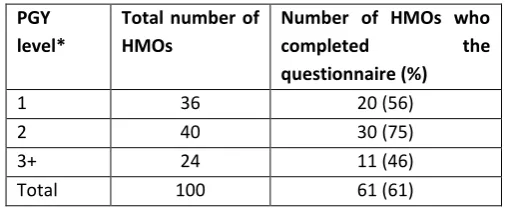
Sixty-one HMOs (61 per cent) who were at different post-graduate levels completed the questionnaire (Table 1).
Table 1: Questionnaire participants according to PGY level PGY
level*
Total number of
HMOs
Number of HMOs who
completed the
questionnaire (%)
1 36 20 (56)
2 40 30 (75)
3+ 24 11 (46)
Total 100 61 (61)
*PGY = post-graduate year
Focus groups
Two focus groups were conducted. Six HMOs were in one group and five were in the other (Table 2).
Table 2: Focus group participants according to PGY level
PGY level*
Total number of HMOs
Number of HMOs who participated in a focus group (%)
1 36 3 (8)
2 40 6 (15)
3+ 24 2 (8)
Total 100 11 (11)
*PGY = post-graduate year
Governance of handover
Quality of handover
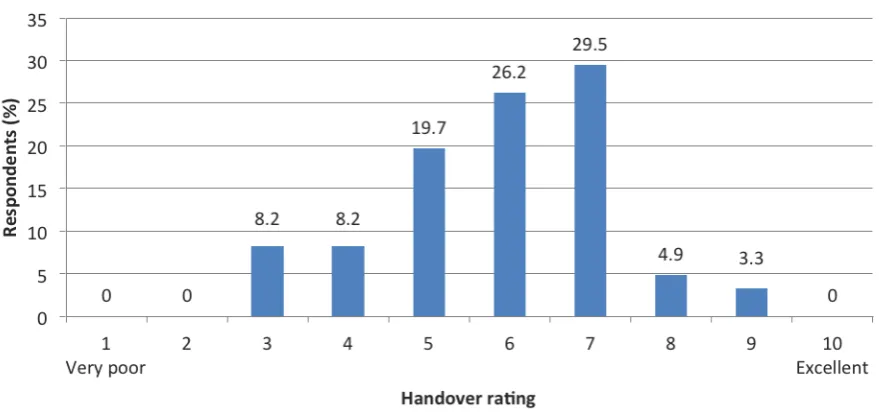
Almost all questionnaire respondents (98 per cent) indicated that handover processes needed improving. On average, HMOs rated handover practices six out of 10 (Figure 1).
Approximately half the responding HMOs (53 per cent) indicated that current HMO shift-to-shift practices led to errors in patient management, and a similar percentage (52 per cent) thought that current handover practices were inefficient. All HMOs reported that the quality of shift-to-shift handover varied according to the doctors involved and 97 per cent stated that shift-to-shift handover was “rarely” or “sometimes” supervised by a senior doctor.
Thirteen per cent of HMOs reported having received training on how to conduct handover at our health service and 20 per cent of HMOs had received training elsewhere.
Focus group data indicated that all participants wanted more handover training. One participant said: “I think there is an assumption that doctors have the knowledge to know
[how to handover] already”. An intern stated: “early on I
think [the handover process] feels a bit like a fog”. The
majority of participants reported learning how to conduct a handover on the job, and voiced that they did not actually know if what they were doing was right. They felt that training on how to perform handover would be most useful as part of orientation for each rotation, and that a training session at the beginning of the year was less helpful as they would forget the information by the time they needed to use it, and it was not relevant to the specific rotation that they were doing. Participants reported that interactive, practice-based training involving “real-life” scenarios, rather than didactic lectures, would be the most effective training.
Almost all questionnaire respondents (97 per cent) stated that shift-to-shift handover was “rarely” or only
“sometimes” supervised by a senior doctor. Focus group participants felt that it would be valuable to get more advice from registrars and consultants as to who and what to hand over—“I think a registrar should have input. That
doesn’t always happen”.
Expectations and rules for handover
Few focus group participants reported having been told by the hospital what was expected of them regarding shift-to-shift handovers. All participants felt strongly that having expectations and clearly defined rules for shift-to-shift handover would be valuable—“I think rules and what the
expectations are [should be clear]”. Without them, practice
varies and it is difficult to hold staff accountable for their behaviour.
Practice of handover
Location and time of handover
Eighty-nine per cent of questionnaire respondents indicated that the current handover location (HMO quarters) is the most appropriate location for handover. Focus group participants indicated that the HMO quarters was preferred for handovers as it was a centralised location that was accessed by most HMOs, particularly at the start or end of a shift, and allowed patient confidentiality to be respected. However, attendance of teams for the morning handover was variable. Some teams did not attend HMO quarters for morning handover, and other teams, such as general
medicine, would meet in their team’s office. Evening and
night shift HMOs commonly attended handover, but 84 per cent of questionnaire respondents reported that day HMOs attended morning handovers “half the time” or less. Evening HMOs gave varied questionnaire responses when asked if they received handovers from day HMOs: 8 per cent stated that they “rarely” received handovers from day HMOs, 29 per cent said they “sometimes” did, 25 per cent stated that they received handovers “half the time”, and another 25 per cent that they “frequently” did. Only 13 per cent stated they “almost always” received handovers. Focus group data indicated that HMOs were frustrated by the time wasted chasing up HMOs who did not attend handover. Failure to attend handover was often due to conflicting commitments at handover times.
Face-to-face handovers, not phone or email handovers,
were considered the “gold standard” due to more efficient
and effective transfer of information and the opportunity to clarify information—“It’s a good opportunity for them [the doctor commencing] to really grasp what’s going on… there
are two people present, so it’s not like you are on the phone, it’s not like you are trying to text them, they can ask you questions”.
Bedside handover was considered the ideal location to hand over the sickest patients as it allowed the incoming HMO to see and talk to the patient, refer to the notes, and converse with nursing staff. A minority of HMOs were already doing bedside handover and commented: “I think for those really big red flag ones [that bedside handover is useful], for the one or two patients that are going to give you grief
overnight.” All focus group participants agreed that bedside
handover was logistically impossible to do for all patients, given that one HMO is covering multiple units on different wards.
Who and what to handover
Seventy-five per cent of questionnaire respondents indicated that they at least “frequently” found it easy to decide which patients to hand over. Despite this, 84 per cent reported at least “sometimes” encountering problems during their cover shifts that they believed were related to poor handover; 94 per cent of HMOs were at least
“sometimes” paged during cover shifts to review patients who they would have liked to have been forewarned about during handover. Almost 40 per cent of respondents indicated that necessary information was missing from handovers they received at least “half the time” (Figure 2). HMOs were frustrated when they received an inadequate
[handover content] varies…. it’s done really well on some
occasions and very poorly on others”. HMOs stated they
would like to be forewarned about unstable patients—“I
find it really useful when I’m receiving handovers for [the outgoing doctor] to say ‘This is a patient for you to be aware of’. An FYI if you like”.
Handover documentation
Seventy-seven per cent of questionnaire respondents indicated that their handover notes are comprehensive and organised at least “half the time” and yet, 69 per cent reported at least “sometimes” finding it challenging to keep track of the information they were handed over. Focus groups revealed that HMOs recorded handover information on blank sheets of paper, which was problematic because: notes could be disorganised, incomplete, and hard to refer back to; you could lose track of what tasks had been completed; and you could forget to hand over jobs/patients at shift changes.
Participants felt that a handover template to prompt and document information would be useful. One participant stated that having a handover template would “give you some structure to record information during handover so
that even when you’re busy, it’s the middle of the night or you’re doing something [else], you don’t forget [outstanding tasks]”. A handover template would include patient
identifiers, problems, plans, outstanding tasks, and risks. Several focus group participants mentioned using the Blue BARRWUE system for shift-to-shift handover,17 which they felt was useful during weekends when rung unexpectedly about a patient, but was less useful for flagging sick patients or recording jobs that needed to be done on weeknights. Recording handover notes electronically was considered a good way of keeping a permanent record of handover and this was an advantage of both Blue BARRWUE17 and electronic task boards.
Consumer involvement
Focus group participants discussed involving patients and family in shift-to-shift handover by undertaking bedside handover where possible. Bedside handover enabled patients and family to: clarify their medical history, presenting complaints, and progress made; ask questions; and be informed about treatment and discharge plans. Bedside handover could result in more accurate and complete information exchange while respecting a patient’s right to be involved in his/her care. Having time to complete bedside handover was considered the principle barrier to completing bedside handover.
Discussion
Standard 6 of the NSQHS Standards aims to “ensure there is timely, relevant and structured clinical handover that
supports safe patient care”.4 Standard 6 criteria include: having clinical handover protocols, tools, and guides; establishing and maintaining structured and documented process for clinical handover; monitoring and evaluating the handover process; and implementing mechanisms to include patients and carers in the handover process. All of these elements were assessed in the current study.
The results of the current study indicate that HMOs believed that current junior doctor shift-to-shift handover practices could be improved. Our results are similar to another Australian study that found doctor shift-to-shift handover was unstructured, informal and error prone; 95 per cent of the 74 respondents did not identify a formal procedure for after-hours handover and doctors reported being unaware of unstable patients until they were paged to review them.11 Internationally, deficiencies in handover are commonly reported.8–14 Horwitz et al.10 found that adverse events occurred when key information was omitted during handovers to night doctors. In 503 night handovers, Horwitz et al. found 24 adverse events that could have been attributed to handover inadequacies. The key information
omitted during the handovers included the patient’s clinical
condition, recent or scheduled events, tasks to complete, anticipatory guidance, a specific plan of action, and rationale for assigned tasks.
In 2009, the Society of Hospital Medicine in the United States developed recommendations for handovers that are applicable in both community and hospital settings.12 A principal recommendation was having a formally recognised handover plan at shift changes. Having a structured and standardised plan helps ensure that all the necessary information is handed over to the correct people. Studies have shown that standardising content and process during
intern handovers improved junior doctors’ ability to transfer
customisation of handover processes to meet the needs of different groups within the health service might represent prudent “middle ground” between standardised and individualised approaches to handover.22 Furthermore, implementing a handover tool such as ISBAR, without considering the broader, multifaceted context of effective communication, such as when and where handover occurs, how handover information is documented, and teamwork, might not yield substantial or sustainable practice change.
Structured handover procedures create clear expectations for staff. HMOs in the current study reported that expectations of them were not clear, which could result in variable handover practices across the organisation, and might explain why all HMOs reported that the quality of handover varied according to the personnel involved.
HMOs reported that a structured handover template would be useful as many found it challenging to keep track of the information handed over to them. Participants reported that not only would a handover template help them organise information in a coherent way, but it would also serve as a prompt during handover sessions to ensure all the necessary information was conveyed. McCann et al.13 surveyed junior doctors regarding handover and found that they considered a standardised handover sheet as the most effective way to improve handover. Written handover templates have resulted in more accurate information transfer than if free-text is used.23–25 Standardised templates in the trauma setting increased the handover of necessary information from 73 per cent with handwritten data on plain paper to 93 per cent with the use of a standardised template.26 The introduction of a standardised
“sign-out” sheet within a general medical ward resulted in significant improvement in the completeness and effectiveness of handovers between night and day interns, and day teams perceived that there were significantly fewer errors by the night interns.20
As a result of our study, a shift-to-shift handover guideline has been implemented, including a standardised handover form. This includes a mnemonic for which patients should be handed over (“JUMP”13 into handover adapted from McCann et al.13):
J = Jobs to be completed
U = Unseen/Unstable patients,
M = MET calls27
P = Patients/Problems to be aware of
Junior doctors are encouraged to include handover notes in the organisation’s electronic data management system to create a retrievable and auditable written handover.
Despite all of our HMOs receiving basic handover training at induction, only 13 per cent of questionnaire respondents recalled this, and almost all HMOs wanted more training. Other studies have also found that junior doctors report receiving little, if any, formal handover training.8,28–30 Chu et al.19 implemented a structured handover training program for interns. After attending the program, interns reported that their knowledge of the handover process and their ability to transfer the care of their patients improved significantly. In a qualitative study exploring the views of doctors (from junior doctors through to consultants) on shift handovers,28 junior doctors were able to describe the skills necessary for effective handovers but senior staff reported them having difficulty putting the skills into practice.28 As suggested by participants in our study, providing interactive, practice-based handover training would be beneficial to allow implementation and consolidation of knowledge. As a result of this feedback, our organisation is redesigning HMO handover training to make learning interactive and practice based.
A core component of the NSQHS Standards is establishing ways to include patients, family, and carers in clinical handover. Several of our study’s participants suggested bedside handover should be conducted for the sickest and most complex patients because it would provide HMOs with the opportunity to see the patient, allow the patient to actively participate in handover, and facilitate teamwork and communication. Patients prefer bedside handover because it is interpersonal and interactive, and allows them to know and meet who is caring for them.31 Nurses reported improved safety, efficiency, and teamwork when handovers were performed at the bedside compared to a handover room.32 Doctors have insufficient time to complete bedside handover for all patients; completing bedside handover for the sickest patients and their carers appears to be a sensible compromise between not completing bedside handover at all, and completing bedside handover for all patients.
given that almost 50 per cent of each post-graduate year level responded, our results are likely to approximate the views of all HMOs. Finally, the comprehensiveness of the issues raised by focus group participants is uncertain, but given the close working relationship between HMOs, participants’ views as well as those of their peers were raised in the focus groups.
Conclusion
The implementation of the NSQHS Standards and the national accreditation scheme necessitates that hospitals assess their current handover practices and improve them as required. HMOs in the current study identified multiple deficiencies in handover practice with regard to structure, documentation, attendance, content, and training. The primary methods to improve handover include making handover more structured and standardised, and to provide HMOs with more relevant and effective practice-based handover training.
References
1. National Patient Safety Agency. Safe handover: safe patients. Guidance on clinical handover for clinicians and managers. London: British Medical Association/National Patient Safety Agency/NHS Modernisation Agency 2004.
2. Australian Commission on Safety and Quality in Health Care. Implementation Toolkit for Clinical Handover improvement. Sydney. ACSQHC, 2011.
3. Australian Commission on Safety and Quality in Health Care. National Safety and Quality Health Service Standards. Sydney. ACSQHC, 2011.
4. Australian Commission on Safety and Quality in Health Care. Safety and Quality Improvement Guide Standard 6: Clinical Handover (October 2013). Sydney. ACSQHC, 2012.
5. Australian Medical Association. Safe handover: safe patients. Guidance on clinical handover for clinicians and managers. Canberra: AMA, 2006.
6. Australian Medical Association Ltd. National Code of Practice – Hours of Work, Shiftwork and Rostering for Hospital Doctors. January 2005.
7. Australian Commission on Safety and Quality in Health Care. OSSIE Guide to Clinical Handover Improvement. Sydney. ACSQHC, 2010.
8. Al-Benna S, Al-Ajam Y, Alzoubaidi D. Burns surgery
handover study: Trainees’ assessment of current
practice in the British Isles. Burns. 2009 Jun;35(4):509-12.
9. Shafiq-ur-Rehman, Mehmood S, Ahmed J, Razzaq MH, Khan S, Perry EP. Surgical Handover in an Era of Reduced Working Hours: An Audit of Current Practice. J Coll Physicians Surg Pak. 2012 Jun;22(6):385-8.
10. Horwitz LI, Moin T, Krumholz HM, Wang L, Bradley EH. Consequences of inadequate sign-out for patient care. Arch Intern Med. 2008 Sep 8;168(16):1755-60.
11. Bomba DT, Prakash R. A description of handover processes in an Australian public hospital. Aust Health Rev 2005;29(1):68–79.
12. Arora VM, Manjarrez E, Dressler DD, Basaviah P, Halasyamani L, Kripalani S. Hospitalist handoffs: a systematic review and task force recommendations. J Hosp Med 2009;4(7):433–40.
13. McCann L, McHardy K, Child S. Passing the buck: clinical handovers at a New Zealand tertiary hospital. N Z Med J 2007;120:56–65.
14. Siemsen IM, Madsen MD, Pedersen LF, Michaelsen L, Pedersen AV, Andersen HB, Østergaard D. Factors that impact on the safety of patient handovers: An interview study. Scand J Public Health. 2012 Jul;40(5):439-48. 15. Barwon Health. Barwon Health Service profile.
(Accessed 2013 Nov 1). Available at:
http://www.barwonhealth.org.au/about-us/column-2/service-profile.
16. Eggins S, Slade D. Clinical handover as an interactive event: informational and interactional communication strategies in effective shift-change handovers. Commun Med 2012;9(3):215–27.
17. Rao BS, Lowe GO, Hughes AJ. Reduced emergency calls and improved weekend discharge after introduction of a new electronic handover system. Med J Aust 2012;197(10):569–73.
18. Liamputtong P. Qualitative Research Methods. South Melbourne: Oxford University Press Australia and New Zealand; 2009.
19. Chu ES, Reid M, Schulz T, Burden M, Mancini D, Ambardekar AV, Keniston A, Albert RK. A Structured Handoff Program for Interns. Acad Med. 2009 Mar;84(3):347-52.
20. Salerno SM, Arnett MV, Domanski JP. Standardized sign-out reduces intern perception of medical errors on the general internal medicine ward. Teach Learn Med 2009;21(2):121–26.
Sensitive Health Informatics: Human and Sociotechnical Approaches 2013;194:48.
23. Grainge C, Traer E, Fulton J. Do weekend plan standard forms improve communication and influence quality of patient care? Postgrad Med J 2005;81(958):524–25. 24. Thompson A, Jacob K, Fulton J, McGavin C. Do post-take
ward round proformas improve communication and influence quality of patient care? Postgrad Med J 2004;80(949):675–6.
25. Lee LH, Levine JA, Schultz HJ. Utility of a standardized sign-out card for new medical interns. J Gen Intern Med 1996;11(12):753–5.
26. Ferran NA, Metcalfe AJ, O'Doherty D. Standardised proformas improve patient handover: Audit of trauma handover practice. Patient Saf Surg 2008;2:24–8. 27. Bellomo R, Goldsmith D, Uchino S, Buckmaster J, Hart
GK, Opdam H, Silvester W, Doolan L, Gutteridge G. A prospective before-and-after trial of a medical emergency team. Med J Aust. 2003 Sep 15;179(6):283-7.
28. Cleland J, Ross S, Miller S, Patey R. “There is a chain of
Chinese whispers…”: empirical data support the call to
formally teach handover to prequalification doctors. Qual Saf Health Care 2009;18(4):267–71.
29. Horwitz LI, Moin T, Green ML. Development and implementation of an oral sign-out skills curriculum. J Gen Intern Med 2007;22(10):1470–4.
30. Australian Medical Association. Opportunities and Impediments to flexibility. Report on consultations with key stakeholders on flexibility in medical training and work practices. 2003.
31. Bradley S, Mott S. Adopting a patient‐centred approach: an investigation into the introduction of bedside handover to three rural hospitals. J Clin Nurs 2014;23(13-14):1927–36.
32. Chaboyer W, McMurray A, Johnson J, Hardy L, Wallis M. Bedside handover; Quality improvement strategy to transform care at the bedside. J Nurs Care Qual 2009;24(2):136–42.
ACKNOWLEDGEMENTS
The current research was undertaken as part of the junior doctor redesign program at Barwon Health. The authors gratefully acknowledge the support of Professor Trisha Dunning, Chair in Nursing, Barwon Health, the staff within
Barwon Health’s Service Redesign Unit, and the HMOs who participated in the study.
PEER REVIEW
Not commissioned. Externally peer reviewed.
CONFLICTS OF INTEREST
The authors declare that they have no competing interests.
ETHICS COMMITTEE APPROVAL
Figure 1: Overall handover rating (out of 10)