Urban Elementary STEM Initiative
Carolyn Parker The Johns Hopkins University
Yolanda Abel
The Johns Hopkins University
Ekaterina Denisova Baltimore City Public Schools
The new standards for K–12 science education suggest that student learning should be more integrated and should focus on crosscutting concepts and core ideas from the areas of physical science, life science, Earth/space science, and engineering/technology. This paper describes large-scale, urban elementary-focused science, technology, engineering, and mathematics (STEM) collaboration between a large urban school district, various STEM-focused community stakeholders, and a research-focused private university. The collaboration includes the development of an integrated STEM curriculum for grade K–5 with accompanying teacher professional development. This mixed-methodology study describes findings from focus group interviews and a survey of teachers from Title I elementary schools. Findings suggest the importance of the following critical features of professional development: (a) coherence, (b) content focus, (c) active learning, (d) collective participation, and (e) duration to the success of large-scale STEM urban elementary school reform
Recent data suggest that many U.S. K–12 students are not well prepared for our future science and technology-focused world economy. Although employer demand for skilled science, technology, engineering, and mathematics (STEM) workers is at its highest level in many years, the United States is currently ranked 27th in the world for producing STEM college graduates, and U.S. students’ interest and academic performance in STEM fields remain weak (Change the Equation, 2012). It is thus critical to engage and excite more students in STEM disciplines. Moreover, racial and ethnic minority populations are pro-jected to expand substantially over the coming decades. Recruiting more people from traditionally underrepre-sented groups is imperative for meeting the demand for qualified STEM workers (Center for Public Education, 2012).
However, according to the 2011 data from the National Assessment of Educational Progress (NAEP), the STEM student achievement for K–12 students is not promising. Approximately 73% of U.S. eighth graders were not pro-ficient in mathematics at the end of eighth grade. In science, 62% of U.S. eighth graders were not proficient at the end of eighth grade. Moreover, there are significant achievement gaps between student populations. Historical evidence from the NAEP suggests that groups of students are being left behind and that there is a “science educa-tion achievement gap” between White and Asian/Pacific Islanders and Black and Hispanic students (National Assessment of Educational Progress [NAEP], 2011). The most recent results of the NAEP exam revealed that White
students received an average score of 163. Asian/Pacific Islander students scored an average of 159. However, His-panic and Black students’ scores trailed. HisHis-panic students scored an average of 137, whereas Black students’ average score was 129.
This integrated approach is an intentional departure from the way typical instruction and accompanying professional development is planned and delivered (Herschbach, 2011; Labov, Reid, & Yamamoto, 2010). Typically, in K–12 schools, subjects such as science, technology, engineering, and math have been taught as separate disciplines and not integrated in ways that dem-onstrate interdisciplinary relationships (Kuenzi, 2008). However, the separation of disciplinary knowledge and processes does not reflect the outside-of-school contexts where knowledge is integrated and applied from across fields of study (Herschbach, 2011). In practice, integrated curriculum and instruction embeds interrelationships within and between disciplines, replicating how knowl-edge is actually used in our day-to-day lives outside the K–12 setting.
A Large Urban District Context
A large urban district is the context of this study. The district enrolls approximately 85,000 students, with almost 45,000 enrolled in grades K–5. About 85% of the district’s students are African American, 8% are White, 5% are Hispanic/Latino, and only 1.0% are Asian. Of the students, 84% are considered low-income, based on eligibility for free or price-reduced meals.
In the district, students underperform in statewide STEM assessments when compared with peers across the state. In statewide mathematics assessments, 2010 data indicate that only 74.0% of fifth-grade students scored at the proficient or advanced level, compared with the state-wide average of 83%. In science, only 39.4% of the dis-trict’s students scored at the proficient or advanced level, compared with the state average of 65.9%. When these data are disaggregated by race, the results are even more alarming. Only 33.2% of African American students scored at a proficient or advanced level on the fifth-grade state mathematics examination. And, only 14.3% of fifth-grade students with limited English proficiency scored at the proficient or advanced level in mathematics.
In December 2010, acknowledging that the district’s students were struggling on the state’s math and science examinations, the district’s leadership turned their atten-tion to the development of an integrated STEM educaatten-tion approach as a way to improve student achievement. An integrated approach at the elementary level is supported by recent research. Cotabish, Dailey, Robinson, and Hughes (2013) found that elementary-aged, general edu-cation students of teachers who employed rigorous curriculum and inquiry-based instruction supported by intensive professional development showed statistically
significant gains in science process skills, science con-cepts, and science-content knowledge when compared with students in a comparison group.
Supported by science education and engineering faculty at a local university, private STEM education stakeholders, and an outside vendor, five integrated STEM units were developed for each elementary grade level: one in life science, one in physical science, one in Earth/space science, and one in environmental science. To connect the new science ideas and math skills, each grade level’s sequence culminated with an engineering design challenge. Each STEM unit follows the 5E learning cycle and focuses on science explorations, while providing full math and technology integration. With only 73.6% of third graders reading at or above grade level (Maryland State Department of Education, 2010), the district administra-tors identified the students’ ability to read informational text and engage in argument writing as an area of aca-demic weakness. Therefore, in order to focus on the reading of informational text and argument writing, the new STEM units follow a “bookend approach.” Each unit begins with a book to engage the students in the explora-tion of a science idea. The non-ficexplora-tion book is followed by a series of hands-on explorations, which allow the students to explore the scientific concepts and topics introduced in the non-fiction text. Finally, students engage in reading a non-fiction title, which confirms or disputes each student’s hands-on, experimental findings. The unit culminates with students using scientific argumentation to dispute or support their experimental findings.
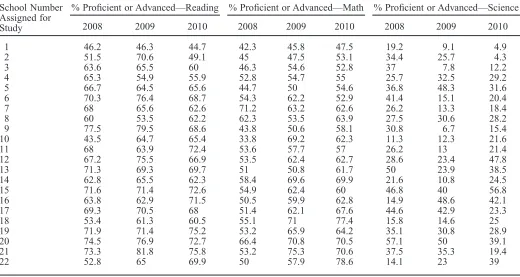
The district’s newly developed STEM curriculum concept was presented to the administrators of the dis-trict’s elementary schools. Administrators from 22 schools agreed to adopt the curriculum. The schools were all underperforming and demonstrated inconsistent progress toward improvement. In the three years preceding the study, at least 25% of students at each of the 22 schools scored at the basic level on the state’s mathematics assess-ment, and more than half of each school’s fifth graders scored at the basic level on the state’s science assessment. Historical achievement data for each school can be found in Table 1, which summarizes three years of state achieve-ment data for the 22 schools that impleachieve-mented the STEM curriculum.
city’s youth while allowing teachers to explore and gain experience in STEM teaching, without the academic year pressures around standardized testing.
Six teachers from each of the 22 schools agreed to participate in the summer STEM program. Each building’s administrator identified teachers who were interested in the program and were available to work over the summer.
Each teacher received two weeks of professional devel-opment immediately preceding the summer school imple-mentation. The professional development focused on the content and pedagogy of the STEM curriculum. Teachers were grouped by the grade level that they would teach over the summer and in the subsequent school year. Led by a STEM master teacher from the district’s central office, the teachers were led through every investigation included in their grade-level curriculum. Following the two weeks of the professional development component, each participant was given the opportunity to teach the STEM modules to summer school students. The summer school program was offered at each of the 22 identified schools for three hours a day, five days a week, for four weeks. This resulted in a total of 60 hours of instruction.
In addition, as the curriculum was being implemented during summer school, in-class support, which consisted of the assignment of a STEM coach to each school for every summer school day, was provided. The STEM coach
supported six teachers, grades K–5, who were implement-ing the summer school STEM program. The support of the coaches varied depending on the needs of the teachers, but included co-teaching, observing lessons, and helping teachers reflect on their STEM instructional practices. Coaches also provided assistance with lesson planning and connected teachers with instructional resources. Further, the coaches met with all of their building’s STEM summer school teachers as a group to reflect on the effectiveness of the STEM program at their school. In addition to the school-based coaches, the teachers met on Thursday after-noons for three hours. During the Thursday afternoon ses-sions, the teachers from the 22 schools met in grade-level groups to discuss the successes and pitfalls of the imple-mented summer STEM program.
Research Questions
The study was framed around the following research questions:
1. How did the teachers describe their experiences with the two-week professional development that prepared them to teach in the six-week STEM summer school curriculum? 2. What aspects of the professional development and subsequent summer school program supported the teachers in the enactment of the STEM curriculum during summer school?
Table 1
State Achievement Data for the 22 Schools that Implemented the STEM Curriculum
School Number Assigned for Study
% Proficient or Advanced—Reading % Proficient or Advanced—Math % Proficient or Advanced—Science
2008 2009 2010 2008 2009 2010 2008 2009 2010
1 46.2 46.3 44.7 42.3 45.8 47.5 19.2 9.1 4.9
2 51.5 70.6 49.1 45 47.5 53.1 34.4 25.7 4.3
3 63.6 65.5 60 46.3 54.6 52.8 37 7.8 12.2
4 65.3 54.9 55.9 52.8 54.7 55 25.7 32.5 29.2
5 66.7 64.5 65.6 44.7 50 54.6 36.8 48.3 31.6
6 70.3 76.4 68.7 54.3 62.2 52.9 41.4 15.1 20.4
7 68 65.6 62.6 71.2 63.2 62.6 26.2 13.3 18.4
8 60 53.5 62.2 62.3 53.5 63.9 27.5 30.6 28.2
9 77.5 79.5 68.6 43.8 50.6 58.1 30.8 6.7 15.4
10 43.5 64.7 65.4 33.8 69.2 62.3 11.3 12.3 21.6
11 68 63.9 72.4 53.6 57.7 57 26.2 13 21.4
12 67.2 75.5 66.9 53.5 62.4 62.7 28.6 23.4 47.8
13 71.3 69.3 69.7 51 50.8 61.7 50 23.9 38.5
14 62.8 65.5 62.3 58.4 69.6 69.9 21.6 10.8 24.5
15 71.6 71.4 72.6 54.9 62.4 60 46.8 40 56.8
16 63.8 62.9 71.5 50.5 59.9 62.8 14.9 48.6 42.1
17 69.3 70.5 68 51.4 62.1 67.6 44.6 42.9 23.3
18 53.4 61.3 60.5 55.1 71 77.4 15.8 14.6 25
19 71.9 71.4 75.2 53.2 65.9 64.2 35.1 30.8 28.9
20 74.5 76.9 72.7 66.4 70.8 70.5 57.1 50 39.1
21 73.3 81.8 75.8 53.2 75.3 70.6 37.5 35.3 19.4
22 52.8 65 69.9 50 57.9 78.6 14.1 23 39
3. What aspects of the professional development and subsequent summer school program created barriers for the teachers as they enacted the STEM curriculum during summer school?
4. What were some of the supports and barriers to the enactment of the STEM curriculum during the academic year?
Professional Development
Darling-Hammond (2010) suggests that student learn-ing is mostly influenced by teacher quality. Moreover, professional development is a necessity for enhancing teachers’ pedagogical content knowledge, classroom prac-tices, and overall teacher quality (Colbert, Brown, Choi, & Thomas, 2008). Recent research supports the idea that “reform-oriented” professional development is generally more effective than the more traditional one-time work-shop professional development and includes being mentored and coached, participating in a study group, and/or engaging in an internship (Garet, Porter, Desimone, Birman, & Yoon, 2001; Loucks-Horsley, Stiles, Mundry, Love, & Hewson, 2009; Penuel, Fishman, Yamaguchi, & Gallagher, 2007; Putnam & Borko, 2000). Little (1993) hypothesized that sustained professional development was more effective than the traditional one-time workshops, as it allowed teachers to explore new concepts and teaching strategies in greater depth.
Penuel et al. (2007) focused more on the design of activities included in the professional development— specifically on the “proximity to practice”—with an understanding that supporting teachers to prepare for their own classroom practices would most readily allow them to translate the professional development to their individual classrooms (Kubitskey & Fishman, 2006). Fishman, Marx, Best, and Tal (2003) suggested that “site-based” or “curriculum-linked” professional development prepared teachers more effectively, as they embedded the profes-sional development in instructional practice and curricu-lum enactment. And, site-based professional development, such as coaching, focused teachers’ attention on how to use materials, enact the curriculum as intended, and administer assessments (Veenman & Denessen, 2001).
Analytic Framework
The analytic framework that guided our work was derived from Desimone’s (2009) Critical Features of Pro-fessional Development, which reflects a consensus of characteristics of teacher professional development that educational researchers and practitioners believe are necessary for increasing teacher knowledge and skills.
Desimone’s five critical areas of professional development are: (a) coherence, (b) content focus, (c) active learning, (d) collective participation, and (e) duration.
Desimone (2009) describes the importance of coherence, which she describes as the alignment of federal, state, district, and school policies, with the content of the profes-sional development. Coherence supports a consistent message of reform to school administrators and teachers.
Professional development that is content-driven, and that explicitly links activities focusing on subject matter content and how K–12 students engage with that content, are crucial to enhancing teachers’ instructional practice and students’ growth and achievement. Desimone (2009) contends that the content focus of teaching may be the most influential component of a professional development offering. Simply stated, teachers must deeply understand the content that they are to teach. Active learning provides an opportunity to observe expert teachers or to be observed, with some sort of interactive follow-up, such as reviewing student work or leading and/or participating in discussions with peers. Content focuses supported with active learning are necessary for successful professional development.
Another critical component of Desimone’s (2009) framework is the notion that teachers from the same grade level, school, or department must be brought together to collaborate toward the objectives of the professional development. This intentional interaction enables educa-tors to meaningfully discuss and reflect on the important themes of the professional development.
Finally, according to Desimone (2009), gone should be the days of one-shot professional development offerings. Although Desimone does not prescribe the length of a professional development opportunity, she suggests that it must be of sufficient duration to support teachers’ intel-lectual and pedagogical changes.
By utilizing Desimone’s (2009) framework, our research helps to advance the premise that a common professional development conceptual framework would increase the impact on teachers’ practice and, ultimately, on students’ growth and achievement.
Study Design
with the mentoring and coaching, the grade-level meetings that occurred on Thursday afternoons, and how they anticipated the rollout of the curriculum during the aca-demic year. We asked the teachers to comment on strengths, weakness, and areas of improvements across various domains of the professional development. All interviews were recorded and transcribed. All participants’ responses are reported using pseudonyms to ensure the anonymity of each teacher.
A grounded theory approach was used to code teachers’ focus group interviews (Glaser & Strauss, 1967). Four analytic categories emerged from the initial coding: (a) coaches, (b) Thursday PD, (c) weaknesses in PD, and (d) positives in PD. Memo was used to make comments and suggest categories based on teachers’ responses. As the memo process continued, constant comparison was used to determine codes and align with appropriate data state-ments. This second round of coding generated two major core categories or themes: helpfulness and barriers. The sorting process identified four sub-codes for helpfulness and three for barriers. These major themes and subcodes were then used to begin the line-by-line analysis of the Thursday PD data. The core categories that emerged from the Thursday PD data were reflective practitioner and frus-tration. The core category of reflective practitioner has three supporting subcodes and frustration has four subcodes. As these core categories were generated, memo was also used to begin situating them within Desimone’s (2009) analytic framework. At this juncture in the coding process, there were 4 core categories and 14 subcodes. These codes were used in the initial line-by-line analysis for the weaknesses in PD data. The major category of reflective practitioner and two of its corresponding subcodes were supported by the data. One new subcode, disposition, was generated in this data set. This added an additional subcode for a total of 15. A new core category of preparation emerged from this data set and was sup-ported by six new subcodes. So, for the last set of data, positives in the PD, there were 5 core categories and 21 subcodes, used in the memo process. No additional codes were generated from this data set. The core categories of reflective practitioner and preparation were supported by the data with a subset of the supporting subcodes for each major theme. At this point, saturation occurred and the coding process was complete.
The focus group interviews were followed up with a survey administered in December of the 2011–2012 aca-demic school year. The survey was sent to all 130 teachers who participated in the summer professional development and teaching experience and queried them about supports
and barriers to enacting the curriculum. A total of 42 teachers responded to the survey, which is a response rate of 32.3%.
Results
Our results are organized around the four research ques-tions while aligning with Desimone’s (2009) analytical framework. Responses during the teacher focus groups, held during the last week of the summer school implemen-tation, align with the following research questions:
• How did the teachers describe their experiences with the two-week professional development that prepared them to teach in the six-week STEM summer school curriculum?
• What aspects of the professional development and subsequent summer school program supported the teachers in the enactment of the STEM curriculum during summer school?
• What aspects of the professional development and subsequent summer school program created barriers for the teachers as they enacted the STEM curriculum during summer school?
The survey, administered in December of the 2011– 2012 academic school year, aligns with the following research question:
• What were some of the supports and barriers to the enactment of the STEM curriculum during the academic year?
Coherence
The state that this reform occurred within was in the process of developing and adopting STEM Standards of Practice. The state’s Standards of Practice, formally adopted in the spring of 2012, explicitly call for the inte-gration of the content and skills of STEM. The district followed the state’s lead, devoting its scarce resources to the development of an integrated curriculum and accom-panying professional development. In our interviews, teachers articulated that they perceived the way in which this professional development experience aligned with where their school district was going with science or STEM education. “It was uh. . .trickle down into our dis-trict’s format because I would love to make sure STEM goes on,” stated Aubrey, a teacher we interviewed (per-sonal communication, July 27, 2011). Another teacher acknowledged that the summer was a bit of a learning process for everyone:
say, and I think it’s going to run smoother next year when they implement this program. (Jenae, personal communication, July 27, 2011)
Johnson (2012), citing the work of Fullan (2006), rein-forces the importance of learning in context, which refers to stakeholders learning new strategies and behaviors in the educational reform’s setting. In our study, each of the school’s teachers needed to learn new STEM instructional strategies and teaching behaviors in the context of his or her urban elementary classroom. Learning in context will support a shift in institutional culture, with the negotiation of “new norms, new norms, structures, and processes” (Johnson, 2012, p. 46). This is illustrated in one teacher’s quote:
Yeah, I think it was very valuable, I think Tom, Tom was our techno, he had a lot of input, a lot of good suggestions and he comes with a lot of experience, and he’s worked with hands-on learning so he knows a lot about it and just teaching us to not give the answers for the design challenges and not model for the students cause they had to do their own learning and go through the engineering process, so he was very helpful in that aspect. (Melissa, personal communication, July 27, 2011).
Coaching is a beneficial mechanism to assist learning in context and address some of the barriers to effective professional development for science teachers (Johnson, 2006). Johnson (2006) examined Anderson’s model, the Study of Curricular Reform, which identified three dimen-sions of barriers that teachers faced while implementing reform efforts. They comprise three categories: (a) techni-cal, (b) polititechni-cal, and (c) cultural. Technical barriers were defined as teachers’ content knowledge, pedagogical knowledge, and their ability to teach effectively in the reform area. Political barriers were expressed as a lack of district and school leadership, along with a lack of resources or materials needed to implement the reform curriculum. Cultural barriers referred to teachers’ existing beliefs and values regarding teaching. The teachers in Johnson’s (2006) research identified barriers that aligned with these categories; in the cultural category, teachers’ lack of understanding of standards-based testing was an issue. In the domain of political barriers, it was found that teachers need more extended support through mentoring and the resources to conduct inquiry-based science lessons with their students. With regard to technical barriers, it was found that teachers provided with school-day
profes-sional development—and substitute teachers to cover their classes—were more successful than teachers whose pro-fessional development was done after school and without a stipend.
The research context, which involves a state that initi-ated STEM Standards of Practice and a district that devoted its scarce resources to an integrated elementary STEM approach, helps to redress the political barriers common to effective professional development for science teachers. In particular, coaches were imperative to support this large-scale professional development. Through the coaches’ regular co-teaching, lesson observations, and support in helping teachers reflect on their STEM instruc-tional practices, coherence was a key element of the professional development and aligned with the district’s STEM education initiatives.
Content-Based Professional Development
As recommended by Desimone (2009), the elementary STEM professional development was a content-based pro-fessional program that was framed around the curriculum each grade would present to their students. Many teachers expressed discomfort engaging with the integrated STEM content. The approach was new. This aligns with the tech-nical barrier discussed in Johnson’s (2006) work. Many of the teachers had only taught STEM as separate subjects. For example, one teacher expressed her discomfort with having to teach an engineering design investigation:
But if I don’t have . . . you tell me I’m going to make a speed racer and you didn’t show me how to make a speed racer, you didn’t model it, then I’m clueless. I’m just like the children. I needed a model. (Casandra, personal communication, July 27, 2011).
inquiry-based teaching and learning, and minimized the impact of technical barriers (Johnson, 2006).
Active Learning
Desimone (2009) describes the importance of active learning as a focus of professional development. Active learning can include being observed, observing other teachers, engaging in interactive discussions, or reviewing student work. Throughout the two weeks of the profes-sional development program, the teachers were organized in small groups, which actively worked through the newly developed STEM curriculum. Teachers felt that the pro-fessional development prepared them well to present the curriculum to their students. For example, one teacher expressed that:
It [the PD] prepared me very well also because we were the teacher and we were able to do all of the projects that the students were doing so I knew what was expected. . .the biggest strength to me was really going through the lessons and going day by day over the two weeks and actually experimenting and actually doing the work that the students would do, so we had a chance to see if we thought the children would like it or not, so we shared our input and we tweaked a couple of things, not a lot just because we hadn’t taught it at that point but that was one of the best things to me. (Tracey, personal communication, July 28, 2011).
Another teacher added:
I agree, we were able to really see the experiment, how it worked, and then model it for our students as well. So we weren’t surprised, but during the training we were able to have that kind of discovery with the students what, or this is how it works, and it worked really well, I really enjoyed the two weeks. (Bernice, personal communication, July 28, 2011).
However, teachers also cite barriers to their own active learning, including coaches whom the teacher perceived as unapproachable, as well as the lack of the necessary class-room or physical space to implement the curriculum’s hands-on investigations.
Collective Participation
Again and again, the cross-grade-level collaboration that was built into the Thursday afternoon professional development was crucial in helping teachers feel more confident in their pedagogy. The teachers also saw a benefit in networking with teachers from other schools
who taught the same grade. Teachers who had received the two-week professional development in grade-level groups continued to meet with their peers throughout the summer. According to one of the teachers:
It was good to meet with my peers who were also teaching the program because I believe that we learned the most from each other. So that was a strength and getting a chance to at least test out some of the mate-rials that we would be using. (Alisha, personal com-munication, July 27, 2011).
A teacher from another school added:
The Thursdays were very helpful, and going back and being able to collaborate again with your fourth graders, what we came up with, what needed to be changed, what we liked, and then they were talking about rewriting the program or rewriting parts that the students didn’t need or that they already knew or things that needed to be added in. (Norma, personal communication, July 27, 2011).
The major code associated with these criteria was reflective practitioner. Four subcodes were especially prevalent: (a) collaboration, (b) modeling, (c) pedagogical instructional practice, and (d) materials instructional prac-tice. The sessions also addressed technical and cultural barriers (Johnson, 2006), as teachers utilized reflection in and on action (Schon, 1983, 1987). The grade-level meet-ings allowed teachers to reflect on their practices while learning from their peers. These interactions supported refinement of the instructional practices.
Duration
development into teachers’ daily instructional practices (Lam, Yim, & Lam, 2002; Waddell & Dunn, 2005). One teacher expressed the pedagogical instruction assistance in the following way:
Mine was the design challenge, he helped me plan activities and I struggled with it so we sat down for like 30 minutes and planned what to do the next day, that was a lot of help though and the rest of the days it as just more assistance on what would be the lesson for the next day. . .that was a lot of help. (Nancy, personal communication, July 27, 2011).
The materials instructional assistance was exemplified by this teacher:
I didn’t have any problem, any material that I needed that I didn’t have and I knew that was somewhere in the building, they didn’t even know the building as well as I do and they would find stuff for me real quick, I didn’t have a problem at all with them. (Carla, personal communication, July 28, 2011).
The reflective practitioner subcode is indicative of how the coaches guided the teachers to think about what they were doing and its effectiveness. One teacher observed that “They provided a lot of feedback and support to each of the staff members” (Mary, personal communication, July 28, 2011). Coaches were seen as a source of encour-agement among the teachers. This statement characterizes the feeling: “I really want to commend our coach for not just being positive but being supportive; she really goes beyond to help us and support us and I have to commend her for that” (Vincent, personal communication, July 27, 2011). These examples help to illustrate how the two-week professional development, the in-school coaches, and the professional learning communities help to minimize cul-tural and political barriers. Coaches provided support with lesson implementation, assistance with acquiring materi-als, and overall encouragement as the teachers imple-mented the inquiry-based lessons they were introduced to throughout the weeklong professional development.
As this was the first iteration of this project in this large-scale urban school district, there were some chal-lenges as well. The teachers characterized barriers as distractors from the instructional process that hindered their understanding and subsequent instructional imple-mentation. A primary theme of mixed messages can be characterized as a political barrier (Johnson, 2006). Teach-ers commented that it was confusing at times receiving
different messages from various persons related to the project. This concern is represented by the following quote: “They didn’t match up. You know, we were all hearing different things, I think that was the only barrier really” (Audrey, personal communication, July 27, 2011). Teachers also cited the lack of time during the 60 hours of summer school instruction as a barrier. “Another great challenge also was the classrooms are not conducive to learning during the summer in terms of getting all of that material done, covering all of that” (Carla, personal com-munication, July 28, 2011). “I still wasn’t prepared unfor-tunately. It was just too much that they wanted to do in such a short period of time” (Chris, personal communica-tion, July 28, 2011). The shortness of time inherent in this comment contradicts Desimone’s (2009) concept of dura-tion and highlights the need to remember that everyone will not agree on how long a period of practice and/or coaching needs to be for the teacher to deem it successful. A shortened summer school session was not adequate for some teachers to fully develop teaching practices around an integrated STEM approach.
To Consider Further
regarding teaching, but in subsequent studies, it would be prudent to ascertain this information, to help reduce bar-riers in the future (Johnson, 2006).
Lessons Learned Overall Organization
1. Grade-level teams allow teachers to reflect and debrief with colleagues who are teaching the same content and to share tips and suggestions that support effective pedagogy. The Thursday afternoon, grade-level debriefings were an integral and important part of the summerlong professional development. Numerous teachers cited the importance of talking through their success and challenges with teachers who were enacting the curriculum.
2. Modeling is a key strategy to help teachers become familiar with new STEM curriculum. Again and again, the teachers cited the modeling that the coaches provided as a necessary piece of the professional development. It is helpful for teachers to experience first-hand the curricu-lum that they will enact.
3. Structured time must be provided for teachers to watch others implement lessons; attempt the lesson them-selves; and reflect on the strengths, weaknesses, and other information learned through the process. The teachers in this study cited, again and again, the need for dedicated time to focus on their pedagogy.
4. A communal learning environment helps teachers develop their confidence and comfort for teaching STEM lessons, particularly when grouped by grade level. A shared learning environment takes teachers out of their “silos” and allows them to examine their practice in a shared, supportive environment.
5. Providing teachers with quality technology, such as videos, websites, computers, etc., helps them to offer appropriate technology-rich resources in support of student learning.
Instructional Coaching
1. Instructional coaches need to have strong STEM content knowledge.
2. Coaches should be teachers within the same district that employs the teachers participating in the professional development. The coaches can then provide important district-level contextual knowledge.
3. The modeling of STEM lessons, by coaches and for teachers, is integral.
4. The coaching experience needs to allow teachers to use the same materials they will use with their students.
5. The classrooms used for the coaching experience need to be conducive to fully implementing the provided STEM lessons.
6. Instructional coaches need to provide teachers with specific feedback on the strengths and weaknesses of their instructional activities.
Implications
The need for reform in the STEM fields has historically been trumpeted by many organizations. The National Council of Teachers of Mathematics (NCTM, 2000), the American Association for the Advancement of Science (1989, 1993), and the National Research Council, Technology, Engineering, and Mathematics Committee (2012) have called for students to think like mathemati-cians, scientists, and engineers.
More recently, the call has become more urgent. In 2010, the National Science Board (2010) issued the report “Preparing the Next Generation of STEM Innovators,” which describes better ways to identify and develop the next generation of “STEM innovators” in the United States. The report suggests that we must “cast a wide net” to seize on historically underrepresented talent, including minority students and children from low-income families. “Currently, far too many of America’s best and brightest young men and women go unrecognized and underdevel-oped, and, thus fail to reach their full potential,” says the report by the board, which sets policy for the National Science Foundation and serves as an advisory body to the White House and Congress. “This represents a loss for both the individualandsociety” (National Science Board, 2010).
The initiative described in this article illustrates how a large urban school district’s STEM education initiative can be supported by collaboration with a local university. The collaboration with the university helped strengthen the STEM curriculum. Content experts from the universi-ty’s engineering school, along with STEM educators from the university’s school of education, provided support for the newly developed and piloted curriculum units. Support was provided, which produced a professional development very closely aligned with Desimone’s (2009) framework. Finally, the university provided support to the school dis-trict to help study the intervention.
outside-school STEM for elementary school students, and professional development for teachers and after-school providers. This project was the beginning of a process that has endured and is continuing to grow within the large-scale urban school district, and which has now become an institutionalized component of how science is offered through an integrated STEM approach. The strength of this model is that it is grounded in solid educational theory and practice.
References
American Association for the Advancement of Science. (1989).Science for all Americans. New York: Oxford University Press.
American Association for the Advancement of Science. (1993).Benchmarks for science literacy. New York: Oxford University Press.
Anonymous. (2012).State Department of Education Report.Baltimore, MD. Center for Public Education. (2012). The United States of education: The changing demographics of the United States and their schools. Retrieved from http://www.centerforpubliceducation.org/You-May-Also -Be-Interested-In-landing-page-level/Organizing-a-School-YMABI/The -United-States-of-education-The-changing-demographics-of-the-United -States-and-their-schools.html
Change the Equation. (2012).Help wanted: Demand for science, technology, engineering and math weathers the storm. Vital signs: Reports on the conditions of STEM learning in the US. Retrieved from http:// changetheequation.org/sites/default/files/CTEq_VitalSigns_Supply%2%22 %29.pdf
Colbert, J., Brown, R., Choi, S., & Thomas, S. (2008). An investigation of the impacts of teacher-driven professional development on pedagogy and student learning.Teacher Education Quarterly,35(2), 135–154. Cotabish, A., Dailey, D., Robinson, A., & Hughes, A. (2013). The effects of
a STEM intervention on elementary students’ science knowledge and skills.School Science and Mathematics,113, 215–226.
Darling-Hammond, L. (2010).The flat world of education: How America’s commitment to equity will determine our future. New York: Teacher’s College Press.
Desimone, L. M. (2009). Improving impact studies of teachers’ development toward better conceptualizations and measures.Educational Researcher,
38(3), 181–199.
Fishman, B. J., Marx, R. W., Best, S., & Tal, R. (2003). Linking teacher and student learning to improve professional development in systemic reform.
Teaching and Teacher Education,19(6), 643–658.
Fullan, M. (2006).Change theory: A force for school improvement. Centre for Strategic Education Seminar Series Paper No. 157. Retrieved from http:// www.catalyst-chicago.rg/sites/catalyst-chicago.org/files/michael_fullen _change_theory.pdf
Garet, M. S., Porter, A. C., Desimone, L., Birman, B. F., & Yoon, K. S. (2001). What makes professional development effective? Results from a national sample of teachers.American Educational Research Journal,38(4), 915– 945.
Glaser, B. G., & Strauss, A. L. (1967).The discovery of grounded theory: Strategies for qualitative research. Chicago, IL: Aldine.
Herschbach, D. (2011). The STEM Initiative: Constraints and challenges.
Journal of STEM Teacher Education,48(1), 96–122.
Johnson, C. C. (2006). Effective professional development and change in practice: Barriers science teachers encounter and implications for reform.
Social Science and Mathematics,106(3), 150–161.
Johnson, C. C. (2012). Implementation of STEM education policy: Chal-lenges, progress, and lessons learned.School Science and Mathematics,
112(1), 45–55.
Kubitskey, B., & Fishman, B. (2006).A role for professional development in sustainability: Linking the written curriculum to enactment. ICLS Proceedings of the 7th International Conference on Learning Sciences. 363–369.
Kuenzi, J. (2008).Science, technology, engineering, and mathematics educa-tion: Background, federal policy, and legislative action. Washington, D.C.: Congressional Research Service.
Labov, J. B., Reid, A. H., & Yamamoto, K. R. (2010). Integrated biology and undergraduate science education: A new biology education for the twenty-first century?CBE Life Science Education,9, 10–16.
Lam, S.-F., Yim, P.-S., & Lam, T. W.-H. (2002). Transforming school culture: Can true collaboration be initiated?Educational Research,44(2), 181–195. Little, J. W. (1993). Teachers’ professional development in a climate of edu-cational reform.Educational Evaluation and Policy Analysis,15(2), 129– 151.
Loucks-Horsley, S., Stiles, K. E., Mundry, S. E., Love, N. B., & Hewson, P. W. (2009).Designing professional development for teachers of science and mathematics(3rd ed.). Newbury Park, CA: Corwin Press.
Maryland State Department of Education (2010). Maryland State Report Card. Retrieved from http://reportcard.msde.maryland.gov/
National Assessment of Educational Progress (NAEP). (2011). The nations’ report card, 2011. Retrieved from http://nationsreportcard.gov/ science_2011/science_2011_report/
National Council of Teachers of Mathematics (NCTM) (2000).Principles and standards for school mathematics. Reston, VA: NCTM.
National Research Council, Technology, Engineering, and Mathematics Com-mittee. (2012).Report of the NRC STEM Committee on the successful K-12 education: Identifying effective approaches in science. Washington, D.C.: NRC.
National Science Board. (2010). Preparing the next generation of STEM innovators: Identifying and developing our nation’s human C=capital.
Washington, D.C.: NRC.
Penuel, W. R., Fishman, B. J., Yamaguchi, R., & Gallagher, L. P. (2007). What makes professional development effective? Strategies that foster curriculum implementation. American Educational Research Journal,
44(4), 921–958.
Putnam, R. T., & Borko, H. (2000). What do new views of knowledge and thinking have to say about research on teacher learning? Educational Researcher,29(1), 4–15.
Schon, D. A. (1983).The reflective practitioner: How professionals think in action. New York: Basic Books.
Schon, D. A. (1987).Educating the reflective practitioner. San Francisco, CA: Jossey-Bass.
Veenman, S., & Denessen, E. (2001). The coaching of teachers: Results of five training studies.Educational Research and Evaluation,7(4), 385–417. Waddell, D. L., & Dunn, N. (2005). Peer coaching: The next step in staff
development.The Journal of Education in Nursing,36(2), 84–89.
Authors’ Notes
Correspondence concerning this article should be addressed to Carolyn Parker PhD, The Johns Hopkins University, School of Education, 2800 North Charles Street, Baltimore, Maryland 21218, USA. E-mail: [email protected]
Keywords: curriculum, curriculum development, teach-ers and teaching, professional development
A Research to Practice article based on this paper can be found alongside the electronic version at http:// wileyonlinelibrary.com/journal/ssm.