ISSN: 2339-076X, Volume 1, Number 4 (July 2014): 175-182
DOI:10.15243/jdmlm.2014.014.175
Research Article
The potential of phosphate solubilizing bacteria isolated from
sugarcane wastes for solubilizing phosphate
Atekan
1,2*, Y. Nuraini
3,4, E. Handayanto
3, Syekhfani
4 1Postgraduate Program, Faculty of Agriculture, Brawijaya University, Jl. Veteran, Malang 65145, Indonesia 2
BPTP West Papua, Indonesian Agency for Agricultural Research and Development, Jl. Base Camp-Arfai Manokwari, West Papua, Indonesia
3 IRC MEDMIND, Brawijaya University, Jl Veteran, Malang, 65145, Indonesia
4
Department of Soil Science, Faculty of Agriculture, Brawijaya University, Jl. Veteran, Malang 65145, Indonesia
* corresponding author: [email protected]
Abstract:
Most of P in agricultural soils is in unavailable forms for plant growth. Phosphate solubilizing bacteria can increase soil P availability. This study was aimed to isolate phosphate solubilizing bacteria from sugarcane waste compost and to test ability of the isolated bacterial to dissolve phosphate. The bacteria were isolated from three types of sugarcane waste, i.e. filter cake compost, bagasse compost, and a mixture of filter cake + bagasse + trash biomass compost. The potential colony was further purified by the Pikovskaya method on selective media. Eight isolates of phosphate solubilizing bacteria were obtained from all wasted studied. Amongst them, T-K5 and T-K6 isolates were superior in dissolving P from Ca3(PO4)2 in the media studied. The two isolates were able to solubilize P with solubilizing index of1.75 and 1.67 for T-K5 and T-K6, respectively. Quantitatively, T-K6 isolate showed the highest P solubilization (0.74 mg / L), followed by T-K5 isolate (0.56 mg / L), while the lowest P solubilization (0.41 mg / L) was observed for T-K4 isolate. The increase of soluble P was not always followed by the decrease in pH.
Keywords : organic waste, phosphorus, phosphate solubilizing bacteria
Introduction
Phosphorus (P) is the second important nutrient after N that affects plant growth and metabolism processes (Widawati and Suliasih, 2006). Mobility of phosphate ions in the soil is very low due to their high retention in soil. Stevenson (1986) and Holford (1997) reported that the recovery rate of P fertilizer by plants is only about 10-30 %. The remaining 70-90 % is accumulated in soil or in the form of immobile that is bound by Al or Fe in acid soils, or Ca and Mg inalkaline soils (Prochnow et al., 2006; Yang et al., 2010). As plants cannot absorb P in bound form, the P must be converted into available form.
Phosphate solubilising bacteria (PSB) can play an important role in dissolving both of fertilizer P and bound P in the soil that is environmentally friendly and sustainable (Khan et al., 2007). Phosphate solubilisation effect is mainly through the reaction between organic acids excreted from organic matters with phosphate
as a source of energy and a carrier for the corresponding phosphate solubilising bacteria. This study was aimed to isolate phosphate solubilizing bacteria from compost of sugarcane wastes and to test examine their ability to dissolve phosphate.
Materials and Methods
Isolation of phosphate solubilizing bacteria
Isolation of phosphate solubilizing bacteria was performed on three types of sugarcane wastes, i.e. filter cake compost, bagasse compost and a mixture of filter cake compost + bagasse compost + sugarcane plant residue. Ten grams of each of the air-dried composts was placed in a 250 mL beaker glass containing 90 mL of sterile distilled water. The mixture was then shaken for 1 hour on a shaker at 120 rpm. The extract was then diluted to 10-7 (1 mL of compost extract was mixed with 9 mL of sterile distilled water) and shaken. From each series of diluted solution, 0.1 mL solution was then poured on a petridish containing Pikovskaya media having composition of 2.5 g Ca3(PO4), 0.5 g (NH4)2SO4, 0.2 NaCl, 0.1 g
MgSO4.7H2O, 0.2 g KCl, 10 g glucose, 0.5 g of
yeast extract, 20 g agar, small amounts of MnSO4
and FeSO4, and 1000 mL distilled water (Rao,
1982). The culture media was then stored upside down for 5-7 days in an incubator with a temperature of about 30o C, and observed daily. Colonies which appeared with a surrounding clear zone were potential phosphate solubilizing bacteria that dissolved Ca3(PO4)2. The potential
colonies were further purified by the scratch method on selective Pikovskaya media. The purification was aimed to obtain a desired pure culture without any contaminants from other microorganisms. The purified isolates were then collected in a slant agar and stored at 4° C to be used for subsequent examination
.
Examination of dissolving ability of phosphate solubilizing bacteria to dissolve P in solid Pikovskaya media
Isolates of solubilising bacteria colonies were collected using a needle ose and placed on sterile solid Pikovskaya media. Ca3(PO4)2 was used as a
source of phosphate. Observations were made until the formation of a clear zone around the colonies of bacteria that indicated the occurrence of phosphate dissolution. The qualitative test was done by calculating the clear zone formed using Solubilization Index by dividing the clear zone diameter with the colony diameter (Premono et al., 1996). Bacteria that formed the fastest clear
areas with the greatest diameter indicate the most superior phosphate solubilizing bacteria.
Examination of dissolving ability of phosphate solubilizing bacteria to dissolve P in liquid Pikovskaya media
Isolates of solubilizing bacteria colonies were mixed with 100 mL of liquid Pikovskaya media and placed in a 250 mL beaker glass. A source of P used in the media was 5 g Ca3(PO4)2/L. The
mixture was then shaken at 120 rpm for 5 days. Every day, 15 mL of sample was collected for pH measurement. Another 6 mL of sample was also collected for measurement of P solubilization after centrifugation at 1000 rpm for 10 minutes. Soluble P in the supernatant was measured by molybdenum-blue method using a spectrophotometer at a wavelength of 882 nm (Watanabe and Olsen, 1965).
Results and Discussion
Isolated phosphate solubilizing bacteria
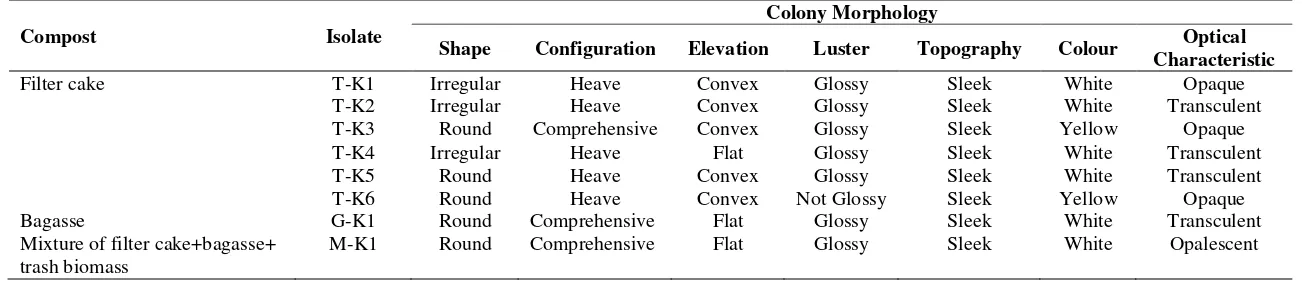
Eight potential phosphate solubilizing bacteria were obtained from sugarcane waste composts. The isolates were found capable of forming a clear zone on solid media Pikovskaya with different characters (Table 1). From the eight isolates, 6 isolates were obtained from filter cake compost, 1 isolate from bagasse compost, and 1 isolate from mixture of bagasse+filter cake+trash biomass compost.
Ability of phosphate solubilizing bacteria to dissolve P in solid Pikovskaya media
The ability of each isolate in dissolving P varied in terms of both speed and magnitude of solubility index. The T-K5 formed the clear zone at hour 24 (day 1), T-K3, G-K1 and M-K1 isolates at hour 48, and T-K1, T-K2, T-K4, T-K6 isolates at hour 72. At the end of observation, isolates T-K5 and T-K6 exhibited higher P solubilisation index of 1.75 and 1.67, respectively, that other isolates. The lowest P solubilization index was observed for T-K1 isolate (Figure 1).
Ability of phosphate solubilizing bacteria to dissolve P in liquid Pikovskaya media
Table 1. Morphology of phosphate solubilizing bacteria isolated from composts of sugarcane wastes
Compost Isolate
Colony Morphology
Shape Configuration Elevation Luster Topography Colour Optical
Characteristic Filter cake T-K1 Irregular Heave Convex Glossy Sleek White Opaque
T-K2 Irregular Heave Convex Glossy Sleek White Transculent T-K3 Round Comprehensive Convex Glossy Sleek Yellow Opaque T-K4 Irregular Heave Flat Glossy Sleek White Transculent T-K5 Round Heave Convex Glossy Sleek White Transculent T-K6 Round Heave Convex Not Glossy Sleek Yellow Opaque Bagasse G-K1 Round Comprehensive Flat Glossy Sleek White Transculent Mixture of filter cake+bagasse+
trash biomass
Figure 1. P solubilization index of eight phosphate solubilizing bacteria isolates in solid Pikovskaya medium. *) see Table 1
At the end of incubation the highest soluble P was observed T-K6 isolate (0.74 mg / L) followed by T-K5 (0.56 mg / L) and the lowest by T-K4 isolates (0.41 mg / L) (Figure 2). Results of quantitative calculation of P solubilization were similar to that of qualitative calculation (solid Pikovskaya media), especially for T-K6 and T- K5 isolates that showed high P solubilization compared to other isolates.
Phosphate solubilization mechanism is closely related to the release of organic acids by the phosphate solubilising bacteria that form a chelate with cations (Al, Fe, or Ca) that bind P through hydroxyl and carboxyl chelation, thus turning it into available forms (Kpomblekou and Tabatabai, 1994; Goldstein, 1995; Kim et al., 1997). According to Gyaneshwar et al. (2002), organic acids that play roles in the release of P include acetate, lactate, malate, oxalate, succinate, citrate, gluconate, and ketogluconate acids. Tri-carboxylic acids (cis-aconitic and citric acids) and the di-carboxylic acids (oxalic, malonic, fumaric, and tartaric acids) were more effective than mono-carboxylic acids (glycolic, pyruvic, and salicylic acids) in releasing P (Kpomblekou and Tabatabai, 2003). Phosphate solubilization may also occur due to the release of protons such as H+ where the mechanism of phosphate solubilization is similar to tricalcium phosphate [Ca3 (PO4)2 ] that can be
described as follows : Ca3(PO4)2 + 2H+ =
2CaHPO4 + Ca 2+
(Bashan et al. 2013).
Media pH changes
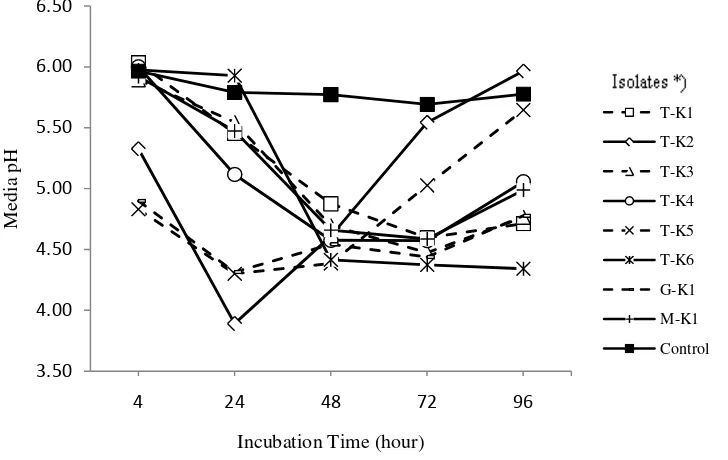
Incubation of eight isolates in liquid Pikovskaya media influenced the change in pH of the media (Figure 3). The T-K1, T-K3, T-K4 T-K6, G-K1, and M-K1 isolates showed pH decrease over time. These results are similar to those reported by Rashid et al. (2004). In contrast, the K2 and T-K5 isolates showed pH decrease only at the beginning of incubation, after which an increase in the pH of the media, even at the end of the observation was higher than at the beginning of incubation.
in turn increase P solubilization. In general, high levels of P solubilization was followed by media pH decrease. In the case of T-K2 and T-K5 isolates, however, the high P solublization was not followed by by pH decrease. These results were
similar to those obtained by Yu et al. (2011) that high P solubilization by W4 bacterial strain was achieved at high pH (pH 6.0). However, P solubilisation is not always comparable to the decrease in pH (Behera et al., 2014).
Figure 2. Solubilization of P by eight phosphate solubilizing bacteria isolates incubated in liquid Pikovskaya media. *) see Table 1
Figure 3. Changes in pH of Pikovskaya liquid media inoculated with eight phosphate solubilizing bacteria. *) see Table 1
0.00 0.10 0.20 0.30 0.40 0.50 0.60 0.70 0.80
4 24 48 72 96
P2 O5
(mg
/L
)
Incubation Time (hour)
T-K1
T-K2
T-K3
T-K4
T-K5
T-K6
G-K1
M-K1
Control
3.50 4.00 4.50 5.00 5.50 6.00 6.50
4 24 48 72 96
M
ed
ia
p
H
Incubation Time (hour)
T-K1
T-K2
T-K3
T-K4
T-K5
T-K6
G-K1
M-K1
Figure 4. Correlations between pH and available P of eight phosphate solubilization bacteria
4.59 4.71 4.87 5.45 6.03
P2
4.59 4.66 4.99 5.47 5.92
P2
4.57 4.58 5.06 5.12 6.00
P2
4.34 4.37 4.41 5.93 5.97
P2
4.47 4.70 4.76 5.55 5.89
P2
4.31 4.44 4.54 4.78 4.90
P2
4.30 4.38 4.83 5.03 5.65
P2
3.89 4.61 5.33 5.54 5.96
Conclusion
Isolation of phosphate solubilizing bacteria from composts of sugarcane wasted resulted in eight potential phosphate solubilising bacteria isolates. Two isolates (T-K5 and T-K6), were quantitatively and qualitatively very potential in solubilizing P from Ca3(PO4)2 in Pikovskaya
media. In general, the increase of P solubilisation was linearly correlated to the decrease of pH media.
Acknowledgements
Authors are grateful to the Agency for Agricultural Research and Development, Ministry of Agriculture of the Republic of Indonesia for financial support of this study.
References
Arcand, M.M. and Schneider, K.D. 2006. Plant-and microbial-based mechanisms to improve the agronomic effectiveness of phosphate rock: a
review. Anais da Academia Brasileira de Ciências
78(4): 791–807.
Bashan, Y., Kamnev, A.A. and de-Bashan, L.E. 2013. Tricalcium phosphate is inappropriate as a universal selection factor for isolating and testing phosphate-solubilizing bacteria that enhance plant growth: a
proposal for an alternative procedure. Biology and
Fertility of Soils 49: 465–479.
Behera, B.C., Singdevsachan, S.K., Mishra, R.R., Dutta, S.K. and Thatoi, H.N. 2014. Diversity, mechanism and biotechnology of phosphate solubilizing microorganism in mangrove: A review.
Biocatalysis and Agricultural Biotechnology 97–110.
Chen, Y.P., Rekha, P.D., Arun, A.B., Shen, F.T., Lai,
W.A. and Young, C.C. 2006. Phosphate
solubilizing bacteria from subtropical soil and their
tricalcium phosphate solubilizing abilities. Applied
Soil Ecology 34: 33–41.
Chung, H., Park, M., Madhaiyan, M., Seshadri, S., Song, J., Cho, H. and Sa, T. 2005. Isolation and characterization of phosphate solubilizing bacteria
from the rhizosphere of crop plants of Korea. Soil
Biology and Biochemistry 37: 1970–1974.
Goldstein, A.H.1995. Recent progress in understanding the molecular genetics and biochemistry of calcium phosphate solubilisation by Gram-negative bacteria.
Biological Agriculture and Horticulture 12: 185– 193.
Gupta, M., Kiran, S., Gulati, A., Singh, B. and Tewari, R. 2012. Isolation and identification of phosphate solubilizing bacteria able to enhance the growth and aloin-A biosynthesis of Aloe barbadensis Miller.
Microbiological Research 167: 358– 363.
Gyaneshwar, P., Kumar, N.J., Pareka, L.J. and Podle, P.S. 2002. Role of soil microorganisms in
improving P nutrition of plants. Plant and Soil
245(1):83–93.
Hameeda, B., Harini, G., Rupela, O.P., Wani, S.P. and Reddy, G. 2008. Growth promotion of maize by phosphate solubilizing bacteria isolated from
composts and macrofauna. Microbiological
Research 163: 234—242
Holford, I.C.R.1997. Soil phosphorus its measurement
and its uptake by plants. Australian Journal of Soil
Research 35: 227–239.
Holguin, G., Vazquez, P. and Bashan, Y. 2001. The role of sediment microorganisms in the productivity, conservation and rehabilitation of
mangrove ecosystems: an overview. Biology and
Fertility of Soils 33: 265–278.
Khan, A.A., Jilani, G., Akhtar, M.S., Naqvi, S.M.S. and Rasheed, M. 2009. Phosphorus Solubilizing Bacteria: Occurrence, Mechanisms and their Role
in Crop Production. Journal of Agriculture and
Biological Science 1(1): 48-58.
Khan, M.S., Zaidi, A. and Wani, P.A. 2007. Role of phosphate-solubilizing microorganisms in
sustainable agriculture – A review. Agronomy and
Sustainable Development 27: 29-43.
Kim, K.Y., Jordan, D. and McDonald, G.A.1997. Solubilization of hydroxyl apatite by Enterobacter agglomerans and cloned Escherichiacoli in culture
medium. Biology and Fertility of Soils 24: 347–352.
Kpomblekou-A, K. and Tabatabai, M.A. 2003. Effect of low-molecular weight organic acids on phosphorus release and phytoavailabilty of phosphorus in phosphate rocks added to soils.
Agriculture, Ecosystems and Environment 100: 275–284.
Kpomblekou-A, K. and Tabatabai, M.A. 1994. Effect of organic acids on release of phosphorus from
phosphate rocks. Soil Science 158: 442–453.
Nuraini, Y., Abadi, A.L., Soemarno. and Ardyati, T. 2011. Potensial of legume and maize to stimulate population of nitrogen-fixing bacteria, phosphate-solubilizing bacteria and indole acetic acid
production. Journal of Agriculte and Food
Technology 1(12): 218-226.
Oliveira, C.A., Alves, V.M.C., Marriel, I.E., Gomes, E.A., Scotti, M.R., Carneiro, N.P., Guimara˜es, C.T., Schaffert, R.E. and Sa, N.M.H. 2009. Phosphate solubilizing microorganisms isolated from rhizosphere of maize cultivated in an oxisol of
the Brazilian Cerrado Biome. Soil Biology and
Biochemistry 41: 1782–1787.
Isolation and identification of phosphate solubilizing bacteria from chinese cabbage and their effect on growth and phosphorus utilization of
plants.
18(4): 773-777.
Premono, M.E., Moawad, A.M. and Vleck, P.L.G. 1996. Effect of phosphate solubilizing Pseudomonas putida on the growth of maize and its
survival in the rhizosphere. Indonesian Journal of
Crop Science 11:13–23
Rao, N.S.S. 1982. Phosphate solubilization by soil microorganisms. In N.S. Rao (ed.) Advanced in Agricultural Microbiology. New Delhi: Oxford and IBH Publishing Co.
Rashid, M., Khalil, S., Ayub, N., Alam, S. and Latif, F. 2004. Organic acids production and phosphate solubilization by phosphate solubilization microorganisms (PSM) under in vitro conditions.
Pakistan Journal of Biological Sciences 7(2): 187-196.
Stevenson, F.J. 1986. Cycles of Soil Carbon, Nitrogen, Phosphorus, Sulphur and Micronutrients. Wiley, New York.
Tao, G.C., Tian S.J., Cai, M.Y. and Xie, G.H. 2008. Phosphate-solubilizing and mineralizing abilities of
bacteria isolated from soils. Pedosphere 18(4):
515–523.
solubilizing microorganisms associated with the rhizosphere of mangroves in a semiarid coastal
lagoon.
468.
Watanabe, F.S. and Olsen, S.R. 1965. Test of an ascorbic acid method for determining phosphorous
in water and NaHCO3 extracts from soil. Soil
Science Society of America
Widawati, S. and Suliasih. 2006. Augmentation of potential phosphate solubilizing bacteria (PSB)
stimulate growth of green mustard (Brasica
caventis Oed.) in marginal soil. Biodiversitas 7(1): 10-14.
Widawati, S., Nurkanto, A. and Sudiana, I.M. 2008. Phosphate solubilizing activities of Actinomycetes isolated from Waigeo, Raja Ampat islands, West
Papua. Biodiversitas 9(2): 87-90.
Yang, M., Ding, G., Shi, L., Xu, F. and Meng, J. 2010. Detection of QTL for phosphorus efficiency at
vegetative stage in Brassica napus. Plant and Soil
339 (1-2): 97–111. doi:10.1007/s11104-010-0516-x.
Yu, X., Liu, X., Zhu, T.H., Liu, G.H. and Mao, C. 2011. Isolation and characterization of phosphate-solubilizing bacteria from walnut and their effect on
growth and phosphorus mobilization. Biology and