Original Research Article
Study of serum homocysteine level in cases of non-diabetic
ischemic stroke
Malati Murmu
1, Karun Mahesh K. P.
1*, Sanjay Dash
2, Lagendra Kumar Singh
1,
Ayaskanta Kar
1, Pravin Kumar Mishra
1INTRODUCTION
Stroke is a major cause of morbidity and mortality worldwide. Stroke or cerebrovascular accident is defined as an abrupt onset of a neurological deficit that is attributable to a focal vascular cause.1 Of all strokes, upto
85% are ischemic and 15% are hemorrhagic.2 Ischemic
stroke syndromes have a multitude of possible causes, characterized by a rule of quarters: 25% cardio embolic, 25% arteroembolic (large-artery disease), 25% lacunar
(small-vessel disease) and 25% due to other causes, with global variation in proportions by population.3
Atherosclerotic risk factors for ischemic stroke are traditional and non-traditional. The traditional risk factors are hypercholesterolemia, hypertension, type 2 DM and smoking.4 Non-traditional risk factors for atherosclerosis
are insulin resistance, endothelial dysfunction, fibrinolysis abnormalities, inflammation,
1Department of General Medicine, VSS.I.M.S.A.R, Burla, Odisha, India
2Department of Medicine, District Headquarter Hospital, Sundargarh, Odisha, India
Received: 23 March 2018
Accepted: 29 March 2018
*Correspondence:
Dr. Karun Mahesh K. P., E-mail: [email protected]
Copyright: © the author(s), publisher and licensee Medip Academy. This is an open-access article distributed under the terms of the Creative Commons Attribution Non-Commercial License, which permits unrestricted non-commercial use, distribution, and reproduction in any medium, provided the original work is properly cited.
ABSTRACT
Background: Aim of the study was to measure serum homocysteine levels in non-diabetic ischemic stroke and to co-relate its significance with other risk factors of ischemic stroke. It was a case control study.
Methods: The study was done in the Department of Medicine, VSS.I.M.S.A.R, Burla, Odisha. 42 patients of non-diabetic ischemic and 42 age and sex matched controls were included in the study. Adults above the age of 18 years who were non-diabetic presenting with first-ever ischemic stroke, confirmed by CT scan of brain were included. Diabetic patients, haemorrhagic stroke, suspected embolic stroke, patients on vitamin supplementations, chronic usage of phenytoin were excluded. Routine investigations, fasting serum lipid profile and serum homocysteine levels were done.
Results: Mean serum homocysteine level in ischemic stroke patients were found to be much higher (25.83 micro mol/L) in comparison to control group (9.77 micro mol/L) which is statistically significant. Mean serum homocysteine levels were found to be higher in patients with age group of more than 60 years, male sex, sedentary lifestyle, vegetarian diet, hypertensive patients and patient with normal fasting lipid profile. Statistical analysis for significance of difference was done using Chi-Square test with Yate’s correction.
Conclusions: A statistically significant correlation was found between all the studied risk factors among non-diabetic patients and serum homocysteine levels. Estimation of serum homocysteine is advisable in all cases of non-diabetic ischemic strokes to know the prognosis.
Keywords: Homocysteine, Ischemic stroke, Non-diabetic, Risk factors
microalbuminuria, hyperhomocysteinemia, postprandial glucose abnormalities and vascular wall abnormalities.5
There is a strong, independent and dose-related association between moderately elevated homocysteine and atherosclerotic vascular disease, including stroke.6 It
is also associated with Alzheimer’s disease and vascular dementia.7
Homocysteine is a non-protein sulfhydryl amino acid, derived from the metabolic conversion of methionine. About 70% of plasma homocysteine is bound to albumin, 30% is oxidized to disulphides, and approximately 1% is present as free homocysteine. Free, bound homocysteine and its disulphides are globally referred to as total homocysteine.8
The term “hyperhomocysteinemia” does not define a pathological condition. It is rather used to describe a biochemical abnormality which can be a direct consequence of various pathological conditions. Every increase of 2.5 µM in plasma homocysteine can be associated with an increase of stroke risk of about 20%.9
Moreover, plasma Total homocysteine levels above 20 µM are associated with a nine-fold increase of the myocardial infarction and stroke risk when compared to concentrations below 9µM.10
Hyperhomocysteinemia is common and is the major prothrombotic factor associated with cerebrovascular accident. Hyperhomocysteinemia can cause cerebrovascular accidents by increasing blood pressure, induces oxidative injury to the vascular endothelial cells by impairment of the endothelial production of NO, a vascular relaxing factor. Other proposed mechanisms include enhancement of platelet adhesion to endothelial cells, promotion of the growth of vascular smooth muscle cells and association of increase homocysteine with higher levels of prothrombotic factors such as thromboglobulin, tissue plasminogen activator and factor VIIC.11
There is controversy concerning plasma total homocysteine levels in type 2 diabetes, plasma total homocysteine levels in type 2 diabetes are reported to be similar to, lower or higher than those in healthy subjects.12,13
In this study, we undertook a case control study of non-diabetic patients hospitalized with a first-ever ischemic stroke and examined specifically whether there may be an association between homocysteine and various traditional risk factors in ischemic stroke.
METHODS
The objective of the study was to observe the serum homocysteine levels in non-diabetic patient with ischemic stroke and to determine any significant correlation
between serum homocysteine levels and various modifiable and non-modifiable risk factors.
The present study was conducted on non-diabetic ischemic stroke patients admitted to the Department of General Medicine, VIMSAR, Burla, Sambalpur, Odisha, from November 2013 to October 2015 with normal individuals of comparable age and sex served as controls. The type of study is of case-control.
The study included a total of 42 adult cases (more than 18 years of age) of ischemic stroke. 42 (forty two) normal individuals of comparable age and sex served as controls for the study. Diabetic stroke patients, Restroke patients, Cerebrovascular accidents associated with head injury or brain tumour, patients who were on vitamin supplementation, chronic use of anticonvulsants like phenytoin, patients with suspected emboli of cardiac origin were excluded from the study.
Data was collected with meticulous history, clinical examination with detailed neurological examinations along with CT scan of brain to confirm ischemic stroke. A structured questionnaire was used to obtain data on family history of diabetes mellitus, history of hypertension, past and present illness, dietary pattern, lifestyle, addiction and medication. Blood samples are collected for CBC, fasting and post prandial blood sugars, HbA1c, blood urea, serum creatinine, fasting lipid profile, serum Electrolytes, ECG, CT scan of brain (MRI of brain, if necessary).
Serum homocysteine levels were measured by drawing about 2 ml of blood sample which was collected in a tube containing the anticoagulant EDTA. The sample was immediately kept in ice pack and later centrifuged for 30 minutes to avoid false estimation of homocysteine level due to its release from RBC. Plasma was then refrigerated and stored at -80ºC till the analysis done. Total plasma homocysteine was determined by high performance liquid chromatography (HPLC).
Statistical analysis for significance of difference between age, sex, and presence or absence of the risk factors such as diet, lifestyle, hypertension, dyslipidemia was done using Chi-Square test with Yate’s correction.
RESULTS
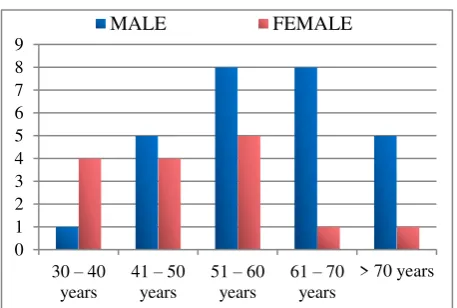
In the present study, 42 cases with ischemic stroke were included and 42 patients were taken as control. Male patients were more in number (64.3%) as compared to females (35.7%). Among them most of the patients were within the age group of less than 60 years (64.3%). Male patients were more in all the age groups except the age group between 30-40 years (Figure 1).
mol/L) in comparison to control group (9.77micro mol/L) which is statistically significant (p<0.0001) (Table 1).
Mean serum homocysteine levels were found to be higher (18±9.7micro mol/L) in patients with age group of more than 60 years than in patients with age group of less than 60 years (12.8±7.2 micro mol/L). In control group, mean serum homocysteine levels were almost equal in both age groups. In total, mean serum homocysteine levels were found to be more (18±13.3micro mol/L) in cases than in control (10.1±1.6micro mol/L). The statistical difference between case and control is highly significant (p<0.0003) (Table 2).
Mean serum homocysteine levels were found to be higher (19.36±10.8micro mol/L) in male patients than in female patients (13.2±2.95micro mol/L). In control group, mean serum homocysteine levels were found to be higher (9.1±2.2micro mol/L) in male patients than in female patients (7.2±2.7micro mol/L). As a whole, mean serum homocysteine levels were found to be more
(16.28±6.8micro mol/L) in cases than in control (8.15±2.45micro mol/L). The statistical difference between case and control is extremely significant (p<0.0001) (Table 3).
Figure 1: Age and sex wise distribution of non-diabetic patients with ischemic stroke in the study.
Table 1: Comparison of serum homocysteine levels in non diabetic patients with ischaemic stroke.
Serum homocysteine level No. of patients Mean±SD of homocysteine P-Value
Case Control Case Control
Normal 14 42 9.77±1.7 8.7±1.2
<0.0001 Significant Hyperhomocysteinemia 28 0 25.83±24 0
Total 42 42 8.7±1.2 17.8±12.58
Table 2: Comparison of serum homocysteine levels in non diabetic patients with ischaemic stroke with age.
Age No. of patients
Mean±SD Of
Homocysteine P-Value
Case Control Case Control
<60
years 28 28 12.8±7.2 10.2±1.8 <0.0003 Highly significant >60
years 14 14 18±9.7 10±1.4 Total 42 42 18±13.3 10.1±1.6
Mean serum homocysteine levels were higher (19.78±12.38micro mol/L) in patients with sedentary lifestyle than in patients with active lifestyle (11.01±10.42 micro mol/L). But in control group, mean
serum homocysteine levels were almost equal in both the groups. In total mean serum homocysteine levels were found to be more (15.44±11.4micro mol/L) in cases than in control (10.1±3micro mol/L). The statistical difference between case and control is very significant (p<0.0044) (Table 4).
Mean serum homocysteine levels were higher (21.76±17.38micro mol/L) in patients on vegetarian diet than in patients with mixed diet (17.5±14.38micro mol/L). But in control group, mean serum homocysteine levels were almost equal in both the groups. In total, mean serum homocysteine levels were found to be more (19.64±15.88micro mol/L) in cases than in control (10.1±2.2micro mol/L). The statistical difference between case and control is highly significant (p<0.002) (Table 5).
Table 3: Comparison of mean serum homocysteine levels with sex of the patient.
Sex No. Of patients Mean±SD of homocysteine P-value
Case Control Case Control
Male 27 27 19.36±10.8 9.1±2.2
<0.0001
Extremely significant
Female 15 15 13.2±2.95 7.2±2.7
Total 42 42 16.28±6.8 8.15±2.45
0 1 2 3 4 5 6 7 8 9
30 –40 years
41 –50 years
51 –60 years
61 –70 years
> 70 years
Table 4: Comparison of mean serum homocysteine with lifestyle of the patient.
Lifestyle No. of patients Mean±SD of homocysteine P-Value
Case Control Case Control
Sedentary 36 36 19.78±12.38 10.2±2.8
<0.0044 Very significant
Active 6 6 11.01±10.42 10±3.1
Total 42 42 15.44±11.4 10.1±3
Table 5: Comparison of mean serum homocysteine with the type of diet consumed by the patient.
Diet No. of patients Mean±SD of homocysteine P-value
Case Control Case Control
Vegetarian 4 4 21.76±17.38 10±2.4
<0.002
Highly significant Mixed diet 38 38 17.5±14.38 10.2±2
Total 42 42 19.64±15.88 10.1±2.2
Table 6: Comparison of mean serum homocysteine with fasting lipid profile of the cases.
Fasting lipid profile No. of patients Mean±SD of homocysteine P-value
Case Control Case Control
Dyslipidemia 25 0 15.78±14.19 0
<0.0322 Significant
Normal 17 42 18.59±15.65 12.1±2.4
Total 42 42 17.18±14.92 12.1±2.4
Table 7: Comparison of mean serum homocysteine with blood pressure of the cases.
Blood pressure No. of patients Mean±SD of homocysteine P-value
Case Control Case Control
Hypertensive 10 0 19.4±15.53 0
<0.0001
Extremely significant Normotensive 32 42 18±10.4 8.5±2.7
Total 42 42 18.7±12.96 4.3±1.35
Mean serum homocysteine levels were found to be higher (18.59±15.65micro mol/L) in patients with normal fasting lipid profile than in patients with fasting dyslipidemia (15.78±14.19micro mol/L). As a whole, mean serum homocysteine levels were found to be more (17.18±14.92micro mol/L) in cases than in control (12.1±2.4micro mol/L). The statistical difference between case and control is significant (p<0.0322) (Table 6).
Mean serum homocysteine levels were higher (19.4±15.53micro mol/L) in hypertensive patients as compared to normotensive patients (18±10.4micro mol/L). In total, mean serum homocysteine levels were found to be more (18.7±12.96 micro mol/L) in cases than in control (4.3±1.35micro mol/L). The statistical difference between case and control is extremely significant (p<0.0001) (Table 7).
Table 8 shows the association of different risk factors of ischemic stroke with mean serum homocysteine level. It was found from our study that the mean serum homocysteine level was found to be highest in patients of ischemic stroke who were on pure vegetarian diet (21.76micro mol/L). Patients with sedentary lifestyle
(19.78micro mol/L), hypertensive patients (19.4 micro mol/L), male patients (19.36micro mol/L) were also having higher mean serum homocysteine levels.
Table 8: Association of different risk factors of non-diabetic ischemic stroke patients with serum
homocysteine levels.
Risk factor No. of
patients
Mean serum homocysteine levels
Age >60 years 14 18 Age <60 years 28 12.8
Male 27 19.36
Female 15 13.2 Hypertension 10 19.4 Dyslipidemia 25 15.78 Sedentary lifestyle 36 19.78 Active lifestyle 6 11.01 Mixed diet 38 17.5 Vegetarian diet 4 21.76
mol/L) and female patients (13.2micro mol/L) are the other factors having lower mean serum homocysteine levels.
DISCUSSION
The present study consisted of 84 patients who were admitted to medicine wards of VSS.I.M.S.A.R, Burla of which 42 patients were non-diabetic ischemic stroke, 42 patients were age and sex matched non-diabetic controls. Maximum number of cases were from 51-60 years age Boysen et al, who also noticed significantly raised serum homocysteine levels among ischemic CVA patients.13,14
Modi et al, concluded that hyperhomocysteinemia as an important risk factor for ischemic stroke.15 Boushley and
colleagues have reported on a meta-analysis of many observational studies relating total homocysteine concentration to atherosclerotic vascular disease, of which 11 studies addressed the association between homocysteine and risk factors, 9 case control studies provided support for the hypothesis that homocysteine is an independent risk factor for ischemic stroke while 2 prospective studies did not support this study.16
Out of 42 patients of ischemic stroke, 27 (64.3%) patients were less than 60 years and 15 (35.7%) patients were
study by Narang et al, and Modi et al.15,18
Our study comprised of 27 (64.3%) male patients and 15 (35.7%) female patients. Mean serum homocysteine levels were estimated to be higher (19.36±10.8micro mol/L) in male patients than in female patients (13.2±2.95micro mol/L). Our study was consistent with study by Narang et al, Modi et al, and Bogdan et al.15,18,19
However Kang et al, study showed that young healthy women have homocysteine levels lower than healthy men.20 This difference diminishes with ageing. An abrupt
increase in serum homocysteine in women after 50 years suggests that sex difference in homocysteine levels disappears with increasing age.
Our study revealed 36 (85.7%) patients with sedentary lifestyle and 6 (14.3%) patients with active lifestyle. Mean serum homocysteine levels were higher (19.78±12.38micro mol/L) in patients with sedentary lifestyle than in patients with active lifestyle (11.01±10.42micro mol/L). Perry IJ suggested in his study about the association between
hyperhomocysteinemia and established vascular risk likely to reflect lifestyle factor.21
In this study, only 4 (9.5%) patients were on pure vegetarian diet and 38 (90.5%) patients were on mixed diet. Mean serum homocysteine levels were higher (21.76±17.38micro mol/L) in patients on vegetarian diet than in patients with mixed diet (17.5±14.38micro mol/L). Our study was consistent with the study of Lawrence JA et al.22 But our study differed from the
study by Mohsin yakub et al.23
Dyslipidemia was found in 25 (59.5%) patients and 17 (40.5%) patients had normal fasting lipid profile. Mean serum homocysteine levels were found to be higher (18.59±15.65micro mol/L) in patients with normal fasting lipid profile than in patients with fasting dyslipidemia (15.78±14.19micro mol/L). Our findings were consistent with the study by Narang et al, and Modi et al.15,18 In serum homocysteine levels were higher (19.4±15.53micro mol/L) in hypertensive patients as compared to normotensive patients (18±10.4micro mol/L). Kittner et al, did not find any definitive evidence of an increased homocysteine levels in hypertensive patients with ischemic stroke.25 Present study was
consistent with study by Modi et al, Narang et al,and Graham et al.15,18,26
CONCLUSION
A statistically significant correlation was found between all the studied risk factors among non-diabetic patients and serum homocysteine levels. Hyperhomocysteinemia may have a greater impact as a risk factor in ischemic stroke among non-diabetic patients, as early detection and treatment with drugs along with dietary and lifestyle modifications can reduce the risk of stroke. So, estimation of serum homocysteine is advisable in all cases of non-diabetic ischemic strokes to know the prognosis. Further research with more number of patients and risk factors are required for better results.
ACKNOWLEDGEMENTS
Authors would like to thank all the participant patients, teaching and non-teaching staffs of department of General Medicine, VSS.I.M.S.A.R, Burla.
Funding: No funding sources Conflict of interest: None declared
Diagnosis and management of acute ischemic stroke: speed is critical. Canadian Medical Association Journal. 2015 Sep 8;187(12):887-93.
3. Ay H, Furie KL, Singhal A, Smith WS, Sorensen AG, Koroshetz WJ. An evidence‐based causative classification system for acute ischemic stroke. Annals of neurology. 2005 Nov 1;58(5):688-97.
4. Kanjwal MK, Cooper C, Bashir R. Peripheral arterial disease-the silent killer. JK-Practitioner. 2004;11(4):225-32.
5. Fonseca V, Desouza C, Asnani S, Jialal I. Nontraditional risk factors for cardiovascular disease in diabetes. Endocrine reviews. 2004 Feb 1;25(1):153-75. 6. Jacobsen DW, Gatautis VJ, Green R, Robinson K, Savon SR, Secic M, et al. Rapid HPLC determination of total homocysteine and other thiols in serum and plasma: sex differences and correlation with cobalamin and folate concentrations in healthy subjects. Clinical chemistry. 1994;40(6):873-81.
7. Seshadri S, Beiser A, Selhub J, Jacques PF, Rosenberg IH, D'agostino RB, et al. Plasma homocysteine as a risk factor for dementia and Alzheimer's disease. New England Journal of Medicine. 2002 Feb 14;346(7):476-83.
8. Haynes WG. Hyperhomocysteinemia, vascular function and atherosclerosis: effects of vitamins. Cardiovascular Drugs and therapy. 2002 Sep 1;16(5):391-9.
9. den Heijer T, Vermeer SE, Clarke R, Oudkerk M, Koudstaal PJ, Hofman A, et al. Homocysteine and brain atrophy on MRI of non‐demented elderly. Brain. 2002 Jan 1;126(1):170-5.
10. Graham IM, Daly LE, Refsum HM, Robinson K, Brattström LE, Ueland PM, et al. Plasma homocysteine as a risk factor for vascular disease: the European Concerted Action Project. Jama. 1997 Jun 11;277(22):1775-81.
11. Mojiminiyi OA, Marouf R, Al Shayeb AR, Qurtom M, Abdella NA, Al Wazzan H et al. Determinants and associations of homocysteine and prothrombotic risk factors in Kuwaiti patients with cerebrovascular accident. Medical Principles and Practice. 2008;17(2):136-42.
12. Chico A, Perez A, Cordoba A, Arcelus R, Carreras G, De Leiva A et al. Plasma homocysteine is related to albumin excretion rate in patients with diabetes mellitus: a new link between diabetic nephropathy and cardiovascular disease?. Diabetologia. 1998 May 1;41(6):684-93.
13. Datta S, Pal SK, Mazumdar H, Bhandari B, Bhattacherjee S, Pandit S. Homocysteine and cerebrovascular accidents. Journal of the Indian Medical Association. 2009 Jun;107(6):345-6.
14. Boysen G, Brander T, Christensen H, Gideon R, Truelsen T. Homocysteine and risk of recurrent stroke. stroke. 2003 May 1;34(5):1258-61.
15. Modi M, Prabhakar S, Majumdar S, Khullar M, Lal V, Das CP. Hyperhomocysteinemia as a risk factor for ischemic stroke: an Indian scenario. Neurology India. 2005 Jul 1;53(3):297.
16. Homocysteine Studies Collaboration. Homocysteine and risk of ischemic heart disease and stroke: a meta-analysis. Jama. 2002 Oct 23;288(16):2015-22.
17. Zongte Z, Shaini L, Debbarma A, Singh TB, Devi SB, Singh WG. Serum homocysteine levels in cerebrovascular accidents. Indian journal of clinical biochemistry. 2008 Apr 1;23(2):154-7. review. Acta Biochimica Polonica 2010;57(4):467-77. 20. Kang SS, Zhou J, Wong PW, Kowalisyn J, Strokosch
G. Intermediate homocysteinemia: a thermolabile variant of methylenetetrahydrofolate reductase. American journal of human genetics. 1988 Oct;43(4):414.
21. Perry IJ. Homocysteine, hypertension and stroke. Journal of human hypertension. 1999 May;13(5):289. 22. Appel LJ, Miller ER, Jee SH, Stolzenberg-Solomon R,
Lin PH, et al. Effect of dietary patterns on serum homocysteine: results of a randomized, controlled feeding study. Circulation. 2000 Aug 22;102(8):852-7. 23. Yakub M, Iqbal MP, Kakepoto GN, Rafique G,
Memon Y, Azam I, et al. High prevalence of mild hyperhomocysteinemia and folate, B 12 and B 6 deficiencies in an urban population in Karachi, Pakistan. Pakistan Journal of Medical Sciences. 2010 Oct 1;26(4). Brattström LE, Ueland PM et al. Plasma homocysteine as a risk factor for vascular disease: the European Concerted Action Project. Jama. 1997 Jun 11;277(22):1775-81.