White House Leadership
Development Program
Program Manual
2017
White House Leadership Development Program
Table of Contents
Introduction……… p.2
Program Overview………. p.3
Program Objectives……… p.3
Program Parameters………... p.4
Program Benefits……… p.4
Nominations & Selection Process Timeline……….. p.7
Agency Nominations………. p.7
Selection Process………... p.7
Rotations………p.8
The Fellow Experience………. p.9
Development Program……….. p.10
Program Roles & Responsibilities……… p.12
Appendix A: Frequently Asked Questions……….. p.16
Introduction
The White House Leadership Development (WHLD) Program aims to strengthen enterprise leadership across the government by providing senior level federal employees with expanded perspective and skillsets to address challenges facing the country. These increasingly complex challenges span agencies and jurisdictions, requiring senior leaders to work across agencies and organizational boundaries while leveraging networks on a greater scale than in the past to ensure the government continues to effectively deliver services to the American people.
The program is primarily focused on:
Developing Talent: Building the next generation of career senior executives with an
enterprise perspective through a rotation focused on the complex, cross-agency challenges that increasingly confront the Federal government; strengthening enterprise leadership skills through targeted development sessions.
Delivering Results: Harnessing top talent from across the government to support
implementation of key priorities and address mission-critical challenges.
The goal of the program is to build a cadre of future career senior executives with strong inter-agency experience and exposure to a broad cross-section of government. Fellows work on challenging, cross-agency initiatives to develop the skillsets and networks that enterprise leaders need – a whole-of-government perspective, stakeholder collaboration and engagement, working across boundaries without formal authority, and working outside traditional agency structures.
White House Leadership Development Program
Program Overview
The WHLD Program is sponsored by the Executive Office of the President (EOP) and the President’s Management Council (PMC) and supported by the Performance Improvement Council (PIC). It is a 1-year rotation with weekly development programming. WHLD Fellows will each be placed in a rotation assignment that is largely outside the Fellow’s subject matter expertise.
The WHLD Program provides an opportunity for a diverse cohort of high-potential career employees to develop enterprise leadership skills as they seek to become future Senior Executives. Fellows spend approximately 80 percent of their time in a rotational assignment gaining on-the-job experience. Fellows spend approximately 20 percent of their time in leadership development programming built around the stakeholders, networks, and skillsets that senior leaders need in an enterprise environment.
This manual provides more information on the program’s nomination and selection process, development component, rotational assignments, and post-program activities. In addition to the information contained throughout the manual, frequently asked questions are in Appendix A.
Program Objectives
• Provide Fellows a broad federal
perspective on high-priority challenges and access to senior decision-makers with exposure to a wide cross-section of government;
• Develop a cadre of leaders with the
skillsets and networks to address challenges through a cross-agency
lens and implement solutions across organizational boundaries;
• Strengthen on-going implementation efforts on specific cross-agency initiatives
(including CAP Goals) that require broad coordination and long-term strategic planning to ensure delivery of tangible results.
Program Parameters
• This program is open only to career GS-15 and equivalent civil service employees;
• Agencies may nominate up to four candidates to the WHLD Program. Agency nominees
will be considered for inclusion in the program (not guaranteed);
• Program duration is one year, starting at the beginning of each fiscal year (October 1);
• The rotation is full-time (outside of home agency) and will include weekly leadership
development programming;
• Fellows may be placed in an EOP component, an agency other than their home agency,
or may split the rotation between the EOP and an agency, depending on the rotation assignment;
• The rotation is non-reimbursable. The Fellow’s home agency is responsible for his or
her salary and continued employment and benefits support;
• A Memorandum of Understanding will be developed between home agency and gaining
agency or agencies;
• There is no guarantee for placement into a Senior Executive Service (SES) position as a
result of participation in this program. Participation does, however, provide experience that may be used in developing executive core qualifications.
Program Benefits
• Increased exposure to a variety of agencies – including cultures, missions, functional
areas, senior leaders and new ways of doing business;
• Improved ability to address complex problems that cut across organizational and
jurisdictional boundaries, and to build and leverage relationships to have an impact beyond their formal authority;
• Heightened government-wide perspective on problem solving, best practices, and real
White House Leadership Development Program
• Experience relying on collaborative leadership skills, rather than technical expertise, to
meet mission goals;
• Firsthand experience integrating into a new culture and fast-paced, ambiguous
environment with an emphasis on flexibility and entrepreneurial skills;
• Increased ability to leverage newly expanded professional networks to identify
innovative and collaborative ways of tackling challenges to address organizational challenges in future positions;
• Firsthand experience developing strategic performance frameworks and tools to drive
progress on initiatives.
Program Schedule
The timeline below is a target and may be adjusted as necessary:
October 2, 2017 – Fellows begin 2-week onboarding program October 16, 2017 – Fellows begin rotations
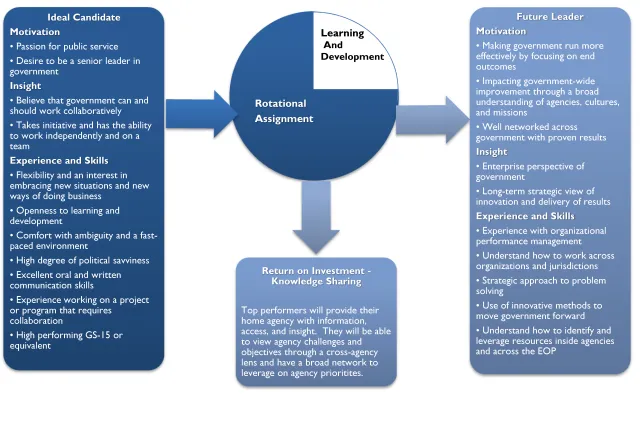
Figure 1: WHLD Program Model
Rotational Assignment
Ideal Candidate Motivation
• Passion for public service • Desire to be a senior leader in government
Insight
• Believe that government can and should work collaboratively • Takes initiative and has the ability to work independently and on a team
Experience and Skills • Flexibility and an interest in embracing new situations and new ways of doing business
• Openness to learning and development
• Comfort with ambiguity and a fast-paced environment
• High degree of political savviness • Excellent oral and written communication skills
• Experience working on a project or program that requires
collaboration
• High performing GS-15 or equivalent
Return on Investment -Knowledge Sharing
Top performers will provide their home agency with information, access, and insight. They will be able to view agency challenges and objectives through a cross-agency lens and have a broad network to leverage on agency prioritites.
Future Leader Motivation
• Making government run more effectively by focusing on end outcomes
• Impacting government-wide improvement through a broad understanding of agencies, cultures, and missions
• Well networked across government with proven results Insight
• Enterprise perspective of government
• Long-term strategic view of innovation and delivery of results Experience and Skills
• Experience with organizational performance management
• Understand how to work across organizations and jurisdictions • Strategic approach to problem solving
• Use of innovative methods to move government forward • Understand how to identify and leverage resources inside agencies and across the EOP
Learning
And
WHLD Program Manual
Nominations and Selection Process Timeline
The following are target dates and are subject to revision as needed.
June 2017 – Agency nominations due to the WHLD Program
June 2017 – WHLD Program selection process begins
July 2017 – Candidates notified of status with program
August 2017 – Finalists begin rotation matching and clearance process
October 2017 – Formal onboarding begins
Agency Nominations
Interested agencies may nominate two to four candidates. Agencies will determine their own
internal processes to select nominees as long as such processes are competitive and follow
applicable laws and regulations.
The Deputy Secretary of the agency or equivalent will formally nominate candidates to the
program. The agency should provide the nominees and completed nomination form directly to
the WHLD Program. Agencies should ensure that the nominees’ direct supervisors are
notified of their subordinates’ nominations. For more information on the nomination process,
selection criteria, and forms, see the separate WHLD Program Nomination Guide.
A diverse group of individuals will be selected from this pool of nominees to participate in the
program.
Selection Process
After reviewing formal nominations from agencies, the WHLD Program implements a selection
process to determine program finalists. The WHLD Program will extend acceptance invitations
to 10 - 20 finalists. All candidates will be notified of their status via e-mail at the conclusion of
Rotations
After selection and acceptance into the program, the program will
match Fellows to assignments. Assignments are high visibility
initiatives that touch multiple agencies and stakeholders with the
Fellows driving cross-agency coordination, innovation,
implementation, and performance management. Specific projects
vary depending on the rotational assignment.
Fellows are matched to a rotation assignment that leverages
broad skillsets outside of the Fellows’ areas of subject matter
expertise. Rotations are not meant to increase technical expertise
but rather to provide an opportunity to use leadership and
collaboration skills.
Past rotations include: (Note: these are not guaranteed to be the
same assignments for next cohort)
Cross-Agency Priority Goals
• Lab to Market
• STEM
• Infrastructure Permitting
Modernization
• Insider Threat & Security Clearance
Reform
• Veterans' Mental Health
• Customer Service
• Federal Sustainability
• People & Culture
• Shared Services
• FOIA CAP Goal/Developing new
CAP Goals
Other Cross-cutting Initiatives
• Enterprise Risk
Management/Strategic Planning
• The Data Cabinet
• State and Local Coordination
Team
• International Women’s and Girls’
Issues
• FirstNet
Cohort 1 Accomplishments: Saving Money and Improving
Government Services
◊ Curbing the government’s IT spending by reducing of the number of contracts issued by 20% and decreasing agency spending 45% for laptops and desktops
◊ Scaling Lab-to-Market tools across 11 federal agencies, resulting in training over 2,500 researchers, creating over 320 companies, and raising over $83 million in follow-on funding, significantly improving the economic return of the government’s R&D funding
WHLD Program Manual
The Fellow Experience
WHLD Program rotations are challenging assignments that expose Fellows to new cultures,
new approaches, a whole-of-government perspective, and an enterprise leadership toolkit.
Fellows are placed on cross-agency initiatives with no formal authority and a variety of
stakeholders and competing priorities to manage. Fellows may experience:
• Flat Structures – Most rotations are situated in small offices with flat organizational
structures (not typical chain of command), flexible roles, and a fast pace. Fellows will
work on multiple levels (doing whatever work needs to be done – no task is too small)
to achieve results.
• Leading Among Peers – Due to flat organizational structures and cross-agency
stakeholder management, Fellows will coordinate and collaborate among peers and
senior level officials. These are often non-traditional leadership roles that require
flexibility, entrepreneurship, and vision.
• Stakeholder Management – Fellows will often not have formal authority nor will
they be in rotations where they can fall back on their subject matter expertise. In order
to achieve results, Fellows will have to identify stakeholders, build relationships/trust
and understand competing priorities and timelines, and work through formal and
informal chains of communication to drive collaboration toward a shared goal/outcome.
• New Cultures – Fellows will be asked to represent their cross-agency initiative and
become comfortable with new cultures and ways of doing business.
• Cross-functional – Fellows will be placed in rotations outside of their subject matter
areas of expertise in order to encourage use of leadership skills and tools. This includes
taking on new functional roles and leveraging subject matter experts in a variety of
fields.
• Rotation Competencies – Fellows must rely on a variety of competencies including
emotional intelligence, adaptability, resiliency, agility, political savvy, conceptual/strategic
Development Program
Fellows participate in a variety of developmental activities, typically spending up to eight hours
per week as a cohort.
Development Objective:
Provide exposure to the business practices,
functional areas, networks, skills and
stakeholders that enterprise leaders need to
leverage in order to deal with a rapidly
changing environment and increasingly
cross-agency, cross-jurisdictional challenges.
Development focuses not on what good
leaders are, but rather what good leaders do
to effectively carry out the job or mission.
Development Program Outline: • 2-week on-boarding
• One day per week or every other week spent in developmental programming
• Visits to agencies to review innovative practices and speak to senior leaders
• SES executive core qualification, resume, and interviewing advice
• Opportunity to network with public and private sector organizations to facilitate and create a broad network of contacts across government and functional areas
• Self-development including Strengths Finder and Entrepreneurial Profile 10 assessments, coaching, and mentoring
“This fellowship gave me the opportunity to extend my interagency leadership beyond shaping policy and programs to developing strategies for communications, social media, and legislative affairs. And along the way I had the chance see my work and contributions regularly reflected White House proclamations, joint statements, speeches and press releases.”
WHLD Program Manual
Stakeholders
Site visits built around stakeholders with whom
enterprise leaders should be familiar, including:
- Government Accountability Office (GAO)
- Council of the Inspectors General on Integrity
& Efficiency (CIGIE)
- Congress
- OMB Budget Offices/OMB Management
Offices
- Executive Office of the President (EOP)
Offices & Policy Councils
- Unions
- Media
- State & Local Entities
- Private Sector
Lines of Business
Exposure to the different functions and lines of business
senior leaders need to leverage to meet an agency’s
mission, including:
- Human Capital – Chief Human Capital
Officers (CHCO) Council
- Finance/Budget – Chief Financial Officers (CFO) Council
- Information/IT – Chief Information Officers (CIO) Council
- Agency Operations – President’s Management Council (PMC)
- Organizational Performance – Performance Improvement Council (PIC)
Promising Business Practices
Specific skills and knowledge for an enterprise leadership toolkit aimed at making government
more effective and results-oriented, including:
Cohort 1 Accomplishments:
Building Communities and Improving Life and Livelihood for Our Country
◊ Opening over 200,000 federal datasets for use by the private sector, civil society, and academia, resulting in creating new companies and improving government services, including new tools to compare the “bang for buck” of colleges; map income and school data to promote Fair Housing.
- Organizational Performance & Government Performance and Results Act
- Metrics, Assessing & Measuring Success, Data Analytics, and Benchmarking
- Storytelling and Briefing Skills
- Strategic Thinking
- Design Thinking and Innovation Sprints
- User-Centered Design
- Emotional Intelligence
- Peer to Peer Coaching
- Leadership Best Practices
Topical Areas for Senior Leaders
Topical areas around emerging and innovative practices to which senior leaders should have
exposure, including:
- Enterprise Risk Management
- Evidence Based Decision-making
- Optics/Strategic Communications
- Agile Management Concepts
- Leadership Accountability
- Meta-Leadership
- Lean/Continuous Process Improvement
- 21st Century Leadership Models
WHLD Program Roles & Responsibilities
The following roles and responsibilities are provided as a guide for nominating agencies,
candidates, and rotation assignments. Further information on roles & responsibilities will be
WHLD Program Manual
Participant/Fellow
The WHLD Program expects that candidates accepted into the Program will rotate out of their
position of record for the duration of the fiscal year. During that time, the WHLD Program
participants will be expected to work on their rotational assignment full-time, except for the
time devoted to developmental programming.
To obtain maximum benefit from the program, the
expectations are:
Fellow
- Transition workload to designated staff and ensure
continuity in the home agency;
- Prepare for the program by researching the host agency and rotational assignment, once
assigned;
- Participate and engage in all aspects of the program;
- Attend all scheduled development sessions in their entirety;
- Craft an Individual Development Plan at the start of the program;
- Make time for reflective thinking on personal and professional experiences throughout
the year to unveil new discoveries, understandings, and insight into their leadership style
and goals;
- Expand networks and build new relationships;
- Maintain an open mind to diverse perspectives and new areas of learning;
- Provide ongoing formal and informal constructive feedback to the program;
- Participate in leadership assessments (StrengthsFinder, EP10, and others as available);
- Schedule regular check in meetings with his/her home agency supervisor to provide
progress updates and ensure home agency timekeeper is aware of time and attendance;
- Following program completion, join and participate in the WHLD Program Alumni
Network;
- Serve as a mentor to future cohorts of WHLD Fellows
Nominating Agency
- Manage internal agency selection process and nominate two to four diverse,
high-quality candidates for consideration to the program;
- Obtain Deputy Secretary approval for each candidate;
- Allow candidates opportunity to participate in WHLD Program selection process
and interviews;
- By nominating a candidate, the agency consents to allowing the individual to
participate in the program if selected and to return to the home agency once the
program is complete;
- Continue to pay salary and benefits of any agency candidate selected into the
program;
- Ensure there is a point of contact for the WHLD Program to provide programmatic
information and other communications to the home agency;
- Allow time for transitioning Fellow’s workload to an alternate employee;
- Invite Fellow to infrequent team building activities, such as team social events, to
ensure the participant stays connected with his or her team during the year;
- Facilitate meeting between Fellow and agency Deputy Secretary or other senior
leaders as appropriate to discuss the rotation assignment and value-add of
experience to home agency;
- With input from appropriate agency points of contact, work with the Fellow to craft
a re-entry plan 2 months prior to completion of WHLD Program rotation and
support the Fellow’s transition back to the home agency upon completion of the
rotation. See Appendix B for Re-Entry Best Practices.
- Along with the re-entry interview, home agencies are encouraged to find other
opportunities within the agency for the Fellow to leverage his or her experience
gained as a WHLD Fellow to best support agency mission. See Appendix B for
Re-Entry Best Practices;
- Following completion of the WHLD Program, participants will become part of the
WHLD Program Manual
activities from time to time and home agencies are encouraged to allow employees
time to participate in WHLD Program mentoring and alumni network programming.
Rotation Assignment / Host Agency
- Craft a position description for the rotation assignment that lays out broad duties
and projects, including areas where the Fellow can take a leadership role on key
projects;
- Identify one or two senior team members to participate in the selection process;
- Notify WHLD Program of any security requirements/clearance, procedures,
conflicts of interest, confidentiality issues, etc.;
- Provide a workspace, laptop, mobile phone, building access, or any necessary tools
to perform the assignment;
- Determine mutually agreeable work schedule and flexibilities (e.g., AWS, telework);
- Conduct a useful onboarding experience to support the success of the fellow;
- Introduce Fellow to cross-agency project team;
- Provide background materials regarding project assignment to Fellow before
rotation begins;
- Establish concrete objectives for the Fellow and work with WHLD Program and
Fellow to complete project scoping document;
- Allow Fellow to attend weekly development sessions;
- Provide work to Fellow that is at a minimum GS-15 level or higher and identify
stretch opportunities to provide experience and exposure for Fellow;
- As needed, provide feedback to WHLD Program and Fellow’s home agency;
Appendix A: Frequently Asked Questions
What are the CAP Goals?
Cross-Agency Priority (CAP) Goals address the longstanding challenge of tackling horizontal
problems across vertical organizational silos. Fifteen CAP Goals were announced in the 2015
Budget; these include seven mission-oriented and eight management-focused goals with a 4-year
time horizon. To establish these goals, OMB solicited nominations from Federal agencies and
several congressional committees.
Established by the Government Performance and Results Act (GPRA) Modernization Act of
2010, CAP Goals are a tool used by leadership to accelerate progress on a limited number of
Presidential priority areas where implementation requires active collaboration between multiple
agencies.
To ensure effective leadership and accountability across the Federal Government, CAP Goals
have a named senior leader both within the EOP and within key delivery agencies. For example,
the National Economic Council, together with the Deputy Secretaries from the Department of
Commerce and the U.S. Department of State, are leading efforts to encourage foreign direct
investment and spur job growth by improving Federal investment tools and resources while
increasing interagency coordination. In another example, the Presidential Personnel Office and
OPM are teaming up to strengthen our Federal workforce through data-driven efforts to
improve employee engagement, hiring reform, and improving our management cadre.
The list of CAP Goals can be found here:
http://www.performance.gov/cap-goals-list?view=public
How is this program different than other leadership programs?
There are a variety of strong rotation programs across the government that aspiring leaders
can select. However, these programs often focus on work in one agency, rather than providing
experience implementing high-visibility programs across government agencies. This program
WHLD Program Manual
candidate development programs (CDPs) or graduates of SES CDPs) who are interested in
gaining a unique perspective of how high-priority policies are implemented across agencies and
how to solve problems through collaborative efforts. Fellows will also receive hands-on
experience with cross-agency management, learn how the Executive Office of the President
(including the Office of Management and Budget) functions, and build a network across agencies
and functions.
Through this program, Fellows participate in rotational assignments to gain valuable experience
by working on the Federal government’s highest priority, highest impact challenges that require
the coordination of multiple federal agencies and stakeholders to succeed. Experiential and
developmental opportunities will enhance critical skill sets such as leading change, building
coalitions, working across government to solve problems, and performance management. This
program is aimed at those ready to enter the ranks of senior leadership, as well as developing
the pipeline of future career Senior Executives.
Increasingly, the most pressing challenges facing the Federal government cut across
organizational boundaries, requiring a workforce that works across agencies to develop
solutions that address these challenges and deliver lasting results.
Upon completing the program, participants will take their valuable experience back to their
agencies, creating a cadre of enterprise-wide leaders across government.
What happens to the Fellows after the program?
Participants may return to their prior position within their home agencies or another
placement they seek out. Agencies are also encouraged to find other opportunities within the
agency for the Fellow to leverage his or her experience as a WHLD Fellow, including a new
position, project, or other opportunities to extend experience gained during the rotation to
applicable agency goals.
Following the end of the program and return to their home agencies, Fellows can choose to
• Alumni activities – From mentoring the next cohort of Fellows to alumni events and
trainings, Fellows can maintain and expand their network of leaders across
government and development activities.
• Database of participants – The WHLD Program will create and maintain a database
of alumni to facilitate post-program networking and future alumni events.
Does nomination by an agency guarantee placement in the WHLD Program?
No. This is a competitive program and agencies may nominate more candidates than there are
slots in the program. Candidates will be selected through an assessment of qualifications and a
structured interview process.
Who will pay the Fellow’s salary?
This is a non-reimbursable rotation. Therefore, the Fellow’s home agency will pay his or her
salary.
Where will the Fellow be located?
The Fellow will be co-located with the EOP Lead, CAP Goal Leader, or the Goal Team to
maximize the experiential learning opportunity. This may be at an EOP office or agency,
depending on the goal and the specific work the Fellow will be doing. Additionally, participants
will meet for development sessions in the New Executive Office Building, the Eisenhower
Executive Office Building, or the General Services Administration, depending on the agenda.
Will the Fellow have to/get to travel?
Generally, no. There may be some travel within Washington, DC. If the host agency would
like the participant to travel as part of the rotational assignment, the host agency must fund the
travel.
Does the Fellow have to be located in Washington, DC?
The rotational work assignment will be located in Washington, DC. In the second year of the
WHLD Program Manual
candidates from outside of the Washington, DC area, the agency will fund associated
travel/relocation expenses if the candidate is selected for the program.
Is this a Candidate Development Program?
No – this is a developmental rotation and may qualify as the developmental assignment
requirement of a CDP. However, the program is also open to qualified candidates who are not
in a CDP.
Does the rotation qualify as a CDP developmental assignment?
The rotational assignment is non-supervisory. As long as the Fellow has a strong supervisory
background, the rotation should satisfy CDP requirements. Candidates should check with their
agency CDP coordinator to ensure it meets all applicable requirements.
Will the Fellow’s position be executive level?
WHLD Program rotations are meant to build a foundation for enterprise leadership – giving a
Fellow experience working on cross-agency initiatives at a larger scale and outside of their
agency perspective. The Fellow is often one of the only full-time people to work on the
cross-agency initiative, and as such, is not in a traditional leadership role with clear authority.
Additionally, many of the positions are housed in small teams that do not have support staff.
Fellows work all aspects of the program to drive the mission and are not set up to be in a
traditional chain of command leadership position.
If a Fellow is using the WHLD Program as his/her rotation for a CDP, the Fellow’s position
must be executive level. Typically, positions are at least at the GS-15 level. However, each
rotation provides significant exposure to senior leaders, the ability to learn and apply new
organizational performance tools, and the opportunity to engage in high-level work on a large
cross-agency scale. Fellows have the ability to help craft their positions and identify ways to add
vision, value, and leadership to complex, cross-agency challenges, and the experience and type
Will Fellows be promoted as a result of or at completion of this program?
This program does not guarantee promotion or entry into the SES or any other position.
However, it provides development and experience that may help the Fellow obtain such a
position in the future.
What will happen to the Fellow’s home position while on rotation?
The WHLD Program is a non-reimbursable developmental rotation. As such, the Fellow will
retain his or her position at his or her home agency and will be allowed to return to that
position at the conclusion of the rotation. However, there is nothing preventing the Fellow
from assuming a different position following the WHLD Program rotation should the Fellow
seek out such an opportunity or the agency engage in a structured talent development plan
with the Fellow.
Is a security clearance required?
No. Fellows do not need to possess a certain clearance level for this program. Should a
clearance become necessary, agencies will be alerted to this change before formal nominations
are due.
Who will conduct the Fellow’s performance review?
The Fellow’s home agency supervisor will conduct formal performance reviews. However, the
rotational assignment supervisor will provide feedback to the Fellow’s home agency supervisor
and will work with the Fellow to create a performance plan based off the rotational assignment.
The rotational assignment supervisor will also provide feedback to inform the final performance
review at the end of the 1-year rotation.
How will the performance of the WHLD Program be assessed?
The WHLD Program will have several levels of evaluation built in during the 1-year
development rotation. To assess the development of the Fellows, individual Fellows will receive
a self-assessment at the beginning of the program and a follow up assessment at the conclusion
WHLD Program Manual
or other project objectives for the duration of their rotation which will be used to assess
individual and organizational progress and outcomes on CAP Goals or projects. These
measures combined will be used to determine overall programmatic performance.
What happens if the rotational assignment is not a good fit with the Fellow or the
Fellow cannot complete the program for personal/work reasons?
The WHLD Program Director will meet regularly with Fellows to check in on their progress
and fit with the developmental and rotational pieces of the program. The Director will also
receive feedback from rotational assignment supervisors. Should the rotational assignment not
be a good fit with the Fellow, the WHLD Program Director will work with the Fellow to
identify a new rotational assignment.
Should the Fellow be unable to complete the program for personal or professional reasons, the
Fellow must notify the WHLD Program Director as soon as possible. The WHLD Program
Director will work with the Fellow and host supervisor to ensure that any work with which the
Fellow was involved is transitioned and that necessary stakeholders are briefed on status of the
project. The Fellow’s slot will not be refilled mid-program.
* * * * *
Appendix B: Post Detail Re-Entry to Home Agency Best Practices
Background
For many Federal employees who take a rotation assignment, leveraging new skills, knowledge,
and networks when they return to their home agencies can be a challenge. In order to address
this challenge up front and ensure that WHLD Fellows have a strong experience during the
program and are able to add value to their agencies upon return, the following are examples of
how agencies may consider handling re-entry of Fellows.
Common re-entry challenges cited by program participants:
• On rotation they are out of sight, out of mind – there is no tie back to the home
• Their job was backfilled and they have no specific position to return to;
• They return to their home agency job, but are given little support to leverage what they
learned on detail;
• It is difficult to find out about opportunities to utilize new skills or find a new position
before they return from detail.
Promising Practices
As the WHLD Program partners with agencies, several promising practices have come to light.
These are shared as options agencies nominating candidates to the WHLD Program may
consider in developing re-entry plans.
• Identify a career sponsor for the Fellow – this should be a senior executive from the
Fellow’s home agency (not necessarily a mentor) who can help facilitate introductions to
other agency executives, engage senior leadership, and help ensure the Fellow has a
touch point and stays visible at the home agency.
• Create a link between home agency executive sponsor and fellowship executive
supervisor so the latter has a good idea of the executive level work that the fellow did
while on rotation.
• Assign a mentor or executive coach (outside of supervisory chain) to the Fellow at the
home agency; can also invite Fellow to CDP or other developmental sessions as
appropriate.
• Create a utilization agreement to be completed by home agency and Fellow
post-acceptance into the program. The agreement should lay out who from the agency will
reach out to the Fellow to stay connected, what that frequency will be, what the Fellow
can do to stay connected (briefings, sponsor, etc.) and how the agency will utilize the
Fellow’s experience post-rotation.
• Set up briefings with senior executives in the home agency that have interest in or are
stakeholders in the rotation issue area.
• Set up a briefing with the home agency Deputy Secretary or other senior officials as
WHLD Program Manual
• Create a tie for the Fellow to the Executive Resources office.
• Have a re-entry plan in place two months before the Fellow’s rotation ends.
• To the extent practicable, place Fellow on a central billet at the home agency for the