the banking issuers”
AUTHORS
Iskandar Muda https://orcid.org/0000-0001-6478-9934 Erlina
Muhammad Panca Diharja
Normah Haji Omar https://orcid.org/0000-0003-3328-8832 Jamaliah Said https://orcid.org/0000-0003-1912-2529
ARTICLE INFO
Iskandar Muda, Erlina, Muhammad Panca Diharja, Normah Haji Omar and Jamaliah Said (2019). The role of institutional ownership in strengthening to the enterprise value on the banking issuers. Banks and Bank Systems, 14(1), 42-54. doi:10.21511/bbs.14(1).2019.05
DOI http://dx.doi.org/10.21511/bbs.14(1).2019.05
RELEASED ON Friday, 08 February 2019
RECEIVED ON Friday, 11 May 2018
ACCEPTED ON Thursday, 24 January 2019
LICENSE This work is licensed under a Creative Commons Attribution 4.0 International
License
JOURNAL "Banks and Bank Systems"
ISSN PRINT 1816-7403
ISSN ONLINE 1991-7074
PUBLISHER LLC “Consulting Publishing Company “Business Perspectives”
FOUNDER LLC “Consulting Publishing Company “Business Perspectives”
NUMBER OF REFERENCES
61
NUMBER OF FIGURES
5
NUMBER OF TABLES
10
Abstract
This study examines the role of institutional ownership in moderating the relation be-tween fundamental factors of a company and Corporate Social Responsibility (CSR) and Enterprise Value (firm value). The type of this research is an explanation research method. The sampling method was a proportional random sampling method of the population of banking companies of the Indonesian Stock Exchange. The method of data collection was documentation. The method of data analysis was Multiple Regression Analysis. The results of this study showed that simultaneous net profit mar-gin and corporate social responsibility had a significant effect on the firm value. Partial test shows that net profit margin variables had an effect on the firm value and corporate social responsibility variables, which consist of economy, and had no influence on firm value. The results also indicated that institutional ownership strengthened the relation of fundamental factors and corporate social responsibility with the Enterprise Value.
Iskandar Muda (Indonesia), Erlina (Indonesia), Muhammad Panca Diharja (Indonesia),
Normah Haji Omar (Malaysia), Jamaliah Said (Malaysia)
BUSINESS PERSPECTIVES
LLC “СPС “Business Perspectives” Hryhorii Skovoroda lane, 10, Sumy, 40022, Ukraine
www.businessperspectives.org
The role of institutional
ownership in strengthening
the enterprise value
on the banking issuers
Received on: 11th of May, 2018 Accepted on: 24th of January, 2019
INTRODUCTION
The responsibility of managing the organization, which was original-ly for shareholders onoriginal-ly, shifted to stakeholders (owners, employees and government). On July 5, 2007, a United Nation Global Compact international conference was held, attended by more than 600 senior executives of the world corporation. The purpose of the conference was to improve business practices with respect to the environment and social aspects inside and outside the company. Corporations were asked to show greater concern and community responsibility. The im-plementation of CSR in public banking companies in Malaysia has succeeded in integrating stakeholder interests as the company’s goal of earning profit but still paying attention to aspects of sustainable social and environmental responsibility and company commitments that pay attention to non-financial aspects (Jaiyeoba et al., 2018; Jusoh & Ibrahim, 2018; Jie & Hasan, 2018; Rahman & Ismail, 2018). Several dimensions of organizational strategy applied by Malaysian banking public companies in the successful CSR implementation are Visibility, Voluntarism, Proactivity, Specificity and Centrality. The
implementa-tion of CSR in six banking public companies in Malaysia was carried out in the aspect of management process voluntary ethical behavior and social obligation. Information on corporate social and environ-mental involvement as well as non-financial information is delivered to stakeholders. These activities are communicated with the annual financial report. The annual financial report is submitted at the Note © Iskandar Muda, Erlina,
Muhammad Panca Diharja, Normah Haji Omar, Jamaliah Said, 2019
Iskandar Muda, Associate Professor, Department of Accounting, Faculty of Economics and Business, Universitas Sumatera Utara, Medan, North Sumatera, Indonesia.
Erlina, Professor, Department of Accounting, Faculty of Economics and Business, Universitas Sumatera Utara, Medan, North Sumatera, Indonesia.
Muhammad Panca Diharja, Master of Accountancy, Faculty of Economics and Business, Universitas Sumatera Utara, Medan, North Sumatera, Indonesia.
Normah Haji Omar, Professor, Accounting Research Institute, Universiti Teknologi MARA, Malaysia.
Jamaliah Said, Professor, Accounting Research Institute, Universiti Teknologi MARA, Malaysia.
enterprise value (firm value), net profit margin, corporate social responsibility, institutional ownership
Keywords
JEL Classification
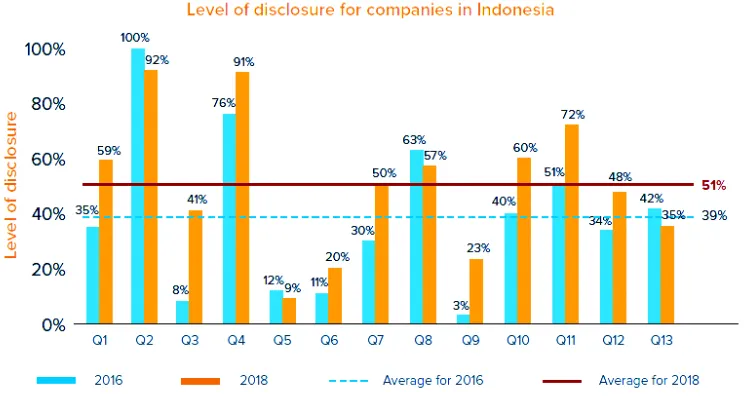
D53, G15, G32, L60financial statement post. Based on research conducted by Loh et al. (2018), the following levels of a com-pany disclosure are defined (see Figure 1).
Based on Figure 1, the level of disclosure of public companies in Indonesia is seen for 2018 with a score of 51%. As a comparison, the levels of public companies disclosure in Malaysia in 2018 are presented in Figure 2.
Based on Figure 2, the level of disclosure of public companies in Malaysia is seen for 2018 with a score of 53%. The development of CSR implementation in Indonesia is marked, many companies have imple-mented CSR. More and more companies are implementing CSR in both charity and empowerment. At least it can be seen from the incessant publications related to the implementation of CSR in print and electronic media. This global phenomenon also hit Indonesia. The development of CSR in Indonesia can be seen from the various efforts of Provincial, District and City Governments to issue legislation related
Figure 1. The levels of Indonesian companies disclosure
Source: Loh, Thao, Lee, & Thomas (2018).
Figure 2. The levels of Malaysian companies disclosure
to the CSR implementation in the provinces, districts and cities concerned. The goal of a company is to maximize the firm value or shareholders’ wealth. Maximizing firm value is considered more appropri-ate as the objective of a company because maximizing firm value means maximizing current value of all future profit of the shareholders. Firm value is reflected in stable stock price, which increases in the long term. The higher the stock price, the higher the firm value (Li & Zaiats, 2018; Bedendo & Siming, 2018; Chen et al., 2018; Saona & San Martin, 2018; Rao, 2018; and Chou & Chan, 2018). Firm value can describe the condition of a company. If a company has good firm value, potential investors will view it positively and vice versa. High firm value shows good company performance. It includes creditor’s view of firm value. For a creditor, firm value is related with company liquidity, meaning a company’s ability to return loan given by a creditor (Ngoc, 2018; Jamali & Karam, 2018; Salehzadehet et al., 2018; Al‐Abdin et al., 2018; Idowu, 2018; Adelopo et al., 2018; and Ameer et al., 2018). If firm value is implied to be poor, an investor will give the company a low value. The value of a public company is from the price of stocks issued by the company (Laoworapng et al., 2018). CSR occurs when CSR activity has ac-tually taken place. In this case, the social department is the initial actors of CSR activities in Indonesia. After 2007, the Law No. 40 of 2007 on Limited Liability Company has been issued, almost all Indonesian
companies have conducted CSR program, although again the activity is still going on the stage of seek-ing popularity and attachment of government regulation. For example, there are still many companies that, when providing assistance, the recipient must stick to the company’s poster in place as a sign that he has received help from the company.
There are many factors which can determine firm value. One of them is profitability, which is a finan-cial factor. Profitability is a factor, which affects firm value (Khumairoh, 2016). Profitability is a com-pany’s ability to produce profit at a certain level of sales, assets and capital (Chen et al., 2018; Eckardt et al., 2018; Guiso & Rustichini, 2018). One of the important indicators for an investor in assessing a company’s future prospect is the growth of the company’s profitability. High profitability reflects good prospect. The higher the profitability of a company, the higher the efficiency of the company, so the company performance is also good. In this study, profitability is proxied by Return on Equity, Return on Assets, Net Profit Margin as measurements of company profitability. Corporate Social Responsibilty is a form of a company’s responsibility in improving social gap and environmental damage due to the operational activities of the company (Blasi et al., 2018; Schipani et al., 2018; Byun, 2018; Civera et al., 2018; Salvioni et al., 2018). The more forms of responsibility performed by a com-pany to its environment, the better the corporate image. Investors are more interested in companies that have good image in the society because the better the corporate image, the higher the customer loyalty (De Jong et al., 2018). Increased customer loyalty will increase sales and profitability. This makes business run smoothly, so firm value will increase. The description shows that CSR can in-crease profitability and firm value. The company not only has economic and legal obligations to share-holders but also obligations to other interested parties that are stakeshare-holders whose scope exceeds the obligations. The underlying idea of corporate social responsibility that is often considered the core of business ethics is that the company not only has economic and legal obligations but also obligations to stakeholders whose scope exceeds the obligation.
Institutional shareholder is a government, a financial institution, a legal entity, a foreign institution, a trust fund, and other institutions which hold corporate stock. Institutional ownership in a company encourages increased monitoring on management performance. The bigger the institutional ownership, the bigger the vote and pressure on the financial institution to monitor its management, thus giving en-couraging management more to optimize company performance and align management’s interest and stakeholder’s interest (Titus et al., 2018). The implementation of Corporate Social Responsibility reveal is a factor which can draw shareholder’s interest to invest. Investors are more interested in investing in companies which implement Corporate Social Responsibility program as their business activities. Therefore, the researcher was interested in studying the influence of profitability and corporate social
1.
LITERATURE REVIEW
1.1. Enterprise value
Enterprise value was defined as market value in this study. Another name for firm value is enter-prise value, which is a description of the size of the company’s economic value as the price of the owner’s takeover value when purchased at a cer-tain time (Vaida, 2017). Formula (1) that can be presented is as follows:
(
)
Enterprise Value
Market Cap Debt Preferred equity
Minority interest
Cash and cash equivalents. =
= + + +
+ −
−
(1)
Other models modified by Chung and Pruitt (1994) include:
(
)
q= MVS+MVD / RVA, (2)
where MVD – the market value of all liabilities (debt), RVA – the replacement value of all produc-tion capacity, MVS – the market value for all out-standing stock.
From formula (2) it is concluded that the company is of high value if the q value is greater than one, which means a good investment opportunity for investors and so is the value of the company gen-erated from the formula. The q value is less than one, and investment opportunities are inadequate for investors. The next formula is (Sial et al., 2018):
E
T
ob
i
M
V
D
EBV
n’s
D
Q
+
+
=
,
(3)where EMV – the equity market value plus the debt on market value, EBV – the equity book val-ue plus the debt on market valval-ue, Tobin Q – the equity market value/the equity book value.
Formula (3) above shows the market value which is the price that occurs from the process of bargain-ing on the stock market (Sial et al., 2018). This val-ue can only be determined if the company shares are sold on the stock market. Firm value is an im-portant indicator for investor to assess company comprehensively (Li & Zaiats, 2018). Firm value is very important because high corporate value will
be followed by high shareholder wealth. High firm value is the desire of the owners of the company, because high value shows that the shareholder prosperity is also high. Market price of the stock reflects the wealth of shareholders and expedien-cy of investment decisions and management. The value of the ownership stock can be an appropriate index to measure the level of corporate effective-ness. For this reason, the financial management objectives are expressed in the form of maximiz-ing the value of shares of the company ownership, or maximizing stock prices. The goal of maxi-mizing stock prices does not mean that managers should seek to increase stock value at the expense of shareholders.
1.2. Net profit margin
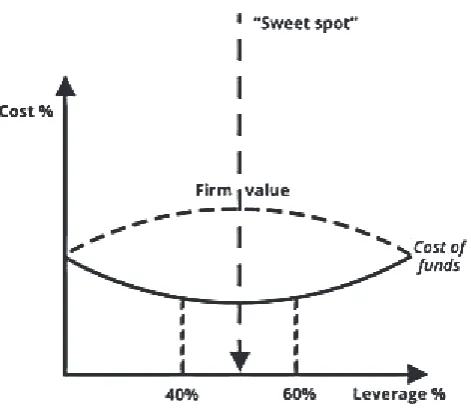
Net Profit Margin (NPM) describes net profit received by a company by very sales. In other words, this ratio measures net profit after tax on sales. The higher NPM value indicates that the company is more efficient. Companies can sup-press unnecessary costs, so the company is able to maximize the net profit earned. The compa-ny will develop faster into a compacompa-ny with great equity. However, the percentage of net income that goes into equity is much higher than the percentage of net income distributed as divi-dends (Saona & Martin, 2018). NPM is used to determine which companies with certain reve-nue succeed in producing maximum net income. Such companies are more efficient in operations than other companies. However, it should be noted that comparing the NPM ratio of a com-pany to another comcom-pany should be done in the same sector. Taking this, the NPM between sec-tors is clearly very different. Figure 3 illustrates the ability of companies to generate profits from several scenarios if there is an increase in ex-penses and cost, the more ineffective existing fi-nancial model and the lower value of the compa-ny. Likewise, the increasing leverage scale shows the ineffectiveness. This is illustrated in Figure 3.
1.3. Corporate social responsibility
Social and environmental responsibility is a com-pany’s commitment to contribute in develop-ing sustainable economy to improve quality of life and beneficial environment, whether for the company, local community, or society in general (Tran, 2018; Baldini et al., 2018; Knudsen, 2018; Bhardwai et al., 2018; Paynter, 2018; Loosemore & Lim, 2018; Spanos, 2018; Maqbool & Zameer, 2018; Buranatrakul & Swierczek, 2018; ElGammal et al., 2018). Corporate Social Responsibility is a phenomenon and a strategy used by companies to accommodate the needs and interests of their stakeholders. CSR begins in an era where the awareness of long-term corporate sustainability is more important than just the profitability of a company. If CSR is truly implemented effectively then it can strengthen or increase the accumula-tion of social capital in order to improve the com-munity welfare. Economic growth can be affected by networking, trust, mutual and social collabo-ration. Through a variety of mechanisms, social capital can increase the level of responsibility for the public interest, the widespread participation in the democratic process, the strengthening of com-munity harmony and the decline in violence.
Corporate responsibility towards the public inter-est can be realized through the implementation of sustainable CSR programs and direct touch to
the aspects of community life. Thus, the realiza-tion of CSR programs is a corporate contriburealiza-tion indirectly to the strengthening of social capital as a whole. Unlike the case with financial capital that can be calculated as quantitative value, then social capital cannot be calculated with certainty. However, it can be asserted that the expenditure of CSR programs is a firm investment in fostering social capital.
1.4. Institutional ownership
Institutional shareholder is a government, a fi-nancial institution, a legal entity, a foreign in-stitution, a trust fund, and other institutions holding corporate stock. Institutional owner-ship is one of the factors that can affect the com-pany performance (Faller & Zu, 2018; Lamb & Butler, 2018; Mota & Uchida, 2018). The exist-ence of ownership by institutional investors will encourage more optimal supervision of man-agement performance, since share ownership represents a source of power that can be used to support or otherwise the management perfor-mance (Buchanan et al., 2018; Hu et al., 2018; and Paynter et al., 2018). Institutional ownership is one of the factors that can affect the perfor-mance of the company. Optimal supervision of the performance of managers will make the de-cision-making procedure more careful. The con-ceptual framework can be described in Figure 4.
Figure 3. Several scenarios of an increase in the enterprise value with the NPM
Based on Figure 4, if managerial ownership is high, it can have a negative impact on the company be-cause it can create defense problems. This means that with high managerial ownership, they have a strong position to exercise control over the com-pany and external stakeholders will have difficul-ty controlling the actions of managers (Cordeiro et al., 2018). This is due to the high voting rights owned by managers.
2.
METHODS
The population of this study was 33 banking com-panies listed on the Indonesia Stock Exchange. The sampling technique for this study was Slovin’s
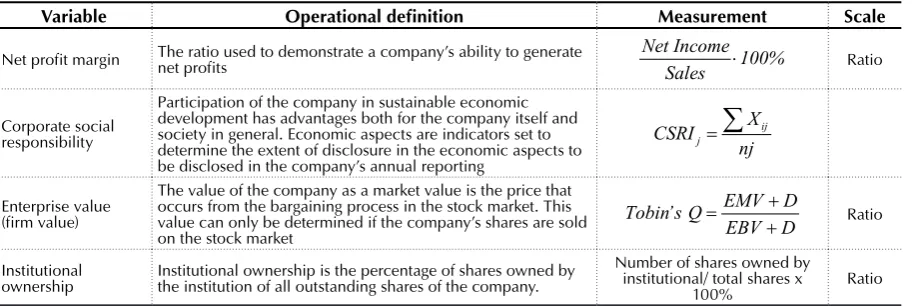
formula by proportional random sampling. The sample in this study was made by 29 banking companies with 10-year (2007–2016) observation period, so that total research data was 29 banking companies x 10 years = 290 observation data. The operationalization of this research variable is pre-sented in Table 1.
As Table 1 shows, for the operationalization of variables, two dependent variables are used, one
moderating variable and one dependent variable. Descriptive statistics was used to provide a sum-mary of research data which consisted of: mean, maximum, minimum, and standard deviation. The basis of decision making in Kolmogorov-Smirnov’s test could be probability value (sig-nificance), which is 1 if probability value > 0.05, then data distribution is normal or equals 2 if probability value 0.05, then data distribution is abnormal. Multicollinearity test aims to ex-amine whether regression model contains any correlation between independent variables. A regression model has multicollinearity if there is perfect linear relation between several or all independent variables of the regression model. Multicollinearity test can be viewed from toler-ance and Varitoler-ance Inflating Factor (VIF) values. Autocorrelation is correlation between members
of a series of observation in a time series or in a spatial series (in cross sectional data). One of the tests of autocorrelation is Durbin-Watson’s test. If Du < DW < (4 – Du), there is no auto-correlation. Heteroscedasticity test aims to ex-amine whether a regression model has variance dissimilarity from the residual of one observa-tion to another. If the variance of the residual
Figure 4. Conceptual framework Net profit margin
Corporate social responsibility
Enterprise value (firm value)
Institutional ownership
Table 1.Operational definition and variable measurement
Variable Operational definition Measurement Scale
Net profit margin The ratio used to demonstrate a company’s ability to generate net profits Net Income 100%
Sales ⋅ Ratio
Corporate social responsibility
Participation of the company in sustainable economic development has advantages both for the company itself and society in general. Economic aspects are indicators set to determine the extent of disclosure in the economic aspects to be disclosed in the company’s annual reporting
j
ij
X I
n CSR
j =
∑
Enterprise value (firm value)
The value of the company as a market value is the price that occurs from the bargaining process in the stock market. This value can only be determined if the company’s shares are sold on the stock market
E Tobin’ MV
D Q
V
s D
EB + +
= Ratio
Institutional
ownership Institutional ownership is the percentage of shares owned by the institution of all outstanding shares of the company.
Number of shares owned by institutional/ total shares x
of one observation to another is fixed, it’s called homoscedasticity, and if different then it’s called heteroscedasticity. Good regression model is ho-moscedasticity or no heteroscedasticity. To see the influences of net profit margin and corporate social responsibility on firm value, the following model was used:
1 1 2 2
á
i
Y
= +
b X
+
b X
+ ,
e
(4)
where Y – firm value, X1 – net profit margin, X2 – corporate social responsibility, α – constant,
b1 – b2 – regression coefficient, ei– estimated error.
Below (4) and (5) are regression equations to see the influences of net profit margin and corporate social responsibility on firm value with institu-tional ownership as a moderating variable:
1
á
1 1 2 2 iZ
= +
b X
+
b X
+ ,
e
(5)
3
e = +a b Y,
(6)
where Z1 – institutional ownership, X1 – net prof-it margin, X2 – corporate social responsibili-ty, α – constant, b1 – b2 – regression coefficient of Independent Variable, b3 – regression coefficient of a moderating variable, ei – estimated error, |e| – absolute residual, Y – profit management.
3.
RESULTS AND DISCUSSION
3.1. Results
3.1.1. Descriptive statistics
Based on Table 2, the descriptive statistics was used to provide a summary of research data which consisted of mean, maximum, minimum, and standard deviation.
Based on Table 2, it can be concluded that the level of CSR disclosure among banking issuers is still minimal. This shows that in the future, capi-tal market authorities can issue rules on the im-portance of mandatory disclosures, especially for banking issuers. The results of the normality test for residual values are presented in Figure 2. According to Syahyunan et al. (2017), the basis of
decision making in Kolmogorov-Smirnov’s test could be probability value (significance), which is:
• if probability value > 0.05, then data distribu-tion is normal;
• if probability value ≤ 0.05, then data distribu-tion is abnormal.
The results of normality testing data are in the Table 3.
Table 3. Normality test
Source: SPSS (2017).
Unstandardized residual
N 290
Normal parametersab
Mean .0000000 Std.
deviation .69091882
Most extreme differences
Absolute .063 Positive .063 Negative –.040 Kolmogorov-Smirnov Z 1.082 Asymp. sig. (2-tailed) .192
Note: a – test distribution is normal, b – calculated from data.
Based on Table 3, significance value of 0.192 is bigger than 0.05. Thus, it’s concluded that the data was normally distributed. Testing residual normality in graphic analysis by examining nor-mal probability plot can also be performed. The results of the multicollinearity test are presented in Table 4.
Table 2. Descriptive statistics
Source: SPSS (2017).
N Minimum Maximum Mean Std. deviation
NP 290 –1.5371 2.3101 .095975 .7105394
NPM 290 –6.9078 4.7118 –.292855 2.5583201
CSR 290 –2.1982 .0000 –.534787 .6335005
IO 290 –2.3026 4.6052 4.524065 .4743695
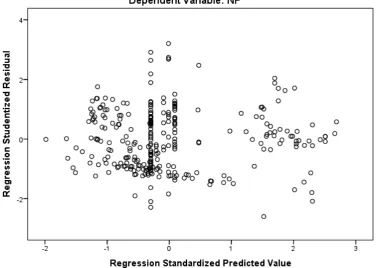
Table 4 shows that all independent variables, i.e. net profit margin and corporate social responsi-bility, have tolerance value bigger than 0.1 and VIF value smaller than 10. Therefore, regression model had no multicollinearity problem. The results of testing the symptoms of the variance of residual inequality for all observations in the linear regres-sion model are shown in Figure 5.
Figure 5 shows that the scatterplot presents that the dots spread randomly above and under the number 0 on Y axis. It’s concluded that there was no heteroscedasticity in the regression model, so the regression model was feasible. Testing the cor-relation of variables in the prediction model with changes in time is presented in Table 5.
Table 5. Autocorrelation test
Source: SPSS (2017).
Model R squareR Adjusted R square Std. error of the estimate Watson
Durbin-1 .233a .054 .048 .6932809 1.962
Note: a – predictors: (Constant), CSR, NPM; b – dependent variable: NP.
Table 5 shows that the Durbin Watson (DW) value is 1.962. The value will be compared with the table value using significance value of 5%, total sample 200 (n) and total independent variables 2 (k = 2) so du = 1.862 so that 1.862 < 1.962 < 2.138 (4 – du) and it’s concluded that there was no autocorrela-tion. Hypothesis test is a difference test between sample value and population of the value of the
Table 4.Multicollinearity test
Source: SPSS (2017).
Model Unstandardized coefficients
Standardized
coefficients t Sig. Collinearity statistics
B Std. error Beta Tolerance VIF
Constant .047 .053 .879 .380
NPM –.062 .016 –.225 –3.946 .000 .997 1.003
CSR –.058 .064 –.052 –.912 .363 .997 1.003
Note: a – dependent variable: NP.
Figure 5.Heteroscedasticity test
studied data and the expected value. The hypothe-sis tests were coefficient determination (R2), F test,
t test and residual test (moderating) (see Table 6).
Table 6.Results of the coefficient determination
test
Source: SPSS (2017).
Model R squareR Adjusted R square Std. error of the estimate
1 .233 .054 .048 .6932809 Note: a – predictors: (Constant), CSR_E, NPM; b – dependent variable: NP.
Table 6 shows, Adjusted R Square value is 0.049 or (4.8%). It means that 4.8% of Firm Value could be explained by Net Profit Margin and Corporate Social Responsibility, while the remaining 95.2% was explained by other variables not included in this study. Simultaneous testing is presented in Table 7.
Table 7.F-test
Source: SPSS (2017).
Model squaresSum of df squareMean F Sig.
Regression 8.084 2 4.042 8.410 .000b
Residual 140.346 292 .481 Total 148.431 294
Note: a – dependent variable: NP; b – predictors: (Constant), CSR, NPM.
Based on Table 7 above, F count is 8.410, bigger than F table of 3.026, and the significance value of F test is 0.000, smaller than alpha 0.05. It’s con-cluded that simultaneously, net profit margin and corporate social responsibility had significance for firm value. Partial testing is presented in Table 8.
Table 8. T-test
Source: SPSS (2017).
Model
Unstandardized
coefficients Standardized coefficients
t Sig. B errorStd. Beta
(Constant) .047 .053 .879 .380 NPM –.062 .016 –.225 –3.946 .000 CSR –.058 .064 –.052 –.912 .363
Based on the results of Table 8, partially the influ-ence of each independent variable on the depend-ent variable is described as follows:
1. Variable net profit margin with significance value of 0.000 is smaller than alpha 0.05. It
meant variable net profit margin partially in-fluenced firm value.
2. Variable corporate social responsibility with significance value of 0.363 is higher than al-pha 0.05. It meant variable corporate social re-sponsibility did not influence firm value.
The testing of the moderation impact used by the Residual Test is found in Table 9.
Table 9. Results of the first residual test
Source: SPSS (2017).
Model
Unstandardized
coefficients Standardized coefficients
t Sig. B errorStd. Beta
Constant 4.564 .036 127.139 .000 NPM .024 .011 .129 2.225 .027 CSR .062 .043 .083 1.426 .155
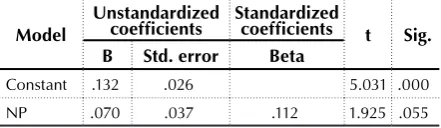
Based on Table 9, the effect of the residuals of in-dependent variables is presented. Then the second residual test is carried out. Table 10 shows that test is an alternative test of various methods available.
Table 10.Results of the second residual test
Source: SPSS (2017).
Model
Unstandardized
coefficients Standardized coefficients t Sig. B Std. error Beta
Constant .132 .026 5.031 .000 NP .070 .037 .112 1.925 .055
The resulting moderation equation is:
1
4 564
0 024
0 062
Z
=
.
+
.
NPM
+
.
CSR e
+ ,
0 132 0 0704
e = . + . NP.
The equation based on Table 10 produces positive and insignificant coefficient value of 0.070 because the significance value of firm value is 0.055 that is bigger than alpha 0.05. So it is concluded that in-stitutional ownership reinforced the relationship between net profit margin and corporate social re-sponsibility and firm value.
3.2. Discussion
pro-gress. The term CSR is enough debatable. The busi-ness world also seems to be giddy with the word ‘responsibility’, whereas the role of the business world with its CSR practices is expected in the pro-cess of sustainable development in Indonesia. The condition of Indonesia still requires CSR as a legal obligation. In the past 10 years, some banking is-suers have had minimal CSR implementation as a corporate social responsibility. Awareness of the existence of CSR is still low, the conditions that oc-cur lack for sufficient moral awareness. Obedience of issuers to the need for social accountability is still very low. CSR is born from the people’s insist-ence on the behavior of companies that ignore so-cial responsibility, such as environmental destruc-tion, exploitation of natural resources and ex-ploitation of workers’ rights. Most companies also tend to distance themselves from the surrounding community. If the situation and conditions that occur need to strengthen awareness of the com-pany roles and responsibilities, then a non-legal responsibility will turn into liability or mandato-ry. This initiates the government to intervene with the aim of expanding the scope of CSR. The CSR scope covers not only corporate responsibility to shareholders, but also to stakeholders, employees, consumers, suppliers, communities, the creation of clean air, clean water, and other constituents where the company is located. CSR practices will have a positive impact on the company, and assess CSR as an investment, not a cost. Companies vol-untarily and earnestly practice CSR and are con-fident that this social investment will result in the smooth operation of the business. They get a pos-itive image because the community assesses the existence of the company to help the community.
The CSR practice is a long-term social invest-ment. Implementing sustainable CSR practices will obtain operational permits from the com-munity (Parida & Wang, 2018; Stancu et al., 2018; Kanaiah & Jayakumar, 2018; Lin et al., 2018; Bertrand & Lapointe, 2018; Kumar et al., 2018; Kim, 2018; Del Brio et al., 2018; Ahigbe et al., 2018; Abukari & Hamid, 2018). In order to have the force of law and stimulus, the CSR, that is all voluntary, needs to be upgraded to a more mandatory CSR. The measurable and sys-tematic contribution of the business world in its participation improves the welfare of society and can boost the value of the company. If the value of the firm increases, then the stock price increases and the company’s profit increases. Conversely, on the other hand, people also can-not casually make demands to the company, if expectations are beyond the limits of applicable rules. In conducting CSR activities, it is strong-ly recommended that the business community involve the local community, so that CSR activ-ities produce positive impact not only for inter-nal but also exterinter-nal companies. Community engagement activities directly in the region of the business world concerned are known as Community Development. Community devel-opment is a process designed to create the pro-gress of the economic and social conditions of citizens through active participation, which in turn will foster initiative and self-reliance of the community itself. The concept of CSR is close-ly related to the concept of Community devel-opment. Community development is an impor-tant part of the implementation process of CSR activities.
CONCLUSION
institutional ownership factors did not play a major role in the relationship. This is also summarized in the fact that banking issuers in Indonesia are minimal in disclosing their social responsibility reporting. It also plays a major role in investor decisions because there are not many issuers who disclose their so-cial responsibilities in the notes to finanso-cial statements. The Indonesian capital market authority must appeal to banking issuers to increase their social disclosure so that the information plays a role in the value of the company.
ACKNOWLEDGEMENT
This paper is dedicated to the implementation of the Memorandum of Understanding (MoU) between the Universitas Sumatera Utara (USU), Indonesia, and Accounting Research Institute (ARI), Universiti Teknologi MARA, Malaysia.
REFERENCES
1. Abukari, A. J., & Abdul-Hamid, I. K. (2018). Corporate social responsibility reporting in the telecommunications sector in Ghana. International Journal of Corporate Social Responsibility, 3(1), 2-12. https:// doi.org/10.1186/s40991-017-0025-9
2. Adelopo, I., Obalola, M., & Moure, R. C. (2017). Corporate social disclosures by banks: Between legal institution and cultural dimensions. In Sustainability and Social Responsibility: Regulation and Reporting (pp. 307-331). Singapore: Springer. https://doi. org/10.1007/978-981-10-4502-8_13
3. Akhigbe, A., Makar, S., Wang, L., & Whyte, A. M. (2018). Interest rate derivatives use in banking: Market pricing implications of cash flow hedges. Journal of Banking & Finance, 86, 113-126. https://doi.org/10.1016/j. jbankfin.2017.09.009
4. Al‐Abdin, A., Roy, T., & Nicholson, J. D. (2017). Researching
corporate social responsibility in the Middle East: the current state and future directions. Corporate Social Responsibility and
Environmental Management, 25(1), 47-65. https://doi.org/10.1002/ csr.1439
5. Ameer, R., & Othman, R. (2018). Corporate Values and Corporate Social Responsibility
Communication Strategies in a Small Economy. In Eco-Efficiency in Industry and Science (pp. 67-100). Cham: Springer. https://doi.
org/10.1007/978-3-319-70899-7_4 6. Baldini, M. A., Bronzetti, G., &
Sicoli, G. (2018). The influence of corporate governance’s decision on corporate social responsibility. International Journal of Business Performance Management, 19(1), 16-35. https://doi.org/10.1504/ ijbpm.2018.10008953
7. Bedendo, M., & Siming, L. (2018). The mitigating effect of bank financing on shareholder value and firm policies following rating downgrades. Journal of Corporate Finance, 48, 94-108. https://doi. org/10.1016/j.jcorpfin.2017.10.019 8. Bertrand, P., & Lapointe, V. (2018).
Risk-based strategies: the social responsibility of investment universes does matter. Annals of Operations Research, 262(2), 413-429. https://doi.org/10.1007/ s10479-015-2081-4
9. Bhardwaj, P., Chatterjee, P., Demir, K. D., & Turut, O. (2018). When and how is corporate social responsibility profitable? Journal of Business Research, 84, 206-219. 10. Blasi, S., Caporin, M., & Fontini,
F. (2018). A Multidimensional Analysis of the Relationship
Between Corporate Social Responsibility and Firms’ Economic Performance. Ecological
Economics, 147, 218-229. https://doi.org/10.1016/j. ecolecon.2018.01.014 11. Buchanan, B., Cao, C. X., &
Chen, C. (2018). Corporate social responsibility, firm value, and influential institutional ownership. Journal of Corporate Finance, 52, 73-95. https://doi. org/10.1016/j.jcorpfin.2018.07.004 12. Buranatrakul, T., & Swierczek, F. W.
(2017). Climate Change Strategic Actions in the International Banking Industry. Global Business Review, 19(1), 32-47. https://doi. org/10.1177/0972150917713371 13. Byun, S. K., & Oh, J. M.
(2018). Local corporate social responsibility, media coverage, and shareholder value. Journal of Banking & Finance, 87, 68-86. https://doi.org/10.1016/j. jbankfin.2017.09.010
14. Chen, N., Liang, H. Y., & Yu, M. T. (2018). Asset diversification and bank performance: Evidence from three Asian countries with a dual banking system. Pacific-Basin Finance Journal, 52, 40-53. https://doi.org/10.1016/j. pacfin.2018.02.007
15. Chen, Y. C., Hung, M., & Wang, Y. (2018). The effect of mandatory CSR disclosure on firm profitability and social externalities: Evidence from China. Journal of Accounting and Economics, 65(1), 169-190. https://doi.org/10.1016/j.
16. Chou, Y. Y., & Chan, M. L. (2018). The Impact of CEO Characteristics on Real Earnings Management: Evidence from the US Banking Industry. Journal of Applied Finance & Banking, 8(2), 17-44.
17. Chung, K. H., & Pruitt, S. W. (1994). A simple approximation of Tobin’s q. Financial Management,
23(3), 70-74. https://doi.
org/10.2307/3665623
18. Civera, C., Casalegno, C., Mosca,F., & Maple, P. (2018). Customers’ judgments and misjudgments of corporate responsibility communication: A cross‐country investigation of the effects on confidence and trust within the banking sector. Psychology & Marketing, 35(2), 138-149. https:// doi.org/10.1002/mar.21075 19. Cordeiro, J. J., Galeazzo, A., Shaw,
T. S., Veliyath, R., & Nandakumar, M. K. (2018). Ownership influences on corporate social responsibility in the Indian context. Asia Pacific Journal of Management, 35(4), 1107-1136.
20. Corporate Finance Institute (2018). What is Net Profit Margin? Retrieved from https:// corporatefinanceinstitute.com/ resources/knowledge/finance/net-profit-margin-formula/ (Acceses on December 22, 2018). 21. De Jong, M. D., Harkink,
K. M., & Barth, S. (2018). Making Green Stuff? Effects of Corporate Greenwashing on Consumers. Journal of Business and Technical Communication, 32(1), 77-112. https://doi.
org/10.1177/1050651917729863 22. Del Brio, E. B., Perote, J., de
Miguel, A., & Gómez, G. (2018). Insider Trading and Corporate Governance in the Banking Sector. New Lessons on the Entrenchment Effect. In Corporate Governance in Banking and Investor Protection (pp. 219-233). Cham: Springer.
23. Eckardt, R., Skaggs, B. C., & Lepak, D. P. (2018). An examination of the firm-level performance impact of cluster hiring in knowledge-intensive firms. Academy of
Management Journal, 61(3), 919-944. https://doi.org/10.5465/ amj.2016.0601
24. ElGammal, W., El-Kassar, A. N., & Canaan Messarra, L. (2018). Corporate ethics, governance and social responsibility in MENA countries. Management Decision, 56(1), 273-291. 25. Faller, C. M., & Zu
Knyphausen-Aufseb, D. (2018). Does equity ownership matter for corporate social responsibility? A literature review of theories and recent empirical findings. Journal of Business Ethics, 150(1), 15-40. https://doi.org/10.1007/s10551-016-3122-x
26. Guiso, L., & Rustichini, A. (2018). Understanding the size and profitability of firms: The role of a biological factor. Research in Economics, 72(1), 65-85. 27. Hu,Y. Y., Zhu,Y., Tucker, J., &
Hu,Y. (2018). Ownership influence and CSR disclosure in China. Accounting Research Journal, 31(1), 8-21. https://doi. org/10.1108/arj-01-2017-0011 28. Idowu, S. O. (2018). Current Issues
in Corporate Social Responsibility: An Introduction. In Current Issues in Corporate Social Responsibility (pp. 1-7). Cham: Springer.
29. Jaiyeoba, H. B., Adewale, A. A., & Quadry, M. O. (2018). Are Malaysian Islamic banks’ corporate social responsibilities effective? A stakeholders’ view. International Journal of Bank Marketing, 36(1), 111-125. https://doi.org/10.1108/
ijbm-10-2016-0146 30. Jamali, D., & Karam, C.
(2018). Corporate social responsibility in developing countries as an emerging field of study. International Journal of Management Reviews, 20(1), 32-61. 31. Jie, C. T., & Hasan, N. A. M. (2018).
Predictors of Employees’ Job Satisfaction Through Corporate Social Responsibility (CSR) Practices in Malaysian Banking Company. Advanced Science Letters, 24(5), 3072-3078. https:// doi.org/10.1166/asl.2018.11320 32. Jusoh, W. N. H. W., & Ibrahim,
U. (2018). The Significance of
Corporate Social Responsibility Disclosure to Islamic Banks in Malaysia: An Islamic View. Journal of Islamic Finance, 7(1), 1-8. 33. Kannaiah, D., & Jayakumar, A.
(2018). Impact of Corporate Social Responsibility (CSR) Practices on Consumer Behavior (with Reference to FMCGs in Tamil Nadu). International Journal of Business and Management, 13(3), 28. https://doi.org/10.5539/ijbm. v13n3p28
34. Kim, J. H. (2018). Asset specificity and firm value: Evidence from mergers. Journal of Corporate Finance, 48, 375-412.
35. Knudsen, J. S. (2018). Government Regulation of International Corporate Social Responsibility in the US and the UK: How Domestic Institutions Shape Mandatory and Supportive Initiatives. British Journal of Industrial Relations, 56(1), 164-188. https://doi.org/10.1111/bjir.12253 36. Kumar, R., Pande, N., & Afreen,
S. (2018). Developing a GRI-G4 based persuasive communication framework for sustainability reporting (SR): examining top 10 Indian banks. International Journal of Emerging Markets, 13(1), 136-161.
37. Lamb, N. H., & Butler, F. C. (2018). The influence of family firms and institutional owners on corporate social responsibility performance. Business
and Society, 57(7), 1374-1406. https://doi.
org/10.1177/0007650316648443
38. Laoworapong, M., Supattarakul, S., & Swierczek, F. W. (2018). Corporate Governance, Board Effectiveness, and Performance of Thai Listed Firms. AU Journal of Management, 13(1), 25-40.
39. Law No. 40 of 2007 on Limited Liability Company (2007). State Gazette of 2007 Number 106
40. Li, T., & Zaiats, N. (2018). Corporate governance and firm value at dual class firms. Review of Financial Economics, 36(1), 47-71. 41. Lin, C., Chang, H., & Zhu, H.
(2018). The Relationship between Social Responsibility and Majority Shareholders’ Stock Selling: Considering the Mediation of Investors Tendency. Journal of Business Theory and Practice, 6(1), 12. https://doi.org/10.22158/jbtp. v6n1p12
42. Loh, L., Thao, N. T .P., Lee, S. P., & Thomas, T. (2018). Corporate Disclosure On Business Integrity in Asean. Retrieved from https:// www.scope.org.sg/phocadown-load/BI%20report%20V6%20 060818%20-%20final.pdf 43. Loosemore, M., & Lim, B. T. H.
(2018). Mapping corporate social responsibility strategies in the construction and engineering industry. Construction
Management and Economics, 36(2), 67-82.
44. Maqbool, S., & Zameer, M. N. (2018). Corporate social responsibility and financial performance: An empirical analysis of Indian banks. Future Business Journal, 4(1), 84-93. https://doi.org/10.1016/j. fbj.2017.12.002
45. Motta, E. M., & Uchida, K. (2018). Institutional investors, corporate social responsibility and stock price performance. Journal of the Japanese and International Economies, 47(1), 91-102. 46. Ngoc, N. (2018). The Effect of
Corporate Social Responsibility Disclosure on Financial Performance: Evidence from Credit Institutions in Vietnam.
Asian Social Science, 14(4), 109-122. https://doi.org/10.5539/ass. v14n4p109
47. Parida, S., & Wang, Z. (2018). Financial Crisis and Corporate Social Responsible Mutual Fund Flows. International Journal of Financial Studies, 6(1), 8. https:// doi.org/10.3390/ijfs6010008 48. Paynter, M., Halabi, A. K., &
Lawton, A. (2018). The Neo-Institutionalism Influences on
Corporate Social Responsibility Reporting Development in Australia: A Three Company
Study. In The Goals of Sustainable Development (pp. 193-214). Singapore: Springer.
49. Rahman, I. M. A., & Ismail, K. N. I. K. (2018). The moderating effect of culture on the relationship between women directors and CSR disclosure in Malaysia. Asian Journal of Accounting and Governance, 9, 133-148. Retrieved From http://ejournal.ukm.my/ ajac/article/view/25303
50. Rao, A. (2018). Empirical Analysis of Joint Impact of Enterprise Risk Management (ERM) and Corporate Governance (CG) on Firm Value. International Review of Advances in Business, Management and Law, 1(1), 34-50. https://doi.org/10.30585/irabml. v1i1.66
51. Salehzadeh, R., Pool, J. K., & Najafabadi, A. H. J. (2018). Exploring the relationship between corporate social responsibility, brand image and brand equity in Iranian banking industry. Journal of Islamic Accounting and Business Research, 9(2), 106-118. https://doi. org/10.1108/jiabr-11-2014-0041 52. Salvioni, D. M., Franzoni, S.,
& Gennari, F. (2018). Social Responsibility as a factor of Convergence in Corporate Governance.Sustainability and Social Responsibility: Regulation and Reporting (pp. 29-53). Singapore: Springer.
53. Saona, P., & San Martín, P. (2018). Determinants of firm value in Latin America: an analysis of firm attributes and institutional factors. Review of Managerial Science, 12(1), 65-112. https://doi. org/10.1007/s11846-016-0213-0 54. Schipani, C. A., Dworkin, T.
M., & Liu, J. (2018). The role of employee voice in promoting corporate social responsibility in China. Globalisation of Corporate Social Responsibility and its Impact on Corporate Governance (pp. 51-75). Cham: Springer.
55. Sial, M. S., Chunmei, Z., Khan, T., & Nguyen, V. K. (2018). Corporate
social responsibility, firm performance and the moderating effect of earnings management in Chinese firms. Asia-Pacific Journal of Business Administration, 10(2/3), 184-199. https://doi.org/10.1108/
apjba-03-2018-0051 56. Spanos, L. (2018).
Complementarity and
interconnection between CSR and crowdfunding: A case study in Greece. In Corporate Responsibility and Digital Communities (pp. 29-49). Cham: Palgrave Macmillan. 57. Stancu, A., Grigore, G., &
McQueen, D. (2017). Corporate Responsibility and Digital Communities: An Introduction. In Corporate Responsibility and Digital Communities (pp. 1-7). Cham: Palgrave Macmillan. https://doi.org/10.1007/978-3-319-63480-7_1
58. Syahyunan, Muda, I., Siregar, H. S, Sadalia,I., & Chandra, G. (2017). The Effect of Lerner Index and Income Diversification on the General Bank Stability in Indonesia. Banks and Bank Systems, 12(4), 56-64. http://dx.doi. org/10.21511/bbs.12(4).2017.05 59. Titus, V. K., & Anderson, B.
S. (2018). Firm Structure and Environment as Contingencies to the Corporate Venture Capital-Parent Firm Value Relationship. Entrepreneurship Theory and Practice, 42(3), 498-522. https://doi.org/10.1111/ etap.12264
60. Tran, B. (2018). Corporate social responsibility. In Encyclopedia of Information Science and Technology, Fourth Edition (pp. 671-681). IGI Global.
61. Vaidya, Dheeraj (2017). What Is Enterprise Value (Firm Value)?