CRIMINAL LEGAL POLICY AND
UNCONSTITUTIONALITY ON CONTEMPT OF RULER OR PUBLIC BODY
Muhammad Reza Winata
Mahkamah Konstitusi Republik Indonesia [email protected]
Erlina M. C. Sinaga
Mahkamah Konstitusi Republik Indonesia [email protected]
Sharfina Sabila
Mahkamah Konstitusi Republik Indonesia [email protected]
Rizkisyabana Yulistyaputri
Mahkamah Konstitusi Republik Indonesia [email protected]
Abstract
Contempt of ruler or public body are criminal offence which
stipulated in article 207 and 208 Penal Code of Indonesia. In practice,
there is legal uncertainty because substantially contradict to
Constitutional Court Decision No.013-022/PUU-IV/2006 about
contempt of President/ Vice President and No. 6/PUU-V/2007
about contempt of Indonesia Government. This paper wants to found
criminal legal policy and constitutionality on contempt of ruler or
public body. The research method used is juridical normative with
regulation, doctrinal, and decision approaches. The result of study
shows changes of criminal law policy on contempt of ruler or public
body based on comparison of current Penal Code and future Penal
Code Draft with changes elements of formulation: (1) suspect; (2)
intention; (3) victim; (4) sanction; (5) impact of action, the norms also
transform from general offence to complaint offense. Next, analysis to
Constitutional Court decisions about contempt of President/Vice President and Indonesia Government which declared null and void, found related legal reasoning: First, violate freedom of expression;
Second, violate right to get information; Third, causing legal uncertainty; Fourth, no longer suitable with society development;
Fifth, changes in norms on Criminal Code Draft; Sixth; follow previous decision; Seventh, against universal value in international law.
Then, the constitutional interpretation methods used in the decisions are: (1) Ethical Interpretation; (2) Historical Interpretation; (3) Futuristic Interpretation; (4) Doctrinal Interpretation. Therefore, according on similar legal reasoning and constitutional interpretation, article 207 and 208 Penal Code also supposed to be stated unconstitutional.
Penghinaan terhadap penguasa atau badan umum merupakan tindak pidana yang diatur dalam pasal 207 dan 208 Kitab Undang-Undang Hukum Pidana.
Dalam praktik, terjadi ketidakpastian hukum karena delik ini justru digunakan untuk mempidanakan pelaku penghinaan yang sebenarnya telah dibatalkan melalui Putusan Mahkamah Konstitusi No.013-022/PUU- IV/2006 tentang penghinaan terhadap Presiden atau Wakil Presiden dan No.
6/PUU-V/2007 tentang penghinaan terhadap Pemerintah Indonesia. Artikel
ini hendak menemukan politik hukum tindak pidana penghinaan terhadap
penguasa atau badan umum berdasarkan hukum yang berlaku saat ini dan
hukum yang akan datang, serta kontitusionalitas delik penghinaan terhadap
penguasa atau badan umum. Metode penelitian yang digunakan adalah yuridis
normatif dengan pendekatan regulasi, doktrinal, dan putusan. Hasil kajian
menunjukkan perubahan politik hukum pidana penghinaan terhadap penguasa
atau badan umum berdasarkan perbandingan ius constitutum pada KUHP
dengan ius constituendum pada RKUHP yaitu perubahan formulasi unsur
mengenai: (1) pelaku; (2) niat; (3) korban; (4) sanksi; dan (5) akibat perbuatan,
serta norma pidana ini menjadi delik aduan. Selanjutnya, analisis terhadap
putusan Mahkamah Konstitusi ditemukan argumentasi hukum berkaitan
mengenai pembatalan norma penghinaan terhadap Presiden/Wakil Presiden dan
Pemerintah Indonesia sebagai berikut: Pertama, menghambat hak atas kebebasan
menyatakan pikiran dengan lisan, tulisan dan ekspresi; Kedua, menghambat
upaya komunikasi dan hak untuk memperoleh informasi; Ketiga, menimbulkan
ketidakpastian hukum; Keempat, tidak sesuai lagi dengan perkembangan
masyarakat; Kelima, terdapat perubahan norma dalam RKUHP; Keenam,
mengikuti kecenderungan putusan sebelumnya; dan Ketujuh, bertentangan dengan nilai universal dalam hukum internasional. Kemudian, serta metode penafsiran konstitusional yang digunakan dalam putusan tersebut: (1) Penafsiran Etikal;
(2) Penafsiran Historis; (3) Penafsiran Futuristik; dan (4) Penafsiran Doktrina.
Untuk itu, Pasal 207 dan 208 KUHP seharusnya juga dinyatakan inkonstitusional.
Keywords: Criminal Legal Policy, Unconstitutionality, Contempt of Ruler or Public Body, Human Rights
Introduction
Criminal legal policy of criminal law is important part of legal system in a nation. Criminal justice system encompasses a whole series of stages and decisions, from the initial investigation of crime, through the various pre-trial processes, the provisions of the criminal law, the trial, the forms of punishment, and then post-sentence decisions.
1All systems of criminal law represent a shared commitment to acquitting the innocent and punishing the guilty. This shared commitment confers upon them a single unifying purpose that centers on the institution of punishment. Without punishment and institutions designed to measure and carry out punishment, there is no criminal law.
2However, criminal law legislation can tend to overcriminalization.
The overcriminalization often causes substantial injustice even to persons who deserve some degree of punishment for their behavior, because injustice occurs when punishments are disproportionate, exceeding what the offender deserves. Overcriminalization frequently produces disproportionate punishments, although this contention will be more difficult to substantiate.
3Overcriminalization even has chance to violates human rights and constitutionalism principles. This is one of problem in criminal legal policy.
1
Andrew Ashworth, Sentencing and criminal justice (Cambridge: Cambridge University Press, 2015), p. 67.
2
George P. Fletcher, Basic Concept of Criminal Law (New York: Oxford University Press, 1998), p. 25.
3
Douglas Husak, Overcriminalization: The limits of the criminal law (New York:
Oxford University Press, 2008), p. 14.
Criminal law as part of the legal system in Indonesia, often said ultimum remedium or the last remedy with criminal sanctions for an act when another branch of law is implemented properly.
4The criminal law implementation must be appropriate to the background of the criminal conviction and the basis conformity with the constitution.
One of criminal offense which the legal policy and constitutionality needs to be examined are contempt of ruler or public body.
The contempt against the authorities is regulated in Article 207 and Article 208 of Criminal Code (KUHP). Formulation of Article 207:
Whoever deliberately publicly verbally or in writing insults a ruler or public body in Indonesia, is threatened with a maximum imprisonment of one year and six months or a maximum fine of four thousand five hundred rupiah.
While Article 208 specifically paragraph (1):
Anyone who broadcasts, displays or attaches publicly a writing or painting that contains contempt of ruler or public body in Indonesia with the intention that the insulting content is known or more publicly known, threatened with a maximum of four months imprisonment or criminal a maximum fine of four thousand five hundred rupiah.
However, in practice, there is confusion in application of contempt of ruler or public body by law enforcement officials. For example, in the case of Ahmad Dhani who allegedly violated contempt of ruler or public body which stipulated in article 207 of Criminal Code, because he insulting the President.
5Even though the article on contempt of President was null and void through Constitutional Court Decision No. 013-022/PUU-IV/2006. This is also the case with Asma Dewi, who has been found guilty for contempt of ruler or public body, because she insulting government policy.
6Even though the
4
Sudarto, Hukum Pidana I (Semarang: Yayasan Sudarto, 2009), p. 20.
5
Akhdi Martin Pratama, “Polisi Dinilai Keliru Gunakan Pasal 207 KUHP Terkait Kasus Ahmad Dhani”, Kompas.com (November 25, 2016), available on https://megapolitan.kompas.com/read/2016/11/25/14200891/polisi.dinilai.keliru.
gunakan.pasal.207.kuhp.terkait.kasus.ahmad.dhani, accessed 5 Sep 2018.
6
Muhammad Radityo Priyasmoro, “Terbukti Hina Penguasa, Asma Dewi
Saracen Divonis 5 Bulan 15 Hari Penjara”, Liputan6.com (March 15, 2018), available
article on contempt of Indonesian Government null and void through Constitutional Court Decision No. 6/PUU-V/2007.
Of course, this paper does not agree with every provocative and tendentious actions, but criminalization of actions that actually have been null and void by the Constitutional Court cause legal uncertainty in implementation contempt of ruler and public body. According to the cases, contempt of ruler or public body report to law enforcement officials is often based on subjective consideration of victims who feel demeaned by their honor and reputation. This criminal offense become biased when people who carry out constructive criticism of the authority performance considered to be insulting the ruler of public body. For this reason, commonly, contempt of ruler and public body only seen as a form of policy that protects authorities from social criticism and political attacks, then considered to disturb public order.
In addition, in the Draft Penal Code, there is a change in criminal offense contempt of ruler or public bodies that indicates this crime has a problem, so it must be corrected. Amendment and renewal as a criminal legal politics in essence implies an effort to re-orient and reform criminal law in accordance with central values of socio- philosophical, socio-political, and socio-cultural in Indonesian society that underlies social policy, criminal policy and law enforcement policy in Indonesia.
7Therefore, criminal legal policy and constitutionality of criminal offence is very important to determine the necessity of the norm.
Therefore, the idea of novelty to be analyzed is criminal legal policy on contempt of ruler or public bodies based on current law (ius constitutum) in Criminal Code (KUHP) and future law (ius constituendum) in Criminal Code Draft (RKUHP), then Constitutional Court decision.
Next, analyze the constitutionality of contempt of ruler or public bodies based on legal reasoning and constitutional interpretation methods.
The legal research method used in analyzing legal issues in this paper is juridical normative. The problem approach uses statutory, doctrinal, and case approach. Data collection techniques from library
on https://www.liputan6.com/news/read/3376446/terbukti-hina-penguasa-asma- dewi-saracen-divonis-5-bulan-15-hari-penjara, accessed 5 Sep 2018.
7
Barda Nawawi Arief, Bunga rampai kebijakan hukum pidana (Bandung: Citra
Aditya Bakti, 1996), p. 32.
research with primary legal materials: 1945 Constitution, Criminal Code (KUHP), and Criminal Code Draft (RKUHP), secondary legal materials: books, journals, and news articles relating to contempt of ruler and public body.
Criminal Legal Policy of Contempt of Rulers or Public Bodies based on the Criminal Code, Criminal Code Draft, and Constitutional Court Decisions
Criminal offence of contempt in the Criminal Code (KUHP) commonly can be divided into two types, general contempt regulated in chapter XVI book II of the KUHP
8and special contempt outside chapter XVI book II of the KUHP.
9Based on the object of its use, the object of public contempt is more toward the personal attacking one’s dignity, while the object of special contempt is more on the group’s dignity.
10One offense of this particular insult that will be analyzed by the author is an insult to the rulers or public bodies.
In general, a criminal offense can be interpreted as an act or attitude of attacking or demeaning one’s honor or reputation.
11Thus, a criminal offense is an act that attacks the right of a person’s good name or honor, so it can be said that the intention to contempt of the ruler or public body is an action of attacking good name or honor against a ruler or public body based on the subject as a person or as an institution. After discussing the meaning of contempt of ruler or public body, then criminal legal policy will be analyzed.
8
General contempt crime offences stipulated in Chapter XVI Book II Criminal Code: a. Defilement (Article 310); b. Defamation (Article 311); c. Mild Contempt (Article 315); d. Complaint Defamation (Article 317); e. False Prejudice (Article 318);
f. Contempt to Dead Person (Article 320, 321).
9
Particular contempt crime offence stipulated not in Chapter XVI Book II Criminal Code: a. Contempt of President or Vice President (Article 134, 135, 136, 137); b. Contempt of Foreign Head of State (Article 142, 143, 144); c. Contempt of Flag and National Symbol (Article 154a); d. Contempt of Foreign National Flag (Article 142a); d. Contempt of Indonesia Government (Article 154, 155); e.
Contempt to Particular Group (Article156); f. Contempt of Religion (Article 156a, 177 number 1 and 2); g. Contempt of Ruler and Public Body (Article 207, 208).
10
Adami Chazawi, Kejahatan Penghinaan (Jakarta: PT Rajagrafindo Persada, 2011), p. 43.
11
Leden Marpaung, Tindak pidana terhadap kehormatan: pengertian dan penerapannya:
dilengkapi dengan putusan-putusan Mahkamah Agung RI (Jakarta: PT Rajagrafindo
Persada, 1997), p. 9.
Criminal legal policy has a relation of meaning to legal policy.
Legal policy is the formulation of a law with the core of making and updating legal materials, so that they can be adapted to the needs of society and implementation of existing legal provisions.
12Whereas, criminal legal policy is an effort to realize criminal legislation in accordance with the circumstances and situations at the time and for the future, so it can be said also that criminal legal policy means an effort to make or formulate a criminal legislation that is good.
13In criminal legal policy, it also important to concern about statutory language regulations that are meticulous and thorough in order to prevent the formulation of legal norms that lead to multiple meanings and ambiguity, in order to guarantee legal certainty.
14An analysis of the criminal legal policy on contempt of ruler and public body will be reviewed based on current law in Criminal Code and future law in Criminal Code Draft.
Current law (ius constitutum) in Criminal Code (KUHP), the contempt of rulers or public bodies is regulated in Chapter VIII regarding Crimes against Public Ruler. Article 207 regulates:
Whoever deliberately publicly verbally or in writing contempt a ruler or public body in Indonesia, is threatened with a maximum imprisonment of one year and six months or a maximum fine of four thousand five hundred rupiah.
While Article 208 specifically paragraph (1) states:
Anyone who broadcasts displays or attaches publicly a writing or painting that contains contempt to rulers or public bodies in Indonesia with the intention that the insulting content is known or more publicly known, threatened with a maximum of four months imprisonment or criminal a maximum fine of four thousand five hundred rupiah.
12
Mahfud MD, Politik Hukum di Indonesia (Jakarta: Rajawali Pers, 2009), p. 8.
13
Barda Nawawi Arief, Bunga rampai kebijakan…, p. 26.
14
H.A.S. Natabaya, Menata Ulang Sistem Peraturan Perundang-undangan Indonesia, (Jakarta: Sekretaris Jenderal dan Kepaniteraan Mahkamah Konstitusi RI, 2008.), p.
334.
Future law (ius constituendum) in the Draft Penal Code (RKUHP)
15the offense for contempt of rulers or public bodies has changed the formulation. This can be seen in Article 240 that reads:
Every person who publicly contempt the legitimate government which results in commotion in the community, shall be punished with a maximum imprisonment of 3 (three) years or a maximum fine of Category IV.
Whereas Article 241 says:
Any person who broadcasts, shows, or pastes writings or pictures so that they are visible to the public, or plays recordings so that they are heard by the public, which contains contempt to the legitimate government with the intention that the contents of the insult are publicly known which results in commotion in society, convicted with imprisonment a maximum of 3 (three) years or a maximum fine of Category IV.
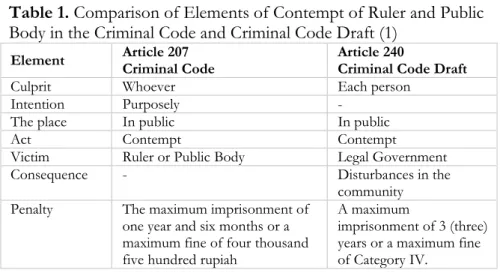
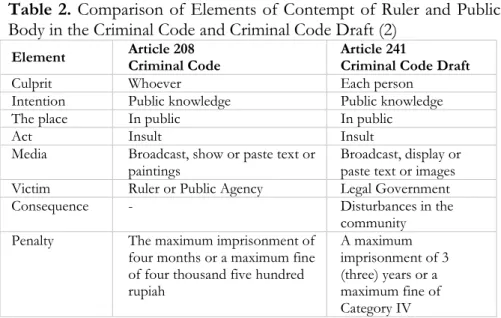
Based on ius constitutum and ius constituendum regarding contempt to rulers or public bodies, this paper finds a comparison of offensive elements as follows.
Table 1. Comparison of Elements of Contempt of Ruler and Public Body in the Criminal Code and Criminal Code Draft (1)
Element Article 207
Criminal Code Article 240
Criminal Code Draft
Culprit Whoever Each person
Intention Purposely -
The place In public In public
Act Contempt Contempt
Victim Ruler or Public Body Legal Government
Consequence - Disturbances in the
community Penalty The maximum imprisonment of
one year and six months or a maximum fine of four thousand five hundred rupiah
A maximum
imprisonment of 3 (three) years or a maximum fine of Category IV.
15
Aliansi Nasional Reformasi KUHP, Rancangan Kitab Undang-Undang Hukum
Pidana/RKUHP (Versi 15 September 2019), available on https://reformasikuhp.org/r-
kuhp/, accessed 30 Mar 2020.
Table 2. Comparison of Elements of Contempt of Ruler and Public Body in the Criminal Code and Criminal Code Draft (2)
Element Article 208
Criminal Code Article 241
Criminal Code Draft
Culprit Whoever Each person
Intention Public knowledge Public knowledge
The place In public In public
Act Insult Insult
Media Broadcast, show or paste text or
paintings Broadcast, display or
paste text or images Victim Ruler or Public Agency Legal Government
Consequence - Disturbances in the
community Penalty The maximum imprisonment of
four months or a maximum fine of four thousand five hundred rupiah
A maximum imprisonment of 3 (three) years or a maximum fine of Category IV
Based on the table, it can be seen the difference in the formulation of regulations concerning insults to the authorities or legal entities in Article 207 and Article 208 of Criminal Code with Article 240 and Article 241 of Criminal Code Draft. Important changes to the formulation include: First, Actors who previously used the term
“Whosoever” became “Everyone”, even though the meaning did not
change, but this shows the updating of Indonesian language in
accordance with an improved spelling; Second, intentions that were
previously “intentionally”, but on the change seen that deemed
contempt must have been intentional, so not include the intentional
element again; Third, victims who were formerly “Ruler or Public
Body” became “Legitimate Governments”, this formulation was the
most significant change, in which the legislators tried to find
terminology more relevant to current context of Indonesian legal
system, but these term actually has the same subject meaning, that is
the Indonesian government in the broad sense that apprentices the
power to administer the government; Fourth, the prison sanctions that
were previously lighter, then the maximum prison sentence changes
more severe. Fifth, result of actions that were not previously used as
elements, but in the change into elements resulting in “disturbance in
the community”.
Changes in the formulation of the offense concerning insults to the authorities or legal entities in the RKUHP, shows that the legislators that is Government and the House of Representatives, aware this articles have legal issues that need to be corrected in the future, so there is a need to change the formulation of contempt of ruler and public body. This shows the future criminal legal policy on contempt of ruler and public body.
The development criminal legal policy on contempt of ruler and public body, aside from implementation experience, also influenced by the decision of the Constitutional Court (MK) as a state institution that played an important role in influencing the process of law and public policy formation.
16Since its establishment, the Court has several times tested the article of contempt, the decisions that are important to be a reference in this paper, namely Constitutional Court Decision No. 013-022/PUU-IV/2006 concerning contempt of President/Vice President, then Constitutional Court Decision No.
6/PUU-V/2007 concerning contempt of Government of Indonesia.
These decisions are chosen because have characteristics of contempt of ruler and public body.
Constitutional Court Decision No. 013-022/PUU-IV/2006 states that Article 134, Article 136 bis, and Article 137 of the Criminal Code are contrary to the 1945 Constitution and do not have legal binding force.
17The interesting thing in this decision is the fact Petitioner did
16
The role of Constitutional Court as stated by Martin Shapiro dan Alec Stone Sweet, “The fact that judicial review not only managed to survive but even spreads to more systems is important evidence its functionality in the contemporary world, because the court has succeeded in influencing the policy processes and outcomes in its polity.” See Martin Shapiro and Alec Stone Sweet, On law, politics, and judicialization (New York: Oxford University Press, 2002), p. 145.
17
Article 134 Criminal Code
Contempt of the President or Vice President is threatened with a maximum imprisonment of six years, or maximum fine of four thousand five hundred thousand rupiah.
Article 136 bis Criminal Code
The definition of contempt as referred in Article 134 also includes the
formulation of action in Article 135, if it insulted no victim presence, whether
by public behavior, or not in public either speak or written, but before more
than four people, or before third person, against his will and therefore feels
offended.
not request an examination of Article 207 and 208 of the Criminal Code, but the Constitutional Justice in legal considerations interpreted contempt to authorities or public bodies (gestelde macht of openbaar lichaam) should be done on the basis of complaints (bij klacht), then emphasized that the state administrators need future adjustments to this crime.
18Even though the interpretation which changes to Articles 207 and 208 becomes a complaint offense, it is only in legal consideration.
Even though, some scholars said the legal considerations of the Constitutional Court’s decision have binding power as an integral whole with the decision because there is a rationalization basis to answer the problem of the constitutionality of the norms of the law which reviewed, so legal considerations are the guidance desired by the constitution according to the interpretation of constitutional justices.
19This decision, has been indirectly change criminal legal policy on contempt of ruler and public body.
Constitutional Court Decision No. 6/PUU-V/2007 states that Article 154 and Article 155 of the Criminal Code are contrary to the 1945 Constitution and do not have legal binding force.
20The thing to
Article 137 Criminal Code
(1) Anyone who broadcasts, displays, or attaches publicly writings or paintings containing contempt to the President or Vice President, with intention that the contents of contempt are known or more known to the public, threatened with a maximum imprisonment for one year and four months or maximum fine four thousand and five hundred rupiah.
(2) If the person guilty of committing a crime at the time, and at that time it has not yet passed two years since the conviction became permanent due to such crimes also, then against him may be prohibited from carrying out the search.
18
Constitutional Court Decision No. 013-022/PUU-IV/2006, p. 60-61.
19
Fajar Laksono, Relasi Antara Mahkamah Konstitusi Dengan Dewan Perwakilan Rakyat dan Presiden Selaku Pembentuk Undang-Undang, Doctoral Dissertation (Faculty of Law, University of Brawijaya, 2017), p. 655-656.
20
Article 154 Criminal Code
Anyone who publicly expresses feelings of hostility, hatred or contempt of the
Government of Indonesia, is threatened with a maximum imprisonment of
seven years or a maximum fine of four thousand five hundred rupiah.
note from this decision is applicant actually applied for review Articles 207 and 208 of the Indonesian Criminal Code. However, the Constitutional Justice considers this article to be irrelevant to the argument of the impairment of the constitutional rights of the applicant and the applicant is declared to have no legal standing of the article.
21So, in fact the Court has never reviewed the constitutionality of Article 207 and 208 of Indonesian Criminal Code.
Based on the description above, it can be found that criminal legal policy on contempt of ruler and public body. Conceptually, there are three central problems in the politics of criminal law, namely: a. What acts should be made a crime; b. Who can be held liable for criminal liability; and c. What sanctions should be imposed on violators.
22This can be answered through an analysis of the differences in the formulation of offense insulting the authorities or public bodies based on current law (ius constitutum) in Criminal Code and future law (ius constituendum) in Criminal Code Draft: First, Actors who previously used the term “Whosoever” becomes “Everyone”; Second, intentions that were previously “intentionally” were not formulated; Third, victims who were formerly “Authorities or Public Bodies” became
“Legitimate Governments”; Fourth, the maximum sanction of imprisonment which was previously mild, becomes more severe. Fifth, the effect of acts that were not previously an element, but became an element resulted in “disturbance in the community”. In addition, criminal legal policy influenced by Constitutional Court’s decision
Article 155 Criminal Code
(1) Anyone who broadcasts, displays or attaches writings or paintings in public which contains statements of feelings of hostility, hatred or contempt of the Government of Indonesia, with the intention that their contents are known or more known to the public, threatened with imprisonment of up to four years and six months or a fine a maximum of four thousand five hundred rupiah.
(2) If the person guilty of committing the crime at the time of carrying out his search and at that time has not passed five years since his conviction became permanent due to committing such crimes as well, the person concerned may be prohibited from carrying out the search.
21
Constitutional Court No. 013-022/PUU-IV/2006, p. 70.
22
Shafrudin, “Pelaksanaan Politik Hukum Pidana Dalam Penegakan Hukum
Pidana Di Indonesia”, Jurnal Hukum Pro Justitia, vol. 27, no. 2 (2009), p. 181.
which change contempt of ruler and public body into a complaint offense.
Unconstitutionality of Contempt of Rulers or Public Bodies Based on Legal Reasoning and Constitutional Interpretation Methods
The existence of Constitutional Court in Indonesia after reformation era is a response to improve mechanism of checks and balances among state institutions.
23The court has function as: (i) the guardian of the constitution (the guardian of constitution); (ii) the interpreter of the constitution; (iii) the guardian of democratization;
(iv) the protector of human rights;
24and (v) guarding the state ideology (the guardian of ideology).
25Analysis of Constitutional Court Decision No. 013-022/PUU- IV/2006 and Constitutional Court Decision No. 6/PUU-V/2007 previously, this paper found there are similar characteristics between the contempt of ruler or public body, contempt of President/Vice President, and contempt of Government of Indonesia, this can be proven in the following table.
The table shows the existence of similar elements among contempt of ruler or public body, contempt of president/vice president, and contempt of Government of Indonesia, that are:
perpetrators, places, and deeds. Although, the victims of contempt are different, but these victims have an incision in the scope of the subject. For this reason, this paper will analyze further the legal reasoning and constitutional interpretation methods in these two decisions, so it will be fundamental analysis to found constitutionality of contempt of ruler or public body which stipulated in Articles 207 and 208 of Criminal Code.
23
Soimin and Mashuriyanto, Mahkamah Konstitusi dalam Sistem Ketatanegaraan Indonesia (Yogyakarta: UII Press, 2013), p. Ix.
24
Jimly Asshidiqie, Perkembangan dan Konsolidasi Lembaga-Lembaga Negara Pasca Reformasi (Jakarta: Sekretariat Jendral dan Kepaniteraan Mahkamah Konstitusi RI, 2006), p. 153.
25
Richaldo Y. Hariandja, “MK Berperan Menjaga Ideologi Negara”, Medcom.id
(January 20, 2017), available on
https://www.medcom.id/nasional/politik/VNxJrO1k-mk-berperan-menjaga-
ideologi-negara, accessed 21 Augu 2018.
Table 3. Comparison of Elements of Contempt of Ruler or Public Body, Contempt of President/Vice President, and Contempt of Government of Indonesia (1)
Element Article 207 of the
Criminal Code Article 134 of the
Criminal Code Article 154 of the Criminal Code
Culprit Whoever - Whoever
Intention Purposely - -
The place In public - In public
Act Contempt Contempt Feelings of hostility,
hatred or contempt Victim Ruler or Public Body President or Vice
President Indonesian
government Penalty The maximum
imprisonment of one year and six months or a maximum fine of four thousand five hundred rupiah
The maximum imprisonment of six years, or a maximum fine of four
thousand five hundred thousand rupiah.
A maximum of seven years imprisonment or a maximum fine of four thousand five hundred rupiah
Table 4. Comparison of Elements of Contempt of Ruler or Public Body, Contempt of President/Vice President, and Contempt of Government of Indonesia (2)
Element Article 208 of the
Criminal Code Article 137 of the
Criminal Code Article 155 of the Criminal Code
Culprit Whoever Whoever Whoever
Intention Purposely Known by public Known by public
The place In public In public In public
Act Contempt Contempt Feelings of hostility,
hatred or contempt Media Broadcast, show or
paste text or paintings
Broadcast, show or post in public writing or painting
Broadcast, show or paste text or paintings Victim Ruler or Public Body President or Vice
President Indonesian
Government Penalty The maximum
imprisonment of four months or a maximum fine of four thousand five hundred rupiah
The maximum imprisonment of one year and four months or a maximum fine of four thousand five hundred rupiah.
The maximum
imprisonment of
four years and six
months or a
maximum fine of
four thousand five
hundred rupiah.
In Constitutional Court Decision No. 013-022/PUU-IV/2006, the Constitutional Court provides construction of legal reasoning to constitutional review Article 134, Article 136 bis, and Article 137: First, articles a quo cause President and Vice President receive discriminatory legal privilege, which differs from the position of society as the true holder of highest sovereignty, so it contradicts to Article 27 Paragraph (1) of 1945 Constitution; Second, articles a quo can cause legal uncertainty because it is very vulnerable to multi interpretation from criticism opinion or thought, so it contradicts to Article 28D Paragraph (1) of 1945 Constitution; Third, articles a quo hinder communication efforts and the acquisition of information, so it contradicts to Article 28F of 1945 Constitution ; Fourth, articles a quo has the opportunity to inhibit the right to freedom of expression of thought through word of mouth, writing and expression, so it contradicts Article 28, Article 28E Paragraph (2), and Paragraph (3) of 1945 Constitution.
26Based on these legal reasoning, this paper found that argumentation for annulment against Article 134, Article 136 bis, and Article 137. Articles a quo also negated equality before the law principle, legal certainty principle, reduced freedom of expression, thoughts, opinions, and information.
Next, methodology of constitutional interpretation analysis found the Constitutional Justices choose ethical interpretation.
27Ethical
26
In addition, beside that five constitutional norms which violated by a quo articles, the Constitutional Court also considers that contempt to President/Vice- President according to the law should apply Article 310-321 of Criminal Code, when contempt is addressed in his personal quality. The Court also believes that article a quo can be a hindrance or obstacle to clarifying the mechanism of impeachment President/Vice President as referred to in Article 7A of the 1945 Constitution. See Constitutional Court Decision No. 013-022/PUU-IV/2006. p. 59-61.
27
“Ethical interpretation is a method of interpretation by deriving moral and
ethical principles as contained in constitution or constitution with a philosophical,
aspirational, or moral approach to issues concerning the importance of human
rights.” See Tim Penyusun Hukum Acara Mahkamah Konstitusi, Hukum Acara
Mahkamah Konstitusi (Jakarta: Sekretariat Jenderal dan Kepaniteraan Mahkamah
Konstitusi, 2010), p. 72-75. For another reference, it said that, “moral Reasoning
argues that certain moral concepts or ideals underlie some terms in the text of the
Constitution, this interpretation based on the text often pertain to the limits of
government authority over the individual rights.” See Brandon J. Murrill, Modes of
Constitutional Interpretation, CRS Report for Congress, R45129 (Congressional
Research Service, 2018), available on https://www.hsdl.org/?view&did=809094,
accessed January 30, 2020, p. 15.
interpretation is used because Constitutional Justices interpret violations of constitutional rights of citizens based on perspective of protecting human rights which guaranteed in the constitution.
In Constitutional Court Decision No. 6/PUU-V/2007, the Court gave legal reasoning in constitutional review Article 154 and Article 155: First, articles a quo historically was intended to ensnare the independence movement in the Dutch East Indies (Indonesia), this provision is contrary to the position of Indonesia as an independent country; Second, the formulation of articles a quo is a formal offense that simply requires the fulfillment of the prohibited acts, thus causing a tendency to abuse power because it can be interpreted according to only authorities reference; Third, the Constitutional Court refers to Constitutional Court Decision No. 013-022/PUU-IV/2006; Fourth, Criminal Code Draft has a different offense formulation showing the urgency of criminal legal policy renewal.
28For this reason, articles a quo is deemed not to guarantee legal certainty, so contradicts to Article 28D Paragraph (1) 1945 Constitution. Articles a quo also violence freedom of thoughts and attitudes, and expression of opinions, so contradicts to Articles 28 and 28E Paragraph (2) and Paragraph (3) 1945 Constitution.
Next, methodology of constitutional interpretation analysis found the Constitutional Justices choose at least four methods of interpretation: historical interpretation, sociological interpretation method, doctrinal interpretation, and futuristic interpretation.
29Historical interpretation based on history and the development of norms, sociological interpretations based on implementation of norms which misused by the authorities, doctrinal interpretations based on previous decisions, and futuristic interpretations based on future consideration.
28
Constitutional Court Decision No. 6/PUU-V/2007, p. 75-79.
29
“Historical interpretations is a method interpretation according to purpose of the provisions of the law such as when they were formed, sociological interpretations, namely interpretations based on social objectives and the latest social situation, doctrinal interpretations, namely interpretations through judicial practices in decisions, and futuristic interpretations, namely interpretations by looking at the law that is aspired or which will come.” See also Tim Penyusun Hukum Acara Mahkamah Konstitusi, Hukum Acara Mahkamah Konstitusi, p. 72-75; Brandon J.
Murrill, Modes of Constitutional Interpretation, p. 22.
Based on legal reasoning and constitutional interpretation methods in Constitutional Court Decision No. 013-022/PUU- IV/2006 and Constitutional Court Decision No. 6/PUU-V/2007 as analyzed above, then with similar logic of legal reasoning will be fundamental analysis to determine the constitutionality of norms in Articles 207 and 208 Criminal Code.
30This paper found at least seven legal reasoning can be used to analyze the constitutionality of Articles 207 and 208 of Criminal Code, these are the argumentations.
First argument, Articles 207 and 208 of Criminal Code hinder the right to freedom of expression of thoughts through oral and written, as guaranteed in Article 28, Article 28E Paragraph (2), and Paragraph (3) of the 1945 Constitution.
31This argument is main argument of the constitutionality review which based on consideration that right to freedom of opinion or expression is a form of respect for individual dignity.
32In addition, freedom of expression can be explain:
Freedom of expression guarantees everyone’s right to speak and write openly, including the right to criticize injustices, illegal activities and incompetence’s, it also guarantees the right to know and right to inform the public and to offer opinions of any kind, to advocate change, to give the minority the opportunity to be heard, and challenge the rise of state tyranny.
3330
The interpretation of the law needs to be done by the judge when there are norms that are unclear or multi interpretation. See Yudha Bhakti Ardhiwisastra, Penafsiran dan konstruksi hukum (Bandung: Alumni, 2000), p. 52-53.
31
Article 28 1945 Constitution
Freedom of association and assembly, expressing thoughts verbally and writing, and so forth are determined by law.
Article 28 E Paragraph (2) 1945 Constitution
Everyone has the right to freedom to believe in beliefs, express thoughts and attitudes, according to his conscience.
Article 28 E Paragraph (3) 1945 Constitution
Everyone has the right to freedom of association, assembly, and expression
32
ELSAM, ICJR, IMDLN, PBHI and YLBHI, Komentar Tertulis (Amicus Curiae) mengenai Pidana Penghinaan adalah Pembatasan Kemerdekaan Berpendapat yang Inkonstitusional (Bekasi: Serpico, 2010), p. 12
33
Rajeev Kumar Singh, “Right to information: The basic need of
democracy”, Journal of Education & Social Policy, vol. 1, no. 2 (2014), p. 86.
This argumentation explains the importance guarantee the right to freedom of expression and opinion in order to uphold democratic rule of law. So, when these rights are violated it will disrupt democracy principle and trigger tyrannical government.
It should be noted, several articles of Criminal Code related of crime to state including contempt to authorities, in practice have been misused to reduce and suppress political freedom and expression for citizens.
34In fact, based on emerging trends, contempt crimes are an effective tool used to protect the interests of public officials.
35The author emphasizes that freedom of expression and opinion are constitutional rights which guaranteed by the constitution, so all efforts are needed to minimize the possibility of criminalization the citizens. For this reason, the existence contempt of ruler or public body as regulated in Article 207 and 208 of Criminal Code has violates the right to freedom of expression and opinion, so contradicts to Article 28, Article 28E Paragraph (2), and Paragraph (3) of the 1945 Constitution.
Second argument, Articles 207 and 208 of the Criminal Code hinder communication efforts and limits the right to obtain information as guaranteed in Article 28F of 1945 Constitution.
36This argument is based on the conception of democracy as stated in the Constitution,
“The right of access to information is fundamental: first, ensuring that citizens are informed of the activities of government; secondly, ensuring that public power is exercised legitimately and fairly.”
37Based
34
Supriyadi Widodo Eddyono and Fajrimei A. Gofar (Elsam), Meneliti Pasal- Pasal Proteksi Negara dalam RUU KUHP: Catatan Kritis terhadap Pasal-Pasal Tindak Pidana Ideologi, Penghinaan terhadap Matabat Presiden dan Wakil Presiden dan Penghinaan terhadap Pemerintah, (Jakarta: ELSAM dan Aliansi Nasional Reformasi KUHP Jakarta, 2007), p. 13-14.
35
Supriyadi W. Eddyono and Erasmus A.T. Napitumulu, Penghinaan dalam Rancangan KUHP 2013: Ancaman Lama bagi Kebebasan Berekspresi (Jakarta: Institute for Criminal Justice Reform/ICJR, 2014), p. 43.
36
Article 28F 1945 Constitution
Everyone has right to communicate and obtain information to develop their personal and social environment, and has right to seek, obtain, own, store, process and deliver information using all types of available channels.
37
Kate O’Regan, “Democracy and access to information in the South African
Constitution: Some reflections”, In Conference Constitutional Right of Access to
on this concept, the right to access information has two essentials:
informing government activities and providing community contribution choices, this right guarantees every action and policy of government are fairly and lawfully. Further explanation about right to obtain information can describe below.
Effective right to information systems require well-designed legal frameworks, stable institutional arrangements, and effective records and information management in order to support adequate response to public demand and to proactively disclose information of relevance to the public.
38This paper considers that right to obtain information is a constitutional right which protected by the Constitution. Every action must be taken to prevent restrictions on access to public information.
For this reason, the existence contempt of ruler and public body as regulated in Articles 207 and 208 of the Criminal Code has provided a loophole for violations of the right to obtain information, so it contradicts to Article 28F of 1945 Constitution.
Third argument, Article 207 and 208 of Criminal Code cause legal uncertainty as guaranteed in Article 28D Paragraph (1) of the 1945 Constitution. There are similarities in criminal offenses with Article 134, Article 136 bis, Article 137, Article 154 and Article 155 which have been declared null and void by the Constitutional Court, especially on the subject victims of contempt.
39Legal certainty is a very important element in upholding the rule of law principle.
40This is
Information, St. George Hotel, Old Pretoria Road, Rietvlei Dam, vol. 4, (September 4, 2000), p. 11.
38
Trapnell, Stephanie E., Right to Information: Case Studies on Implementation, Right to information working paper series (Washington DC: World Bank, 2014), available on https://openknowledge.worldbank.org/handle/10986/22527, License: CC BY 3.0 IGO, accessed January 30, 2020, p. xiii.
39
Article 28D Paragraph (1):
Every person has the right to recognition, guarantees, protection and certainty of law that is fair and the same treatment before the law.
40
The Venice Commission concluded core elements of the Rule of Law are:
(1) Legality, including a transparent, accountable and democratic process for
enacting law; (2) Legal certainty; (3) Prohibition of arbitrariness; (4) Access to Justice
(5) Respect for Human Rights; and (6) Nondiscrimination and Equality before the
Law. See Venice Commission of the Council of Europe, The Rule of Law Checklist,
in line with the thought of Gustav Radbruch who claims legal certainty as one of the elements in law, Radbruch said there are three general precepts of law: justice, legal certainty, and expediency.
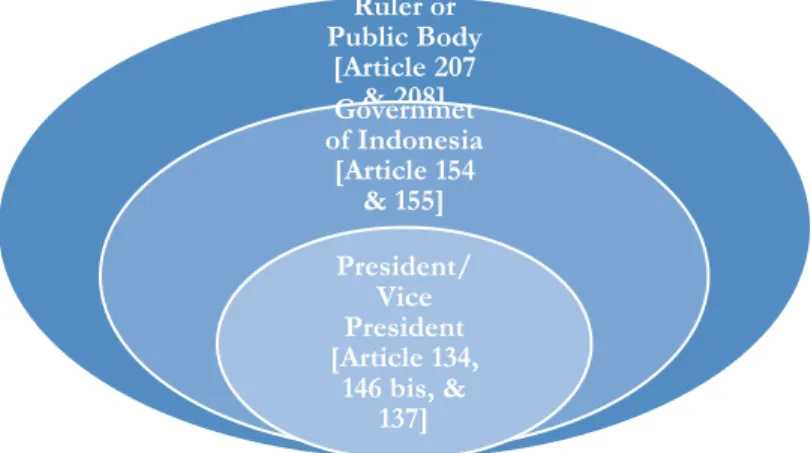
41As explained in previous part, there is an intersection of criminal elements between several articles which have been declared null and void by Constitutional Court that is Article 134, Article 136 bis, Article 137 of Criminal Code concerning contempt to the President/Vice President, then Article 154 and Article 155 Criminal Code regarding Contempt to Government of Indonesia, with Articles 207 and 208 of the Criminal Code concerning contempt of ruler or public body, especially in crimes element that is victims of contempt, this paper found important problem of intersection among that norm.
Figure 1. Intersection of Victims on Contempt in Article 134, Article 136 bis, Article 137, Article 154, Article 155, Article 207,
and 208 of Criminal Code
Another problem is the definition of ruler and public body cannot be found in terminology of Criminal Code, Criminal Code Draft, Criminal Procedure Code, or any regulations at this time. The meaning of ruler only can trace in Indonesia language reference can define as a ruler who is the master; people in power to organize things, govern,
(Venice: Documents and Publications Production Department (SPDP) Council of Europe, 2016), p. 10.
41
Heather Leawoods, “Gustav Radbruch: An Extraordinary Legal Philosopher”, Washington University Journal of Law & Policy, vol. 2, no. 1 (2000), p. 493.
Ruler or Public Body
[Article 207
& 208]
Governmet of Indonesia [Article 154
& 155]
President/
Vice President [Article 134,
146 bis, &
137]
and so on.
42Meanwhile the meaning of public body even can be found in General Dictionary of Indonesia Language. The difference in terms between the ruler or public body with the Indonesian Government due to use of term “ruler” during Dutch East Indies referred to rulers outside the legal government in Indonesia or “the invaders”, but after independence the term ruler who became the true ruler to govern and administer in Indonesia was surely the Government of Indonesia.
Therefore, this paper found that the subject of victim contempt is interconnection because the President/Vice President is part of Government of Indonesia, as well as the Government of Indonesia is part of the Ruler or Public Body (Government in broad meaning).
Thus, when article on contempt of President/Vice President and article on contempt of Indonesia Government is declared null and void by Constitutional Court, article on contempt of Ruler or Public Body also supposed to be stated unconstitutional, in order to prevent legal uncertainty in law enforcement practices.
The analysis is proven by the occurrence of various criminal cases against citizens using articles of contempt of ruler or public body, even though the real subject of victim contempt is the President/Vice President or the Government of Indonesia. For example, the case of Ahmad Dhani who allegedly violated Article 207 of Criminal Code, even though he said was aimed subject is President.
43Another case occurred in Asma Dewi, who was found guilty of insulting the authorities for contempt government policy.
44Of course, this paper does not agree with every provocative and tendentious actions, but the problem is practice the law enforcer use Article 207 or 208 on the subject of contempt which actually has been overturned by Constitutional Court Decision No. 013-022/PUU-IV/2006 and Constitutional Court Decision Number No. 6/PUU-V/2007, so in the
42
Kamus Besar Bahasa Indonesia (KBBI), Kuasa, available on https://kbbi.web.id/kuasa, accessed Sept 5, 2018.
43
Jerome Wirawan, “Ahmad Dhani dan kontroversi pasal penghinaan penguasa”, BBC Indonesia (23 November 2016), available on https://www.bbc.com/indonesia/indonesia-38064915, accessed Sept 5, 2018.
44
Nursita Sari, “Asma Dewi Divonis Bersalah karena Gunakan Ujaran
“Koplak” dan “Edun”“, Kompas.com (15 Maret 2018), available on
https://megapolitan.kompas.com/read/2018/03/15/20152311/asma-dewi-divonis-
bersalah-karena-gunakan-ujaran-koplak-dan-edun, accessed Sept 5, 2018.
end these decisions is futile because contempt to the same subject with the same actions can be punished using Articles 207 and 208.
Therefore, all explanations above prove the existence of contempt of ruler or public body as regulated in Article 207 and 208 of Criminal Code has caused legal uncertainty, so contradict to Article 28D Paragraph (1) of 1945 Constitution.
Fourth argument, based on historical analysis, it must be recognized that Criminal Code (KUHP) which is a translation from Wetboek van Strafrecht (WvS) made in the Netherlands including Articles 207 and 208 of Criminal Code, is not relevant anymore with Criminal Code reform to realize national law reform of Indonesia Republic which based on Pancasila, 1945 Constitution, and respect human rights.
45Therefore, the existence of contempt of ruler and public body is a legacy from the colonial era to protect the reputation and dignity of invader, especially Queen and King, so this norm no longer compatible with development of Indonesian society today.
Fifth argument, analysis of future law that will apply in the Criminal Code Draft, this paper found that in the last draft there was a change in the article on contempt of ruler or public body in Article 240 and Article 241. The new formulation of articles changes in the term of victim which not use ruler or public body anymore. Therefore, based on a futuristic legal analysis there must be correction to current Article 207 and 208 of Criminal Code.
Sixth argument, based on the previous court decision that is Constitutional Court Decision No. 013-022/PUU-IV/2006 and Constitutional Court Decision Number No. 6/PUU-V/2007, the Constitutional Court has tendency to promote the protection of human rights, especially right to express opinions and though, also right to obtain legal certainty. Furthermore, because this study has the similar constitutional issues and construction of legal reasoning, so Constitutional Court should be consistent with the previous decision by declares Article 207 and 208 of Criminal Code also contradict to constitution in order to guarantee the enforcement of human rights as stipulated in the constitution.
45
ELSAM, “Tinjauan Umum terhadap Rancangan Kitab Undang-Undang Hukum Pidana (KUHP) Nasional”, Background Paper Advokasi RUU KUHP, Jakarta:
ELSAM, 2005, p. 5-6.
Seventh argument, analysis based on the perspective of international law, especially regarding universal human rights, also referred by Constitutional Court in previous decision, that is Constitutional Court Decision No. 013-022/PUU-IV/2006. Furthermore, similar arguments can use to examine the constitutionality of Articles 207 and 208 Criminal Code. Considering Article 19 of the Universal Declaration of Human Rights and the International Covenant on Civil and Political Rights, requires each state party to guarantee protection of rights to freedom of opinion and expression. Furthermore, this human rights is a universal value that recognized and guaranteed by all countries in the world, so Articles 207 and 208 of Criminal Code must be declared contradicts to human rights which guaranteed in international law.
Next this paper will analysis the constitutional interpretation methods. The concept of interpretation methods used in the constitutional interpretation will be explained first. Philip Bobbit identified six types of constitutional interpretation methods: (1) Historical (relying on the intentions of the framers and ratifies of the Constitution); (2) Textual (looking to the meaning of the words of the Constitution alone, as they would be interpreted by the average contemporary); (3) Structural (inferring rules from the relationships that the Constitution mandates among the structures it sets up); (4) Doctrinal (applying rules generated by precedent); (5) Ethical (deriving rules from those moral commitments of ethos that are reflected in the Constitution); and (6) Prudential (seeking to balance the costs and benefits of a particular rule).
46It is interesting to compare this thought with idea delivered by James E. Fleming that explains the seven methods of constitutional interpretation, (1) Textualism (plain words of the constitutional document); (2) Consensualism (current social consensus on what the words mean); (3) Philosophic (nature of things the words refer to/best understanding of concepts embodied in the words); (4) Originalism (intentions or original meanings of framers/ratifiers /founding generation; (5) Structuralism (document’s arrangement of offices, powers, and relationships; (6) Doctrinalism (doctrines of courts and
46
Philip Bobbit, Constitutional Fate: Theory of the Constitution (New York: Oxford
University Press, 1982), p. 3-8.
judicial precedents; and (7) Pragmatism (preferences of dominant political forces).
47Based on the analysis of legal reasoning to Articles 207 and 208 of the Criminal Code that explained before, these offenses should be declared unconstitutional because it contradicts to 1945 Constitution with several reasoning: First, it inhibits the right to freedom of expression; Second, it impedes communication efforts and right to obtain information; Third, it creates legal uncertainty; Fourth, it no longer compatible with society development; Fifth, it has change in future norms of Criminal Code Draft; Sixth, it must follow previous Constitutional Court decision; and Seventh, it contrary to universal values in international law. Furthermore, based on these legal reasonings, constitutional interpretation methods are used: (1) ethical interpretation; (2) historical interpretation; (3) futuristic interpretation, and; (4) doctrinal interpretation
Conclusion
The criminal legal policy for contempt of ruler and public body is answered through an analysis of differences in the formulation based on current law (ius constitutum) in Criminal Code with future law (ius constituendum) in Criminal Code Draft. The transformation of formulations are: First, the offender who previously used the term
“Whosoever”, then became “Everyone”; Second, intentions that previously “deliberately”, then not formulated; Third, victims who formerly “Authorities or Public Bodies”, then became “Legitimate Governments”; Fourth, maximum sanction of imprisonment which previously mild, then becomes more severe; Fifth, the effect of action that previously not an element, but then became an element result in
“disturbance in the community”. In addition, criminal legal policy as a result of Constitutional Court’s decision has changed the criminal action contempt of ruler and public body from general offense, then into a complaint offense.
Constitutional review of Articles 207 and 208 Criminal Code can be analysis on several legal reasoning: First, it inhibits the right to freedom of expression which contradict to Article 28, Article 28E Paragraph (2), and Paragraph (3) 1945 Constitution; Second, it hinder
47