Vol.6 (2016) No. 3
ISSN: 2088-5334
The Chitinase Activity in Banana Seedling that Induced
by Trichoderma spp. as Resistance Responce
to Fusarium Oxyporum f.sp.cubense
Nurbailis
#, Mardinus
#, Nasril Nasir
#, Abdi Dharma
#, Trimurti Habazar
# #Department of Plant Protection, Faculty of Acriculture, Andalas University, Padang 25613, Indonesia E-mail: [email protected]
Abstract— An experiment was conducted to study the chitinase activities of banana seedling that induced by Trichoderma spp. The experiment consisted of two parts: 1. Testing chitinase activity in banana seedlings induced by Trichodernia spp. Using a factorial in a completely randomized design with two factors: a. types of inducers (biomass, liquid culture and filtrate), b. Isolates of Trichoderma spp. (T. Koningii-S6sh, T. Viride-T1sk, T.harzianum-P4sh and control.) with 4 replications. Parameters measured were, the specific activity of the chitinase enzyme were detected in stems, leaves and roots of banana seedlings. 2. Testing of several types of inducers of Trichoderma spp. in inducing resistance in banana seedlings to Foc, together with the study design 1. Parameters measured were: incubation period, the percentage of symptomatic leaves and percentage discoloration of vessels. Result showed that 1. Liquid culture of induser T. Viride -T1sk and T. koningii-S6sh and biomass of T. koningii-s6sh and T. harzianum-P4sh were effective in increasing the specific activity of chitinase enzyme on banana seedling. The increase the amount specific activity of chitinase enzyme on banana seedling tissues by liquid culture of T. viride- T1sk 346% and 131,32% by T. koningii could be suppress fusarium wilt desease on banana seedling.
Keywords— Trichoderma spp, Fusarium oxysporum f,sp, cubense, chitinase enzymes, induced resistance
I. INTRODUCTION
Plant resistance can be induced by inoculation of inducer agent, so as to protect plants against pathogens known with immunization. Induction resistance can be activated with biotic and abiotic factors [1][2]. In general, plants that were immunized react rapidly in the presence of inducer agents that activate plant defense mechanisms against the disease. These mechanisms include the accumulation of secondary metabolites that are antimicrobial with low molecular weight such as phytoalexin and diterpene, protective biopolymers such as lignin formation, callus and hydroxyproline-rich glycoproteins and enzymes in plant defense compound production line products gene primer such as chitinase, β ,1-3-glucanase, peroxidase and pathogenesis related proteins (PR-proteins) [3][4] . One of the reactions induced plant resistance, which is activated by Trichoderma spp. is an increase in the chitinase enzyme activities in plant tissues [5]. Chitinase enzyme function as plant defense from pathogen attack because this enzyme is able to cut ties of β -1.4 in N acetylglucosamine polymer of chitin which is a major component of the cell wall of fungal pathogens [6].
Reference [7] Reported that Trichoderma spp. induced chitinolytic activities in tomato leaves, especially on 14 days after inoculation, compared to uninoculated tomato plants. High activities were detected in tomato leaves induced by
Trichoderma spp :T13, T18, and 103 isolates with 42.76,
41.28 and 41.56 µmole (GlcNac)/mg protein/hr. T.
harzianum (T9 isolate ) induced resistance of tomato against
XCV with spot reduction 69.32 %. T. asperellum (T18 isolate) reduce gray leaf spot 19.23%. According to [8] The application of T. harzianum to control downy mildew desease caused by Pseudoperonospora cubensis on cucumber showed that increased of peoxidase and B-1,3 glucanase activities as the marker for induce systemic resistance against P. cubensis.
had correlation increased in the total phenol content, Tr8 isolate was the best to induce systemic resistance in pistachio seedling against Verticillium dahliae tissue, so that the plant is resistant to powdery mildew disease caused by Sphaerotheca fuligenea.
Some Trichoderma isolates derived from banana rhizosphere in West Sumatra (T. Koningii-S6sh, T. Viride-T1sk, T.harzianum-P4sh) effectively suppress Fusarium
oxysporum f.sp. cubense (Foc) on banana seedlings.
Suspected isolates have potential as inducers that can activate systemic resistance in banana seedlings [10]. For further detection capability of the isolates as inducers research on chitinase activity assays in banana seedlings induced by some species of inducers Trichoderma spp. as to resistance response to Foc was conducted.
This study were aimed : first, To detect chitinase enzyme activity in banana seedlings applied with Trichoderma spp. inducer,second, Knowing effect of chitinase activity increase to the development of Fusarium wilt on banana seedlings applied with Trichoderma spp inducer.
II. METHODOLOGY
The research was conducted in Phytopathology laboratory and green house of Agriculture Faculty and Laboratory of Animal Husbandry production, Livestock Faculty Andalas University. This study consisted of two parts: first, Testing chitinase activity in banana seedlings induced by some types of inducers of Trichoderma spp.second, Testing several types of inducers of Trichoderma spp. in inducing resistance in banana seedlings to Foc.
A. Testing chitinase activity in banana seedlings induced by some types of inducers of Trichoderma spp.
The Experiment used a Factorial in a complete randomized block design with 2 factors and 4 replications was used. These factors were: A. Isolates of Trichoderma spp : T. viride T1sk, T. Koningii S6sh and T. harzianum P4sh. B. Type of Inducers: Biomass, filtrate, the liquid culture, sterile distilled water as control.
Inducer Preparation, Trichoderma spp. (T. viride T1sk, T.
Koningii S6sh and T. harzianum P4sh) fermented in a liquid
specific medium for the chitinase enzyme production (Anjanikumari and Panda, 1985) [11]. The composition of the medium in 1 liter were: (NH4) 2S04, 4 g/l, KH2PO4, 2.0
g/l, Na H2PO4, 6.9 g/l, MgSO4, 7H2O, 0.3 g/l, Dextrosa l.0 g/l,
Peptone l0 g/l, colloidal chitin 4.0 g/l. Then inoculated with suspension of Trichoderma spp (106 conidia/ml) 1% of volume total. Incubation was carried out on a rotary shaker at a speed of 180 rpm for 36 hours at room temperature. Fermentation result in liquid culture obtained 36 hours after incubation. The filtrate obtained by separating liquid culture between cells and the filtrate using centrifuge with speed of 4000 rpm for one hour. The filtrate was filtered using Whatman paper into another test tube. Biomass of
Trichoderma spp. obtained from the separation of hyphae
and filtrate. Hyphae of Trichoderma spp. in the form of sediment at the bottom of the reaction tube was transferred into a beaker and add with 250 ml of distilled water.
have been aclimatized for 1 month. Before the banana seed planted first applied with inducers by soaking the seeds in liquid culture, filtrate and biomass of Trichoderma spp. and sterile water (control) for 30 minutes. Soaking was done in the beaker each containing 250 ml of inducer. The seedlings were planted in polythene bags containing sterile soil and maintained for 7 days in the green house.
Extraction of enzyme, Banana seedling that have been applied to the inducer were harvested after 7 days. Parts of each plant were separated (pseudostem, roots and leaves) and weighed 0.5 g. Extraction of the enzyme using Pirttila et
al (2002) method, as follow: 0.5 g sample was added 2 ml of
extraction buffer (0.005 M tris HCI pH 8.65 and 54 mM 2-mercaptoethanol) and 0.2 g polyvinylpolypyrrolidone. This mixture was ground into powder with a mortar, transferred to a test tube, incubated 40 minutes in a container filled with ice and homogenized. Samples were centrifuged at 4000 rpm for one hour, filtered with Whatman paper into another test tube. supernatant was centrifuged again at speed of 2500 rpm for 1 hour [12].
Measurement of chitinase enzyme activity , Chitinase enzymes activity from enzyme extracts was measured with Schales method [13] which is using colloidal chitin as a substrate. A mixture of 0.5 ml of 0.5% colloidal chitin alkaline with a pH of 5.2 was added to the 1480 uL of pH 7.0 buffer Mcllvaine , {10,507g C6H8O7.H2O (0,1 M),
35.841 g Na2HPO412H2O (0,2 M) in 500 ml, then added 20
ml of enzyme sample (extract). This mixture was incubated at 30°C for 30 minutes on a rotary shaker. Hydrolysis reaction was stopped by boiling the samples in boiling water for 15 minutes, centrifuged at 3500 rpm for 5 minutes, 1.5 ml supernatan was added 2 ml of reagent Schale {10.6 g Na2CO3 (0.5 M), 0.1 g K3Fe (CN)6}. Reducing sugar
formation reaction was stopped by boiling the mixture in boiling water for 15 minutes, then detected with a spectrophotometer at α 420 nm.
Measurement of soluble protein content, Levels of soluble protein of enzyme extracts was determined by the Lowry method (1951). 1 ml enzyme extract was treated with 5.5 ml of Lowry reagent C and incubated 15 minutes. Then added 0.5 ml of Lowry D, incubated for 30 min and homogenized. Levels of soluble protein was detected using a spectrophotometer at α 650 nm. The calculation is done using the soluble protein content regression equations and standard protein solution.[14].
Specific activity of enzyme chitinase, Chitinase specific activity (units/ug protein) was calculated by dividing the enzyme activity (units/ml) with soluble protein content and enzyme extract (ug/ ml)
B. Testing several types of inducers of Trichoderma spp. in inducing resistance in banana seedlings to Fusarium oxysporum f.sp. cubense
Banana seedling treatment with inducers, Cavendis banana seedlings derived from Parent Breeding Centre Sintuak Lubuk Alung that have been aclimatized for 30 days, treatment with inducers the same as in Experiment 1 treatment, then the seed was planted. 15-week-old plants were inoculated with Foc. Furthermore, development of Fusarium wilt symptoms on banana seedlings to 90-day-old plants was observed.
Observations of Fusarium Wilt Disease on Banana Plants: Incubation period (days), The incubation period was observed by the appearance of the first symptoms done every day after Foc inoculation until 90 days old.
The percentage of symptomatic leaves, Observed by counting the number of symptomatic leaves on each plant. Observation begin with the appearance of the first symptoms until 90 days old at intervals of 7 days. The percentage of symptomatic leaves was calculated using the formula:
Pd = c / d x l00% (1) Description:
Pd = percentage of symptomatic leaves c = number of symptomatic leavesper plant d = total number of leaves per plant
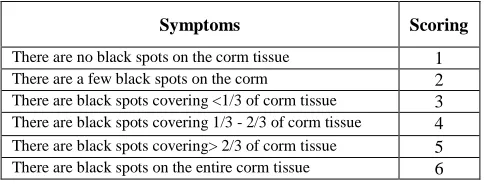
Damage intensity of corm, Observations of corm damage conducted during the end of the observation. Calculation scoring of corm damage with method developed by Network In Banana and Plantain (INIBAP) in 1998 as Table 1.
TABLE I
SCORING CRITERIA OF CORM DAMAGE TO BANANA PLANT
Symptoms Scoring
There are no black spots on the corm tissue 1 There are a few black spots on the corm 2 There are black spots covering <1/3 of corm tissue 3 There are black spots covering 1/3 - 2/3 of corm tissue 4 There are black spots covering> 2/3 of corm tissue 5 There are black spots on the entire corm tissue 6
According to [15] The intensity of corm damage was calculated using formula:
Ds = Σ (n1 XV1) / Z x N.100 (2) Description:
Ds = Damage intensity (%)
n1 = number of corm affected in each category V1 = number numerical of each attack category Z = the highest numerical value of attack category N = Number of observed corm
III.RESULT AND DISCUSSION A. Specific Activity of Chitinase Enzyme in Banana
Seedlings
Treatment of banana seedlings with 3 species of inducers gave variated responses to increase specific activity of chitinase enzyme in banana seedlings (figure 1). In general the 3 species of inducers could increase total chitinase activities in banana seedlings (Table 2). The highest increase belonged to T. viride T1sk liquid culture inducer as big as 346,34% followed by T. viride T1sk filtrate 216%, T.
koningii-S6sh biomass 181,30%, T. harzianum-P4sh
biomass 137,18% dan T. koningii-S6sh liquid culture 131, 32% (Table 2). Liquid culture and biomass inducer were effective inducers to increase chitinase enzyme activity in banana seedlings for all isolate but the effective filtrate banana seedling that induced its resistance by Trichoderma spp
This matter indicate that to activate chitinase enzyme in plant tissue needed interaction between inducer agent with the plant. Several species of Trichoderma can be able to colonize and endophytic on banana seedling root tissues. Interaction between inducer agent with plant tissues can be activate plant defence mechanisms. [3], repoted that immunized plant reacted immediately because of the inducer agent existence activating plant defence mechanism against pathogens. One of the plant defense mechanism reaction were enzyme accumulation and increasing in plant defense compounds production line products of primary gen like chitinase, B-1-3 glucanase, peroxidase as pathogenesis related protein (PR-protein). [7] Reported that application of
Trichoderma spp (T13, T18 and T103) on tomato could
TABLE II
THE INCRASE IN SPECIFIC ACTIVITY OF CHITINASE ENZYME IN BANANA SEEDLINGS THAT INDUCE ITS RESISTANCE BY TRICHODERMA SP
Symptom Development of Fusarium Wilt Desease on Banana Seedlings Introduced with Trichoderma spp. inducers
B. Fusarium Wilt Disease Attack Stage
Fusarium wilt disease attack stage indicated that liquid culture and biomass inducers of T. koningii S6sh isolate could delay Foc incubation period in banana seedlings with effectivities 56% and 34% and liquid culture inducer of T1sk isolate whose effectivity 52% T. viride T1sk liquid.culture inducer could suppress symptom leaves percentage with effectivity 27%.
Plant resistance induced by Trichoderma spp would be more effective using liquid culture inducer than biomass and filtrate because liquid culture contained biomass and metabolite produced by those organisms. This matter caused the high increase of chitinase enzyme activity in banana seedling tissues treated with those inducers especially in roots and stems (Table 1) which influenced suppressing
fusarium wilt desease on banana seedling. Chitinase enzyme function as plant defense from pathogen attack because this enzyme is able to cut ties of B-1.4 in N acetyl glucosamine polymer of chitin which is a major component of the cell wall of fungal pathogens [6]. According to [9] that melon plant treated with cellulose enzyme from T. longibrachiatum indicated peroxidase and chitinase enzyme increasing in its tissue, hence the plant was resistant to powdery mildew disease cause by Sphaerotheca fuligenea. [5] Reported that cucumber plant treated with Trichoderma sp T-203 isolate, it entered the root tissue that caused the wall of root cell become stronger. The observation result showed that chitinase enzyme activity increase in root and stem tissues, this described that plant induce resistance happening.
TABLE III
LEVELS OF FUSARIUM WILT DISEASE IN BANANA SEEDLINGS INDUCED RESISTANCE USING TRICHODERMA SPP
The figures in the column followed by the same lowercase letter are not significantly different according to DNMRT 5%
No Inducers
specific activity of chitinase enzyme (unit/ug protein) and increased activity (%) compared to control
Root Stem Leaves Total
Activity (x10-6)
Increased (%)
Activity (x10-6)
Increased (%)
Activity (x10-6)
Increased (%)
Activity (x10-6)
Increased (%)
1 LCT1sk 7.05 29.50 18.2 280.00 57.1 594.00 82.4 346.34
2 Filtrat T1sk 13.7 152.00 18.0 276.00 26.7 225.00 58.4 216.53
3 Bio T1sk 9.83 80.60 2.00 58.20 6.82 17.10 18.7 1.08
4 LC P4sh 11.7 115.00 7.20 50.50 12.6 53.20 31.5 70.73
5 Filtrat P4sh 4.28 -21.40 4.66 2.60 21.4 160.00 30.3 64.44
6 Bio P4sh 5.56 2.14 16.8 251.00 21.4 160.00 43.8 137.18
7 LC S6sh 5.98 9.86 24.4 410.00 12.3 49.60 42.7 131.32
8 Filtrat S6sh 5.08 -6.67 8.15 70.40 17.6 114.00 30.8 67.10
9 Bio S6sh 15.1 177.00 14.9 211.00 21.9 166.00 51.9 181.30
10 Water (C ) 5.44 0.00 4.78 0.00 8.22 0.00 18.5 0.00
Inducers First symptom
(%)
Inducer effectiveness
(%)
Symptomatic leaves (%)
Inducer effectiveness
(%)
Discolorization vessel (%)
Inducer effectiveness (%)
LC-S6sh 39,50 a 56,00 30,91 b c 27,00 7,11 b 72,00
LC-T1sk 38,50 ab 52,00 24,73 c 42,00 7,74 b 69,00
Bio-S6sh 34,00 abc 34,00 41,62 ab 2,00 6,46 b 74,00
Bio-T1sk 29,00 cd 14,85 42,98 a -2,00 7,74 b 69,00
Filtra-tS6sh 29,75 cd 17,82 38,30 ab 9,00 7,95 b 68,00
Filtrat-T1sk l 27,75 cd 10,00 45,99 a -8,00 7,11 b 72,00
Filtrat-P4sh 26,50 cd 5,00 36,95 ab 13,00 9,05 ab 64,00
Bio-P4sh 25,00 cd 0,00 43,68 a -3,00 6,55 b 74,00
LCP4sh Kc 23,00 d 0,00 39,19 ab 7,00 15,94 a 37,00
IV.CONCLUSIONS
Liquid culture of induser T. Viride -T1sk and T. koningii-S6sh and biomass of T. koningii-s6sh and T. harzianum-P4sh were effective in increasing the specific activity of chitinase enzyme on banana seedling. The increase the amount specific activity of chitinase enzyme on banana seedling tissues by liquid culture of T. viride- T1sk 346% and 131,32% by T. koningii could be suppress fusarium wilt desease on banana seedling. The increase the amount specific activity of chitinase enzyme on banana seedling tissues by liquid culture of T. viride- T1sk 346% and 131,32% by T. koningii could be suppress fusarium wilt desease on banana seedling.
REFERENCES
[1] I.L.Kothari,and M. Patel,“Plant Immunization,” Indian J. exp Biol., vol. 42, pp. 244-255, 2004.
[2] S.N. Lavanya, and K.N. Amruthes,“3,5-Dicloroanthranilic acid (DCA) – an elicitor induces systemic resistance againts downy mildew in pearl millet,” Int. J. of life Sciences, Vol. 4, pp. 97-106, 2016.
[3] G. N. Agrios, Plant Pathology.4th edition. Academic Press Inc.San Diego New York Boston London-Sydney-Tokyo-Toronto. 1997 [4] M.D.M. Oliveira, M.R.F.Varanda,and M.R.F Felix,“Induced
resistance during interaction pathogen x plant and the use of resistance inducer,” Phytochemistry letters Vol.15, pp. 152-158, 2016.
[5] G. E. Harman. “Changes in Perceptions Derived from Research on Trichoderma harzianum T-22,” Plant Disease. Publication Number.D-2000-0208-01F. 2000
[6] N. Sharma, K.P. Sharma, R.K. Gaur, and V.K .Gupta, “Role of Chitinase in Plant Defense”. Asian Journal of Biochemistry, Vol. 6. pp. 29-37. 2011
[7] S.Weerasak, C. Punyisa, and B. Wandee, “Induced systemic resistance of biocontrol fungus, Trichoderma spp. against bacterial and gray leaf spot in tomatoes” As. J. Food Ag-Ind., Special Issue, S99-S104. pp. 99-104. 2009.
[8] Z. Fotoohiyan, S. Rezaee, Gh.H.S. Bonjar, A.H.Mohamadi, and M. Moradi, “Induction of Systemic Resistance by Trichoderma isolates in Pistachio plant infected with Verticillium dahlia,” Journal of Nuts, Vol. 6, pp. 95-111, 2015.
[9] M. A. Amer, M. El-abd. Sawsan, F. D. Sahar, and A.Z.Nehal. (2015) Systemic Acquired Resistance Induced by some biotic agents against Downy mildew of cucumber desease. Internasional Conference, Marine and Enviromental Sciences (PMES. 2015). Kuala Lumpur (Malaysia). [Online]. Available: http://dx.doi.org/10.15242/IICBE. Co 115022.
[10] Nurbailis, Mardinus, N. Nasril, D. Abdi., dan H. Trimurti. “Penapisan Isolat Trichoderma yang berasal dari Rizosfir Tanaman Pisang di Sumatera Barat untuk Pengendalian Penyakit Layu Fusarium”. Jurnal Akta Agrosia, Vol. 9 ,pp. 49 – 55, 2006
[11] Y. Elad, and A. Kapat, “The Role of Trichoderma harzianum Protease in the Biocontrol of Botrytis cinerea” European Journal of Plant Pathology, Vol. 105, pp. 177 – 189. 1999.
[12] A. M. Pirtitla, H. Laukkanen, and A. Hohtola, “Chitinase production in pine callus (Pinus sylvestris L.) : a defence reaction against endophytes,” Planta, vol 214, pp. 848 – 852, 2002. [13] T. Imoto, and K.Yagishita, “A simple Activity Measurement of
lysozyme,” Acric, Biol.Chem vol. 35, pp. 1154-1156l, 1971. [14] O.H. Lowry, H. P. J .Rosebrough, A.L.Fart, and R. J. Randall,
“Protein measurement with the Valin Phhenol Reagent”, J. Biochem., vol.193, pp. 256-275. 1951.