Bali Medical Journal (Bali Med. J.) 2015, Volume 4, Number 1: 41-43 P-ISSN.2089-1180, E-ISSN.2302-2914
Open access:
www.balimedicaljournal.org
and
www.ojs.unud.ac.id
41
EFFECTIVENESS OF DIFFERENT DETERGENT SOLUTIONS AS
LARVISIDE FOR AEDESAEGYPTI LARVAE
I Made Sudarmaja, I Kadek Swastika
Departement of Parasitology, Faculty of Medicine Udayana University, Bali-Indonesia
Background: Dengue hemorrhagic fever the spread of which is mediated by Aedesaegypti mosquito
that becomes a health problem in Indonesia every year. Some natural and chemical substances had
been experimented to combat Aedesaegypti, one of them is detergent solution. This study aims to
investigate the effect of several concentrations of detergent to kill Aedesaegypti larvae, and to find out
the lethal concentration (LC)50, LC90, and LC95. Method: Randomized posttest only control group
design was applied to observe the percentage of Aedesaegypti larvae instar III-IV killed when they
contacted to various detergent concentrations within 24 hour of observation. Results: This study result
showed that detergent with the concentration of 0.12 g/l; 0.14 g/l; 0.16 g/l; 0.18 g/l; 0.20 g/l; 0.22 g/l
and 0.24 g/l respectively showed the killing of Aedesaegypti larvae 37.6%, 42.4%, 74.4%, 85.6%,
89.6%, 95.2% and 100%, respectively. Probit analysis showed that LC50 = 0.14 gram/liter, LC90 =
0.20 g/l and LC95=0.22 g/l.
Key words: Aedesaegypti; detergent; solution
INTRODUCTION
Dengue hemorrhagic fever (DHF) is a disease caused by virus infection which is spread by mosquito. The fastest spreading in the world is indicated by incidences that tend to increase every year. It was predicted that about 50 to 100 million cases of new infection emerge every year and about 2 to 5 billion citizens who live in endemic countries that have high risk areinfected.1,2 The species of mosquito that plays the main role as DHF vector in Southeast Asia is Aedes aegypti.3
Because the specific medicine and vaccine for DHF has not yet been founded, the prevention of DHF is aimed to control the vector.2 Aedesaegypti is known to prefer breeding places mainly in man-made containers with clear water inside such as rainwater.4,5 In order to control Aedesaegypti, people should clean, close and burry those man made containers.6,7 Bali as the world’s tourism destination is one of Indonesian provinces with high incidence rate of DHF within above national rate.8,9 For supporting tourism, Bali produces a lot of artworks and handicrafts, such as basins made from stone and big pots that can became breeding place of Aedesaegypti in the rainy season. Those artworks and handicrafts that contain water are difficult to clean and empty because they are usually deep and if covered, it will decrease the value of art and purchase. In this case, safe larvicide was needed that is available for people. Some natural and chemical substances have been experimented to combat larvae of Aedes aegypti, one of them is detergent solution.
Address of Correspondence: I M Sudarmaja Department of Parasitology Faculty of Medicine Udayana University, Bali-Indonesia
Email: [email protected]
Detergent is one of cleansing agents used in households that is available and has the potential as larvicide for Aedesaegypti. Some studies showed that detergent could prevent oviposition and killed the larvae of Aedesaegypti in various concentrations.10-12 However, water that contains detergent can still be used as breeding place of Aedesaegypti.13 This study was carried out in order to find the lethal concentration (LC) of detergent solution for killing of Aedesaegypti larvae.
MATERIALS AND METHODS
This sudy applied randomized post test only control group design with one control group versus seven treatment groups, while the selection and inputting of samples were carried out randomly. Control group was a container which contained well water while treatment groups were containers which contained well water plus detergent with concentration of 0.12, 0.14, 0.16, 0.18, 0.20, 0.22 and 0.24 g/l. Every group was replicated 5 times and each container filled with 25 larvae of Aedesaegypti instar III – IV according to WHO standard.14
RESULTS
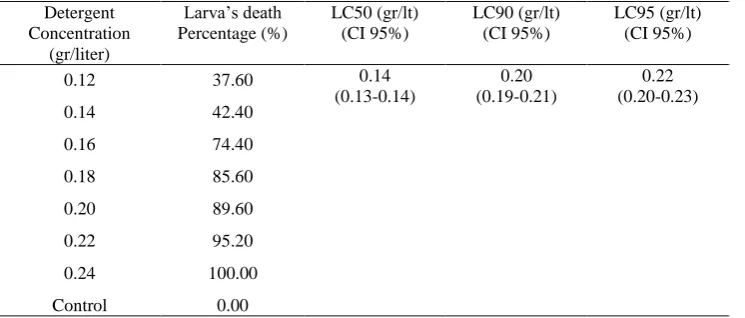
After 24 hours observation, the Aedesaegypti larvae in all treatment groups were dead but not in the control group. The average percentage of the larva’s death in the treatment groups can be monitored in Table 1.
Probit analysis was carried out to determine the ability of detergent water as Aedesaegypti larvicide, to get the exact detergent concentration that can kill 50% larva (LC50), 90% larva (LC90)
and 95% larva (LC95). The result of the probit
Bali Medical Journal (Bali Med. J.) 2015, Volume 4, Number 1: 41-43 P-ISSN.2089-1180, E-ISSN.2302-2914
Open access:
www.balimedicaljournal.org
and
www.ojs.unud.ac.id
42
Table 1The average percentage of the Aedesaegypti larva’s death in several detergent concentrations during 24 hours observation
Concentration (gr/liter)
Percentage of larva’s death Average percentage of
larva’s death
I II III IV V
0.12 32 40 44 36 36 37.6
0.14 32 40 40 60 40 42.4
0.16 76 72 80 68 76 74.4
0.18 92 84 84 88 80 85.6
0.20 92 84 86 92 84 89.6
0.22 100 84 100 96 92 95.2
0.24 100 100 100 100 100 100
Table.2
The Percentage of larva’s death, LC50, LC90anf LC95 value of the detergent solution on the Aedesaegypti larva
Detergent Concentration
(gr/liter)
Larva’s death Percentage (%)
LC50 (gr/lt) (CI 95%)
LC90 (gr/lt) (CI 95%)
LC95 (gr/lt) (CI 95%)
0.12 37.60 0.14
(0.13-0.14)
0.20 (0.19-0.21)
0.22 (0.20-0.23)
0.14 42.40
0.16 74.40
0.18 85.60
0.20 89.60
0.22 95.20
0.24 100.00
Control 0.00
DISCUSSION
Table 1 shows that detergent has the potential as larvicide on Aedesaegypti mosquito. Higher concentration increases the larvicide capability. At 0.24 g/l concentration, all of the larvae were destroyed (100%). With the one-way anova statistic test, the result was p < 0.05 which means that there was significant difference from the average Aedesaegypti larvae death in the study groups. The post hoc LSD test showed that the significant difference existed in all treatment groups and also in the control group. This result showed that higher detergent concentration in a container killed more larvae, up to 0.24 g/l concentration. Some previous researches also support this result. Water with higher detergent concentration, 1.5 g/l, even is not chosen by the Aedesaegypti mosquito as its oviposition place.12 Beside not being chosen as oviposition place, at 1.5 g/l detergent concentration, until the seventh day, none of the Aedesaegypti eggs hatched.11 Prasantong also found similar result, where some detergent brands were able to prevent ovipostition and killed the Aedesaegypti larvae. The Fab detergent brand in 0.07% concentration could prevent oviposition of Aedesaegypti until 22 days.10
Lethal concentration of detergent solution that can kill 50% larvae (LC50) in this study were 0.14
g/l (CI 95%= 0.13-0.14). This was far less than that found in the study by Prasantong in Thailand who got result at 0.07% or 0.7 g/l in the Fab brand detergent. The study in Thailand also found LC50
result that was nearly the same with this study, which was obtained with different detergent brand, Breeze, that was 0.02 % (0.17 g/l), and Paic brand 0.02% or 0.19 g/l.10 The probit analysis also obtained lethal concentration that can kill 90% larvae (LC90) at 0.19 concentration (CI 85% =
0.19-0.21) and lethal concentration that could kill 95% larvae (LC95) at 0.22 g/l concentration (CI 95% =
0.20-0.23). LC90 in this study showed similar result
with the LC50 of the study by Prasantong with Paic
brand solution.10
Bali Medical Journal (Bali Med. J.) 2015, Volume 4, Number 1: 41-43 P-ISSN.2089-1180, E-ISSN.2302-2914
Open access:
www.balimedicaljournal.org
and
www.ojs.unud.ac.id
43
CONCLUSIONS
Detergent has potential as larvicide for the Aedesaegypti larvae. Detergent solution with 0.12, 0.14, 0.16, 0.18, 0.20, 0.22 and 0.24 g/l concentration is able to kill Aedesaegypti larvae as high as 37.2%, 42.4%, 74.4%, 85.6%. 89.6%, 95.2% and 100%, respectively. Higher concentration of detergent was capable to kill more larvae. The statistic test showed that the average percentage of the death of Aedesaegypti larvae differed significantly between all the treatment groups and also with the control group. The probit analysis found that the lethal concentration that could kill 50% larvae (LC50) is 0.14 g/l (CI 95% =
0.13-0.14), lethal concentration that could kill 90% larvae (LC90) is 0.19 g/l (CI 85% = 0.19-0.21) and
lethal concentration that could kill 95% larvae (LC95) is 0.22 g/l (CI 95% = 0.20-0.23).
REFFERENCES
1. Schwartz, E., Weld, L.H., Smith, A.W., Sonnenburg, F.V., Keystone, J.S., Kain, K.C., Torresi, J., Freedman, D.O. 2008. Seasonality, Annual Trends, and Characteristics of Dengue among III Returned Travelers, 1997-2006. Emerging Infectious Diseases. 14.(7) : 1081-8 2. Nathan, M.B., Drager, R.D., Guzman, M. 2009.
Epidemiology, Burden of Disease and Transmission in Dengue Guidelines for Diagnosis, Treatment, Prevention and Control. Geneva:World Health Organization. p.1-24 3. Soedarto, 2012. DemamBerdarah Dengue.
Jakarta: CV Sagungseto. p. 61-74.
4. Anonim. 2007a. Pedoman Survei Entomologi Demam Berdarah Dengue. Jakarta: Departemen Kesehatan RI Direktorat Jenderal Pengendalian PenyakitdanPenyehatanLingkungan (Dit.Jen PP & PL). p. 1-24.
5. Anonim. 2007b. Ekologi dan Aspek Perilaku Vektor. Jakarta: Departemen Kesehatan RI Direktorat Jenderal Pengendalian Penyakitdan Penyehatan Lingkungan (Dit.Jen PP & PL). p. 1-28.
6. Kusriastuti, R. and Sutomo, S. 2005. Evolution of Dengue Prevention and Control Programme in Indonesia. Dengue Bulletin. 29: 1-7
7. Becker, N., Petric, D., Zgomba, M.,Boase, C., Dahl, C., Madon, M., Kaiser, A. 2010.
Mosquitoes and Their Control. Second Edition. New York: Springer.
8. Kusriastuti, R. 2010. Evaluasi Pengendalian Penyakit PPBB Tahun 2009 dan Upaya Memanfaatkan Peluang dalam Mencapai Indikator PPBB dalam RPJMN 2010-2014. Seminar on Evaluasi dan Upaya Pemanfaatan Peluang Penyakit PPBB. Surabaya
9. Anonim. 2012. Data Kasus Demam Berdarah Dengue (DBD) per bulan per Kabupaten di Propinsi Bali. Denpasar: Report Program P2BD DinasKesehatanPropinsi Bali
10.Prasantong, R. 1989. The Study of The Efficiency of Using Detergent Against Aedes aegypti.Thesis. Mahidol University Library. 11.Sudarmaja, M. 2008. Pengaruh Air Sabun dan
Detergen terhadap Daya Tetas Telur Aedes aegypti. Medicina . 39 (1): 56-58
12.Sudarmaja, M. danMardihusodo, S.J. 2009. PemilihanTempatBertelurNyamukAedesaegypti pada Air LimbahRumahTangga di
Laboratorium. JurnalVeteriner. 10.(4): 205-7. 13.Hadi, U.K., Sigit, S.H., Agustina, E. 2006.
Habitat Jentik Aedesaegypti (Diptera: Culicidae) pada Air Terpolusi di Laboratorium. Research report (unpublish).
14.Anonim. 2005. Guidelines for Laboratory and Field Testing of Mosquito Larvicides. Geneva. World Health Organization. p.7-33
15.Lutfi, A. 2009. Sabun dan Detergen. Situs Kimia Indonesia. chem-is-try.org, download at 15 October 2012