R E V I E W A R T I C L E British Journal of Dermatology
Smartphone applications for melanoma detection by
community, patient and generalist clinician users: a review
A.P. Kassianos,1J.D. Emery,1,2P. Murchie3and F.M. Walter1,21
The Primary Care Unit, Department of Public Health & Primary Care, University of Cambridge, Cambridge CB1 8RN, U.K.
2
General Practice and Primary Care Academic Centre, University of Melbourne, Parkville, Vic., Australia
3
Division of Applied Health Science, Centre of Academic Primary Care, University of Aberdeen, Polwarth Building, Foresterhill, Aberdeen AB25 2ZD, U.K.
Correspondence
Fiona M. Walter.
E-mail: [email protected]
Accepted for publication
11 January 2015
Funding sources:
This report is independent research arising from a Clinician Scientist award supported by the National Institute for Health Research (RG 68235).
Conflicts of interest
None declared.
The views expressed in this publication are those of the authors and not neces-sarily those of the NHS, the National Institute for Health Research, or the Department of Health.
DOI 10.1111/bjd.13665
Summary
Smartphone health applications (‘apps’) are widely available but experts remain cautious about their utility and safety. We reviewed currently available apps for the detection of melanoma (July 2014), aimed at general community, patient and gen-eralist clinician users. A proforma was used to extract and assess each app that met the inclusion criteria, and we undertook content analysis to evaluate their content and the evidence applied in their development. Thirty-nine apps were identified with the majority available only for Apple users. Over half (n = 22) provided infor-mation or education about melanoma, ultraviolet radiation exposure prevention advice, and skin self-examination strategies, mainly using the ABCDE (A, Asymme-try; B, Border; C, Colour; D, Diameter; E, Evolving) method. Half (n= 19) helped users take and store images of their skin lesions either for review by a dermatologist or for self-monitoring to identify change, an important predictor of melanoma; a similar number (n= 18) used reminders to help users monitor their skin lesions. A few (n= 9) offered expert review of images. Four apps provided a risk assessment to patients about the probability that a lesion was malignant or benign, and one app calculated users’ future risk of melanoma. None of the apps appeared to have been validated for diagnostic accuracy or utility using established research methods. Smartphone apps for detecting melanoma by nonspecialist users have a range of functions including information, education, classification, risk assessment and monitoring change. Despite their potential usefulness, and while clinicians may choose to use apps that provide information to educate their patients, apps for melanoma detection require further validation of their utility and safety.
What’s already known about this topic?
•
Earlier detection of melanoma would allow timely treatment and could improve outcomes.•
Although smartphone applications (‘apps’) are recognized as having potentially wide use in dermatology and oncology, experts have expressed caution concerning their diagnostic utility and safety.What does this study add?
•
We identified almost 40 smartphone apps available to detect or prevent melanoma by nonspecialist users including previously unaffected individuals, patients previ-ously diagnosed with skin cancer, and generalist clinicians.•
Most apps gave advice or education about melanoma, ultraviolet radiation exposure preventive advice, and skin self-examination strategies; half of the apps enabled patients to capture and store images of their skin lesions either for review by a der-matologist or for self-monitoring to identify change, an important predictor of melanoma; only four apps provided a risk assessment about a skin lesion.•
There was little evidence of clinical or research-based input into the design of these apps or of evaluation of their utility, so clinicians should be cautious about sup-porting the use of such apps to detect melanoma.Smartphones are rapidly evolving from being solely devices for communication and entertainment to include specialized applications (‘apps’) that are intimately involved in many aspects of daily life. A vast range of health apps is now avail-able to assist users (>13 000 in a 2012 report), for example
to monitor their pulse and blood pressure, or to track their food intake and exercise undertaken to manage weight loss. Furthermore, two out of three U.S. clinicians already use smartphone health apps in their practice to manage a range of conditions.1 Some apps have been evaluated, such as those to assist in managing diabetes2 and pain,3and to aid monitoring of anticoagulation therapy4 and epilepsy,5but such evaluation is not common among apps aimed at general community users, probably due to the rapid evolution and commercial drivers of this field. While smartphones have been hailed as ‘new clinical tools in oncology’,1 many experts remain cau-tious about the utility of the thousands of apps currently avail-able, either free or at a small charge, for the prevention, detection and management of cancer.6,7 It has also been sug-gested that apps for detecting cancers tend to lack scientific and specialty input,8and the use of technology to deliver can-cer follow-up has only begun to be studied for safety and util-ity: a recently published systematic review found only two randomized studies that had used smartphone technology.9
A number of dermatology-specific apps have been devel-oped which aim to help previously unaffected individuals or those previously diagnosed with a skin cancer to decide if they should seek medical review for a skin lesion,10,11and to assist nonspecialist clinicians such as general practitioners (GPs) to make decisions about whether to reassure the patient that their lesion is benign or to refer for specialist assessment.10 How-ever, a recent comparison of the accuracy of four smartphone apps in assessing melanoma risk demonstrated wide variation in performance and utility.7 Furthermore, smartphone apps for the identification or management of cancer including mel-anoma have not been subject to any sort of validation or regu-latory controls in the U.S.A., the U.K. or elsewhere. Therefore, while they have the potential to improve patient and nonspe-cialist clinician assessment and patient–clinician communica-tion about potential skin cancer there is the risk that these apps could actually harm users. The advice could be inaccurate or misleading, apps could be used as a substitute for a clinical consultation, and they could even delay melanoma diagno-sis.12 This risk is particularly concerning for melanoma com-pared with other cancers as the majority are detected by the
symptom is longer than for all other cancers except those of the head and neck.13
In this paper we report a review of currently available smartphone apps for the detection of melanoma aimed at gen-eral community, patient or gengen-eralist clinician users, evaluat-ing their content and the evidence applied in their development.
Methods
In July 2014 we searched the online stores of the two most popular smartphone providers (Apple14 and Android,15which together provide more than 90% of cancer-related apps6), for health apps that suggested any kind of support for previously unaffected individuals, or those previously diagnosed with a skin cancer, to detect melanoma. Our search terms included ‘skin cancer’, ‘mole’ and ‘melanoma’. We assessed the descriptions of each app identified by the searches, and included in this review all apps that stated an aim to help to detect melanoma. We excluded all apps that aimed to provide entertainment, cosmetics advice or general medical informa-tion alone. We also excluded those designed only for use by skin cancer specialists (dermatologists and plastic surgeons) including apps which use a dermoscopy attachment to the phone, but included any aimed specifically at generalist clini-cians. We also excluded apps that were not available in Eng-lish.
We developed a proforma specifically for this review, and one researcher (A.P.K.) extracted data about all the apps that met the inclusion criteria. The proforma was completed based only on the online descriptions; no apps were downloaded for data extraction purposes. All included apps were evaluated for their operating systems (Apple, Android, both), whether they were derived from research and/or validated, and the year of the latest update. The included apps were also evaluated for (i) general information about melanoma and/or skin cancer, ultraviolet radiation (UVR) and sun exposure preventive advice, and skin self-examination strategies; (ii) risk factor assessment; (iii) cataloguing and/or classifying using ‘image analysis’, defined as a comparison between the lesion and a stored image or an algorithm to assess the image, or the for-warding of images to a dermatologist; and (iv) monitoring changes in moles over time.
researchers, whose differing perspectives and expertise facili-tated a robust and critical interpretation of assigned themes, and discussion and resolution of any differences by consensus.
Results
We identified 39 unique smartphone apps that met our inclu-sion criteria (Tables 1 and 2). Most are available for Apple Inc. devices only (26, 667%), with eight available for
Android devices only (205%), and just five available for both
platforms (128%).
Properties of available smartphone apps
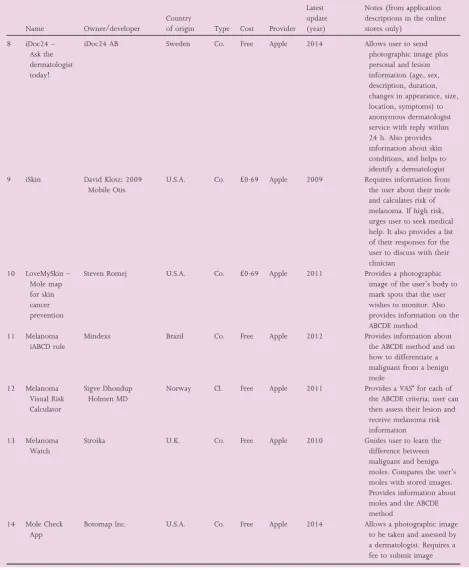
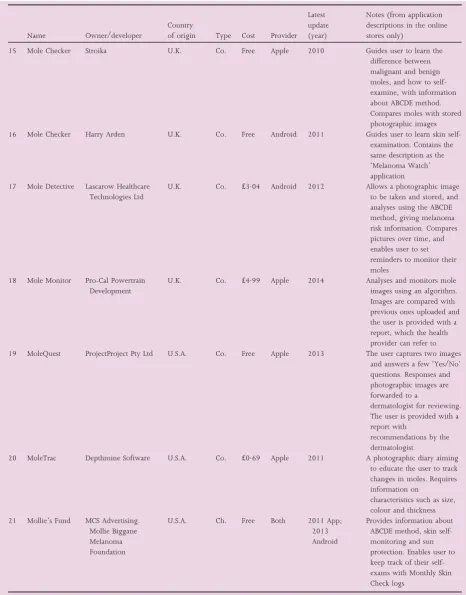
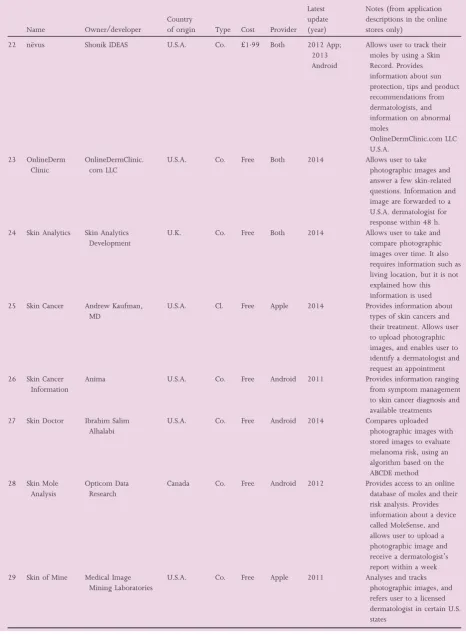
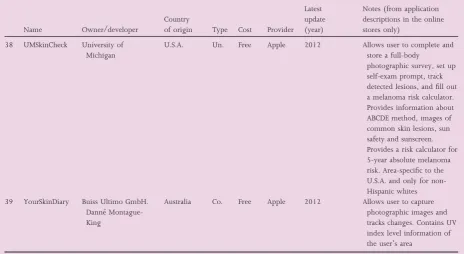
Table 1 demonstrates the 39 smartphone apps currently avail-able (July 2014) for previously unaffected individuals or those previously diagnosed with a skin cancer in the online stores of the two main application providers. Most of the apps (n =28)
were available to download for free, with the remaining apps having an added cost to download (range£069
–£499).
Table 2 shows the properties and functions of these apps. The commonest function was to provide general information about melanoma and/or skin cancer (n=22). Nineteen apps
catalogued and classified lesions by capturing images, and applying integral algorithms, and 18 apps aimed to monitor skin lesions.
Information about melanoma and/or skin cancer was pro-vided in a number of ways including access to online libraries. The ABCDE method (A, Asymmetry; B, Border; C, Colour; D, Diameter; E, Evolving) was most commonly used to provide education about skin self-examination and self-assessment of moles (n=12).16 Most of the apps provided more than one
type of function. For example, the Mollie’s Fund app provided information on skin self-examination, the ABCDE method, and how to protect from UVR exposure; and the UMSkinCheck app provided information about the ABCDE method, the com-monest types of skin lesions, and how to protect against UVR exposure. Four apps (Dermatology Planet, iDoc24, Skin Can-cer, Skin of Mine) also offered guidance on how to find a der-matologist in the U.S.A. One app (UMSkinCheck) stated it was specifically designed for non-Hispanic white U.S. citizens.
Cataloguing and classifying lesions was mainly undertaken by comparing the users’ own photographic images obtained by the smartphone against a set of exemplar images, such as in Embarrassing Bodies – My MoleChecker. Some apps con-tained integral algorithms for photographic analysis such as pattern recognition and real-time computer image analysis technology in Doctor Mole and SpotMole, enabling the user to take a photographic image of the mole for assessment of each of the ABCDE criteria, and reporting changes in the features of the mole compared with previous photographic images. One app, Melanoma Visual Risk Calculator, used a Visual Analogue Scale (VAS) to compare the user’s skin lesion against the ABCDE criteria. It was noteworthy that seven apps (Mole Detective, Mole Monitor, Skin of Mine, Skin Prevention –
Photo Body Map, Skin Scanner, Skin Vision, SkinXM) provided limited or no information on how the photographic images were processed and analysed to provide advice on likelihood of melanoma. Apps from Apple Inc. are available for iPhones, iPads and iPod touch with software 3.1.3 and later, and apps from Android for all Android phones with software 1.6 and up. A minority of apps (n=9), such as Dermlink.md and
Mole Check App, offered prompt expert review of images taken by the user. These were often accompanied by advice on making an appointment with a dermatologist, and func-tioned only in the U.S.
Using smartphone apps to monitor skin lesions was under-taken via the storage of photographic images of their skin lesions. Users were encouraged to track the evolution of indi-vidual lesions by comparing serial images over time. While some such as Doctor Mole and Skin Prevention used simple comparisons with stored images, others used more sophisti-cated algorithms, such as Skin Analytics, which claimed to use ‘real time vision technology’. Some, such as the Doctor Mole app, provided feedback to patients based on the ABCDE method; others, such as the Embarrassing Bodies –My Mole-Checker and the Mole Detective apps allowed users to set reminders to take another photograph for comparison after a selected time. These apps also suggested that users could share the images during consultations with their dermatologist or family physician.
Only four apps provided tools to assess a skin lesion for likelihood of melanoma. The Doctor Mole and Skin Doctor apps used a computerized algorithm based on the ABCDE method, and the Melanoma Visual Risk Calculator provided a risk approximation based on patients’ responses to a VAS. iSkin claimed to gather information about a mole and then calculate risk of melanoma, but provided no further informa-tion about the method involved.
A single app offered assessment of a person’s baseline risk factor: UMSkinCheck used eight risk factors (region, sex, race, age, complexion, tanning, small moles and freckling) to calcu-late 5-year absolute risk for melanoma. However, there was no information about the model used to underpin this calcula-tion.
Development and performance of apps
Even though several of the apps incorporated the ABCDE method, only one app acknowledged any research and devel-opmental processes; the Melanoma Visual Risk Calculator was based on the diagnostic value of the ABCDE criteria for patient users.17Clinician involvement in the development of apps was clearly stated in only four apps. None of the apps were reported to have been validated.
Version updates
Table 1 Smartphone applications for melanoma detection by nonspecialist users including previously unaffected individuals, patients previously
diagnosed with skin cancer, and generalist clinicians
Name Owner/developer
Country
of origin Type Cost Provider Latest update (year)
Notes (from application descriptions in the online stores only)
1 ABCDEs of melanoma
Mouhammad Aouthmany
U.S.A. Cl. Free Android 2013 Provides information on the
ABCDE method, and a game aiming to identify abnormal moles
2 Dermatology Planet
Edizioni Scripta Manent snc
Italy Co. Free Apple 2013 Provides daily news and skin
cancer information, and helps U.S. user to identify a dermatologist; available for patient and provider use
3 Dermlink.md Dermlink Inc. U.S.A. Co. Free Apple 2013 Allows user to take a
photographic image of a mole and send to a U.S. dermatologist; the user receives a diagnosis within 24 h
4 Doctor Mole– Skin Cancer App
RevoSoft/Mark Shippen
Australia Co. £399 Both 2014 App;
2013 Android
Provides information on the ABCDE method. Contains a risk calculator (based on ABCDE method) with real-time computer vision technology aiming to assess changes in moles. Enables setting of reminders to monitor moles 5 Embarrassing
Bodies–My MoleChecker
Channel 4 U.K. Co. Free Apple 2012 Tracks moles by taking and
storing photographic images and comparing them with standard images. Contains a ‘mole gallery’, self-examination videos, and enables setting of reminders to monitor moles
6 Embarrassing Bodies–My SelfChecker
Channel 4 U.K. Co. Free Apple 2012 Provides information on skin
self-examinations among other self-checks. Enables setting of reminder to monitor moles together with self-check videos, information about skin checks and the ABCDE method
7 FotoSkin Wake App Health SL Spain Co. Free Apple 2014 Allows user to monitor their
Table 1 (continued)
Name Owner/developer
Country
of origin Type Cost Provider Latest update (year)
Notes (from application descriptions in the online stores only)
8 iDoc24– Ask the dermatologist today!
iDoc24 AB Sweden Co. Free Apple 2014 Allows user to send
photographic image plus personal and lesion information (age, sex, description, duration, changes in appearance, size, location, symptoms) to anonymous dermatologist service with reply within 24 h. Also provides information about skin conditions, and helps to identify a dermatologist
9 iSkin David Klotz; 2009
Mobile Otis
U.S.A. Co. £069 Apple 2009 Requires information from
the user about their mole and calculates risk of melanoma. If high risk, urges user to seek medical help. It also provides a list of their responses for the user to discuss with their clinician
10 LoveMySkin– Mole map for skin cancer prevention
Steven Romej U.S.A. Co. £069 Apple 2011 Provides a photographic
image of the user’s body to mark spots that the user wishes to monitor. Also provides information on the ABCDE method
11 Melanoma iABCD rule
Mindexs Brazil Co. Free Apple 2012 Provides information about
the ABCDE method and on how to differentiate a malignant from a benign mole
12 Melanoma Visual Risk Calculator
Sigve Dhondup Holmen MD
Norway Cl. Free Apple 2011 Provides a VASafor each of
the ABCDE criteria; user can then assess their lesion and receive melanoma risk information
13 Melanoma Watch
Stroika U.K. Co. Free Apple 2010 Guides user to learn the
difference between malignant and benign moles. Compares the user’s moles with stored images. Provides information about moles and the ABCDE method
14 Mole Check App
Botomap Inc. U.S.A. Co. Free Apple 2014 Allows a photographic image
Table 1 (continued)
Name Owner/developer
Country
of origin Type Cost Provider Latest update (year)
Notes (from application descriptions in the online stores only)
15 Mole Checker Stroika U.K. Co. Free Apple 2010 Guides user to learn the
difference between malignant and benign moles, and how to self-examine, with information about ABCDE method. Compares moles with stored photographic images
16 Mole Checker Harry Arden U.K. Co. Free Android 2011 Guides user to learn skin
self-examination. Contains the same description as the ‘Melanoma Watch’ application 17 Mole Detective Lascarow Healthcare
Technologies Ltd
U.K. Co. £304 Android 2012 Allows a photographic image
to be taken and stored, and analyses using the ABCDE method, giving melanoma risk information. Compares pictures over time, and enables user to set reminders to monitor their moles
18 Mole Monitor Pro-Cal Powertrain Development
U.K. Co. £499 Apple 2014 Analyses and monitors mole
images using an algorithm. Images are compared with previous ones uploaded and the user is provided with a report, which the health provider can refer to 19 MoleQuest ProjectProject Pty Ltd U.S.A. Co. Free Apple 2013 The user captures two images
and answers a few ‘Yes/No’ questions. Responses and photographic images are forwarded to a
dermatologist for reviewing. The user is provided with a report with
recommendations by the dermatologist
20 MoleTrac Depthmine Software U.S.A. Co. £069 Apple 2011 A photographic diary aiming
to educate the user to track changes in moles. Requires information on
characteristics such as size, colour and thickness 21 Mollie’s Fund MCS Advertising.
Mollie Biggane Melanoma Foundation
U.S.A. Ch. Free Both 2011 App;
2013 Android
Table 1 (continued)
Name Owner/developer
Country
of origin Type Cost Provider Latest update (year)
Notes (from application descriptions in the online stores only)
22 nevus Shonik IDEAS U.S.A. Co. £199 Both 2012 App;
2013 Android
Allows user to track their moles by using a Skin Record. Provides information about sun protection, tips and product recommendations from dermatologists, and information on abnormal moles
OnlineDermClinic.com LLC U.S.A.
23 OnlineDerm Clinic
OnlineDermClinic. com LLC
U.S.A. Co. Free Both 2014 Allows user to take
photographic images and answer a few skin-related questions. Information and image are forwarded to a U.S.A. dermatologist for response within 48 h. 24 Skin Analytics Skin Analytics
Development
U.K. Co. Free Both 2014 Allows user to take and
compare photographic images over time. It also requires information such as living location, but it is not explained how this information is used 25 Skin Cancer Andrew Kaufman,
MD
U.S.A. Cl. Free Apple 2014 Provides information about
types of skin cancers and their treatment. Allows user to upload photographic images, and enables user to identify a dermatologist and request an appointment 26 Skin Cancer
Information
Anima U.S.A. Co. Free Android 2011 Provides information ranging
from symptom management to skin cancer diagnosis and available treatments 27 Skin Doctor Ibrahim Salim
Alhalabi
U.S.A. Co. Free Android 2014 Compares uploaded
photographic images with stored images to evaluate melanoma risk, using an algorithm based on the ABCDE method 28 Skin Mole
Analysis
Opticom Data Research
Canada Co. Free Android 2012 Provides access to an online database of moles and their risk analysis. Provides information about a device called MoleSense, and allows user to upload a photographic image and receive a dermatologist’s report within a week 29 Skin of Mine Medical Image
Mining Laboratories
U.S.A. Co. Free Apple 2011 Analyses and tracks
Table 1 (continued)
Name Owner/developer
Country
of origin Type Cost Provider Latest update (year)
Notes (from application descriptions in the online stores only)
30 Skin Prevention– Photo Body Map for Melanoma and Skin Cancer Early Detection
Dimension S.r.l. Italy Co. £499 Apple 2014 Allows user to upload
photographic images to monitor skin changes by comparisons with previous images. It is described as promoted by the International Society of Dermatoscopy 31 Skin Scanner Intelligent Life
Solutions
Portugal Co. £069 Apple 2012 Scans mole area in order to
monitor the moles. It then provides information on moles that need observation and skin counselling. Enables user to set reminders to monitor their moles. Permits forwarding of photographic images to the user’s dermatologist 32 SkinTagger Coriumedic Systems
LLC
U.S.A. Co. Free Apple 2014 Annotates corresponding site
of lesion on a model to facilitate tracking of changes. Contains information about ABCDE method
33 SkinVision SkinVision B.V. Netherlands Co. £069 Apple 2014 Creates instant analyses of
mole photographic images and provides information on how to improve skin health and determine personal UVR exposure to prevent melanoma 34 SkinXM AlternateUniverse
Technologies
U.S.A. Co. £299 Apple 2012 Allows user to monitor their
moles using image analysis tools to compare images for changes
35 SpotCheck 2 SpotCheck Applications Inc.
U.S.A. Co. Free Apple 2013 Provides information and
images to differentiate between a malignant or benign mole, based on ABCDE method. Provides access to dermatologist review of photographic images within 24 h. Not available in England
36 SpotMole Cristian Munteanu Spain Co. Free Android 2014 Detects signs of melanoma
using image processing and pattern recognition techniques 37 Track-A-Mole Peak Mobile Designs
LLC
two in 2010 and one in 2009. Three apps (Doctor Mole – Skin Cancer app, Mollie’s Fund, nevus) had their Apple and Android versions updated in different years.
Discussion
This review has identified smartphone apps for detecting melanoma by nonspecialist users including previously unaf-fected individuals, patients previously diagnosed with skin cancer, and generalist clinicians. We have evaluated the con-tent of the apps with respect to general information about melanoma and/or skin cancer, UVR and sun exposure pre-ventive advice, skin self-examination strategies, assessment of current and future melanoma risk, personal or expert image analysis to classify lesions, and lesion monitoring over time. We have identified 39 smartphone apps with the majority available only for Apple users. One-third of these apps pro-vided information only. A similar number enabled patients to capture and store images of their skin lesions either for review by a dermatologist or for self-monitoring to identify change, an important predictor of melanoma. Four apps pro-vided a risk assessment to patients about the probability that a lesion was malignant or benign, and only one app incor-porated a validated risk model giving individuals information about their future risk of melanoma. None of the apps appeared to have been validated for diagnostic accuracy or utility using established research methods. There was limited
information about whether the apps were developed with clinician involvement, and some apps had not been updated for more than 3 years.
While a recent systematic review of smartphone apps for the prevention, detection and management of cancer in gen-eral concluded that there has been ‘a lot of action, but not in the right direction’, as they tend not to incorporate technolog-ical innovation,6we have identified a range of uses of smart-phone technology for melanoma detection. For example, image analysis allows for self-monitoring, and the use of reminders and alerts promote the added use of monitoring skin changes over time. Furthermore, the technology can use a ‘teledermatology’ model, and send the image for expert review and advice. Nevertheless, one-third of the apps that we identified only promoted awareness of cancer symptoms or solar protection, with no potential for interaction or specialist overview, despite the strong evidence suggesting that the pro-vision of information alone is not an effective intervention to improve patient self-management of chronic disease in pri-mary care.6,18 Adding self-monitoring techniques could be more effective than information-provision alone.19 Moreover, as communication with clinicians may improve adherence to e-healthcare interventions,20 apps that facilitate communica-tion with skin specialists may have utility, particularly for individuals previously diagnosed with a skin cancer.
Almost a quarter of the apps used a teledermatology model to send the image for expert review. Evaluations of remote
Table 1 (continued)
Name Owner/developer
Country
of origin Type Cost Provider Latest update (year)
Notes (from application descriptions in the online stores only)
38 UMSkinCheck University of Michigan
U.S.A. Un. Free Apple 2012 Allows user to complete and
store a full-body
photographic survey, set up self-exam prompt, track detected lesions, and fill out a melanoma risk calculator. Provides information about ABCDE method, images of common skin lesions, sun safety and sunscreen. Provides a risk calculator for 5-year absolute melanoma risk. Area-specific to the U.S.A. and only for non-Hispanic whites 39 YourSkinDiary Buiss Ultimo GmbH.
Danne Montague-King
Australia Co. Free Apple 2012 Allows user to capture
photographic images and tracks changes. Contains UV index level information of the user’s area
Table 2 Properties of smartphone applications for melanoma detection by nonspecialist users including previously unaffected individuals, patients
previously diagnosed with skin cancer, and generalist clinicians
Name
Information and/or education
Risk factor assessment
Cataloging/classifying
Monitoring/ tracking Melanoma/
skin cancer
UVR/sun exposure advice
Skin self-examination
Image analysisa
Dermatologists review
1 ABCDEs of melanoma
2 Dermatology Planet
3 Dermlink.md
4 Doctor Mole–Skin Cancer App b
5 Embarrassing Bodies–My
MoleCheckerb
6 Embarrassing Bodies–My SelfChecker
7 FotoSkin
8 iDoc24–Ask the dermatologist today!
9 iSkin
10 LoveMySkin–Mole map for skin cancer prevention
11 Melanoma iABCD rule
12 Melanoma Visual Risk Calculatorf
13 Melanoma Watchg
14 Mole Check App
15 Mole Checker (by Stroika)g
16 Mole Checker (by Harry Arden)
17 Mole Detectiveh
18 Mole Monitorb
19 MoleQuest
20 MoleTrac
21 Mollie’s Fund
22 nevus
23 OnlineDermClinic
24 Skin Analytics
25 Skin Cancer
26 Skin Cancer Information
27 Skin Doctorh
28 Skin Mole Analysisi
29 Skin of Minef
30 Skin Prevention–Photo Body Map for Melanoma and Skin Cancer Early Detectionc
31 Skin Scannerc
32 SkinTagger
33 Skin Visionb
34 SkinXMd
35 SpotCheck 2c
36 SpotMolei
37 Track-A-Mole
38 UMSkinChecke
39 YourSkinDiaryf
Total 22 6 15 4 18 9 19
ABCDE (A, Asymmetry; B, Border; C, Colour; D, Diameter; E, Evolving); UVR, ultraviolet radiation.aDefined as comparison between lesion and a stored image;brequires iOS 6
0 or later;crequires iOS 51 or later;drequires iOS 50 or later;erequires iOS 43 or later;frequires iOS
apps, and there could be roles for generalist clinicians and allied health professionals, particularly if using a dermoscope attached to a phone.25 Fewer apps used automated image analysis for skin self-examination. While this is clearly feasi-ble,26 there is less clear evidence around its diagnostic accu-racy or utility. Indeed, a recent report highlighted the diagnostic inaccuracies of four smartphone apps for melanoma detection, with wide variations in sensitivity and specificity to detect malignant skin lesions.7
Twelve apps made use of the ABCDE method27 to inform and educate users. The Doctor Mole and Skin Doctor apps also used a computerized algorithm based on the ABCDE method to help people assess the risk of melanoma directly for a spe-cific lesion. Most apps that we identified were developed in the U.S.A. where the ABCDE method is widely used, even though there is evidence that the revised ‘Glasgow’ 7-point checklist has higher sensitivity for diagnosing cutaneous mela-noma when compared with the ABCDE method.28 Future apps could consider incorporating and validating the 7-point check-list for melanoma detection, particularly for use in the U.K. population where it was developed and recently validated in a primary care population.29 Two apps were not included in the review as they were marketed for doctor’s use only. iDoc24 Pro was the ‘professional’ version of iDoc24, aiming to ‘help clinicians assess whether to refer a patient to a dermatologist’, and Melanoma Risk Assessment Tool (Apple; last updated 2011) used the patient’s personal and medical history and the result of a back and shoulders examination to calculate an esti-mate of a patient’s absolute melanoma risk.
We found that some apps have not been updated for more than 3 years. Even when updated recently, there was no dis-cussion around whether the updates were based on new evi-dence, and we were not able to distinguish whether commercial or other apps were updated most regularly. We also found surprisingly scanty scientific evidence about the development or evaluation of the smartphone apps included in our review; only one app provided a single reference to a peer-reviewed publication. Reviews of smartphone apps for dermatology in general,7,11 and for colorectal cancer,8 have reported similar findings. There seems to be a profound mis-match between the promise of the app developers on the one hand and evidence of clinical validity and utility on the other hand, as demonstrated in this study. This is of concern for two reasons: firstly, it is important to establish the safety, including accuracy and utility, of these apps, particularly as the market is unregulated; secondly, clinicians may be benefit-ing financially from both the sale of the apps and the teleder-matology role, and this should be disclosed.
Strengths and limitations
Previous reviews of smartphone apps focused mainly on those developed by Apple Inc.3,30 This review extends knowledge to apps for melanoma detection developed by Google. This is the first review that evaluates the content of smartphone apps available for melanoma detection for
previ-ously unaffected individuals or those previprevi-ously diagnosed with a skin cancer, and generalist clinicians. It is also the first review to outline the content of available apps, whether they are derived from research evidence, and whether they have been validated.
We recognize that there are limitations to this review. It was restricted to the descriptions available from the online stores; more information may have been available after pur-chasing or using the apps, but this was not undertaken in order to ensure equity across the review. Moreover, we felt that users should be able to make an informed choice about the apps by reading their description in the online stores. We reviewed apps only available in English; therefore we may have failed to identify any apps published in other languages. In reality this is unlikely as the U.S.A. and U.K. were the main countries publishing these apps, with a few also coming from Western Europe and South America. Finally, we only reviewed apps applicable to Apple and Android phones as we knew that more than 90% of apps are available via these two platforms. It is likely that small platforms would use the same apps –as some were available via both of the major platforms–and we are therefore confident that few are missing.
Clinical and policy implications
A recent systematic review mapping mobile health research over the last decade identified 117 publications, but concluded that few included large or rigorous evaluation of the novel technologies.31 Another recent review has also identified patients as having a stronger desire to be informed about underpinning scientific evidence than commercial stakehold-ers.32 Our review has shown little evidence of clinical- or research-based input; therefore, more research is needed to evaluate their content, validity and utility to support detection of melanoma in previously unaffected individuals and those previously diagnosed with a skin cancer. A particular priority should be to evaluate how skin self-monitoring could help people appraise their skin changes and make appropriate help-seeking decisions. Without a more explicit research base, clini-cians should be cautious about supporting the use of such apps to detect melanoma earlier, although they may choose to use apps for education and/or information alone. It is note-worthy that although the U.S. Food and Drug Administration (FDA) does not currently regulate the mobile health industry, there are plans to do so in a similar way to regulation for medical devices;33 the European Medicines Agency has signalled similar intentions.34 Further evidence on clinical validity and utility are likely to be required for these regulators.
then contribute towards minimizing the diagnostic delay expe-rienced by people with melanoma, which may be significantly associated with mortality.36
Acknowledgments
We would like to thank Daniel Obute who conducted the pre-liminary searches.
References
1 Senior K. Smart phones: new clinical tools in oncology?Lancet Oncol
2011;12:429–30.
2 Chomutare T, Fernandez-Luque L,Arsand E, Hartvigsen G. Fea-tures of mobile diabetes applications: review of the literature and analysis of current applications compared against evidence-based guidelines.J Med Internet Res2011;13:e65.
3 Rosser BA, Eccleston C. Smartphone applications for pain manage-ment.J Telemed Telecare2011;17:308–12.
4 Lee JA, Nguyen AL, Berg Jet al.Attitudes and preferences on the use of mobile health technology and health games for self-man-agement: interviews with older adults on anticoagulation therapy.
JMIR MHealth UHealth2014;2:e32.
5 Pandher PS, Bhullar KK. Smartphone applications for seizure man-agement.Health Informatics J2014; pii: 1460458214540906. 6 Bender JL, Yue RYK, To MJ et al.A lot of action, but not in the
right direction: systematic review and content analysis of smart-phone applications for the prevention, detection, and management of cancer.J Med Internet Res2013;15:e287.
7 Wolf JA, Moreau JF, Akilov O et al. Diagnostic inaccuracy of smartphone applications for melanoma detection. JAMA Dermatol
2013;149:422–6.
8 O’Neill S, Brady RR. Colorectal smartphone apps: opportunities and risks.Colorectal Dis2012;14:e530–4.
9 Dickinson R, Hall S, Sinclair JE et al. Using technology to deli-ver cancer follow-up: a systematic review. BMC Cancer 2014;
14:311.
10 Brewer AC, Endly DC, Henley Jet al.Mobile applications in derma-tology.JAMA Dermatol2013;149:1300–4.
11 Hamilton AD, Brady RR. Medical professional involvement in smartphone ‘apps’ in dermatology.Br J Dermatol2012;167:220–1.
12 Robson Y, Blackford S, Roberts D. Caution in melanoma risk analysis with smartphone application technology. Br J Dermatol
2012;167:703–4.
13 Baughan P, O’Neill B, Fletcher E. Auditing the diagnosis of cancer in primary care: the experience in Scotland.Br J Cancer2009;101
(Suppl. 2):S87–91.
14 Apple iTunes. Apple iTunes App Store website. Available at: http://www.apple.com/itunes/download (last accessed 24 April 2015).
15 Android apps. Google Play website. Available at: https://play. google.com/store/apps (last accessed 24 April 2015).
16 Robinson JK, Ortiz S. Use of photographs illustrating ABCDE crite-ria in skin self-examination.Arch Dermatol2009;145:332–3.
17 Thomas L, Tranchand P, Berard F et al. Semiological value of ABCDE criteria in the diagnosis of cutaneous pigmented tumors.
Dermatology1998;197:11–17.
18 Bodenheimer T, Lorig K, Holman H, Grumbach K. Patient self-management of chronic disease in primary care. JAMA 2002;
288:2469–75.
19 Bandura A. Health promotion by social cognitive means.Health Educ Behav2004;31:143–64.
20 Mohr DC, Cuijpers P, Lehman K. Supportive accountability: a model for providing human support to enhance adherence to eHealth interventions.J Med Internet Res2011;13:e30.
21 Kroemer S, Fr€uhauf J, Campbell TMet al.Mobile teledermatology for skin tumour screening: diagnostic accuracy of clinical and dermoscopic image tele-evaluation using cellular phones.Br J Der-matol2011;164:973–9.
22 Lamel SA, Haldeman KM, Ely Het al.Application of mobile tele-dermatology for skin cancer screening.J Am Acad Dermatol 2012;
67:576–81.
23 Massone C, Hofmann-Wellenhof R, Ahlgrimm-Siess Vet al. Mela-noma screening with cellular phones.PLoS ONE2007;2:e483.
24 Tran K, Ayad M, Weinberg Jet al. Mobile teledermatology in the developing world: implications of a feasibility study on 30 Egyp-tian patients with common skin diseases.J Am Acad Dermatol2011;
64:302–9.
25 Janda M, Soyer HP. Skin cancer detection by one click–are we any closer?Med J Aust2013;199:739.
26 Janda M, Loescher LJ, Soyer HP. Enhanced skin self-examination: a novel approach to skin cancer monitoring and follow-up. JAMA Dermatol2013;149:231–6.
27 Rigel DS, Friedman RJ, Kopf AW, Polsky D. ABCDE–an evolving concept in the early detection of melanoma. Arch Dermatol 2005;
141:1032–4.
28 Healsmith MF, Bourke JF, Osborne JE, Graham-Brown RAC. An evaluation of the revised seven-point checklist for the early diag-nosis of cutaneous malignant melanoma. Br J Dermatol 1994;
130:48–50.
29 Walter FM, Prevost AT, Vasconcelos J et al. Using the 7-point checklist as a diagnostic aid for pigmented skin lesions in general practice: a diagnostic validation study. Br J Gen Pract 2013; 63:
e345–53.
30 Pandey A, Hasan S, Dubey D, Sarangi S. Smartphone apps as a source of cancer information: changing trends in health informa-tion-seeking behavior.J Cancer Educ2013;28:138–42.
31 Fiordelli M, Diviani N, Schulz PJ. Mapping mHealth research: a decade of evolution.J Med Internet Res2013;15:e95.
32 Dehzad F, Hilhorst C, de Bie C, Claassen E. Adopting health apps, what’s hindering doctors and patients?Health2014;6:2204.
33 U.S. Food and Drug Administration. Mobile Medical Applications. Available at: http://www.fda.gov/MedicalDevices/Productsand-MedicalProcedures/ConnectedHealth/MobileMedicalApplications/ ucm255978.htm (last accessed 24 April 2015).
34 European Medicines Agency. Guidelines on the qualification and classification of stand alone software used in healthcare within the regulatory framework of medical devices. 2012. Available at: http://ec.europa.eu/health/medical-devices/files/meddev/2_1_6_ ol_en.pdf (last accessed 24 April 2015).
35 Muessig KE, Pike EC, Legrand S, Hightow-Weidman LB. Mobile phone applications for the care and prevention of HIV and other sexually transmitted diseases: a review.J Med Internet Res2013;15:e1.