SUSTAINABILITY
REPORTING IN ASEAN
State of Progress in Indonesia, Malaysia, Singapore and Thailand 2015
TABLE OF CONTENTS
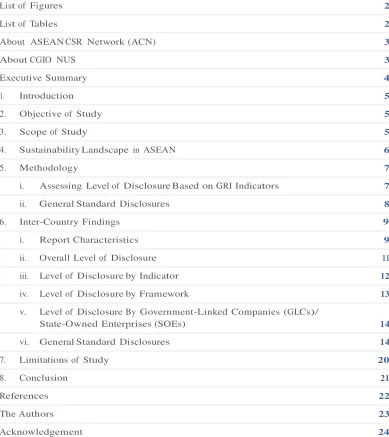
List of Figures 2
List of Tables 2
About ASEAN CSR Network (ACN) 3
About CGIO NUS 3
Executive Summary 4
1. Introduction 5
2. Objective of Study 5
3. Scope of Study 5
4. Sustainability Landscape in ASEAN 6
5. Methodology 7
i. Assessing Level of Disclosure Based on GRI Indicators 7
ii. General Standard Disclosures 8
6. Inter-Country Findings 9
i. Report Characteristics 9
ii. Overall Level of Disclosure 11
iii. Level of Disclosure by Indicator 12
iv. Level of Disclosure by Framework 13
v. Level of Disclosure By Government-Linked Companies (GLCs)/
State-Owned Enterprises (SOEs) 14
vi. General Standard Disclosures 14
7. Limitations of Study 20
8. Conclusion 21
References 22
The Authors 23
LIST OF FIGURES
Figure 1: Number of companies that communicated sustainability 9
Figure 2: Mediums of communicating sustainability by country 10
Figure 3: Number of companies adopting GRI framework and seeking external
assurance 10
Figure 4: Level of disclosure in ASEAN 11
Figure 5: Level of disclosure by indicator 12
Figure 6: Level of disclosure by framework 13
Figure 7: Level of disclosure by GLC/SOE and non-GLC/non-SOE 14
Figure 8: Number of companies that provided CEO statement on relevance of
sustainability 15
Figure 9: Number of companies that provided description of key impacts, risks
and opportunities 15
Figure 10: Number of companies that explained process for defining report
content and aspect boundaries 16
Figure 11: Number of companies that listed material aspects identified 17
Figure 12: Number of companies that reported aspect boundaries for each
material aspect within and outside the organisation 17
Figure 13: Number of companies that disclosed stakeholder engagement
and inclusiveness policies and procedures 18
Figure 14: Number of companies that provided list of stakeholder groups engaged 19
Figure 15: Number of companies that reported basis of identification and
selection of stakeholders 19
LIST OF TABLES
Table 1: Sustainability landscape in ASEAN 6
Table 2: Indicators in GRI assessment methodology 8
ABOUT ASEAN CSR NETWORK (ACN)
In line with the achievement of an ASEAN Community, the ASEAN CSR Network (ACN)
was established in 2011 through the ASEAN Foundation with a mandate to ensure
that corporate social responsibility (CSR) is incorporated in the corporate agenda and
contributes towards sustainable socio - economic development in ASEAN Member States.
As a regional organisation, the ACN provides a platform for networking and cooperation
at the ASEAN level, supports capacity-building and training activities, helps catalyse
collective action on key issues, and provides a link with regional and international bodies
interested in supporting the advancement of CSR in the region.
For more information, please visit www.asean-csr-network.org
ABOUT CGIO NUS
The Centre for Governance, Institutions and Organisations (CGIO) was established by
the National University of Singapore (NUS) Business School in 2010. It aims to spearhead
relevant and high-impact research on governance issues that are pertinent to Asia,
including corporate governance, governance of family firms, state-owned-enterprises,
business groups, and institutions. The CGIO also organises events such as public lectures,
industry roundtables, and academic conferences on topics related to governance.
EXECUTIVE SUMMARY
In a rapidly globalised and dynamic environment, it is a challenge for businesses to
mitigate their operations from leaving footprints that affect society economically,
environmentally and socially. As a result, there is an increasing demand of better
knowledge from stakeholders of how such impacts are handled and incorporated into
a business’ strategies (Amran & Keat Ooi, 2014).
Sustainability reporting helps companies disclose information about its activities and
such strategies. Furthermore, it allows them to manage change to make their
operations more sustainable. Through sustainability reporting, stakeholders become well
informed of the businesses they are investing in and be assured that companies do
integrate sustainable practices into their operations.
It is with these benefits in mind that the ASEAN CSR Network (ACN), in collaboration
with Centre for Governance, Institutions and Organisations (CGIO) at NUS Business
School, conducted a study on four countries in the Association of Southeast Asian
Nations (ASEAN), to find out the state of sustainability reporting in these countries.
Countries included in the study are Indonesia, Malaysia, Singapore and Thailand. The
development and extent of reporting in each country is studied and the state of overall
progress of reporting in ASEAN is analysed.
The following are several key points of the findings observed:
• 100 out of 100 selected companies in Indonesia, Malaysia and Thailand communicated sustainability. 71 out of 100 companies in Singapore did so.
• Thailand had the highest overall quality of sustainability disclosure, as represented by its high level of disclosure of 56.81, followed by Singapore with 48.8, Indonesia
with 48.4 and Malaysia with 47.7.
• Environmental indicator, amongst the four Global Reporting Initiative (GRI) indicators, had the lowest level of disclosure across all four countries.
• Majority of the companies communicated sustainability through integrating their sustainability report into their annual reports, of which are supplemented either with
or without communication on their corporate website.
• Companies who used GRI framework as guidelines for their sustainability reporting had higher level of disclosure than those who used other or no framework.
• On average, Government-Linked Companies (GLCs)/State-Owned Enterprises (SOEs) disclosed more information on their business operations than non-GLCs/non- SOEs and fared higher level of disclosure.
These findings suggest that the overall state and progress of sustainability reporting are fairly healthy in the four countries. While there is room for further improvements, these
countries have taken additional efforts towards producing better quality of sustainability
reporting following this study.
1. INTRODUCTION
Sustainability reporting has increasingly gained recognition and acclaim from countries in
ASEAN. It forms a core component of businesses’ Corporate Social Responsibility (CSR)
practice that assesses and discloses non-financial information about their business
operations and practices.
The emerging trend of sustainability reporting from companies reflects their awareness
on the benefits and usefulness of doing so. As it encourages companies to be transparent
about the details of their operations, it thereby reflects their commitment to be
responsible and accountable for their practices. In the perspective of a company, this
transparency improves its reputation to, not only its stakeholders and consumers, but
also to its main human capital, its employees. A company becomes more aware of its
operational efficiency and thus, could work towards increasing its sustainability efforts
and financial performance.
Furthermore, sustainability disclosure could serve as a differentiator for potential
stakeholders to invest in companies. Even though sustainability reporting is not yet a
requirement in Singapore, the number of companies that communicated sustainability
had grown steadily from 2011, 2013 and 2015, as they recognised the value of doing so.
2. OBJECTIVE OF STUDY
Studies on sustainability reporting for companies in Indonesia, Malaysia, Singapore
and Thailand, have been conducted and it was observed that each country has varying
practices and cultures that could influence its rate of sustainability reporting and the
comprehensiveness of information disclosed. Thus, together with findings from the
respective studies, the objective of this report is to provide and review the inter-country
analysis of the aforementioned countries in ASEAN.
3. SCOPE OF STUDY
The sample size used for each country involves the largest 100 mainboard listed companies
ranked by market capitalisation, as of 30 June 2015. This study centres on companies,
out of selected 100 from each country, that communicated sustainability and covers
disclosed information provided by them from 1 January 2014 up to 31 December 2015.
When companies choose to communicate sustainability, they could do so by
communicating their sustainability practices on their corporate website, having them
integrated into their annual reports, as a standalone report or, as any combination of the
three mentioned. A standalone report is either a sustainability report or a CSR report
and it represents a complete and comprehensive type of sustainability reporting that a
4. SUSTAINABILITY LANDSCAPE IN ASEAN
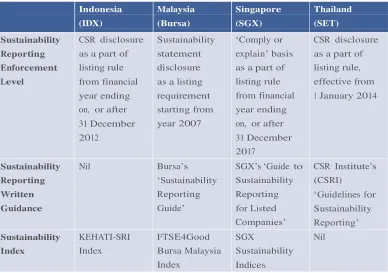
In Indonesia, CSR disclosure is a part of a listing rule for its issuers and public companies.
The requirements from this listing rule stipulate them to disclose CSR information on
mainly, their environmental and social performances. These requirements were applied
from financial year ending on, or after 31 December 2012. Bursa Malaysia also had
enforced the preparation of Sustainability Statement as a part of listing requirements
starting from the year 2007. Additionally in 2015, listed issuers are required to disclose a
narrative statement of their management of material economic, environmental and social
efforts, which replaces a simpler statement on their CSR practices.
Similar to Indonesia and Malaysia, CSR disclosure also constitutes as part of listing rules
in Thailand. Listed companies are required to disclose their CSR practices regarding
stakeholders, the economy, society and environment in either their annual or standalone
report. This regulation became effective on 1 January 2014. Meanwhile, sustainability
reporting is not yet mandatory in Singapore, as compared to the three countries.
However, it will be on a ‘comply or explain’ basis from financial year ending on, or after
31 December 2017, when listed companies are required to prepare an annual sustainability
report that describes its sustainability practices.
Table 1 provides an overview of the sustainability landscape in the four countries
and summarises the availability of a sustainability reporting written guidance and
sustainability index in each country. The home exchanges in Indonesia, Malaysia,
Singapore and Thailand are known as the Indonesia Stock Exchange (IDX), Bursa
Malaysia (Bursa), Singapore Exchange (SGX) and the Stock Exchange of Thailand
(SET) respectively.
5. METHODOLOGY
In all the studies on companies conducted, the GRI G4 guidelines and Code of Corporate
Governance of each country were adopted as a reference for framework to assess
sustainability reports. These guidelines form a set of an extensive and comprehensive
quantitative framework that are widely recognised as a global standard for sustainability
reporting.
In assessing the sustainability reports, the methodology builds on those used in previous
sustainability studies. These studies are Sustainability Reporting in Singapore (Thomas &
Chin, 2011) and Accountability for a Sustainable Future (Loh, Low, Sim & Thomas, 2014).
i. Assessing Level of Disclosure Based on GRI Indicators
The GRI guidelines provide a holistic and comprehensive assessment of sustainability
issues including those related to supply chain management and human rights. The
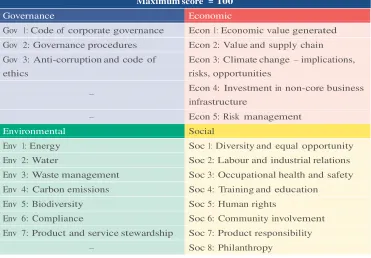
extensive assessment framework is condensed into 23 criteria, which were in turn
grouped into the four following indicators: Governance, Economic, Environmental
and Social (Table 2). The depth of disclosure was analysed through the assignment
of scores ranging from 1 to 5 for each criterion. 1 point was awarded if there was no
information provided or specified for the particular criterion, while 5 points were
awarded if detailed information substantiated with measurements was furnished.
The total score under each indicator was then converted to a relative score out of 5,
in order to assign equal weight to each of the four indicators. The maximum score
that a company could obtain was 20 but was converted to a scale of 100. The score
obtained reflects the level of sustainability disclosure of the company to the areas
of assessment in this methodology. This level of disclosure thereby also reflects the
quality of sustainability disclosure of the company.
The scores for each company were subsequently aggregated to compute a country’s
average. It is noted that this scoring method is a quantitative mean employed to
gauge the comprehensiveness of information disclosed by a company, and does not
Maximum score = 100
Governance Economic
Gov 1: Code of corporate governance Econ 1: Economic value generated Gov 2: Governance procedures Econ 2: Value and supply chain Gov 3: Anti-corruption and code of
ethics
Econ 3: Climate change – implications, risks, opportunities
– Econ 4: Investment in non-core business
infrastructure
– Econ 5: Risk management
Environmental Social
Env 1: Energy Soc 1: Diversity and equal opportunity Env 2: Water Soc 2: Labour and industrial relations Env 3: Waste management Soc 3: Occupational health and safety Env 4: Carbon emissions Soc 4: Training and education
Env 5: Biodiversity Soc 5: Human rights
Env 6: Compliance Soc 6: Community involvement Env 7: Product and service stewardship Soc 7: Product responsibility
– Soc 8: Philanthropy
Table 2: Indicators in GRI assessment methodology
ii. General Standard Disclosures
Disclosures on three other areas Strategy and Analysis, Materiality and Stakeholder
Engagement, were also reported for companies in this study. These general
standard disclosures are applicable to all companies or organisations preparing a
sustainability report. A total of eight criteria fall under these areas (Table 3) and
each criterion is assessed based on the proportion of companies that disclosed
information on it.
Strategy and Analysis Materiality Stakeholder Engagement
Provide a statement from
the most senior decision-
maker of the organisation
(such as CEO) about the relevance of sustainability
Explain the process
for defining the report content and the aspect
key impacts, risks and opportunities
N
This section covers an overview of the sustainability disclosure performances of the
four countries and also highlights each country’s strengths. As stated previously, all
100 selected companies in Indonesia, Malaysia and Thailand were observed to have
communicated sustainability. This is attributed to the mandatory nature of sustainability
reporting in these countries. Singapore had 71 out of 100 companies that did so
(Figure 1) but a higher proportion of companies are expected to do so when the
new listing rule is introduced.
100
Figure 1: Number of companies that communicated sustainability
i. Report Characteristics
a. Mediums of Communicating Sustainability
Companies are able to communicate their sustainability efforts through several
mediums. They could do so by communicating their sustainability practices on their corporate website, having their sustainability report integrated into annual reports,
having a standalone report or, any combination of the three aforementioned. A
standalone report could be either a sustainability report or a CSR report.
It was observed that many companies across all countries, with the exception of
those in Malaysia, communicated their sustainability practices mostly through
integrating their sustainability report into the annual reports. Additionally, these annual reports are either supplemented with or without communication on the
companies’ corporate website. 73 out of 100 companies in Indonesia, 54 out of 71 in
Singapore and 47 out of 100 in Thailand did so accordingly (Figure 2). The remaining
number of companies in these countries communicated sustainability either by
N
With respect to companies in Malaysia, 56 companies out of 100 that communicated
sustainability published a standalone sustainability report. This is commendable
of Malaysian companies that went the extra mile to produce a standalone report,
of which shows their enthusiasm and commitment to sustainability. The remaining
44 companies then communicated sustainability by having an integrated annual report. Similarly, these reports are either supplemented with or without sustainability
communication on the companies’ corporate website.
100 Annual Report with/without Corporate Website Standalone Report and Annual Report with/without Corporate Website Figure 2: Mediums of communicating sustainability by country b. Framework Analysis
L
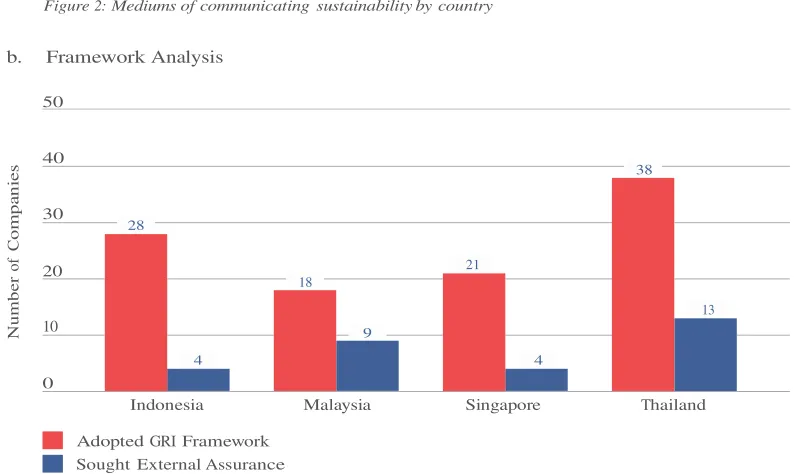
As seen from Figure 3 above, 28 companies in Indonesia adopted the GRI framework
as a reference guideline for their sustainability reports while Malaysia, Singapore
and Thailand had 18, 21 and 38 companies who did so respectively. The remaining
companies from all countries either adopted other frameworks, such as the United
Nations Global Compact (UNGC) or Roundtable Sustainable Palm Oil (RSPO), or
had no framework as guidance. Additionally, only a small proportion of companies
from each country sought external assurance from other auditors to check their
sustainability reports.
Average level of disclosure in ASEAN
Figure 4: Level of disclosure in ASEAN
Based on all the companies in these countries studied, the average level of
disclosure for sustainability reporting in ASEAN was found to be 50.4 (Figure 4).
This level of disclosure represents a fairly healthy quality of sustainability reporting across the four countries. Thailand had the highest overall level of disclosure from
its companies and was also the only country which had an above-average level of
disclosure in ASEAN. This suggests that it has the highest quality of sustainability
disclosure and the most widespread sustainability landscape, preceding Singapore,
L
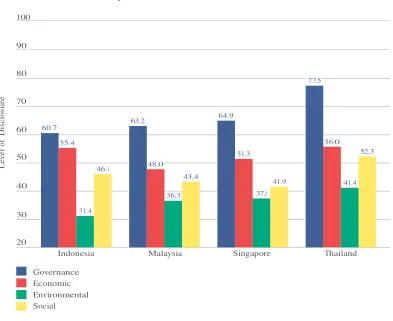
Figure 5: Level of disclosure by indicator
Comparing across the GRI indicators, Thailand had higher levels of disclosure than the other countries for all the Governance, Economic, Environmental and Social
indicators (Figure 5). This could be due to its business culture that strongly
emphasises compliance. Some companies (such as PTT Public Limited Company)
had CSR or similar statements incorporated into their company’s missions and
values even since its early days (Srisuphaolarn, 2011).
All four countries were also observed to follow the same trend of having the lowest
level of disclosure on its Environmental indicator. Economic developments generally generate environmental impacts and when companies are unwilling to disclose more
information regarding its environmental impacts or corresponding efforts to mitigate
them, it could be because of a lack of such efforts that would reflect negatively on
L
Other Frameworks (eg UNGC, RSPO) No Framework
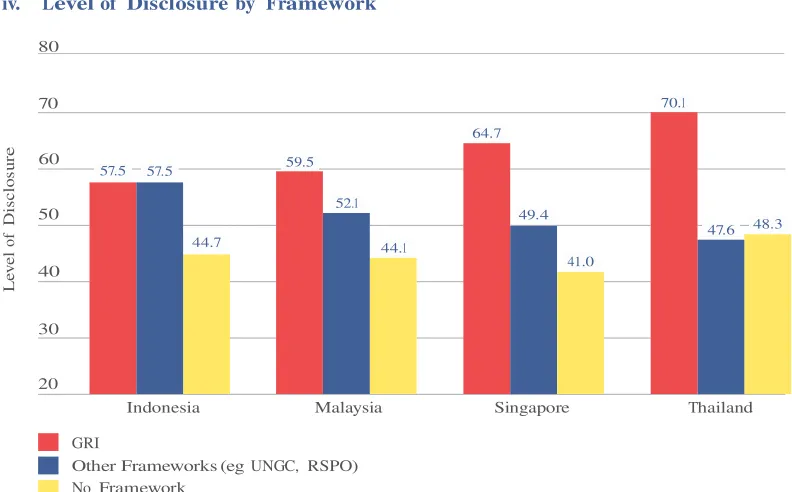
Figure 6: Level of disclosure by framework
GRI provides a comprehensive framework for companies to understand and
communicate their governmental, economic, environmental and social performances
and impacts. Companies which adopted the GRI framework were observed to have
higher level of disclosure than those who adopted other or no framework (Figure 6).
This result is consistent across all countries, with the exception of Indonesia. In
Indonesia, companies which adopted the GRI framework had the same level of
disclosure as those who adopted other frameworks. However, only 1 company out
of 100 used other framework as its sole sustainability reporting guide. Hence, the
level of disclosure from this company cannot be representative of referencing from
N
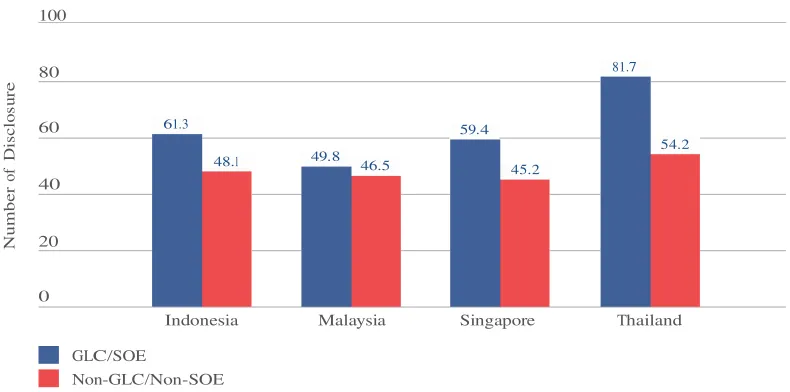
Figure 7: Level of disclosure by GLC/SOE and non-GLC/non-SOE
Companies are defined as Government-Linked Companies (GLCs) or, alternatively known as State-Owned Enterprises (SOEs), if the government has a substantial
shareholding of 20% or more in the business. Based on the studies conducted, GLCs
in all four countries were found to disclose more information on their sustainability
practices than their non-GLC counterparts and hence, yielded higher levels of
disclosure (Figure 7). Due to the globalisation of such companies worldwide, they
are more inclined to be transparent on their practices and thus, disclose more.
vi. General Standard Disclosures
General standard disclosures from companies aim to provide insights into
sustainability topics, beyond just summarizing the report. Such disclosures are
assessed by the number of companies in each country that disclosed information
with respect to three areas: Strategy and Analysis, Materiality and Stakeholder
Engagement.
a. Strategy and Analysis
Strategy and analysis provides a general strategic insight into the company’s
sustainability and looks into two aspects. The first aspect studies whether the
company provided a statement about the relevance of sustainability to the company.
Such a statement has to be made from the most senior decision-maker of the
company (e.g. the CEO) and should include the respective company’s strategy
for addressing sustainability. The second aspect studies if they also provided a
N
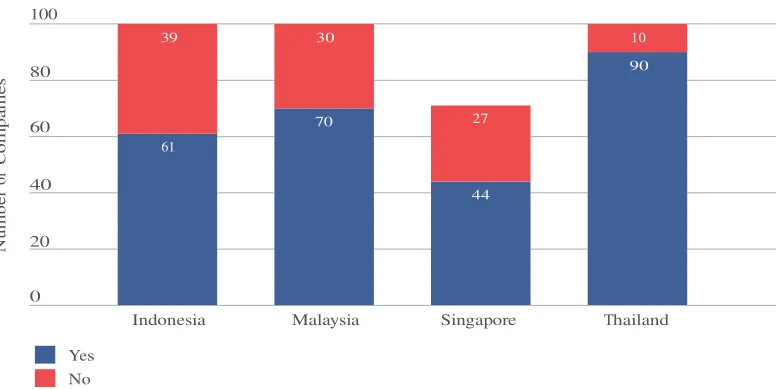
Companies in Indonesia and Thailand had relatively more extensive disclosures
relating to their strategic view on sustainability. Most companies from these
countries addressed both aspects (Figure 8). However, Singapore and Malaysia
had a significant disparity between companies that made a CEO statement versus
companies that went further and identified the key risks, impacts and opportunities
of sustainability. Such a disparity implies that while companies seemed to address
the relevance and importance of sustainability, it could only be on a superficial
commitment as reflected by the higher number of CEO statements provided but
lower number of companies recognising the key impacts, risks and opportunities
(Figure 9).
Figure 8: Number of companies that provided CEO statement on relevance of sustainability
100
N
This standard disclosure looks into the topics that companies consider as material to
their business, that is when they recognise that some information of their operations
are important to potential investors making investment decisions. Companies are
studied based on three criteria: whether they explained the process for defining
report content and aspect boundaries, listed the material aspects identified and if
they reported aspect boundaries for each material aspect within and outside the
organisation.
Across all four countries, only a small proportion of countries disclosed information
on all three criteria of materiality (Figures 10-12). Omitting disclosure of material
information from its sustainability report could influence decisions that investors
make on the basis of financial information. Hence, overall disclosure of what
companies regard as material to their business can be greatly improved to assist
both their current and potential stakeholders on making decisions. As for those
who disclosed, the most cited material issues in all four countries are under social
indicator and they are issues pertaining to Occupation Health and Safety and
Training and Education.
N
Figure 11: Number of companies that listed material aspects identified
100
N
Disclosure on this area provides an overview of a company’s engagement with its
stakeholders during or outside the sustainability reporting period. Such disclosure
reveals information on how a company’s stakeholders are selected and included
in its business operations. Companies were assessed based on three aspects: their
disclosure of stakeholder engagement and inclusiveness policies and procedures,
whether they provided a list of the stakeholder groups they engaged with and if they
reported the basis for identification and selection of stakeholders.
Proportion of companies that addressed disclosures pertaining to stakeholdership
is greatest in Thailand. It also has the highest number of companies that
communicated sustainability on these three aspects. In comparison, Indonesia
has a moderate proportion of companies that did so, with more than half of them
disclosing information on related policies and procedures. A considerable number
of them also did list the stakeholder groups engaged and reported the basis for
selection of their stakeholders. Malaysia, on the other hand, has 8 companies out of 100 that reported the basis for identification and selection of its companies’
stakeholders (Figures 13-15). Likewise, companies in Singapore could also be more
transparent on matters pertaining to their stakeholdership.
100
N
Figure 14: Number of companies that provided list of stakeholder groups engaged
100
7. LIMITATIONS OF STUDY
This study is also subject to a number of limitations.
First, this study constitutes the pioneer study that has been conducted on sustainability
reporting for four countries in ASEAN. Studies on Indonesia, Malaysia and Thailand were
also conducted for the first time, while it is the third study conducted on Singapore’s
mainboard listed companies. With a lack of archive studies from the other three
countries, one limitation of this study is the inability to track and analyse the progress of
sustainability reporting in ASEAN. By having data on the sustainability landscapes and
levels of disclosures of each country from year to year, the development of sustainability
reporting in each country and throughout ASEAN can be observed.
Second, the study only looks into the companies’ annual reports/ sustainability reports
or their corporate websites in which sustainability effort is communicated. However,
these disclosures do not necessarily represent the company’s actual performance.
Future research is recommended to include field trips or other validation processes
to gain a holistic assessment.
Nonetheless, this serves as a benchmark and motivates further research and future
studies for each country. Ideally, other countries such as Brunei, Cambodia, Laos,
Myanmar, Philippines and Vietnam can be included for more comprehensive and
8. CONCLUSION
Based on this study, it was observed that the Economic and Social indicators in Indonesia
are relatively well-disclosed but, there needs to be further disclosure on its Governance
and Environmental aspects. As for Malaysia, a more comprehensive sustainability
reporting landscape can be anticipated with the newly-implemented Sustainability
Reporting Guide by Bursa. Similarly, a higher proportion of companies communicating
sustainability in Singapore is also expected, when on the ‘comply or explain’ basis from
financial year ending on, or after 31 December 2017. Lastly, Thailand was observed to
have the highest quality of sustainability disclosure, which is largely attributed to its
business culture that strongly emphasises on compliance.
Overall across all four countries, a higher quality of disclosure is generally observed
when companies adopted the GRI framework than other or no framework. As the GRI
guidelines provide a comprehensive yet clear framework for companies to understand,
it is therefore easier for them to communicate their sustainability practices. GLCs/SOEs
also tend to fare better on their quality of disclosure, as compared to non-GLCs/non-
SOEs. The increase in quality of disclosure of GLCs/SOEs could be attributed to their
links with the government, where there is a greater need for transparency of their actions
and operations. Additionally, it was found that only a small proportion of companies
across all countries disclosed information on materiality. Thus, the quality of disclosure on
this general standard disclosure can be improved so as to assist their current and future
stakeholders in making informed decisions.
In essence, sustainability reporting is an integral part of companies’ business as it enables
them to manage their environmental and social impacts as well as improves on their
operating efficiency. It reflects a company’s reputation and practices to its consumers,
employees and also its current and potential stakeholders. This is necessary to assess
one’s credibility and values and promote brand loyalty.
As a final remark, the overall quality of disclosure of each country, represented by
its respective level, is fairly healthy. Companies also appear to increasingly recognise
the importance of sustainability report and made progress to improve on their quality
REFERENCES
Amran, A., & Keat Ooi, S. (2014). Sustainability reporting: Meeting stakeholder demands.
Strategic Direction, 30(7), 38-41. doi:10.1108/SD-03-2014-0035
Global Reporting Initiative (2015). G4 Sustainability Reporting Guidelines. Retrieved from
https://www.globalreporting.org/standards/g4/Pages/default.aspx
Loh, L., Low, B., Sim, I., & Thomas, T. (2014). Accountability for a Sustainable Future.
Sustainability Reporting in Singapore among Singapore Exchange Mainboard Listed
Companies 2013. Retrieved from http://www.csrsingapore.org/c/resources/publications?d
ownload=69:accountability-for-a-sustainable-future
Monetary Authority of Singapore and Singapore Exchange (2012). Code of Corporate
Governance. Retrieved from http://www.mas.gov.sg/~/media/resource/fin_development/
corporate_governance/CGCRevisedCodeofCorporateGovernance3May2012.pdf
Monetary Authority of Singapore and Singapore Exchange (2011). Guide to Sustainability
Reporting for Listed Companies. Retrieved from http://rulebook.sgx.com/net_file_store/
new_rulebooks/s/g/SGX_Sustainability_Reporting_Guide_and_Policy_Statement_2011.pdf
Srisuphaolarn, P. (2013). From altruistic to strategic CSR: How social value affected
CSR development - a case study of Thailand. Social Responsibility Journal, 9(1), 56-77.
doi:10.1108/17471111311307813
Thomas, T., & Chin, H. (2011). Sustainability Reporting in Singapore. Non-Financial
Reporting Among Mainboard Listed Companies in Singapore: A View of the Sustainability
Reporting Landscape in 2010-2011. Retrieved from http://www.csrsingapore.org/c/
resources/publications?download=43:sustainability-reporting-in-singapore-non-financial-
THE AUTHORS
Dr Lawrence Loh, Director, Centre for Governance, Institutions and Organisations &
Deputy Head and Associate Professor, Department of Strategy and Policy, NUS Business
School, National University of Singapore
Ms Nguyen Thi Phuong Thao, Programme Manager, ASEAN CSR Network
Dr Isabel Sim, Senior Research Fellow, Department of Social Work, Faculty of Arts and
Social Sciences, National University of Singapore & Research Adviser to ASEAN CSR
Network
Mr Thomas Thomas, Chief Executive Officer, ASEAN CSR Network
Ms Wang Yu, Research Associate, Centre for Governance, Institutions and Organisations,
ACKNOWLEDGEMENT
This project was made possible with the contribution of the following:
Donor
Centre for Governance, Institutions and Organisations
Centre staff
Ms Siti Nurbuwwah binte Ismail Mr Koh Luwen
Ms Yam Jia Hui Mr Kendrick O’Keefe
Students from NUS Business School
Ms Ang Shuang Shuang Ms Bak Ke Yun Geraldine Mr Chew You Jing Nicholas Mr Christopher Michael Law Mr Keh Zhao Hui
Disclaimer
The information contained in this publication is provided for general purpose only and published in good faith for the benefit of the CSR community and business practitioners in Singapore. Whilst every effort has been made to ensure that the information is accurate at the time of publication, the publishers wish to highlight that the content is for general guidance only and does not aim to be comprehensive or exhaustive. The publishers accept no responsibility for any loss which may arise from information contained within the publication.
No part of this publication may be reproduced, in any format, without prior written permission. Please contact the ASEAN CSR Network for details.
d
Published by the ASEAN CSR Network
This study is a part of the ASEAN CSR Vision 2020 – an initiative by the ASEAN CSR Network supported by the Government of Sweden through its Embassy in Bangkok.