SEO Warrior
John I. Jerkovic
SEO Warrior by John I. Jerkovic
Copyright © 2010 John I. Jerkovic. All rights reserved. Printed in the United States of America.
Published by O’Reilly Media, Inc., 1005 Gravenstein Highway North, Sebastopol, CA 95472.
O’Reilly books may be purchased for educational, business, or sales promotional use. Online editions are also available for most titles (http://my.safaribooksonline.com). For more information, contact our corporate/institutional sales department: 800-998-9938 or [email protected].
Editor: Mike Loukides
Production Editor: Sarah Schneider
Copyeditor: Audrey Doyle
Proofreader: Sarah Schneider
Indexer: Lucie Haskins
Cover Designer: Karen Montgomery
Interior Designer: David Futato
Illustrator: Robert Romano
Printing History:
November 2009: First Edition.
O’Reilly and the O’Reilly logo are registered trademarks of O’Reilly Media, Inc. SEO Warrior, the image of an Eleonora’s falcon, and related trade dress are trademarks of O’Reilly Media, Inc.
Many of the designations used by manufacturers and sellers to distinguish their products are claimed as trademarks. Where those designations appear in this book, and O’Reilly Media, Inc. was aware of a trademark claim, the designations have been printed in caps or initial caps.
While every precaution has been taken in the preparation of this book, the publisher and author assume no responsibility for errors or omissions, or for damages resulting from the use of the information con-tained herein.
TM
This book uses RepKover, a durable and flexible lay-flat binding.
ISBN: 978-0-596-15707-4
[M]
Table of Contents
Preface . . . xv
1. The Big Picture . . . 1
SEO Benefits 2
SERP Real Estate 2
The Trust Factor 3
Lower Cost of Ownership 5
SEO Challenges 6
Competition 6
No Guarantees 6
Ranking Fluctuations 7
Time Factors 8
Organizational Structure 8
The SEO Process 9
The Research Phase 10
The Planning and Strategy Phase 12
The Implementation Phase 14
The Monitoring Phase 15
The Assessment Phase 16
The Maintenance Phase 17
SEO Alternatives 17
Paid Ads (or Links) 17
Traditional Marketing 18
Summary 18
2. Search Engine Primer . . . 19
Search Engines That Matter Today: Google 20
Yahoo! 21
Bing 22
Types of Search Engines and Web Directories 23
First-Tier Search Engines 23
Second-Tier Search Engines 23
Regional Search Engines 24
Topical (Vertical) Search Engines 24
Web Spider–Based Search Engines 24
Hybrid Search Engines 25
Meta Search Engines 25
Web Directories 26
Search Engine Anatomy 27
Spiders, Robots, Bots, and Crawlers 27
The Search (or Query) Interface 30
Search Engine Indexing 31
Custom Site Design or Third-Party Software 49
Employing Custom Development 49
Utilizing Free or Paid Software 54
Website Usability 56
General Considerations 57
Linking Considerations 57
Know Your Demographics 57
Ensure Web Browser Compatibility 58
Create Simple Page Layouts 58
Use Intelligent Page Formatting 59
Create Smart HTML Forms 59
Optimize Your Site for Speed 59
Test Your Interface Design for Usability 60
Website Accessibility 60
Summary 60
4. Internal Ranking Factors . . . 63
Analyzing SERPs 63
On-Page Ranking Factors 64
Keywords in the <title> Tag 64
Keywords in the Page URL 66
Keywords in the Page Copy 67
Keywords in the <meta> Description Tag 67
Keywords in the Heading Tags 69
Keyword Proximity 70
Keyword Prominence 70
Keywords in the Link Anchor Text 71
Quality Outbound Links 72
Web Page Age 73
Web Page Size 73
On-Site Ranking Factors 74
Domain Name Keywords 75
Size or Quantity of Content 76
Linking Considerations 77
Freshness of Pages 80
Putting It All Together 80
Running the Script 80
Quantity and Quality of External Links 88
Broken Outbound Links 92
Handling Broken Links 92
User Behavior Patterns 93
Analyzing the Search Engine Query Interface 94
Google Analytics 95
Google Toolbar 95
User Behavior Lessons 97
Website Performance and Website Age 97
Website Performance 97
Website Age 99
Summary 100
6. Web Stats Monitoring . . . 101
Web Server Logs and Formats 101
NCSA Common Format 102
NCSA Combined Format 103
NCSA Combined Format in Apache 104
Converting IIS W3C to NCSA Combined 104
Spotting a Web Spider in Web Logs 104
Popular Web Stats Tools 105
Using WebLog Expert 106
Number of Visitors 106
Unique Versus Total Visitors 106
Number of Hits 107
Number of Page Views 107
Referrers 108
Search Engine (Referral) Hits 109
Searches/Keywords 110
Web Spider Hits 110
Using AWStats 110
Using Webalizer 112
Tying Searches to Individual Web Pages 116
Web Spider Patterns 117
User Patterns 118
Filtering Specific Data 120
Types of Web Page Elements 120
Summary 121
7. Google Webmaster Tools and Google Analytics . . . 123
Google Webmaster Tools 123
Webmaster Tools Setup 123
Dashboard 124
The “Site configuration” Section 124
The “Your site on the web” Section 129
The Diagnostics Section 131
JavaScript Dynamic Links and Menus 150
Ajax 152
Dynamic Widget Traps 154
Using Flash 154
Using Java Applets 155
Using ActiveX Controls 156
HTML Traps 156
Complex HTML and Formatting Problems 163
Website Performance Traps 163
Very Slow Pages 163
Error Pages 166
Session IDs and URL Variables 167
Splash or Doorway Pages 168
Robots.txt 168
Summary 169
9. Robots Exclusion Protocol . . . 171
Understanding REP 171
Crawling Versus Indexing 172
Why Prohibit Crawling or Indexing? 172
More on robots.txt 176
Creation of robots.txt 177
Validation of robots.txt 177
Placement of robots.txt 177
Important Crawlers 177
Understanding the robots.txt Format 178
Robots.txt Directives 179
Case Sensitivity 182
Common robots.txt Configurations 183
Summary of the robots.txt Directive 185
Robots Meta Directives 186
HTML Meta Directives 187
HTTP Header Directives 189
The nofollow Link Attribute 189
Dealing with Rogue Spiders 190
Reverse DNS Crawler Authentication 190
Summary 191
XML Sitemap Format 197
XML Sitemap Example 200
Why Use XML Sitemaps? 201
XML Sitemap Auto-Discovery 201
Multiple XML Sitemaps 202
Sitemap Location and Naming 203
XML Sitemap Limitations 203
XML Sitemap Generators 204
XML Sitemap Validators 205
XML Sitemap Submissions 205
Utilizing Other Sitemap Types 209
Pure Text (URL Listing) Sitemaps 209
News Sitemaps 210
RSS and Atom Sitemaps 210
Mobile Sitemaps 210
The Importance of Word Stemming 217
Keyword Modifiers 219
Latent Semantic Indexing (LSI) 221
Keyword Research Process 222
Establish a Current Baseline 223
Compile a Draft List of Keywords You Wish to Target 224
Evaluate Your Keywords 237
Finalize Your Keyword List 240
Implement Your Strategy 240
Summary 240
12. Link Building . . . 241
Precursors to Link Building 242
Start Building Your Reputation Early 242
Assess Your Current Situation 242
Emulate Your Competitors 242
Natural Link Acquisition 243
Link Sources and Link Quality 244
Elements of Link Building 244
Basic Elements 244
Link Bait 245
Social Bookmarking 248
Website Syndication 253
Directories 257
Adding Your Links Everywhere 260
Build a Complementary Site 260
Summary 261
13. Competitor Research and Analysis . . . 263
Finding Your Competition 263
Keyword-Based Competitor Research 264
Finding Additional Competitor Keywords 268
Competitor Backlink Research 271
Analyzing Your Competition 272
Historical Analysis 273
Web Presence and Website Traffic Analysis 273
Estimating Website Traffic 277
Estimating Social Networking Presence 278
Competitor Tracking 280
Current State Competitor Auditing 280
Future State Tracking 282
Automating Search Engine Rank Checking 282
Summary 285
14. Content Considerations . . . 287
Becoming a Resource 287
Predictive SEO 287
Short-Term Content 289
Long-Term Content 291
Content Balance 292
Content Creation Motives 293
Content Duplication 293
Canonical Link Element 294
Multiple URLs 296
Fine-Grained Content Indexing 298
External Content Duplication 298
Similar Pages 298
Deep-Linked Content 299
Protecting Your Content 300
Content Verticals 301
Vertical Search 301
Summary 303
15. Social Networking Phenomenon . . . 305
Social Platforms and Communities 306
Blogs 306
Creating a Twitter Scheduler 320
Google and Social Media Sites 324
Real-Time Search 325
Twitter Real-Time Search 325
OneRiot Real-Time Search 326
Summary 326
16. Search Engine Marketing . . . 329
The World of SEM 330
PPC Platforms 330
SEM and SEO Unison 359
SEO Keyword Tuning with PPC Testing 359
Choosing Better Keywords 359
Summary 359
17. Search Engine Spam . . . 361
Understanding Search Engine Spam 362
What Constitutes Search Engine Spam? 362
Search Engine Spam in Detail 363
What If My Site Is Penalized for Spam? 373
Summary 374
18. Industry Buzz . . . 375
Bing 375 The Keyword Dashboard Tool 376 SearchWiki 377 SearchWiki in Action 377 Benefits of SearchWiki 378 Addressing SearchWiki Concerns 379 The nofollow Link Attribute 379 Format 380 Further Thoughts 380 Finding the Buzz 381 SEO-Related Sites Provided by Search Engines 381 Blog Sites 381 Summary 382
A. Script Listings . . . 383
B. Ping Servers . . . 447
C. Programming Environment . . . 451
Index . . . 453
Preface
I was compelled to write SEO Warrior for many reasons. Every day, thousands of sites are born in the hopes of making it big. Most of them will fail before achieving their goals. Many site owners create their sites blindly, without conducting proper research. Many site owners do not even know what search engine optimization (SEO) is and what its benefits are. Although this approach might work for some sites, it is hardly the case for popular and successful sites. The goal of SEO Warrior is to make you, the website owner, successful!
The topic of SEO is one of my passions. SEO—when considered right from the start— will give you an edge as well as an improved return on your investment. Although nobody can guarantee your site’s rankings, if you do the things I discuss in this book you will greatly increase your site’s chances of doing well in Google. If you follow the same approach, you should also do well in all of the other major search engines. Everything happens for a reason. In 2001, I was hired as a consultant to work at Tucows.com, which was (and still is) one of the top-tier domain name registrars. It was one of the first to be accredited by the Internet Corporation for Assigned Names and Numbers (ICANN). During my stay at Tucows.com, I had the opportunity to work on the popular OpenSRS domain reseller software, which proved to be the catalyst of what was to come.
Not long after finishing my contract at Tucows.com, I was inspired to create my very own international web hosting company, with offices in North America and Europe. During this time I became interested in search engines and search engine algorithms. This experience provided me the opportunity to work on several hundred sites over the past several years.
I did many things during this time, from managing the business to providing different services including web hosting, web design, SEO, and search engine marketing (SEM). I worked on many different types of sites, including blogs, community sites, news portal sites, small business sites, and big corporate sites. This book represents the knowledge and experience I gained in working on many different websites over the past 15 years of my career.
Who This Book Is For
I wrote SEO Warrior with a diverse audience in mind. This book is aimed at webmas-ters, web owners, IT professionals, savvy markewebmas-ters, and anyone interested in the topic of SEO. I cover many tools and concepts, all of which can help bring your site to the next level. This book is different from other SEO books in its breadth and depth of coverage.
Getting to the top of search engine results often requires multiple factors to work in your favor. SEO is not a one-time thing. If you are thinking of creating a new site, read this book before making your move. If you already have a site, you may want to do the same or just skip to your particular area of interest. Accordingly, you can read SEO Warrior from cover to cover or use it as a reference. I recommend going with the first approach and then coming back to the book as you see fit.
How This Book Is Organized
SEO Warrior takes a holistic approach when it comes to SEO. The book comprises 18 chapters. Here is a rundown of what you’ll find in each:
Chapter 1, The Big Picture
Examines the various parts of the SEO landscape, including SEO benefits and challenges. It also stresses the importance of formalizing the entire SEO process in a way that will help you track your SEO progress.
Chapter 2, Search Engine Primer
Provides an overview of the search engine landscape. It covers the most important search engines (Google, Yahoo!, and Bing) while observing some of the lesser-known alternatives. It also examines search engine algorithms, including Google PageRank, as well as search engine bots.
Chapter 3, Website Essentials
Examines domain name and hosting options, custom software design, and third-party software, along with website usability and web accessibility. This chapter provides the most fundamental building blocks for creating your online presence as well as the underlying infrastructure in an SEO sense.
Chapter 4, Internal Ranking Factors, and Chapter 5, External Ranking Factors
Cover the various SEO factors that influence a site’s rankings. Instead of just stating what those factors are, I actually prove them. The proof comes in the form of a Perl script that is available in Appendix A as well as on the book’s companion website,
http://www.seowarrior.net. Chapter 6, Web Stats Monitoring
Examines different web stats monitoring tools, including the most popular ones used by shared hosting providers. It also examines the NCSA Common log format
in detail. Understanding what goes into web logs is important for you to gauge your website traffic, no matter what tool you use.
Chapter 7, Google Webmaster Tools and Google Analytics
Goes into detail regarding these two platforms. Both tools are helpful in SEO. The bottom line is that you will need to use several tools to ensure proper tracking and monitoring.
Chapter 8, Search Engine Traps
Examines the kinds of scenarios that will prevent your site from being crawled. It examines each scenario in detail, with many code examples.
Chapter 9, Robots Exclusion Protocol
Discusses Robots Exclusion Protocol in detail. Coverage includes robots.txt and its associated directives, HTML meta directives, the .htaccess access control method, and the HTTP Header X-Robot-Tag(s). This chapter provides a solid foundation in terms of ensuring proper crawling and indexing of your site. Chapter 10, Sitemaps
Highlights the benefits of Sitemaps. Google and others encourage site owners to create Sitemaps to help them index their sites. The chapter explores the creation of several different Sitemap types, including plain-text URL listings, HTML, XML, RSS/Atom, video, and mobile Sitemaps.
Chapter 11, Keyword Research
Covers one of the most important activities in SEO: keyword research. The chapter discusses ways to find keywords, a basic strategy and process, and timing and trending factors. It also covers several tools and how you can use them to find keywords.
Chapter 12, Link Building
Goes over the different link-building strategies you should use. Link building is one of the most important activities in SEO. The chapter discusses the topics of link bait, social bookmarking, and many others.
Chapter 13, Competitor Research and Analysis
Examines ways to find, analyze, and track your competitors. It also provides details on many of the tools you can use to perform these tasks properly and efficiently. Chapter 14, Content Considerations
Covers many details related to website content. It discusses different concepts, including how to become a resource, short-term content, and long-term content. It also covers content duplication and content verticals.
Chapter 15, Social Networking Phenomenon
Discusses the importance of social networking and social media, and how to lev-erage the different social platforms and communities including Facebook, Twitter, and Digg. It also covers social media strategy and methods for automating social media interactions. You will create a Twitter scheduler application that you can
use as part of your Twitter strategy. The chapter also covers the concept of real-time search.
Chapter 16, Search Engine Marketing
Teaches ways to complement and improve your SEO efforts by utilizing SEM methods. Specifically, the chapter covers how to use Google AdWords to forecast SEO results, and it provides an overview of two of the most important Google platforms: Google AdWords and Google AdSense.
Chapter 17, Search Engine Spam
Discusses things you should stay away from to ensure that the search engines do not penalize your site for spam propagation.
Chapter 18, Industry Buzz
Covers three of the most talked about SEO topics as of this writing: Bing, Search-Wiki, and the nofollow link attribute. The chapter also discusses the Keyword Dashboard tool, which can help you compare search results in Bing, Google, and Yahoo!.
Tools come and go, but some of the most basic SEO tips will always be applicable. Most of the significant programming scripts mentioned in the book appear in their entirety in Appendix A. Even if you do not have any technical knowledge, you should still benefit from reading this book.
Conventions Used in This Book
The following typographical conventions are used in this book:
Italic
Indicates new terms, URLs, filenames, and file extensions Constant width
Indicates variables, method names, and other code elements, as well as the contents of files
Constant width bold
Highlights new code in an example Constant width italic
Shows text that should be replaced with user-supplied values
This icon signifies a tip, suggestion, or general note.
This icon indicates a warning or caution.
Using Code Examples
This book is here to help you get your job done. In general, you may use the code in this book in your programs and documentation. You do not need to contact us for permission unless you’re reproducing a significant portion of the code. For example, writing a program that uses several chunks of code from this book does not require permission. Selling or distributing a CD-ROM of examples from O’Reilly books does
require permission. Answering a question by citing this book and quoting example code does not require permission. Incorporating a significant amount of example code from this book into your product’s documentation does require permission.
We appreciate, but do not require, attribution. An attribution usually includes the title, author, publisher, and ISBN. For example: “SEO Warrior by John I. Jerkovic. Copy-right 2010 John I. Jerkovic, 978-0-596-15707-4.”
If you feel your use of code examples falls outside fair use or the permission given here, feel free to contact us at [email protected].
We’d Like to Hear from You
Every example in this book has been tested, but occasionally you may encounter prob-lems. Mistakes and oversights can occur and we will gratefully receive details of any that you find, as well as any suggestions you would like to make for future editions. You can contact the authors and editors at:
O’Reilly Media, Inc.
1005 Gravenstein Highway North Sebastopol, CA 95472
800-998-9938 (in the United States or Canada) 707-829-0515 (international or local)
707-829-0104 (fax)
We have a web page for this book, where we list errata, examples, and any additional information. You can access this page at:
http://www.oreilly.com/catalog/9780596157074
To comment or ask technical questions about this book, send email to the following, quoting the book’s ISBN number (9780596157074):
For more information about our books, conferences, Resource Centers, and the O’Reilly Network, see our website at:
http://www.oreilly.com
Safari® Books Online
Safari Books Online is an on-demand digital library that lets you easily search over 7,500 technology and creative reference books and videos to find the answers you need quickly.
With a subscription, you can read any page and watch any video from our library online. Read books on your cell phone and mobile devices. Access new titles before they are available for print, and get exclusive access to manuscripts in development and post feedback for the authors. Copy and paste code samples, organize your favorites, down-load chapters, bookmark key sections, create notes, print out pages, and benefit from tons of other time-saving features.
O’Reilly Media has uploaded this book to the Safari Books Online service. To have full digital access to this book and others on similar topics from O’Reilly and other pub-lishers, sign up for free at http://my.safaribooksonline.com.
Acknowledgments
SEO Warrior represents roughly two years of work. I would like to thank many people who have assisted me in many ways during this time. First, I would like to thank my wife, Adriana. Without her, this book would not exist. She took care of our three little children (Drazen, Fernando, and Angelina) while providing me with her timeless love and support.
I will always remember my aunt, Blanka Jerkovic, who passed away April 4, 2009 (while I was writing this book). She is one of the people who have made a profound mark on my life in many ways. I am forever grateful to her. I would also like to remember Jasen Drnasin, my fallen friend and real-life warrior, who was one of the most phenomenal people I have ever known.
Furthermore, I would like to thank all of my extended family, including my mother, father, and Jana Lubina. There are also many friends and colleagues (they know who they are) to whom I would like to extend my humble gratitude and a big Thank You for all of their support.
I am also grateful to O’Reilly Media for giving me the opportunity to write this book. I want to take this opportunity to thank the editor, Mike Loukides, for all of his help and support over the past 12 months. I also want to thank the entire O’Reilly produc-tion team for their assistance in bringing this book into your hands. This includes Audrey Doyle, copyeditor; Rachel Monaghan, senior production editor; Sarah Schneider, production editor; Lucie Haskins, indexer; Rob Romano, illustrator; Jacque Quann, editorial assistant; and Laurel Ackerman, marketing director.
Furthermore, I would like to thank Soren Ryherd of the Working Planet Marketing Group for taking the time to review the book. I am grateful for your time and all of your comments. I am also grateful to Matt Cutts (of Google.com) for reading SEO War-rior while providing many great comments.
Most importantly, I want to thank each and every reader of SEO Warrior for buying the book in either the electronic or printed version.
Everything good in life requires sacrifice, patience, and hard work. May this book bring you one step closer to all of your online aspirations.
CHAPTER 1
The Big Picture
Often, search engine optimization (SEO) comes as an afterthought, and not everyone is always fully aware of its long-term benefits. Depending on the situation, SEO may involve both the IT and marketing departments. In a small business, just one (or very few) individuals will be doing everything. Other times, companies will hire specialists to help them with their SEO needs.
SEO can be defined as an aggregate of all the work necessary to produce a high volume of referral hits from search engines, web directories, and other websites, with the ulti-mate goal of making the website popular. SEO involves internal and external website analysis, including link building, proper website architecture and development, com-petitor analysis, keyword research, content development, and many other tasks. SEO is partly about building appropriate content and partly about getting people to link to you. Your content is essential, but Google’s ability to count incoming links, in addition to content, was considered a major breakthrough.
Search engine marketing (SEM) refers to the utilization of pay-per-click (PPC) adver-tising such as through Google AdWords. Although some elements are common to both SEO and SEM, PPC advertising is much easier to implement and can achieve immediate results, usually in the form of getting visitors to see your website in a matter of minutes. Marketers will often ignore (or confuse) SEO in favor of (PPC) SEM, but by doing so they are ignoring great opportunities. SEO is about as close to free as you can get. It takes work, and work costs money, particularly if you hire a consultant. But you won’t have any advertising bills coming in. SEO work brings long-term value.
If you operate your website for hobby or profit, SEO can be an important tool in making your website popular. SEO is not rocket science (or anywhere close to it). But it certainly can get as technical and detailed as you want to make it.
One could argue that the deceptive SEO practiced in its early days is long gone. Today it takes a lot more effort for sites to be ranked well. Ranking well does not necessarily translate to relative site popularity or sites meeting their objectives (desired
conversions). SEO gets the visitor to the door. It is up to your site’s content to welcome and retain that visitor.
Optimizing just for search engines may not be enough. Social media websites along with social bookmarking should be considered as well. Today’s web user demands more from websites. This evolution in site usability and interactivity, coupled with ever-changing search engine technology, brings with it additional demands for the website owner.
SEO Benefits
SEO provides numerous benefits. These include greater search engine results page (SERP) real estate, a historical trust factor, and a lower cost of ownership. SEO benefits are typically long lasting. The following subsections explore these benefits in more detail.
SERP Real Estate
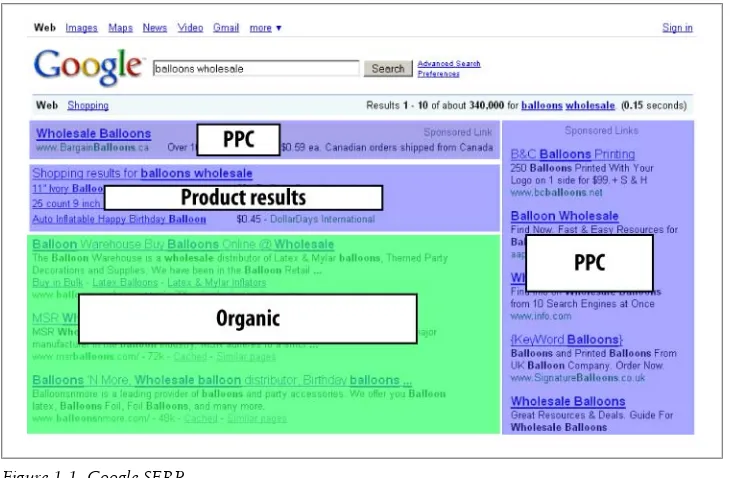
Figure 1-1 shows the typical layout of a Google SERP. Sponsored (PPC) links appear on the far right as well as at the top (just below the Search box). Product results, local business results, book results, news results, and so forth may also appear just under the top Sponsored Links section. Moving farther down we find the SEO-based organic search results.
Figure 1-1. Google SERP
When looking at the SERP real estate in totality, you can see that organic results occupy most of the screen real estate. This is abundantly clear for the less popular keywords that have fewer sponsored links in the search results.
Popular keywords
When searching for popular keywords, search results are usually mixed with Blended Search results, as shown in Figure 1-1. This is perhaps the worst-case scenario in an SEO context. How do you stand out in all of the clutter? Typically, part of the answer is by targeting less popular keywords.
Niche keywords
Not all search results are cluttered. Searches for niche keywords often produce 100% organic results. Figure 1-2 is one example (for the keyword electrodermal testing sen-sitivities toronto). As you can observe, nobody is bidding for this keyword.
Figure 1-2. Google SERP: Niche keywords
Optimizing for niche keywords helps to attain greater conversion rates. To fortify their brands, the big industry players will also optimize their sites for the more (broad) pop-ular keywords, irrespective of the conversion rate.
The Trust Factor
Most people trust organic search results. According to a survey by iProspect, more than 60% of users click on organic search results. The percentage is even higher for indi-viduals with more Internet experience. The full report is at http://www.iprospect.com/ premiumPDFs/iProspectSurveyComplete.pdf.
Another study, titled “Paid search rates by industry” and conducted by Hitwise Intelli gence, shows a wider gap in favor of organic search results. The only exception to the rule is that of the insurance industry, with 45% of traffic coming in via PPC campaigns. The full article is available at http://weblogs.hitwise.com/robin-goad/2008/09/paid _search_rates_by_industry.html.
It should be very clear that if you are solely using PPC as your conduit for search engine traffic, you are missing out on the broader picture. Organic search results have tradi-tionally enjoyed more trust, especially among more experienced and Internet-savvy people. And if these people are your demographic, you need to have your SEO in order.
The Golden Triangle
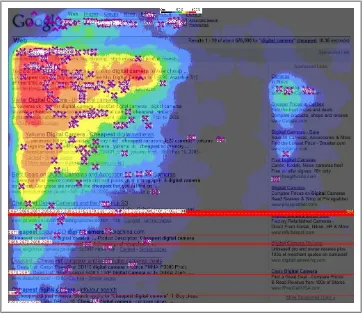
In an eye-tracking study conducted by Didit, Enquiro, and Eyetools, 50 participants were observed while browsing through Google search results. The results of this study uncovered what is termed the “Golden Triangle.” This refers to the screen area (in the shape of the letter F) that 100% of the participants viewed, as shown in Figure 1-3. Figure 1-3. The Golden Triangle
Another interesting finding of this study included an analysis of the percentage of peo-ple looking at specific search result(s) as well as the percentage of peopeo-ple looking at specific paid results. Table 1-1 shows the breakdown. For more information, visit http: //www.prweb.com/releases/2005/03/prweb213516.htm.
Table 1-1. The Golden Triangle findings
Organic results AdWords results
Rank Percent viewed Ad position Percent viewed
1 100% 1 50%
2 100% 2 40%
3 100% 3 30%
4 85% 4 20%
5 60% 5 10%
6 50% 6 10%
7 50% 7 10%
8 30% 8 10%
9 30%
Note: there are only eight ads per SERP
10 20%
Lower Cost of Ownership
Contrary to popular belief, SEO is not free. At the very least, it takes time to implement. From a long-term perspective, it does provide for better ROI when compared to PPC or other marketing methods.
Getting free hits from organic results can minimize or eliminate the need to use PPC campaigns. Well-ranked sites (utilizing only organic SEO techniques) can significantly reduce marketing expenditures. The added benefit of SEO is that it is long lasting, provided that it is content- and web user–centric. For companies on a budget, SEO can make all the difference. Investing some time in early website setup (mindful of SEO) can make a big impact on the future growth and visibility of such companies’ websites.
Making provisions for SEO from the very beginning pays dividends in the long term, as less rework will be required to achieve specific SEO goals. If time is not a factor, that’s all the more reason to use SEO. Once a company adopts SEO as part of its online strategy, everything becomes easier. Web designers, developers, web server adminis-trators, and marketers now carry the same vision, with SEO being the norm. Ta-ble 1-2 provides a summary of the advantages and disadvantages of SEO and PPC.
Table 1-2. SEO and PPC summary
SEO PPC
Advantages • Lower cost (time) • Sustained long-term benefits
• Fosters natural website growth with reliance on compelling content
• Trust
• Higher click-through rate (CTR)
• Instant traffic • Easier to implement • Easier to manage
Disadvantages • Initial results take time • Requires more effort
• No guarantees (but has proven to work time and time again)
• Can drain budgets quickly with low conversion rates
• Highest positions go to highest bidders • Historical distrust
• Traffic stops when you stop paying
SEO Challenges
SEO does have its quirks and is a long-term commitment. Some of these challenges are not related to the technology. Some are just out of your control. The following sub-sections discuss some of these challenges, including competition, no guarantees, rank-ing fluctuations, time factors, and organization structure.
Competition
In June 2008, VeriSign reported that there were about 168 million domain name reg-istrations across all of the top-level domain (TLD) names. You can find the report at
http://www.verisign.com/static/044191.pdf. According to another survey, conducted by Netcraft in April 2009, there were approximately 231.5 million websites across the globe (http://news.netcraft.com/archives/web_server_survey.html).
Although these numbers are staggering, it is likely that the true number of all websites is even higher. As each domain can have numerous subdomains, websites realistically number somewhere in the billions.
It’s almost inconceivable that you are the only person in your niche. At the same time, many sites don’t do any SEO, and so it’s relatively easy to gain mindshare and search engine rankings, particularly if you are serving a niche market.
No Guarantees
Nobody can actually guarantee the top spot on Google, Yahoo!, or Bing. It is simply impossible to do so. Though many have certainly tried, too many variables are involved.
However, the benefit of SEO is real. If you do your SEO due diligence, rankings and popularity will come in time—provided you have relevant content. Many sites are tak-ing advantage of SEO. It would be foolish not to utilize SEO as part of your overall online marketing strategy.
Ranking Fluctuations
The motive of any business is growth. If you don’t grow, you could be in trouble. This is especially the case with businesses that depend solely on their websites for revenues. For some, the Internet is one way to expand and increase their business. For others, the Internet is their lifeline and the core of their business model. With tens of millions of domains all competing for popularity, trying to stand out in the crowd can be a daunting or even frightening prospect.
With continuous improvements in search engine technology, search engines are using hundreds of different ranking factors. Sometimes all it takes is for one factor to change for your site to sink in the rankings or (even worse) be wiped out of the index completely.
Although nobody knows the exact ranking formula, each search engine has its own take on ranking factors. “Positive” ranking factors aid your rank. “Negative” ranking factors (such as having duplicate content) penalize your rank.
If you could illustrate this concept, it would look similar to Figure 1-4. The positive weights would represent the factors aiding your rank, while the negative weights would represent the factors working against your rank. The cumulative total (of all weights) would represent the relative rank weight that search engines could use in establishing the relative page rank for a particular keyword.
Figure 1-4. Ranking factors
Note that the bar height is only for illustration purposes. Every search engine will have its own weight formula.
Time Factors
Each site is different, so the SEO strategy applied to each site will also be different. There are so many factors that it would be naïve to put an exact time frame for SEO to show desired results.
SEO is not finished when you start seeing results. Even if you get to the top spot on the Google searches that you care about, your job isn’t done. You need to make sure you stay on top of these searches. Your competitors will want to take your top spot away from you.
SEO fosters the natural, long-term growth of a website, and once you achieve its ben-efits, there is usually a ripple effect where you’ll be getting traffic from sources other than search engines by means of other websites linking to yours. If you have the content or product that people want to see, it is only natural to attract inbound links.
Organizational Structure
Organizational structure can play a significant role in SEO. Big companies can some-times be difficult to navigate. It may be unclear who is responsible for SEO. Having no ownership typically means no work gets done. Smaller companies can be faster paced, but also carry their own troubles.
Big companies and organizations
Although big companies have large marketing budgets, they too can benefit from re-ceiving (almost free) hits. When it comes to large departmentalized organizations with marketing (or e-business) and IT departments operating in isolation, it can be difficult to adopt a common SEO vision.
Typically, large organizations have complex, dynamic websites. In these cases, mar-keters depend on IT (usually web development and infrastructure teams) for publishing their content, for site maintenance, and so on.
Most software developers or web server administrators do not think about SEO. Most marketers today employ SEM (PPC) and do not know all of the technical details of SEO. This is where a bit of education and training is essential.
Forming virtual teams comprising members from each department can help solve these problems. This is often necessary because the best SEO is attained from expertise derived from multiple disciplines.
Adopting an early strategy and identifying roles and responsibilities can make a big difference. Most developers are not proficient copywriters. Most marketers do not understand what the HTTP response codes are.
Virtual teams.
Sometimes an in-house approach may not be the best choice simply because no in-house expertise is available. Even when you have in-house expertise, sometimes it is good to get second opinions. Other times your key people may be involved in other projects and you just don’t have enough resources.
Large, complex sites
Industry giants can run hundreds of different websites with millions of web pages. Having so many web pages (typically) manifests many unique challenges. Some of those challenges include:
• How to optimize many thousands or millions of pages • Poor indexing of deep pages
• Determining which pages are preferred entry pages • The quality of most inner pages
• Duplicate content
• Making changes to many pages at once • Archiving
Small companies and individuals
Many small-business owners often struggle with the concept of the Internet, web de-sign, and SEO. A smaller company generally means a smaller budget. With this in mind, SEO can become the most important tool for gaining online traction and eventual sales leads. Many free tools are available on the Internet, including content management system (CMS) portals, blogs, and forums—with built-in SEO. Leveraging these tools can significantly lower the total cost of SEO ownership while achieving most of the benefits. Refer to Chapter 3 for more details.
The SEO Process
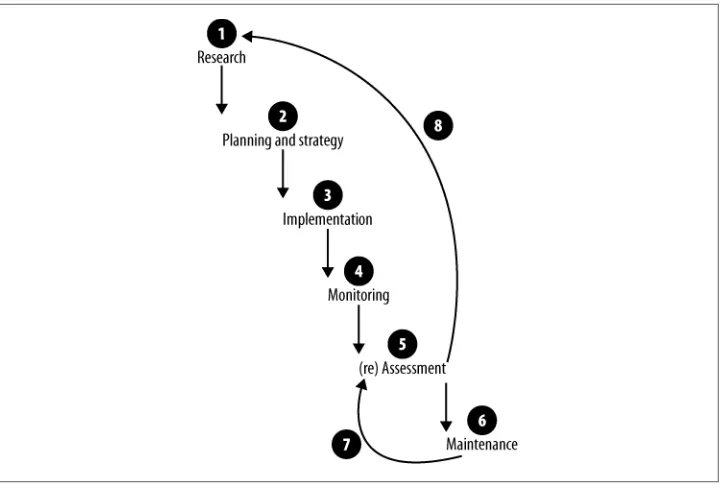
The SEO process can be broken down into six general phases. These include research, planning and strategy, implementation, monitoring, (re)assessment, and maintenance. Figure 1-5 shows the phases connected with arrows. Note that the SEO process is highly iterative. Each phase constitutes its own body of knowledge.
Also note that Figure 1-5 uses arrows to indicate the relative order of each phase, and loops to indicate the iterative nature of the SEO process. The smaller loop occurs between the (re)assessment phase and the maintenance phase, and the larger loop oc-curs between the (re)assessment phase and the research phase. Moving forward, let’s explore each of these phases.
Outsourcing.
The Research Phase
The research phase is the first phase of the SEO process. It usually consists of several different types of research, including business research, competitor analysis, current state assessment, and keyword research.
Business research
Before doing anything else, learn about your business in relation to its online presence. In this phase, you need to answer lots of questions, and most of them may be specific to your business. What does your company have that the competition does not? What is your selling point?
Many other questions and topics need to be asked and explored, and much of this may be outlined in your standard business and/or marketing plans as well as in your (web-site) business requirements. When it comes to your online marketing, ask yourself: how much do you understand about SEO and PPC? Are you looking to target certain dem-ographics or geographical locations? What are your general and specific expectations? How do you measure success? What do you perceive as failure? What is your budget? Do you have resources available to handle SEO and/or SEM? Who is the owner (driver) of your SEO efforts? What does the project schedule look like? Are there specific timelines?
Figure 1-5. SEO process phases
The more you know about the business, the better. The clearer the picture you have at the start, the more focused your efforts will be. Find answers to all of your questions early.
Competitor analysis
Once you know what the business is like and what the expectations are, it is time to see what others are doing. How can you base your SEO if you are not aware of the playing field? Rest assured that your site will be looked at, crawled, and scrutinized by your competitors or their SEO consultants!
Learn about all the players in your business area. Understand where they are now and how they got there. Find out who is linking to them. Explore how much content their site contains.
See how many pages they have indexed in Google and other search engines. Estimate their website traffic and investigate what keywords they are targeting. In general, the more you know about your competitors, the better. This book talks about a number of tools you can use to analyze your site and your competitors’ sites.
Current state assessment
So, you are tasked with increasing the visibility of an existing site. Now you must dig deep into the site, dissecting it from all angles. In SEO vocabulary, this is labeled as the
site clinic. This research process is very similar to competitor analysis, only this time your focus is solely on the site you are assigned to work with.
First things first: you check the current site rankings (if any). Next, you start examining the internal (on-page and on-site) factors, including site age, <title> tags, <meta> tags, internal linking structures, content duplication, search engine traps, and so forth. In parallel, you also look at the external factors. How many backlinks does this site have? Who is linking to this site?
From there, you inquire about current technology being used, current practices, the availability of any in-house technical expertise, web server logs, web analytics, and so on. Knowing the current website size and the current website performance can also help. Resource availability and budget need to be defined.
Keyword research
Conversion rate can mean several different things (depending on the site context). For some sites, conversion rate can be the number of visitors that bought a particular prod-uct. For other sites, it can mean the number of visitors that registered on the site. Con-version implies a specific gained value. In PPC, if the conCon-version rate is too low, the gained value may be less than the invested value, defeating the purpose of the PPC campaign.
Keyword research is the activity of identifying and targeting specific keywords with the goal of creating relevant search engine referrals. For existing sites, keyword research identifies keywords that are already “working” (i.e., keywords that convert) and tries to find new ones that can assist in attaining additional quality traffic.
Keyword research does not apply only to on-page textual elements. It also applies to domain name selection, inbound links, link composition, directory listings, and many other elements. The basic question is always: what keywords do I target? The answer is not always the same. Do you target the most popular (broad) keywords? Or do you target the niche (narrow) keywords?
Output of the research phase
After all of the research is done, it is helpful to produce a document (the SEO research artifact) summarizing the findings of the research phase. This document should contain all of your findings, including the business research, competitor analysis, current state assessment, and keyword research.
The Planning and Strategy Phase
The planning and strategy phase answers some fundamental questions based on the output of the research phase. You need to iron out several strategies in this phase, including those for handling content, link building, social media, and SEM, as well as technical strategies. All of these strategies can be rolled up into a single artifact: the SEO plan.
Content strategy
Your content strategy needs to address all aspects of content: creation, modification, dissemination, and archival. It also needs to address the area of content presentation: how will this content be presented to end users? Your content strategy also needs to answer many additional questions, such as whether the site will include blogs, press releases, testimonials, syndication, media files, and similar items. Also consider which content needs to be crawled (and indexed) and which does not need to be in the search engine index.
Link-building strategy
One of the pillars of SEO, a link-building strategy is crucial. Whether you are going after (paid or free) directory submissions, social media sites, social bookmarking, blog comments, direct solicitation, news syndication, or press releases, you must have solid inbound links. Content with no links can go only so far. Good content can foster natural link acquisitions. However, you cannot rely only on content.
Social media strategy
Engaging your clients on social media sites can be helpful and rewarding if done prop-erly. You can consider this strategy as an important extension of the overall link-building strategy. The phenomenon of Twitter, Facebook, and LinkedIn, among others, is changing the landscape of link acquisitions.
Search engine targeting strategy
A search engine targeting strategy can mean several things. First, what search engines will you be targeting? This includes targeting regional as well as major search engines. There are search engines besides Google, Yahoo!, and Bing. If you are concerned about your presence overseas, there are many other search engines you need to worry about. Big search engines also operate on several different search engine verticals. Do not confuse search engine verticals with vertical search engines (which specialize in specific areas or data). The reference is to the Blended Search results shown on Google, Yahoo!, and Bing. These are additional avenues that you may want to explore.
SEM strategy
Using PPC in parallel with SEO can be helpful. The benefits are multifold, especially if the site in question is brand new. PPC can provide accurate forecasts for targeted key-words. For example, within the Google AdWords platform you can target the same keywords in your ads that you are currently targeting on specific pages. You can then accurately forecast how your pages will convert for the same keywords once you start getting the equivalent SEO traffic.
Technical strategy
Developing a sound technical strategy involves many technical considerations. For starters, you should think about URL rewriting, avoiding content duplication (canon-icalization), error messaging, and linking structures. After the basic SEO technical elements, think about some of the other elements.
For instance, what tools and platforms are required to build the site? Will you be de-veloping custom software? In the case of custom software development, understanding the underlying software architecture is important. Even more important is for the cus-tom software to make architectural provisions to allow for proper SEO.
You need to ask many other questions as well. What browsers will need to be suppor-ted? Do any hosting considerations need to be taken into account? Information on DNS, file space, traffic bandwidth, backups, CPU utilization, and so on can be helpful in painting an accurate technical picture. Make sure you understand the acceptable performance baselines, the scheduled maintenance times, and the change request methodology (if any).
Website performance is important. It is essential for large sites with many thousands of pages. In general, slow sites waste everyone’s time and tend to be a big distraction to your web visitors. Also, web crawlers may not crawl all of the pages in a big site (if it is very slow).
Your technical strategy also needs to include provisions for monitoring, reporting, and analyzing SEO progress. Web server log analysis and web analytics are part of SEO monitoring. Analyzing web traffic is at the core of SEO activities. Converting traffic is what matters. Ranking high with no conversions is a wasted effort.
Output of the planning and strategy phase
The output of the planning and strategy phase is the SEO plan. The SEO plan contains information on internal and external proposed optimizations. This includes on-page and off-page optimizations as derived from particular strategies. The SEO plan is really a proposal and a call to action to address pertinent SEO requirements.
The SEO plan is also a road map. It documents the steps and activities that are required to get better rankings for a particular site. It also documents steps and procedures that will need to be followed for the addition or modification of any new content, after the SEO plan is implemented. The SEO plan should be revised every few months, as search engines and your rankings never stand still.
The Implementation Phase
After the SEO plan is approved, the implementation phase can start. The SEO imple-mentation phase is where all the planning and strategy come into effect. This phase comprises two broad areas of work effort: internal and external optimizations. Ta-ble 1-3 lists some of the activities in each area. Note that the creation of compelling content is implied.
Table 1-3. Implementation phase activities
Internal optimization External optimization
On-page optimization On-site optimization Authoritative backlinks
Title tag Domain name selection Social media Meta description Website (re)design Link solicitation Keyword density Web server (re)configuration Directory submissions Keyword proximity Geotargeting Blog submissions Keyword prominence URL canonicalization Forum submissions Long-tail keywords Linking architecture Article writing Short-tail keywords Performance enhancements Press releases Anchor text robots.txt file Syndication
And more... And more... And more...
Internal optimization
Internal optimization refers to on-page and on-site activities. On-page activities include keyword optimizations of <title> tags, description meta tags, page copy, and link anchor text.
On-site optimization refers to holistic sitewide activities. Domain selection (in the case of new sites), website design or redesign, web server configuration, and sitewide performance tuning are all part of on-site optimization activities. For more detailed coverage of internal optimization, refer to Chapter 4.
External optimization
External optimization is just as important as internal optimization. The major goal of all external optimization activities centers on link building. It is all about your site’s visibility. Each link referral can be viewed as a vote for your site. The more quality links you have, the more popular your site will be. For more detailed coverage of external optimization, refer to Chapter 5.
Output of the implementation phase
The implementation phase can vary drastically in size and complexity depending on the project. It does not have to be done all at once, and it usually never is. Introducing too many variables can get confusing when tracking SEO progress.
The output of the implementation phase can be several artifacts detailing any new technical knowledge gained, problems encountered, and lessons learned. Furthermore, any deviations from the original SEO plan should be documented with appropriate rationale noted (and any future actions that would need to be performed). Procedures and processes for adding new content or making website changes (e.g., backups, main-tenance, and deployment) should also be formalized. Sticking to the SEO plan is a must. Introducing deviations could be counterproductive and could hinder (or confuse) the benefits of other work.
The Monitoring Phase
The monitoring phase comprises just that: monitoring. You need to monitor several things, including web spider activities, referral sites, search engine rankings, website traffic, conversions, hacker intrusions, and more. All of these activities are related and are highly dependent on the analysis of your web server logs. Chapter 6 explores several web stats monitoring tools, including Webalizer, AWStats, and WebLog Expert. Con-sult Chapter 7 for additional information on the subject.
Web spider activity
You’ve just done a lot of work on your site (in the implementation phase). No spider activity could signal problems. Watch spidering activities closely.
Website referrals
Knowing website referrals can help you identify which link-building strategies are working. It is all about time. There is no point wasting additional time in specific link-building avenues if they are not producing any referral hits.
Search engine rankings
The search engine page rankings are important. Without good rankings, you will not get any traffic. With no traffic, you will not get any conversions. Don’t get too obsessed! Initially, your page rankings could be in a state of flux. Focus on your most important pages.
Website traffic
Although website traffic is different from converting traffic, it is still an indicator of your relative site visibility. An increase in visitor traffic is always good news (unless your site is having performance problems). Examining your web server logs can help you spot particular trends. You may even get some surprises in terms of which pages are getting hits.
Conversions
Ultimately, it is the conversions that matter. If you are selling products or services, you want to know how many people that came from search engines bought the product or service. More specifically, you may want to know the entry pages that contributed to these conversions. Depending on your organization and your level of expertise, this could be a challenge if you are employing SEO and SEM at the same time. Knowing how to differentiate SEO from SEM conversions is essential. Utilizing Google Analytics can help you achieve these goals.
Output of the monitoring phase
The output of the monitoring phase is sets of data, typically organized in monthly report summaries. This usually includes data from web stats tools and web analytics tools. This output serves as the input to the (re)assessment phase.
The Assessment Phase
The assessment phase uses the output of the monitoring phase as well as a series of checklists (on which to base the assessment). This phase is also referred to as the checkpoint phase. SEO checkpoints can be defined on a monthly, quarterly, semiannual, or yearly basis. At the very least, quarterly assessments are required. The point of the assessment phase is to see what is and isn’t working according to the SEO plan. The assessment phase can uncover many problems. Referring back to Fig-ure 1-5, minor problems would be handled in the maintenance phase. Major problems
might need a different approach, including getting a second SEO opinion or going back to the research phase.
Output of the assessment phase
The output of the assessment phase is the recommendation artifact. At times, this could be a call to action for further research or a call to action for further minor tweaks.
The Maintenance Phase
Once the major SEO work is done in the implementation phase, the focus will be on website maintenance. The maintenance phase takes care of problems (minor and ma-jor) found in the (re)assessment phase. In many ways, the maintenance phase is similar to the implementation phase.
Output of the maintenance phase
The output of the maintenance phase is a confirmation of all the SEO work performed, in addition to any problems encountered and any lessons learned.
SEO Alternatives
The Internet is not just about search engines. If your objective is solely to reach your desired level of traffic, there are many ways to “skin the cat.” SEO alternatives (or complements) can be divided into two broad categories: online and offline. Online alternatives come in the form of paid ads, while offline alternatives are used in the traditional marketing sense.
Paid Ads (or Links)
Paid links can be highly targeted and produce excellent-quality traffic to your site— often outperforming search engine traffic. If your paid link traffic conversion rate is producing a profit, there is no reason to stop utilizing paid links.
The essence of organic SEO is in natural link acquisitions. Paid links are typically con-sidered noise factors in search engine algorithms. Google is most vocal about paid links. This wasn’t always the case, but Google is now looking at paid links carefully. If you use paid links, Google wants to ensure that it doesn’t follow these paid links when spidering.
It’s your responsibility to make sure paid links have the nofollow link attribute. If they don’t, your site may be penalized. We will discuss paid links and the nofollow attribute in more detail throughout this book.
Traditional Marketing
Many books cover the topic of traditional marketing, so that is not the focus of this book. Nonetheless, you should be aware of any other promotions that your company is doing. Your URL should appear on all of the company’s advertising; otherwise, it’s a waste.
Summary
The value of using SEO is clear. Studies have shown that organic search results are more highly trusted than PPC (SEM) advertising. SEO is about having the right knowledge, applying proven techniques, experimenting with new ones, and letting the search en-gine do the rest. Naturally, the prerequisite to all of that is to have engaging content and a quality product (or service). Stay away from:
• Making changes to emulate the competition without knowing why the change was made
• Applying every SEO rule in the book (overdoing it)
• Not trying different keywords, and instead stopping at only one or a few
• Making frequent SEO-related changes without realizing the effects of previous changes
The SEO work for each website is different. What is similar, though, is the actual SEO process. You still have to go through the same exercise, regardless of whether you are working on a new site or an existing one.
The SEO process is always in motion. Along its path, several artifacts are produced to foster better tracking and management of overall SEO efforts. When done properly, working through the SEO process phases will take time.
Once the major SEO efforts are complete (in the implementation phase), SEO becomes more of an operational activity as opposed to a full-blown project. With the SEO fun-damentals in place, your website will be on the right path toward increased search engine visibility.
CHAPTER 2
Search Engine Primer
It is vital for you to understand—even if at only a basic level—how search engines work, as they are not all created equal, nor do they produce identical search engine results pages (SERPs). Website owners need to carefully examine which search engines they want to target. The current leader in the search engine marketplace is, of course, Google.
When performing SEO, it is important to target specific search engines. You cannot possibly target every search engine that exists. If you are in the Western parts of the world, your choices boil down to Google, Yahoo!, and Bing. According to comScore’s June 2009 press release for U.S. searches (http://bit.ly/sLQfX):
Google Sites led the U.S. core search market in June with 65.0 percent of the searches conducted, followed by Yahoo! Sites (19.6 percent), and Microsoft Sites (8.4 percent). Ask Network captured 3.9 percent of the search market, followed by AOL LLC with 3.1 percent.
Google is even more dominant in Europe, with approximately 80% of search engine market share. However, in Asia the situation is a bit different. comScore’s press release for the Asia–Pacific region for July 2008 states the following:
“Although Google leads the Asia–Pacific search market, powerhouse Chinese search en-gine Baidu.com follows closely on its heels with only a 6-percent difference separating the two,” said Will Hodgman, comScore executive vice president for the Asia–Pacific region. “It will be interesting to watch Google and Baidu compete for the top spot in the region and the loyalty of the growing Asian population.”
According to comScore, in the Asia–Pacific region Google is running neck-and-neck with Baidu. It will be interesting to watch how this situation develops in the coming months and years, as currently Baidu is eating away at Google’s market share. Another regional search engine powerhouse is Yandex, which owns more than 60% of Russia’s search engine market share. Although it is hard to dispute Google’s world dominance in terms of world searches, take these numbers with a grain of salt, as some search engines may be inflating their numbers.
Search Engines That Matter Today: Google
If you focus your design on Google’s webmaster guidelines, chances are your website will also do well across all of the other (important) search engines. Google’s rise from its humble beginnings to what it is today is nothing short of phenomenal.
Google was created by Larry Page and Sergey Brin at Stanford University. In many ways, Google was similar to most of the other major search engines, but its interface did not look like much, consisting of a simple form and search button. This simplicity, so different from portal-like search engine sites, was a welcome relief for many.
Over the years, Google evolved into the multiproduct company it is today, providing many other applications including Google Earth, Google Moon, Google Products, AdWords, Google Android (operating system), Google Toolbar, Google Chrome (web browser), and Google Analytics, a very comprehensive web analytics tool for webmas-ters. In 2008, the company even launched its own standards-compliant browser, Chrome, into what some feel was an already saturated market.
Designing your website around Google makes sense. The Google search network (search properties powered by Google’s search algorithms) has 65% of the market share, according to comScore’s June 2009 report.
Google’s home page has not changed much over the years. Its default search interface mode is Web, and you can change this to Images, Maps, Shopping, or Gmail, among others. What have changed greatly are Google’s results pages, mostly with the addition of ads and supplementary search results.
In the years ahead, Google will be hard to beat, as it is many steps ahead of its compe-tition. Google is using many of its own or acquired tools and services to retain its grip on the search engine market.
Granted, Google’s competitors are watching it. It is also clear that Google is not stand-ing still in its pursuit to maintain and increase its search engine market share domi-nance. This is evident in its acquisition of YouTube.com and others.
According to comScore’s press release for July 2008, YouTube drew 5 billion online video views in the United States:
In July, Google Sites once again ranked as the top U.S. video property with more than 5 billion videos viewed (representing a 44 percent share of the online video market), with YouTube.com accounting for more than 98 percent of all videos viewed at the property. Fox Interactive Media ranked second with 446 million videos (3.9 percent), followed by Microsoft Sites with 282 million (2.5 percent) and Yahoo! Sites with 269 million (2.4 percent). Hulu ranked eighth with 119 million videos, representing 1 percent of all videos viewed.
In late 2006, Google made a deal with MySpace to provide search and ad services to MySpace users. Currently, with more than 100 million users and still growing, MySpace is one of the two biggest social networking websites.
Some additional notable Google offerings include: • Google Book Search
• Google Desktop • Google Finance • Google Scholar • Google Talk • Google Groups
• Google Webmaster Central
To see even more Google products and services, visit http://www.google.com/options/
and http://en.wikipedia.org/wiki/List_of_Google_products.
Yahoo!
Founded by Jerry Yang and David Filo, Yahoo! emerged in the clumsy form of http:// akebono.stanford.edu/yahoo (this URL no longer exists, but you can read about Ya-hoo!’s history in more detail at http://docs.yahoo.com/info/misc/history.html). For the longest time, Yahoo! leveraged the search services of other companies. This included its acquisition of Inktomi technology. This changed in 2004, when it dropped Google as its search provider in favor of using its own acquired technology.
Yahoo! was Google’s biggest rival for many years. What sets Yahoo! apart from Google is its interface. When you go to the Yahoo! website, you actually see a web portal with all kinds of information. Many people see this design as cluttered, with too much com-peting superfluous information. Once you get to Yahoo!’s search results pages, things start to look similar to Google and Bing.
In 2008, Microsoft made a failed attempt to buy Yahoo!, which responded by forming an advertising relationship with Google. That changed in July 2009, when Yahoo! reached an agreement with Microsoft to use Bing as its search engine provider while focusing more heavily on the content delivery and advertising business.
As of this writing, Yahoo! is still using its own technology to provide its search results. It will take some time before Microsoft and Yahoo! are able to merge their systems. Today, Yahoo!’s main attraction is in its textual and video news aggregations, sports scores, and email services. Yahoo! is a strong brand, and the Yahoo! Directory continues to be one of the most popular paid web directories on the Internet.
Its search home page, http://search.yahoo.com, shows top link tabs that are similar to Google’s and Bing’s. Web is the default search mode; additional tabs include Images, Video, Local, Shopping, and More.
Popular tools owned by Yahoo! include: • Finance Portal
• Yahoo! Messenger • Yahoo! Maps • Yahoo! Weather
• APT from Yahoo! Advertising Platform • Yahoo! Groups
• Yahoo! Directory
Bing
Microsoft Bing is the successor to Microsoft Live Search, which failed to gain substantial market traction. Bing is also struggling to cut into Google’s market share, but it has made some inroads thus far. Moreover, with Microsoft’s 10-year agreement with Ya-hoo!, Bing will see a boost in its search user base by absorbing Yahoo!’s search traffic. It may be a long time before the majority of people switch to Bing, if they ever do. The fact is that for many people, the word Google is synonymous with the term search engine. Google is even commonly used as a verb, as in “I’ll Google it.”
At the time of this writing, Microsoft is investing heavily in marketing Bing, spending tens of millions of dollars on Bing campaigns. Over the next few years, the general anticipation is that Microsoft will battle it out with Google for the top spot in the search engine market space. Microsoft did this with Netscape in the browser wars; there is no reason to believe it will not attempt to do the same thing with Google.
The Bing search interface is similar to any other search engine. Bing inherited the same (top) tabs from its predecessor, including Web, Images, Videos, News, Maps, and More.
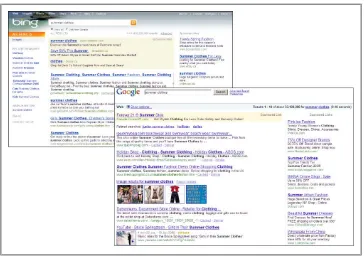
Where it differs is in its search results. Figure 2-1 shows the Bing interface. The left side of Bing’s search results page is called the Explorer pane. Within the Explorer pane, you are presented with results categories (quick tabs) if your particular search query has related search categories.
To the right of the Explorer pane are the actual search results, which are now more centered on the page when compared to Google’s search results. Every search result is also accompanied by a Quick Preview pane. Bing will select additional text from the URL to show in this pane. The intent is to help searchers see more information about the destination URL before they click on the search result.