A JOURNAL ON TAXONOMIC BOTANY,
PLANT SOCIOLOGY AND ECOLOGY
A JOURNAL ON TAXONOMIC BOTANY, PLANT SOCIOLOG Y AND ECOLOG Y
Vol. 12(3): 205-259. 22 Desember 2006
Editors
ELIZABETH A. WIDJAJA, MIEN A. RIFAI, SOEDARSONO RISWAN, JOHANIS P. MOGEA
Correspondence and subscriptions of the journal should be addressed to
REINWARDTIA Vol 12, Part 3, pp: 223 – 235
EVOLUTIONARY ANALYSIS OF POLLINARIA MORPHOLOGY OF
SUBTRIBE AERIDINAE (ORCHIDACEAE)
TOPIK HIDAYAT
Department of Biological Education, Faculty of Mathematic and Natural Science Education, Indonesia University of Education (UPI); JL. Dr. Setiabudi 229 Bandung 40154 Indonesia; E-mail: [email protected]
TOMOHISA YUKAWA
Tsukuba Botanical. Garden, National. Science Museum; 1-1, Amakubo 4, Tsukuba, Tel. +81-(0)29-853-8475; E-mail: [email protected]
MOTOMI ITO
Department of General Systems Sciences, Graduate School of Arts and Sciences, The University of Tokyo; Komaba 3-8-1, Meguro-ku, Tokyo, Tel. +81-(0)3-5454-6638; E-mail: [email protected]
ABSTRACT
HIDAYAT, TOPIK; YUKAWA, TOMOHISA; ITO, MOTOMI. 2006. Evolutionary analysis of pollinaria morphology of subtribe Aeridinae (Orchidaceae). Reinwardtia 12(3): 223–235. –– Pollinarium is one of the distinct synapomorphies of Orchidaceae. With using characters derived from the pollinarium, phylogenetic relationships among genera of subtribe Aeridinae was examined. Cladistic analysis showed that (1) Subtribe Aeridinae is monophyletic group. (2) Five of six groups constructed in the analysis are consistent with the groups recognized in previous molecular phylogenetic analyses. (3) The genera Cleisostoma and Phalaenopsis are non-monophyletic group. (4) Pollinarium morphology endorses monophyly Trichoglottis and Phalaenopsis alliances. (5) Although transformation of the stipe and viscidium shapes in the subtribe is subjected to parallelism, the results showed that these characters are much useful in determining relationships in the subtribe than those of pollinium.
Keywords: Aeridinae, Orchidaceae, Pollinarium, Cladistic
ABSTRAK
HIDAYAT, TOPIK; YUKAWA, TOMOHISA; ITO, MOTOMI. 2006. Analisis evolusi morfologi polinaria pada subtribe Aeridinae (Orchidaceae). Reinwardtia 12(3): 223–235. –– Di dalam famili Orchidaceae, polinarium merupakan salah satu ciri pembeda dari famili tumbuhan Angiospermae lainnya, dan berperan dalam menyediakan karakter bagi penelitian-penelitian taksonomi dan filogenetika. Polinarium tersusun dari polinium dan organ-organ tambahan seperti kaudikel, stipe dan viscidium. Dengan menggunakan karakter morfologi dari polinarium, hubungan filogenetika diantara marga-marga yang tergolong ke dalam subtribe Aeridinae (famili Orchidaceae) telah diteliti. Analisis kladistik dengan melibatkan 90 jenis (50 marga) menunjukkan bahwa: (1) Subtribe Aeridinae adalah kelompok monofiletik. (2) Lima dari enam kelompok monofili yang dihasilkan sesuai dengan beberapa kelompok yang dihasilkan dari penelitian sebelumnya berdasarkan karakter molekuler. (3) Dua marga yaitu Cleisostoma dan Phalaenopsis bukan kelompok monofiletik. (4) Meskipun hasil penelitian menunjukkan bahwa karakter bentuk stipe dan viscidium mengalami evolusi paralel, kedua karakter ini secara taksonomi lebih berguna dibandingkan polinium.
Kata kunci: Aeridinae, Orchidaceae, Pollinarium, kladistik
INTRODUCTION
The pollinarium is defined as pollinia,a pollen mass, and accessory organs such as a caudicle, a stipe, and a viscidium. In Orchidaceae, this feature is an informative source both in taxonomy and phylogenetics (Freudenstein and Ramussen 1996) and has been considered to be less subject to parallelism than are other floral features (Chase 1987). In particular, pollinia characters have been used as a cardinal marker for classification systems such as Brown (1810) and Lindley (1826). Further, micromorphology of pollinia has often
given a great impact on the classification in various orchid groups (e.g., Ackerman and Williams 1980,1981; Schill and Wolter 1986; Zavada 1990; Freudenstein 1991,1994). Chase (1987), on the other hand, has used pollinarium structure in clarifying systematic problems in subtribe Oncidiinae.
The orchid subtribe Aeridinae is a large, diversed group with many taxonomic and phylogenetic problems among the members. The subtribe comprises 103 genera with approximately 1350 species, distributed throughout warm- temperate Asia to tropical Asia and Australia, and
the Pacific islands in the east. Two genera, Taeniophyllum and Acampe, extend the distribution as far west as tropical Africa.
Vegetative parts of the subtribe are characterized by monopodial growth and highly developed velamentous layers of roots adapted to epiphytic life form. The pollinarium parts are characterized by two or four hard pollinia with a definite stipe and a viscidium. Several genera are further characterized by a column foot and a spurred lip.
Most systematic work in the subtribe has been concentrated at the generic level (e.g., Garay 1972; Christenson 1994). Several workers, however, have attempted to trace relationships at higher levels. Schlechter (1926) subdivided subtribe Aeridinae into two groups on the basis of presence or absence of the column foot. The usefulness of pollinia characters (number and aperture) to subdivide this group was outlined by Smith (1934) and was further elaborated by Holttum (1958), Senghas (1988), Seidenfaden (1988) and Dressler (1993), but they neglected information of the shape of stipe and viscidium.
Our recent study of molecular phylogenetics based on plastid matK, a maturase-coding gene, and internal transcribed spacers (ITS) of nuclear ribosomal DNA sequences recognized 14 monophyletic groups within the subtribe (Topik et al., 2005). The result is inconsistent with previous classifications of the subtribe such as Schlechter (1926) and Senghas (1988). In addition, the result
indicated parallel evolution of characters such as pollinium number and presence or absence of column foot.
Although diversity in pollinarium structure in subtribe Aeridinae has been studied (Szlachetko 2003), no satisfactory conclusion existed in relation with the process leading to character evaluation, which would then be useful in inferring phylogenetic evidence. In this study, therefore, we re-examined phylogenetics implication of pollinarium morphology in subtribe Aeridinae with emphases on the structure of stipe and viscidium in more explicit cladistic approach. The cladistic analysis is useful for evaluating previous systems of classification in providing a concrete, explicit set of characters, and coding (Gravendeel 2000).
MATERIALS AND METHODS
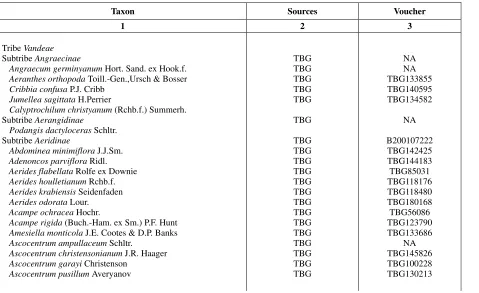
A total of 90 species that represent 50 genera in subtribe Aeridinae, five genera of subtribe Angraecinae, and a single genus of subtribe Aerangidinae were examined. The two latter subtribes have been recognized as the sister group to subtribe Aeridinae on the basis of morphological characters (Dressler 1993) and macromolecular characters (Jarrell and Clegg 1995; Cameron et al., 1999; Chase 2005; van den Berg et al., 2005). The plant materials are shown in Table 1.
Table 1. Plant materials examined in this study.
Taxon Sources Voucher
1 2 3
Tribe Vandeae
Subtribe Angraecinae
Angraecum germinyanum Hort. Sand. ex Hook.f.
Aeranthes orthopoda Toill.-Gen.,Ursch & Bosser
Cribbia confusa P.J. Cribb
Jumellea sagittata H.Perrier
Calyptrochilum christyanum (Rchb.f.) Summerh. Subtribe Aerangidinae
Podangis dactyloceras Schltr. Subtribe Aeridinae
Abdominea minimiflora J.J.Sm.
Adenoncos parviflora Ridl.
Aerides flabellata Rolfe ex Downie
Aerides houlletianum Rchb.f. Aerides krabiensis Seidenfaden Aerides odorata Lour.
Acampe ochracea Hochr.
Acampe rigida (Buch.-Ham. ex Sm.) P.F. Hunt Amesiella monticola J.E. Cootes & D.P. Banks Ascocentrum ampullaceum Schltr.
Ascocentrum christensonianum J.R. Haager Ascocentrum garayi Christenson
Ascocentrum pusillum Averyanov
2006] HIDAYAT et.al.: Evolutionary analysis of pollinaria morphology 225
Taxon Sources Voucher
1 2 3
Ascochilus siamensis Ridl.
Brachypeza zamboangensis (Ames) Garay Ceratocentron fesselii Senghas
Ceratochilus biglandulosus Blume Chiloschista parishii Seidenfaden
Christensonia vietnamica J.R. Haager Cleisomeria lanatum Lindl. ex G.Don Cleisostoma arietinum (Rchb.f.) Garay Cleisostoma aff. gjellerupii (J.J.Sm.) Garay
Cleisostoma javanicum (Bl.) Garay Cleisostoma weberi (Ames) Garay
Cleisostoma uraiense (Hayata) Garay & H.R. Sweet Doritis pulcherrima Lindl.
Dyakia hendersoniana (Rchb.f.) Christenson Gastrochilus calceolaris D.Don
Gastrochilus obliquus Kuntze
Grosourdya callifera Seidenf.
Haraella retrocalla Kudo
Holcoglossum subulifolium (Rchb.f.) Christenson
Hygrochilus parishii Pfitzer
Lesliea mirabilis Seidenf.
Luisia amesiana Rolfe
Malleola witteana J.J.Sm. & Schltr. ex Schltr.
Micropera philippinensis Lindl.
Micropera spp
Micropera spp
Microsaccus griffithii (Par. & Rchb.f.) Seidenf.
Neofinetia falcata Hu.
Omoea philippinensis Ames
Paraphalaenopsis laycockii (M.R. Hend.) A.D. Hawkes
Pelatantheria ctenoglossum Ridl.
Phalaenopsis amabilis Blume
Phalaenopsis appendiculata Carr
Phalaenopsis chibae T. Yukawa
Phalaenopsis fasciata Rchb.f.
Phalaenopsis lowii Rchb.f.
Pomatocalpa kunstleri J.J.Sm. Pomatocalpa spicatum Breda Pteroceras fragrans (Ridl.) Garay Pteroceras pallidum (Bl.) Holttum
Pteroceras semiteretifolium H.A. Pedersen
Renanthera bella J.J.Wood
Renanthera angustifolia Hook.f.
Renanthera spp
Rhyncostylis coelestis Rchb.f.
Rhyncostylis gigantea (Lindl.) Ridl.
Rhyncostylis retusa (L.) Blume
Robiquetia cerina (Rchb.f.) Garay
Robiquetia bertholdii Schltr.
Saccolabium pusillum Bl.
Sarcoglyphis comberi (J.J.Wood) J.J. Wood
Schoenorchis fragrans (Parish & Rchb.f.) Seidenf. & Smitin.
Schoenorchis paniculata Bl.
Schoenorchis secundiflora J.J.Sm.
Sedirea japonica (L. Linden & Rchb.f.) Garay & HR. Sweet
Seidenfadenia mitrata (Rchb. f.) Garay
Staurochilus ionosma Schltr.
Stereochilus aff. dalatensis (Guill.) Garay
Thrixspermum centipeda Lour
Trichoglottis latisepala Ames var. tricarinata T. Hashimoto
Trichoglottis philippinensis Lindley
Trichoglottis pusilla Rchb.f.
Trichoglottis wenzeilli Ames Trudelia cristata (Lindl.) Senghas Trudelia pumila (Hook.f.) Senghas
Tuberolabium escritorii (Ames) Garay Tuberolabium odoratissimum (J.J.Sm.) Garay
Vanda roeblingiana Rolfe
Vanda tricolor Lindley
Ventricularia tenuicaulis (Hook.f.) Garay
TBG TBG TBG TBG THAI (Chiang Mai)
TBG THAI (Chiang Mai)
TBG
MAL (Cameron Highland) TBG THAI (Chiang Mai)
TBG144146 TBG84208 or 118430
Cult. K. Tsukahara NA
Fig. 1. Pollinarium diversity of some represented genera in subtribe Aeridinae (A-H) and the Angraecoids group (I-K). A. Brachypeza zamboangensis. B. Pelatantheria ctenoglossum. C. Malleola witteana. D. Phalaenopsis lowii. E. Schoenorchis fragrans. F. Cleisomeria lanatum. G. Micropera philippinensis. H. Thrixspermum centipeda. I. Calyptrochilum christyanum. J. Angraecum germinyanum. K. Podangis dactyloceras. p= pollinium, c= caudicle, s= stipe, v= viscidium.
For pollinarium preparation, the methods described in Chase (1987) were used with several modifications. Pollinarium morphology was observed only from living materials due to the fact that: (1) the caudicle is easy to dry and dissolve in alcohol and permits the pollinia to fall away, (2) the viscidium is easy to change its shape in alcohol, and (3) intact pollinaria are easy to remove. Pollinaria were observed using a light microscope and a stereo-dissecting microscope, illustrated on a drawing book, photographed using a stereo - dissecting microscope, and stored in 70% ethanol.
The cladistic analysis was conducted with PAUP version 4.0 v 10 (Swofford 1998). Homogeneous genera were represented by a single
2006] HIDAYAT et.al.: Evolutionary analysis of pollinaria morphology 227
RESULTS
Characters
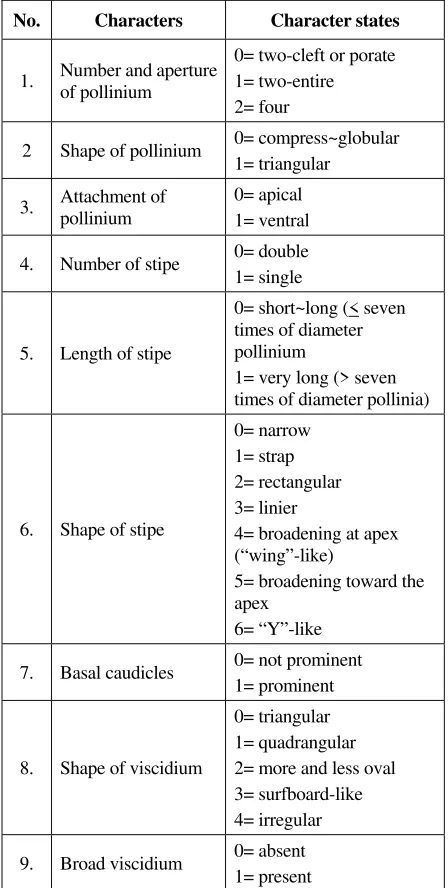
As found in some orchid groups, e.g., subtribe Oncidiinae (Chase 1987), a substantial diversity of the pollinia (p); the caudicle (c), thread connecting between the pollinia and the apex of the stipe; a cellular stipe (s), thread connecting between the caudicle and viscidium; and a sticky viscidium (v), viscid plate adhering to the pollen vector (Fig. 1-A) was observed in subtribe Aeridinae. In this study, we found some typical features of pollinarium structure in subtribe Aeridinae; the stipe is flattened of variable width and length and the pollinia orientation when four is typically superposed, the pairs of pollinia are stacked one on another. Characterization and scoring were made for each character state and were summarized in Table 2.
Pollinium- In their molecular phylogenetic study, Topik et al., (2005) suggested the ancestral condition of two pollinia in subtribe Aeridinae. Most genera studied have either compressed or globular pollinia. Only a single genus, Thrixspermum (Fig. 1-H), has peculiar pollinia shape, triangular. Phalaenopsis (Fig. 1-D), Doritis, and Lesliea have pollinia that ventrally attach to the stipe.
Stipe- Subtribes Angraecinae and Aerangidinae, the outgroups of our study, have diversed shape of stipe. Predominantly, they have a separate double stipe, of which each part is either attached to a separate viscidium (e.g., Angraecum; Fig. 1-J) or share a common viscidium (e.g., Podangis; Fig. 1-K), but a few have a single stipe (e.g., Calyptrochilum; Fig. 1-I). In contrast, the stipe of subtribe Aeridinae is always single with great diversity in shape. For example, Cleisomeria (Fig. 1-F) has a “Y”-like stipe whereas Malleola (Fig. 1-C) has a “wing”-like stipe.
Length of stipe within subtribe Aeridinae varies very much. We scored very long stipe (> seven times longer than the diameter of pollinia) (e.g., Micropera; Fig. 1-G) to be the derived state due to the fact that no outgroup taxa demonstrates this state.
The stipe shape varies from strap-like (e.g., Brachypeza; Fig. 1-A), linier (e.g., Micropera; Fig. 1-G), to very broad (e.g., Pelatantheria; Fig. 1-B). Chase (1987) used this character as a major feature to infer the affinity of subtribe Oncidiinae.
Caudicle- The caudicle facilitates pollinia to
divide into each pollinium (Rasmussen 1986). Freudenstein and Rasmussen (1999) showed that the caudicle is one of important states for orchid relationships. The prominent state seems to be stable in a few genera examined such as Brachypeza (Fig. 1-A).
Table 2. Pollinarium characters and polarization characters.
No. Characters Character states
1. Number and aperture of pollinium
0= two-cleft or porate 1= two-entire 2= four
2 Shape of pollinium 0= compress~globular 1= triangular
0= short~long (< seven times of diameter pollinium
1= very long (> seven times of diameter pollinia)
6. Shape of stipe
0= narrow 1= strap 2= rectangular 3= linier
4= broadening at apex (“wing”-like)
5= broadening toward the apex
6= “Y”-like 7. Basal caudicles 0= not prominent
1= prominent
very broad viscidium was found in several genera such as Schoenorchis (Fig. 1-E).
Tree topology
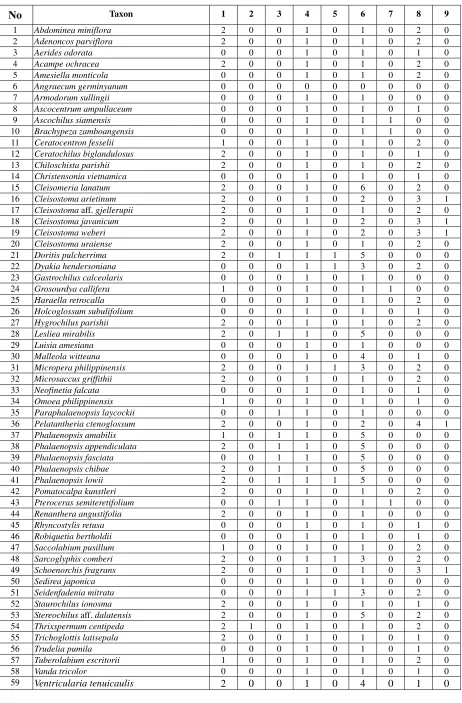
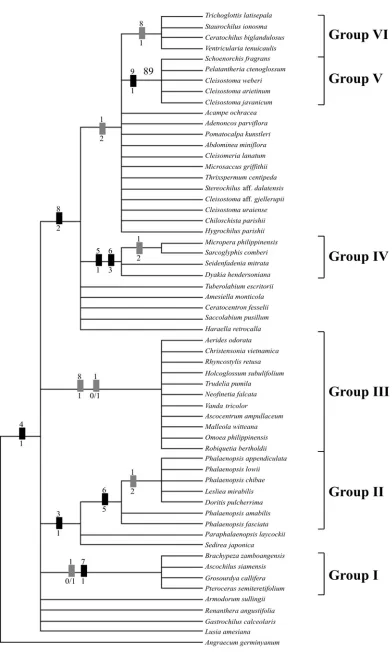
102,5 MPTs, with length= 25 steps, CI= 0.80, and RI= 0.89 were generated from the analysis of nine characters and 59 taxa (Table 3). The tree shown in Fig.2 is strict consensus of the 1025 MPTs. Although the tree is not well resolved as deduced by the low bootstrap percentages (BP<50) in most clades, six groups are recognized. All the ingroup taxa share an apomorhicstates, a single stipe. Group I includes Ascochilus, Brachypeza, Grosourdya, and Pteroceras, which is defined by the prominent basal caudicle, strap-like stipe, and two pollinia.
Phalaenopsis, Doritis, and Lesliea make up group II, characterized by the ventral attachment of pollinia to the apex of stipe and broadening stipe toward the apex. Group III has a quadrangular viscidium, two pollinia, and a strap-like stipe, comprising Robiquetia, Omoea, Maleolla, Aerides, Holcoglossum, Ascocentrum, Christensonia, Neofinetia, Rhyncostylis, Vanda, and Trudelia.
Pollinarium morphology in all of the members of group IV is defined by the linier, very long stipe. Oval viscidium characterizes Micropera, Sarcoglyphis, and Dyakia, whereas Seidenfandenia has quadrangular viscidium.
Placement of three sampled species of Cleisostoma, namely, C. weberi, C. arietinum, and C. javanicum, suggests a close relationship to Schoenorchis and Pelatantheria (group V), because they all have a very broad viscidium; viscidium shape is either surfbroad-like or irregular. Group VI comprises Trichoglottis, Staurochilus, Ceratochilus, and Ventricularia, all of which share a quadrangular viscidium and four pollinia.
DISCUSSION
Characteristics of morphological data
In cladistic analyses of morphological data, support values such as bootstrapping (Felsenstein, 1985), Bremer support (Bremer, 1988), and jackknifing (Farris, 1996) are often much lower than those in cladistic analyses of molecular data. Many groups are only supported by a few characters, simply because the ratio of characters to taxa is small and many of these characters are
homoplasious (Freudenstein and Rasmussen 1999). In these cases, support indices become less important to evaluate the robustness of each clade. In this study only group V had bootstrap percentages more than 50 (Fig. 2).
Intergeneric relationships
Pollinarium morphology has provided valuable source of characters to evaluate hypothesis of relationships within subtribe Aeridinae. Although the number of character found here is somewhat meager (only nine characters), pollinarium analysis has added another features from which such systematic information may be derived. Smith (1934) noticed that the shape of stipes and viscidium could be useful characters in determining major systematic groups in subtribe Aeridinae.
In accordance with the results of molecular phylogenetic analysis based on matK and ITS regions (Topik et al., 2005), the results of pollinarium analysis (Fig. 2) supported the monophyly of subtribe Aeridinae. Moreover, five of the six groups recognized in the pollinarium analysis agree with groups resulted in molecular phylogenetic analysis (Topik et al., 2005). Group I, consisting of Brachypeza, Ascochilus, Pteroceras, and Grosourdya, is considerably appeared to be a monophyletic group because this group has a synapomorphic state, the prominent basal caudicle.
Several genera recognized as Phalaenopsis alliance in molecular analyses (Topik et al., 2005) have pollinia attached ventrally to the broadening stipe toward the apex. Moreover, we confirmed that genus Phalaenopsis is non-monophyletic group as has been reported in previous study (Topik et al., 2005). As depicted in Fig. 2, within this group, species of Phalaenopsis is split according to their pollinium number: one is with two pollinia and the other is with four pollinia. According recent study of molecular phylogenetic of Phalaenopsis and allied genera (see detail in Yukawa et al., 2005), the latter has been transferred to the genus Doritis. Most members of the Aerides alliance examined here: Aerides, Holcoglossum, Ascocentrum, Christensonia, Neofinetia, Rhyncostylis, Vanda, and Trudelia merged in group III, by the quadrangular viscidium and long stipe (< seven times longer than the diameter of pollinium). Further, some of the traditional character states have defined this group. These character states include a long leafy stem, a stout column, and a broad epichile of the
lip (Christenson 1987, 1994). An exception is
2006] HIDAYAT et.al.: Evolutionary analysis of pollinaria morphology 229
Table 3. Data matrix for the cladistic analysis. Character numbers as in Table 2.
No Taxon 1 2 3 4 5 6 7 8 9
1 Abdominea miniflora 2 0 0 1 0 1 0 2 0
2 Adenoncos parviflora 2 0 0 1 0 1 0 2 0
3 Aerides odorata 0 0 0 1 0 1 0 1 0
4 Acampe ochracea 2 0 0 1 0 1 0 2 0
5 Amesiella monticola 0 0 0 1 0 1 0 2 0
6 Angraecum germinyanum 0 0 0 0 0 0 0 0 0
7 Armodorum sullingii 0 0 0 1 0 1 0 0 0
8 Ascocentrum ampullaceum 0 0 0 1 0 1 0 1 0
9 Ascochilus siamensis 0 0 0 1 0 1 1 0 0
10 Brachypeza zamboangensis 0 0 0 1 0 1 1 0 0
11 Ceratocentron fesselii 1 0 0 1 0 1 0 2 0
12 Ceratochilus biglandulosus 2 0 0 1 0 1 0 1 0
13 Chiloschista parishii 2 0 0 1 0 1 0 2 0
14 Christensonia vietnamica 0 0 0 1 0 1 0 1 0
15 Cleisomeria lanatum 2 0 0 1 0 6 0 2 0
16 Cleisostoma arietinum 2 0 0 1 0 2 0 3 1
17 Cleisostoma aff. gjellerupii 2 0 0 1 0 1 0 2 0
18 Cleisostoma javanicum 2 0 0 1 0 2 0 3 1
19 Cleisostoma weberi 2 0 0 1 0 2 0 3 1
20 Cleisostoma uraiense 2 0 0 1 0 1 0 2 0
21 Doritis pulcherrima 2 0 1 1 1 5 0 0 0
22 Dyakia hendersoniana 0 0 0 1 1 3 0 2 0
23 Gastrochilus calceolaris 0 0 0 1 0 1 0 0 0
24 Grosourdya callifera 1 0 0 1 0 1 1 0 0
25 Haraella retrocalla 0 0 0 1 0 1 0 2 0
26 Holcoglossum subulifolium 0 0 0 1 0 1 0 1 0
27 Hygrochilus parishii 2 0 0 1 0 1 0 2 0
28 Lesliea mirabilis 2 0 1 1 0 5 0 0 0
29 Luisia amesiana 0 0 0 1 0 1 0 0 0
30 Malleola witteana 0 0 0 1 0 4 0 1 0
31 Micropera philippinensis 2 0 0 1 1 3 0 2 0
32 Microsaccus griffithii 2 0 0 1 0 1 0 2 0
33 Neofinetia falcata 0 0 0 1 0 1 0 1 0
34 Omoea philippinensis 1 0 0 1 0 1 0 1 0
35 Paraphalaenopsis laycockii 0 0 1 1 0 1 0 0 0
36 Pelatantheria ctenoglossum 2 0 0 1 0 2 0 4 1
37 Phalaenopsis amabilis 1 0 1 1 0 5 0 0 0
38 Phalaenopsis appendiculata 2 0 1 1 0 5 0 0 0
39 Phalaenopsis fasciata 0 0 1 1 0 5 0 0 0
40 Phalaenopsis chibae 2 0 1 1 0 5 0 0 0
41 Phalaenopsis lowii 2 0 1 1 1 5 0 0 0
42 Pomatocalpa kunstleri 2 0 0 1 0 1 0 2 0
43 Pteroceras semiteretifolium 0 0 1 1 0 1 1 0 0
44 Renanthera angustifolia 2 0 0 1 0 1 0 0 0
45 Rhyncostylis retusa 0 0 0 1 0 1 0 1 0
46 Robiquetia bertholdii 0 0 0 1 0 1 0 1 0
47 Saccolabium pusillum 1 0 0 1 0 1 0 2 0
48 Sarcoglyphis comberi 2 0 0 1 1 3 0 2 0
49 Schoenorchis fragrans 2 0 0 1 0 1 0 3 1
50 Sedirea japonica 0 0 0 1 0 1 0 0 0
51 Seidenfadenia mitrata 0 0 0 1 1 3 0 2 0
52 Staurochilus ionosma 2 0 0 1 0 1 0 1 0
53 Stereochilus aff. dalatensis 2 0 0 1 0 5 0 2 0
54 Thrixspermum centipeda 2 1 0 1 0 1 0 2 0
55 Trichoglottis latisepala 2 0 0 1 0 1 0 1 0
56 Trudelia pumila 0 0 0 1 0 1 0 1 0
57 Tuberolabium escritorii 1 0 0 1 0 1 0 2 0
58 Vanda tricolor 0 0 0 1 0 1 0 1 0
2006] HIDAYAT et.al.: Evolutionary analysis of pollinaria morphology 231
2006] HIDAYAT et.al.: Evolutionary analysis of pollinaria morphology 233
The grouping of Dyakia, Sarcoglyphis, Seidenfadenia, and Micropera (group IV) provides insight into affinities among them. They are united by very long stipe. Molecular phylogenetic analyses showed that these four genera have polyphyletic relationships (Topik et al., 2005).
Heterogeneity of a large, complex genus Cleisostoma recognized by molecular tree (Topik et al., 2005) has been confirmed in the present study. Three sampled species of Cleisostoma (C. weberi, C. javanicum, and C. arietinum), Pelatantheria and Schoenorchis are united (group V) by a unique synapomorphic state, broad viscidium with either irregular or surfboard-like in shape. The remaining two sampled species of Cleisostoma (C. gjellerupii and C. uraiense) are scattered in the tree.
As found in our molecular analysis (Topik et al., 2005), Trichoglottis alliance contains Trichoglottis, Ceratochilus, Staurochilus, and Ventricularia, and that this group also share a morphological character, raising tongue across the spur from the column base to the spur base (Seidenfaden, 1988). A pollinarium character state, quadrangular viscidium, is further support this grouping.
Evolution of stipe and viscidium
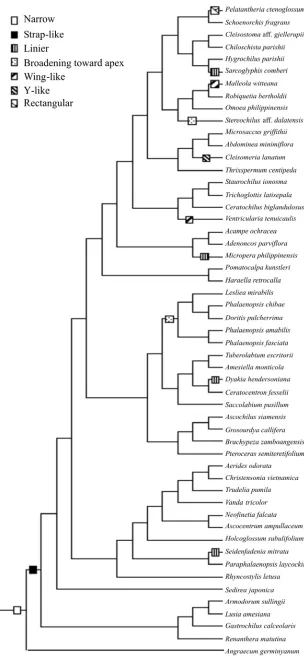
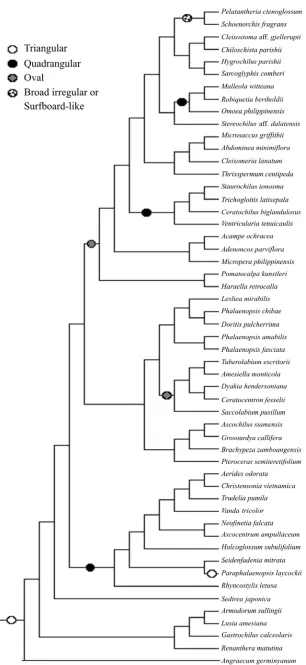
The significance of stipe and viscidium characters has been received much attention in orchid taxonomy for a long time (e.g., Williams 1970a, 1970b, 1972; Chase 1987). Since this study showed that the shape of stipe and viscidium varies greatly in subtribe Aeridinae, we tested the evolutionary trend of these characters. Using MacClade 3.05 under accelerated character transformation (ACCTRAN) optimization, we thus mapped the character states of stipe and viscidium shape onto one tree derived from molecular data (Topik et al., 2005).
As shown in Fig. 3, seven states of stipe shape were recognized in the subtribe in which the narrow stipe is the ancestral state. The strap-like stipe that appeared once is likely an intermediate form from which other derived states are evolved. While the linier stipe likely evolved four times, the wing-like and broadening toward the apex stipes probably appeared two times. The rectangular and “Y”-like stipes occurred once. The viscidium shape, on the other hand, comprises four states in which the triangular shape represents the plesiomorphic state (Fig. 4). The quadrangular and oval viscidiums were shown to evolve three times and twice respectively, whereas the broad irregular or surfboard-like viscidium appeared once. On the other hand, reversal occurred once from the quadrangular to the triangular viscidiums. These facts indicated that changes of states both in stipe
and viscidium shapes occurred repeatedly in subtribe Aeridinae as many other similar evolutionary events are found in Orchidaceae.
Pollinarium versus pollinators
Relationships between the diversity of pollinarium morphology in subtribe Aeridinae and their pollinators still remain unresolved. Pollinia characters are not likely to be correlated with particular classes of pollinators as the hard pollinium cannot be used as food by pollinators. Besides, pollinia are enclosed within an anther cap so that not visible by pollinators; color and shape of pollinia are not related to pollinators preferences. It seems logical to suppose that there is no direct relationship between pollinium characters and pollinators in subtribe Aeridinae. However, there is an assumption that the diversity of pollinarium structure could be stimulated under the influence of evolutionary interactions between flowers and pollinators (Cozzolino et al., 2001).
It is well known that morphological characters of stipe and viscidium are directly related with functions in pollination (Dressler 1981, 1993). The stipe plays a role in determining efficiency of pollination in which, if long, the pollinia are relatively easy to reach stigma to initiate pollination. Viscidium is functioned in transportation of the pollinia from one flower to another via a pollinator as “vehicle” to which it is attached. Consequently, its shape (and size as well) seems likely to be a factor in mechanism of attachment to the pollinator’s body either the head or the trunk. Accordingly, with having of a broad viscidium enable plant prone to attach to the pollinator’s body and lead to an increased probability of pollination, or the reverse. The diversity of stipe and viscidium found in this study, therefore, indicate diversity of evolutionary interactions between flowers and pollinators in the subtribe, which would then promote diversity of pollinarium structure as a whole.
CONCLUSION
Cleisostoma and Phalaenopsis indicated by molecular characters. Although transformation of the stipe and viscidium shapes in the subtribe is subjected to parallelism, the results showed that these characters are much useful in determining relationships in the subtribe than those of pollinium (number and aperture) as indicated by our previous molecular analyses (Topik et al., 2005). Further cladistic analysis through rigorously examining more characters of pollinarium morphology and utilizing more taxon intensities will improve the results and reveal more reliable hypothesis on relationships of subtribe Aeridinae. Outputs from pollination biology of the group are much needed to understand the character evolution of the pollinarium.
ACKNOWLEDGEMENT
The authors are much indebted to Kazuhiro Suzuki for skilful cultivation of the plants. This study was partly supported by a Grant-in-Aid for Scientific Research from JSPS (MI).
REFERENCES
ACKERMAN, J.D.; WILLIAMS, N.H. 1980. Pollen morphology of the tribe Neottieae and its impact on the classification of the Orchidaceae. Grana 19:7-18.
ACKERMAN, J.D.; WILLIAMS, N.H. 1981. Pollen morphology of the Chloraeinae (Orchidaceae: Diurideae) and related subtribes. Am. J. Bot. 68:1392-1402.
BREMER, K. 1988. The limit of amino acid sequence data in angiosperm phylogenetic reconstruction. Evolution 42:795-803.
BROWN, R. 1810. Prodromus flora Nova Hollandia et insula Van-Diemen. J. Johnson, London.
CHASE, M.W. 1987. Systematic implications of pollinarium morphology in Oncidium SW., Odontoglossum Kunth and allied genera (Orchidaceae). Lindleyana 2:8-28.
CHASE, M.W. 2005. Classification of Orchidaceae in the age of DNA data. Curtis’s Bot Mag 1:2-7. CHRISTENSON, E.A. 1987. The taxonomy of Aerides
and related genera. Proc of the 12th World Orchid Conference, Tokyo, Japan.
CHRISTENSON, E.A. 1994. Taxonomy of the Aeridinae with an infrageneric classification of Vanda Jones ex R.B. Proc of the 14th World Orchid Conference. HMSO Publications, London. COZZOLINO, S.; ACETO, S.; CAPUTOP;WIDMER,
A; DAFNI, A. 2001. Speciation processes in Eastern Mediterranean Orchis s.l. species:
molecular evidence and the role of pollination biology. Israel J Plant Sci 49:91-103..
DRESSLER, R.L. 1993. Phylogeny and classification of the orchid family. Dioscorides Press, Portland, Oregon, USA.
FARRIS, J.S.; ALBERT, A; KALLERSJO, M; LIPSCOMB, D; KLUGE, A.G. 1996. Parsimony jackknifing outperforms neighbor-joining. Cladistics 12:99-124.
FELSENSTEIN, J. 1985. Confidence limit on phylogenies: an approach using the bootstrap. Evolution 39:783-791
FITCH, W.M. 1971. Toward defining the course of evolution: minimum change for a specific tree topology. Syst Zool. 20:406-416.
FREUDENSTEIN, J.V. 1991. A systematic study of endothecial thickenings in the Orchidaceae. Am. .J Bot. 78:766-781.
FREUDENSTEIN, J.V. 1994. Gynostemium structure and relationships of the Corallorhizinae (Orchidaeceae: Epidendroideae). Plant Syst. Evol. 193:1-19.
FREUDENSTEIN, J.V.; RASMUSSEN, F.N. 1996. Pollinium development and number in the Orchidaceae. Am. J. Bot. 83:813-824
FREUDENSTEIN, J.V.; RASMUSSEN, F.N. 1999. What does morphology tell us about orchid relationships? A cladistic analysis. Am. J. Bot. 86:225-248
GARAY, L.A. 1972. On the systematics of the monopodial orchids I. Bot Mus Leaflets of Harvard University 23:149-212.
GRAVENDEEL, B. 2000. Reorganizing the orchid genus Coelogyne: A phylogenetic classification based on morphology and molecules. National Herbarium Nederland, Universiteit Leiden branch, Nederland
HOLTTUM, R.E. 1958. Evolutionary trends in the Sarcanthine orchids. Proc of the Second World Orchid Conference. Harvard University Printing Office, Cambridge, Massachusetts, USA
JARRELL, D.C.; CLEGG, M.T. 1995. Systematic implications of the chloroplast-encoded matK gene on the tribe Vandeae (Orchidaceae). Am. J. Bot. 82 (Supplement):137.
LINDLEY, J. 1826. Orchidearum sceletos. Richard Taylor, London.
RASMUSSEN, F.N. 1986. Ontogeny and phylogeny in the Orchidaceae. Lindleyana 2:114-124
SCHILL, R.; WOLTER, M. 1986. On the presence of elastoviscin in all subfamilies of the Orchidaceae and the homology to pollenkitt. Nordic J. Bot. 6:321-324
2006] HIDAYAT et.al.: Evolutionary analysis of pollinaria morphology 235
SEIDENFADEN, G. 1988. Orchid genera in Thailand XIV: Fifty-nine vandoid genera. Opera Botanica 95:1-357.
SENGHAS, K. 1988. Eine neue Gliederung der subtribus Aeridinae (= Sarcanthinae). Die Orchidee 39(6):219-223.
SMITH, J.J. 1934. Artificial key to the orchid genera of the Netherlands Indies, together with those of New Guinea, the Malay Peninsula and the Philippines. Blumea I:194-215
SWOFFORD, D.L. 1998. PAUP*4.0b10. Phylogenetic analysis using parsimony (*and other methods). Version 4. Sinauer Associates, Sunderland, Massachussets, USA
SZLACHETKO, D.L. 2003. Gynostemia Orchidalium III. Acta Botanica Fennica 176:1-311
TOPIK, H.; YUKAWA, T.; ITO, M. 2005. Molecular phylogenetics of subtribe Aeridinae (Orchidaceae): insight from plastid matK and nuclear ribosomal ITS sequences. J. Plant Res. 18:271-184
VAN DEN BERG, C; GOLDMAN, D.H; FREUDENSTEIN, J.V; PRIDGEON, A.M;
CAMERON, K.M; CHASE, M.W. 2005. An overview of the phylogenetic relationships within Epidendroideae inferred from multiple DNA regions and recircumscription of Epidendreae and Arethuseae (Orchidaceae). Am. J. Bot. 92: 613-624
WILLIAM, N.H. 1970a. Some observations on pollinaria in the Oncidiinae. Am. Orchid Soc. Bull. 39: 32-43
WILLIAM, N.H. 1970b. Some observations on pollinaria in the Oncidiinae-II. Am. Orchid Soc. Bull. 39:207-220
WILLIAM, N.H. 1972. Additional studies on pollinaria in the Oncidiinae. Am. Orchid Soc. Bull. 41: 222-230
YUKAWA, T; KITA, K; HANDA,T; TOPIK, H; ITO, M. 2005. Molecular phylogenetics of Phalaenopsis (Orchidaceae) and allied genera: Re-evaluation of generic concept. Acta Phytotax. et Geobot. 56: 141-162
aligned-couplet type.
Manuscripts intended for publication in Reinwardtia should be written either in English,
French or German, and represent articles which have not been published in any other journal or proceedings. Each manuscript received will be considered and processed further if it is accompanied by signed statements given independently by two reviewers chosen by the author(s) attesting to its merits as well as its scientific suitability for publication in Reinwardtia.
Two printed copies (on A4 paper) of the manuscript of not more than 200 pages should be sent to Editors, together with an electronic copy prepared on Word Processor computer programme using Times New Romance letter type and saved as Rich Text File must be submitted.
For the style of presentation authors should follow the latest issue of Reinwardtia very closely. Title of the article should be followed by author's name and mailing address and a one-paragraphed abstract in English (with French or German abstract for papers in French or German) of not more than 250 words. Keywords should be given below each abstract. On a separate paper author(s) should prepare the preferred running title of the article submitted.
Strict adherence to the International Code of Botanical Nomenclature is observed, so that taxonomic and nomenclatural novelties should be clearly shown, Latin description for new taxon proposed should be provided, and the herbaria where type specimens are deposited should be indicated. Synonyms should be presented in the long form [name of taxon, author's name, year of publication, abbreviated journal or book title, volume (number): [page].
Maps, line drawing illustrations or photographs preferably should be prepared in landscape presentation to occupy two columns. Illustrations must be submitted as original art accompanying, but separate from, the manuscripts. On electronic copy, the illustrations should be saved in .jpg or .gif format. Legends for illustrations must be submitted separately at the end of the manuscript.
Bibliography, list of literature cited or references follow the Harvard System.
ISSN 0034 - 365 X
REINWARDTIA
Vol. 12. No. 3. 2006CONTENTS
Page
BENITO C. TAN, BOON-CHUAN HO, VIRGILIO LINK, EKA A.P. ISKANDAR, IPAH NURHASANAH, LIA DAMAYANTI, SRI MULYATI and IDA HAERIDA.
Mosses of Gunung Halimun National Park, West Java, Indonesia ,.... 205
S. DEWI. Stachylidium pallidum Dewi sp. nov. from Java 215
W.J.J.O. DE WILDE, B.E.E. DUYFJES and R.W.J.M. VAN DER HAM. Anangia,
a new monotypic genus of Cucurbitaceae from East Mollucas 219
TOPIK HIDAYAT, TOMOHISA YUKAWA and MOTOMIITO. Evolutionary analysis
of pollinaria morphology of subtnbe Aeridinae (Orchidaceae) 223
DOLLY PRIATNA, KUSWATA KARTAWINATA and ROCHADI ABDULHADI. Recovery of a lowland dipterocarp forest twenty two years after selective logging at
Sekundur, Gunung Leuser National Park, North Sumatra, Indonesia 237
MARTHEN T. LASUT. A new species of Ischaemum from Sulawesi 257
HERBARIUM BOGORIENSE BIDANG BOTANI