VOLUME 26 No. 3 Oktober 2014 Halaman 315-327
* English Department, Faculty of Letters, Jember University
TOPIC DEVELOPMENT AND THEMATIC PATTERNS
FOR THE INDONESIAN TEXT OF FRIDAY SERMONS
Sukarno*
ABSTRAK
Artikel ini merupakan sebagian dari hasil penelitian yang dilakukan di kota Jember, Jawa Timur, tentang metafungsi, register, dan struktur generik teks khotbah Jumat. Fokus artikel ini adalah teknik pengembangan topik melalui tematisasi (penataan tema) yang merupakan salah satu realisasi makna tekstual. Data penelitian dikumpulkan dengan merekam tuturan empat khatib pada empat masjid di kota Jember pada bulan Januari, Februari, dan September 2012 melalui observasi partisipasi. Data lisan, kemudian, ditranskrip ke dalam teks tulis yang disebut teks khotbah Jumat (TKJ). Selanjutnya, data tersebut didekonstruksi untuk mengkaji pengembangan topik pada tataran klausa kompleks, tataran paragraf, dan tataran teks. Hasil penelitian ini menunjukkan bahwa pengembangan topik pada tataran klausa kompleks dilakukan melalui tiga pola tematisasi, yakni: Pola 1: Tema-Tema, Pola 2: Tema-Rema-Tema, dan pola 3: Tema-Tema-Rema-Tema, sedangkan pengembangan topik pada tataran paragraf dilakukan utamanya dengan metode deduktif atau penempatan Hiper-tema di awal paragraf. Pada tataran teks, topik bahasan dikembangkan melalui penataan Makro-tema dan Makro-rema dengan pola Makro-tema berposisi di bagian awal teks; pada paragraf pertama (TKJ 3), paragraf kedua (TKJ 1 dan 4) dan paragraf ketiga (TKJ 2) . Di samping sebagai perangkat pengembangan topik bahasan, tematisasi juga berkontribusi pada kepaduan teks.
Kata Kunci: hiper-rema, hiper-tema, makro-rema, makro-tema, pola tematisasi, tema-rema
ABSTRACT
INTRODUCTION
Researches on Friday sermons have been conducted by many scholars from many different perspectives. Ma’aruf (1999) and Saddhono (2012) examined the kinds and functions of codes used in Friday sermons in Yogyakarta and in Surakarta respectively. Soepriatmadji (2009) looked at the genre analysis on English Friday sermons prepared by the Islamic Religious Council of Singapore. Sukarno (2013) investigated the persuasive rethorics to persuade the jamaah (congregation) by khatib (preacher) in Friday sermon texts in Jember, and Nitiasih (2007) examined the directive speech acts in Islamic sermon texts.
As a religious text, a Friday sermon always contains a certain topic or information which should be delivered to jamaah (the Friday sermon participants, or congregation) since the main purpose of presenting Friday sermons is to disseminate the divine truths, which are from Quran, and hadiths to convey the rights and responsibilities of Islam followers in respect to religious, social, economic, even political affairs (Soepriatmadji, 2009:171). To achieve the purpose, the topic of discussion needs to be organized in such way, so the message can be put into a well-formed text. One way of organizing the information which is commonly used by the speaker is using Theme-Rheme organization (Gonzalez-Gomez, 1984:1; Suparno, 1993:18). In relation to the topic development, Sukesti (2011) examined the information organization of Theme-Rheme in Ngoko Javanese of Banyumas dialect. According to Sukesti (2011:219), there are three aspects of information organization; they are information status, information urgency, and information structure. From the three aspects of information organization, information structure plays an important role because information structure of the topic of discussion directly deals with how the
speakers need to keep their listeners well informed about the information, e.g. where they are starting and where they are going (Butt et al, 1995:88).
Following Systemic Functional Linguistics (SFL), every clause is organized as a message to an unfolding text which consists of Theme and
Rheme (Halliday and Matthiessen, 2004:64-65; Eggins, 1994:273). Theme is the starting point in a clause which tells the listener(s) what the speaker has in mind (Halliday, 1985:39), it is what the clause is going to be about (Eggins, 1994:275). Therefore, Theme needs to be further developed. Rheme is the element after the Theme which further develops the Theme (Martin et al, 1997:21; Eggins 1994:275). The clause as a message is thus organized into Theme + Rheme. In other words, Theme is equal with something that will be discussed (old information), and Rheme is the explanation of the Theme (new information) (Vachek, 1996:89).
In SFL, the term clause is classified at least into: independent clause, dependent clause, and clause complex (But et al, 1995:108-110). An independent clause is always finite, containing Subject and a verbal group with a finite element (except where the Mood of the verb is imperative), and its meaning is complete by itself. In contrast, a dependent clause is a clause which cannot stand alone, but functions to provide some kind of supportive information for other clauses. Finally, a clause complex is an independent clause which may be linked with other independent clauses, with dependent clauses, or with various combinations of both (But et al, 1995:108; Martin et al, 1997:165-166). In traditional grammar, a clause complex corresponds to a simple sentence, to a compound sentence, to a complex sentence, or to a compound-complex sentence. In relation with the topic development, thematic patterns can occur in a clause complex, in a paragraph, and in a text as a
the third paragraph (FST 2). In addition to be the device for developing the topics, thematic patterns also contribute to build a coherent text.
whole (Halliday and Matthiessen, 2004:98-105; Sinar, 2002:21). In addition, thematic patterns can also be used as a device to organize any text into a coherent whole (Butt, et al, 1995:88).
The data of this research were collected by recording the Friday sermons conducted in four different mosques in Jember city, East Java in 2012. The first text was delivered by Drs. Yusuf Ridwan, M.Pd on January 6th in Mifthachul Jannah mosque,
the next text was carried out by Dr. Hairus Salikin, M. Ed. on February the 3rd in Al-Hikmah mosque,
the third text was spoken by Drs. Hadiri, M.A. on September the 7th in Attaqwa mosque, and the final
text was presented by Drs. H. Supardi, M.Hum on September the 28th in Al-Huda mosque. The
recorded data were transcribed into written texts named Friday sermon Texts (FSTs). In the analysis, FSTs are named as FST 1, FST 2, FST 3, and FST 4 respectively. If needed, each FST is accompanied by a slash and a number to show the source of the data, for example the symbol FST 1/2 shows that the quotation is taken from FST 1, clause complex 2. Next, the analysis was conducted by deconstructing the Indonesian texts for the Friday sermons into smaller parts (paragraphs, and clause complexes), and by investigating the patterns of the Theme-Rheme relationship in the clause levels, the patterns of hyper-Theme and hyper-Rheme in the paragraph level, and the patterns of macro-Theme and macro-Rheme in a text (Sinar, 2002:21). The goal of this study is to find the thematic patterns as a device to develop topics for the Indonesian texts for Friday sermons.
TYPES OF THEMES
In relation with their meanings, themes can be subdivided into three types, namely: topical Theme, interpersonal Theme, and textual Theme (Halliday, 1994:38; Butt et al, 1995:90-94; Thompson, 2004:142). Topical Theme refers to the first group or phrase which is relevant to the experiential meaning (eg. Participant, Process, or Circumstance) in a clause. Interpersonal Theme deals with the interpersonal meaning (e.g. vocative),
whereas textual Theme concerns with the textual meaning (for instance conjunctions). Since Theme is a beginning part of a clause, it can be identified by looking at the function of the first group part of a clause, whether it functions as experiential meaning (topical theme), interpersonal meaning (interpersonal theme), or textual meaning (textual theme) (Butt et al, 1995:90-92). Therefore, it is also possible in a clause that something precedes the topical Theme, such as textual or interpersonal elements which are also parts of different Themes: interpersonal and textual Themes. In short, a clause may have one Theme (which is always a topical Theme) or more than one Theme which is called a multiple Theme (Thompson, 2004:158-159) as demonstrated by the data below.
(1a)
Allah selalu memberikan hidayah, dan inayahnya kepada kita. (always gives us His guidance, and help)
Theme Rheme
(1b)
Mudah-mudahan (Hopefully)
Allah selalu memberikan hidayah, dan inayah kepada kita. (always gives us His guidance, and help)
Interpersonal Topical
Rheme Theme
(1c)
Oleh karena itu, (Therefore,)
semoga (hopefully)
Allah selalu memberikan hidayah, dan inayah kepada kita. (always gives us His guidance, and help)
Textual Interpersonal Topical
Rheme Theme
Therefore, it must be the topical Theme. The term ‘topical’ is not necessarily to be stated since this is the only Theme in the clause (a single Theme). In data (1b), the topical Theme is preceded by an interpersonal element, which also functions as Theme. That is why; the clause has two Themes: the interpersonal Theme, and the topical Theme. And, finally data (1c) indicates that the topical Theme is preceded by textual and interpersonal elements. So, the clause has three Themes: textual, interpersonal, and topical Themes. As the study of the article is the topic development, the relevant Theme discussed in this study is topical Theme.
TOPIC DEVELOPMENT AND THEMATIC PATTERNS
To organize any text into coherent whole, writers and speakers need to keep their readers and listeners well informed about the structure of the text in presenting what the speaker or writer has in mind (the topic) and developing it. In SFL, the topic development occurs through clause complexes, paragraphs, and a text as whole (Butt et al, 1995:88). In other words, the topic development can be done in the clause complex level, in the paragraph level, and in the text level. In the clause complex level, each topic can be developed based on the relationship between one clause (complex) to another. In the paragraph level, the topic development can be conducted by the relation among clause complexes in the paragraph, in which one of them functions as a Hyper-theme, while the others as Hyper-rhemes to further explain the Hyper-theme. And in the text level, the main paragraph as the Macro-theme is developed by the other paragraphs as the Macro-rhemes. Textually, the Theme-Rheme organizations (thematic patterns) realize the information organization in clause complexes; in turn they also contribute to the information structures in the paragraphs, and finally in the text as a whole. The topic development using thematic patterns in each scale of language units (clause complexes, paragraphs, and texts) of FSTs is the main concern of this article.
THE TOPIC DEVELOPMENT IN CLAUSE COMPLEXES
As stated above, the first part of a clause serves as the point of departure of the message, and this function is called Theme. The remainder of the message, the part which develops the Theme is called Rheme. Because addresses or readers need to be reassured that they are following the development of the topics, many texts are signposted by placing elements from Rheme of one clause into the Theme of the next, or by repeating meaning from the Theme of one clause in the Theme of subsequent clauses (Butt et al, 1995:96). In other words, the structures of the Theme-Rhemes in clause complexes are often organized in a repeated way or reiteration (Eggins, 1994:303). Following this theory, the regular ways of structuring Rheme may produce Theme-Rheme (thematic) patterns.
Through this research, it is found three thematic patterns for developing the topics in the clause complex level. The first thematic pattern (Thematic Pattern 1) found in FSTs is that a Theme of a clause becomes the Theme of the following clause either happening in one clause complex or in two or more clause complexes. Therefore, Pattern 1 has the following Theme structure: Theme-Theme. It also means that the topical Theme of a clause is developed from the topical Theme of the previous one. Figure 1 presents this thematic pattern.
Figure 1
Thematic Pattern 1: Theme-Theme
Theme of Clause (complex) 1 Rheme of clause (complex) 1
Theme of Clause (complex) 2 Rheme of clause (complex) 2
Theme of Clause (complex) 3 Rheme of clause (complex) 3
(2) Memang orang yang sudah berani menunda-nunda bertaubat berarti (Theme) (Rheme)
ia mengira
(Theme) (Rheme)
bahwa dirinya akan hidup kekal di dunia ini. (FST 3/9)
(Theme) (Rheme)
(Actually, someone who has dared to cancel to regret thinks that he will live in the world forever)
(3) Marilah lima sampai sepuluh menit ke depan, kita
luruskan niat kita untuk beribadah semata-mata karena Allah. (FST 2/1)
(Theme) (Rheme)
Kita hadapkan diri kita kepada
Allah untuk merenungkan kekurangan-kekurangan diri kita selama 24 jam. (FST 2/2)
(Theme) (Rheme)
Kemudian, kita bertekad untuk 24 jam berikutnya kita berusaha akan memperbaikinya. (FST 2/3)
(Theme) (Rheme)
(In five to ten minutes, let us concentrate to pray merely for Allah. We face ourselves to Allah for doing self-evaluation during 24 hours. Then, we determine to improve it in the 24 hours later)
(4) Tak seorang pun tahu berapa lama lagi jatuh waktu pentasnya di dunia akan berakhir. (FST 4/12)
(Theme) (Rheme)
Sebagaimana tak seorang pun
tahu di mana kematian akan menjemputnya. (FST 4/13)
(Theme) (Rheme)
Ketika seseorang melalaikan nilai waktu pada hakekatnya, ia sedang menggiring dirinya pada jurang kebinasaan. (FST 4/14)
(Theme) (Rheme)
(Nobody knows how long his life time quota in the world will end. Similarly, nobody knows where the death will meet him. Once someone neglects the value of time, it means that he is directing himself into a destruction)
In data (2), the topic is developed by thematic pattern through repeating meaning from the topical Theme in the first clause ‘orang’ (a man) for the Themes for the subsequent clauses; ‘ia’ (he) for the second clause, and ‘dirinya’ (he himself) for the third clause. This also means that the topical Theme of the second clause ‘ia’ (he) is derived from the topical Theme of the first clause ‘orang’, and the topical Theme of the third clause ‘dirinya’ is derived from the topical Theme of the second clause ‘ia’. While in data (3) and (4), the thematic patterns take place among clause complexes. In data (3), the development of the topics is done by replacing the element from the Theme of the first clause ‘Kita’ (We) into the Themes of the next clause complexes. Therefore, the topical Themes ‘Kita’ (We) in the second clause complex (FST 2/2), as well as in the third clause complex (FST 2/3) are developed from the previous topical Theme, the first clause complex (FST 2/1). In data (4), the topic development is conducted by replacing the topical Theme of the first clause complex (FST4/12), ‘Tak seorang pun’ (nobody) for the topical Theme of the second clause complex (FST 4/13), and by repeating one of the elements of the topical Theme ‘seseorang’ (someone) to be the topical Theme of the third clause complex (FST 4/14).
The second thematic pattern to develop the topic discussion found in this research is named as Thematic Pattern 2, in which the Rheme of the first clause complex moves forward to be the topical Theme of the second clause complex. This thematic structure is also called as a zig-zag pattern (Eggins, 1994:303), which can be written in the following order: Theme-Rheme-Theme. In a short, Thematic Pattern 2 can be described by Figure 2.
Figure 2
Thematic Pattern 2: Theme-Rheme-Theme
Theme Rheme
Theme Rheme
Some data of FSTs which use Thematic Pattern 2 to develop the topics of discussion are demonstrated by the following clause complexes.
(5) Oleh karena itulah, kita
seharusnya dalam menghadapi tahun-tahun mendatang, katakanlah tahun baru, mulai hari ini kita memerlukan penyikapan. (FST 1/11)
(Theme) (Rheme)
Penyikapan yang pertama
adalah ‘muhasabah’. (FST
1/12)
(Theme) (Rheme)
‘Muhasabah’
itu
artinya selalu menghitung-hitung diri kita sendiri. (FST 1/13)
(Theme) (Rheme)
(Therefore, in facing the following years, for instance a new year, from now we need good steps. The first step is muhasabah. Muhasabah means doing self-evaluation.)
(6) Mari kita ikuti budi pekerti Rasulullah, tingkah laku Rasulullah, dalam memimpin siapa saja termasuk memimpin dirinya sendiri. (FST 2/22)
bukan saja dikagumi oleh umat Islam, tetapi non-muslim pun secara objektif mengatakan Rasulullah adalah panutan yang paling baik. (FST 2/23)
(Theme) (Rheme)
Seorang sastrawan Inggris
bernama Bernard Shaw. (FST 2/24)
(Theme) (Rheme)
Karya-karyanya
begitu terkenal di seluruh dunia. (FST 2/25)
(Theme) (Rheme)
(Let us follow Rasulullah’s behaviors and characters in leading everyone including leading himself. Our leader, the Prophet Muhammad, is not only admired by Muslim, but non-Muslim also
objectively say that Rasulullah is the best leader. (One of them is) An English literary man whose works are well-known in the world names Bernard Shaw.)
(7) Marilah kita bertakwa kepada Allah Ta’ala, dengan sebenar-benarnya takwa. (FST 3/1)
(Theme) (Rheme)
Bukan cuma takwa
yang hanya diucapkan dalam bibir, melainkan takwa yang dinyatakan di dalam ucapan dan perbuatan sehari-hari. (FST 3/2)
(Theme) (Rheme)
Yaitu segala ucapan dan perbuatan kita
selalu berpegang dan berlandaskan pada syariat Allah melalui agama yang lurus ialah agama Islam. (FST 3/3)
(Theme) (Rheme)
(Let us devote to Allah, the Almighty God, with the truly real devotion. It is not only devotion which is expressed orally, but it is the one that is really spoken and applied in everyday life. Clearly, our speech and deed are always based on Allah’s rules which become the lessons of Islam.)
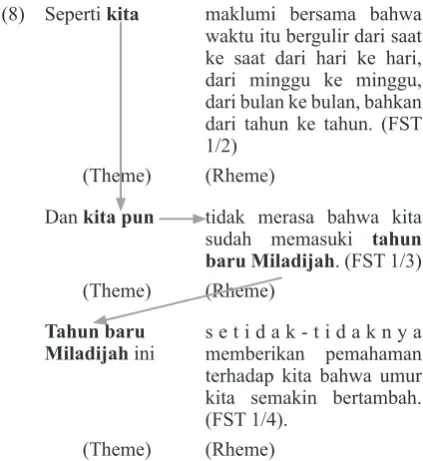
(8) Seperti kita maklumi bersama bahwa waktu itu bergulir dari saat ke saat dari hari ke hari, dari minggu ke minggu, dari bulan ke bulan, bahkan dari tahun ke tahun. (FST 1/2)
(Theme) (Rheme)
Dan kita pun tidak merasa bahwa kita sudah memasuki tahun baru Miladijah. (FST 1/3)
(Theme) (Rheme)
Tahun baru Miladijah ini
s e t i d a k - t i d a k n y a memberikan pemahaman terhadap kita bahwa umur kita semakin bertambah. (FST 1/4).
(Theme) (Rheme)
(As we know that time runs very fast, from one day to another, from one month to another, furthermore from one year to another. And, we do not feel that we have been in the new year of Miladiyah. This new year of Miladiyah at least gives a meaning that we become older)
(9) Nabi Muhammad dengan senyum mengatakan “Alhamdullillah aku terima segala kepercayaan, tetapi biarkan aku yang mengaturnya” kata Muhammad. (FST 2/44)
(Theme) (Rheme)
Jamaah yang dimuliakan Allah Nabi Muhammad
mengambil selembar kain yang besar sudah barang tentu kemudian batu itu diletakkan di tengah-tengahnya, dan dimintalah semua kepala suku, kabilah, yang ada untuk bersama-sama mengangkat batu hitam itu ke tempatnya. (FST 2/45)
(Theme) (Rheme)
Dengan demikian, masing-masing (pihak)
merasa dihargai. (FST 2/46)
(Theme) (Rheme)
Rheme of the previous clause complex (FST 2/23) ‘non-Muslim’. At last, the Theme of the final clause complex ‘Karya-karyanya’ (his literary works) refers to the Rheme of the previous clause complex ‘Bernard Shaw’. In data (7), the Rheme of the first clause complex (FST 3/1) ‘takwa’ (devotion) is repeated as the Theme of the next clause complex (FST 3/2). And the Rheme of the second clause complex (FST 3/2) ‘ucapan dan perbuatan’ (speech and deed) moves forward to be the Theme of the subsequent clause complex (FST 3/3).
Finally, the thematic pattern found in this research is the combination of Pattern 1 and Pattern 2 which is called Thematic Pattern 3. In Pattern 1, the topic is developed by taking the topical Theme of the previous clause complex to be the topical Theme of the following clause complex, whereas Pattern 2 dictates that the Rheme of a clause complex moves forward to be the topical Theme of the next clause complex. Therefore, the topic in Thematic Pattern 3 is developed by combining both of them, which is realized in the following theme-rheme organization: Theme-Theme-Rheme-Theme. It means that the topical Theme of a clause complex becomes the topical Theme of the next clause complex, and the Rheme of the second clause complex moves forward to be the topical Theme of the following clause complex. In a short, Thematic Pattern 3 is presented by Figure 3.
Figure 3
Thematic Pattern 3: Theme-Theme-Rheme-Theme
Theme Rheme
Theme Rheme
Theme Rheme
(The Prophet Muhammad smilingly said “Alhamdullillah (thanks God) I agree, but let me arrange it”. The congregation most respected by Allah, The Prophet Muhammad took a wide cloth, and put the stone in the middle of the cloth, and then all the heads of the ethnics, kabilah, uplifted the stone together, and moved it to its place. By doing so, it means that each part was respected equally).
(10) Rasulullah SAW bersabda “Setiap anak Adam itu bersalah, dan sebaik-baiknya orang bersalah adalah mereka yang meminta ampun”. (FST 3/7)
(Theme) (Rheme)
Selanjutnya, sabda Rasulullah
yang artinya celakalah bagi orang-orang yang suka menunda-nunda bertaubat kepada Allah. (FST 3/8)
(Theme) (Rheme)
Memang orang yang sudah berani
menunda bertaubat berarti ia mengira bahwa dirinya akan hidup kekal di dunia ini. (FST 3/9)
(Theme) (Rheme)
(The Prophet Muhammad said that ‘Everyone makes mistakes, and the best way for those who make mistakes is those who ask apologizing (to repent)’. Further, the next Prophet’s words mean that everyone who likes to delay to repent to Allah will get misfortune. Certainly, one who has dared to postpone repenting indicates that he thinks he will live in the world forever.)
As demonstrated by data (8) to (10) above, the topic of each clause complex is developed through Thematic Pattern 3 in which the topical Theme of the second clause complex is developed from the topical Theme of the first clause complex, and the Rheme of the second clause complex is moved forward to be the Theme of the third clause complex. Following the thematic pattern, the topical Theme ‘kita pun’ (we) (FST 1/3) in data (8) is
derived from the topical Theme of the previous clause complex (FST 1/2). Next, the Rheme of the second clause complex (FST 1/3) ‘tahun baru Miladijah’ (the New Year of Miladiyah) moves forward to be the topical Theme of the following clause complex (FST 1/4). In data (9), the topical Theme of (FST 2/45) ‘Nabi Muhammad’ (The Prophet Muhammad) is taken from the topical Theme of the clause complex (FST 2/44). In turn, the Theme of the last clause complex (FST 2/46) ‘masing-masing pihak’ (each part) is derived by repeating meaning (paraphrasing) the Rheme of the previous clause complex (FST 2/45) ‘semua kepala suku, kabilah’ (all the heads of the ethnics). And, in data (10) the Theme of the second clause complex (FST 3/8) ‘sabda Rasulullah’ (The Prophet Muhammad’s words) is derived from the topical Theme of the first clause complex (FST 3/7) ‘Rasulullah SAW’ (The Prophet Muhammad). Next, the topical Theme of the third clause complex (FST 3/9) ‘orang’ (a man) is derived from the Rheme of the second clause complex (FST 3/8) ‘orang-orang’ (people).
The thematic patterns used to develop the topics in FSTs in the clause complex level have been presented. The result of the analysis shows that the Themes in clause complexes are developed through thematic patterns: 1, 2, and 3. These thematic patterns are really related one to another. Thematic pattern 1 is the simplest pattern, while thematic pattern 3 is the most complicated one because pattern 3 is the combination of pattern 1 and pattern 2.
THE TOPIC DEVELOPMENT IN PARAGRAPHS
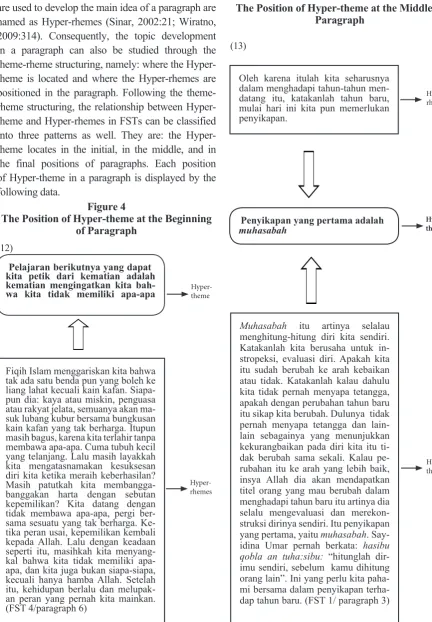
Similarly, the supporting clause complexes which are used to develop the main idea of a paragraph are named as Hyper-rhemes (Sinar, 2002:21; Wiratno, 2009:314). Consequently, the topic development in a paragraph can also be studied through the theme-rheme structuring, namely: where the Hyper-theme is located and where the Hyper-rhemes are positioned in the paragraph. Following the theme-rheme structuring, the relationship between Hyper-theme and Hyper-rhemes in FSTs can be classified into three patterns as well. They are: the Hyper-theme locates in the initial, in the middle, and in the final positions of paragraphs. Each position of Hyper-theme in a paragraph is displayed by the following data.
Figure 4
The Position of Hyper-theme at the Beginning of Paragraph
(12)
Figure 5
The Position of Hyper-theme at the Middle of Paragraph
(13)
Hyper-theme
Hyper-rhemes
Hyper-rheme
Hyper-themes Hyper-theme
Fiqih Islam menggariskan kita bahwa tak ada satu benda pun yang boleh ke liang lahat kecuali kain kafan. Siapa-pun dia: kaya atau miskin, penguasa atau rakyat jelata, semuanya akan ma-suk lubang kubur bersama bungkusan kain kafan yang tak berharga. Itupun masih bagus, karena kita terlahir tanpa membawa apa-apa. Cuma tubuh kecil yang telanjang. Lalu masih layakkah kita mengatasnamakan kesuksesan diri kita ketika meraih keberhasilan? Masih patutkah kita membangga-banggakan harta dengan sebutan kepemilikan? Kita datang dengan tidak membawa apa-apa, pergi ber-sama sesuatu yang tak berharga. Ke-tika peran usai, kepemilikan kembali kepada Allah. Lalu dengan keadaan seperti itu, masihkah kita menyang-kal bahwa kita tidak memiliki apa-apa, dan kita juga bukan siapa-siapa-apa, kecuali hanya hamba Allah. Setelah itu, kehidupan berlalu dan melupak-an permelupak-an ymelupak-ang pernah kita mainkmelupak-an. (FST 4/paragraph 6)
Pelajaran berikutnya yang dapat kita petik dari kematian adalah kematian mengingatkan kita bah-wa kita tidak memiliki apa-apa
Oleh karena itulah kita seharusnya dalam menghadapi tahun-tahun men-datang itu, katakanlah tahun baru, mulai hari ini kita pun memerlukan penyikapan.
Penyikapan yang pertama adalah
muhasabah
Figure 6
The Position of Hyper-theme at the End of Paragraph
(14)
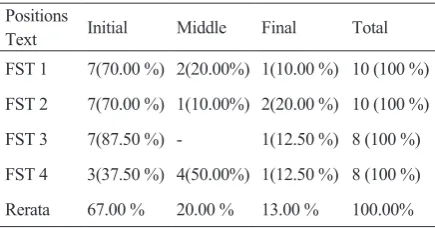
The data (12-14) above show that the position of Hyper-theme in a paragraph of FSTs can take a place either in the initial, middle, or final position. The distribution of the positions of Hyper-theme in the four texts of FSTs is presented in Table 1.
Table 1
The Position Distribution of Hyper-themes in Paragraphs of FSTs
Positions
Initial Middle Final Total Text
FST 1 7(70.00 %) 2(20.00%) 1(10.00 %) 10 (100 %) FST 2 7(70.00 %) 1(10.00%) 2(20.00 %) 10 (100 %) FST 3 7(87.50 %) - 1(12.50 %) 8 (100 %) FST 4 3(37.50 %) 4(50.00%) 1(12.50 %) 8 (100 %) Rerata 67.00 % 20.00 % 13.00 % 100.00%
As indicated by Table 1, mostly Hyper-themes take an initial position (67%), followed by the middle position (20%), and by the final position (13%). It means that paragraphs as the realization of khatib’s experience or knowledge are built from the general idea goes to the more specific one (deductive method). Beside the Hyper-theme takes place in the initial position, it also occurs in the middle position, in which the paragraph begins with (some) supporting clause complex (es) as the Hyper-rheme(s), followed by the clause complex as the Hyper-theme, and some clause complexes as Hyper-rhemes (further explanations) go after. In the pattern of final position, some clause complexes containing some facts, explanations, or detail statements are introduced first in a paragraph, and then it is ended with a clause complex containing the general statement as the Hyper-theme of the paragraph (inductive method).
THE TOPIC DEVELOPMENT IN THE WHOLE TEXT
In the whole text, the topic is developed through paragraphs. Ideally, one text has one controlling paragraph containing the subject matters (the main idea) of the text to be discussed, and some other paragraphs to develop the topic. By doing so, it will achieve the unity of the text or cohesion because one paragraph relates to another or they are linked together in the text. If it is associated with the theme-rheme structure in the clause complex level, the controlling paragraph is equal with the topical Theme, while the developing paragraphs
Hyper-rhemes
Hyper-theme
Jangan lupa, jamaah yang dimuliakan Allah, kita yang duduk di masjid ini adalah pemimpin. Mari kita perbaiki diri kita masing-masing sebagai pe-mimpin. Setiap diri kita yang ada di masjid ini, siapapun setiap manusia, mereka adalah pemimpin yang kelak dimintai pertanggungjawaban ter-hadap orang-orang yang kita pimpin. Mulai dari pimpinan negara, pimpi-nan provinsi, kabupaten, pimpipimpi-nan instansi, lembaga, sampai pimpinan rumah tangga,pimpinan terhadap diri sendiri. Jamaah yang dimuliakan Allah, kelak akan dimintai pertang-gungjawaban. Oleh karena itu bukan saatnya kita untuk saling menyalah-kan, bukan saatnya kita untuk ter-lalu banyak mencari-cari kesalahan orang lain, tetapi mari kita koreksi diri kita masing-masing, dengan satu acuan bahwa teladan kita adalah Ra-sulullah saw: “Laqod kana lakum ii
rasulullah uswatun hasanah” arti-nya, “sungguh dalam diri Rasulullah terdapat suri tauladan yang baik”. Sebagai umat Muhammad, kita sa-dar kita mencintai Rasulullah dengan membaca shalawat, kita sadar kita mencintai Rasulullah dengan sering datang pada kegiatan-kegiatan sep-erti maulid nabi dan lain sebagainya.
are similar with the Rhemes. In a text, a controlling paragraph holds one main idea as the topical Theme of the text, which is called as Macro-theme, and the other paragraphs which are used to develop the Macro-theme can be similarized as Rhemes, and named as Macro-rhemes (Sinar, 2002:21). The analysis of the topic development in the whole text of FSTs indicates that the ways the Macro-themes are developed in the four texts of FSTs using the similar patterns as the Themes or Hyper-themes are developed in the clause complexes, and in the paragraphs respectively. Following is presented the topic development for each text of FSTs.
In FST 1, having persuaded the jamaah to do devotion (takwa), khatib introduces the topic of discussion (the Macro-theme), namely: ‘hal-hal yang perlu dilaksanakan oleh setiap individu terkait dengan perubahan waktu (things should be done by everyone in conjunction with time changes, such as facing the New Year)’. The structure of the Macro-theme and Macro-rhemes in FST 1 is presented below.
Paragraph 1: (Opening)
}
In FST 2, the structure of Macro-theme and Macro-rhemes is organized as follows. After the opening paragraph (the devotion part), khatib presents the moral degradation of our public leaders. This situation, then, leads him to introduce the topic of discussion (Macro-theme) that is ‘ajakan untuk meniru dan mengikuti budi pekerti dan tingkah laku Rasulullah baik sebagai pemimpin atas dirinya sendiri maupun sebagai pemimpin umat’ (the persuasion to imitate and follow the Prophet Muhammad’s behaviors and characters
as a leader for himself as well as for others). The thematic structure of the theme and Macro-rhemes in FST 2 is presented below.
Paragraph 1: (Opening) Paragraph 2: Moral degradation
Different from FST 1, and FST 2 (as well as FST 4), khatib in FST 3 directly introduces the topic of discussion, namely: ‘ajakan untuk bertaubat kepada Allah SWT’ (the persuasion to repent to Allah, the Almighty God). Then, he delivers many reasons why people (jamaah) should repent as soon as possible, and what sanctions for those who always postpone doing the repentance. The structure of the Macro-theme and Macro-rhemes for FST 3 is presented below.
Paragraph 1: the persuasions to
repent to Allah, the Almighty God
Finally, in FST 4, after khatib opens the ceremony by asking the jamaah to do devotion, khatib introduces the topic of discussion (Macro-theme) in the second paragraph, namely: ‘kematian memberikan banyak pelajaran bagi umat manusia’ (death gives many lessons to human). Those different lessons are further discussed in more detail by khatib through the subsequent paragraphs (Macro-rhemes). The structure of the Macro-theme and Macro-rhemes in FST 4 is presented below.
Macro-theme
Macro-rhemes Paragraph 2: things should be done by
everyone in conjunction with the time changes
Paragraphs: 3 to 10:
The explanations about many things should be done by the Muslim in conjunctions with the time changes, such as the responsibilities of using our body, our age, our knowledge or sciences, and our wealth.
Macro-Paragraphs: 4 to 10:
The explanations about the goodness of Muhammad’s behaviors and characters as a leader, so he is proper to be a model for a leader both for himself and for others
Paragraph 3: the persuasions to imitate and follow Muhammad’s behaviors and characters as a leader for himself as well as for others Paragraphs: 2 s/d 8: The explanations of some
reasons why people need to repent as soon as possible, and the bad effects and the sanctions for those who like to cancel repenting
Macro-theme
}
Paragraph 2:
Death gives many lessons to humans
As demonstrated above, the Macro-themes of the four FSTs occur in the beginning of the texts (though they do not need to be in the first paragraph). The Macro-theme which occurs in the first paragraph is FST 3, while the others occur in the second paragraph (FST 1 and 4), and in the third paragraph (FST 2). If the Macro-theme takes positions in the second or third paragraph, the previous paragraph functions as the introducing situation which makes possible for khatib to introduce the topic of discussion (Macro-theme) to jamaah.
CONCLUSION
The research result shows that the topic of discussion in FSTs can be developed in the levels of clause complex, paragraph, as well as in the text as a whole. In the level of clause complex, the topic is developed through three thematic patterns, namely: Theme-Theme, Theme-Rheme-Theme, and Theme-Theme-Rheme-Theme patterns. In the level of paragraph, the topic of discussion is developed based on the relationship among the clause complexes of the paragraph as a whole. One of the clause complex in the paragraph functions as a Hyper-theme, and the others function as Hyper-rhemes, to support the Hyper-theme as the central idea (main idea) of the paragraph. The most position of Hyper-themes in the paragraphs is in the initial position, or developing the topic of discussion using a deductive method. Finally, the topic development also takes place in the text as a whole. In this case, one paragraph of the text functions as the
central issue, called Macro-theme, while the others perform as modifiers (Macro-rhemes) to develop the central issue. The thematic pattern used in FSTs is placing the Macro-theme in the beginnings of the texts; in the first paragraph (FST 3) in the second paragraph (FST 1 and 4), and in the third paragraph (FST 2).
In addition to develop the topics of discussion, thematic patterns also contribute to build a coherent text. In a clause complex level, a topical Theme becomes the central idea in the clause complex. It always controls the other (supporting) elements of the clause complex to be relevant with the Theme (the irrelevant elements should be eliminated). In the next level, the paragraph level, the Hyper-theme also controls all supporting clause complexes functioning as the Hyper-rhemes (the irrelevant clause complexes cannot be the Hyper-rhemes of the paragraph). Therefore, one clause complex should semantically relate to the other ones, and makes the paragraph tie together semantically. Finally, as the central issue, the Macro-theme of a text also controls all other supporting paragraphs functioning as the Macro-rhemes in the text, so all the paragraphs in the text hung together and make the text coherent.
REFERENCES
Butt, D., R. Fahey, S. Spinks, and C. Yallop. (1995). Using Functional Grammar: An Explorer’s Guide. NCELTR, Sydney: Macquarie University.
Eggins, S. (1994). An Introduction to Systemic Functional Linguistics. London: Pinter Publisher.
Gonzalez-Gomez, M.A. (1984). The Theme-topic Interface Evidence from English. Philadelpia: John Benyamin Publishing Company.
Halliday, MAK. (1985). An Introduction to Functional Grammar. London: Edward Arnold.
____. (1994). An Introduction to Functional Grammar. London: Edward Arnold.
Macro-theme
Paragraphs: 3 to 8
Further explanations of the lessons given by death to human, such as: nothing can help people in the world hereafter except the good deed, and time for living is very short, or life timeruns very fast.
Macro-rhemes Macro-rheme
}
}
Halliday, M.A.K. and C.M.I.M Matthiessen. (2004). An Introduction to Functional Grammar. London: Arnold.
Ma’ruf, A. (1999). ”Jenis Kode dan Fungsi Kode dalam Wacana Khotbah Jumat: Studi Kasus Empat Masjid di Yogyakarta.” Jurnal Humaniora, 11, 7-15.
Martin, J.R., C.M.I.M Matthiessen, dan C. Painter. (1997). Working with Functional Grammar. London: Edward Arnold.
Nitiasih, P.K. (2007). ”Direktif dalam Dakwah: Representasi Kekuasaan dalam Wacana TGK.” Hamzanwadi. Jurnal Linguistika: Wahana Pengembangan Cakrawala Linguistik, Vol 14, No. 27, September 2007, pp: 184 - 195.
Saddhono, K. (2012). ”Bentuk dan Fungsi Kode dalam Wacana Khotbah Jumat (Studi Kasus di kota Surakarta).” Adabiyyat: Jurnal Bahasa dan Sastra, Vol. XI, No. 1, Juni 2012, pp: 71-92.
Sinar, T.S. (2002). Phasal and Experiential Relations in Lecture Discourses (A Systemic Functional Analysis). Malaysia: Faculty of Languages and Linguistics, University of Malaya. (Ph.D. Thesis).
Soepriatmadji, L. (2009). ”Genre Analysis on English Friday Sermons Prepared by the
Islamic Religious Council of Singapore.”
Dinamika Bahasa dan Budaya, Jurnal Pengembanagan Ilmu Bahasa dan Budaya. Vol 3, No. 2. July 2009, pp: 152-170.
Sukarno. (2013). ”Retorika Persuasi sebagai Upaya Memengaruhi Jamaah pada Teks Khotbah Jumat.” Jurnal Humaniora, 25, 218-228.
Suparno. (1993). Konstruksi Theme-Rheme dalam Bahasa Indonesia Lisan Tidak Resmi Masyarakat Kotamadya Malang. Jakarta: Penelitian dan Pengembangan Bahasa dan Sastra Indonesia dan Daerah.
Sukesti, R. (2011). ”Tema-rema dalam Bahasa Jawa Ngoko Dialek Banyumas: Kajian Penataan Organisasi Informasi.” Jurnal Humaniora, 23,
218-228.
Thompson, G. (2004). Introducing Functional Grammar. London: Oxford University Press. Wiratno, T. (2009). Makna Metafungsional Teks
Ilmiah Bahasa Indonesia pada Jurnal Ilmiah
(Sebuah Analisis Sistemik Fungsional). Surakarta: Program Studi Linguistik (S3) Program Pascasarjana Universitas Sebelas Maret. (Ph.D. Thesis).