Issues ISSN: 2146-4138
available at http: www.econjournals.com
International Journal of Economics and Financial Issues, 201X, X, X-X.
The Effect of Export, Import and Investment to
Economic Growth of Riau Islands Indonesia
Dwi Kartikasari1*
1Department of Management and Business, Batam State Polytechnic, Batam, Indonesia, *Email: [email protected]
ABSTRACT
This study aimed to analyze the effect of export, import, and investment to economic growth of Riau Islands Indonesia. Data were obtained from the quarterly regional economic report of Riau Islands Province Indonesia in the period of 2009 to 2016 or 8 years. Export and import were free on board value reported by importer/exporter to Indonesia customs. While investment was measured by investment credit reported by all banks to Bank Indonesia, and economic growth by Gross Regional Domestic Product provided by Central Bureau of Statistic. Panel data regression analysis was implemented to analyze the influence of independent variables to the dependent variable. The most suitable panel data regression model in this study was a random effect model. The study found that partially, export had an insignificant negative effect on economic growth, while import had a significant negative impact and investment had a significant positive impact. Simultaneaously, the three variables had statistically significant effect to the economic growth of Riau Islands Province Indonesia.
Keywords: Export, Import, Investment, Economic Growth, Panel Data JEL Classification: F43
1. INTRODUCTION
Macroeconomics describes the factors that may affect companies and society. It can analyze some government targets, such as economic growth, price stability or inflation rate, investment, employment and government balance sheet performance (Prasetyo, 2009).
that alludes the importance of international trade conducted by entrepreneurs in realizing economic growth.
International trade has an important role considering the strategic location of the Riau Islands which borders directly with foreign countries. The special zones in Riau Islands are Batam, Bintan, and Karimun (BBK). While the other districts i.e. Anambas Islands, Lingga, Natuna, and Tanjung Pinang are supporting the implementation of special zones in BBK by providing manpower, food, etc. Given the strategic location of Riau Islands and the government support to the special zones of BBK, Riau Islands trade balance reached 20 percent of total GDRP in 2010-2014. However, in the last four years, both export and import are facing a decline. Under this condition, the author hopes to find empirical evidence whether export and import really influence economic growth as expected by the government.
Meanwhile, the author recognizes the importance of investment to economic growth. Keynes's theory that is expanded and developed by R.F. Harrold and E.D. Domar (Gilarso, 2004:398), emphasizes the balance between the amount of savings and investment required for a harmonious economic growth. Investment can be interpreted as expenditure to buy capital goods and production equipment to increase the capability of a company to produce goods and services available in the market. One way to catch investment expenditure data is through financial institutions or banks. Funds disbursed by financial institutions include investment credit. Investment credit is a type of long-term credit used to finance capital expenditure in the context of rehabilitation, modernization, land expansion or the establishment of new projects. The author used data of investment credit from Bank Indonesia, the central bank in Indonesia.
This article intends to explain the influence of export, import, and investment to the economic growth of a region, especially Riau Islands province in Indonesia, both partially and simultaneously. The author conducted the research using secondary data obtained from Bank Indonesia in the form of panel data within the
period 2009-2016 and processed the data using panel data regression method. The author has not found previous research involves the three independent variables simultaneously to the dependent variable. More unlikely, in the case of Riau Islands province. Thus, the author hopes to contribute to enrich the literature in this field. The author also hopes to motivate companies to conduct international trade and motivate the government to attract investment as they will contribute heavily to the local economic growth.
2. LITERATURE REVIEW
Sari, et. al (2016) examined the effect of investment, labor, and government expenditure to the economic growth of Indonesia. This study showed that investment, labor, and government expenditure simultaneously affect the economic growth of Indonesia. Partially, investment has a positive impact to the economic growth in Indonesia significantly.
Mohsen (2015) examined the effects of export and import on the economic growth of Syria. Using Johansen Cointegration test, he showed that export and import have a positive and significant effect on GDP. Using Granger Causality test, he found that there was a two-way causal relationship between export, import, and GDP in the long and short term. The impulse response functions (IRFs) indicated that when there is a shock to exports, GDP will respond positively in the following years, but when there is a shock to imports, GDP will respond negatively in the following years. The variance decomposition (VD) analysis showed that at a ten-year forecasting horizon, exports and imports shocks explain 28% and 25% of the GDP forecast error variance, respectively.
Dewi and Sutrisna (2015) examined the effect of investment annd export on the absorption of labor through economic growth. The results of this study showed that investment has a significant positive effect on economic growth, while exports have an insignificant negative effect on economic growth.
have a positive effect on economic growth. Partially, both investment and export have a positive effect.
Hasan et. al (2013) examined the effect of investment, labor, and government expenditure on economic growth in West Sumatera Province. This study showed that there is a significant influence showed that export growth has a positive effect on economic growth in Indonesia but import growth has a negative impact on economic growth. Export was the main driver of economic growth.
Export
According to the Law of the Republic of Indonesia Number 17 Year 2006, export is the activity of removing goods from customs areas. If the buyer comes from abroad and the seller comes from within the country, then the activity can be regarded as export. Export of goods can be judged according to the price of Free On Board (FOB), the calculation of the export of goods is done by multiplying the value of goods (according to notification of export of goods or PEB) with the exchange rate.
FOB means that the seller (exporter) is delivering the goods to the port mentioned in a contract, this means that the buyer (importer) shall bear all costs and risks of loss or damage of goods starting from that point (Amir, 2007).
Export is vital on a country's economic growth, as has been explained in Hecksher-Ohlin's theory in Pridayanti (2014) that a country will export products that production cost is less expensive and raw materials are abundant. This will benefit the exporting country as it will increase the national income and economic growth.
Import
According to the Law of the Republic of Indonesia, import is the activity of entering goods into the customs area. Literally, imports can be
interpreted as the activities of entering goods from foreign country into the customs territory of our country (Susilo, 2008).
Investment
Investment is one of the decisive factors in economic growth (Prasetyo, 2011:88). Credit investment is a credit to finance investment activities of a company with a credit period of more than 1 year (Supriyono, 2011).
Economic Growth region is Gross Domestic Regional Product (GDRP). GDRP is basically the amount of value added generated by all business units within a particular country, or is the sum of the value of final goods and services produced by all economic units. Sjafrizal (2008:93) mentioned that GDRP is a sum of consumption, investment, government expenditure, and exports, minus imports.
3. METHODOLOGY
This research used secondary data from quarterly report of regional economy published by Bank Indonesia in the period of eight years from 2009 until 2016, hence 32 data were observed. Whenever necessary, the author confirmed the data with those of the central bureau of statistics and customs report. All data obtained were in thousand rupiahs.
fixed effect and random effect. While the LM test is to select between common effect and random effect model. Last, she conducted panel data regression, interpreted the model output, and drew conclusions.
4. RESULTS AND DISCUSSIONS
In line with sluggish global demand, Riau Islands exports recorded a contraction starting in the beginning of 2014 until 2016. The decline in exports was recorded by almost all of Riau
Islands’ flagship commodities, i.e. natural gas, electronic equipment, iron products, and crude palm oil processed products. However, net exports in 2014 – 2016 were more frequently reported than the period before.
Figure 1. Export, Import, Investment, and Economic Growth of Riau Islands 2009 - 2016
Economic growth as proxied by GDRP looks increasing during the period of research. This increase is influenced by the increase in prices and net exports. Investment increases slowly but sure during the period of research.
Measures of Central Tendency
Table 1 below describes statistics parameters on 8-year-data. The table shows that the average export is Rp 28,991,048, the highest value is Rp
40,144,000, the lowest value is Rp 16,824,990, and standard deviation Rp 5,175,006. Batam City has the largest contribution in the export value of Riau Islands with its four main ports namely Batu Ampar, Sekupang, Kabil and Belakang Padang, contributing approximately 75.98 percent in year 2016. This figure is followed by Tarempa port in Anambas Islands contributing 12.30 percent. While export based on volume, Tanjung Balai Karimun has the largest contribution of 41.86 percent.
Table 1: Descriptive statistics
Statistics Variables
Export Import Investment Economic growth
Mean 28,991,048 28,568,483 6,160,718 21,423,508 Median 29,788,590 29,036,995 6,138,017 12,215,082 Maximum 40,144,000 38,044,240 10,019,346 41,620,151
5,000,000 10,000,000 15,000,000 20,000,000 25,000,000 30,000,000 35,000,000 40,000,000 45,000,000
I II III IV I II III IV I II III IV I II III IV I II III IV I II III IV I II III IV I II III IV
2009 2010 2011 2012 2013 2014 2015 2016
In Thousand Rupiahs
Statistics Variables
Export Import Investment Economic growth
Minimum 16,824,990 20,829,640 2,332,006 9,212,961 Std. Dev. 5,175,006 5,204,136 2,957,713 13,724,235
Skewness (0.31) 0.23 (0.05) 0.52
Kurtosis 2.75 2.02 1.39 1.32
Jarque-Bera 0.59 1.56 3.48 5.24
Probability 0.74 0.46 0.18 0.07
Import has an average of Rp 28,568,483 with the highest value of Rp 38,044,240, the lowest Rp 20,829,640, and standard deviation of Rp 5,204,136. Like export, Batam City has the largest contribution in the import value of Riau Islands with its two main ports namely Batu Ampar, Sekupang and one airport which is Hang Nadim, contributing approximately 73,98 percent in year 2016. This figured is followed by Tanjung Uban, Bintan regency of 9,58 percent, and the smallest contribution is given by the port of Tanjung Balai Karimun, Balai Karimun Regency at 8,73 percent.
Investment variable has an average of Rp 6,160,718, the highest value of Rp 10,019,346, the lowest value of Rp 2,332,006, and the standard deviation of Rp 2,957,713. According to a report published by Bank Indonesia in first quarter on 2017, the largest portion of investment variable was absorbed by the manufacturing sector by 17,35 percent, the commercial sector of 14,22 percent and the transportation, warehousing and communications 10,52 percent.
The economic growth variable has an average of Rp 21,423,508, the highest value of Rp 41,620,151, the lowest Rp 9,212,961, and the standard deviation of Rp 13,724,235. Based on the above figures, Riau Islands’ economic growth throughout 2012-2016 is higher than the national economic growth, However, economic growth decelerated from year to year, this could be caused by one of the weakening of industrial and mining sector demand, and low prices of oil and gas.
Panel data regression
Classical assumptions must be met in order to obtain a good regression model. Data in this study
can be said to be of normal distribution when probability of JB is more than 0.05. As can be seen from Table 1, the probability in all variables are more than 0.05 so it can be concluded that the data is normally distributed.
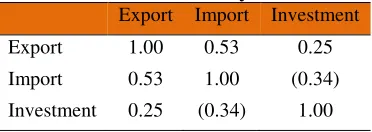
A good regression model is considered free of multicollinearity once the correlation between independent variables does not exceed 0.90. A correlation matrix of this study follows:
Table 2: Multicollinearity test Export Import Investment
Export 1.00 0.53 0.25
Import 0.53 1.00 (0.34) Investment 0.25 (0.34) 1.00
Table 2 shows that correlation values are all less than 0.90, thus, the author concludes that multicollinearity is not present in the model.
To choose the best model between common effect and fixed effect model, we conducted Chow test.
Table 4: Chow test
Effects Test Statistic Prob,
Cross-section F 0.186464 0.9046
Table 4 shows that the probability of cross-section F is more than 0.05, thus the model chosen is a common effect.
Next, table 5 below shows that the probability of cross-section random is more than 0.05, Thus, the model chosen is a random effect.
Test Summary Chi-Sq, Statistic Chi-Sq, d,f, Prob, Cross-section random 0.559392 3 0.9057
Last test to choose the best model is LM test.
Table 6: Lagrange Multiplier (LM) test
Test Summary Both
Breusch-Pagan 0.00000
Table 6 indicates that Prob. Breusch-Pagan (BP) in both columns shows the number 0.000 < 0.05, thus the appropriate model is a random effect.
The results of the three tests are in table 7 follows: Table 7: Tests to select the best model
Test Type Choose between Decision
Chow Test Common effect and fixed effect Common effect Hausman Test Random effect and fixed effect Random effect LM Test Common effect and random effect Random effect
Of the three tests above, the author selected the most dominant results. Therefore, she concluded that the best model is random effect model. Using
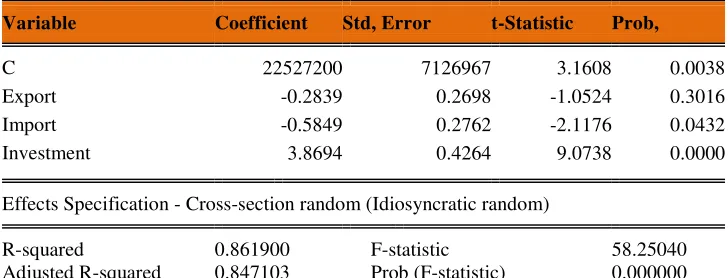
Eviews, she obtained the following output as shown in table 8.
Table 8: Panel data regression (Random effect model)
Variable Coefficient Std, Error t-Statistic Prob,
C 22527200 7126967 3.1608 0.0038
Export -0.2839 0.2698 -1.0524 0.3016
Import -0.5849 0.2762 -2.1176 0.0432
Investment 3.8694 0.4264 9.0738 0.0000
Effects Specification - Cross-section random (Idiosyncratic random)
R-squared 0.861900 F-statistic 58.25040
Adjusted R-squared 0.847103 Prob (F-statistic) 0.000000
Notes: Regression method is pooled least squares with 32 pool (balanced) observations
Table 8 above shows the coefficient of determination (Adjusted R-squared) of 0.847103 indicates that the model explains 84.71 percent of the variability of economic growth, while the remaining 15,29 percent of economic variance should be explained by other variables which do not exist in the regression model. Table 8 also exhibits that export, import and investment have significant effect on economic growth simultaneously as concluded from the probability value (F-Statistics) of 0.00 (p <0.05).
However, when the author looks at each variable partially, she concluded that import dan investment influence the economic growth of Riau Islands province in Indonesia. This conclusion is based on the probability value (t-Statistics) of
0.0432 for import and 0,0000 for investment. The other variable, that is export, has insignificant effect on profitability because its probability value (t-Statistics) is greater than 5 percent amount 0.3016.
competing products may spur innovation and finally lead to economic growth.
Further, this research shows a negative but insignificant relation between export and economic growth which is supported by previous research such as Dewi and Sutrisna (2015). At first, this finding sounds confusing because exports bring money to a country, thus increase economic growth. Broadly speaking, export growth can promote economic growth and vice versa. However, the empirical evidence associated with the effect of export on economic growth is mixed. The negative correlation between exports and GDP is supported by the theory of the paradox of plenty that states that a country can sometimes focus too heavily on exporting only one lucrative export that is not a value-added export and thus neglects the rest of its economy and decreases its GDP. This condition might be the case of Riau Islands that depends on exporting primary commodities such as natural gas and machineries/electronic equipment.
Last, this research supports the abundant empirical evidence that investment has significant positive effect on economic growth. This result is similar with that of Sari, et. al (2016), Dewi and Sutrisna (2015), Susi et. al (2015), Wahyuni et. al (2014), and Hasan et. al (2013) that indicate a significant positive influence. Hypothetically, investment improves productivity then it can lead to an increase in the long run trend rate of economic growth. However, if the economy is close to full capacity or investment is inefficient then an economy could not enjoy growth prospects.
5, CONCLUSIONS AND RECOMMENDATIONS
In this study, data were obtained from the quarterly regional economic report of Riau Islands Province Indonesia in the period of 2009 to 2016 or 8 years. Export and import were free on board value reported by importer/exporter to Indonesia customs. While investment was measured by investment credit reported by all banks to Bank Indonesia, and economic growth by Gross Regional Domestic Product provided by Central Bureau of Statistic. Panel data regression analysis
was implemented to analyze the influence of independent variables to the dependent variable.
In line with sluggish global demand, Riau Islands exports recorded a contraction starting in the beginning of 2014 until 2016. Economic growth as proxied by GDRP as well as investment looks increasing during the period of research.
Data in this study can be said to be of normal distribution and multicollinearity is not present in the model. Chow test selects common effect, Hausman test chooses random effect, and LM test picks random effect. Therefore, the author investment have significant effect on economic growth simultaneously. In detail, this study indicates a negative relation between import and economic growth which is logically accepted and supported by previous research. Further, this research shows a negative but insignificant relation between export and economic growth which is supported both by empirical evidence and the theory of the paradox of plenty that states that a country can sometimes focus too heavily on exporting only one lucrative export that is not a value-added export and thus neglects the rest of its economy. This condition might be the case of Riau Islands that depends on exporting primary commodities such as natural gas and machineries/electronic equipment. Last, this research supports the abundant empirical evidence that investment has significant positive effect on economic growth.
Further research is expected to add more independent variables and period of observation in examining the factors of economic growth. Comparation study with other countries or regions in the most updated period with the same research methodology would be beneficial for international investors.
REFERENCES
Dewi, N.M.S., Sutrisna, I.K. (2015), Pengaruh Investasi Dan Ekspor Terhadap Penyerapan
Tenaga Kerja Melalui Pertumbuhan
Ekonomi. E-Journal Ekonomi Pembangunan Universitas Udayana, 4(6), 621-636.
Gilarso, T. (2004), Pengantar Ilmu Ekonomi Makro. Yogyakarta: Kasinus.
Hasan, E., Amar, S., Anis, A. (2013), Pengaruh Investasi, Angkatan Kerja Dan Pengeluaran
Pemerintah Terhadap Pertumbuhan
Ekonomi Di Provinsi Sumatera Barat. Jurnal Riset Manajemen Bisnis dan Publik, 1(1), 1-13.
Kholis, M. (2012), Dampak Foreign Direct
Investment Terhadap Pertumbuhan
Ekonomi Indonesia; Studi Makroekonomi dengan Penerapan Data Panel. Jurnal Organisasi dan Manajemen, 8(2), 111-120.
Mohsen, A.S. (2015), Effects of Exports and Imports on the Economic Growth of Syria. Euro-Asian Journal of Economics and Finance, 3(4), 253-261.
Prasetyo, P.E. (2011), Fundamental Makro Ekonomi. Yogyakarta: Beta Offset.
Pridayanti, A. (2014), Pengaruh Ekspor, Impor, Dan Nilai Tukar Terhadap Pertumbuhan Ekonomi Di Indonesia Periode 2002-2012. Jurnal Pendidikan Ekonomi, 2(2), 10-20.
Sari, M., Nur, M.S., Majid, S.A. (2016), Pengaruh Investasi, Tenaga Kerja Dan Pengeluaran
Pemerintah Terhadap Pertumbuhan
Ekonomi Di Indonesia. Jurnal Ekonomi Dan Kebijakan Publik Indonesia, 3(2), 109-115.
Sjafrizal (2008), Ekonomi Regional : Teori Dan Aplikasi. Padang: Badouse Media.
Sukirno, S. (2012), Makroekonomi Teori Pengantar. Jakarta: Rajawali Pers.
Susi, L.I.D.S., Kirya, I.K., Yudiaatmaja, F. (2015), Pengaruh Investasi, Tenaga Kerja, Dan Ekspor Terhadap Pertumbuhan Ekonomi Di Kabupaten Buleleng Periode 2008-2012. e-Journal Bisma Universitas Pendidikan Ganesha, 3(1), 20-30.
Susilo, A. (2008), Buku Pintar Ekspor-Impor (Manajemen Tata Laksana & Transportasi Internasional). Jakarta: TransMedia.
Wahyuni, I.G.A.P., Sukarsa, M., Yuliarmi, N. (2014), Pengaruh Pengeluaran Pemerintah
dan Investasi Terhadap Pertumbuhan