Concurrency
Concurrency
Objectives
Objectives
To understand the concept of multithreading and apply it to develop concurrent To understand the concept of multithreading and apply it to develop concurrent programs (§
programs (§24.224.2).).
To develop task classes by implementing the Runnable interface (§
To develop task classes by implementing the Runnable interface (§24.324.3).). To create threads to run tasks using the Thread class (§
To create threads to run tasks using the Thread class (§24.324.3).). To control threads using the methods in the Thread class (§
To control threads using the methods in the Thread class (§24.424.4).). To control animations using threads (§§
To control animations using threads (§§24.524.5, , 24.724.7).). To run code in the event dispatcher thread (§
To run code in the event dispatcher thread (§24.624.6).). To execute tasks in a thread pool (§
To execute tasks in a thread pool (§24.824.8).).
To use synchronized methods or blocks to synchronize threads to avoid race To use synchronized methods or blocks to synchronize threads to avoid race conditions (§
conditions (§24.924.9).).
To synchronize threads using locks (§
To synchronize threads using locks (§24.1024.10).).
To facilitate thread communications using conditions on locks (§§
To facilitate thread communications using conditions on locks (§§24.1124.11–24.12–24.12).). (Optional) To use blocking queues to synchronize access to an array queue, linked (Optional) To use blocking queues to synchronize access to an array queue, linked queue, and priority queue (§
queue, and priority queue (§24.1324.13).).
(Optional) To restrict the number of accesses to a shared resource using semaphores (Optional) To restrict the number of accesses to a shared resource using semaphores (§
(§24.1424.14).).
(Optional) To use the resource-ordering technique to avoid deadlocks (§
(Optional) To use the resource-ordering technique to avoid deadlocks (§24.1524.15).). To understand the life cycle of a thread (§
To understand the life cycle of a thread (§24.1624.16).).
To create synchronized collections using the static methods in the Collections class (§ To create synchronized collections using the static methods in the Collections class (§ 24.17
24.17).).
(Optional) To display the completion status of a task using JProgressBar (§
Thread Concept
Thread Concept
A
A threadthread is the flow of execution of a task in a program (from is the flow of execution of a task in a program (from beginning to end).
beginning to end).
A task is a program unit that is executed independently of other
A task is a program unit that is executed independently of other
parts of the program.
parts of the program.
A thread provides the mechanism for running a task. W ith Java,
A thread provides the mechanism for running a task. W ith Java,
you can launch multiple threads from a program concurrently.
you can launch multiple threads from a program concurrently.
These threads can be executed simultaneously in multiprocessor
These threads can be executed simultaneously in multiprocessor
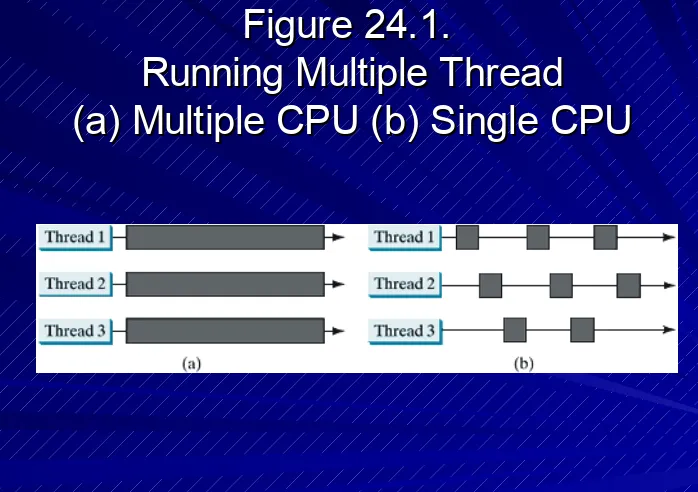
systems, as shown in
systems, as shown in Figure 24.1(a)Figure 24.1(a)..
In single-processor systems, as shown in
In single-processor systems, as shown in Figure 24.1(b)Figure 24.1(b), the , the multiple threads share CPU time, and the operating system is
multiple threads share CPU time, and the operating system is
responsible for scheduling and allocating resources to them. This
responsible for scheduling and allocating resources to them. This
arrangement is practical because most of the time the CPU is idle.
arrangement is practical because most of the time the CPU is idle.
It does nothing, for example, while waiting for the user to enter
It does nothing, for example, while waiting for the user to enter
data.
[image:3.720.31.694.40.520.2]Figure 24.1.
Figure 24.1.
Running Multiple Thread
Running Multiple Thread
(a) Multiple CPU (b) Single CPU
Thread Concept (c.)
Thread Concept (c.)
Multithreading can make your program more responsive and
Multithreading can make your program more responsive and
interactive, as well as enhance performance. For example, a good
interactive, as well as enhance performance. For example, a good
word processor (
word processor (misalnya MS Wordmisalnya MS Word) lets you print or save a file ) lets you print or save a file while you are typing. In some cases, multithreaded programs run
while you are typing. In some cases, multithreaded programs run
faster than single-threaded programs even on single-processor
faster than single-threaded programs even on single-processor
systems. Java provides exceptionally good support for creating
systems. Java provides exceptionally good support for creating
and running threads and for locking resources to prevent conflicts.
and running threads and for locking resources to prevent conflicts.
W hen your program executes as an application, the Java
W hen your program executes as an application, the Java
interpreter starts a thread for the main method. W hen your
interpreter starts a thread for the main method. W hen your
program executes as an applet, the W eb browser starts a thread
program executes as an applet, the W eb browser starts a thread
to run the applet.
to run the applet.
You can create additional threads to run concurrent tasks in the
You can create additional threads to run concurrent tasks in the
program. In Java, each
program. In Java, each task is an instance of the Runnable task is an instance of the Runnable interface, also called a runnable object.
interface, also called a runnable object. A thread is essentially A thread is essentially an object that facilitates the execution of a task.
Creating Task
Creating Task
Tasks are objects.
Tasks are objects.
To create tasks, you have to first declare a class
To create tasks, you have to first declare a class
for tasks.
for tasks.
A task class must implement the Runnable
A task class must implement the Runnable
interface. The Runnable interface is rather simple.
interface. The Runnable interface is rather simple.
All it contains is the run method. You need to
All it contains is the run method. You need to
implement this method to tell the system how your
implement this method to tell the system how your
thread is going to run.
thread is going to run.
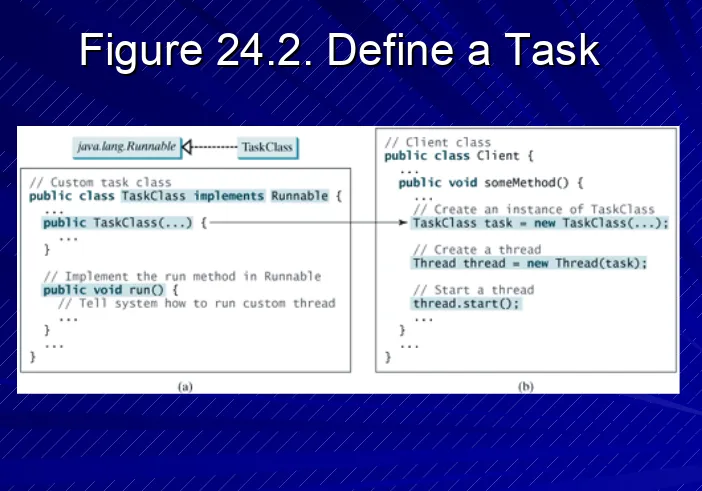
A template for developing a task class is shown in
A template for developing a task class is shown in
Figure 24.2(a)
Once you have declared a TaskClass, you can create a task using
Once you have declared a TaskClass, you can create a task using
its constructor. For example,
its constructor. For example,
TaskClass task = new TaskClass(...);
TaskClass task = new TaskClass(...);
A task must be executed in a thread. The Thread class contains
A task must be executed in a thread. The Thread class contains
the constructors for creating threads and many useful methods for
the constructors for creating threads and many useful methods for
controlling threads. To create a thread for a task, use
controlling threads. To create a thread for a task, use
Thread thread = new Thread(task);
Thread thread = new Thread(task);
You can then invoke the
You can then invoke the start()start() method to tell the JVM that the method to tell the JVM that the thread is ready to run, as follows:
thread is ready to run, as follows:
thread.start();
thread.start();
The JVM will execute the task by invoking the task's
The JVM will execute the task by invoking the task's run()run()
method.
method. Figure 24.2(b)Figure 24.2(b) outlines the major steps for creating a task, outlines the major steps for creating a task, a thread, and start the thread.
Creating Task and Thread Example
Creating Task and Thread Example
Listing 24.1. A program that creates three
Listing 24.1. A program that creates three
tasks and three threads to run them:
tasks and three threads to run them:
The first task prints the letter a one
The first task prints the letter a one
hundred times.
hundred times.
The second task prints the letter b one
The second task prints the letter b one
hundred times.
hundred times.
The third task prints the integers 1
The third task prints the integers 1
Contoh Hasil Eksekusi
Contoh Hasil Eksekusi
TaskThreadDemo.java
Importance to note:
Importance to note:
Task adalah
Task adalah
runable object
runable object
, sehingga deklarasi
, sehingga deklarasi
kelas untuk task harus
kelas untuk task harus
implements Runnable
implements Runnable
.
.
Thread digunakan untuk menjalankan setiap task
Thread digunakan untuk menjalankan setiap task
run()
run()
adalah method standar yang digunakan
adalah method standar yang digunakan
oleh Thread untuk menjalankan Task
oleh Thread untuk menjalankan Task
start()
start()
adalah method standar untuk
adalah method standar untuk