Human Resource
© 2003 Southwestern College Publishing. All rights reserved.
Strategic Human Resource
Strategic Human Resource
Management
Management
Strategic Human Resource
Strategic Human Resource
Management
Management
Overview Overview
I Gede Iwan Suryadi, SE., MM.
© 2002 Southwestern College Publishing. All rights reserved. Presented at STIKOM BALI, F AQ:[email protected]
2–2
Learning Objectives
Learning Objectives
Learning Objectives
Learning Objectives
After you have read this chapter, you
should be able to:
– Discuss why human resources can be a core competency for organizations.
– Define HR planning, and outline the HR planning process.
– Specify four important HR benchmarking measures.
– Identify factors to be considered in
© 2002 Southwestern College Publishing. All rights reserved. Presented at STIKOM BALI, F AQ:[email protected]
2–3
Learning Objectives (cont’d)
Learning Objectives (cont’d)
Learning Objectives (cont’d)
Learning Objectives (cont’d)
– Discuss several ways to manage a surplus of human resources.
© 2002 Southwestern College Publishing. All rights reserved. Presented at STIKOM BALI, F AQ:[email protected]
2–4
Human Resources as a Core Competency
Human Resources as a Core Competency
Human Resources as a Core Competency
Human Resources as a Core Competency
Strategic Human Resources
Management
– Organizational use of employees to gain or keep a competitive advantage against
competitors.
Core Competency
© 2002 Southwestern College Publishing. All rights reserved. Presented at STIKOM BALI, F AQ:[email protected]
2–5
Possible HR Areas for Core Competencies
Possible HR Areas for Core Competencies Possible HR Areas for Core Competencies
Possible HR Areas for Core Competencies
© 2002 Southwestern College Publishing. All rights reserved. Presented at STIKOM BALI, F AQ:[email protected]
2–6
HR-Based Core Competencies
HR-Based Core Competencies
HR-Based Core Competencies
HR-Based Core Competencies
Organizational Culture
– The shared values and beliefs of the workforce
Productivity
– A measure of the quantity and quality of work done, considering the cost of the resources used.
– A ratio of the inputs and outputs that indicates the value added by an organization.
Quality Products and Services
– High quality products and services are the
© 2002 Southwestern College Publishing. All rights reserved. Presented at STIKOM BALI, F AQ:[email protected]
2–7
Customer Service Dimensions
Customer Service Dimensions Customer Service Dimensions
Customer Service Dimensions
© 2002 Southwestern College Publishing. All rights reserved. Presented at STIKOM BALI, F AQ:[email protected]
2–8
Factors That Determine HR Plans
Factors That Determine HR Plans Factors That Determine HR Plans
Factors That Determine HR Plans
© 2002 Southwestern College Publishing. All rights reserved. Presented at STIKOM BALI, F AQ:[email protected]
2–9
Linkage of Organizational and HR Strategies
Linkage of Organizational and HR Strategies Linkage of Organizational and HR Strategies
Linkage of Organizational and HR Strategies
© 2002 Southwestern College Publishing. All rights reserved. Presented at STIKOM BALI, F AQ:[email protected]
2–10
Human Resource Planning
Human Resource Planning
Human Resource Planning
Human Resource Planning
Human Resource (HR) Planning
– The process of analyzing and identifying the need for and availability of human resources so that the organization can meet its
objectives.
HR Planning Responsibilities
– Top HR executive and subordinates gather information from other managers to use in the development of HR projections for top
© 2002 Southwestern College Publishing. All rights reserved. Presented at STIKOM BALI, F AQ:[email protected]
2–11
Typical Division of HR Responsibilities
Typical Division of HR Responsibilities
in HR Planning
in HR Planning
Typical Division of HR Responsibilities
Typical Division of HR Responsibilities
in HR Planning
in HR Planning
© 2002 Southwestern College Publishing. All rights reserved. Presented at STIKOM BALI, F AQ:[email protected]
2–12
Human Resource Planning (cont’d)
Human Resource Planning (cont’d)
Human Resource Planning (cont’d)
Human Resource Planning (cont’d)
Small Business and HR Planning Issues
– Attracting and retaining qualified outsiders – Management succession between
generations of owners
© 2002 Southwestern College Publishing. All rights reserved. Presented at STIKOM BALI, F AQ:[email protected]
2–13
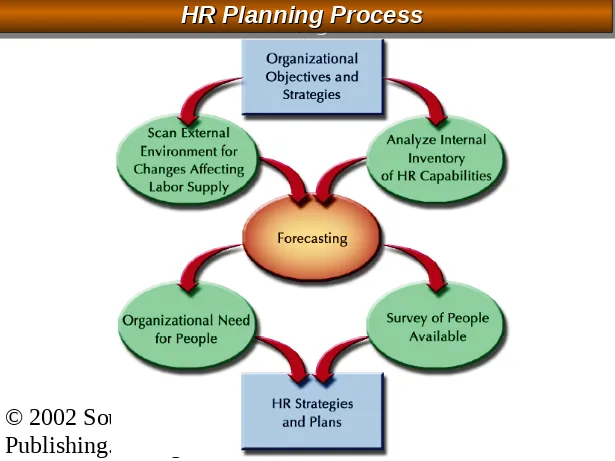
HR Planning Process
HR Planning Process HR Planning Process
HR Planning Process
© 2002 Southwestern College Publishing. All rights reserved. Presented at STIKOM BALI, F AQ:[email protected]
2–14
HR Planning Process
HR Planning Process
HR Planning Process
HR Planning Process
HR Strategies
– The means used to anticipate and manage the supply of and demand for human resources.
• Provide overall direction for the way in which HR activities will be developed and managed.
Overall
Overall
Strategic Plan
Strategic Plan
Human Resources
Human Resources
Strategic Plan
Strategic Plan
HR Activities
© 2002 Southwestern College Publishing. All rights reserved. Presented at STIKOM BALI, F AQ:[email protected]
2–15
Benefits of HR Planning
Benefits of HR Planning
Benefits of HR Planning
Benefits of HR Planning
Better view of the HR dimensions of business
decisions
Lower HR costs through better HR
management.
More timely recruitment for anticipate HR
needs
More inclusion of protected groups through
planned increases in workforce diversity.
© 2002 Southwestern College Publishing. All rights reserved. Presented at STIKOM BALI, F AQ:[email protected]
2–16
Scanning the External Environment
Scanning the External Environment
Scanning the External Environment
Scanning the External Environment
Environmental Scanning
– The process of studying the environment of the organization to pinpoint opportunities and threats.
Environment Changes Impacting HR
– Governmental regulations – Economic conditions
© 2002 Southwestern College Publishing. All rights reserved. Presented at STIKOM BALI, F AQ:[email protected]
2–17
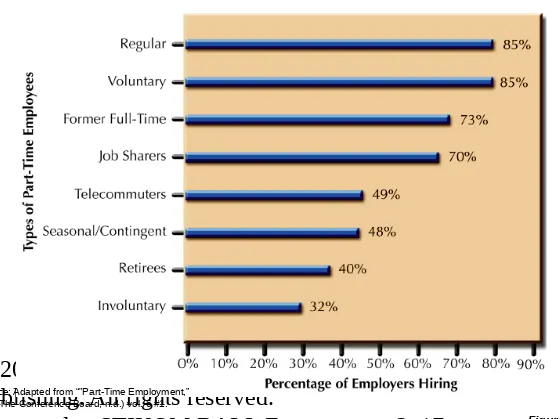
Employers’ Use of Part-Time Workers
Employers’ Use of Part-Time Workers Employers’ Use of Part-Time Workers
Employers’ Use of Part-Time Workers
Figure 2–7
© 2002 Southwestern College Publishing. All rights reserved. Presented at STIKOM BALI, F AQ:[email protected]
2–18
Internal Assessment of the
Internal Assessment of the
Organizational Workforce
Organizational Workforce
Internal Assessment of the
Internal Assessment of the
Organizational Workforce
Organizational Workforce
Auditing Jobs and Skills
– What jobs exist now?
– How many individuals are performing each job?
– How essential is each job?
– What jobs will be needed to implement future organizational strategies?
© 2002 Southwestern College Publishing. All rights reserved. Presented at STIKOM BALI, F AQ:[email protected]
2–19
Internal Assessment of the
Internal Assessment of the
Organizational Workforce
Organizational Workforce
Internal Assessment of the
Internal Assessment of the
Organizational Workforce
Organizational Workforce
Organizational Capabilities Inventory
– HRIS databases—sources of information about employees’ knowledge, skills, and abilities (KSAs)
– Components of an organizational capabilities inventory
© 2002 Southwestern College Publishing. All rights reserved. Presented at STIKOM BALI, F AQ:[email protected]
2–20
Forecasting HR Supply and Demand
Forecasting HR Supply and Demand
Forecasting HR Supply and Demand
Forecasting HR Supply and Demand
Forecasting
– The use of information from the past and present to identify expected future
conditions.
Forecasting Methods
– Judgmental
• Estimates—asking managers’ opinions, top-down or bottom-up
• Rules of thumb—using general guidelines • Delphi technique—asking a group of experts
© 2002 Southwestern College Publishing. All rights reserved. Presented at STIKOM BALI, F AQ:[email protected]
2–21
Forecasting HR Supply and Demand
Forecasting HR Supply and Demand
Forecasting HR Supply and Demand
Forecasting HR Supply and Demand
Forecasting Methods (cont’d)
– Mathematical
• Statistical regression analysis— • Simulation models
• Productivity ratios—units produced per employee • Staffing ratios—estimates of indirect labor needs
Forecasting Periods
– Short-term—less than one year – Intermediate—up to five years
© 2002 Southwestern College Publishing. All rights reserved. Presented at STIKOM BALI, F AQ:[email protected]
2–22
Forecasting
Forecasting
Methods
Methods Forecasting
Forecasting
Methods
Methods
© 2002 Southwestern College Publishing. All rights reserved. Presented at STIKOM BALI, F AQ:[email protected]
2–23
Forecasting HR Supply and Demand
Forecasting HR Supply and Demand
Forecasting HR Supply and Demand
Forecasting HR Supply and Demand
Forecasting the Demand for Human
Resources
– Organization-wide estimate for total demand – Unit breakdown for specific skill needs by
number and type of employee
• Develop decision rules (“fill rates”) for positions to be filled internally and externally.
• Develop additional decision rules for positions impacted by the chain effects of internal promotions and transfers.
Forecasting the Supply for Human
Resources
© 2002 Southwestern College Publishing. All rights reserved. Presented at STIKOM BALI, F AQ:[email protected]
2–24
Forecasting HR Supply and Demand
Forecasting HR Supply and Demand
Forecasting HR Supply and Demand
Forecasting HR Supply and Demand
Forecasting External HR Supply
– Factors affecting external
• Net migration for an area
• Individuals entering and leaving the workforce • Individuals graduating from schools and colleges • Changing workforce composition and patterns • Economic forecasts
• Technological developments and shifts • Actions of competing employers
© 2002 Southwestern College Publishing. All rights reserved. Presented at STIKOM BALI, F AQ:[email protected]
2–25
Forecasting HR Supply and Demand
Forecasting HR Supply and Demand
Forecasting HR Supply and Demand
Forecasting HR Supply and Demand
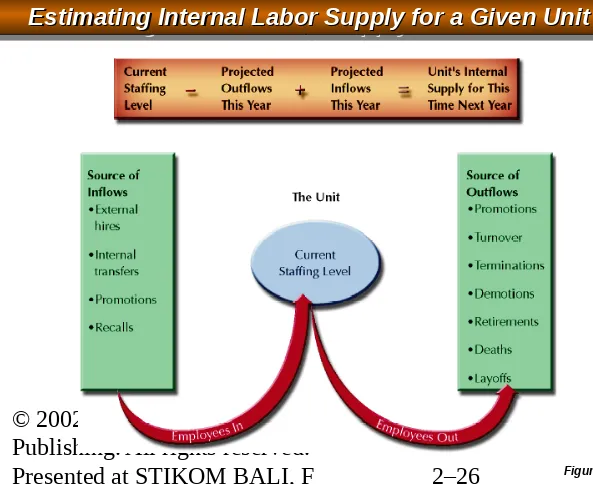
Forecasting Internal HR Supply
– Effects of promotions, lateral moves, and terminations
– Succession analysis
• Replacement charts
• Transition matrix (Markov matrix)
Exit Manager Supervisor Line Worker
Manager .15 .85 .00 .00.
Supervisor .10 .15 .70 .05
© 2002 Southwestern College Publishing. All rights reserved. Presented at STIKOM BALI, F AQ:[email protected]
2–26
Estimating Internal Labor Supply for a Given Unit
Estimating Internal Labor Supply for a Given Unit Estimating Internal Labor Supply for a Given Unit
Estimating Internal Labor Supply for a Given Unit
© 2002 Southwestern College Publishing. All rights reserved. Presented at STIKOM BALI, F AQ:[email protected]
2–27
Managing Human Resource
Managing Human Resource
Surplus or Shortage
Surplus or Shortage
Managing Human Resource
Managing Human Resource
Surplus or Shortage
Surplus or Shortage
Workforce Reductions and the WARN Act
– Identifies employer requirements for layoff advance notice.
• 60-day notice to employees and the local community before a layoff or facility closing involving more than 50 people.
• Does not cover part-time or seasonal workers.
• Imposes fines for not following notification procedure. • Has hardship clauses for unanticipated closures or
© 2002 Southwestern College Publishing. All rights reserved. Presented at STIKOM BALI, F AQ:[email protected]
2–28
Managing Human Resource
Managing Human Resource
Surplus or Shortage
Surplus or Shortage
Managing Human Resource
Managing Human Resource
Surplus or Shortage
Surplus or Shortage
Workforce Realignment
– “Downsizing”, “Rightsizing”, and “Reduction in Force” (RIF) all mean reducing the number of employees in an organization.
– Causes
• Economic—weak product demand, loss of market share to competitors
© 2002 Southwestern College Publishing. All rights reserved. Presented at STIKOM BALI, F AQ:[email protected]
2–29
Managing Human Resource
Managing Human Resource
Surplus or Shortage
Surplus or Shortage
Managing Human Resource
Managing Human Resource
Surplus or Shortage
Surplus or Shortage
Workforce Realignment (cont’d)
– Positive consequences
• Increase competitiveness • Increased productivity
– Negative consequences
• Cannibalization of HR resources
• Loss of specialized skills and experience • Loss of growth and innovation skills
– Managing survivors
• Provide explanations for actions and the future
© 2002 Southwestern College Publishing. All rights reserved. Presented at STIKOM BALI, F AQ:[email protected]
2–30
Managing Human Resource
Managing Human Resource
Surplus or Shortage
Surplus or Shortage
Managing Human Resource
Managing Human Resource
Surplus or Shortage
Surplus or Shortage
Downsizing approaches
– Attrition and hiring freezes
• Not replacing departing employees and not hiring new employees/
– Early retirement buyouts
• Offering incentives that encourage senior employees to leave the organization early.
– Layoffs
• Employees are placed on unpaid leave until called back to work when business conditions improve.
© 2002 Southwestern College Publishing. All rights reserved. Presented at STIKOM BALI, F AQ:[email protected]
2–31
Managing Human Resource
Managing Human Resource
Surplus or Shortage
Surplus or Shortage
Managing Human Resource
Managing Human Resource
Surplus or Shortage
Surplus or Shortage
Downsizing approaches (cont’d)
– Outplacement services provided to displaced employees to give them support and
assistance:
• Personal career counseling
• Resume preparation and typing services • Interviewing workshops
• Referral assistance • Severance payments
© 2002 Southwestern College Publishing. All rights reserved. Presented at STIKOM BALI, F AQ:[email protected]
2–32
Dealing with Downsizing
Dealing with Downsizing
Dealing with Downsizing
Dealing with Downsizing
Investigate alternatives to downsizing
Involve those people necessary for success in
the planning for downsizing
Develop comprehensive communications plans
Nurture the survivors
© 2002 Southwestern College Publishing. All rights reserved. Presented at STIKOM BALI, F AQ:[email protected]
2–33
Assessing HR Effectiveness
Assessing HR Effectiveness
Assessing HR Effectiveness
Assessing HR Effectiveness
Diagnostic Measures of HR Effectiveness
– HR expense per employee
– Compensation as a percent of expenses
– HR department expense as a percent of total expenses
– Cost of hires – Turnover rates
– Absenteeism rates
© 2002 Southwestern College Publishing. All rights reserved. Presented at STIKOM BALI, F AQ:[email protected]
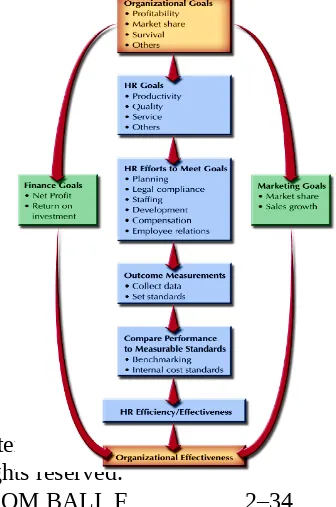
2–34 Overview of the
Overview of the HR Evaluation HR Evaluation
Process Process
Overview of the
Overview of the
HR Evaluation
HR Evaluation
Process
Process
© 2002 Southwestern College Publishing. All rights reserved. Presented at STIKOM BALI, F AQ:[email protected]
2–35
Assessing HR Effectiveness
Assessing HR Effectiveness
Assessing HR Effectiveness
Assessing HR Effectiveness
HR Audit
– A formal research effort that evaluates the current state of HR management in an
organization – Audit areas:
• Legal compliance (e.g., EEO, OSHA, ERISA, and FMLA)
• Current job specifications and descriptions
• Valid recruiting and selection process
• Formal wage and salary system • Benefits
• Employee handbook
• Absenteeism and turnover control
• Grievance resolution process
• Orientation program • Training and development
© 2002 Southwestern College Publishing. All rights reserved. Presented at STIKOM BALI, F AQ:[email protected]
2–36
Using HR Research for Assessment
Using HR Research for Assessment
Using HR Research for Assessment
Using HR Research for Assessment
HR Research
– The analysis of data from HR records to determine the effectiveness of past and present HR practices.
Primary Research
– Research method in which data are gathered first-hand for the specific project being
conducted.
Secondary Research
– Research method using data already gathered by others and reported in books, articles in
© 2002 Southwestern College Publishing. All rights reserved. Presented at STIKOM BALI, F AQ:[email protected]
2–37
HR Performance and Benchmarking
HR Performance and Benchmarking
HR Performance and Benchmarking
HR Performance and Benchmarking
Benchmarking
– Comparing specific measures of performance against data on those measures in other
“best practice” organizations
Common Benchmarks
– Total compensation as a percentage of net income before taxes
– Percent of management positions filled internally
– Dollar sales per employee
© 2002 Southwestern College Publishing. All rights reserved. Presented at STIKOM BALI, F AQ:[email protected]
2–38
Doing the Benchmarking Analysis
Doing the Benchmarking Analysis
Doing the Benchmarking Analysis
Doing the Benchmarking Analysis
Return on Investment (ROI)
– Calculation showing the value of expenditures for HR activities.
A = Operating costs for a new or enhance system for the time period
A = Operating costs for a new or enhance system for the time period
B = One-time cost of acquisition and implementation
B = One-time cost of acquisition and implementation
C = Value of gains from productivity improvements for the time period
C = Value of gains from productivity improvements for the time period
© 2002 Southwestern College Publishing. All rights reserved. Presented at STIKOM BALI, F AQ:[email protected]
2–39
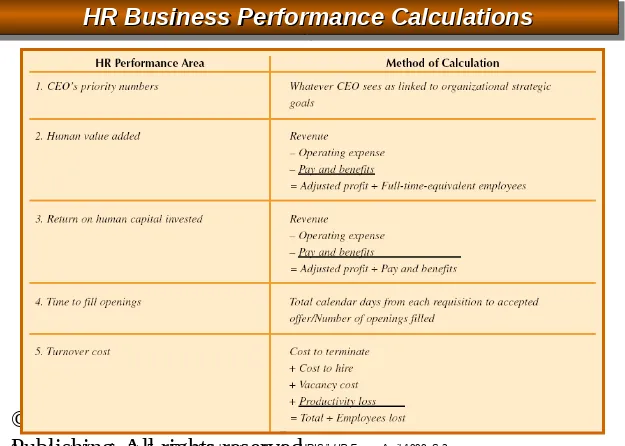
HR Business Performance Calculations
HR Business Performance Calculations HR Business Performance Calculations
HR Business Performance Calculations
Figure 2–11a
© 2002 Southwestern College Publishing. All rights reserved. Presented at STIKOM BALI, F AQ:[email protected]
2–40
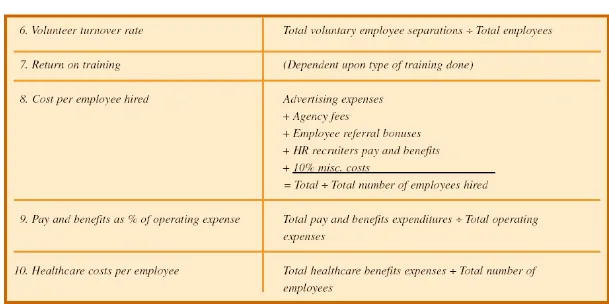
HR Business Performance Calculations
HR Business Performance Calculations HR Business Performance Calculations
HR Business Performance Calculations
Figure 2–11b
© 2002 Southwestern College Publishing. All rights reserved. Presented at STIKOM BALI, F AQ:[email protected]
2–41
Doing the Benchmarking Analysis
Doing the Benchmarking Analysis
Doing the Benchmarking Analysis
Doing the Benchmarking Analysis
Economic Value Added (EVA)
– A firm’s net operating profit after the cost of capital (minimum rate of return demanded by the shareholders) is deducted.
– Cost of capital is the benchmark for returns for all HR activities.
Utility analysis
– Analysis in which economic or other
© 2002 Southwestern College Publishing. All rights reserved. Presented at STIKOM BALI, F AQ:[email protected]
2–42
Human Resource Information Systems
Human Resource Information Systems
Human Resource Information Systems
Human Resource Information Systems
Human resource information systems
(HRIS)
– An integrated system of hardware, software, and databases designed to provide
information used in HR decision making. – Benefits of HRIS
• Administrative and operational efficiency in compiling HR data
• Availability of data for effective HR strategic planning
– Uses of HRIS
© 2002 Southwestern College Publishing. All rights reserved. Presented at STIKOM BALI, F AQ:[email protected]
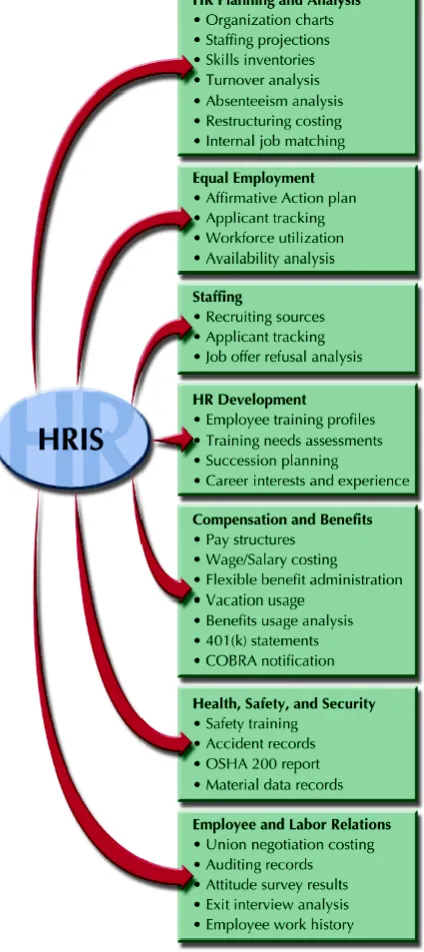
2–43 Uses of an HR
Uses of an HR Information Information System (HRIS) System (HRIS) Uses of an HR
Uses of an HR
Information
Information
System (HRIS)
System (HRIS)
© 2002 Southwestern College Publishing. All rights reserved. Presented at STIKOM BALI, F AQ:[email protected]
2–44
Designing and Implementing an HRIS
Designing and Implementing an HRIS
Designing and Implementing an HRIS
Designing and Implementing an HRIS
HRIS Design Issues
– What information available and what is information needed?
– To what uses will the information be put?
– What output format compatibility with other systems is required?
– Who will be allowed to access to the information?
© 2002 Southwestern College Publishing. All rights reserved. Presented at STIKOM BALI, F AQ:[email protected]
2–45
Accessing the HRIS
Accessing the HRIS
Accessing the HRIS
Accessing the HRIS
Intranet
– An organizational (internal) network that operates over the Internet.
Extranet
– An Internet-linked network that allows
employees access to information provided by external entities.
Web-based HRIS Uses
– Bulletin boards – Data access