December 2013 179
Accredited by DGHE No: 66b/DIKTI/Kep/2011 DOI: 10.5398/medpet.2013.36.3.179
*Corresponding author:
E-mail: [email protected]
The Relationship between Sperm Morphometry and Sperm Competition in Local
Goats of Central Java, Indonesia
S. B. Wibowoa, E. T. Setiatinb, & E. Kurniantob,*
aPostgraduate Program in Animal Sciences, Faculty of Animal and Agricultural Sciences, Diponegoro University bFaculty of Animal and Agricultural Sciences, Diponegoro University
Tembalang Campus, Semarang 50275 – Indonesia (Received 06-09-2013; Reviewed 25-10-2013; Accepted 12-11-2013)
ABSTRACT
The objective of this study was to examine the relationship between sperm morphometry and sperm competition in local goats. Forty bucks were used in this study, consisted of 4 breeds namely Etawa Grade Goat (EGG), Kejobong Goat (KJG), Kacang Goat (KCG), and Jawarandu Goat (JWG), each breeds consisted of 10 bucks. GLM, REG and DISRCRIM procedures of SAS were used to com-pute all data observed. UPGMA of MEGA 5 was used to illustrate the genetic distance among breeds. The result showed that there were diferences in the sperm morphometry among 4 breeds of goats (P<0.05). Sperm length positively related to the level of sperm competition in all local goats (P<0.05) although the value of coeicient of determinant was low (r2= 0.0043). Within breed analysis showed
that there was no positive relationship between sperm length and level of sperm competition in EGG and JWG goats. Midpiece area positively related to the principal piece (P<0.05). Sperm morphometry had a signiicant positive relation to sperm competition in local goats of Central Java.
Key words: local goats, sperm competition, sperm morphometry
ABSTRAK
Penelitian ini bertujuan untuk mengkaji hubungan antara morfometri spermatozoa dengan kompetisi spermatozoa pada kambing lokal. Empat puluh pejantan kambing digunakan dalam pene-litian ini yang terdiri atas 4 bangsa, yaitu: Peranakan Etawa (PE), Kejobong (KJ), Kacang (KC) dan Jawarandu (JR), masing-masing bangsa terdiri atas 10 ekor. Analisis data dilakukan menggunakan SAS melalui prosedur GLM, REG dan DISCRIM. UPGMA dari MEGA 5 digunakan untuk meng-gambarkan jarak antar bangsa. Hasil penelitian menunjukkan bahwa terdapat perbedaan morfometri spermatozoa diantara 4 bangsa kambing (P<0,05). Panjang spermatozoa berhubungan positif dengan level kompetisi spermatozoa pada seluruh bangsa kambing (P<0,05) meskipun koeisien determinan rendah (r2= 0,0043). Analisis dalam bangsa menunjukkan bahwa tidak terdapat hubungan positif
antara panjang sperma dengan level kompetisi sperma pada PE dan JR. Luas area midpiece berhubun-gan positif denberhubun-gan principle piece (P<0,05). Morfometri spermatozoa berhubunberhubun-gan denberhubun-gan kompetisi spermatozoa pada kambing lokal Jawa Tengah.
Kata kunci: kambing lokal, kompetisi spermatozoa, morfometri spermatozoa
INTRODUCTION
Sperm competition that was identiied in 1970, is an event where two or more males mate with a female in any given receptive period. Sperm from each ejaculate compete to fertilize ovum (Parker & Pizzari, 2010). The study about sperm competition have been reported
in mammals (Tourmente et al., 2011), amphibia (frog)
(Byrne et al., 2003), and red deer (Malo et al., 2005).
Sperm morphometry is deined as a measure of the sperm dimensions (head area, midpiece area, principal piece length, lagella length and sperm length (µm)). An automated sperm morphometry analysis system (ASMA) is a method that used for sperm morphometry analysis (Marco-Jiménez et al., 2006). The experimental study of
that large testis will produce more sperm in ejaculate (Lüpold et al., 2009). Therefore, testis mass was often
used as measure of the level sperm competition.
There are two component of sperm relating to sperm competition is still debated in evolutionary biology. Firstly, increasing of midpiece will generate in greater energy due to increasing mitochondrial area (Gomendio & Roldan, 2008). Secondly, increasing of lagella length is expected to increase swimming velocity, therefore it can be assumed there will be increasing in motility percentage. The both of components were important due to the need of velocity to arrive early in the site of fertilization within female reproductive tract.
Longer lagella will increase in sperm swimming velocity. In other hand, sperm energy is produced by mitochondrial within midpiece area. Greater energy is needed for sperm velocity. Positive correlation between longer lagella and midpiece area may give a good impact on sperm longevity. Firman & Simmons (2010) stated that size of midpiece is a predictor of swimming velocity of Mus musculus domesticus sperm. Diferent
results shown by Malo et al. (2006) who found a negative
relationship between midpiece length and swimming velocity in red deer (cervus elaphus).
The evidence of a positive relationship between sperm size and testis mass (proxy sperm competition) has been supported by several studies on various taxa (Tourmente et al., 2011). Inter-speciic studies suggest
that sperm competition was positively relating with greater number of sperm. The larger testes produce more sperm. Increasing on sperm size increasing in the sperm competition, however diferent results shown by Immler & Birkhead (2007) who found inconsistent re-sults on passerine birds. The rere-sults indicated that there was positive relationship among midpiece and lagella length to sperm competition in Fringillidae, therefore a positive relationship between sperm size and sperm competition was found in Sylviidae.
Sperm competition is a controversial issue during in the last 20 yr and unresolved in mammals. However, the results were still doubt. Several studies indicate inconsistent results and tend to vary among researchers. The study on sperm competition in Indonesian local goats is still rarely reported.
The objective of this study was to examine the relationship between sperm morphometry and sperm competition in local goats of Indonesia. In addition, to examine the relationship between midpiece area and principal piece length closely relating to the sperm ve-locity and viability.
MATERIALS AND METHODS
Materials
Semen of forty bucks (n) were used as materials in this study, consisted of 4 breeds, namely Etawa Grade Goat (EGG), Kejobong Goat (KJG), Kacang Goat (KCG), and Jawarandu Goat (JWG), in which each breeds consisted of 10 buck. Data were taken from sperm morphometry, testis mass and body mass.
Methods
Testis and body mass measurements. Semen was col-lected using an artiicial vagina (AV). Data of testis mass were obtained by measuring testicular volume (liters) from live buck. Volume measurements were measured by dipping testicles into a measuring cup scale contain-ing water, then water wasted was assumed as a measure testicular volume measured. Testicular volume measure-ments were based on the archimedes principle, in which the volume of the object that placed in water, equal to the volume of the water displaced (Sears & Zemansky, 1994). Testis mass measurements based on formula m= ρ x v, where ρ testis= 1.40 g/cm3 (ICRU Report 44, 1989). Body mass data was obtained by weighing the goats body weight (kg).
Sperm morhometry measurements. Semen was collect-ed by artiicial vagina and then dissolvcollect-ed in 0.9% physi-ological saline (1:6) on the object glass and air dried. The object glass were ixed by Bunsen lame and after that washed in alcohol absolute (cat. no. 100983 by MERCK) for 4 minutes then air dried. Put inside Cloramin 0.5% for 2 min. After that the object glass were washed with distilled water, then placed in 95% alcohol, then stained with Williams solution for 8-10 min. The object glass were washed in running water and dried (Ariiantini et al., 2006). The sperm were photographed using a Nikon
phase-contrast microscope with a magniication of 400 times.
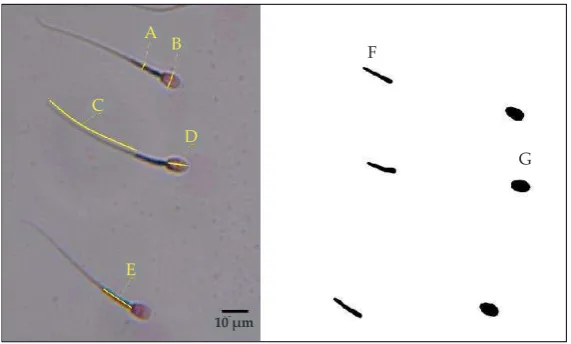
Sperm morphometry measurements were made using “ImageJ software” to 80 sperm cells in each buck. It was about 3200 sperm cell were observed. Micrometer was used to determine the unit of measure-ment. Flagella length was measured using “Segmented Line”. Head area and midpiece measurements were using “Threshold” to make adjustments the image. After that, the part of sperm tail that are not measured may removed (F and G in Figure 1). “Fill holes” was used to enhance sperm head shape. “Filters” was used to reine the part to be measured.
Statistical Analysis
General Linear Model (GLM) procedure (SAS, 2004) was used to analyze multivariate and univariate analysis. REG procedure (SAS, 2004) was used to perform multiple regression analysis to investigate the relationship between sperm morphometry and relative testis mass. UPGMA (Unweighted Pair-Group Method with Arithmetic Mean) of MEGA 5 (Tamura et al., 2011)
was used to perform distance among goat breeds based on sperm morphometry. sperm is presented in Table 1.
December 2013 181
Vol. 36 No. 3 SPERM MORPHOMETRY AND COMPETITION IN LOCAL GOAT
Sperm morphometry Breed
EGG KJG JWG KCG
Head area (µm) 37.27 ± 3.72c 34.93 ± 3.56d 41.42 ± 4.27a 37.69 ± 3.91b Head length (µm) 9.50 ± 0.52c 9.30 ± 0.56d 9.95 ± 0.55a 9.65 ± 0.53b Head width (µm) 5.07 ± 0.36b 4.85 ± 0.33c 5.36 ± 0.38a 5.05 ± 0.36b Midpiece area (µm) 16.95 ± 2.23b 16.43 ± 2.55c 17.46 ± 2.72a 16.71 ± 2.44b Midpiece length (µm) 12.66 ± 0.91b 12.86 ± 1.18a 12.85 ± 1.12a 12.83 ± 1.20a Midpiece width (µm) 2.07 ± 0.44c 2.00 ± 0.48d 2.34 ± 0.56a 2.12 ± 0.55b Principal piece length (µm) 37.81 ± 2.26a 37.56 ± 1.78b 37.48 ± 2.05b 37.84 ± 2.05a Flagella length (µm) 50.47 ± 2.06b 50.42 ± 1.47b 50.33 ± 1.83b 50.67 ± 1.64a Sperm length (µm) 59.96 ± 2.13b 59.72 ± 1.63c 60.28 ± 1.99a 60.31 ± 1.72a Note: Means in the same row with diferent superscript difer signiicantly (P<0.05). EGG= Etawa Grade Goat, KJG= Kejobong Goat, JWG= Jawarandu
Goat, KCG= Kacang Goat.
Table 1. Comparison of goats sperm morphometry
Figure 1. Sperm morphometry of Jawarandu goat, (A) midpiece width, (B) head width, (C) principal piece length, (D) head length, (E) midpiece length, (F) midpiece area, (G) head area (phase contrast microscope, stained with Williams solution).
The results showed that there were diferences in sperm morphometry of 4 local breed goat (P<0.05). The diferences were found in any part of the sperm. Sperm length of KCG and JWG goats were 60.31±1.72; 60.28±1.99 µm, in which this value was longer than EGG and KJG sperm (59.96±2.13; 59.72±1.63 µm). The sperm of JWG goats had the widest head size compared to the other 3 breeds. Goats sperm morphometry was reported that length of sperm head was 7.69 µm, width of sperm head was 3.80 µm and width/length ratio was 0.5 µm (Gravance et al., 1995). The result of this study showed
that sperm head size of Central Java Goats is larger than before inding. Head width among Central Java goats were 4.85–5.36 µm, and head length were 9.30–9.95 µm.
The sperm of JWG goats has widest midpiece area (17.46±2.72 µm), the smellers midpiece was found in KJG (16.43±2.55 µm), while longer lagella was obtained in KCG goats (50.67±1.64 µm). The lagella length of the EGG, KJG and JWG was 50.47±2.06, 50.42±1.47, 50.33±1.83 µm (P>0.05), respectively. This results were consistent with the previous inding which stated that
sperm length and sperm width of the sheep, pig and bull were 8.0–10.0 x 4.0–4.5 µm with head thickness head was 0.5–1.5 µm (Garner & Hafez, 2000). The sperm body was about twice of the length of the sperm. Length of the sperm tails were 35–45 µm. Generally length of the sperm was 50–70 µm. The staining technique used may afect the sperm head length and principal piece length (Ariiantini et al., 2006).
Relationship between Midpiece Area and Principal Piece Length
There was a signiicant positive relation between midpiece area and principal piece length at all breeds, although correlation was low (r= 0.46; r2= 0.1316; P<0.05; n= 40 buck (3200 sperm). Signiicant relationships within breeds, included in EGG (r= 0.30; r2= 0.0909; P<0.05; n= 10 buck), KJG (r= 0.43; r2= 0.1820; P<0.05; n= 10 buck), KJG (r= 0.42; r2= 0.1794; P<0.05; n= 10 buck), JWG (r= 0.33; r2= 0.1087; P<0.05; n= 10 buck). Relationships between mid-piece area and lagella length (include principal mid-piece)
#!,)()% %')("'%+)/ -)&,!'+ %#(#-#+" "-#+" ()#&#($ (# $&!+" " $&!+" %#(# $&!+" %#(# ) " )("*'&+)*+%#)'*'(.%!&# #+#'&*+#& -#+"#$$#%**'$,+#'&
#!,) "/$'!&/'&()%')("'%+)/
F
G A
10 µm E
D C
182 December 2013
was also exists in passerine birds (Immler & Birkhead, 2007). A signiicant relationship between midpiece area and lagella length was used as a possible indicator of the metabolic regulation of sperm.
Relationships between two sperm components (midpiece area and principal piece length) are important due mitochondrial contain of midpiece which resulting energy for sperm movement. All sperm components (head, midpiece and lagella) in an integrative manner, and each component have a functionally important and contribute to enhance sperm velocity (Gomendio & Roldan, 2008). Longer lagella without larger midpiece area may impact on sperm longevity, because longer lagella may resulting greater velocity and surely need greater energy. Thus, the sperm velocity and longevity may depend on it components.
Relationship between Sperm Morphometry and Sperm Competition
There were signiicant positive relationships between testis mass and sperm length at all of local goat breeds. Although the result showed a signiicant, however the value of coeicient of determinant was low (Table 2).
Figure 2 shows that there were two major groups sperm category from 4 local goat breeds based on sperm morphometry. The irst group consisted of KCG, EGG and KJG, and the second group was JWG. This result was diferent from categorize group based on morpho-metrical measurements showing two groups where the irst group consisted of KJG, JWG, and EGG and the sec-ond group was KCG (Kurnianto et al., 2013). This result
indicated that large or longer body size does not always produces the large or longer sperm size.
There were a positive relationships between midpiece area and principal piece length of local goats sperm at all breeds although the value of coeicient of correlation was low. The increasing in sperm swim-ming velocity was output from length of the lagella and supported by greater energy supply. This will be beneicial in reaching the site of fertilization and give a beter sperm penetration to the ovum (Byrne et al., 2003).
However, an increasing lagella length without followed by an increasing midpiece may impact on sperm viabil-ity due to the sperm midpiece contain of mitochondrial producing sperm energy.
Relative mass of testis was believed to be used for measure the level of sperm competition in several spe-cies including mammals (Gage & Frenckleton, 2003). There were signiicant positive relationships between sperm length and testis mass (proxy sperm competition) (P<0.05), although no signiicant relationship was found in the principal piece lagella length (P>0.05). The regres-sion analysis showed that coeicient of determinant be-tween sperm morphometry and sperm competition was low (r2). It means that there was a dominance of other factors beyond the sperm morphometry in the sperm competition (Table 2).
Although the value of r2 was low, there was an evidence of a positive relationship between sperm mor-phometry and sperm competition. It was consistent with the previous inding, in which there was a close relation-ship between sperm size and sperm competition level in 226 species of mammals (Tourmente et al., 2011). In
contrast, Gage & Freckleton (2003) found no evidence of
#!,)()% %')("'%+)/ -)&,!'+ %#(#-#+" "-#+" ()#&#($ (# $&!+" " $&!+" %#(# $&!+" %#(# ) " )("*'&+)*+%#)'*'(.%!&# #+#'&*+#& -#+"#$$#%**'$,+#'&
#!,) "/$'!&/'&()%')("'%+)/
Sperm morphometry Intercept Slope r2 CV P
Body mass Testis mass
Head length (µm) 9.563 -0.0154 0.0017 0.0552 5.97 < 0.0001 Head width (µm) 4.971 -0.0081 0.0012 0.0404 7.72 < 0.0001 Midpiece area (µm) 16.154 -0.1076 0.0031 0.0089 14.85 < 0.0001 Midpiece length (µm) 12.94 0.0027 -0.0007 0.0018 8.69 0.0533 Midpiece width (µm) 2.080 -0.0035 0.0005 0.0046 24.53 0.0006 Principal piece length (µm) 37.541 -0.0011 0.0005 0.0004 5.42 0.5608ns Flagella length (µm) 50.481 0.0016 -0.0002 0.0001 3.50 0.8954ns Sperm length (µm) 60.042 -0.0138 0.0015 0.0043 3.15 0.0010 Note: * NS (Non Signiicant), CV (Coeicient of Variance).
Table 2. Relationships between sperm morphometry and sperm competition in four breeds of local goat
Figure 2. Phylogeny on sperm morphometry
December 2013 183 relationship between sperm length and sperm
competi-tion level in 83 species of mammals.
Sperm competition is a mater, which still de-bated among related researchers, especially in mammals showing diferences results. Exploration about research regarding to local goats are still rarely reported in Indonesia. Related studies have been reported in mam-mals (Anderson et al., 2005; Malo et al., 2005; Tourmente et al., 2011), snake (Tourmente et al., 2009), amphibia
(frogs) (Byrne et al., 2003), and sea urchin (Fizpatrick et al., 2010).
Analysis results within breeds showed that there were signiicant positive relationships between sperm length and sperm competition level in KJG and KCG (P<0.05), however there was no signiicant relationship in EGG and JWG (Table 3). There was no signiicant relationship between principal piece and sperm compe-tition level in three breeds (EGG, KJG and JWG),
how-Note: NS= non signiicant, EGG= Etawa Grade Goat, KJG= Kejobong Goat, JWG= Jawarandu Goat, KCG= Kacang Goat.
Sperm morphometry Intercept Slope r2 r P
Body mass Testis mass EGG (n=10)
Head length (µm) 9.128 -0.0097 0.0018 0.026 0.16 < 0.0001 Head width (µm) 4.758 -0.0076 0.0015 0.026 0.16 < 0.0001 Midpiece area (µm) 15.233 -0.0373 0.0077 0.026 0.16 < 0.0001 Midpiece length (µm) 13.267 0.0042 -0.0017 0.013 0.11 0.0053 Midpiece width (µm) 1.436 -0.0044 0.0018 0.061 0.25 < 0.0001 Principal piece length (µm) 38.455 0.0148 -0.0030 0.004 0.06 0.2218ns Flagella length (µm) 51.723 0.0191 -0.0047 0.013 0.11 0.0065 Sperm length (µm) 60.849 0.0094 -0.0029 0.005 0.07 0.1218ns KJG (n=10)
Head length (µm) 8.466 -0.0241 0.0050 0.189 0.44 < 0.0001 Head width (µm) 4.404 -0.0131 0.0027 0.160 0.40 < 0.0001 Midpiece area (µm) 15.671 -0.0742 0.0102 0.042 0.21 < 0.0001 Midpiece length (µm) 11.309 -0.007 0.0051 0.052 0.23 < 0.0001 Midpiece width (µm) 2.049 -0.0059 0.0005 0.005 0.07 0.1546ns Principal piece length (µm) 36.69 0.0119 0.0011 0.004 0.06 0.1883ns Flagella length (µm) 47.997 0.0049 0.0063 0.062 0.25 < 0.0001 Sperm length (µm) 56.263 -0.0193 0.0113 0.129 0.36 < 0.0001 KCG (n=10)
Head length (µm) 9.843 -0.012 0.0005 0.018 0.13 0.0007 Head width (µm) 5.295 -0.0091 0.0000 0.023 0.15 < 0.0001 Midpiece area (µm) 15.422 0.0235 0.0025 0.014 0.12 0.0045 Midpiece length (µm) 12.382 0.0157 0.0001 0.007 0.08 0.0721 Midpiece width (µm) 1.914 0.0024 0.0006 0.009 0.09 0.0298 Principal piece length (µm) 36.597 0.024 0.0023 0.017 0.13 0.0010 Flagella length (µm) 48.979 0.0397 0.0023 0.046 0.21 < 0.0001 Sperm length (µm) 58.821 0.0277 0.0028 0.036 0.19 < 0.0001 JWG (n=10)
ever there was a signiicant positive relationship in KCG (P<0.05). The inconsistent result was found in Passerinde birds (Immler & Birkhead, 2007).
Sperm size has an important role in sperm competi-tion, while the sperm length is known related to sperm velocity (Tourmente et al., 2011). The high motility was
described as sperm swimming velocity. A success-ful of fertilization is a complex event, one of which is determined by individual of sperm to keep the fertilize ability and arrive in site of fertilization. Longer lagella can produce higher velocity and provides a power boost to early arrives in oviduct, so it can be predicted that longer sperm able to swim faster to reach the site of fertilization (Gomendio & Roldan, 2008).
Sperm competition is a complex event that occurs in the female reproductive organs. The female repro-ductive organs may have a stronger impact than sperm morphometry in the sperm competition, this assump-tion may cause value of r2 was low (Minder et al., 2005; Immler & Birkhead, 2007).
CONCLUSION
There are diferences in sperm morphometry among 4 breeds of local goats. Sperm morphometry has a signiicant positive relation to sperm competition level in local goats of Central Java. The next experimental study is needed to demonstrate this inding.
REFERENCES
Ariiantini, R. I., T. Wresdiyanti, & E. F. Retnani. 2006. Kaji banding morfometri spermatozoa sapi Bali (Bos sondaicus) menggunakan pewarnaan Williams, Eosin, Eosin Nigrosin dan Formol-Saline. J. Sain Vet. 24:65-70.J. Sain Vet. 24:65-70.
Anderson, M. J., J. Nyholt, & A. F. Dixion. 2005. Sperm com-2005. Sperm com-petition and the evolution of sperm midpiece volume in mammals. J. Zool. 267: 135-145. htp://dx.doi.org/10.1017/ S0952836905007284
Byrne, P. G., L. W. Simmons, & J. D. Roberts. 2003. Sperm competition and the evolution and the evolution of gamete morphology in frogs. Proc. R. Soc. B 270: 2079-2086. htp:// dx.doi.org/10.1098/rspb.2003.2433
Firman, C. R. & L. W. Simmons. 2009. Sperm midpiece length predicts sperm swimming velocity in house mice. Biol. Let. 6:513-516. htp://dx.doi.org/10.1098/rsbl.2009.1027 Fizpatrick, J.L., F. Garcia-Gonzalez, & J. P. Evans. 2010. Link
-ing sperm length and velocity: the importance of intramale variation. Biol. Let. 6: 797-799. htp://dx.doi.org/10.1098/ rsbl.2010.0231
Gage, M. J. G. & R. P. Frenckleton. 2003. Relative testis size and
sperm morphometry across mammals: no evidence for as -sociation between sperm competition and sperm length. Proc. R. Soc. B 270:625-635. htp://dx.doi.org/10.1098/ rspb.2002.2258
Garner, D. L. & E. S. E. Hafez. 2000. Spermatozoa and Seminal Plasma.In: B. Hafez & E. S. E. Hafez (Eds.). Reproduction in Farm Animals. 7th Ed. Lippincot Wiliams & Wilkins.
Philadelphia.
Gomendio, M. & E. R. S. Roldan. 2008. Implications of diver -sity in sperm size and function for sperm competition and fertility. Int. J. Dev. Biol. 52: 439-477. htp://dx.doi. org/10.1387/ijdb.082595mg
Gravance, C.G., K. M. Lewis, & P. J. Casey. 1995. Computer
automated sperm head morphometry analysis (ASMA) of goat sperm. Theriogenology 44: 989-1002. htp://dx.doi. org/10.1016/0093-691X(95)00286-H
Hosken, D. J. & P. I. Ward. 2001. Experimental evidence for tes -tis size evolution via sperm competition. Ecol. let. 4:10-13. htp://dx.doi.org/10.1046/j.1461-0248.2001.00198.x
ICRU, 1989. Tissue Substitutes in Radiation Dosimetry and
Measurement, Report 44 of the Comimission on Radiation Units and Measurements, Bethesda, MD.
Immler, S. & T. R. Birkhead. 2007. Sperm competition and sperm midpiece size: no consistent patern in passerine birds. Proc. R. Soc. B. 274:561-568. htp://dx.doi.org/10.1098/ rspb.2006.3752
Kurnianto, E., S. Sutopo, E. Purbowati, E. T. Setiatin, D. Sam-sudewa, & T. Permatasari. 2013. Multivariate analysis of
morphological traits of local goats in central java, Indone -sia. Iran. J. Appl. Anim. Sci. 3:361-367.
Lüpold, S., S. Calhim, S. Immler, & T.R. Birkhead. 2009. Sperm morphology and sperm velocity in passerine birds. Proc. R. Soc. B 276:1175-1181. htp://dx.doi.org/10.1098/ rspb.2008.1645
Malo, A.F., J. Garde, A. J. Soler, A. J. Garcia, M. Gomendio, & E. R. S. Roldan. 2005. Male fertility in natural populations
of red deer is determined by sperm velocity and the pro -portion of normal spermatozoa. Biol. Reprod. 72: 822-829. htp://dx.doi.org/10.1095/biolreprod.104.036368
Malo, A. F., M. Giomendio, J. Garde, B. Lang-Lenton, A. J. Soler, & E. R. S. Roldan. 2006. Sperm design and sperm function. Biol. Let. 2:246-249. htp://dx.doi.org/10.1098/ rsbl.2006.0449
Marco-Jiménez, F., M. P. Viudes-de-Castro, S. Balasch, E. Mocé, M. A. Silvestre, E.A. Gomez, & J.S. Vicente. 2006. Morphometric changes in goat sperm heads induced by cryopreservation. Cryobiology 52: 295-304. htp://dx.doi. org/10.1016/j.cryobiol.2006.01.002
Minder, A. M., D. J. Hosken, & P. I. Ward. 2005. Co-evolution
of male and female reproductive characters across the Sca -tophagidae (Diptera). J. Evol. Biol. 18:60-69. htp://dx.doi. org/10.1111/j.1420-9101.2004.00799.x
Parker, G. A. & T. Pizzari. 2010. Sperm competition and ejacu -late economics. Biol. Rev. 85: 897-934.
SAS Institute. 2004. SAS®/STAT Software, Release 9.11. SAS In
-stitute, Inc., Cary, North Carolina.
Sears, F. W., & M. W. Zemansky. 1994. Fisika untuk Universitas1994. Fisika untuk Universitas
1. Bina Cipta, Jakarta.
Tamura, K., D. Peterson, N. Peterson, G. Stecher, M. Nei, & S. Kumar. 2011. MEGA 5: Molecular evolutionary gene -tics analysis using maximum likelihood, evolutionary dis -tance, and maximum Parsimony methods. Mol. Biol. Evol. 28:2731- 2739. htp://dx.doi.org/10.1093/molbev/msr121 Tourmente, M.,M. Gomendio, E. R. S. Roldan., L. Giojalas, &
M. Chiaraviglio. 2009. Sperm competition and reproducti -ve mode inluence sperm dimensions and structure among snakes. Evolution. 63: 2513-2524.Evolution. 63: 2513-2524. htp://dx.doi.org/10.1111/ j.1558-5646.2009.00739.x
Tourmente, M., M. Gomendio, & E. R. S. Roldan. 2011. Sperm competition and the evolution of sperm design in mam -mals. J. Evol. Biol. 11:12 1471-2148.