O R I G I N A L A R T I C L E
Do We Tweet Differently From Our Mobile
Devices? A Study of Language Differences
on Mobile and Web-Based Twitter Platforms
Dhiraj Murthy1, Sawyer Bowman2, Alexander J. Gross3, & Marisa McGarry2 1 Department of Sociology, Goldsmiths, University of London, London SE14 6NW, UK2 Social Network Innovation Lab, Bowdoin College, Brunswick, ME 04011, USA 3 Department of Intermedia Arts, University of Maine, Orono, ME 04469, USA
Using Twitter as a case study, this article hypothesizes that social media content that is produced on mobile versus web platforms may be qualitatively different. As we increas-ingly tweet from our smartphones, we may be encouraged to “report” on our immediate thoughts, feelings, physical self, and surroundings. This article seeks to understand whether these presentations of self tend to be more egocentric, negative/positive, gendered, or com-munal depending on whether they were tweeted from mobile devices or web platforms. Using 6 weeks of Twitter data collected in 2013, we found evidence that users tweet differ-ently from mobile devices and that mobile tweeting is informing new behaviors, attitudes, and linguistic styles online.
Keywords:Mobile, Desktop, Twitter, Gender, Egocentric, Communal, Social Media.
doi:10.1111/jcom.12176
Mobile penetration worldwide has increased exponentially in the last decade. The International Telecommunications Union (2015) reports that there are over 7.08 billion mobile phone subscriptions. In many ways, the smartphone has become ubiquitous (Niels, 2013). Smartphones allow their users to access a host of additional applications that go beyond traditional phone calls such as accessing the Internet, taking and uploading photographs, and providing GPS services. Indeed, 64% of American cell phone users own a smartphone (Smith, 2015). Given this pervasive-ness, it is important to understand how the rise of mobile computing has changed (if at all) social media content.
Social researchers have found Twitter, the popular microblogging platform, extremely useful in understanding a multitude of complex social processes due to its easily accessible data, brief messages, and timeliness (Murthy, 2015; Sloan, Morgan,
Burnap, & Williams, 2015). However, there remains a lack of understanding as to how mobile or web engagement of Twitter changes one’s use of the medium in current Twitter literature. Owing to their small data size, tweets can be easily sent out over mobile devices or via text messages in instances where web access is unavailable (Veinott, Cox, & Mueller, 2009). Indeed, Twitter was first conceived as an SMS-based service with a 140-character limit. Yet, we do not have a complete picture as to when mobile access to Twitter is more prevalent than web access. We increasingly document what we are doing “in the moment” such as what we are eating, watching, or who we are with via mobile-based Twitter apps (Naaman, Boase, & Lai, 2010). But, is the content of these mobile-originated tweets any different from those we produce on our desktop/laptop computers? This study seeks to directly answer this question by inves-tigating the differences in content between mobile and web-based tweets as well as categorizing differences in content through the notion of social media “styles.” Specif-ically, tweets are considered to reflect gendered, communal, and egocentric styles.
However, the study of mobile Twitter usage can be particularly challenging. Because of the plethora of Twitter clients, the literature has generally singled out the most frequently used mobile and desktop platforms (Wohn & Na, 2011). Previously, studies of mobile Twitter usage had been oriented toward marketing or business intelligence, leaving a gap in the literature. Studying mobile usage of Twitter from an academic perspective is critically important to better understanding the context of social media content production. This article seeks to fill this gap by providing a detailed comparison of tweets originating from mobile and web-based platforms. Ultimately, we seek to understand whether our social media presentations of self tend to be more egocentric, negative/positive, gendered, or communal depending on whether they were tweeted from mobile devices or web platforms. We selected these specific categories based on previously established word lists in social psychology to investigate our research questions. Additionally, these categories covered a broad range of behaviors that represent the user population as a whole. Using 6 weeks of Twitter data, we found that we tweet differently from our mobile devices. Specifically, we found that mobile tweets do tend to use more egocentric language than web-based tweets. We also found that tweets tend to be gendered, employing masculine language, but this does not vary significantly by platform. Importantly, we found that negative language is used more frequently by mobile users, suggesting that our in the moment social media reporting of our lives may be skewed toward negative portrayals.
Studying mobile tweet content
of digital tracing. Because so much of our social life exists in social media, it is critical that we use a wide variety of interdisciplinary methods such as natural language processing to try and discern the extremely complex and nuanced social processes that are being performed, enacted, and articulated in these technosocial spaces. Though Burrows and Savage (2014) single out sociology, the social sciences have historically struggled to leverage the power of social Big Data. Fortunately, many social scientists are beginning to embrace it. For example, Tinati, Halford, Carr, and Pope (2014) studied tweets regarding the UK student fees protests to uniquely understand the flow of information and the emergence of social networks over time. They conclude that the broadening of experimental methodology with large social datasets such as Twitter allows for novel ways to study “detailed content as well as overall patterns” (Tinati et al., 2014, p. 678). Sloan et al. (2013) argue that the Twitter spritzer stream (1% of all tweets) is an important data source for social science. They argue that understanding the demographics of Twitter users via these data provides extremely large sample sizes for social scientific analytic methods. However, there remains much to uncover about user demographics as well as general sociolinguistic behavior on Twitter to get to Sloan et al.’s (2013) desired endpoint.
Though there is a general lack of scholarship on mobile Twitter use, studies of mobile Internet usage have found that mobile content production and consumption centers on activities such as watching TV and eating dinner and that mobile-web usage tends to peak late at night around 10 pm (Cui & Roto, 2008). Chae and Kim (2003) found that mobile-web usage was more intimate since most users do not share their cell phone. Page (2012, p. 7) argues that mobile technologies such as smart-phones have led to an “untether[ing] from static computer terminals” and have facil-itated interactions that are “interwoven increasingly with daily experience.” Though not specific to mobile tweets, Naaman et al. (2010) found that, on average, over 40% of a user’s messages consisted of emotional or physical status updates, a class of mes-sages they term “me-now.” Tweets regarding what users are eating, for example, could help reveal important dietary choices and better contribute to the health of Twitter users (Hingle et al., 2013). While these choices reflect a user’s personal life, we also see instances of real-time Twitter use for professionals. Some surgeons live-tweet during surgeries and educators successfully used the medium to further engage with students outside the classroom (Junco, Heiberger, & Loken, 2011). This literature explores some aspects of mobile social media but generally does not specifically compare mobile-and web-based platforms.
Categorizing tweets
conjunctions. Gendered content, rather than the biological sex of a user, is impor-tant as a common unit of analysis for the content of tweets. However, sex has been an important variable for studying social media use. For example, Lasorsa (2012) found that female journalists tend to reveal more about themselves and their personal lives on Twitter than their male counterparts. Sloan et al. (2013) collected a large set of tweets using the Twitter API to investigate demographic characteristics of Twitter users. They found near gender parity among users in their sample. While the ratio of female to male users on Twitter is nearly equal, it is important to consider how the gendered content of language may or may not change across devices. Different devices may provide particular “affordances” (Treem & Leonardi, 2012) for certain types of tweeting (e.g., sharing professional content with colleagues versus sharing intimate content with family and friends), encouraging the use of more gendered language on a particular device over another. Others argue that context collapse in platforms such as Facebook and Twitter has led to some users taking great care to restrict what con-tent (including biographical information) can be seen by the public or by less close ties (Page, 2013). While it is difficult to grasp a full picture of Twitter users by gen-der, there have been successful broader examinations of self-presentation within the medium (e.g., Marwick & boyd, 2011).
This self-presentation is often strongly me-centric or communal as discussed in the previous section. Following Bakan’s (1966) argument that human behavior can often be categorized into “agency” and “communion,” tweets could potentially be grouped into similar categories. For Bakan, agency includes behavior that focuses on achievement and success, while communion represents behavior aimed at improv-ing social ties. Adjectives representimprov-ing agentic ideas include those like “assertive,” “confident,” and “outspoken.” Conversely, adjectives considered to represent com-munal ideals include “affectionate,” “tactful,” and “caring” (Madera, Hebl, & Martin, 2009). Others have found that participants were more likely to describe themselves and others in communal ways (Abele & Bruckmüller, 2011). However, Leonard (1997) cautions against viewing agency and communion as opposite ends of a spectrum. She found that these traits can rise and fall in tandem. These traits are often mapped along gender lines with agentic traits often considered more masculine and communal traits more feminine (Rudman & Glick, 2001).
from the WordNet Affect database (Strapparava & Valitutti, 2004). Naaman, Zhang, Brody, and Lotan (2012), in their study of tweets from 29 major cities in the United States & United Kingdom, focused on the diurnal patterns associated with certain keywords. They found that certain words associated with repeated actions—like sleep and lunch—appeared consistently during certain times regardless of city, while others—like lol or funny—did not appear in similar patterns. This use of Twitter data has been important for discerning macrolevel trends.
The use of natural language processing techniques to study Twitter data has become established in the literature (Hachey & Osborne, 2010). For example, Grin-berg, Naaman, Shaw, and Lotan (2013) study aggregate daily patterns of Foursquare check-ins and use Twitter data to extract similar patterns. Like the work of Golder and Macy (2011), their work is also diurnally focused. Grinberg et al. use bigrams and trigrams in order to analyze speech patterns of tweets during Hurricane Sandy. They use a hybrid approach to label the top 200 terms they extracted from Twitter and Foursquare data. They found the diurnal patterns in Foursquare—which are closely tied to face-to-face actions—are extremely similar to patterns on Twitter. Using analytic techniques from sociolinguistic scholarship, Zappavigna (2011) applied Systemic Functional Linguistics (SFL) to study sentiment toward the election of Barack Obama in the wake of the 2008 U.S. presidential election. She argues that tweet content provides affordances—especially through hashtags—that make it searchable (what she terms “searchable talk”) and, as such, conducive to the work of Internet linguistics (Zappavigna, 2012).
Research questions (RQs)
Research Question (RQ1): Are mobile tweets more egocentric than web tweets? As a result of the inherently personal nature of mobile devices, we hypothesize that tweets from mobile sources will contain more references to the self. This follows from Deuze’s (2012, p. 57) argument that mobile phones have facilitated “processes of personal transformation toward greater individualization.” On the other hand, the web may represent a source that results in more reflection and thus more references to others in addition to the self.
Research Question 2 (RQ2): Do mobile tweets employ more “feminine” language than web tweets?While the user population in Sloan et al.’s (2013) study represents near gender parity, women have been found to have different motivations for using social media (e.g., for keeping in touch with family and friends) compared to men (Smith, 2011). Mobile tweeting could be complementing these relationship mainte-nance behaviors. Additionally, different computer-mediated communication contexts have been found to have consequences for gendered language use (Huffaker & Calvert, 2005). Mobile platforms may encourage feminine language through a perceived social connectedness.
and occurrences in the moment. Styles of tweeting from mobile devices are likely to be more in the moment partially due to ease of access. While this likely provides a more in-depth look into an active user’s life, the ease with which the user can tweet may be facilitating more sentiment in tweets. And a pull to negative sentiment could occur much like the “negativity bias” in online reviewing (Yin, Bond, & Zhang, 2014). In comparison, tweeting from the web may not have the same ease of access as mobile throughout the day. As a result, web tweets may encourage more careful reflections of the day’s events, leading to less sentiment-laden tweets.
Research Question 4 (RQ4): Are mobile tweets more agentic than web tweets?In Research Question 1, we predict that mobile tweets could be more egocentric than web-based tweets. Consequently, we hypothesize that mobile tweets would also center more on individualistic attributes of the self. These traits tend to reflect bold, outspoken, and frank personalities as well as reflection and censorship. As a result, web-based tweets may be more representative of communal characteristics. These traits emphasize behavior that contributes to the health of the group as opposed to the individual.
These four research questions seek to provide a more nuanced understanding of the similarities and differences between mobile and web usage of Twitter by exposing and evaluating possible tweeting behaviors and patterns in self-presentation found in tweets of each source. Each of these questions evaluates expressions of differences in time and space between mobile- and web-based tweets. More specifically, these ques-tions address the level of egocentricity in tweets, gendered tweets, the level of positivity or negativity in tweets, and the nature of agentic and communal traits exhibited in tweets across mobile and web sources.
Methods
Data collection
Twitter provides an Application Programming Interface (API) that allows for the col-lection of a stream of sampled tweets from the overall flow of all global tweets at any given time. Twitter delivers approximately 1% of all tweets via the free “Spritzer” stream. We used a Hadoop distributed file system (HDFS) to store the tweets and accompanying metadata and this data was queried using the Apache Hive distributed database system (Murthy & Bowman, 2014). In the summer of 2013, we collected over 235 million tweets at a rate of approximately 5 million tweets per day.
Tweet classification and filtering methods
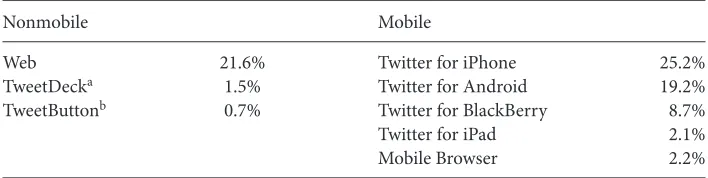
In order to investigate differences between mobile and web Twitter usage, it is impor-tant to be able to identify individual tweets as having been published via web/desktop clients or from a mobile device. Information about tweet sources is recorded in the metadata delivered with each tweet. In a previous study of mobile versus non-mobile Twitter usage (Perreault & Ruths, 2011), a list of commonly used tweet sources was generated and coded as mobile, nonmobile, or mixed sources. Because of the large number of unique sources observed, only the top 215 were coded, accounting for about 90% of all sources observed. Our data indicate that in a typical day, more than 15,000 unique sources are observed, though only a few sources are popularly used. In fact, over 90% of all tweets can be sourced to just the top 20 Twitter sources. This aggre-gation of Twitter source diversity may be in part related to the fact that in recent years, Twitter has taken a greater interest in controlling the Twitter experience through lim-iting access of third-party Twitter clients (Gayomali, 2013; Valentino-DeVries, 2011). The specific classification of sources and their weights within the overall sample are reported in Table 1. We were able to select a set of eight official, Twitter-sanctioned sources and classify them as mobile or nonmobile in nature. In particular, the pres-ence of a diversity of types for mobile sources reduces the potential for bias introduced by favoring one type over another. For example, a dataset containing only Twitter for iPhone may represent a population of users with inherent similarities. The presence of different types of mobile tweeting platforms in our dataset minimizes the possibil-ity for such bias. The differences in percentage of users tweeting from these platforms also indicate that mobile tweets will proportionally represent behaviors correspond-ing to types of mobile devices. These eight sources (as detailed in Table 1) account for 81.2% of all tweets.
To better explore diurnal trends in tweeting behavior, we chose to focus our investigation of tweets to a particular range of time zones largely encompassing the American continents (UTC −5 to UTC −8). Further, we limited our analysis
Table 1 Sources used in Mobile/Nonmobile Tweet Sample and Percentage Usage Among All Tweets
Nonmobile Mobile
Web 21.6% Twitter for iPhone 25.2%
TweetDecka 1.5% Twitter for Android 19.2%
TweetButtonb 0.7% Twitter for BlackBerry 8.7%
Twitter for iPad 2.1%
Mobile Browser 2.2%
aTweet Deck was previously a mixed platform since their purchase by Twitter in May 2011.
They discontinued the mobile version and desktop client of TweetDeck as of May 2013.
bTweetButton is the officially sanctioned website-embeddable tweet button, typically employed
to allow web users to easily share content from the web. Although not explicitly limited to nonmobile, it is limited to website interactions and mobile “tweet button” usage is rare.
regardless of language, while 34% of tweets regardless of time zone are English-language. The final dataset taking into consideration common sources, time zones, and languages of interest is comprised of roughly 24 million tweets, about 10% of the overall number of tweets collected over the same time period. This gives 500 K tweets per day and roughly 21 K tweets per hour on average.
Tweet n-gram analysis
and trigrams typically have lower max occurrences for the top n-gram in each cate-gory, but also decay at a slower rate. This follows as bigrams and trigrams project the finite word space,𝕎per hour, onto larger𝕎2and𝕎3spaces.
In order to model the various behaviors proposed in our research questions, we selected a set of words for each behavioral aspect category of the research questions. We grouped n-grams via a series of lookup tables created for each category, assign-ing specific n-grams to groups by date-hour, source, and aggregate frequency. This allowed us to track and compare these behaviors over time as well as between mobile and nonmobile Twitter usage. Each category underwent the same process. For certain categories, the set of chosen words are not all common n-grams; some may not even consistently occur among the top n-gram for any given hour. By grouping together collections of words, we sought to smooth the diurnal time series for each group and serve as a proxy for overall relative volumes of occurrences of n-grams which indicate the chosen categorical traits within the available tweet corpus.
In developing our groupings, we extended to Twitter data word lists developed by Greenwald and Farnham (2000) for use in Implicit Association Tests (IAT), an associative psychosocial personality test often used to test positive and negative asso-ciations with self and other. This test relies on presenting a series of words selected from four word lists representing two binary concepts. Users are asked to repeatedly classify words presented randomly from each list from one pole of each binary oppo-sition together. The speed with which this can be accomplished represents the level to which the association is natural to the user. For instance if the binaries selected in the test are gendered words and self/other words, most women should be able to more easily associate the self-words with the feminine words and thus complete the test faster. Though the nature of our work is not about issues of implicit association, the word lists developed by Greenwald and Farnham provide good, simple lists of words associated with several of the behavioral patterns we seek to address in this article, specifically self concept, gender concept, and emotional concept. To investi-gate agency in the Twitter unigram corpus, we developed word lists based on Madera et al.’s (2009) work that seeks to categorize agentic versus communal language.
Self style
To test RQ1, we utilized Greenwald and Farnham’s (2000) set of words associated with the notion of “self.” A partial list of these words includes words such asI,me, my,mine, andself againstthey,them,their,it, andother. Applying these lists to the body of tweets we have collected serves as a good proxy for the overall egocentricity of tweets.
Gender style
gender, as opposed to common gendered nouns and pronouns. This was thought to be more accurate for discerning the gendered valence of tweet messages themselves as opposed to common gendered object of tweet messages.
Emotional style
To test RQ3, we used Greenwald and Farnham’s (2000) positive and negative emo-tion word list that includes a set of words that represent both positive and negative emotions. This list incorporates words such ashappy,smile, andjoyfor positive and pain,grief, andagonyfor negative. We used this list instead of traditional word sen-timent libraries, because these lists were developed to represent concepts generally accepted by most individuals as associated with the positive or negative. Additionally, traditional sentiment dictionaries are often challenged by tweet language and do face difficulties in terms of the classification of negation, sarcasm, etc. (Martínez-Cámara, Martín-Valdivia, Urena-López, & Montejo-Ráez, 2014). Though any list is bound to face these challenges, we hypothesized that a list of general words which focuses on negative or positive concepts as opposed to action words or adjectives would help us avoid some of these common sensitivities and gauge the level to which tweets contain positive and negative ideas.
Agentic and communal style
To test RQ4, we used Madera et al.’s (2009) agentic and communal word list. This list uses words such asassertive,confident, andambitiousfor agentic andaffectionate, helpful, andsympatheticfor communal. This comprehensive list is particularly suited to investigating the level to which tweets display agentic or communal properties and allowed us to group tweet unigrams within our sample.
Results
The data we collected and the interdisciplinary methodological approaches we employed allowed us to reach conclusions regarding the ways in which language on Twitter operates in terms of whether that language is more individualistic (agentic) or more societally oriented (communal). We were also able to evaluate gendered patterns within tweets and whether language in tweets was considered more ego-centric. Some of the key areas we explored were: the percentage difference between mobile and web sources for a particular research question, the time of peak tweet frequency for a particular research question, and the prevalence of one source over another across all research questions. These conclusions are similar to Naaman et al.’s (2010) study of the egocentric nature of mobile tweets but different than literature that correlates communal traits with gender (Rudman & Glick, 2001).
RQ1: Egocentricity
hour
0 5 10 15 20
fr
eq
source_class
Mobile other Mobile self Web other Web self
20000
15000
10000
5000
0
Figure 1 Self versus other for mobile- and web-based tweets.
mobileself andotherunigrams versus nonmobileself andotherunigrams across an average day. The results demonstrate that both mobile and web have consistently higher frequencies forself than their counterpart. Whileself continues to increase steadily into the night for both mobile and web,otherexhibits a shallower slope or even a decreasing slope at the same hour.
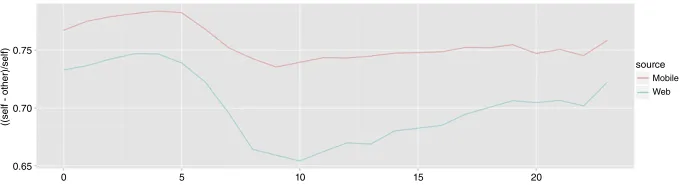
While Figure 1 effectively illustrates the rise and fall of frequencies forself and othercategories over mobile and web sources, it fails to demonstrate if one source is more egocentric than the others due to a lack of scaling. In order to see more clearly the relationship between the volume ofself andotherfocused language, Figure 2 ren-ders that relationship as the percent by whichself-centered language dominates over other-centered language for each date-hour for mobile and nonmobile tweets respec-tively. We were able to observe that mobile tweets are consistently around 2.5% more egocentric than nonmobile users on average. All tweets are observed to be least ego-centric in the late mornings (around 9 to 10 a.m.). From that point onward, mobile and nonmobile gradually rise into the evening and through to the next morning, peaking around 3–4 a.m. This, in part, helps to confirm RQ1 by demonstrating that mobile tweets contain a higher ratio of egocentric language at all times of the day. We found that regardless of tweet source, egocentricity is most tempered during the hours of the day when people are usually at work. This is despite the fact that overall tweet volume is known to steadily increase throughout the day. Though tweeting is not sup-pressed midday, our egocentricity is. When we are at work or school, we may focus more on activities that are communal or we may not have time to tweet. After school
hour
0 5 10 15 20
((self - other)/self)
source
Mobile Web
0.75
0.70
0.65
hrid
Sun Mon Tue Wed Thu Fri Sat
((self - other)/self)
source
Mobile Web
0.75
0.70
0.65
Figure 3 Self versus other for mobile- and web-based tweets across an average week (by
percent).
and after work hours, the focus seems to shift back to a more egocentric presentation of self.
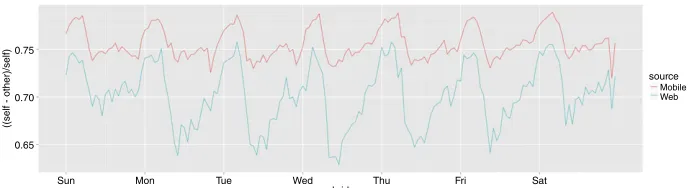
Self-unigrams are consistently used most regardless of day or source. However, we found no special relationship between the frequency of egocentric language pro-duced in tweets and the days of the week. Each typical day was found to be more or less identical to the day before, aside from a small drop in typical frequencies on Fri-days and SaturFri-days. This may be due to Twitter users not using their phones to tweet as frequently while going out on the weekend. This finding contradicts the general assumption that users provide a real-time rundown of their weekend tweet by tweet. This trend is not as pronounced for the web for either self or other unigrams. Sun-day morning exhibits especially low frequencies for web-sourced egocentric language. This may speak to a slower pace of life on Sundays or visiting houses of worship, which results in lower frequencies of web-based tweets. As fewer total tweets are produced on those days, the production of egocentric and nonegocentric language is similarly blunted.
Figure 3 affirms the findings illustrated in Figure 2. By examining the percentage by which egocentric unigrams outnumber nonegocentric ones over time, mobile tweets are at least 2.5% more egocentric than nonmobile tweets on average. The drop-off in egocentricity is not as severe on Saturdays and Sundays as users are more likely to be free from work and school commitments on those days.
hour
0 5 10 15 20
fr
eq
source_class
Mobile feminine Mobile masculine Web feminine Web masculine
40
30
20
10
0
Figure 4 Gendered n-gram use in tweets by day.
We also found that the daily egocentricity depression and mobile-web deficit increases toward the middle of the week, peaking with an 11% web deficit on Wednesdays. It may be that Wednesday is the day when people are most distant from their personal selves in what has been referred to popularly as “Hump Day” (Areni & Burger, 2008). Thursdays and Fridays bring the promise of the weekend and tweets are more connected with our personal selves, resulting in an increasing tendency to publish egocentric tweets. Once the weekend has passed, tweets again move away from the personal, confirming a relationship between tweeting patterns and free time.
RQ2: Gender
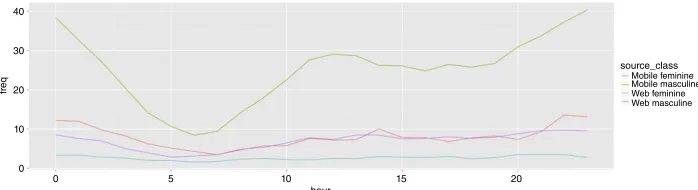
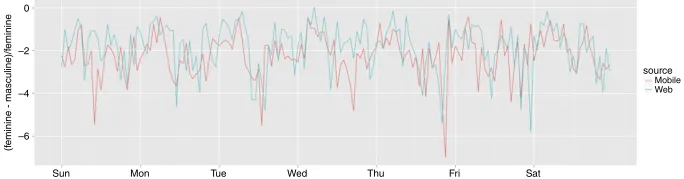
Research Question 2 posits that mobile tweets are gendered, specifically containing more feminine-associated words than web-based tweets. Our data negate this research question. Figure 4 illustrates that for mobile and web-based tweets, unigrams associ-ated with masculinity clearly dominate in typical usage. For mobile and web, “mas-culine” unigrams not only rise in frequency earlier in the morning than “feminine” unigrams, but also experience a dramatic rise and a sharp fall after midnight (see Figure 4). Furthermore, masculine unigrams exhibit a rise or plateau into the late evening, whereas feminine-associated unigrams demonstrate a general decline across mobile and web.
fr
Sun Mon Tue Wed Thu Fri Sat
Figure 5 Gendered n-gram use in tweets by week.
words. Each list consists of only six words, which reduces the chances of finding a match in these data.
Data by week is noisy and does not actually reveal any clear daily pattern in either instance (see Figure 6). This noisy relation is likely the result that tweets do not consistently use particular words to signify gender. As we measured the gendered presence of n-grams which are typically associated as masculine or feminine, these data are not intended to indicate the relative number of male or female users of Twitter on various devices over time. Rather, it indicates that regardless of user gen-der, a more linguistically masculine discourse is dominant. Our results also indicate that time matters. For example, feminine-associated unigrams on mobile do not rise dramatically during school or work hours, whereas masculine-associated unigrams on mobile experience dramatic rises in frequency. Indeed, feminine-associated unigrams on mobile only rise sharply after 8 p.m.
RQ3: Positive/Negative
Research Question 3 posits that mobile-based Twitter users have a greater propensity for using more negative words in their tweets. Since mobile access allows for real-time updates to a user’s Twitter profile, this could encourage users to tweet experienced sentiment in real-time. And a tendency to tweet the negative potentially parallels “negativity bias” in online reviewing (Yin et al., 2014). Web users may be less inclined to share any sentiment at all as they may be more self-censored or because they tweet less spontaneously. However, tweeting in the moment via mobile may also not
(f
Sun Mon Tue Wed Thu Fri Sat
source
Mobile Web
hour
Figure 7 Negative and positive (both affective and evaluative) n-grams in tweets.
necessarily imply negativity, but could simply result in an increase in sentiment—both negative and positive—as users may reflect minimally before tweeting. In contrast, the reflection of web users may be part of intentional self-presentation in positive terms, processes that have benefits for employment as well as our social lives.
Figure 7 illustrates that there are more occurrences of positive words than nega-tive words for both mobile and web Twitter users. While the occurrence of positivity is higher than negativity, Figure 8 illustrates that we found a higher percent of neg-ative tweets from mobile users over an average day in our sample. These data indi-cate that over an average week in our sample, there appears to be an unexpectedly large tendency toward negative tweets from both mobile and web sources on Saturday evening.
Figure 7 compares positive and negative unigrams over the course of an average day. Positive unigrams were found to have a slightly higher frequency for both sources. Mobile, negative unigrams tend to start rising in frequency later in the morning than positive unigrams. The same trend can be seen for the web data. Additionally, negative unigrams tend to decline earlier in the evening than positive unigrams.
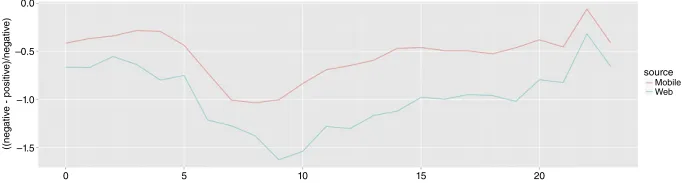
Figure 8 illustrates the percent difference between mobile and web for pos-itive and negative tweets. These data confirm the hypothesis that mobile tweets are more negative than web-based tweets. At any given point in the day, mobile tweets are at least 25% more negative than web-based tweets. Negativity is highest for both mobile and web sources in the late evening, but there is also a significant
((neg
hrid
Sun Mon Tue Wed Thu Fri Sat
source_class
Figure 9 Negative versus positive (both affective and evaluative) n-grams across an average week.
amount of negativity early in the morning. The level of negativity experiences a steep drop-off in the late morning and steadily climbs until evening for both sources.
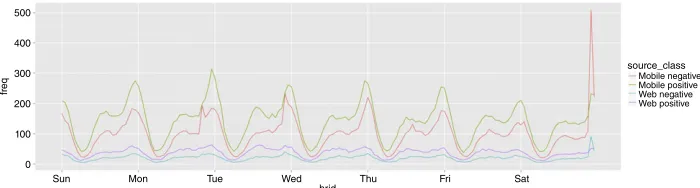
Figure 9 illustrates the frequencies of positive and negative unigrams for mobile and web sources across an average week. Again, frequencies are highest for positive unigrams across mobile and web sources. Moreover, these peaks experience signifi-cant drops in frequency during Friday and Saturday (with the exception of spikes in negative tweets attributed to discrete events such as the death of actor Cory Mon-teith). There is a level of tweet frequency that is constant (e.g., see Figure 3). How-ever, the magnitude of some events can skew the expected frequency distribution of tweets. Web-based positive unigrams have similar frequency peaks in the morn-ing and evenmorn-ing, whereas mobile evenmorn-ing peaks are significantly higher. In terms of mobile-based tweets, negative peaks appear to occur earlier in the day on Monday and Tuesday than the positive peaks.
By expanding our time frame from an average day to an average week, mobile tweets were found to continue to be more negative throughout the week. As Figure 10 indicates, the general trend for mobile indicates a higher level of negativity in the early morning, followed by a steep drop-off in the late morning. This is followed by a steady increase to a peak in the late evening early in the week. However, as the week pro-gresses, the peak in the evening shifts to a peak in the early evening. This trend starts
hrid
Sun Mon Tue Wed Thu Fri Sat
source
hour
Figure 11 Agentic and communal n-grams over an average day.
on Thursdays. Additionally, the moment where web users become more negative than mobile users is on Saturday during the late morning.
RQ4: Agentic/Communal
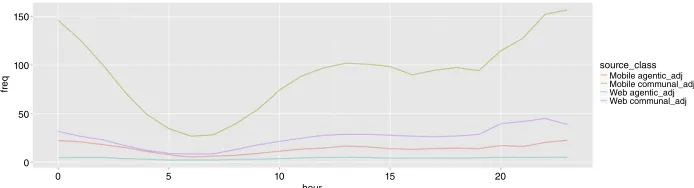
Research Question 4 posits that mobile tweets are more agentic than web-based tweets. This hypothesis was refuted as mobile-based tweets were not found to be more agentic than web-based tweets. Figure 11 illustrates the relative frequencies of agentic and communal unigrams across mobile and web sources. This figure indicates that communal n-grams are more prevalent than agentic for both mobile and web sources. However, there are some fundamental differences in mobile and web. For example, mobile has a steady increase into the late evening for both communal and agentic n-grams, whereas web has a decrease.
Figure 12 illustrates data that negate the hypothesis that mobile tweets are more agentic than web-based tweets. Web is slightly more agentic than mobile as indicated by the fact that the majority of the web curve is above the mobile curve in Figure 12. For both mobile and web, the peak of agentic tweeting occurs in the early morning and steadily declines until the late evening. Web-based tweets particularly experienced a severe drop in the evening, highlighting more agentic mobile tweets during the end of the day.
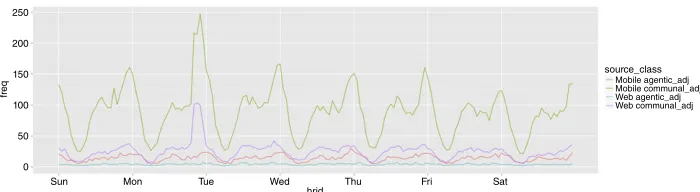
Figure 13 illustrates that over an average week, mobile-based tweets tend to exhibit communal traits at much higher rates than agentic. This trend is consistent across both mobile- and web-based. There is a significant rise of communal tweets on Monday
hour
hrid
Sun Mon Tue Wed Thu Fri Sat
source_class
Mobile agentic_adj Mobile communal_adj Web agentic_adj Web communal_adj
150 200 250
100
50
0
fr
eq
Figure 13 Agentic and communal n-grams across an average week.
night. Unusual spikes are likely occurring because of specific events associated with a particular word for a brief time during the observation period. When we account for unusual spikes, there is no significant difference in the use of communal and agentic unigrams on Twitter. These n-grams rise and fall in conjunction with the expected volume of tweets over the week.
When comparing the percent of agentic and communal tweets across source, we found that consistent patterns emerged, suggesting a greater number of communal tweets across both platforms. There is a considerable increase in these tweets from web sources on Monday evening. As before, this is likely due to particular events skewing the data.
Conclusion
This study developed from our belief that Twitter is an increasingly important space for social communication and that the medium—mobile or other—where tweet-ing occurs can shape that communication (Murthy, 2013). This is not to say that the medium is deterministic of the content. Rather, tweets constructed to echo a partic-ular sentiment or tell a particpartic-ular side of a story can and do appear on both mobile and web-based platforms. However, as McLuhan (1964) famously argued, the “na-ture of the medium” itself should be an important object of study for media scholars. Given the ubiquitous nature of smartphones and their push toward “greater individ-ualization” (Deuze, 2012), mobile media was hypothesized to be influencing tweet styles.
Ultimately, we found that mobile tweets are not only more egocentric in language than any other group, but that the ratio of egocentric to nonegocentric tweets is consistently greater for mobile tweets than from nonmobile sources. We did not find that mobile tweets were particularly gendered. Regardless of platform, tweets tended to employ words traditionally associated as masculine. We did find that negative language is used more frequently by mobile users at any point in time, a finding that would benefit from further research. The ratio of negative to positive unigrams was also found to be consistently greater for mobile tweets than web tweets. Lastly, we did not find that mobile-based tweets are more agentic than web-based tweets. Rather, both platforms tended to employ language that was associated with communal behaviors.
These conclusions are important for several reasons. This is the first study to inves-tigate tweets for the daily and weekly trends for various behaviors by mobile- and web-based platforms. This is significant because we did find significant differences between mobile- and web-based social media use. Our results provide evidence of linguistic styles that emerge based on the source of social media content. Some of the differences between mobile- and web-based platforms speak to the on-the-go nature of tweeting from a mobile device. We increasingly tweet while we move through our day (e.g., while we walk, travel, and eat). Our results also illustrate interesting patterns in terms of the diurnal rise and fall of tweet frequency for both mobile- and web-based sources. For example, egocentric spikes tend to occur in the early morning, whereas negative spikes tend to occur in the late evening for both mobile and web. Overall, we found that not all tweets are the same and the source of tweets does influence tweet-ing patterns. This article also underscores the point that social media research should investigate the source of social media content in addition to raw textual content.
Ultimately, a major argument this article makes is that the context of media pro-duction really matters. We have highlighted the value of keeping the question open as to whether the type of people who tweet from mobile devices are qualitatively differ-ent from those who tweet from web-based platforms. This question requires further study but is fundamentally important. This is particularly true because scholarship across the disciplines has been quick to study Twitter data but often with minimal effort in understanding differences in how these data are produced.
References
Abele, A. E., & Bruckmüller, S. (2011). The bigger one of the “Big Two”? Preferential
processing of communal information.Journal of Experimental Social Psychology,47(5),
935–948. doi:10.1016/j.jesp.2011.03.028.
Areni, C. S., & Burger, M. (2008). Memories of “bad” days are more biased than memories of
“good” days: Past Saturdays vary, but past Mondays are always blue.Journal of Applied
Social Psychology,38(6), 1395–1415.
Bakan, D. (1966).The duality of human existence: Isolation and communion in Western man.
Boston, MA: Beacon Press.
Bamman, D., Eisenstein, J., & Schnoebelen, T. (2012). Gender in twitter: Styles, stances, and
Burrows, R., & Savage, M. (2014). After the crisis? Big Data and the methodological
challenges of empirical sociology.Big Data & Society. doi: 10.1177/2053951714540280.
Chae, M., & Kim, J. (2003). What’s so different about the mobile Internet?Communications of
the ACM,46(12), 240–247. doi:10.1145/953460.953506.
Cui, Y., & Roto, V. (2008).How people use the web on mobile devices. Paper presented at the
Proceedings of the 17th International Conference on the World Wide Web, Beijing, China.
Deuze, M. (2012).Media life. Cambridge, England: Polity Press.
Gayomali, C. (2013, March 5). Why Twitter is killing tweet.The Week. Retrieved from
http://theweek.com/article/index/240907/why-twitter-is-killing-tweetdeck
Golder, S. A., & Macy, M. W. (2011). Diurnal and seasonal mood vary with work, sleep, and
daylength across diverse cultures.Science,333(6051), 1878–1881.
doi:10.1126/science.1202775.
Greenwald, A. G., & Farnham, S. D. (2000). Using the Implicit Association Test to measure
self-esteem and self-concept.Journal of Personality and Social Psychology,79(6),
1022–1038. doi:10.1037/0022-3514.79.6.1022.
Grinberg, N., Naaman, M., Shaw, B., & Lotan, G. (2013).Extracting diurnal patterns of real
world activity from social media. Paper presented at the 7th International AAAI Conference on Weblogs and Social Media.
Hachey, B., & Osborne, M. (2010).Proceedings of the NAACL HLT 2010 Workshop on
Computational Linguistics in a World of Social Media, Los Angeles, CA.
Hingle, M., Yoon, D., Fowler, J., Kobourov, S., Schneider, M. L., Falk, D., & Burd, R. (2013). Collection and visualization of dietary behavior and reasons for eating using Twitter.
Journal of Medical Internet Research,15(6). doi:10.2196/jmir.2613.
Huffaker, D. A., & Calvert, S. L. (2005). Gender, identity, and language use in teenage blogs.
Journal of Computer-Mediated Communication,10(2). doi:10.1111/j.1083-6101.2005. tb00238.x.
International Telecommunications Union. (2015). Key ICT indicators for developed and developing countries and the world. From International Telecommunications Union.
Jones, C. (2014). Apple is starting to claw back some iPhone market share.Forbes.
Junco, R., Heiberger, G., & Loken, E. (2011). The effect of Twitter on college student
engagement and grades.Journal of Computer Assisted Learning,27(2), 119–132.
doi:10.1111/j.1365-2729.2010.00387.x.
Lampos, V., Lansdall-Welfare, T., Araya, R., & Cristianini, N. (2013). Analysing mood
patterns in the United Kingdom through Twitter content.arXiv preprint arXiv:1304.5507.
Lasorsa, D. (2012). Transparency and other journalistic norms on Twitter.Journalism Studies,
13(3), 402–417. doi:10.1080/1461670X.2012.657909.
Leonard, R. (1997). Theorizing the relationship between agency and communion.Theory &
Psychology,7(6), 823–835.
Madera, J. M., Hebl, M. R., & Martin, R. C. (2009). Gender and letters of recommendation for
academia: Agentic and communal differences.Journal of Applied Psychology,94(6), 1591.
Martínez-Cámara, E., Martín-Valdivia, M. T., Urena-López, L. A., & Montejo-Ráez, A. R.
(2014). Sentiment analysis in twitter.Natural Language Engineering,20(01), 1–28.
Marwick, A. E., & boyd, d. (2011). I tweet honestly, I tweet passionately: Twitter users,
context collapse, and the imagined audience.New Media & Society,13(1), 114–133.
McLuhan, M. (1964).Understanding media: The extensions of man(1st ed.). New York, NY:
Mislove, A., Lehmann, S., Ahn, Y.-Y., Onnela, J.-P., & Rosenquist, J. N. (2011). Understanding
the demographics of Twitter users.ICWSM, 11, 5th.
Murthy, D. (2013).Twitter: Social communication in the Twitter age. Cambridge, England:
Polity.
Murthy, D. (2015). Critically engaging with social media research methods. In L. McKie & L.
Ryan (Eds.),An end to the crisis of empirical sociology? Trends and challenges in social
research. Abingdon, England: Routledge.
Murthy, D., & Bowman, S. A. (2014). Big Data solutions on a small scale: Evaluating
accessible high-performance computing for social research.Big Data & Society,1(2),
1–12. doi:10.1177/2053951714559105.
Naaman, M., Boase, J., & Lai, C.-H. (2010).Is it really about me? Message content in social
awareness streams. Paper presented at the Proceedings of the 2010 ACM conference on Computer supported cooperative work, Savannah, GA.
Naaman, M., Zhang, A., Brody, S., & Lotan, G. (2012). On the Study of Diurnal Urban Routines on Twitter. International AAAI Conference on Web and Social Media, North America. Retrieved from http://www.aaai.org/ocs/index.php/ICWSM/ICWSM12/ paper/view/4610
Niels, H. (2013). Empirical research through ubiquitous data collection.Computer,46,
74–76.
Page, R. (2012).Stories and social media: Identities and interaction. New York, NY: Routledge.
Page, R. (2013). Hoaxes, hacking and humor: Analysing impersonated identity. In
P. Seargeant & C. Tagg (Eds.),The language of social media: Identity and community on
the Internet(pp. 46–64). London, England: Palgrave Macmillan.
Perreault, M., & Ruths, D. (2011).The effect of mobile platforms on Twitter content generation.
Rudman, L. A., & Glick, P. (2001). Prescriptive gender stereotypes and backlash toward
agentic women.Journal of Social Issues,57(4), 743–762.
Sloan, L., Morgan, J., Burnap, P., & Williams, M. (2015). Who tweets? Deriving the demographic characteristics of age, occupation and social class from Twitter user
meta-data.PLoS ONE,10(3), e0115545.
Sloan, L., Morgan, J., Housley, W., Williams, M., Edwards, A., Burnap, P., & Rana, O. (2013). Knowing the tweeters: Deriving sociologically relevant demographics from Twitter.
Sociological Research Online,18(3), 7.
Smith, A. (2011). Why Americans use social media.Pew Internet & American Life Project,
1–11.
Smith, A. (2015). The smartphone difference.Pew Internet & American Life Project.
Washington, DC: Pew Research Center.
Strapparava, C., & Valitutti, A. (2004).WordNet affect: An affective extension of WordNet.
Paper presented at the LREC.
Tinati, R., Halford, S., Carr, L., & Pope, C. (2014). Big data: Methodological challenges and
approaches for sociological analysis.Sociology,48(4), 663–681.
doi:10.1177/0038038513511561.
Treem, J. W., & Leonardi, P. M. (2012). Social media use in organizations: Exploring the
affordances of visibility, editability, persistence, and association.Communication
Yearbook,36, 143–189.
Valentino-DeVries, J. (2011, May 25). Twitter buys TweetDeck.Wall Street Journal. Retrieved
Veinott, B., Cox, D., & Mueller, S. (2009).Social media supporting disaster response: Evaluation of a lightweight collaborative tool.Paper presented at the Proceedings of NDM9, the 9th International Conference on Naturalistic Decision Making.
Williams, J., & Katz, G. (2012).A new Twitter verb lexicon for natural language processing.
Paper presented at the LREC.
Wohn, D. Y., & Na, E.-K. (2011). Tweeting about TV: Sharing television viewing experiences
via social media message streams.First Monday,16(3). Retrieved from http://firstmonday.
org/ojs/index.php/fm/article/view/3368/2779
Yarkoni, T. (2010). Personality in 100,000 words: A large-scale analysis of personality and
word use among bloggers.Journal of Research in Personality,44(3), 363–373.
doi:10.1016/j.jrp.2010.04.001.
Yin, D., Bond, S., & Zhang, H. (2014). Anxious or angry? Effects of discrete emotions on the
perceived helpfulness of online reviews.MIS Quarterly,38(2), 539–560.
Zappavigna, M. (2011). Ambient affiliation: A linguistic perspective on Twitter.New Media &
Society,13(5), 788–806.
Zappavigna, M. (2012).The discourse of Twitter and social media. London, England: