STRATEGIC VALUES IN MADRASA
DEVELOPMENT IN KUDUS
(Management Study of Islamic Education
Perspective in Nusantara)
Kisbiyanto IAIN Kudus
Setyoningsih IAIN Kudus
Abstract
This study aims to explain the basic values of madrasa management in Kudus, the values of developing madrasa in Kudus, and the excellent
values of madrasa in Kudus. This research is a field study that uses
a qualitative approach. Data collection uses interview, observation, and document study methods. Data analysis used the Spradley model, namely domain, taxonomic, compound, and cultural themes analysis. The result of this study explains that the strategic values in the madrasa lie in the basic values of the madrasa i.e. an educational institution whose main mission is to teach the islamic sciences. The next strategic values are the values of development which focus on a better quality learning model, namely curriculum, learning and output. Furthermore, the excellent values of the madrasa are focused on three
in the knowledge of Islam, the values of excellence in memorizing
the Qur’an, and the values of excellence in the field of research. It is
recommended that the madrasah aliyah in Kudus also develop other strategic values to become excellent, such as international schools or ICT based schools.
Keywords: Strategic Values, Madrasa Development.
Introduction A.
Madrasas in Indonesia have a strategic role after they are
defined as organizers of public education that have religious
characteristics. Madrasas become two education centers, namely the science and knowledge education center, and
the Islamic study center. The scientific and religious mission
of Islam are united as a madrasa mission which is also the mission of islamic education, namely educating muslim
students to be intellectually, emotionally and spiritually perfect personalities for the success and happiness of life
in the world and the hereafter. Therefore, a madrasa is an
Islamic school that has a special role in spiritual education
aimed at national education in Indonesia as embodied in
the Law of the Republic of Indonesia Number 20 of 2003
Article 11.
Madrasas as recipients of socio-religious mandates have strategic values to carry out the educational process
to achieve goals. These values are also from social values in Indonesia. Therefore education in madrasas is not only about
understanding and implementing the teachings of Islam, but
also creating ethics and order of life in Indonesia. Madrasas later became institutions of Islamic education and nationhood
nationalism education. So, madrasas are important not only for muslims, but also for Indonesian citizens.
Madrasas in Kudus Central Java consist of 116 Raudlatul Athfal, 143 Madrasah Ibtidaiyah, 67 Madrasah Tsanawiyah, and 36 Madrasah Aliyah which are all formal
madrasas. Non-formal madrasas consist of 472 Koran
learning centers for children (TPQ), 237 madrasah diniyah ula, 30 madrasah diniyah wustha, 10 madrasah diniyah ulya, and 1 ma’had aliy2. Madrasah Aliyah in Kudus, Central Java
Indonesia have a fairly good position as many students from
outside the area are studying in Kudus. Madrasah Aliyah that are the reference for the community include MAN 2 Kudus, MAN 1 Kudus, Madrasah Aliyah Qudsiyah, Madrasah Aliyah
NU Tasywiqut Thullab Salafiyah (TBS), Madrasah Aliyah NU Banat, Madrasah Aliyah Tahfidz Yanbu’ul Qur’an,
and Madrasah Aliyah Ma’ahid. Madrasah aliyah in Kudus does have its own characteristics so that it is interesting to study further.
The religious value system is the most important part of the spirit of managing the madrasah aliyah in Kudus.
The learning tradition as tafaqquh fiddin or the deepening of Islamic religion is the basic value of administering madrasa.
Other strategic values such as superior programs, special programs, and so on are very interesting to study in order to get the patterns that make up the value system.
Madrasah aliyah which have good qualifications in Kudus should be studied further because of their proven success, both in academic and non-academic achievements,
as well as achievements at the local, national and international levels. Surely, there are factors that cause the success of madrasah aliyah i.e. good management in terms of vision,
mission, programs, activities, and overall implementation of
education so that madrasa education is ensured of quality.
Madrasas also experience progress and setbacks in various aspects. A madrasa has many students because the community believes in its quality in the past and then
decreases the number of students in the future. However,
there is also the opposite, i.e the madrasa experience progress from the previous time. All cannot be separated from the causes behind it. Madrasas are organized in a clear direction
based on the results of the thoughts and efforts of the managers. The madrasa managers have values that become their reference for behaving and acting. These values are really interesting to study because they have a very decisive
role for the strategic steps of developing madrasas.
This study uses a qualitative approach to explain reality convincingly as a scientific finding3. The focus of the study
on the typology of madrasas is aimed at three studies, namely explain the basic values of managing madrasa in Kudus, then (2) explain the values of developing madrasa in Kudus, and (3) explain the excellent values of madrasa in Kudus. Data
collection through various methods as stated by Nasution4, Matthew5, Bogdan6, namely interview, observation, and
documentation study techniques. Focus group discussion
(FGD) is data collection through discussion forums, as
well as data verification stages7. Testing the validity of the data uses four criteria, namely credibility, transferability,
3 James H. McMillan and Sally Schumacher, Reseach In Education : A Conceptual
Introduction, (San Francisco:Longman, 2001), p 29.
4 S. Nasution, Metode Penelitian Naturalistik. (Bandung:Tarsito, 1996), p 58. 5 Matthew B Miles and A Michael Huberman, Analisis Data Kualitatif .
Terjemahan Tjetjep Rohendi, (Jakarta: Universitas Indonesia, 1992). P 59
6 Robert C. Bogdan and S Knopp Biklen, Riset Kualitatif untuk Pendidikan :
Pengantar Teori dan Metode. Terjemahan Munandir, (Jakarta:Pusat Antar Universitas untuk
Peningkatan dan Pengembangan Aktifitas Instruksional Universitas Terbuka, 1990), p 33.
7 Catherine Marshall and Gretchen B. Rossman, Designing Qualitative Research,
dependability and confirmability8. The collected and validity
data tested are then analyzed. Data analysis uses Spradley9
model analysis as well as those suggested by Ryan10, and
exemplified by Sugiyono11 that is through four stages of analysis, namely domain analysis, taxonomic analysis,
compound analysis, and analysis of cultural themes. Domain analysis is the first step in this type of qualitative research to
determine what categories of data have been obtained. The
next step is taxonomic analysis to describe the results of the categories in those domains. Then the componential analysis is to find specific differences from each detail obtained in
taxonomic analysis. The last is the theme analysis, which is
to find relationships between domains and how they relate to the whole so that research finds conclusions as findings.
The analytical model used is the analysis model according to
Ryan and Bernard in Denzin where the technical analysis of data in cultural domains uses compound analysis, taxonomy and mental maps.
Discussion B.
Literature Review 1.
Strategic management is the art and science of
formulating, implementing and evaluating cross-functional decisions that enable an organization to achieve its objectives.
In other words, strategic management focuses on integrating
management, marketing, finance, and accounting, production and operations, research and development (R&D) and
8 Lexy J. Moleong, Metodologi Penelitian Kualitatif, (Yogyakarta:Rake Sarasin,
2000), p 78.
9 James Spradley, Participant Observation, (Rinchart and Winston:Holt, 1980), p. 115. 10 Norman K Denzin and Yvonna Lincold, Handbook of Qualitative Research.
(California:Sage Publication Inc, 2000), p 377
11 Sugiyono, Metode Penelitian Pendidikan Pendekatan Kuantitatif, Kualitatif dan R &
information system to achieve organizational success12.
The strategic management process consists of three stages: strategy formulation, strategy implementation, and strategy evaluation. The first stage in strategic management is strategy formulation which includes developing a vision and a mission, identifying an organization’s external opportunities
and threats, determining internal strengths and weaknesses,
establishing long-term objectives, generating alternative strategies, and choosing particular strategies to pursue. The second stage is strategy implementation. It requires a firm to establish annual objectives, devise policies, motivate employees, and allocate resources so that formulated strategies can be executed. In addition, it includes developing a strategy-supportive culture, creating an effective organizational structure, redirecting marketing efforts, preparing budgets, developing and using information systems, and linking employee compensation to organizational performance. The third stage is the final stage namely, strategy evaluation that
is needed because success today is no guarantee of success
tomorrow. Therefore, managers desperately need to know when particular strategies are not working well. To obtain
the information they use three fundamental activities i.e. reviewing external and internal factors that are the bases
for current strategies, and then measuring performance, and
then taking corrective actions.13
To determine the main strategy of an organization, it is
necessary to do three stages of the framework with a matrix as a model of analysis. These matrixes are in accordance with
all size and type of organization, so that they can be used in identifying, evaluating, and choosing the most appropriate
12 David, Fred R, Strategic Management Concepts and Cases: A Competitive Advantage
Approach, (Edinburgh Gate:Pearson Education Limited, 2017), p 33
strategies. This model does not guarantee success, but it does
represent a clear and practical approach for formulating, implementing, and evaluating strategies. It can be seen that relationships among major components of the strategic management process shown in the model appears in all subsequent chapters with appropriate areas shaped to show the particular focus of each chapter. Furthermore, this text is organized around this model because the model reveals how organizations actually do strategic planning. 14
In education, a good principal must know and understand his duties and responsibilities as a leader in
an educational institution so that he is able to know and
formulate policies in achieving set goals and can implement
effective strategic management by conducting environmental
scans, creating strategy formulations, implement strategies and conduct evaluations and supervision of teachers and
school staff. The study conducted by Moh amin15 on the
strategic management implementation of the junior high school principal in Serang concluded that the principal
had carried out strategic management activities to move teachers and education staff to achieve school goals namely learning achievement / quality of graduates who could
master the competencies contained in KTSP by applying
strategic management by conducting environmental scans,
making strategy formulations, implementing strategies and
conducting monitoring and evaluation.
14 David, Fred R, Strategic Management Concepts and Cases: A Competitive Advantage
Approach, (Edinburgh Gate:Pearson Education Limited, 2017), p 42
15 Moh. Amin, “Impelementasi Manajemen Strategis Kepala Sekolah Menengah Pertama
Di Kabupaten Serang”, TARBAWI Volume 2, Number 02, Juli – Desember 2016, p
Abazar Zohrabi, Nikzad Manteghi16 are proposing a
comprehensive framework in order to formulate strategy in educational organizations. This approach is based on Malcolm Baldrige National Quality Award (MBNQA) Education Criteria for selecting competitive strategies. In this method, firstly, by using SWOT matrix, they have formulated initial strategies of the organization. After that, they have allocated these strategies to four BSC perspectives. Then making
use of these strategies in the House of Quality (HOQ) as
«Whats/alternatives», they subsequently considered MBNQA
Education Criteria with the role of «Hows/criteria” in the HOQ as a criteria for selection of strategies. Finally they
performed screening and selection of initial strategies by using fuzzy screening technique. A case study is utilized to show the efficiency of the proposed model.
Albana Berisha Qehaja, Enver Kutllovci, Justina
Shiroka Pula 17 review the empirical literature on strategic management tools and techniques usage using textual
narrative synthesis method. Initially, their study presents tabulation with a summary of empirical research for the period 1990–2015. The included studies are organized clustering them by enterprise size and sector and by country level development. A synopsis of the ten most used strategic
tools and techniques worldwide resulted as follows: SWOT analysis, benchmarking, PEST analysis, “what if ” analysis,
vision and mission statements, Porter’s five forces analysis, business financial analysis, key success factors analysis,
costbeneft analysis and customer satisfaction.
16 Abazar Zohrabi, Nikzad Manteghi, “A Proposed Model for Strategic Planning in Educational Organization”, Procedia - Social and Behavioral Sciences, 28 (2011), p 205 –
210
17 Albana Berisha Qehaja, Enver Kutllovci, Justina Shiroka, “Strategic Management Tools and Techniques Usage: A Qualitative Review”, Acta Universitatis Agriculturae Et
Ahmad M. Rabee18 represents a case study of the University of Jordan concerning strategic management of
human resources in educational organizations. He found
that the innovation can be executed but the results of the innovation cannot be seen in short time. The resistance
of innovation of academic staff for the application and
use of new technologies to activate the communication and effective management of human resources will slow down the tangible results closely. Furthermore, the result also shows that the human resources management and
the innovation process can be executed successfully as the
academic staff will be obligated to use the new technologies in his academic activities.
In Arief Subhan’s research19, one of the results concluded that the madrasa, at the beginning of the 20th
century, was a symbol of modernization which experienced an important shift, namely as a public school characterized by
religion. In this case, he called it the culmination of madrasa
modernization. The Law of the Republic of Indonesia
Number 20 of 2003 concerning the National Education System determines the vision of national education in Indonesia. One of them regulates madrasa education as equated with school education with the term general
education characterized by religion. Since 2003, the madrasa has a vision that has changed slightly from purely Islamic religious education to general education characterized by Islam. This has a big impact, especially on the structure of
the curriculum and the distribution of time allocation for each subject.
18 Ahmad M. Rabee, “Strategic Management of Human Resources in Educational
Organizations”, European Scientific Journal, Volume 10, Number 10, April 2014, p
292-300
19 Subhan Arief, Lembaga Pendidikan Islam Indonesia Abad ke-20 – Pergumulan
In his research, A. Zuhdi concluded about excellent madrasas with their types, namely excellent madrasa because of student input, infrastructure, and learning system20. In
this study it was explained that excellent madrasas can be characterized by several criteria, namely excellence because the input is very good so the output also shows success. There
is also a madrasa which is excellent because the facilities
and infrastructure are well fulfilled so that it becomes a supporting learning system that produces very good output.
There are also excellent madrasas because learning systems
are well designed and implemented as effective learning that
makes students achieve their achievements.
Kisbiyanto’s research results concluded that madrasah diniyah has a value system that is applied in its organizational behavior, namely religious values (natijah diniyah), social values (natijah ijtimaiyah), and scientific values (natijah ilmiah)21.
Madrasah diniyah is a form of non-formal madrasas organized by the community with a prioritization of a socio-religious
vision with a learning system that focuses on mastering the knowledge of religion through arabic books. The education
system does not depend very strongly on regulations from
the government as in formal education. The scholars and
teachers who teach emphasize the life curriculum in the form of social behavior that prioritizes morals, mutual respect, and
love for the country.
The classic conception of values in anthropology was
introduced by Kluckhohn and Strodtbeck. According to
them, values answer basic existential questions, helping to provide meaning in people’s lives. For example, Kluckhohn
20 A. Zuhdi, ”Madrasah sebagai Tipologi Lembaga Pendidikan Islam – Kajian tentang
Berbagai Model Madrasah Unggulan”, Jurnal MADRASAH, Volume 5, Number 1,
Desember 2012, p 8.
21 Kisbiyanto, “Organizational Behavior At Madrasah Diniyah In Indonesia”, Volume
and Strodtbeck argue that Americans value the effort and
respect of individuals because of their fundamental beliefs in the innate nature of human nature and the capacity of
individuals to get the desired goals. In sociology, sociologists,
particularly Parsons, accentuated a different conception of
values, and according to Parsons and Shils i.e. values are
believed to help alleviate conflicts between individual and collective interests. Values serve an important function by enabling individuals to work together to realize collectively
desirable goals.22
The value theory according to Schwartz is conception of values that specifies six main features that are implicit in the writings of many theorists. The first, values are beliefs
linked inextricably to affect. When values are activated, they
become infused with feeling. For example, people for whom independence is an important value become aroused if their independence is threatened, despair when they are helpless to protect it, and are happy when they can enjoy it. The
second, values refer to desirable goals that motivate action.
People who consider social order, justice, and helpfulness are important values are motivated to pursue these goals. The third, values transcend specific actions and situations. Honesty values, for example, may be relevant in the workplace or school, in business or politics, with family, friends or
strangers. The fourth, values serve as standards or criteria to
guide the selection or evaluation of actions, policies, people, and events. People decide what is good or bad, justified or illegitimate, worth doing or avoiding, based on possible consequences for their cherished values. The fifth, values are ordered by importance relative to one another. An ordered system of priorities that characterize them as individuals is formed from people’s value. This hierarchical feature also
distinguishes values from norms and attitudes. The sixth,
the relative importance of multiple values guides action. Any attitude or behavior typically has implications for more than one value. Values influence action when they are relevant in the context or hence likely to be activated and important to
the actor.23 Result 2.
The vision and mission of the madrasah aliyah are determined by many values that are the reach of thoughts,
ideals, and goals and assumptions that are built from the public’s perception of the image of the madrasa. Therefore,
internal and external factors are always a consideration for
developing the madrasa in the future. Madrasah Aliyah in Kudus has gained the trust of the Kudus people and its surroundings so that they feel confident to send their children to study and seek experience there. The students
are not only from Kudus, but also from outside the region
and outside the island such as Demak, Jepara, Pati, Rembang, Grobogan, Blora, East Java, West Java, outside Java and some
from abroad.
There are 36 madrasas in Kudus that have their own characteristics, namely the Madrasah Aliyah which has
mastery of islamic knowledges, such as MANU TBS, MA
Qudsiyah, MA Ma’ahid and the like, and then madrasah
aliyah that favor the memorization of the Koran such as MA Tahfidz Yanbu’ul Qur’an, and then madrasah aliyah that favor institutional management such as MANU Banat as the first ISO-signed madrasa in Indonesia, and Madrasah Aliyah that favor their research fields such as MAN 2 Kudus and then also proclaimed at MAN 1 Kudus.
23 Shalom H. Schwartz, “An Overview of the Schwartz Theory of Basic Values”, Online Readings In Psychology And Culture, International Association for
Based on domain analysis, there are several strategic
values as a result of thinking and are then believed to be
making progress by managers and educators in madrasa. These strategic values are referred to as basic values, development values, and excellent values for the development of madrasa. Basic values are values that are built from the foundation of
islamic science as an islamic educational institution. Madrasa
as the center of islamic studies is the most important
value and should not be changed because it is the soul of
the madrasa. Development values are the effectiveness of madrasas in providing islamic education services to the community where each madrasa has a specific strategy in learning as outlined in the curriculum and its implementation, both open curriculum and hidden curriculum. The values of
excellence are the values of the wisdom of the madrasa in
affirming their image as madrasas that have specificities that can be relied upon as excellent madrasas.
Based on taxonomic analysis, the basic values in the madrasa culminate in scientific and islamic values. The value of development leads to the value of learning that exceeds the minimum standard of learning, with a press point on theoretical learning in the classroom and learning with field studies. Most learning is generally carried out in
the classroom with the aim of mastering the subject matter
thoroughly. Meanwhile, learning based on field studies is less
widely carried out. For madrassas that have a strong desire to
develop, the managers and educators work hard to act more
advanced than usual habits. It is an advance in thinking with
lies in three types, namely the excellence of the tafaqquh fiddin
madrasa, the tahfidz madrasa, and the research madrasa.
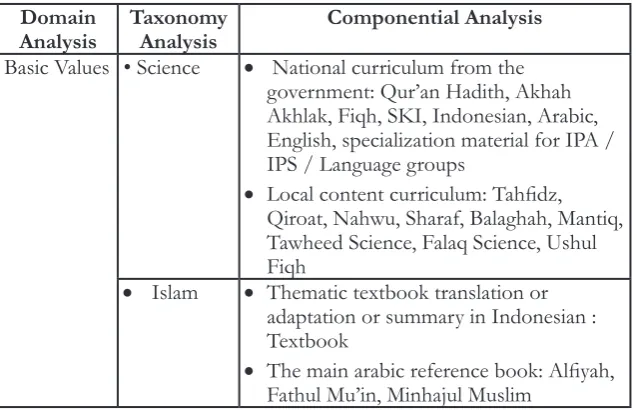
Based on the compound analysis, there are specifications of the strategic values of each madrasa in all its aspects. Parts of these values are evident in the operational implementation of education that applies national and reinforcement curricula and specifications that are applied independently in their respective madrasas, including the use of teaching
materials from the original sources in the form of books
in arabic and learned from the beginning to completion. Learning uses teaching media and fieldwork instruments such as observations, case studies, and also internships. Part of the value that is held firmly by the organizers of education is having a excellent output in reading and understanding arabic islamic books especially kitab kuning. Some other
madrasas target memorized outputs of the Koran, and a few others have proficient and trained output in the field of scientific research.
Figure : Strategic Values for Madrasa Development
Domain Analysis
Taxonomy Analysis
Componential Analysis
Basic Values • Science • National curriculum from the government: Qur’an Hadith, Akhah Akhlak, Fiqh, SKI, Indonesian, Arabic, English, specialization material for IPA / IPS / Language groups
Local content curriculum: Tahfidz, •
Qiroat, Nahwu, Sharaf, Balaghah, Mantiq, Tawheed Science, Falaq Science, Ushul Fiqh
Islam
• • Thematic textbook translation or adaptation or summary in Indonesian : Textbook
The main arabic reference book: Alfiyah, •
Development
Values Theoretical
•
Learning
Learning based on mastery of teaching •
Mainstreaming the mastery of the •
religious sciences in depth
Educators are people who have expertise •
in the science of the Koran, the science of Hadith, the Science of Fiqh, the Science of Date
Students can read and understand the •
arabic books they learn well
Students are trained skillfully in the •
practice of religious practices
Oriented to the regeneration of scholars •
Tahfidz •
Madrasa
Mainstreaming the reading and •
memorizing the Koran as well as possible Educators are people who master the •
scientific field, memorizing the Koran (hafidz)
Mastery of foreign languages, especially •
English / Arabic is very emphasized Special subjects in the field of scientific •
research
Coaching and mentoring programs for •
student research
Participation and success of research •
competitions and scientific work Useful research findings
•
Oriented to further studies in college to •
Based on the analysis of cultural themes, the Madrasah
Aliyah in Kudus as a whole is quite strong in instilling basic strategic values that the madrasa is the center of learning for Islamic science. The strengthening of Islamic studies at
the Madrasah Aliyah was then realized in three excellences
of the madrasa, namely tafaqquh fiddin, tahfidz al-Qur’an, and research.
Conclusion C.
Strategic values in the madrasa lie in the basic values that madrasas are educational institutions whose main mission is to teach the Islamic sciences. Curriculum design,
learning, quality development, and graduates are oriented
towards mastering islamic knowledge. The next strategic
values are the values of development which are focused on a more qualified learning model. Education measured by eight
standards according to government regulations was met,
and then developed beyond these standards to achieve the
excellence of madrasas. The excellence of madrasa is focused
on three values, namely the value of profit in tafaqquh fiddin
or mastery in the islamic religion, the value of excellence
in memorizing the Qur’an, and the value of excellence in the field of research. So, there are three excellent values of
madrasa in Kudus, while other excellent values are suggested
to be further developed by the madrasa. International schools
REFERENCE
Arief, Subhan, Lembaga Pendidikan Islam Indonesia Abad ke-20 – Pergumulan antara Modernisasi dan Identitas, Jakarta:Kencana, 2012.
Bogdan, Robert C dan Biklen, S Knopp, Riset Kualitatif untuk Pendidikan : Pengantar Teori dan Metode, (Terjemahan
Munandir), Jakarta:Pusat Antar Universitas
untuk Peningkatan dan Pengembangan Aktifitas Instruksional Universitas Terbuka, 1990.
Bohrnstedt, George W, Values Theory And Research.
David, Fred R, Strategic Management Concepts and Cases:
A Competitive Advantage Approach, Edinburgh
Gate:Pearson Education Limited, 2017
Denzin, Norman, K and Lincold, Yvonna S, Handbook of Qualitative Research (Second Edition), California:Sage Publication Inc, 2000.
Kantor Kementerian Agama Kabupaten Kudus, Data
Madrasah, Kudus, 2017.
Kisbiyanto, “Organizational Behavior At Madrasah Diniyah In Indonesia”, Volume 1, Number 2, Desember 2013.
Marshall, Catherine and Gretchen B. Rossman, Designing Qualitative Research, California:Sage Publication Inc, 2006.
Matthew, Miles B, dan Huberman, Analisis Data Kualitatif
(Terjemahan Tjetjep Rohendi), Jakarta: Universitas Indonesia, 1992.
Moh. Amin, “Impelementasi Manajemen Strategis Kepala Sekolah Menengah Pertama Di Kabupaten Serang”, TARBAWI
Volume 2, No. 02, Juli – Desember 2016.
Moleong, Lexy J, Metodologi Penelitian Kualitatif, Yogyakarta: Rake Sarasin, 2000.
Qehaja, Albana Berisha and Enver Kutllovci and Justina
Shiroka, “Strategic Management Tools and Techniques Usage: A Qualitative Review”, Acta Universitatis Agriculturae
Et Silviculturae Mendelianae Brunensis, Volume 65,
Number 2, 2017.
Rabee, Ahmad M, “Strategic Management Of Human Resources In Educational Organizations”, European Scientific Journal,
Volume 10, Number 10, April 2014.
Schwartz, Shalom H, “An Overview of the Schwartz Teory of Basic Values”, Online Readings In Psychology And
Culture, International Association For Cross-Culture
Psychology, 2012.
Spradley, James, Participant Observation, Rinchart and
Winston:Holt, 1980.
Sugiyono, Metode Penelitian Pendidikan Pendekatan Kuantitatif, Kualitatif dan R & D, Bandung:Alfabeta, 2008.
Zohrabi , Abazar and Nikzad Manteghi, A Proposed Model for Strategic Planning in Educational Organizations, Procedia -
Social and Behavioral Sciences 28, 2011.
Zuhdi, A, ”Madrasah sebagai Tipologi Lembaga Pendidikan Islam – Kajian tentang Berbagai Model Madrasah Unggulan”, Jurnal MADRASAH, Volume 5, Number 1, Desember 2012.
Undang-Undang Republik Indonesia Nomor 20 Tahun 2003 tentang Sistem Pendidikan Nasional. Jakarta:Dihimpun