Comparison of DNA Extraction Methods Between Conventional, Kit, Alkali
and Buffer-Only for PCR Amplification on Raw and Boiled Bovine and
Porcine Meat
Arif Yahya
*, Marindra Firmansyah, Annisa Arlisyah, Rio Risandiansyah
Medical Faculty, Islamic University of Malang, Malang, Indonesia
Abstract
Detection of porcine contamination in food material by employing PCR techniques is integral in halal food confirmation. However, PCR is both costly and laborious, particularly in DNA isolation method. This study explores several different methods in DNA extraction for PCR amplification in bovine and porcine raw and boiled meat samples. Four methods for DNA extraction (conventional PCI method, DNA isolation kit, alkaline-based method, and a DNA lysis buffer-only from the same kit) was employed followed by PCR using primers from previous studies and compared for DNA quality and quantity (in six replicates) and PCR amplification on the best three DNA samples. This study shows that in all samples, the conventional method had the best DNA yield based on nanodrop measurement, followed by an alkali-based method, buffer-only method, and DNA isolation kit. Each method except lysis-buffer only had at least one sample with good DNA quality. Conventional and isolation kit showed reliable positive PCR detection for all porcine and bovine samples (92% positive). Using the alkaline-lysis method, DNA was amplified reliably on boiled meat samples (83% positive). Lysis-buffer-only method did not show consistent PCR amplification on the samples used (50% positive). The conclusion was that conventional PCI method and DNA isolation kit showed high reliability in PCR amplification of bovine and porcine meats, both raw and boiled. While high DNA yield was obtained using the alkaline-lysis method, PCR amplification was only successful on boiled samples. Lysis-buffer only method yielded in poor DNA quality and was not able to result in reliable DNA amplification.
Keywords: DNA extraction methods, halal, Porcine food contaminants.
INTRODUCTION
The consumption of meat products as a food staple was regulated in several major religions (e.g. Islam, Christianity and Judaism) mainly in the form of prohibitive consumption of porcine meat [1]. In many countries, a commitment to this principle is by the certification of meat products being sold to consumers by religious or government bodies, in which food free from
porcine products is deemed halal in Islamic
regulation, or kosher in Judaism. Unfortunately, contamination of porcine meat in halal-certified has been shown to occur in several countries, including Indonesia [2,3].
Detection of porcine meat product can be accomplished using several different methods. Commonly used, due to its high sensitivity and specificity, are DNA amplification methods, such as PCR [4,5,6]. However, this method, while reliable, has some drawbacks. Firstly, PCR
method requires special equipment and
relatively costly reagents, although cheaper than other methods [7]. Secondly, conventional DNA isolation methods (such as phenol-chloroform
Correspondence address:
Arif Yahya
Email : [email protected]
Address : Medical Faculty, Islamic University of Malang, MT Haryono 193, Malang 65144
isoamyl-alcohol or PCI) are also costly, labor- intensive, time-consumptive, and requires toxic chemicals [8]. Thus, while having a high reliability, these methods are prohibitive to be used on a day to day basis.
Several DNA isolation methods which are less time-consuming or costly has been attempted and published. While conventionally a kit is used to isolate DNA, one researcher reported the use of its accompanying lysis buffer with successful DNA amplification, cutting the DNA isolation time to 20 minutes after overnight incubation for preparation [9]. Other researchers have attempt-ed to isolate DNA using an alkaline-lysis method, which uses a simple heat and alkaline treatment method to lyse the cells and isolate the DNA [8,10]. While these two methods have shown success in DNA isolation and PCR amplification for detection in raw meat, its reliability compared side by side to the established kit and conventional PCI has not been explored.
as well as novel and rapid isolation methods, on heat-treated meat had not been compared. Therefore, in this study, we attempt to compare DNA isolation methods in the quantity and quality of extracted DNA and its success in PCR amplification for the detection of porcine material in raw and boiled meat.
MATERIALS AND METHODS Samples Preparation
Bovine and Porcine meat samples was pur-chased from a local market in Malang, Indonesia. Meat samples were weighed to approximately 50 g before further handling and stored at -20°C until use. These samples were separated into two groups: a raw meat and a boiled meat group. Bovine and Porcine meats were mixed with tapioca flour with a 10:1 ratio (meat g. flour g-1),
and left for 15 minutes in boiling water, to stimulate the creation of meatballs. Both raw and boiled meat was weighed at 80 g and 150 g and distributed in 1.5 mL microtube for DNA extraction.
DNA Extraction Protocols
Samples were subjected to four DNA
extraction and purification methods: a
conventional PCI method [12], isolation kit method, alkaline-lysis method [9], and a lysis-buffer only method [10], in 6 replicates. Each method was validated using quantitative method (Nanodrop Spectrophotometer ND-1000). DNA extraction and PCR amplification were conducted in Central Laboratory for Life Science (LSIH), University of Brawijaya, Malang, Indonesia.
Conventional PCI Method
Modified from Erwanto et al [3], DNA was
extracted by addition of 150 mg of sample with 500 µL TNE buffer, 50 µL SDS 10% and 10 µL Proteinase K and incubated at 42°C for 18 hours. Following this, 40 µL phenol (pH 8.0), 5 µL NaCl 5M, and 400 µL PCI (pH 8.0) was added and incubated at 37°C for 1 hour. The solution was centrifuged (Sigma-Santorius 318K) at 3000 rpm for 5 minutes in room temperature, and the with 600 µL absolute ethanol, 300 µL ammonium acetate 5 M, and 500 µL TB buffer and incubated at -20°C for ten minutes, before a final centrifugation at 13.000 rpm for five minutes in
4°C. Dried pellets were eluted using 50 µL of TE buffer.
Isolation Kit Method
The isolation kit used in this method was the
Jena Bioscience DNA Isolation Kit (Jena
Bioscience, Jena, Germany). Samples were first aliquoted at 80 mg in microtubes, and DNA extraction method was following manufacturer’s instructions.
Alkaline Lysis Method
Modified from Buntjer et al [10], each sample
was added with 2 mL NaOH (0.5 M per gram), vortexed and incubated at 100°C for 10 minutes. The resulting solution was centrifuged at 13.000
Lysis-Buffer Only (Modified ASL Method)
Modified from Alaraidh [9], each sample (80 mg) was extracted using the lysis buffer provided in the Jena Bioscience DNA isolation kit. Each sample was added with 300 µL lysis buffer and 2 µL RNase A, and vortexed prior to 8 µL column for purification, following instruction from the manufacturers. DNA was eluted using a 50 µL elution buffer and stored at -20°C.
DNA Amplification Method
The oligonucleotide primers [13], were synthesized by Integrated DNA Technology, Singapore. According to this study [13], oligonucleotides used were forward primer SIM
5’- GAC CTC CCA GCT CCA TCA AAC ATC TCA TCT
TGA TGA AA -3’, used for both porcine and
bovine samples, and a bovine reverse primer 5’-
CTA GAA AAG TGT AAG ACC CGT AAT ATA AG -3’
and porcine reverse primer 5’- GCT GAT AGT AGA
TTT GTG ATG ACC GTA-3’. The amplicon length
Figure 1. DNA yield and quality (denoted by symbol ■) from A. conventional PCI method, B. isolation kit, C. alkaline-lysis, and D. lysis buffer method. The conventional method showed very high yield and good DNA quality in all samples.
The annealing temperature of these primers was optimised for both porcine and bovine samples using DNA samples obtained from PCI method. For porcine samples, five temperatures were tested, whilst seven temperatures were tested for bovine samples. The optimum annealing temperature was determined to be 64°C for bovine samples and 58°C for porcine samples (data not shown).
DNA amplification was carried out using five µL Go-Taq PCR mix, 0.5 µL for each forward and reverse primers, three µL of nuclease-free water, and one µL of the DNA samples itself. PCR was carried out with a 5 minute 95°C pre-heating prior to 35 cycles of amplification for bovine samples (30 seconds at 94°C, 30 seconds at 64°C, and 45 seconds at 72°C) and porcine samples (30 seconds at 94°C, 30 seconds at 58°C, and 45 seconds at 72°C).
Detection of Amplified Products
PCR products were analysed using electro-phoresis using a 1.5% Agarose gel. DNA band imaging was performed using a Gel Doc.
RESULT AND DISCUSSION
Conventional PCI Method Showed Reliable DNA Isolation Compared to Other Methods
A comparison of DNA yield and DNA quality (as measured by Nanodrop) obtained using the
methodology previously described is shown in Figure 1, with good DNA quality defined as
having a λ260/280 of 1.8 – 2.0, as described in a
previous literature [14].
Conventional PCI method was found to have the highest DNA yield with an average
concentra-tion of 566.16± 370.05 ng.µL-1 (up to 60 times of
other methods), while also having a good quality with an average quality for all samples of 1.74±0.12. On the other hand, both alkaline lysis and lysis-buffer method showed good DNA yield (91.78±29.32 ng.µL-1 and 76.45±24.73 ng.µL-1,
respectively), with good quality for alkaline lysis method (1.94±0.31) and a very low quality for lysis-buffer method (1.34±0.17). Lastly, isolation kit yielded the lowest DNA concentration (aver-aging at 7.21±2.85 ng.µL-1), although having a
good DNA quality (1.92±0.39).
were also concurrent with many researchers in this field, whereas DNA yield in various kit assays was often shown to be significantly lower com-pared PCI method [16]. PCR amplification, how-ever, seems to be dependent than other factors aside from high DNA yield, whereas PCR amplifi-cation was shown to be successful on DNA yield as low as five ng.µL-1 [17].
As for the unconventional methods tested in this study, alkaline-lysis method showed good reliability in DNA extraction for these samples, while lysis buffer method showed good DNA iso-lation, albeit having poor quality. Results from alkaline-lysis method used in this study showed comparable DNA yield from other studies using similar methods [8], and higher than the original method [10]. Lysis-buffer only method differed from the previous article, in which a DNAzol® Direct from Qiagen was used; however, the DNA isolation yield quality was not reported [9].
PCR Amplification Showed Varied Results De-pending on DNA Isolation Method
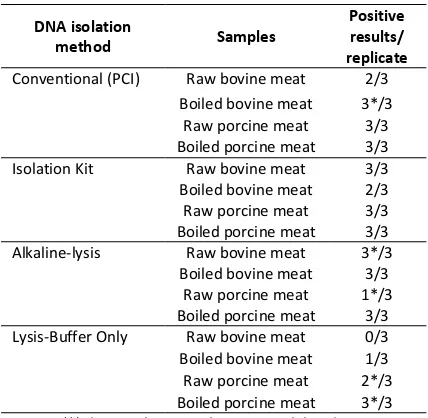
PCR amplification results summarized in table 1. Amplification was conducted on a cytochrome b gene with a common forward primer and spe-cific reverse primers, as first described previous literature [18]. The size calculated from these samples were different than previously reported [13], whereas bovine samples, a band size of 320 bp was calculated, and from porcine samples a band size of 360 bp was calculated.
Table 1. Summary of PCR amplification from raw and boiled bovine and porcine meat samples
DNA isolation
method Samples
Positive results/ replicate Conventional (PCI) Raw bovine meat 2/3
Boiled bovine meat 3*/3 Raw porcine meat 3/3 Boiled porcine meat 3/3
Isolation Kit Raw bovine meat 3/3
Boiled bovine meat 2/3 Raw porcine meat 3/3 Boiled porcine meat 3/3 Alkaline-lysis Raw bovine meat 3*/3 Boiled bovine meat 3/3 Raw porcine meat 1*/3 Boiled porcine meat 3/3 Lysis-Buffer Only Raw bovine meat 0/3 Boiled bovine meat 1/3 Raw porcine meat 2*/3 Boiled porcine meat 3*/3 Notes: (*) denotes hazy, unclear, or weak bands
Based on this study, conventional and isola-tion kit method showed a 92% PCR amplificaisola-tion from all samples. Alkaline-lysis success in
amplifi-cation was 83%, and lysis-buffer method had only a 50% chance. Control methods, therefore, showed more reliability in the detection of por-cine and bovine samples, and alkaline-lysis had a higher chance of detection compared to the lysis-buffer method. It should be noted that while some bands were unclear/weak, all bands showed the same band size corresponding to bovine and porcine samples.
Previous research has noted the importance of DNA isolation methods in successfully amplify-ing a DNA product [16,17], in which this research also concurs. Amplification failure may occur in samples having high PCR inhibitors, including various proteins found in meat samples, as de-scribed elsewhere [19]. While both conventional and isolation kit methods provide efforts to min-imalize these inhibitors, unconventional methods used in this study do not. Therefore, the pres-ence of these inhibitors may explain the low reli-ability in using lysis-buffer method for PCR ampli-fication, in which false negatives occurred. Simi-larly, this may also explain the increased amplifi-cation of gene products using the alkaline-lysis method on boiled meats, whereas previous stud-ies indicate that boiling as an inexpensive meth-od to remove PCR inhibitors [20].
CONCLUSION
Conventional methods for DNA isolation in this study, which was PCI method and isolation kit method, showed high reliability in detection of bovine and porcine meat samples, both raw and boiled for a short time; despite the low DNA yield for isolation kit method. In the unconven-tional method tested in this study, DNA isolation using alkaline-lysis method resulted in a higher reliability in PCR amplification on boiled samples compared to raw samples, while also having a high DNA yield and good DNA quality. On the other hand, lysis-buffer method only showed poor results in DNA isolation as well as PCR amplification.
ACKNOWLEDGEMENT
We acknowledge Indonesian Ministry of Research, Technology and Higher Education (RISTEK-DIKTI) for the funding of this research science perspectives. 2nd Int. Conf. Humanit.
[2] Farouk, A.E., M.F. Batcha, R. Greiner, H.M. Salleh, M.R. Salleh, A.R. Sirajudin. 2006. The use of a molecular technique for the detection of porcine ingredients in the
Malaysian food market. Saudi Med. J. 27(9).
1397–1400.
[3] Erwanto, Y., M.Z. Abidin, E.Y.P.M. Sugiyono,
A. Rohman. 2014. Identification of pork contamination in meatballs of Indonesia local market using Polymerase Chain Reaction-Restriction Fragment Length
Poly-morphism (PCR-RFLP) analysis.
Asian-Australasian J. Anim. Sci. 27(10).
1487-1492.
[4] Plath, A., I. Krause, R. Einspannier. 1997. Species identification in dairy products by
three different DNA-based techniques. Z
Leb Unters Forsch A. 205. Available at:
https://doi.org/10.1007/s002170050195. [5] Wolf, C., J. Rentsch, P. Hubner. 1999.
PCR-RFLP analysis of mitochondrial DNA: a reliable method for species identification. J.
Agric. Food Chem. 47. Available at:
https://doi.org/10.1021/jf9808426.
[6] Pfeiffer, I., J. Burger, B. Brenig. 2004.
Diagnostic polymorphisms in the
mito-chondrial cytochrome b gene allow
discrimination between cattle, sheep, goat,
roe buck and deer by PCR-RFLP. BMC
Genet. 5(1). 30.
[7] Farag, M.R., M. Alagawany, M. Ezzat Abd
El-Hack, R. Tiwari, K. Dhama. 2015. Identi-fication of different animal species in meat and meat products: trends and advances.
Adv. Anim. Vet. Sci. 3(6). 334-346.
[8] Girish, P.S., S. Haunshi, S. Vaithiyanathan, R.
Rajitha, C. Ramakrishna. 2013. A rapid method for authentication of Buffalo
(Bubalus bubalis) meat by Alkaline Lysis
method of DNA extraction and species specific polymerase chain reaction. J. Food
Sci. Technol. 50(1). 141-146.
[9] Alaraidh, I.A. 2008. Improved DNA
extraction method for porcine contami-nants, detection in imported meat to the Saudi market. Saudi J. Biol. Sci. 15(152). 225-229.
[10] Buntjer, J.B., J.A. Lenstra, N. Haagsma.
1995. Rapid species identification in meat by using satellite DNA probes. Zeitschrift
f{ü}r Leb und Forsch. 201(6). 577-582.
[11] Arslan, A., O.I. Ilhak, M. Calicioglu. 2006. Effect of method of cooking on identifi-cation of heat processed beef using
polymerase chain reaction (PCR) technique.
Meat Sci. 72(2). 326-330.
[12] Erwanto, Y., M.Z. Abidin, X. Sismindari, A. Rohman. 2012. Pig species identification in meatballs using polymerase chain reaction- restriction fragment length polymorphism for Halal authentication. Int. Food Res. J.
19(3). 901-906.
[13] Di Pinto, A., M. Bottaro, E. Bonerba, G.
Bozzo, E. Ceci, P. Marchetti, et al. 2015. Occurrence of mislabeling in meat products
using DNA-based assay. J. Food Sci. Technol.
52(4). 2479-2484.
[14] Sambrook, J., D.W. Russell. 2001. Molecular
cloning - Sambrook & Russel - Vol. 1, 2, 3.
[16] Djurkin-Kusec, I., Z. Radisic, M. Komlenic, G.
Kusec. 2015. Comparison of commercial DNA kits and traditional DNA extraction
products by PCR assay. Meat Sci. 51(2).
143-148.
[19] Schrader, C., A. Schielke, L. Ellerbroek, R. Johne. 2012. PCR inhibitors - occurrence, properties and removal. J. Appl. Microbiol.
113(5). 1014-1026.
[20] Böddinghaus, B., T.A. Wichelhaus, V. Brade,
T. Bittner. 2001. Removal of PCR inhibitors by silica membranes: evaluating the
Amplicor Mycobacterium tuberculosis Kit. J.