Motivating Factors among Achievers in the High School Grade Levels of S.I.A.T.I during the First and Second Grading Periods
in the Frist Semester of S.Y. 2016-2017
______________________________________________________ A Research Paper
Presented to Dr. Sotera F. Diaz
San Isidro Academy of Tudela, Incorporated Tudela, Misamis Occidental
_____________________________________________________ In Partial Fulfillment of the Subject
Requirements in Practical Research I
_____________________________________________________ By:
GracevelleMhaeVillamor Jonalyn Malmis Trisha Marie Adecir
Cherry Mie Eroy Marjorie Anne Villanueva
Mary Loise Acla Rachel Tangub John Welbert Gallegos
Acknowledgement
The researchers owe deep gratitude to those who have helped them make this researchers paper possible. They were the people behind this piece to whom this page is dedicated to .For without the, the researchers would not become so courageous, dedicated and committed to finish this research.
Heartfelt thanks to Dr. Sotera F. Diaz, our Practical Research 1 teacher for her effort, guidance and
suggestions in the preparation and completion of this research study.
Our sincerest thanks to the S.I.A.I.T.I. library and the very supportive librarian, Mrs. Salome Langiras for accommodating our stimulating urge for information by generously providing us with classified dissertations, theses, journals and books.
Deepest gratitude is given to the school
principal, faculty and staff the high school grade levels of S.I.A.T.I for allowing the researchers to field the
questionnaires.
We likewise offer our great thanks to our beloved parents for their invaluable financial and moral support.
To our friends who empathized with their leisure time simply to work and help us to perfect completion of the research.
Thanks to the respondents, the high school grade levels achievers for being part of the success of this research capitalized by their cooperation of giving exact information needed.
Special thanks to the people whom the researchers failed to mention but in one way or another helped the
researchers in the completion of this study.
Research Abstract
This study is a descriptive study, which aimed to determine the motivating factors among achievers in the high school grade levels of S.I.A.T.I during the first and second grading periods in the first semester of S.Y. 2016-2017.
It also aimed to determine which among the 2 factors predicted the most effective motivation. The findings of the study served as the basis in knowing more the effective way of motivating the achievers as well as the non-achievers.
Gender was also investigated as a variable to determine if it affected the motivating factors of the high school grade levels achievers.
The respondents of the study were the 38 high school grade levels achievers of San Isidro Academy of Tudela, Incorporated during the first and second grading periods in the first semester of S.Y. 2016-2017.
The study revealed that among the 2 motivating factors, the students are found to be most effectively motivated in intrinsic motivation factor and least effectively motivated in extrinsic motivation factor. The study also found out that gender affected the motivating factors of the respondents. Females are more
motivated in the affective factor than males.
Based on the findings, it was conclude that each of the motivating factors has a great extent in the achievements of the achievers.
List of Tables
TABLE PAGE
1 Respondents’ Profile as to Gender
2 Respondents’ Degree of Motivating factors in Intrinsic Motivation Factors
3 Summary Table of the Respondents’ Degree of
Motivating Factors in Intrinsic Motivation Factors 4 Respondents’ Degree of Motivating Factors in
Extrinsic Motivation Factor
5 Summary Table of the Respondents’ Degree of
Motivating Factors in Extrinsic Motivation Factor 6 Analysis on the Mean Scores of the Two
Motivating Factors
Data-Gathering Procedure
Statistical Treatment of the Data
Chapter 3
RESULTS AND DISCUSSION Respondents’ Profile
Gender of the Respondents Motivating Factors
Intrinsic Motivation Factor Extrinsic Motivation Factor
The Most and Least Effective Motivation as
Experienced by the High School Grade Levels Achievers Gender Differences in the Most and Least Effective Motivation as Experienced by the High School Grade Levels Achievers
Chapter 4
SUMMARY, CONCLUSION AND RECOMMENDATIONS Summary
Findings Conclusion
Table of Contents
TITLE PAGE
ACKNOWLEDGEMENT ABSTRACT
LIST OF TABLES LIST OF FIGURES Chapter 1
THE PROBLEM AND REVIEW OF RELATED LITERATURE Setting of the Study
Review of Related Literature Conceptual Framework
Schema of the Study
Statement of the Problem Research Hypothesis
Scope and Limitation of the Study Significance of the Study
Chapter 2 METHOD Research Design
Respondents of the Study Sources of Data
List of Figures
FIGURE PAGE
Chapter 1
The Problem and a Review of Related Literature
To be motivated means to be moved to do something. A person who feels no impetus or inspiration to act is thus characterized as unmotivated, whereas someone who is energized or activated toward an end is considered motivated. Most everyone who works or plays with others is, accordingly, concerned with motivation, facing the question of how much motivation those others, or oneself, has for a task, and practitioners of all types face the perennial task of fostering more versus less motivation in those around them (Deci & Ryan, 1985).
Motivation is based on your emotions and achievement-related goals. But the problem is, “What are the factors that motivates the students especially the achievers to excel or be on top of the class?” Researchers explored and conducted a study about the possible factors of motivation that affects
student’s achievement. There are different forms of motivation and the two of them were extrinsic and intrinsic.
Intrinsic motivation is defined as the doing of an activity for its inherent satisfactions rather than for some separable consequence .When intrinsically motivated a person is moved to act for the fun or challenge entailed rather than because of external prods, pressures or rewards. The phenomenon of intrinsic motivation was first acknowledged within
experimental studies ofanimal behavior, where it was discovered that manyorganisms engage in exploratory, playful and curiosity-driven behaviors even in the absence of reinforcement or reward (White, 1959). It also refers to doing something because it is inherently interesting or enjoyable. Intrinsic motivation has emerged as an important phenomena for educators—a natural
In humans, intrinsic motivation is not the only form of
motivation, or even of volitional activity, but it is a pervasive and important one.
Extrinsic motivation occurs when we are motivated to perform a behavior or engage in an activity to earn a reward or avoid punishment. It refers to behavior that is driven by external rewards such as money, fame, grades, and praise. Extrinsic motivation is construct that pertains whenever an activity is done in order to attain some separable outcome. Extrinsic
motivation thus contrasts with intrinsic motivation, which refers to doing an activity simply for the enjoyment of the activity itself, rather than its instrumental value. There are different types of extrinsic motivation. It includes: home environment, peer motivation, teacher motivation and school environment.
Home environment- A child whom comes from a home
environment which is caring , comfortable and supportive brings to the classroom , motivation arising from his conducive home environment .
Classroom Environment – A positive school environment will reinforce the student’s motivation and cause him to achieve at even higher levels or it will create motivation where there was none from the home.
Peer Motivation - Peer are also a great source of motivation for one another.Lifelong friendship are formed at school and peers have been known to stand up for one another something even more than siblings. They assist one another with school work and also become mentors to one another in their lives. Very often one finds that the studentswho work in groups, sharing their
knowledge and skills, obtain better results than those who work alone.
Setting of the Study
The study was conducted at San Isidro Academy of Tudela, Incorporated, located at Raagas Street, Upper Centro, Tudela, province of Misamis Occidental, Philippines. It is the only Catholic secondary learning institution in the town of Tudela. San Isidro Academy of Tudela, Incorporated (SIATI) was formerly known as San Isidro Academy (SIA, 1953-2016). SIATI was
historically founded by an Irish National, Fr. Patrick “Pat Farrel, who in his mid-twenties came to the Philippines as a Columban Missionary, June 1953. It was named after the town’s Patron Saint, San Isidro Labrador.
The school started with a one-storey concrete building. First year was offered with an enrolment of forty-five boys and forty-five girls. The rest of the year levels were offered
gradually until finally during the school year 1956-1957, the school completed its secondary course and had its first
graduation.
Being a Parochial School, it was administered by the Parish Priest. At that time, the parishes of Misamis Occidental were under the Missionary Priest of the Columban Order. In the
sixties, a new set of Diocesan Filipino priests began to replace the Columban Missionaries in the parishes. Like a mustard seed, SIATI flourished through the years. Enrolment increased thus more rooms were constructed to accommodate the students. The present St. Peter’s Building was constructed in 1963.
In 1964, the administration of the school was turned over to the Columban Missionary Sisters. That was the beginning of the long-line of Columban Sisters in the school. Everything has its end just as the Columban Missionary Sisters’ stay in school also ended.
In the year 1988, the administration of the school was again turned over to the Daughters of Charity. However, they only
stayed for two years and again left for another mission. In the year 1990, Msgr. Jesus Dosado took over the
In the year 1997, Rev. Fr. JovenLustre became the school director equipped with dreams and optimism in life. During his time, the first Kindergarten School I and ii were opened. He did not stop there, amidst difficulties and hardship along the way, it did not deter him to pursue his dream of opening the
Elementary Department. The wild dream became a reality and now, a preparatory school, a complete elementary course are being
offered added to the secondary course of San Isidro Academy.
In the year 2003, San Isidro Academy of Tudela, Incorporated celebrated its Golden Jubilee (50 years of existence). It was also for the first time that the school has three graduations, the Kindergarten, Elementary and Secondary.
In the year 2016, the government implemented a new education curriculum – the K-12 Curriculum. The school decided to open a Senior High School program. The former Fr. Patrick Farrel
building was turned into a Senior High School Building. The first senior high school students were the SIATI- Batch 2016. SIATI offered the following courses for Senior High School: Academic Track (GAS and ABM) and Technical-Vocational Track (Cookery and ICT).
The San Isidro Academy of Tudela, Incorporated will continue to flourish and mold students in a holistic way in the next
decade as long as it exists.
Review of Related Literature
Human beings can be motivated by strangest things, but basically motivation can be either intrinsic or extrinsic.
But, before we go through, let us know what is the meaning of the word “motivation”. What really is motivation? Motivation, the act or process of giving someone a reason for doing something or the act or process of motivating someone.
Fabien (2015) said that a positive school environment will reinforce the students motivation and cause him to achieve at even higher levels r it will create motivation where none from the home.
Rosales (2017) said that having a crush as an inspiration is one of the motivating factors that makes the student become an achiever.
Joyette (2015) said that peers are also a great source of motivation for one another. She also said that lifelong
friendships are formed at school and peers have been known to stand up for one another sometimes even more than siblings.
Villamor (2017) said that one of the motivating factors among achievers for her is her loving family. She also said that having a family who never fails to show their love and support is the one who motivates her to study well.
Fabien (2015) said further that a child who comes from a home environment which is caring, comfortable, and supportive brings to the classroom, motivation arising from his conducive home environment.
The related literature and the findings of same studies became the bases of the present study.
Conceptual Framework
Motivation the process of giving someone a reason for doing
something. It also can be defined as the driving force behind all the actions of an individual. There are different factors of motivation but we only choose two factors, namely; intrinsic motivation and extrinsic motivation.
The first factor is the intrinsic motivation. Intrinsic motivation is defined as the enjoyment of and interest in an activity for its own sake. Fundamentally viewed as an approach form of motivation, intrinsic motivation is defined as an
important component of achievement goal theory. Examples of actions that are the result of intrinsic motivation include: participating in a sport because you find the activity enjoyable and solving a word puzzle because you find the challenge fun and exciting.
The second factor is the extrinsic motivation. Extrinsic motivation occurs when we are motivated to perform a behavior or engage in an activity to earn a reward or avoid punishment. It includes: home environment, peer motivation, teacher motivation and school environment.
C. Extrinsic Motivation
Statement of the Problem
The study focused on the motivating factors among achievers in the High School Grade Levels of San Isidro Academy of Tudela, Incorporated (SIATI) during the first and second
A.
Student’s Profile
B.
grading periods in the first semester of S.Y 2016-2017. Specifically, the study intended to answer the following problems:
1. What is the profile of the respondents in terms of:
Gender
2. What are the motivating factors encountered by the high school grade levels students in the following areas:
Intrinsic Motivation Extrinsic Motivation
2.1 Which among the motivating factors do the students consider most effective and least effective?
3. Which factors affect the males most?
4. Which factors affect the females most?
Research Hypothesis
Scope and Limitation of the Study
The scope of the study was confined mainly on the motivating factors among achievers in the high school grade levels of SIATI .Although there are a number of possible motivating
factors that may affect the student’s achievement , the research only focused on the intrinsic and extrinsic motivating factors due to the limited time given, to be specific two and a half months only and it will really be hard for the researchers if they would include all the possible factors that may affect the respondent’s achievements.
The extent of the study is limited on the data being gathered through questionnaires used as they were equally distributed to the 38 respondents, the high school grade levels achievers, enrolled first semester of school year 2016-2017.
The study dealt primarily on the identification of the effective factors dimension that best describes students’ especially achievers’ achievements, the results of which
provided information and basis for the benefit of the respondents and to the researchers to know the motivating factors among achievers.
Significance of the Study
The results of the present study provide valuable information. The researchers feel that this study is important for the
A. School Administrators
The result of the study may help the school administrators in designing programs and re-engineering of their curriculum to provide maximum students learning and create strategies and activities that will be relevant and useful for the enhancement of student’s personality towards achievement through motivation.
B. Faculty
This study may give teachers new directions to design new teaching strategies and approaches and provide classroom
experiences and activities that will enhance students’
personality towards achievement and will address the affective factor dimensions of all the students, achiever or non-achiever. It will also help them to recognize and change their personality towards work.
C. Guidance Counselor
The findings may give information about the students’
motivating factors and the possible barriers to their goals. It would guide them more in strengthening their growth session activities on self-awareness, life skill seminar, workshops and boosting confidence of the achievers. Moreover, the results may be used as basis in their planning of activities for
non-achievers to become one and enhancing the different guidance services.
The results may help them identify their own personality, interpersonal interaction, and their ability to motivate their selves, which can help improve their totality as they strive more to learn and become globally competitive. It can also help them in encouraging other students through motivation.
E. Researchers
For the researchers alone, they would have the feeling of gratefulness for doing such research as they know that it would benefit many people especially the students. And also, for the future researchers, the results may give them guide and be a good source or basis for another research.
Other maybe encouraged to further do researchers on other factors that predict the motivating factors among students
especially achievers.
Chapter 2
Method
produce, scoring produce, and statistical treatment that were used in this study.
Research Design
The descriptive method was employed in this study. It was descriptive because the study is concerned with the description, presentations, recording, analysis and interpretation of the facts regarding the profile of the respondents in terms of their motivating factors.
An actual survey was conducted to the respondents, by means of questionnaire. Informal interview was also conducted to gather supplementary information from the respondents.
Respondents of the Study
Purposive random sampling is used in the selection of the respondents of the study. The respondents of this study were 38 achievers of San Isidro Academy of Tudela, Incorporated enrolled in the first and second grading periods in the first semester of school year 2016-2017. Of the total respondents 10 were males and 28 were females.
Sources of Data
1.Questionnaires. The researchers used questionnaires to gather information from the respondents. It has two parts, first is the Profile of the Students and the second refers to the indicators of the Motivating Factors namely:
intrinsic and extrinsic.
2.Interview. An informal interview to the respondents was also employed to gather additional information.
3.Other Sources.
A. Records from the Guidance Office. Additional
information about the Student’s Personal Profile from the Guidance Office was also used in the research.
B. Records form the Registrar. The gender and year of the respondents were taken from the student’s individual folders in the Registrar’s Office.
Data- gathering Instruments
To measure the constructs of the students’ motivating factors, the researcher-made and modified standardized survey instruments taken from finished research journals as a reference. An informal interview to the respondents was also adopted to gather supplementary data.
On the other hand, the survey-questionnaire consists of 33-item questions and is divided into 2 factors, namely: intrinsic motivation factor-7 and extrinsic motivation factor – 26.
In the interpretation of data, the researchers adopted the following scales to measure the variables in the study.
The respondent’s intrinsic motivation factors were categorized as follows:
5.0 – 5.9 = Strongly Agree 4.0 – 4.99 = Agree 3.0 – 3.99 = Undecided
2.0 – 2.99 = Disagree 1.0 – 1.99 = Strongly Disagree
The respondent’s extrinsic motivation factors were categorized as follows:
5.0 – 5.9 = Strongly Agree 4.0 – 4.99 = Agree 3.0 – 3.99 = Undecided
2.0 – 2.99 = Disagree 1.0 – 1.99 = Strongly Disagree
Data Gathering Procedure
questionnaires and personally administered them. It was
informally distributed since not all respondents have the same class schedule. It took 2-3 hours for the distribution of the questionnaires. The answered questionnaires were collected after 1 and a half hours from the distribution.
The questionnaires were distributed to the
students with a cover letter explaining the purpose of the study. It stresses the important of full, honest and accurate completion of the instruments and assurance of the confidentiality of the responses.
The data gathered were statistically treated, interpreted and analyzed accurately according to the stated research problems.
Statistical Treatment of the Data
The following statistical measures were used in analyzing and interpreting the data gathered:
Percentage Distribution.This was used to come up with the profile of the respondents in terms of their gender.
Weighted Mean.This was used to show the profile of the
respondents in terms of the following variables: (a) intrinsic motivation factor and (b) extrinsic motivation factor.
Chapter 3
This chapter includes the presentation, analysis and
interpretation of the gathered data. The data presented in this chapter are arranged according to the specific problems treated in this study.
Profile of the Respondents
This study deals with the respondent’s profile in terms of gender. Its focus is on the description of the respondents’
motivating factors in terms of intrinsic and extrinsic motivation factor.
Gender
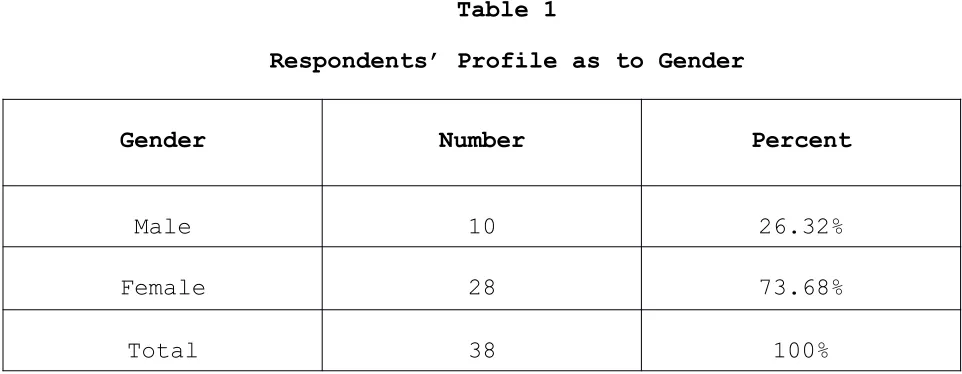
Table 1 presents the profile of the respondents according to gender.
Table 1
Respondents’ Profile as to Gender
Gender Number Percent
Male 10 26.32%
Female 28 73.68%
Total 38 100%
The result figures out the majority of achievers in the High School Grade Levels of S.I.A.T.I. were females. In a follow-up interview, the respondents mentioned that the achievers in S.I.A.T.I. are mostly females. Their observation was supported with the present situation which revealed that majority of the achievers in many schools or in universities are females
especially in academic. The information indicated culturally gender-biased undertones in terms of intellectual capacity.
Motivating Factors
Intrinsic Motivation Factor
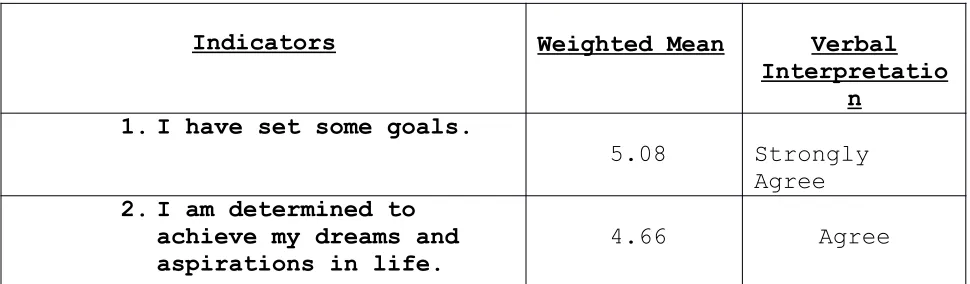
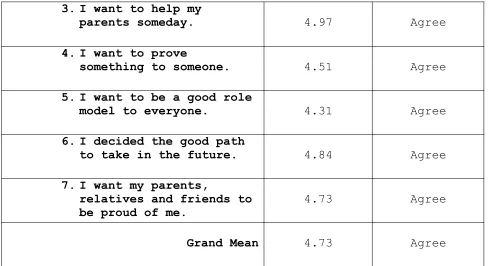
Table 2 shows the degree of motivating factors of the respondents in intrinsic motivation factor, then corresponding mean scores and interpretations.
Table 2
Respondents’ Degree of Motivating Factorsin Intrinsic Motivation Factor
Indicators Weighted Mean Verbal
Interpretatio n
1. I have set some goals.
5.08 Strongly Agree 2. I am determined to
achieve my dreams and
3. I want to help my
parents someday. 4.97 Agree
4. I want to prove
something to someone. 4.51 Agree
5. I want to be a good role
model to everyone. 4.31 Agree
6. I decided the good path
to take in the future. 4.84 Agree 7. I want my parents,
relatives and friends to be proud of me.
4.73 Agree
Grand Mean 4.73 Agree
The data reveals that the respondents are found to be effectively motivated in the first indicator which is they have set some goals.
Moreover, to be a good role model to everyone with weighted mean of 4.31 is agree and is considered as the least motivation. This is because achievers didn’t really just want to be a good role model but they have set some goals.
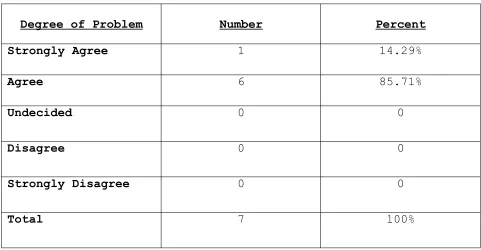
Table 3 shows the summary of the respondents’ degree of motivation in intrinsic motivation factor.
Table 3
Degree of Problem Number Percent
Strongly Agree 1 14.29%
Agree 6 85.71%
Undecided 0 0
Disagree 0 0
Strongly Disagree 0 0
Total 7 100%
The results show that motivating factors in intrinsic motivation factor are strongly agree with 14.29% of the respondents’
answers.
Extrinsic Motivation Factor
Table 4 presents the degree of motivating factors of the respondents in extrinsic motivation factor, then corresponding mean scores and interpretations.
Table 4
Respondents’ Degree of Motivating Factors in Extrinsic Motivation Factor
Indicators Weighted Mean Verbal
n A. Home Environment
1. I am comfortable at home.
4.52 Agree
support me holistically. 4.57 Agree 5. My parents want me to
become an achiever and a professional someday.
4.93 Agree
B. Peer Motivation 6. I have many friends.
4.45 Agree
with my school work. 4.21 Agree
11. My friends become my mentors on my personal life.
3.72 Undecided 12. My friends share
their knowledge and skills.
4.17 Agree
13. I like my teacher/
adviser most. 4.50 Agree
14. My teacher teaches
very well. 4.40 Agree
15. My teacher is my
role model. 4.42 Agree
16. My teacher
encourages me to study
well. 4.40 Agree
17. My teacher supports
me in everything I do. 3.92 Undecided 18. My teacher is
concerned about my
well-being. 4.20 Agree
19. My teacher has a good personality or
attitude and attire every time.
4.19 Agree
20. My teacher becomes my second mother, father
or friend. 4.42 Agree
D. School Environment 21. The school is
famous. 4.06 Agree
22. The school is
beautiful and clean. 4.00 Agree
23. The school cares for their teachers, faculty staff and students.
25. The school’s
facilities are good and well-ventilated.
3.90 Undecided 26. The school
satisfaction and enjoyment.
Grand Mean 4.24 Agree
Among the 26 indicators of motivating factors in extrinsic motivation factor, the thought of parents want their children to become an achiever and a professional someday is considered to be significantly the most effective motivation. It entails the home environment they live in is the greatest concern of the students.
According to Fabien (2015) that a child who comes from a home environment which is caring, comfortable, and supportive brings to the classroom, motivation arising from his conducive home environment.
However, of all the items within the extrinsic motivation factor, having a crush or relationship with someone is considered to be the least effective motivation.
Table 5 presents the summary of the respondents’ degree of motivating factors in extrinsic motivation factor.
Table 5
Summary Table of the Respondents’ Degree of Motivating Factors in Extrinsic Motivation Factor
Degree of Problem Number Percent
Agree 21 80.77%
Strongly Agree 0 0
Disagree 0 0
Strongly Disagree 0 0
Total 26 100%
The data shows that motivating factors in extrinsic motivation factor are considered agree with 80.77% of the respondents’ answers.
The Most and the Least Effective Motivation as Experienced by the High School Grade Levels Achievers
Table 6 presents the mean scores of the effective
motivations arrange from highest to lowest. Beside the mean score is its qualitative interpretation.
Table 6
Analysis on the Mean Scores of the Two Motivating Factors
Adjustment Factors
Mean Score Verbal Interpretation
Rank
Intrinsic Motivation
Factor
4.73 Agree 1
Extrinsic Motivation
Factor
The results revealed that among the two factors, intrinsic motivation factor is considered as the significantly most problematic.
Among the motivating factors, it is the extrinsic motivation factor which is considered as the least effective motivation. This motivating factor entails
Gender Differences in the Most and Least Effective Motivating Factor Experienced by the High School Grade Levels Achievers Table 7 presents the analysis on the mean scores between males and females in the two motivating factors.
Table 7
Analysis on the Mean Scores between Males and Females in the Two Motivating Factors
4.64 Agree 4.64 Agree
Extrinsic Motivation
Factor
4.23 Agree 4.42 Agree
The qualitative interpretation shown on table indicates that both males and females are more motivated in intrinsic motivation factor.On the other hand, the males and females considered extrinsic motivation factors as rarely a motivation and is significantly least effective.
The table also reveals that females experience more motivation towards achievement than males.
Chapter 4
This chapter presents the summary, conclusion drowned and the recommendations formulated in the study.
Summary
This descriptive study attempted to investigate the motivating factors among achievers in the high school grade levels of S.I.A.T.I during the first and second grading periods in the first semester of school year 2016-2017.It also determined the influence of gender on the motivating factors of the same target population.
The respondents consisted of 38 high school grade levels achievers (10 are males and 28 are females) enrolled at S.I.A.T.I during the first and second grading periods in the first semester of school year 2016-2017.
The findings of this study indicate that there are
motivating factors experienced among the achievers in the area of intrinsic and extrinsic motivation.
In conducting the study, the researchers made use of a modified standardized and researcher-made survey questionnaires. From the results of the survey questionnaires, the researchers used statistical instruments such as; 1.) Percentage distribution -- to get the respondent’s profile in terms of the gender and 2.)Weighted mean -- to show the profile of the respondentsin terms of the two motivating factors, intrinsic motivation and extrinsic motivation.
The findings were prevented according to the order of the problems stated in chapter 1.
1. Seventy-three and sixty-eight percent (73.68%) of the respondents are females while twenty-six and thirty-two percent (26.32%) are males.
2. The respondents considered having set some goals as the most effective motivation in intrinsic motivation factor.
3. Within the extrinsic motivation factor, the thought of parents want their children to become an achiever and a professional someday is found out to be the most effective motivation.
4. Majority of the respondents are affected most in intrinsic motivation factor towards their achievements.
5. It is the extrinsic motivation factor, where the respondents considered as the least motivation.
6. Both genders considered intrinsic motivation factor as the most effective motivation towards achievement.
Conclusions
Based on the findings of the study, the following conclusions are drawn:
1. The population of the achievers of the 5 high school grade levels of S.I.A.T.I. comprised more of females.
2. Having set some goals is the greatest motivation encountered by the high school grade levels achievers of S.I.A.T.I. in intrinsic motivation factor.
4. Few students don’t believe that having a crush or
relationship with someone could motivate them more in doing something beneficial to them.
5. Most of the students are not extrinsically motivated and it had only a little impact to them.
6. Both genders are intrinsically motivated towards achievements.
7. Extrinsic motivation factor is the least effective motivation.
Recommendations
Based on the findings and conclusions of the study, the researchers presented the following recommendations:
1. The guidance center should create and consider programs for students, achievers or non-achievers to be helped in their personality and motivation towards achievement.
2. The teachers, in collaboration with the guidance counselors, should provide classroom experiences and activities that will help the students enhance their personality towards achievement especially the non-achievers.
3. The administration should create and reconstruct their
curriculum and programs to provide maximum students learning that will be relevant and useful for the enhancement of student’s personality towards achievement.
4. The school principal, faculty and staff and faculty registrar should continue to coordinate, follow-up and should be considerate with the students.
5. The parents, relatives, guardians and friends should
6. Other researcher may focus on other factors which are not included in this study but are perceived to affect
motivating factors among achievers.
Bibliography
Brown, L.V. (2007). Psychology of motivation. New York: Nora Publishers
Deci, E.L. (1975). Intrinsic motivation .New York: Plenum. White, R.W. (1959). Motivation reconsidered. Psychological Review, 66, 297-333
http://hubpages.com/education/Selfmotivationforsucces (Date of Retrieval: October 23, 2015. By Fabien, Joyette
Hull, C. L. (1943). Principles of Behaviour. New York: Appleton- Century—Crofts
Myers, D. (2005). Exploring Psychology, Sixth Edition in Modules. New York: Worth Publishers
Rabideau, Scott T.(1997).Effects of Achievement Motivation on Behaviour , Unpublished Research Journal , Rochester Institute of Technology
Rosales, Raymond (2017). Interview
Ryan, Richard M. and Edward L. Deci(1985).Intrinsic and Extrinsic Motivation :Classic Definitions and New Direction , Research Journal , Rochester, N.Y., Academic Press Co. Villamor, GracevelleMhae (2017). Interview
Appendices
Appendix A- Letter to the Respondents
We are conducting a survey about the Motivating Factors among Achievers in the High School Grade Levels of S.I.A.T.I during the First and Second Grading Periods in the First Semester of S.Y. 2016-2017. Please help us answer honestly the items in the questionnaires. YOUR ANSWERS WILL BE HANDLED WITH UTMOST CONFIDENTIALITY and your help is much appreciated.
Thank you,
The Researchers
Appendix B- Motivating Factors Questionnaire
Name: Gender: _____M _____F
Year:
B. Instructions: The following are indicators of the motivating factors among achievers. Please encircle the number that best describes the degrees of the motivating factors.
5 – Strongly Agree (SA) 4 – Agree (A)
3 – Undecided (Un) 2 – Disagree (D)
1 – Strongly Disagree (SD)
Fill-up Questions.
SA A Un D SD
Intrinsic Motivation
8. I have set some goals. 5 4 3 2 1
9. I am determined to achieve my dreams and aspirations in life. role model to everyone.
13. I decided the good path to take in the future.
5 4 3 2 1
14. I want my parents, relatives and friends to be proud of me.
5 4 3 2 1
Extrinsic Motivation
E. Home Environment
15. I am comfortable at home.
5 4 3 2 1
16. I have a complete happy family.
5 4 3 2 1
17. My parents are proud of me.
5 4 3 2 1
18. My parents care and support me holistically.
5 4 3 2 1
19. My parents want me to become an achiever and a professional someday.
5 4 3 2 1
F. Peer Motivation
20. I have many friends. 5 4 3 2 1
21. I have lifelong friendships.
23. My friends are good influence.
5 4 3 2 1
24. My friends help me with my school work.
5 4 3 2 1
25. My friends become my mentors on my personal life.
26. My friends share their knowledge and skills.
5 4 3 2 1
G. Teacher Motivation 27. I like my teacher/
adviser most. 5 4 3 2 1
28. My teacher teaches
very well. 5 4 3 2 1
29. My teacher is my
role model. 5 4 3 2 1
30. My teacher
encourages me to study well.
5 4 3 2 1
31. My teacher supports
me in everything I do. 5 4 3 2 1
32. My teacher is
concerned about my well-being.
5 4 3 2 1
33. My teacher has a good personality or
attitude and attire every time.
5 4 3 2 1
34. My teacher becomes my second mother, father or friend.
39. The school’s
facilities are good and well-ventilated.
5 4 3 2 1
40. The school activities give us satisfaction and enjoyment.