Evaluation of Educational Interactions in
Accounting Tele-Teaching
Abdel Halabi
Accounting and Finance Monash University, AUSTRALIA
Juhani Tuovinen
Centre for Learning and Teaching Support Monash University, AUSTRALIA
Jodie Maxfield
Accounting and Finance Monash University, AUSTRALIA
Abstract
This paper reports on an investigation into the use and effectiveness of tele-teaching with two groups of internal Introductory Accounting classes within a multi-campus University. The paper has three aims: To introduce a four-interaction model for analysing and evaluating distance and flexible learning, to use the four-way model of educational interactions to analyse and outline the new teaching and learning issues in tele-teaching, and to evaluate the students’ attitudes to the new learning context using the above framework. This study shows that while students did accept tele-teaching and report some benefits in its use, most students strongly preferred the traditional face-to-face approach to teaching accounting. The content-learner, and instructor-content interactions in accounting tele-teaching were judged similar to face-to-face teaching, with some exceptions. However, some aspects of the instructor-learner and learner-learner interactions appear to be a more problematic in tele-teaching than the other two interactions, and need further development and research. This research has confirmed prior reports about tele-teaching in large classes across a multi-campus situations. Tele-teaching in university classes is still in its infancy, especially in its use and applicability to the accounting subject, so more development and research needs to be undertaken.
Keywords
Introduction
In contrast to sweeping claims that media (technology) does not influence learning (Clark, 1983; 1994), both comparative studies of live and
televised lectures (Brown, 1987) and recent reviews of research on videoconferencing indicate that different forms of communications utilising audio and visual channels affect the participants in different ways, particularly if they are compared to face to face contexts (Finn, 1997; Whittaker & O’Conaill, 1997). For example, some of the problems identified in research on lectures (Mathews, 1998), such as students being reluctant to ask lecturers questions about poorly understood content, are likely to be even worse in tele-teaching contexts. In such environments the staff and students are on different campuses and the technology does not support the same level of easy facilitation of turn-taking and coordination as face to face contexts (Sellen 1995; O’Conaill, Whittaker & Wilbur, 1993). Consequently Olson and Olson (1997) argue that in researching video-mediated communication, such as videoconferencing or tele-teaching, the technology needs to be addressed as a significant variable alongside other major variables, such as group and task characteristics. The multitude of significant task variables in university lecturing, whether face-to-face or tele-teaching, includes learning objectives, complexity of the subject matter, etc., and the group variables comprise capabilities of the learner and lecturer characteristics among others (Biggs, 1999; McLeish, 1968; Parer, 1994).
In the analysis of any distance, open, or flexible learning, at least four fundamental interactions need to be addressed in the development, implementation and evaluation of the programs. They are the
content-learner, learner-instructor, learner-learner and instructor-content
interactions (Tuovinen, 2000), as shown in Figure 1. This four-way interactions model is based on Moore’s (1993) three interaction model, which did not include the instructor-content dimension as discussed by Tuovinen (2000). These interactions have a significant bearing on the educational outcomes, and thus this framework appears to be particularly suitable for the analysis of tele-teaching programs. These four dimensions will be used as the main organising classification for the evaluation results in this study.
Instructor
Content
Figure 1: Four-way educational interactions model
In this program tele-teaching was used to deliver Introductory Accounting lecture material. Growth in tele-teaching has become more widespread across multi-campus universities in Australia, particularly in large introductory classes or in specialised subjects (see Freeman, 1998; Tennant, 1999; Knox, 1996). Accounting educators have used and examined many different teaching and learning approaches, yet very little research has been conducted on tele-teaching (see Rebele, Apostolou, Buckless, Hassell, Paquette, & Stout, 1998).
Tele-teaching at Monash University
Monash University operates on six campuses in Victoria. The University’s tele-teaching intentions were stated in the Monash Plan (1997), which indicated that the University would promote flexible learning and global networks. Tennant (1999) noted that video-conferencing was introduced to Monash University through the Department of Employment Education and Training (DEET) funding in 1991. The fundamental reasons for
implementing tele-teaching were expressed by Tennant (1999: p.81) as follows: “…it would appear that economic and student load factors drove the introduction of tele-teaching between the two campuses…” Freeman (1998) also noted that matters of duplication and financial concerns led to a video-conferencing solution, while Knox (1996) reported that the
decision to introduce video-conferencing of lectures has often been driven by technology.
Accounting and Tele-teaching
Saudagaran (1996) noted that in recent years there has been a growing demand for significant changes in the design and delivery of accounting education, and that much of the change has related to technology. Rebele et.al. (1998) concluded that many of the educational technological
continues with the Internet having a growing impact on accounting education (Sangster & Mulligan; 1997).
In one of the few reported studies on accounting and video-conferencing, Carl and Desmore (1988) evaluated the effectiveness of a video
conference course in Introductory Accounting delivered from a studio to distance students. This study involved simultaneously teaching classroom students and distance students at a number of distant locations by means of one-way full motion video-conferencing. The distance students were connected to the class and the teacher via means of a telephone. Carl and Desmore (1988) did not formally evaluate the students’ attitudes to this teaching style, instead comparing performances of the distance and internal students. The results indicated that distance students generally performed better than the in-class students.
Research is also limited on tele-teaching (as opposed to
Issues in Tele-teaching
Tele-teaching Introductory Accounting lectures were initiated at Monash University in semester 2, 1996, between the Berwick and Gippsland Campuses. Tele-teaching required a very different method of presentation to conventional face-to-face lectures because there were two different classes of students (although students were collectively treated as one). Staff needed become familiar with new equipment and software, material preparation, clothing and dealing with two sites of students, e.g. by using appropriate camera eye contact and managing student use of microphones on the two.
Although most lectures proceeded smoothly, a number of problems were encountered which would not have been evident in face-to-face lectures. These concerned the connection problems, time delays in transmission of material, and staff student interaction in lectures. Tele-teaching was not used in for Introductory Accounting in 1997 and 1998. In 1999, the accounting team once again decided to tele-teach the Introductory Accounting subject again. In 1999 the lectures were scheduled over longer time spans, i.e. 1.5 hours, to avoid start up time and time delays in material compression. Communication between the staff and the students during a lecture was encouraged by frequent questions. The teaching staff also encouraged the students to ask questions. The microphone settings and camera work allowed the staff to focus on students who were asking questions and transmit their sound and image to the other site. The change of screens transmissions between lecture sites had improved to a stage where there was no noticeable time delay. Audio and video quality also had improved.
Tennant (1999) and Freeman’s (1998) student evaluations were used in developing the changes to tele-teaching in 1999. Benefits (expressed by Freeman, 1998) such as greater equality in assessment and learning and an increase in cross-campus interaction, were stressed. Disadvantages of tele-teaching, such as a reduction in learning time, increased potential for disruptive behaviour, reduction in access to lecturers (see Freeman, 1998), were also included in planning the teaching approach. Tennant (1999) also found that students at remote sites did not feel part of the lecture, and experienced a reduced concentration span.
whether there were differences in student experience depending on the lecturer’s location. Considerable efforts were made to improve tele-teaching during this period and so a survey of students was undertaken to see if the effort had borne fruit.
Reasons for the Present Study
S pecif ically, the s tudy had three pr incipal aims :
• to evaluate s tudents ’ attitudes r egarding the us ef ulnes s and ef fectivenes s of the tele- teaching lectur es
• to compar e tele- teaching lectures w ith tr aditional f ace- to- f ace clas s es, and
• to deter mine the des ir ability of f utur e us e of tele- teaching based on the s tudent r espons es.
A questionnaire was developed which sought information on the students’ attitudes and responses to the tele-teaching lectures, and compared their attitudes to traditional face-to-face lectures. The questionnaire comprised 17 questions. Most were closed questions, with three being open. 185 questionnair es w er e dis tr ibuted to the s tudents attending the f inal lectur e in the s ubject; 159 at Ber wick and 26 at G ipps land. Of those r eturned, 120 w er e us eable, r epr es enting a r es pons e r ate of 65% . The res pons e r ate fr om the Ber w ick Campus w as 67% ( N = 107) , and f rom the G ipps land Campus w as 50% ( N = 13) . Demographic information showed that 40 students were male and 80 female, and their ages ranged between 18 and 29
Results
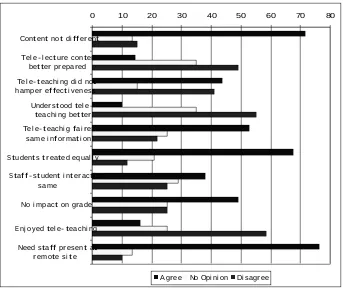
D ata w as analys ed us ing quantitative and qualitative pr ocedur es . After seeking demographic information, a number of questions were asked about students’ responses to the tele-teaching lectures. These questions asked students to rate the various aspects of the tele-teaching lectures based on a Likert scale of 1 = strongly agree to 5 = strongly disagree. The content of the questions and the percentage response frequencies are shown in Figure 2 below, with the ‘strongly agree’ and ‘agree’ percentage response categories collapsed to form one ‘agree’ category and the
‘strongly disagree’ and ‘disagree’ categories collapsed to one ‘disagree’ category.
The final group of closed questions asked students how they would like to have been taught in the Introductory Accounting subject. In the first question about student preferences for the origin of the tele-teaching lectures, three alternatives were offered, with only one being chosen. Student responses were The lecture was delivered from the local site (65%); The lecture was delivered from the far site (2%); Didn’t care what site (24%), (Missing cases 9%).
Figure 2: Aanswers to tele-teaching vs. face-to-face teaching evaluation questions.
The second question asked, “How would you prefer the subject be taught?” four alternatives were offered with only one being selected. Student responses were: As it was this semester with lectures from
alternative sites each week, (37%); Completely from the remote site, (1%); Completely from the original site (15%), Completely face-to-face (no tele-teaching), (36%) (Missing cases 9%).
0 10 20 30 40 50 60 70 80
Cont ent no t di ff er ent
Tel e - l ect ure con ten t bet ter pr epa red
Te l e- t eachi ng di d not h amp er ef fect i ven ess
Under st ood tel e -tea chi ng bet ter
Te l e t eachi g fa i rer -sam e i nf or mat i on
S tu dent s t r eate d eq ual l y
S taf f - st udent i nt er act i on sa me
No i mp act on gra de
E nj o yed tel e- tea chi ng
Need sta ff pr esen t at r em ote si t e
Analysis
Individual Question Analysis
When a Chi-Square test was used on the above results, each of the
responses was significantly different (at 1% significance level or better) to a random distribution of responses. Combining the “strongly agree” and “agree” categories and “disagree” and “strongly disagree” categories into two opposing opinions, we found that there was significantly greater agreement (72%) than disagreement (15%, the no opinion percentage is ignored in this analysis) that the content of the tele-lectures lectures was not different to face-to-face lectures. Over three times as many disagreed (49.2% vs. 14.4%) with the proposition that tele-teaching lecture materials were better prepared than for face-face context. The opinions on whether tele-teaching hampered effectiveness of lectures were evenly divided between no hampering (43.7%) and those who thought it would hamper (40.9%).
Over five times as many students (55% vs. 10%) did not think they understood lecture material better when it was tele-taught. More than twice as many people (52.5% vs. 21.7%) thought tele-teaching was fairer than repeat lectures. About six times as many people (67.5% vs. 11.6%) thought the students were treated equally irrespective of their location. The opinions were split evenly (agree: 38.1% vs. disagree: 39%) between those who thought the student-lecturer interaction was as good as in face-to-face lectures. Twice as many people (49.2% vs. 25%) thought tele-lectures would have no different impact on their final grades than face-to-face lectures. Almost four times as many students (58.4% vs. 16 %) did not enjoy tele-lectures as much as face-to-face sessions. Over seven times as many (76.1% vs. 10%) thought it was necessary to have subject staff present in the remote lecture theatre when the lecture was tele-taught.
The Four Interactions Analysis
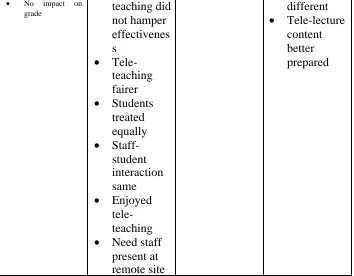
In an effort to get a more detailed view of what effect tele-teaching had on the four different interactions the questions shown in Figure 2 were
grouped together as follows:
• No impact on
Table 1: Classification of questions by interaction category
The results from the component questions were added together for each category, and averaged, e.g. the results of 6 questions in the instructor-learner category were added together for each response and then divided by 6. The results were then separated into 3 components: “strongly agree” and “agree” were collapsed to one “agree” category, and the “strongly disagree” and “disagree” categories were collapsed into one “disagree” category. The third category “no opinion” was not recoded.
For the combined score on the two questions relating to content-learner interaction there was about 50% more agreement than disagreement (39% vs. 26%) that the content-learner interaction was as good as in face-to-face lectures. Chi-squared analysis indicated this was significant at the 1% level. The combined result of the six questions relating to
instructor-learner interaction indicated there was more than 2 and half times as much
result, we need to look at the patterns of individual question responses, to see if a composite result is reasonable.
In fact, we find that on three questions there was strong agreement, that is, staff were needed at the remote site, the students were treated equally, and tele-teaching was fairer than repeat lectures. On two issues the responses were more even, i.e. that tele-teaching did not hamper effectiveness and whether student-lecturer interaction was as good as in face-to-face
lectures. On the question of enjoyment of tele-teaching compared to face-to-face lectures, the answer was clearly negative. This response is the strongest indication that the composite positive score for the instructor-learner interaction needs to be treated with caution. It would appear this category should be separated into at least two classifications. These could be, firstly, instructor-learner interaction issues related to the learning context effectiveness and organisational issues, and secondly, affective learning issues.
For the combined score on the two questions relating to instructor-content interaction there was nearly four times more agreement than disagreement (51% vs. 13%) that the instructor-content interaction was as good as in face-to-face lectures. Chi-squared analysis indicated this was significant at the 1% level as well. However, if we look at the two questions making up this category, it could be that the students in answering the first question were simply making an observation that they would not expect the actual accounting material taught in the two modes to be different. In the second question they seemed to reflect on the comparative quality of the
preparation of face-to-face and tele-teaching materials, which they judged to be poorer than equivalent face-to-face lecture materials. Due to these conflicting interpretations this issue needs to be further clarified via subsequent research.
None of these evaluation questions related specifically to the learner-learner interaction, so this issue will be analysed on the basis of the qualitative responses to questions. I nf or mation about the ins tr uctor -content inter action w as obtained by a ques tion whether Accounting was tele-taught better or worse than other subjects. A large number of students who answered this (N = 33, or 53 %) felt the accounting lectures were better than other subjects, and many complimented the technical understanding. “In the past tele-teaching has been awful. However with Accounting both
going ahead at all, whereas in Accounting they always seemed to be relatively problem free.” Other students disagreed (9%), while 46% had
no opinion.
Many students noted important benefits of tele-teaching when analysis of the impact on the ins tr uctor -lear ner inter action w as conducted. The major responses concerned the two different lecturers and styles (33%, N = 21), for instance “Different styles of lecturing appeal to different people. By
alternating it allows more people to be satisfied in the lecture
presentation,” no benefits (30%) “I don’t think I could specifically name any benefits, I certainly had no complaints though,” and the class was
treated equally (23%) “The lecturers have made us feel united as a class,”
“I think it is mainly due to a lecturer being present whether face to face or tele-teaching.”
Another open question asked if there were any limitations to the tele-teaching, and a number of students (25%) stated tele-teaching led to a lack of communication between staff and students, and an inability to ask questions (25%), for instance “When tele-teaching from the far end, it is
very difficult to ask questions if I didn’t understand any thing,” and “What happened to the time you had your own lecturer in class, and when you could ask question?” This bears out the problem of student reluctance to
ask clarifying questions, identified in research on large class teaching (Mathews, 1998), is exacerbated by the channel limitations in inter-personal communication via synchronous audio-video systems identified by Sellen (1995) and O’Conaill, Whittaker & Wilbur (1993). A large number of students (36%) stated that more questions could be asked because there was always a lecturer present at both sites, for example, “A
lecturer should always be present at all times a lecture is being taught. To either be spoken to after the lecture or to answer questions which may arise and provide a link to the students.”
The final question asked how tele-teaching could be improved. Most felt that the technology should be improved and training should be given to the lecturers (28%, N = 20). For example “you should ensure that those using
the technology are trained in it so that there isn’t time wasted in
establishing the links.” A large number of students felt that tele-teaching
should not be used (26%), “Not to have it at all. As students we pay to be
already good (12%), there should be less interruptions and discussion between the teachers (8%), and 8% felt more microphones were needed.
While many s tudents f elt that they pref er r ed f ace- to- f ace to tele- teaching ( 30% of s tudents f elt it did not have any benef its and s ome s ugges ted that an improvement in tele- teaching w as not to have it) w hen an analys is of the
content and lear ner inter action w as done, no s tudent s tated that it hamper ed
their unders tanding. M os t concer ns on tele-teaching f ocus ed on technology, the inability to as k ques tions and time los t in beginning lectures . With r egar d to content and lear ner inter action, one s tudent, for example, noted
“ T he content of the lectur es does not have anything to do with tele- teaching.” The f inal analys is concer ned the learner to lear ner inter action.
Conclusion
So what have we learned about students’ views on tele-teaching? Firstly, the results confirm what other studies have shown about the limitations and benefits of this approach. The students’ attitudes to tele-teaching are the same irrespective of the subject matter taught (see Tennant, 1999; Freeman, 1998). Indeed in respect to accounting, this study has also confirmed the views of Milkman and Seay (1994).
Secondly, we discovered important information about the students’ impressions of the four key educational interactions in tele-teaching. The
content-learner interaction was provided as well in accounting
tele-teaching as in face-to-face classes, according to a majority of the students, but tele-teaching was not seen to provide better student understanding than face-to-face teaching. The instructor-learner interaction probably needs to be addressed in two parts. Firstly, the affective learning interactions are adversely affected by the tele-teaching context, but the interaction
effectiveness and organisational aspects appear to be positive, although the difference is not as clear as in the affective area. In particular, the
communication from students at the distant site to the lecturing staff, e.g. asking questions, was seen to be more difficult in tele-teaching. The critical importance of staff available to support tele-teaching at the remote site was strongly confirmed by this study. It appears the students at the site with smaller student numbers were somewhat more satisfied with the instructor-learner interaction than the students at the more populous site, which raises a question about the desirable size of the tele-teaching groups.
The instructor-content interaction results were ambivalent, and require further research. The weakest interaction appeared to be between
learners. This interaction needs the most attention in further educational
planning, development and evaluation of tele-teaching in accounting at this level. For example, the value of adapting and incorporating some common student small group activities, such as buzz-groups (Blight, 1972), into the tele-teaching lectures should be investigated. Overall this study has not only confirmed previous general findings about teaching, but also pinpointed areas that need particular attention in tele-teaching.
Biggs, J. (1999). Teaching for quality learning at university. Buckingham, UK: Open University Press.
Brown, G. (1987). Lectures and lecturing. In W. Dunkin (Ed.) The international encyclopedia of teaching and teacher education. Oxford: Pergamon Press.
Bligh, D. A. (1972). What’s the use of lectures? Harmondsworth: Penguin.
Clark, R. E. (1983). Reconsidering research on learning from media. Review of Educational Research, 53(4), 445-459.
Clark, R. E. (1994). Media will never influence learning. Educational Technology Research & Development,42(2), 21-29.
Carl, D R., & Desmore, B. (1988). Introductory Accounting on Distance Education University Education Via Television (DUET): A Comparative Evaluation. Canadian Journal of Educational Communication, 17(2), 81 - 94.
Finn, K. E. (1997). Introduction: an overview of video-mediated communication literature. In K. E. Finn, A. J. Sellen & S. B. Wilbur (Eds.) Video-mediated communication. Mahwah, NJ: LEA, 3-21.
Freeman, M. (1998). Video Conferencing: a solution to the multi campus large classes problem? British Journal of Educational Technology, 29(3), 197 – 210.
Knox, D.M. (1996). A review of the use of video-conferencing for actuarial education – a three year case study. Distance Education, 18(2), 225 – 235.
Mathews, A. (1998). Teaching and learning of science in a large class situation. In B. Black and N. Stanley (Eds.) Teaching and learning in changing times : the proceedings of the 7th Annual Teaching and Learning Forum (4 and 5 February, 1998). The University of Western Australia, 194-198.
McLeish, J. (1968). The lecture method. Cambridge: Cambridge Institute of Education. Monash University. (1997). Leading the Way : The Monash Plan 1998 – 2002. Monash
University.
Moore, M. G. (1993). Three typs of interaction. In K. Harry & M. John (Eds.), Distance education: New perspectives (pp. 19-24). London: Routledge.
O'Conaill, B., Whittaker, S., & Wilbur, S. (1993). Conversations over videoconferences: an evaluation of the spoken aspects of video-mediated communication. Human-Computer Interaction, 8, 389-428.
Olson, G. M. & Olson, J. S. (1997). Making sense of the findings: common vocabulary leads to the synthesis necessary for theory building. In K. E. Finn, A. J. Sellen & S. B. Wilbur (Eds.) Video-mediated communication. Mahwah, NJ: LEA, 75-91.
Parer, M. (1994). Lecturing. Churchill, Victoria: Monash University.
Rebele, J.E., Apostolou, B.A., Buckless, F.A., Hassell, J.M., Paquette, L.R., & Stout, D.E. (1998). Accounting Education Literature Review 1991 - 1997, Part 2: Students, Educational Technology, Assessment, and Faculty Issues. Journal of Accounting Education, 16(2), 179-245.
Sangster, A., & Mulligan, C. (1997). Integrating the World Wide Web into an accounting systems course. Accounting Education, 6(1), 53 – 62.
Saudagaran, S. A. (1996). The First Course in Accounting: An Innovative Approach. Issues in Accounting Education, 11(1), 83–94.
Seay, R.A., & Milkman, M.I. (1994). Interactive Television Instruction: An Assessment of Student Performance and Attitudes in an Upper Division Accounting Course. Accounting Education, 9(1), 80 – 95.
Sellen, A. J. (1995). Remote conversations: the effects of mediating talk with technology. Human-Computer Interaction, 10(4), 401-444.
Tennant, J. (1999). Tele-teaching with large groups: A case study from the Monash experience. Australian Journal of Educational Technology, 15(1), 80–94.
International, 37(1), 16-24.
Whittaker, S. & O’Conaill, B. (1997). The role of vision in face-to-face and mediated communication. In K. E. Finn, A. J. Sellen & S. B. Wilbur (Eds.) Video-mediated communication. Mahwah, NJ: LEA, 23-49.
Copyright 2000 Halabi, Tuovinen & Maxfield