THE INFLUENCE OF FACULTY ON
TAIWAN-ESE UNIVERSITY STUDENTS
ENGLISH-LEARNING MOTIVATION
Dylan Sung1, Chih-Wei Yang 2, and Lai-Yu Cheng 2
1Department of Applied Linguistics and Language Studies 2Department of Industrial and Systems Engineering
Chung Yuan Christian University
200 Chung Pei Rd., Chung-Li, Taoyuan 32023, Taiwan [email protected]
Abstract
level of English learning needs to be enhanced.
Keywords: English learning, English as a foreign language
(EFL), Learning motivation, English teaching, Teaching strategy, Teacher influence
INTRODUCTION
In the rapidly changing world, English has become an in-ternational language (Liao, 2004). The spread of globalization influences English education greatly. Therefore, there has been a growing recognition of the importance of learning English.
Many factors were pointed out as affecting students En-glish learning, such as the learners first language, learning atti-tudes, and learning motivation (Wilhelm, 1995). Brown (2000) indicated that motivation is probably the most important factor of leading to success or failure of virtually any complex task. Moti-vation has been considered one of the key factors in learning a foreign language successfully (Gardner, 1985). However, many university students lack the motivation to acquire English as a second language (Wu, 2003).
Several studies have indicated that learning motivation plays an important role in language learning (Gardner & Tremblay, 1994; Orpet, 1984). Learners with higher learning motivation tend to have better performance (Chung & Chow, 2004; Wilhelm, 1995). How-ever, many university students did not think that their English classes were inspiring and motivating. Most students expect to learn En-glish in a relaxing and more interactive environment. In a study conducted by Sung (2007) to investigate teaching quality of En-glish education, Taiwanese university students identified having positive interactions in class as attractive. Richards (2006) found that faculty s personality affects students learning motivation. Moreover, faculty s positive influences will lead to students higher learning motivation (Rugutt, 2004). Thus, faculty members are a crucial role player in motivating students to be involved in learning. Instructors play a fundamental role in their students lan-guage acquisition. Research on students articulation of their in-structors influence on their language learning process is relatively lacking. Therefore, the purpose of this study is to investigate Tai-wanese university students viewpoints toward faculty s influences on their English learning motivation. This study examines the dif-ferences in learning strategies based on students different demo-graphic background. The results provide English instructors with useful information about Taiwanese university students learning motivations and preferred learning approaches. Findings of the study are beneficial for educators who want to understand the factors that contribute to students higher English learning moti-vation.
.
METHODS
This study focuses on the factors influencing students En-glish learning motivation. There were three major research ques-tions developed to guide the study:
(1) What are students opinions on their English learning? (2) What kinds of factors affect students English learning
motivations?
styles and strategies affect students English learning motivation?
In the following sections, data collection, analysis proce-dures, findings of the study, and discussion of potential implica-tions for future studies are described.
In order to achieve the objectives of the study, a survey instrument was developed. The survey utilized a five-point Likert scale ranging from 1 (strongly disagree) to 5 (strongly agree). One hundred and five university students from a selected univer-sity in Taiwan completed the survey. Students were asked to rate their opinions about the influential factors on their English learn-ing motivations.
Participants
This study is based on a survey questionnaire taken by 105 university students at a selected university in Taiwan. All stu-dents participated in the study have completed at least six years of English learning since high school. Among the 105 partici-pants, there were 37 male (35.2%) and 68 female (64.8%) stu-dents.
Data Collection and Analysis
The survey questionnaire was done over a period of two weeks during October 1st and October 15th, 2006. The students
back-ground, time spent on learning English per day, stage of starting English learning, and overseas living experiences. The dependent variables include: interest in learning English, English proficiency, confidence level of English learning, reasons for English learn-ing, English teaching strategies, personality influence, and per-formance in English classes.
The analytic process included three major parts. First, this study used descriptive statistics (frequencies, percentages, means, standard deviation, etc.) to obtain demographic information from the questionnaire. Second, factor analysis was used to identify the potential primary factors. Third, analysis of variance (ANOVA) was performed to examine the differences in the overall mean. Based on the p-value test ( is equal to 0.05), a conclusion can be drawn to examine if the hypotheses in section 2.2 will be signifi-cantly rejected or not.
RESULTS
Participants Background Information
Item N Percent (%)
Time spent on English learning per day
8 < Time 1 1.0
Stage of starting English learning
Senior high
school 1 1.0
Never 99 94.3
Overseas living experience Yes 6 5.7
Table 1. Demographic Information of Participants
Factor Analysis
The factor analysis must eliminate the factor that consists of less than two items. Among the 10 items of interest in English learning, Principal Component Analysis was performed to deter-mine the potential groupings. Varimax rotation was used to better account for expected correlations among potential factors (KMO measure of adequacy = 0.937). One factor emerged with eigen-values greater than 1.0, explaining 53.81% of the total variance. This consisted of 10 items reflecting students interest in English learning. Result derived from the calculation shows that students were willing to practice English in daily life (Mean = 3.62). Also, they were interested in the classes which enhanced their speaking ability the most. The reliability of these 10 items as indicated by Cronbach s alpha was high at 0.85.
vari-ance (KMO measure of adequacy = 0.878). This consisted of nine items reflecting students self-evaluation of their English profi-ciency, including listening, speaking, reading, and writing ability. Results derived from the calculation show that students thought that they were not good at communicating with others in English (Mean=2.41). Furthermore, they thought that they need to im-prove their English writing ability. The reliability of these nine items as indicated by Cronbach s alpha was high at 0.89.
Among the 16 items, two main factors were extracted via Principal Component Analysis with Varimax rotation (KMO mea-sure of adequacy = 0.804). There were two factors extracted with an eigenvalue greater than 1.0. The first factor was confidence level of English learning (eigenvalue = 3.721, 41.35% of the vari-ance). This factor reveals students learning English for self-achievement, self-gratification and self-confidence. The reliabil-ity of these items as indicated by Cronbach s alpha was high at 0.88. Reasons for English learning was the second factor (eigen-value = 2.344, 26.05% of the variance). It included students pur-poses for learning English to enhance their overall ability and knowledge development (Cronbach s alpha was 0.78). The two factors explain 66.05% of the total variance. And the total Cronbach s alpha was 0.88.
use English to communicate in class. One factor emerged with eigen-values greater than 1.0, explaining 59.88% of the total variance (KMO measure of adequacy = 0.84). This category consisted of eight items indicating students willingness to use English to com-municate and express their opinion in class. The result derived from the calculation shows that students were willing to use English to communicate in class (Mean = 3.37). The reliability of these eight items as indicated by Cronbach s alpha was high at 0.90.
Analysis of Variance for Principle Factors Based on Partici-pants Background
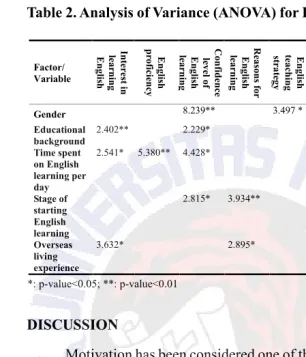
This section describes whether the background variables significantly influence the principle factors or not. There are seven principle factors in the questionnaire based on results of factors analysis. From the results shown in Table 2, this study yielded the following results from using analysis of variance (ANOVA).
Factor/
Table 2. Analysis of Variance (ANOVA) for Principle Factors
*: p-value<0.05; **: p-value<0.01
DISCUSSION
Motivation has been considered one of the significant fac-tors in foreign language learning. Researchers in the foreign lan-guage education have considered motivation a key factor in learn-ing a language successfully (Gardner, 1985; Gardner & Clement, 1990). It is widely accepted that the higher motivation learners have, the more efforts and progresses they will make (Dulay & Burt, 1977). As such, it is essential to realize the importance of teachers influence on students learning motivation.
find-ing was that the students who spent more time on English learn-ing are more easily influenced by instructors personality.
Moreover, students who started to learn English earlier had better performance in English classes. Actually, they are more confident in their English proficiency than the other students who started to learn English later. Another finding indicated that stu-dents who had overseas living experiences thought that their En-glish is superior.
CONCLUSION
Based on the above discussion, we conclude that students who spend more time on English learning will be influenced by faculty s teaching styles and strategies. Male students and female students have different viewpoints on interests of English learn-ing and faculty s influences in English classes. Moreover, we found that faculty s influence on Taiwanese university students English learning motivation will be significantly different based on dif-ferent genders, time spent, and stage of learning English. There-fore, we recommend that in addition to grouping the students based on only their English proficiency, students in an English class can be grouped according to their genders, time spent on English learn-ing, and stage of learning English. Additionally, faculty members can apply different teaching strategies to meet students needs to achieve more effective English learning. Lastly, students better English proficiency results from higher English learning motiva-tion enhanced by faculty s influences.
REFERENCES
Brown, H. (2000).Principles of language learning and teaching. Englewood Cliffs, NJ: Prentice Hall Regents.
Chung, J. C. C., & Chow, S. M. K. (2004). Promoting student learning through a student-centered problem-based learn-ing subject curriculum.Innovations in Education and
Teach-ing International, 41(2), 157-168.
acquisition. In M. Burt, H. Dulay, & M. Finnochiaro (Eds.),
Viewpoints on English as a Second Language, (pp. 95-126).
New York: Regents.
Gardner, R. C. (1985).Social psychology and second language
learning: The role of attitudes and motivation. London, UK:
Edward Arnold.
Gardner, R. C., & Clement, R. (1990). Social psychological per-spectives on second language acquisition. In Giles, H., & Robison, W. P. (Eds.),Handbook of Social Psychology (pp.
495-517). Chichester, UK: John Wiley & Sons.
Gardner, R. C., & Lambert W. (1972)Attitudes and motivation in
second-language learning. Rowley, MA: Newbury House.
Gardner, R. C. & Tremblay, R. F. (1994). On motivation research agendas and theoretical frameworks. Modern Language
Journal, 78, 359-368.
Liao, P. S. (2004). English as a global language and its effects on Taiwan s English education. English Teaching & Learn-ing,29(1), 107-121.
Lin, L. Y. (2004).Learner motivation in the film-based classroom:
The learner-centered approach. Paper presented on the
Thirteenth International Symposium and Book Fair on En-glish Teaching, Taipei, Taiwan.
Orpet, B. R. (1984). Foreign language learning in Sweden.
Brit-ish Journal of Language Teaching,22(1), 43-47.
Oxford, R, & Shearin, J. (1994). Language learning motivation: Expanding the theoretical framework. The Modern
Lan-guage Journal, 78(1), 12-25.
Richards, J. (2006). Setting the stage for student engagement.
Kappa Delta Pi Record,42(2), 92-94.
Sung, D. (2007). Attractive quality attributes of English language instruction identified by students at a selected Taiwanese university.Proceedings of 2007 International Conference and Workshop on TEFL & Applied Linguistics, Taoyuan,
Taiwan, 453-461.
Wilhelm, K. H. (1995).Identification of LL (Language Learning) background variables associated with university IEP suc-cess. Paper presented at the Annual Conference of the American Association for Applied Linguistics. (ERIC Docu-ment Reproduction Service No. ED386939)
Wu, H. Y. (2003).Teaching techniques that keep university
stu-dents interested in English learning. Paper presented in the