• Tidak ada hasil yang ditemukan

[Jenny Rogers] Adults Learning

N/A
N/A
Protected

Academic year: 2017

Membagikan "[Jenny Rogers] Adults Learning"

Copied!
296
0
0

Teks penuh

(1)
(2)
(3)
(4)

Adults Learning

Jenny Rogers

Fifth edition

(5)

McGraw-Hill Education McGraw-Hill House Shoppenhangers Road Maidenhead

Berkshire England SL6 2QL

email: [email protected] world wide web: www.openup.co.uk

and Two Penn Plaza, New York, NY 10121–2289, USA

First published 1971 Second edition 1977 Third edition 1989 Fourth edition 2001

This fifth edition published 2007

Copyright#Jenny Rogers 2007

All rights reserved. Except for the quotation of short passages for the purposes of criticism and review, no part of this publication may be reproduced, stored in a retrieval system, or transmitted, in any form or by any means, electronic,

mechanical, photocopying, recording or otherwise, without the prior permission of the publisher or a licence from the Copyright Licensing Agency Limited. Details of such licences (for reprographic reproduction) may be obtained from the Copyright Licensing Agency Ltd of Saffron House, 6–10 Kirby Street, London, EC1N 8TS.

A catalogue record of this book is available from the British Library

ISBN–13: 978–0–33–522535–4 (pb) ISBN–10: 033–522535–7 (pb)

Library of Congress Cataloguing-in-Publication Data CIP data applied for

(6)

Acknowledgements

Introduction 1

1 Adult learners: what you need to know 6

2 The first session 44

3 Giving feedback 58

4 Understanding your group 77

5 Facilitating 107

6 Action learning 144

7 Problem-based learning 160

8 Coaching 174

9 Role play and simulation 197

10 Delivering information: lecturing, demonstrating and blended learning 219

11 Design for learning 238

12 Evaluating 262

(7)

Most of what I know about teaching and learning has been as a result of working with more experienced colleagues and with groups frank enough to give me high-quality feedback. My current colleagues at Management Futures are skilled designers and managers of learning and I benefit constantly from their wisdom. Without all these people there would be little for me to write about.

My interest in social psychology was first sparked as a postgraduate stu-dent at Oxford where I was lucky enough to encounter teachers such as Henri Tajfel, Michael Argyle and Peter Kuenstler. Their combined knowledge and enthusiasm woke me up from the trance of my undergraduate career. I have learnt enormously from every course I have attended as a participant, but the Columbia University course on organizational development run by Warner Burke stands out, as does my training in the Myers Briggs Type Indicator from Susan Block.

I owe gratitude to early colleagues at the BBC: John Robinson, Donald Gratton, Roger Owen and Sheila Innes for giving me the chance to deepen my experience as an educationist and to my long-standing friend Chris Longley for her personal support. As someone then new to the whole theory of adult learning, I learnt an enormous amount in informal conversations with a distinguished generation of British adult educationists such as Ralph Ruddock and Brian Groombridge. Later on, during my stint as a Commissioning Editor at the Open College, I also gained a great deal of knowledge about applied learning from both Richard Freeman and Martin Fischer.

The book would never have been written without the active encourage-ment and insight of my editor at Penguin, Richard Mabey. John Skelton at the Open University Press saw the book through several of its subsequent editions and his successor, Shona Mullen, has also been consistently encouraging.

(8)
(9)

If you are one of the many tens of thousands of people involved in helping other adults learn, then this book could be for you.

When I wrote the first edition in 1971, I produced the book that I wished someone had given to me when I was new to teaching adults. Now, for this fifth edition thirty-six years later, that wish remains the driving force behind substantially rewriting the book yet again with several entirely new chapters and radically updated treatments of old ones. I now know a lot more about teaching and learning than I did in 1971, but the core principles of good practice seem much the same. The context has changed, the research is deeper and fuller, but the needs of adult learners are recognizably what they were then.

I envisaged the original target reader as someone who was an expert in a particular subject, but lacked knowledge of how to apply that expertise to working with adult learners. Probably I saw my core reader as working in adult education institutions of one kind or another – the old ‘evening class’ whose worthy tradition was firmly rooted in nineteenth-century philan-thropic ideas of helping talented people climb out of the poverty imposed by their lack of access to education.

(10)

The possibilities for learning and teaching seem literally unlimited. The quest for ‘self-development’ means that good old favourites like yoga classes are still going strong, but so too are the thousands of ‘be-a-better-person’ books. The ultra-rapid pace of change in companies of all sorts as they struggle to stay competitive means that training and development are now open to virtually everyone who is employed. ‘Having a development plan’ is no longer the preserve of people who’d been through a hippy stage in earlier life and had never quite got over it, but a sensible strategy for keeping your entire workforce flexible and up to date. Anyone who is a manager needs to accept that they must also be a coach. Leadership is now as much about coaching as it is about setting direction, and coaching is about helping people learn.

The media through which training is delivered are many times more varied than they were. Where once the only way to learn was assumed to be face to face or with a book, now it can be through blended learning, manuals, and increasingly by ‘e’ means, whether through the phone, video, the internet or by ‘e-coaching’. Whatever the medium or the context, I still believe that the subject is a lot less important than the method or the means of delivery. The art of teaching adults is a broad-based and flexible one whose principles can be applied to a wide variety of situations.

It is a hard task to write a book about teaching and learning without sounding prescriptive or saintly – or possibly both. In the early editions, I did not attempt to explain how and why I had come to write it, perhaps because the experience was still too recent or perhaps because I was sensitive to the possible accusation that I was too young and inexperienced to be writing a book of ‘advice’ at all. The original book came out of two strands of experi-ence: my own in the classroom and an early career experience with the BBC. My first job as a young graduate was in a college of further education where teaching adults became an important part of a job which I had ori-ginally thought was going to be about the education of 16- to 19-year-olds. To survive and learn your craft in this environment your wits had to be sharp and your sense of humour well to the fore. As the youngest person in my ‘adults’ class working towards an English exam, I was the teacher but without any of the natural authority that age and experience confer. No wonder that I often felt I was engaged in a role-play rather than the real thing.

(11)

we read the play instead of you talking’. They had gloriously direct ways of teaching teachers humbling lessons.

In effect my younger students trained me and I diligently and gratefully applied what I was learning to the adults’ classes where the same forces were at work but far more subtly. After all, the adults did not have to be there. If the class was disagreeable, they could stop coming. The overriding impact of this experience amounted to one simple message. In teaching, the customer, not the subject, comes first and is always right, and the customer is the learner.

However valuable this experience was, it was considerably sharpened by my next job where I worked as an adviser on adult education to the BBC. If only every tutor could, as I did, sit anonymously in other people’s classrooms. The ‘mistakes’ that we all fudge in our own efforts become burningly obvious when looking at someone else making them. I am reminded now of some-thing I say to the people I train as coaches when alerting them to the dangers of disliking something you see in a client: ‘If you spot it, you got it!’

Since no one in adult and further education really believed that the BBC knew anything whatsoever about teaching and learning, I was welcomed everywhere. ‘It’s only some girl from the BBC’ I overheard one principal explain to one of his tutors, ‘She just wants to sit in at the back’. So as an honorary invisible woman, I saw adult teaching of all types – probably several hundred classes in all – in the raw. I saw bold and innovative teaching that was years ahead of its time and that would still stand scrutiny today as out-standing. Equally, and perhaps more often, I saw tutors struggling because no one had apparently even attempted to show them solutions to the common problems of all teaching and learning: how to motivate, how to simplify without losing the integrity of the original ideas, how to help people learn.

One piece of good fortune fuelled my desire to pass on to others what I felt I now knew. In my first year at the BBC, I was asked to help evaluate a pioneering series called Teaching Adults. The series became a classic and introduced me to some of the best brains in the business. Some of them contributed to the book I edited for the BBC,Teaching on Equal Terms, but working on this project made me even keener to write a book of my own, henceAdults Learning.

(12)

feedback. Maybe this was just as well, as the Tube is full of crazy people and I don’t think I looked very authorial that day.

In the years since writing the earlier editions, I believe I have become a living case study myself of why adult learning is still such a vital topic. I had had three different careers in earlier life – teacher, internal consultant on education and TV producer and all required concentrated learning in order to master the various skills that they needed. Since then, I have added several more careers. After working as a commissioning editor for the Open College, I became a manager, running a training department for the BBC. Then, feeling that spending my time on endless so-called working parties was not for me, I moved again. This time it was to start my own company, Management Futures, where we train, teach, consult and coach. So in addition to con-tinuing to teach, I have also had to learn how to become an entrepreneur, management consultant, coach and director of a small company.

The safe career is now a fantasy for all of us. This is true for me, for my sons and for my clients. Like so many others, I have needed and wanted to learn new skills as I have shifted into the ‘portfolio’ economy. I have become computer and internet literate. I have added satisfying new hobbies to my life, including line-dancing and other forms of dance, an interest that involves a lot of intensive learning and which arouses much puzzled amu-sement among family and friends. I have continued my own formal devel-opment through courses on subjects as varied as personal image and mediation. I have written many other books, including three on human personality as seen through the lens of psychometric questionnaires and two books on coaching, also published by the Open University Press. Also, like so many of my contemporaries, I refuse to accept the possibility of the ‘R’ word. Retirement is not something I can contemplate. I am struck by the truth of one friend’s recipe for a happy life: never get divorced, never stop learning, never stop working – and never spend Christmas with your family. The last perhaps is somewhat controversial, but I strongly agree with the other three. As with its predecessor editions, this is not a textbook, though I know it is commonly recommended on teacher-training courses. You will not find a sober, pedagogical treatment here. I wanted to convey the essence of important ideas on teaching and learning but also to give some flavour of the authentic voices of tutors and learners, so this edition, like its predecessors, contains direct, anonymized quotes. I wrote the original book precisely because I was so maddened by the footnoted complexity and what felt like the perverse and cranky obfuscation of all the other material then available. There are now some excellent academic treatments of the same subject and I recommend some of them in the Further Reading suggestions which end each chapter.

(13)

expressed in the first edition about the need to put learners at the centre of teaching, then considered to be radical and maybe somewhat barmy, are now mainstream and backed by far more proper research than was available when I originally wrote. Then, frankly, I was backing my hunches much of the time. However, even now, I emphasize what I have seen work for me and others through several decades of observation, thinking and practice in a wide range of settings. My hope is that it works for you, too, but in the end it is your choice. You will bring to the task, as we all do, a blend of understanding learners’ needs with your own personal need, personal style, subject knowl-edge and experience. This book cannot offer you any easy, infallible guides to ‘good’ teaching. Teaching and learning are infinitely variable processes. You and your learners will have particular needs which only you can interpret. The suggestions I offer are meant to outline a range of possibilities from which you and your group can choose, rather than being a set of rules to which you must always adhere.

(14)

to know

Ask yourself what sticks in your mind as the outstanding pieces of learning you accomplished at school or college. My guess is that you are not very likely to nominate sitting spellbound at the feet of a ‘great teacher’. My own main memory of school is of sitting in classrooms where teaching and not learning was the emphasis. If the teacher was a captivating character and able to hold my attention, the time would pass painlessly. Mostly, though, mediocrity prevailed and like so many of my fellows, I became an expert in a variety of displacement activities: daydreaming, skilfully passing notes to friends, doodling decorative hearts and names of fantasy boyfriends on my notebooks and otherwise dealing with the tedium that most of the timetable seemed to involve. The only activity in some lessons was scribbling down the teachers’ words for regurgitation into essays, marked by the same teacher according to how faithfully we had reproduced what she had said. Lessons, with some noble exceptions, were the price to be paid for enjoying the real life of school – the social life of the breaks.

Rather than remembering wonderful lessons, it is far more likely that you will immediately remember your part in a particular school play, a project, a trip abroad, an experiment you successfully concluded on your own, the achievement of some sporting feat – all of them active pieces of learning where you were at the centre of the effort. From three years’ study of history at university, my mind has wiped most dates, wars, monarchs and all the essays and lectures that went into recording them. If asked, for instance, as I have been by a homework-doing child, why William of Normandy invaded England, and why the industrial revolution started, I could not give a coherent response to either. Yet I can still recall much of the detail of a project in my final year at university when, as a special privilege, we were allowed to research and write up a subject of our choice.

(15)

In the learner’s mind

Anxiety

Let’s start with basics. Assume that most of your potential learners are anxious. The anxiety may not last, and, if you are doing your job properly, it will soon fade, but some anxiety is probably inevitable. Here are the authentic voices of adult learners talking about how they felt approaching learning:

For months before this training started I used to dream about looking stupid on it. I was astonished at myself – a Cambridge First – being so worried about going ‘back to school’, but I used to think to myself, oh well, in another three months, two months, one month, it’ll all be over.

I opted to go on a special course for chief executives. The publicity emphasized that it would be very stretching – it was being run by a university business school. I know it was silly, but I felt that there was a severe risk of being out of my depth.

I enrolled for a basic graphic design course at the local adult educa-tion place, but was very nervous about going – in fact I nearly didn’t. I’d been working as a web designer already without any formal training and I really thought I was likely to be shown up as a fraud.

My department is very keen on ‘awaydays’ but I dread them. It always seems to me that you are put on the spot and have to speak. What if I say something silly?

I went on a leadership course which was led by people who had all been actors. It was run in a theatre with the idea that you could learn a lot about leadership by learning from acting techniques. To say I was frightened would be putting it mildly. I have always felt self-conscious anyway and I felt certain that other people would be far more confident and better at everything than I would be.

Memories of school

(16)

status. As adults we are, after all, people who have acquired the status of maturity in our own and other people’s eyes as partners, friends, employers or employees. Perhaps this status and self-esteem is less robust than it appears and is easily threatened when put back in the apparently subservient status of the learner.

This will be more of an issue when people’s experience of school edu-cation has been disappointing, and even more so where eduedu-cation has involved the ritual humiliation so common in the worst of our secondary schools of all sorts, whether the fascistic rituals of the harsher sort of boarding school or the patronizing sneers of the graduate who is forced to teach chil-dren he or she despises at a so-called bog-standard comprehensive school. Don’t underestimate the power of these memories:

My parents thought they were doing a wonderful thing by sending me to a famous boys’ school. What I learnt there was the corrupting power of authority. Of course there were some decent teachers there but so many of them were in it for the wrong reasons. Put me in a ‘classroom’ now, even one in a nice hotel with no sitting in rows or anything like that, and I’m right back there, still aged 13, terrified and determined to fight back in ways that won’t get me into immediate trouble!

Experience of school: constant failure. I was labelled not very bright at an early age because I’d had undiagnosed problems with my hearing. Even now, I see trainers/tutors as hostile to me and expecting me to be dim. I know how silly this is because I realize the kind of people I now encounter leading courses are the absolute opposite, but it takes me a long time to trust them.

When I met my coach for the first time, the thought in my mind was that I was going to be meeting the headmaster. I just couldn’t get it out of my mind.

(17)

Challenge to beliefs

Another possible explanation is that potential conflict is involved when an adult comes forward for learning. As adults we already have certain well-developed ideas about life along with our own systems and beliefs. To admit that we need to learn something new is to admit that there is something wrong with our present system. Many people, though they may perceive that they do need new skills or knowledge, feel so threatened by the challenge to their previous beliefs that they are unable to learn. I recently ran a short course on leadership for a group of media clients. It was soon apparent that I had a problem with one member of the group – or, perhaps to put it another way, he had a problem with me. I put forward some simple and commonly accepted ideas about ‘emotional intelligence’ (skill with people) being essential for effective leadership. He loudly challenged me on the grounds that I was suggesting an ‘identikit’ style of leadership that would ‘take all the creativity out of the media’. Of course I was suggesting no such thing. What I was suggesting, however, was clearly a threat to his previous assumptions about leadership – and perhaps about his own behaviour, since emotional intelligence was not very apparent in the aggressive way he questioned me.

This may be why adult learners so often take refuge in the idea that what we are learning is really meant for someone else. Many years ago I was part of a group of teachers who had been pressed, perhaps clumsily, to attend a refresher course on basic teaching skills. Even though we all enjoyed ourselves and learnt a lot, it would have been impossible at the time to find a single member of staff willing to admit that the course was aimed at us. No, it was meant for ‘very young’ or ‘part-time’ teachers. To have admitted that we

needed help would have aimed too sharp a blow at our ideas of ourselves as already competent teachers.

(18)

at the time, ‘If I had £10 for every time I heard the phrase, ‘‘this isn’t a baked bean factory you know’’, I’d be a rich man!’

People who work on education programmes in developing countries have learnt the hard way that it is better to face up to the implications of these phenomena than to wait for them to catch you out. If you can run an edu-cational event where the tutor is ‘one of us’ – literally a member of the community, you probably increase many times over the chances of your message being heard.

Let’s not exaggerate the problems and let’s accept that it will vary enor-mously from one person and one situation to another. A young graduate full of confidence with a degree newly in his or her pocket may bounce into a training course with little anxiety. A mature chief executive working on a course with his or her peers may soon lose whatever quivers of worry he or she has experienced beforehand. On the other hand, an adult non-reader may travel over city and county boundaries to make sure of finding a class where anonymity is guaranteed. However, my working assumption is that there will be some anxiety wherever there is real learning because real learning involves change, and that’s difficult stuff for most of us.

Don’t be fooled by the apparent confidence of the learner. One of my clients is a celebrity in his field and widely admired for his ability (known to some for being so clever that he is jokingly assumed to have two brains). He told me much later that he was so frightened at the thought of his first coaching session with me that he nearly cancelled it. And what was he frightened of? ‘Ah’, came the reply, ‘it was fear of exposure. I felt sure that you would show me up as a fraud.’ Since he had never met me, I think we can be sure that this said a lot more about him than it did about me.

Along with your assumption that there will be some apprehension goes a duty to defuse it as soon as possible. There is no case whatsoever for delib-erately whipping up anxiety. Anxiety gets in the way of learning, because the person is preoccupied with his or her fears, and it gets in the way physiolo-gically because it increases the amount of free fatty acids in the bloodstream and makes learning even more difficult. This is why ice-breakers, a bit of early fun and a frank acknowledgement of fear are all a good idea. I say more about this in the next chapter – on the first session.

Managing change

(19)

a great motivator – in fact, without it, change is unlikely. But if it is just at the level of a low hum of discontent, it may not be enough to prod us into learning. As a tutor you can learn from many years of research into change in organizations, all of which show clearly that the pain can be reduced by a series of precepts, which, though simple in themselves, often turn out to be hideously hard to implement. For tutors, there are a few which are worth a mention. Perhaps the most important is constantly to remind people of the rewards they will achieve by committing themselves to the effort of the change – the vision of how wonderful life will be when they achieve their end and to invite their comments and feelings at all stages of the process. At the same time, it would be unfair to minimize the hardships en route. I like the psychologist John Fisher’s Process of Transition curve2 as a way of under-standing what is likely to be going on for your learners. Fisher suggests that we typically pass through eight stages of change. In learning terms this is how I interpret them:

Table 1.1

Stage Learner’s state of mind

1: Anxiety Something new happens to create anxiety – perhaps the need to learn a new skill associated with a new job. The dominant state of your mind is, ‘Can I cope?’

2: Happiness Help is at hand – the course sounds good, there will be people there like you; your problems could be solved. You try not to worry too much about what could happen if this optimism is unjustified.

Lesson for tutors: prepare people in advance as far as you can by sending plenty of helpful information to shape expectations.

3: Fear Once the learning starts, worry about coping revives. It seems more difficult; other people may seem more adept or experienced. You may take refuge in a belief that faking it will be possible but will worry about whether such faking is sustainable. You may worry about what effect success or failure will have on you. For instance, if you fail, what will others say?

Lesson for tutors: do everything you can to anticipate and defuse this stage; see pages 7 and 54.

(20)

alternatively, you may attack the other learners for their arrogance and stupidity.

Lesson for tutors: stay calm. It’s not personal, though it may feel as if it is. Don’t suppress the expression of learners’ feelings, in fact encourage people to express them. Listen sensibly to feedback but be prepared to tough out this phase, especially if you know, based on past experience, that your materials and methods work.

5: Guilt Now you understand what it is that you don’t know. You may feel shame and guilt that you have been operating under

misapprehensions for so long. Self-belief may be at stake – you have defined yourself as competent and now may be discovering that this has been an illusion.

Lesson for tutors: support and understanding are vital. Again, encourage people to express their feelings. Tell them that it’s normal to feel like this and that it will pass. Encourage people to put their feelings of incompetence and helplessness into perspective: it is unlikely that they will have been getting whatever it is totally wrong.

6: Depression It all feels overwhelming, the task seems endless and progress slow. You have reached a plateau. You have little energy and may feel stuck in a kind of paralysis. You procrastinate about the tasks that would progress the learning. At this stage you may decide to cut your losses and leave because in this way you believe you will save face.

Lesson for tutors: remind learners of their successes. Design learning which minimizes the chances of failure in the first place. Re-energize people through activities that are fun and low-risk.

7: Gradual acceptance

You begin to make real progress. The puzzle begins to fit together. You get encouragement from modest success and can see, at last, what it would be like to achieve mastery.

Lesson for tutors: feedback, feedback, feedback (page 58).

8: Moving forward You are making faster progress and gaining confidence. Practice brings more confidence and with it, more success.

Lesson for tutors: offer affirmation, support and challenge. Discuss action plans for further learning (page 272).

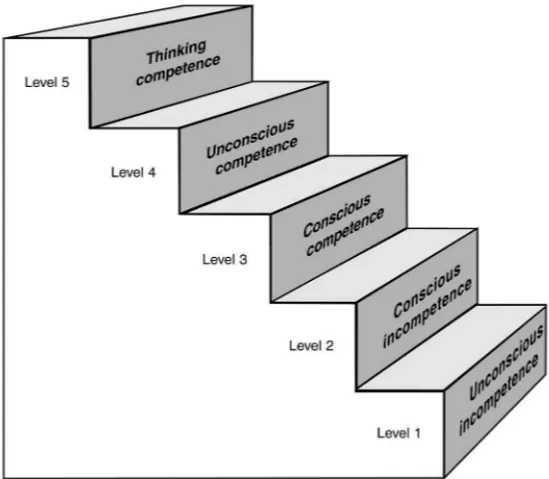
The ladder of competence

(21)

worried about whether you’d ever learn to do it properly, especially since so much of it needs to be done simultaneously. After a great many lessons and even more practice, you take your test and pass. Now you do know how to drive, but you can’t relax for a moment because any lapse in concentration could cause an accident, so you still feel anxious and uncertain. Finally after you have clocked up many more miles, you don’t really have to think about it any more – it’s automatic.

This process is usually known asThe Ladder of Competence. Its originator is unknown though there have been many competing claims for authorship, among them from the US organization, Gordon Training International, founded by Dr Thomas Gordon in the early 1970s.3

The Ladder of Competence is an idea that is both simple and profound – obvious once it has been stated but not so obvious until then.

Level 1: Unconscious incompetence

(22)

possibly that you never were skilled in the first place. This is not a good place to be as a learner but it is where many of our learners will start. As a tutor, if you suspect that this is where your learners are, you will need to devise fair methods of initial assessment so that both you and they know where they stand. Be alert to the possibility that many tutors assume that most of the people they will be teaching are at Level 2 whereas actually many will be at Level 1. The shock of discovering that this is their level may be enough to drive some learners away. Your task is first to uncover the truth and then to support people through their dismay. It is always important to devise some way of separating aptitude and essential ability (potential) from existing skill. If you have a learner who has neither aptitude nor skill then both you and they may be better off honestly agreeing that your event is not for them.

Level 2: Conscious incompetence

Here, as a learner, you have been confronted with your ignorance or lack of skill, or both. Shock, despair and that feeling of never getting past this level may accompany this phase. You look at others who are outstripping you and wonder how they can do what they do. The task of learning feels gargantuan, a mountain you will never be able to climb. As a tutor your role at this stage is to reassure, to point out that this phase is both normal and essential. Remind people that it is better to know what you don’t know than to live in the pitiable ignorance of Level 1. Alternatively, people may feel challenged in the best possible way by the learning journey ahead, but my experience is that they are more likely to be this at the point when their confidence and skill begin to build again. This is why the catch-them-doing-something-right approach is so important. Simplifying the task so that you maximize the possibility of right first time is the key to getting learners over this phase. In the terms of Benjamin Bloom’s useful taxonomy (page 244), learners are at the stage of copying. Copying is slow, you are aware that you are following someone else’s template, you don’t feel completely in control, the script is running you rather than the other way around. Adults may find this even more agonizing than children do, but my guess is that probably children do too – we just don’t notice it in quite the same way.

Level 3: Conscious competence

I have always found this phase the most interesting and challenging. Here people are saying things like

If I try this my colleagues will say, ‘She’s been on a course’ It feels clunky

I’m so aware that I’m following a sort of painting-by-numbers approach and that feels unnatural and restrictive

(23)

It seems as if everything I’m doing is contrary to what I did before – it’s like speaking a foreign language but you don’t know the rules and everyone else does.

All of these comments are spot on. It does indeed feel clunky and unnatural because itis clunky and unnatural. Tell your learners, again, that this is all part of the expected scheme of things. Reassure them that it will get better. The key to success at this phase is to take it steadily, to follow the protocols, to learn each phase of whatever it is and to be patient about lapses because they are inevitable. One danger here is that as confidence begins to grow, the old default mode of Level 1 may begin to assert itself. Closely observed feedback is the key to averting this disaster. Many adults want to skip the discomforts of this phase. They want instant competence. In many cases this is an illusion, so beware of colluding with it. Instant competence usually just isn’t possible because it takes a certain steady accumulation of supervised experience plus hours of practice to get beyond the fumbling slowness of progressing from Level 2 to Level 3 and from there to the genuine expertise of Level 4. For instance, learning a language or a musical instrument may take around 1000 hours of learning before you are at Level 2 and another 2000–4000 hours before you are at Level 3. If this is the case for your course, don’t fudge it.

Level 4: Unconscious competence

This is the aim of all learning. At Level 4 you are operating like the experi-enced car driver who does not need to think about when to brake, signal or use the mirror. It is second nature. In the psychological jargon, you have

internalizedthe learning and made it your own. You are confident. You have adapted the protocols and scripts and guidance of your tutors to your own unique style. You can and do experiment. You can and do play. You have created your own version of whatever was being taught and feel a degree of pleasure that this is so. You may have surpassed your tutors. You no longer have to think about what to do or why you do it. It’s easy. Time passes quickly, you are unaware of the different parts of the skills you are using and if necessary you could teach others how to do it. You wonder, ‘Why did this thing ever perplex me?’

Level 5: Thinking competence

There are dangers in reaching Level 4. One might be that of believing that you know everything anyone could ever need to know in this area. Another might be the danger of slipping into a habit of under-preparing for what previously seemed like an immense challenge.

(24)

When that worked, why did it work? What didn’t work and what might explain it? What do I need to be aware of? What may I be concealing from myself about what I don’t know? Where might I experiment even further? Where is the leading edge in my field? Who is challenging my own accepted ideas?

This is where a professional supervisor may be useful, as is common in counselling and psychotherapy, coaching, nursing and medicine. Given the rapid expansion of knowledge, Level 5 seems like an essential part of keeping your skill fresh and relevant. It is why CPD (Continuing Professional Devel-opment) is a requirement in most professions where licensing is part of the deal – for instance, law and medicine. You may need to think about how to apply this to your own professional development as a tutor as well as to anything in terms of content that you deliver to your learners.

It is helpful to expose this model of learning to your group. Show them how it works and use it to explain how they are likely to feel at any one stage of their progress. Build careful strategies for tackling the related behaviours you are likely to see in any group whose learning you are managing.

Differing expectations

(25)

adult education classes. People often want something familiar. Here is one tutor describing this issue and how she coped:

I was teaching French to children during the day using a very good audio-visual method. My adult class nobly agreed to try the same thing. I met my first snag in the first five minutes – no books. No books? They demand books, nicely of course. I say they cannot have books until they are familiar with certain sounds and patterns. Rebellion subsides. Second snag, five minutes later. Several of the class sneakily trying to write things down according to a phonetic script of their own. I explain about listening and speaking, they explain they must see things written down. We have this very polite battle lasting a few sessions. They begin to see the advantages. I begin to see that they need the reassurance of the written word. Eventually I do give out some written material and they sigh with relief as at the appearance of old friends. Pronunciation slips a bit, but general progress seems to be faster.

Now that the case for participation has been so widely and so well made, you may also see the reverse. I once ran a group where there was a somewhat doughy theoretical element to be taught and understood. I explained this at the outset. My group was disappointed. They wanted ‘games’. I explained that games and the content of our course did not sit neatly together in my view. If they could come up with a relevant game then I would be perfectly willing to incorporate it into our event. That was the last I heard of games, but I was aware that my creativity and ability to design an interesting programme had been soundly challenged and that I was considered to have failed an impor-tant test.

Ageing

(26)

roles (page 94), was commissioned to retrain train drivers. He and his wife Eunice ran two experiments at the early stages of the work with matched groups of drivers. When offered active methods of learning where there was no time pressure, age made no difference at all to the drivers’ performance.4 One large-scale study,5in which the same group of adults was studied over several decades, showed that scores on primary mental abilities increased slightly until the subjects were 40, then stabilized, only declining slightly after 60 and still to all intents and purposes in working order until the mid-70s. Other studies6have shown that it all depends what you measure. For instance, it may be true that younger learners are better at swift rote learning, but older people can make up for this in what is calledcrystallized intelligence

through the more sophisticated judgement that may come with experience. More recent research has confirmed that the inevitability of decline in cog-nitive function with age is a myth. For instance, Professor Felicia Huppert of the University of Cambridge Interdisciplinary Research Centre on Ageing has commented7that risk can be reduced by deliberate efforts to remain physi-cally, socially and mentally active. She points out that age-related loss of brain cells is far less than was once believed and also that new evidence suggests considerable potential for reorganization and plasticity. In fact, low birthweight seems to be a better predictor of cognitive decline in older adults than mere age. Professor Huppert’s conclusions are that negative age stereo-types do impair performance because they encourage older adults to believe that they will fail. If you believe you will fail then you probably will. The issue for anyone teaching older adults is to make sure that you do not reinforce negative stereotypes – for instance through patronizing assumptions about ‘making allowances’ – but offer views which are based instead on positive assumptions. These will reflect the reality that a healthy, happy and active older age is far more the common experience than that gloomy vision of inevitable misery and degeneration.

Assuming there are no physical problems which affect brain functioning, my own experience as a tutor, and now as an older learner myself, is that age makes no difference whatever as long as people are motivated. Motivation is far, far more important than any other factor.

Motivation

Why it matters

(27)

To learn, you must be motivated. To teach, you must uncover and sustain the motivation.

Some tutors feel that just being exposed to the subject is enough – people will ‘learn by stealth’. Alas, this is not a sensible way to proceed. Can you, for instance, remember the telephone number of the last restaurant you phoned to book a table? Or your room number in your last holiday hotel? Most likely not. You probably learnt quadratic equations for Maths GCSE but can you explain the principle now? Think of the last foreign holiday you took in a place where no English is spoken. What words did you learn there, when you were hearing the language spoken all around you every day? Probably very few unless you were determined to try your hand at communicating in a new language and made a deliberate effort. Unless these are useful pieces of knowledge, being exposed to the information is not enough.

Lack of, or wilting motivation is one of the main reasons that learning fails:

I ran a government training scheme. The people on the courses hated them. They saw them as a poor substitute for a job and were resentful about being obliged by threat of losing their benefits to be there. It was a real struggle.

Basically they didn’t know why they were doing the course. OK, the organization was introducing a new costing scheme but they were all cynical about whether it would actually happen because so many others had been proposed and then nothing had happened. They didn’t see why they had to waste their time – they’d think about it when the new system was a certainty. It was grim. Stony faces, looking at watches and ‘when’s coffee?’

The upside of this downside is how wonderfully sustaining motivation can be. An adult who is determined to learn something is a fearsome force:

My aim is to pass GCSE English because that is what my son is doing. I have been able to help him a lot and I suddenly realized I might be able to do it myself. I am absolutely determined to do it because I’ve always thought there was something special about English as a qualification. What has sustained me is the thought of actually get-ting that certificate. My tutor has been wonderful. She has praised us, nagged us and has kept dangling the thought of THE PASS at the end!

(28)

My stepmother and I did not get on very well and she made it clear that I was a financial burden, so university was out. She also implied that I was not bright enough. Although she’s been dead for many years now, I know that one of my principal motivators is to prove her wrong on the second count and to feel, on the first, that this is something I deserve and owe to myself. Iwilldo it!

There are some subtle differences here in how adults learn compared with the child equivalent. Being an adult and acknowledging that this is your status means that you have made the transition from others being responsible for you (however reluctantly you accept this, for instance as a teenager) to being responsible for yourself. This was the argument made so persuasively by Malcolm Knowles in his interesting book,The Modern Practice of Adult Edu-cation.8Adults are likely to have more insight than children into the actual processes of learning. They are likely to have more sense of discrimination about the methods they like and dislike and to be more able to support their arguments through evidence. Unlike children, adults are sharply aware that they want to use the learning they are acquiring and may want to do so immediately, whereas children may need to swallow their teachers’ argu-ments about the curriculum being useful at some distant point in the future, or simply as an instrumental process that gets the student through an exam, itself a staging post to something else, also in the future.

When, as is increasingly the case, adults may have as many as eight different changes of career, they are also likely to have experienced training and retraining and to have been exposed to a wide variety of learning methods. Consumerism comes into play here as it does in every other area of life. Also, whether adults come to learning willingly or not, the truth is that, unlike children, they are free to leave. There may be unpleasant consequences of leaving – for instance a row with a boss, a failure to get promotion because of lack of a vital new skill or loss of government benefits – but they can leave the training if they wish. They are not prisoners. On the rare occasions when I have a reluctant learner in a group, I always point this out – very kindly and politely, but point it out I do. The presence of a grumbling cynic is destructive to a group; if people are so hostile to learning, and you have done your best to motivate them and they are still obdurate, it is much better for them to go.

All reasons for attendance are acceptable because any motivation is better than none. Adult learning is also time-bound in a way that is not the case for children. All adults will be able to think of attractive alternative ways of spending their time and your event has to compete with those:

(29)

What do I give up to get here? WatchingEastEnders!

At the end of a long day there are great attractions to just sliding off to the pub with the others. It takes discipline to come here instead.

Extrinsic motivators

Adults bring a great range of motivations with them for learning. The sim-plest to understand are the so-called extrinsic ones – the learning that seems demanded by the learner’s situation. Here are some of the most common:

* Promotion may depend on acquiring new skills or on passing an exam. For instance, in the police force, an exam system is an entry-level qualification for promotion – it does not guarantee a job. * Entry to a new career may depend on acquiring the qualifications

that go with it. So, for instance, a secretary wanting to make a career in human resource management will study for his or her CIPD (Chartered Institute of Personnel Development) qualification. * More money may be offered to people who have a qualification. * Change is a powerful motivator. Even people who declared

them-selves computer phobic now understand that a computer is more than just another kind of typewriter. IT literacy is fundamental to most jobs.

Intrinsic motivators

‘Intrinsic’ motivation is harder to grasp because it is not so visible. For example:

* Social motivation is a powerful propellant. Your learners may simply want the pleasure of being with other people. They may feel lonely and isolated. Learning may be their passport to essential socializing. * Others come to learning because they see it as an important part of a new identity. They may want the yardstick of achievement: am I the kind of person who can learn Russian? Can I satisfy myself that I have the ability to get a black belt in judo? For these learners, the subject is important but so too is the proof they are obtaining that they can do something that they and the outside world think difficult.

(30)

I read OK but writing was just a torment. When my son was 6 he began learning writing at school and he just couldn’t understand why I wouldn’t ‘play writing’ with him. He pestered me so much that I couldn’t bear the shame of it any more. A local scheme found me a tutor and it was much easier than I’d thought. The worst bit was admitting to someone outside the family that I couldn’t write.

This story and the many others like it was behind the modest success of the Adult Literacy Campaign of the 1960s and 1970s. Interestingly, the campaign found it much easier to recruit tutors than students, a difficulty which remains today. Any survey of functional literacy estimates anything between 10 per cent and 20 per cent of adults to be poor readers and writers.

Messing up my A levels meant that I went straight into an tancy office as a junior and then worked my way up to get accoun-tancy qualifications. From there I got a succession of promotions, but always felt secretly a bit inferior to people who had degrees. So I set my heart on doing an MBA. To my colleagues, I presented it as something I needed to improve my CV, but actually it was all about how I felt about me! Getting that degree was fabulous and it made me realize that I had indeed been at a disadvantage before through the lack of that academic rigour in my thinking. I did get a promo-tion soon after, but I think it was more about increasing my self-confidence than about impressing my new employer with the letters after my name.

X and Y theories of motivation

Management thinking has much to offer teaching and learning. One astoundingly simple idea about motivation that has stood the test of time is Douglas McGregor’s X–Y theory.9 It is usually described in terms of man-agement style, but since as a teacher you are also a manager – of a classroom – I believe it is highly relevant. People who lead, manage or teach using ‘Theory X’ assumptions believe that human beings cannot be trusted to work. They believe that we will avoid responsibility and effort if we can, therefore we must be controlled, directed, manipulated, force-fed and punished for dis-obedience. A more benign version of this style is also possible, characterized by condescension and faint praise, but where power and control are still essentially with the leader.

(31)

engaging people, trusting them and giving them autonomy. Praise is more effective than criticism as a way to lead.

When you apply this to the classroom, it is possible to see that early mass education was largely a Theory X process. Iron discipline with harsh pun-ishment for disobedience was the rule. Rote learning was the main teaching technique. Facts and not emotions were the focus, there were right and wrong answers and teaching was about talking, not about listening. Charles Dickens satirized this approach brilliantly in his novelHard Timeswhen he had the teacher, Thomas Gradgrind, a weak man who is also a bully, interrogate a class of young children on how to define a horse in order to impress a visiting government inspector. The only correct answer was a series of predetermined facts, none of which the children was likely to have known. Blame for what was going wrong got more attention than praise for what was going right. 130 years after the beginning of compulsory education, it is clear that learning professionals have largely embraced Theory Y as a better set of assumptions about motivation.

Another reason for the superiority of Theory Y is that, as years of research into organizations has proved, you get vastly better results. Everything you will read in this book about the methods that I believe will work is based on these beliefs. A piece of learning designed on Theory X assumptions is des-tined to fail. Adults, particularly, will fight back: through indifference or absence, through complaints and vehement protest, or just through skilful sabotage. My own last experience of this process as a learner was many years ago on a BBC management course where over a period of two weeks we were force-fed one complacent speaker after another, all of them men, who lec-tured us remorselessly, questions mostly not invited, on what to think and how to be. A game developed in the group where the focus of attention was on rearranging the detachable pin-board letters on our table-based name plates, but to do it in a way that the speaker would not notice. The prize, a large drink in the bar, went to the person who could rearrange the speaker’s own name plate into some kind of – preferably scurrilous and clever – ana-gram, without him noticing. You can be assured that little or nothing of the speaker’s fine thoughts was taken in and remembered.

Multiple intelligences

(32)

intelligences, not just EQ – Emotional Intelligence as popularized by Daniel Goleman10 – but many more including Linguistic, Musical, Bodily-Kinaesthetic and Spatial. Knowing in which category or categories your cur-riculum belongs is an intriguing and useful line of inquiry. Too much of traditional education assumed that the only intelligence that mattered was verbal reasoning. For instance, the education of accountants assumed that they were essentially number-crunchers, so the only thing that mattered was their mathematical ability, whereas clearly if they are going to work directly with us, their clients, they need a high degree of emotional intelligence as well.

The pleasure of learning

Whatever analysis you make of the motivation of your learners, you will find that there are always some in any group who are simply there for the pleasure of learning:

I have always loved learning. It gives me the kick other people might obtain from cocaine or booze. I have bought many part works and I own a set of encyclopaedias. I’ve joined many courses in and out of work. In my organization the head of the training department says I’m her favourite course junkie!

While it’s important for you to know what the motivation is of your learners, remember that initial motivation is just that: the bundle of hopes and fears that people bring to the beginning of a piece of learning. It can be changed. In a successful group it grows and develops. In an unsuccessful group it shrivels and dies: this is a defeat for the tutor.

(33)

The essence of learning

It has in fact been established that if we were to reverse the natural order of things and keep children away from school while sending their parents there instead, we could teach the parents the same thing for about a quarter of the expenditure in time and money.

(John McLeish)

I hear and I forget I see and I remember I do and I understand.

(Chinese proverb)

Let’s assume that your students are highly motivated. You understand that they might be feeling anxious and you have techniques ready to allay their fears. But this still leaves other questions. How do you guide learners through the substance of your subject? What are the best ways to engage their interest? Is it actually harder for adults to learn quickly than for children? Are there any special methods that should be encouraged or avoided with adults?

There are some simple rules of thumb based on research, experience and common sense which can help give answers to all these issues. First, remember again that it is important to distinguish between teaching and learning. You can be teaching away vigorously but your students are not necessarily learning:

I have never in my life had such terrible teaching as on the course I did on industrial law. I swear the lecturer would never have noticed if the whole class had played noughts and crosses because once he’d started it would have taken an earthquake to stop him. His method was to introduce the topic, say ‘Any questions?’ and then before anyone could answer, plod on in a deadpan way non-stop for an hour and a half. The content was so dense that it was impossible to remember. He gave out some notes but these weren’t much help because they seemed to cover different ground.

Here was a tutor who had prepared conscientiously, who probably left his classroom drained by the effort of talking for an hour and a half, but whose students had learnt nothing.

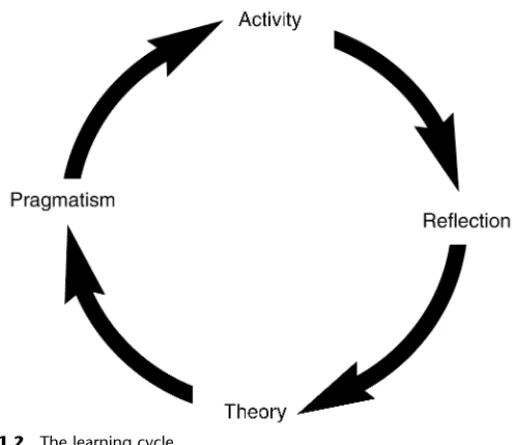
The learning cycle

This idea was first mooted by the US academic, David Kolb.11

(34)

* activity – doing something;

* reflection – thinking about the experience;

* theory – seeing where it fits in with theoretical ideas; * pragmatism – applying the learning to actual problems.

David Kolb went on to develop his own descriptions of four learning styles, but I prefer the simplicity of the model developed by his British interpreters, Alan Mumford and Peter Honey.12What follows is based on their work.

Let’s suppose that you want to learn how to design a garden. In the

activityphase, you might, with a tutor’s help, have a go at actually designing a small garden with a particular aspect and set of problems – let’s say it is a small town garden with dry sandy soil, facing east and shaded by large sycamores from a neighbour’s garden. This would involve you in making a number of decisions about materials, costs and planting. Having done that, it would be useful toreflecton it, standing back, getting feedback perhaps and observing how other learners have solved the same problems. You might then consider thetheory:what rules of thumb there are for using particular mate-rials or for dry, east-facing, shady gardens? At thepragmaticphase you might return to the original plan, revising your ideas in the light of everything else you now know and working out how to apply what you have learnt to your own particular situation. The cycle begins again when you return to activity – adding new features to your design.

(35)

pronounced. Some people may be equally at home with all four styles, but mostly adults will have developed greater comfort with one over the other three. This will affect you as a tutor because your natural tendency will be to emphasize the stylesyouare comfortable with. It will also affect your group because they will have their own preferences and areas of comfort. So, for instance, if you as a tutor enjoy the activist style, you will want to run events which have a high degree ofdoing. You will build in a lot of variety – perhaps getting people working in small groups for much of the time with a lot of discussion. There will inevitably be people in your group whose preferences Table 1.2 Likes and dislikes of different learners

Style Like Dislike

Activists Doing and experiencing. Enjoy games, practical activities, anything that’s new, energetic and involving, will take risks and volunteer to take the lead even when they don’t understand the implications of doing so. Natural optimists.

Sitting around for too long; working alone; theorizing; having to listen to others droning on; having to wait a long time to see results.

Reflectors Time to think, observe, take it all in first; love to watch others; need some solitude and above all, time. Like to ponder before speaking. Need to read and consider before giving a judgement.

Being hurtled from one activity to another, having no time to think; crammed timetables; lack of privacy, no time to prepare.

Theorists To know where something fits in to overall ideas and concepts; analysis and logic; being stretched; abstract concepts; structure and clarity. Enjoy systems and seeing the connections of one idea to another; ask how an assertion is supported by research then ask questions about the quality of the research.

Frivolity, mindless fun; wasting time; not being able to question and be sceptical; lack of a timetable and proper structure. answers the question ‘How can I apply this?’

(36)

are for the reflective style. They may well find the relentless pace imposed by an activist tutor to be overwhelming because it gives them no time for their favourite style which is to think, stand back and reflect.

There can be strong likes and dislikes associated with each of the styles. Table 1.2 gives some brief descriptions.

Implications of the learning styles

The first challenge is to know yourself. Which of these styles are you naturally drawn to? Whatever your answer, remember that many of your learners will have different preferences. When designing learning (see Chapter 11), remember to touch on all four styles as far as possible, not just your own favourite.

Remember, too, that different subjects and circumstances will have their own imperative. For instance, if you are teaching people how to drive a car, there is probably no great place for theory – to drive a car successfully does not depend on knowing how the internal combustion engine works, though to pass the driving test you do need to know the Highway Code, a reflective activity. But mostly, learning to drive needs an activist approach. It cannot be learnt through reading books. If your subject is management development, you may be drawn by the attraction of the many US gurus and their books – a theoretical approach. However, your learners may only want the pragmatic answers: ‘What can I apply from this to my own work and job?’ ‘What really works?’

Personality and learning

In the early 1990s a colleague introduced me to the Myers Briggs Type Indi-cator2, (MBTI) a personality questionnaire based on the work of the Swiss psychoanalyst Carl Jung. I became licensed to administer it and, later, so fascinated that I wrote two books on it.13There are thousands of other per-sonality questionnaires and approaches to human perper-sonality and some of them have much merit. However, my personal favourite is the MBTI for its all-round versatility and also for the seventy years of research that has made it the classic it is today. To understand the full implications, you will need to take the questionnaire, either the standard MBTI itself14or one of many rivals also based on Jungian thinking, some of which are freely available on the internet. You will then need a debrief with a skilled and experienced practi-tioner and a permanent reference in the form of a set of Type descriptions. However, the essential ideas are relevant to teaching and learning as I briefly introduce them here.

(37)

four bi-polar dimensions, known as Preferences. The theory is that although everyone can call on each of the eight preferences, we are all likely to have a preference for one side of each dimension. This is the dimension in which we are likely to have developed skill. All preferences are assumed to be of equal value:

Table 1.3

Getting energy

Extraversion (E)

Being with people, activity, breadth.

As learners: like variety, discussion and talking, being active.

Or Introversion (I)

Reflection, needing privacy to think things through.

As learners: like to watch, listen, think and read.

Taking in information: how we perceive the world

Sensing (S) Or iNution (N)

Trusting your five senses, liking things to be tangible, concrete, real, being comfortable with detail.

As learners: like rules, guidance and being told how; may enjoy rote learning; comfortable with detail and data; like to follow a protocol step by step; like practicalities and the here and now.

Liking ideas, theories and the intangible, seeing the big picture, don’t want to be like others; jump in anywhere rather than step by step.

As learners: like to be autonomous, creative and individualistic. Like frameworks and theories. Attracted to the bigger picture, impatient with detail. Like the intangible, to consider what might be possible and what’s in the future.

Deciding

Thinking (T) Or Feeling (F)

Deciding on the basis of logic and rationality; seeking truth, being tough if necessary.

Deciding on the basis of human values and relationships first, valuing harmony and collaboration.

As learners: like to critique and debate; sceptical; tough on self and others; competitive; spot the flaws before appreciating.

As learners: like the human story, interested in relationships and emotions; enjoy working in groups in a non-competitive way; appreciative rather than critical.

Living your life

Judging (J) Or Perceiving (P)

Liking to be decisive and in control; liking planning, predictability and order.

Liking to stay adaptable, work at the last minute; need to have options.

As learners: need to see a full plan; need definite goals and stages; responsive to deadlines.

(38)

When you perm any of these preferences you come up with a four-letter Type profile – for instance ENTP, or ISFJ. There are sixteen possible profiles each with their own strengths, weaknesses and differing motivations. (See Figure 1.3)

One of the main lessons I have learnt from my own work on the Myers Briggs, and from having used it now with many hundreds of individuals, is that Type prejudice is deep rooted in all of us. As naı¨ve subjects, we all tend to believe that our own way of experiencing the world is exactly how others experience it, and once we discover that this may not be so, we will tend to believe that our own way is also somehow superior to any other way. Research into Myers Briggs preferences and learning shows how much it influences both the way we learn and also how learning is presented to us by others. For instance, much traditional education was a Sensing–Judging process: a great deal of practical detail presented step by step in a planned and orderly way:

Follow this protocol and you will get to the right answer. This would not have suited learners whose preferences were for Intuition and Perceiving. In higher education, which largely favours Intuition over Sensing, students with pre-ferences for Sensing tend to take longer to get to the same point, and may not do so well as a result.

Personality preferences also influence motivation, so learners who share N and T (Intuition and Thinking) are likely to be driven by the need for competence. Those who share N and F (Intuition and Feeling) may be motivated by the wish to bring about social good; those who share S and F (Sensing and Feeling) by the need to bring about practical benefit for people, whereas people who share S and T (Sensing and Thinking) are likely to have efficiency and order as a motivator.

As with learning style preferences, this cuts both ways. Your own pre-ferences will influence the way you learn and therefore most probably the way you design and present learning to others, but you will be presenting it to people who could be any mixture of the sixteen Types. These psychological preferences make a strong case for variety in method and approach as a given rather than just as an afterthought or happy accident.

Varying the pace

(39)

Figure 1.3 The sixteen personality types: in outline

ADULT

LEARNER

S:

WHAT

YOU

NEED

TO

KNOW

(40)

the pace is fixed to suit the fastest it will demotivate the majority. If it is right for the middle band it will alienate both the brighter and the slower learners. The more you can design learning so that people can work at their own pace, the more effective it is likely to be. This is not because competition is ideologically unsound, but because it doesn’t work. With adults this is espe-cially important. The older you are, the more likely you are to want to sacrifice speed for accuracy and the more likely you are to want information before making a response.

Scores of different experiments have shown that if adults are asked to learn something new under time pressure, the older they are the more likely they are to become confused and to make mistakes. Where no clock-watching is involved there is no difference in performance.

When no allowance is made for the increase in individual differences which age and experience bring, when decline in short-term memory is ignored and when tutors simply plunge on bearing the whole load of infor-mation-giving themselves, packing every moment with fresh and complex detail, then some situations of monstrous futility can develop:

I came to nursing as a mature entrant and I nearly left it for the same reason. I could not bear the monotony of sitting for hour after hour where you were treated like children and where the facts came at you in a steady stream. No attempt was made to involve us in the learning: the only thing that mattered was passing the exams. It was like a convent school full of silly adults!

It is always better for adults to measure their progress against their own previous performance rather than to attempt frantic rivalry with their neighbours. People start with different kinds of knowledge and work at dif-ferent speeds.

Relevance

While of course it is true that there are people who are drawn to learning for learning’s sake, most adult learners are strongly motivated by wishing to acquire skills and knowledge they can use in practical ways. The nearer you can make the learning to the ‘real’ world, the more acceptable it will be and therefore the more quickly and effectively your students will learn. The obverse is true too. Offer adults learning that they consider irrelevant and they may well resist:

(41)

way we actually did the job that the poor tutors had to follow the same silly ‘rules’. They were constantly apologizing for it, saying that they knew we didn’t need to know this or that thing, but it was on the syllabus and could appear in the exam papers. It had virtually no relevance to my job and I resented every minute I spent there.

Your skill as a tutor is to make the training resemble the real task, even if some of the distractions and complications of reality have to be stripped away:

I wasn’t sure how far you could ‘learn’ negotiating, but I went to the course anyway. It was excellent because all the exercises were based on exactly the sort of situations we meet every day. We started with simple two-handers and then went on to more elaborate scenarios using the same principles and finished with team exercises. Some people felt it was artificial because you didn’t have all the informa-tion that you would have for real, but I felt that was actually a help. It allowed me to see the basic principles pretty clearly.

The importance of relevance holds good for any situation where adults are learning, even when the students are people whose intellectual capacities are well below the average. One tutor of adults with learning difficulties reported their indignation at having to practise handling money by using cardboard coins. She was forgiven this blunder only when the rightly despised cardboard was replaced by the real thing.

In the past, much vocational training ignored this need for realism and relevance. This led to the establishment in the UK of the Qualifications and Curriculum Authority, a body which sponsors National Vocational Qualifi-cations (NVQs). These endorse the idea that it is only the skills needed for the job that should count as a qualification. NVQs have had mixed success. They have probably been more successful at entry level than for senior-level qua-lifications. However, the principle is sound, as is the movement to accredit prior learning. If you can demonstrate that you have competence, then you should get the qualification. And competence means you can produce the same excellent performance under the eagle eye of a trained observer every time.

Reinforcement and practice

Without reinforcement, skill and knowledge will fade quickly. The basic principles are easy enough:

(42)

3 Break the objectives down into their component parts and set down success criteria for each.

4 Start with the pieces of learning that fulfil these criteria: they are basic building blocks; they are easy to learn.

5 Reinforce them through practice until people have thoroughly ‘internalized’ them – that is, they can do them accurately without conscious thought.

6 Slowly add more building blocks, making the learning more complex.

7 Reinforce through more practice.

Sounds easy doesn’t it? In reality you will need immense subtlety to apply these principles. What isenoughwhere reinforcement is concerned? How do you know whether you are going too fast or too slowly? What happens when you have a group which contains very mixed abilities? Is it possible to break down a skill so far that it loses its resemblance to the real thing?

The dance classes I attend as a learner are an excellent example. Such is my love of dancing that I go to classes wherever and whenever I can, and since I travel a lot I have sampled classes in many different places. I have probably been taught now by perhaps 50 different teachers over a ten-year period. All are teaching the same dances (they come and go in popularity just as pop music does) to similar groups of people. I see huge variations in effectiveness. Some teachers can barely be bothered to teach the steps, hur-rying through the demonstration of a new dance, pleasing the minority in the group who are talented natural dancers but dismaying almost everyone else. You can spot these teachers by the large numbers of people who sit out a dance that is in any way complicated. At the other extreme are the patient plodders who break down every dance into tiny, slow sequences, going through it many times without music, reteaching every dance every week on the assumption that no one in the group will have remembered the steps. These teachers also lose people because the pace is too slow for many of their students. One such teacher in particular broke each sequence into such tiny, slow fragments that it lost its resemblance to the dance and became unrec-ognizable. The effect of this intended helpfulness was, paradoxically, to make the dance much harder to learn.

Gambar

Figure 1.1 The ladder of competence
Figure 1.2 The learning cycle
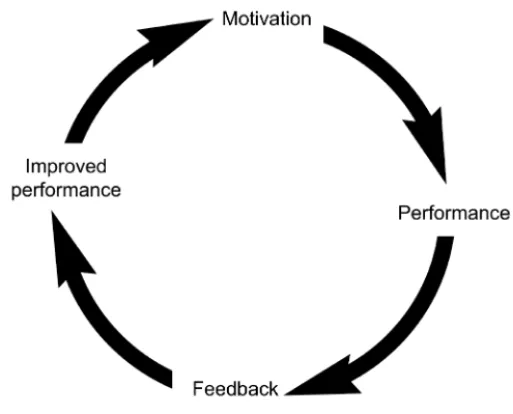
Figure 3.1 The improvement cycle
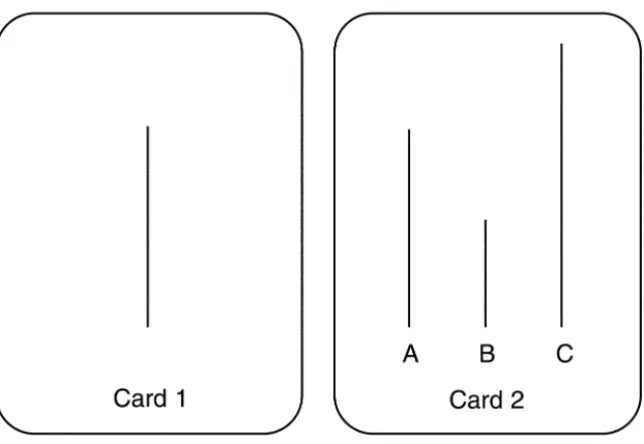
Figure 4.1 The Asch experiment
+2

Referensi

Dokumen terkait