ISSN: 0976-1206
Research Article
www.ijcas.infoCorresponding A uthor:
Is Fatimah, Chemistry Department, Faculty o f Mathematics and Natural Science,Islamic University of Indonesia; <[email protected]>
Novel
Synthesis
of
1,5-dibenzalacetone
Using
NaOH/ZrO
2-M ontmorillonite as Cooperative Catalyst
Sri Handayani 1,2, Sabirin M atsjeh 2, Chairil Anwar2, Sri A tun1 and Is Fatimah*3
1
Chemistry Education Department, Faculty of Mathematics and Natural Sciences, Yogyakarta State
University, Karangmalang, Indonesia
2
Chemistry Department, Faculty of Mathematics and Natural Sciences, Gadjah Mada University, Sekip Utara,
Indonesia
3
Chemistry Department, Faculty of Mathematics and Natural Sciences, Islamic University of Indonesia
INTRODUCTION
Aldol condensation reaction is usually performed to synthesize unsaturated α-carbonyl compounds w ith various advantageous such as chalcone, benzalacetone, etc. Synthesis of analogeous dibenzalacetone by reacting acetone and benzaldehyde and its derivatives is a well-known reaction [1,2]. Acetone which has Hα in both sides can be reacted in condensation w ith the same or different aldehyde. By the scheme, previous research investigated ultrasound-induced crossed aldol condensation of benzalacetone and several derivatives to obtain 1,5-dibenzalaseton [3]. Eventhough the reaction is an efficient reaction but it is time consumed due to two steps of reaction required. In simpler way, previous experiment was conducted by using acetone and two different aldehydes and derivatives but with low yield [ 4]. Refer to these w orks, in this paper, an efficient and novel method for producing high yield and purity of 1,5-dibenzalacetone is presented. Cross aldol condensation can be conducted under both acid and base condition and homogeneous form of catalyst [5]. Recently, heterogeneous catalyst has been attempted to replace the homogeneous catalyst refer to the more selective, stability and reusable characters [6,7. In this purpose for example, hydrotalcite was used as the most popular catalyst based on its anionic surface properties [8]. Started from this point of advantageous in using heterogeneous catalyst, many researches pay more attention to look for other solid catalyst instead of hydrotalcite.
Zirconium dioxide is a promising heterogeneous catalyst due to its thermal stability and reduction-oxidation properties. Potassium-modified ZrO2 is heterogeneous base catalyst w hile in pillared form into montmorillonite has acid properties [9,10]. Due to surface acidity and its potential application as environmental friendly catalyst, it is interesting to take advantageous from immobilized ZrO2 in montmorilonite. Refer to aldol condensation conducted by Ordomsky et al.(2010), an effort to use the active sites of immobilized ZrO2 in montmorilonite can be achieved[6]. Bifunctional catalysis of Lewis acid and Broensted base of ZrO2/ SiO2 was reported to
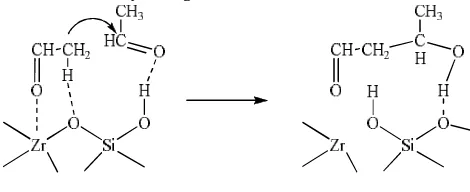
accelerate the reaction by abstracting Hα an aldehyde to form an enol structure for further reaction with C carbonyl from another acetaldehyde (Fig 1) [6].
.
Fig 1. Aldol condesation of acetaldehyde over ZrO2/ SiO2 catalyst
M A TRIAL A ND M ETHOD
Materials used in this synthesis were acetone, benzaldehyde, 4-methoxybenzaldehyde, 3,4-dimethoxybenzaldehyde, 3-hydroxybenzaldehyde, HCl, methanol, ethanol, sodium hydroxide, ZrO2-montmorillonite and aquadest. All chemicals were obtained from E.Merck in pure analytical grade w hile ZrO2-montmorillonite was obtained from previous research [11]. Coloumn filler for chromatographic separation was prepared by silica gel 60 (230-400 mesh ASTM), TLC plate of silicagel 60 F254 and several solvents such as chloroform, hexane, ethyl acetate, and methanol. Analytical instruments were use for characterization purposes such as FTIR 8201 PC Shimadzu for FTIR-spectra investigation and (1H and 13C) Nuclear magnetic resonance (NMR) JEOL 500 with the frequency of 125 MHz together with HMQC and HMBC for structural analysis.
Synthesis of 4-methoxydibenzalacetone:. Tw o sets of reactions were enganged. The set number 1: consists of 0.6 g (0.015 mol) sodium hydroxide in 10 mL of ethanol-water (1:1), which was added by 0.1 g of ZrO2-montmorillonite before the addition of 0.68 g (0.005 mol) 4-methoxybenzaldehyde, 0.53 g (0.005 mol) benzaldehyde and 0.29 g (0.005 mol) acetone Synthesis of 4 analogue 1,5-dibenzalacetones through double cross aldol condensation has been conducted. Condensation was enganged by acetone with tw o different aldehyde at the same mole ratio at 100C for 3 hours with NaOH as catalyst. In the same time another reaction over NaOH/ ZrO2-montmorillonite catalyst was conducted. The purity and yield of both reaction were evaluated by thin layer chromatography technique. Yield of reaction result showed that cooperative properties of NaOH/ ZrO2-montmorillonite in cross aldol condensation was gained with more efficient impact compared to the use of only NaOH as homogeneous catalyst.
sequentially followed by stirring at 100C (ice bath) for 4 hours in a flask with ethanol solvent. Reaction was kept for 18 hours in a refrigerator, continued by filtering the solution to obtain the solid precipitate w hich then dried. The set number 2 was the same reaction as number 1 but without addition of ZrO2 -montmorillonite. The product of both reactions was analyzed by using thin layer chromatography technique. The reaction using NaOH/ ZrO2-montmorillonite catalyst has resulted 1.32 g yellow precipitate w ith the target content of compound 1 is 47.48%, while the reaction without ZrO2-montmorillonite resulted 0.24 g (7.29%).
The reaction that resulted highest value of yield was then separated by coloumn chromatography technique. Silica gel 60 (230-400 mesh) filled a 50cm in lenght x 2.5 cm in width of a coloumn was used with a mobile phase of ethyl acetate-hexane 1:9. Target compound was identified by thin layer chromatography (TLC) with the mobile phase of ethyl acetate-hexane 1:5 followed by elucidation of structure by using FTIR, 1H NMR, 13C NMR, HMQC and HMBC FTIR (KBr) (cm -1): 3035 (aromatic CH), 2922 and 2842 (aliphatic CH), 1668
(C=O), 1423 and 1446 (aromatic C=C), 1175 and 1283 (C-O). 1H NMR (500 MHz, CDCl3, TMS) (ppm): 6.93 (2H, dd, J = 1.85 and 8.5 Hz, H3a and H5a), 6,97 (1H, d, J = 15.85 Hz, H2), 7.07 (1H, d, J = 15.85 Hz, H4), 7.4 (2H, dd, J = 1.85 and 8.5 Hz, H3b and H5b), 7.41 (1H, dd, J = 8.5 Hz, H4b), 7.58 (2H, dd, J = 1.85 and 8.5 Hz, H2a and H6a), 7.61 (2H, dd, J = 1.85 and 8.5 Hz, H2b and H5b), 7.72 (1H, d, J = 15.85 Hz, H5), 7.73 (1H, d, J = 15.85 Hz, H1), 3.8 (3H, s, H4a-OCH3). 13C NMR (125 MHz, CDCl3) (ppm) : 56, 114.6, 123, 125, 127, 128, 129, 130.3, 130.5, 135, 143, 143.3, 161, 189.
Synthesis of 3,4-dimethoxydibenzalacetone: Two sets of reaction assigned as reaction number 1 and number 2. For number 1: a 0.6 g (0.015 mol) sodium hydroxide was solved in 10 mL ethanol-aquadest (1:1), followed by addition of 0.1 g ZrO2-montmorillonite. 3,4-methoxybenzaldehyde of 0.83 g (0.005 mol), 0.53 g (0.005 mol) benzaldehyde and 0.29 g (0.005 mol) acetone were then added respectively under stirring at 10oC (ice bath) for 4 hours. Similar procedure was done to synthesize 4-methoxydibenzalacetone, w hich then followed by ageing the result solution in refrigerator, filtering and drying. Reaction set number 2 was the same technique with reaction number 1 but without the addition of ZrO2 -montmorillonite. Characterization of the product was conducted by TLC with ethyl acetate–hexane 1:4 as mobile phase. A yellow precipitate of 1.99 g was obtained from reaction over NaOH/ ZrO2-montmorillonite and the target compound number 2 valued at 49.86% while from reaction without ZrO2-montmorillonite, the product was 1.34 g (30.36%). Target compound was separated by coloumn cromatography technique in a coloumn with a 50 cm in lenght x 2.5 cm in width filled with stationary phase of 230-400 mesh silica and silica of 60 mesh for impregnation. As mobile phase, ethyl acetate-hexane 1:9 was employed. Characterization was also conducted by TLC technique using ethyl acetate-hexane 1:4. Structure Elucidation was performed by FTIR, 1H NMR, 13C NMR, HMQC and HMBC. FTIR (KBr) (cm-1): 2933; 2837
(aliphatic CH), 1645 (C=O), 1514-1417 (aromatic C=C) and 1255-1139 (ether CO). 1H NMR (500 MHz, CDCl
3, TMS) (ppm): 3.9 (6H, s, H3a-OCH3), 6.81 (1H, t, J = 1.85 and 7.5 Hz, H3b), 6.83 (1H, t, J = 1.85 and 7.5 Hz, H5b), 6.89 (1H, t, J = 1.85 and 7.5 Hz, H5a), 6.94 (1H, d, J = 15 Hz, H2), 7.1 (1H, d, J = 15 Hz, H4), 7.14 (1H, d, J = 7.5 Hz, H2a), 7.2 (1H, dd, J = 1.85 dan
1.85 and 7.5 Hz, H2b), 7.62 (1H, dd, J = 1.85 and 7.5 Hz, H4b), 7.69 (1H, d, J = 15 Hz, H1), 7.74 (1H, d, J = 15 Hz, H5). 13C NMR (125 MHz, CDCl3, TMS) (ppm) : 27.5, 56, 110, 111.2, 111.5, 123.3, 123.8, 125.5, 128.5, 129, 130.5, 143, 143.6, 149.3, 149.4, 151.6, 198.
Synthesis of 3,4,4’-trimethoxydibenzalacetone:. Tw o sets of reaction denoted as reaction number 1 and reaction number 2. Both reactions system consist of 15 mL ethanol-aquadest 1:1 with dissolved 0.6 g (0.015 mol) of sodium hydroxyde. A t the reaction number 1, ZrO2-montmorillonite was added before the addition of 0.83 g (0.005 mol) of 3,4-dimethoxybenzaldehyde, 0.68 g (0.005 mol) 4-methoxybenzaldehyde and 0.29 g (0.005 mol) of acetone respectively. The mixture was stirred for 3 hours at 100C in ice bath. The reaction number 2 was done at the same reaction number 1 without the addition of ZrO2-montmorillonite. The mixture of both reactions were stored for 7 days in refrigerator and the precipitates obtained by filtering the resulted solution and drying the solid. TLC analysis of the products was enganged by using ethyl acetate-hexane (1:3). Reaction result of 2.45 g (47.69%) brownish-yellow precipitate compound 3
obtained over NaOH/ ZrO2-montmorillonite catayst, w hile the product obtained from reaction number 2 was 1.09 g (8.33%) in weight. Coloumn chromatography technique to separate the products was done using a 40 cm in lenght x 2.5 cm in width coloumn filled with silica 230-400 mesh and mobile phase of ethyl acetate-hexane 1:9. Characerization was conducted by TLC w ith the eluent of ethyl acetate-hexane 1:4.
The structure elucidation was performed by FTIR, 1H NMR, 13C NMR, HMQC and HMBC. FTIR (KBr) (cm-1): 186.8 (CH
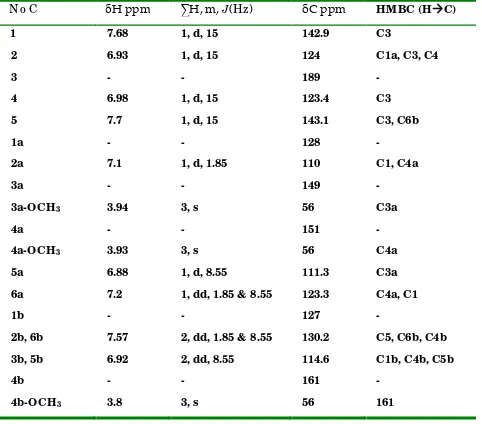
alkene), 3070 (CH aromatic), 1674.2 (C=O), 1597 alkene 1512.19 (C=C aromatic), 1033-1273 (C-O), 1381 (CH3). 1H NMR (500 MHz, CDCl3, TMS) (ppm): 3.8 (3H, s, H3a-OCH3), 3.93 (3H, s, H4a-OCH3), 3.94 (3H, s, H4b-OCH3), 6.88 (1H, d, J = 8.55 Hz, H5a), 6.92 (2H, dd, J = 8.55 Hz, H3b dan H5b), 6.93 (1H, d, J = 15 Hz, H2), 6.98 (1H, d, J = 15 Hz, H4), 7.1 (1H, d, J = 1.85 Hz, H2a), 7.2 (1H, dd, J = 1.85 and 8.55 Hz, H6a), 7.57 (2H, dd, J = 1.85 and 8.55 Hz, H2b and H6b), 7.68 (1H, d, J = 15 Hz, H1), 7,7 (1H, d, J = 15 Hz, H5). 13C NMR (125 MHz, CDCl
3, TMS) (ppm): 55.6, 56.1, 56.1, 76.9, 77.2, 77.4, 110, 123.2, 123.4, 124, 127.8, 128, 130.3, 142.9, 143.1, 149.4, 151.5, 161.5, 188.9.
Identification was done by thin film chromatography with eluent of ethyl acetate-hexane 1:8. Structure elucidation was also done using FTIR, H-NMR, C-NMR, HMQC dan HMBC. FTIR (KBr) (cm-1): 3444 (OH), 1668.83 (C=O), 1580 supported by 1493 (C=C aromatic), 1170-1249 (C-O). 1H NMR (500 115.6; 120.8; 126; 130.9; 126; 129.8; 143; 129.5; 143; 136; 137.5; 158; 189.
RESULT A ND DISCUSSION
Characterization of synthesis results of compound 1, 2, 3 and 4 by using NMR spectrometer are listed in Table- 1- Table-4. Cross aldol condensation between acetone and tw o different aldehydes is presented in Fig.2.
Fig. 2. Cross aldol condenstion in synthesis of 1,5- dibenzalacetone.
Theoretically, synthesis of 1,5-dibenzalacetone w hich has different subtituent in ring a and b has low efficiency. This condition is caused by tw o step cross aldol condensation occured. The first cross aldol condensation left Hα that make it possible to undergo further cross aldol condensation. Therefore tw o kinds of aldehyde and some other side products were produced. Reaction efficiency was defined as high selectivity towards main product. As stated in introduction section, as an effort to increase efficiency heterogeneous catalysis was used in this research.
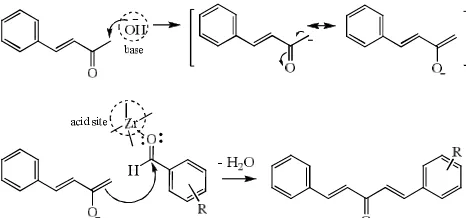
cross aldol condensation over NaOH/ ZrO2-montmorillonite is demo nstrated in Fig-3 and Fig-4.
Table. 4: 1H, 13C - NMR and HMBC data of compound 4 (CDCl 3)
No C δH ppm ∑H, m, J (Hz) δC ppm HM BC (HC)
1 2 3
4 5 1a
2a 3a 4a
5a 6a 1b 2b, 6b
3b, 4b, 5b 7.73 7.24 -
7.31 7.8 -
6.94 - 7.2
7.27 7.23 - 7.76
7.4
1, d, 16 1, d, 16 -
1, d, 16 1, d, 16 -
1, d, 1.75 - 1, d, 1.75
1, d, 8 1, d, 8 -
2, dd, 1.75 & 8
3, t, 1.75 & 8
143.3 126.6 189
126.6 143.4 137
118 158 115
130.9 120.8 136 129.3
129.8
C3, C6a C1a -
C3, C1b C3, C2b, C6b -
C1a - C6a
C1a, C3a C4a - C2b, C6b
C3b, C4b, C5b
Fig. 3. First step of cross aldol condensation mechanism over NaOH/ ZrO2 -montmorillonite.
Fig. 4. Second step of cross aldol condensation mechanism over NaOH/ ZrO2 -montmorillonite
Reaction mechanisms as depicted in Fig.2 and Fig.3 are potential to increase the formation of the product. Acid sites of ZrO2-montmorillonite are easily to adsorb lone pair electron in oxygen of aldehyde carbonyl due to the lower steric hindrance effect. Therefore carbon in carbonyl has more positive profile compared to the carbon of ketone carbonyl and easier to be attacked by nucleophille. ZrO2 -montmorillonite that used in this reaction was the same material as reported in previous studies [11]. Important physico-chemical characters such as specific surface area, surface acidity and Zr content of material are responsible characters to accomodate base localization in order to activated the reaction orientation. The specific surface area of material is 96.75 m2/ g and the total surface acidity is 0.65 mmeq/ g. With 3.34% wt. Zr content in ZrO2-montmorillonite, Lewis acid sites from outer d-orbital of Zr provided bonding site of lone pair electron of oxygen from carbonyl as also showed by Broensted to Lew is acid ratio measurement at the value of 1.24.
Efficiency of the synthesis over cooperative NaOH/ ZrO2 -montmorillonite was evaluated from the value of reaction yield based on following calculation:
= ℎ ( )
ℎ ℎ 100%
Table. 5: Yield of synthesis result over NaOH and NaOH/ ZrO2 -montmorillonite catalyst
No. Starting materials Catalyst weight (g)/
purity (% ) Yield
(% )
1 NaOH 0.24/40.12 7.29
NaOH/ZrO2 -montmorillonite
1.45/43.22 47.48
2 NaOH 1.34/33.31 30.36
NaOH/ZrO2 -montmorillonite
1.99/36.83 49.86
3 NaOH 1.09/12.38 8.33
NaOH/ZrO2 -montmorillonite
2.45/31.54 47.69
4 NaOH 0.83/19.88 13.35
NaOH/ZrO2 -montmorillonite
1.56/37.06 46.24
The result of the reaction yield was listed in Table 5, showed that the reaction using cooperative NaOH/ ZrO2 -montmorillonite catalyst have resulted higher weight amount and purity of target molecules than the reaction that performed over only using NaOH. This is provided the fact that the use of cooperative catalyst leads to a more efficient and effectively cross aldol condensation reaction
CONCLUSION
Reaction of double cross aldol condensation has been conducted between acetone and two different aldehydes at the same mole ratio. The more efficient reaction mechanism was achieved by the combination of NaOH/ ZrO2 -montmorillonite catalyst w hich attributed to the cooperative acid-base catalyst to minimize the formation of side product. The reaction yields of the reaction indicated that the surface acid sites and adsorption capability of ZrO2-montmorillonite played the catalyst role in the double cross aldol condensation reaction with presence of NaOH in the reaction system.
A CKNOWLEDGEM ENTS
Authors thank to Indonesian Science Institute (LIPI) Serpong, Indonesia for supporting NMR spectrometer A nalysis.
REFERENCES
1. Handayani, S dan A rty, I.S., Jo urnal of Physical Chemistry, 19(2), 2008, 62.
2. Motohashi, N., A shisara, Y., Yamagami, C., and Saito, Y., Mutation Research/ Fundamental and Molecular Mechanism of Mutagenesis, 474, 2001, 113.
3. Guofeng, C., Jitai, L., Huiyun, D and Tongshuang, L. Chemical Journal on Internet, 6(1), 2004, 7.
5. Pudjono, Sismindari and Widada, H,Majalah Farmasi Indonesia, 19(1), 2008, 48.
6. Ordomsky, V.V., Sushkevich, V.L. and Ivanova, I.I. Journal of Molecular Catalyst A : Chemical, 2010,333.
7. Kustrow ski, P., Sulkowska, D., Chmielarz, L. and Dziembaj, R. A pplied Catalysis A : General, 302, 2006, 317.
8. Cavani, F., Trifiro, F., Vaccari, A ., Catalysis Today, 11, 1991,173. 9. Li, Z., Novel Solid Base Catalyst for Michael A dditions : Synthesis,
Characterisation and A pplication, Dissertation, 2005, Humboldt-Universitat zu Berlin, Germany
10. Fatimah,I., Wijaya, K. , and Setyawan, K.H., Bulletin of Reaction Engineering and Catalyst, 2, 2008, 9.
11. Fatimah, I, Journal of A pplied Sciences Research, 5,2009, 1277-1284. 12. Goksu, S.; Celik, H.; Secen, H., Turk. J. Chem., 27, 2003, 31.
13. Sardjiman, Synthesis of some New series of Curcumin A nalogues,
A ntioxidative, A ntiinflamatory, A ntibacterial A ctivities and
Qualitative-Structure A ctivity Relationship, Disertation, 2003,
Gadjah Mada University, Yogyakarta
14. A bello, S., Med ina, F., Tichit, D., Perez-Ramirez, J., Rodriguez, X., Sueiras, J.E., Salagre, P., and Cestero s, Y, A pplied Catalysis A : General, 281,2005, 191.
15. Climent, M.J., Corma A ., Fomes, V., Guil-Lopez, R. and Iborra, S.(2002),A ldol Condensation on Solid Catalysts : A Cooperative Effect betwees Weak and A cid Base Sites, A dvanced Synthesis and Catalysis, Vol. 344, Issue 10, 1090-1096.