GRASSROOTS ADVOCATES’ STRATEGIES & LESSONS
Protecting
community Lands
& resources
funders
This publication and the 2013 Africa Regional Symposium on Protecting Community Lands and Natural Resources were generously supported by:
Ford Foundation Southern Africa, The ABS Capacity Development Initiative, American Jewish World Service (AJWS), Open Society Initiative for Southern Africa (OSISA), The Heinrich Böll Foundation and
edited by: Stephanie Booker, Rachael Knight and Marena Brinkhurst.
Volunteers
Thank you to our team of committed volunteers - Abra Lyman, Marisa Choy, Cath Traynor, and Shaun Dunn - for your generous contribution of time, skills, and persistence!
© 2015 Natural Justice and Namati
design:www.onehemisphere.se cover image: javarman3/istock. citation:Booker, Stephanie, Knight, Rachael and Brinkhurst, Marena (Eds.).
rights. Namati’s Community Land Protection Program supports communities to follow national land documentation laws to protect their customary and indigenous land claims. Namati works in partnership with national organizations to implement community land protection programs, research impacts, support governments to enact and implement legislation that protects community land rights, and advocate for increased global protections for community land and natural resource rights.
NAMATI.ORG/COMMUNITYLAND
natural Justiceworks at the local, national and international levels to promote
social and environmental justice. To challenge local forms of marginalization, Natural Justice provides legal support to Indigenous peoples, local communities and their representative organizations. To tackle systemic injustice, Natural Justice’s lawyers work at the national level to improve the quality of legislation and its implementation, and engage directly in international processes. Since 2010, Natural Justice has run the Global Initiative on Community Protocols, as a means to empower communities to use the law to speak for themselves and to engage other stakeholders as equals.
Protecting community lands & resources in africa
contents
author biographies 4
introduction 8
CHAPTER 1 addressing identity Politics & state-imposed definitions of “community” 11
1.1 Rediscovering levels of “community” among displaced populations in South Africa (LRC) 15
1.2 Harmonizing customary boundaries & administrative borders in Mozambique (CTV) 22
box1Balancing between community self-definition & national identity in Botswana 27
1.3 Securing collective land tenure for hunter-gatherers in Tanzania (UCRT) 28
1.4 Complexities of communityself-identification in Liberia (SDI) 35
CHAPTER 2 resolving inter- & intra-community Land conflicts 48
2.1 Supporting intra-community land conflict resolution in Northern Uganda (LEMU) 53
2.2Using traditional solutions in land conflict dispute resolution in Liberia (SDI) 63
2.3Resolving historical inter-community boundary conflicts in Mozambique (CTV) 70
CHAPTER 3 strengthening Local Land & natural resource governance 73
3.1 Promoting inclusive & accountable community governance in Liberia (SDI) 78
3.2Supporting community-driven development in Togo (ADHD) 86
box2Tools for sharing & mapping indigenous knowledge 94
3.3Resisting legislative efforts to undermine local governance in South Africa (LRC) 96
CHAPTER 4 responding to state-driven mega-Projects, exclusionary conservation & forced resettlement 101
4.1 Challenging State-sanctioned evictions & diamond mining in Zimbabwe (ZELA) 106
4.2Transforming conservation for locally-driven development & bio-cultural restoration in Namibia (IRDNC) 113
4.3Countering the displacement of communities for trophy hunting in Tanzania (ALAPA) 121
4.4Supporting diverse communities to respond to LAPSSET with one voice in Kenya (Save Lamu) 126
CHAPTER 5 empowering communities to address Large-scale Land concessions & investments 136
5.1 Empowering communities to recover their rights over land & natural resources in Ethiopia (MELCA) 142
5.2Supporting empowerment community engagement with gold mining companies in Ghana (CIKOD) 151
Jeremy akinis a mediator and researcher specializing in alternative land dispute resolution. A native of Savannah, Georgia, USA Jeremy has worked in northern Uganda for many years and served as a Namati Program Fellow with the Land and Equity Movement in Uganda (LEMU), Namati’s partner in efforts to protect community land rights in northern Uganda.
nelson alfredois a native of Inhambane, the southern province of Mozambique. He has a degree in law from Universidade Eduardo Mondlane (Mozambique) and has been working on land issues since 2009. He is the Program Assistant and lawyer with the Centro Terra Viva (CTV) ProTerras Land Protection Program. In this role, Nelson supports communities to delimitate their community lands, learn about national laws and human rights, GPS their boundaries, create by-laws to govern their community land and natural resource rights, revitalize customary rules, and resolve conflicts. .
friedrich (fidi) alpershas led the Integrated Rural Development and Nature Conservation (IRDNC) team inside the Bwabwata National Park in Namibia for the past 9 years, where they have assisted in the development and maintenance of the integrated national park management program between the resident Khwe San community and the Namibian Ministry of Environment and Tourism (MET). Over the past 16 years, Fidi has focused on initiating rural community development and supporting community-based natural resource management (CBNRM). He is also a keen project innovator and the co-founder of the Traditional Environmental Knowledge Outreach Academy (TEKOA) programme. Fidi is a Namibian by birth and gained his Masters of Science degree from Oxford University.
mohamed athmanis the Director of Social Services with the Lamu County Government in
Kenya. Before his current post, Mohamed was the coordinator of Save Lamu and a human
author
BiograPhies
Participants at the 2013 symposium in south africa.
autHor BiograPHies
daniel Banoukuis the Director of Programmes for the Center for Indigenous Knowledge
and Organizational Development (CIKOD) in Ghana. He is responsible for programme implementation and co-ordination on community empowerment against mining and natural resources management in the Upper West Region of Ghana.
stephanie Bookerwas formerly a lawyer at Natural Justice in South Africa. At Natural
Justice she worked primarily with communities impacted by extractive industries and infrastructure projects. She worked with Save Lamu and the Lamu community in Kenya, with CIKOD in Ghana and with CCDT in Zimbabwe for a number of years to support the development of their biocultural community protocols.
marena Brinkhurstis a Program Officer with Namati’s Community Land Protection
Program. Marena is a planner, natural resource manager, and researcher with experience working with Indigenous communities on land and resource tenure systems and rural community development.
melanie chipondais a sociologist with a focus on Gender Development Studies. She is
currently studying for a Master’s Programme in Development Studies with the Women’s University in Africa. She works with rural communities affected by natural resource extraction in Zimbabwe to build a Coalition of Communities affected by mining in the country. Melanie also participated in the Zimbabwe Constitution-making process in 2010 and 2011.
sonkita contehis the Director of Namati’s work in Sierra Leone. He has been a legal
practitioner of the High Court of Sierra Leone for a decade and holds a master’s degree in human rights and democratization from the University of Pretoria. He previously worked as a consultant for the Centre on Housing Rights and Evictions Africa Office in Accra, Ghana. Whilst there he researched and reviewed law and policy on the right to water and sanitation in South Africa and Ghana; draſted amicus curiae briefs, publications and training manuals; and provided training to civil society organizations.
frédéric djinadja is the Executive Director of Auto Promotion Rurale pour un Développement Humain Durable (ADHD) in Togo. He holds a master degree in natural sciences from the University of Lomé and worked as a high school teacher for 20 years before joining non-profit and civil society work. Frédéric has completed several International Land Coalition (ILC) capacity building workshops relating to land and especially women’s land rights. With support from the ILC, ADHD led the formulation of the National Engagement Strategy in 2012 which brought together all actors involved in land sector in Togo and is now being implemented.
hadija ernstis an author and editor in Lamu, Kenya. She is an executive board member of Save Lamu and founder of a local magazine, Chonjo. Hadija is also a community activist involved in education on natural resource rights and conservation in Kenya.
rowena hnede geddehwas the Social Mobilization Officer and lead facilitator for the Sustainable Development Institute (SDI) Community Land Protection Program in Rivercess county, Liberia between 2009 and 2015. Before joining SDI, Rowena was a classroom teacher in Ivory Coast and worked with the Danish Refugee council (DRC) as a community mobilizer and gender officer and later a County Development officer in Harper Maryland county, Liberia.
Bernard guriis the Executive Director of the Center for Indigenous Knowledge and Organizational Development (CIKOD). His professional interest is in indigenous knowledge and institutions and their relevance for contemporary development. Bernard provides strategic direction for all programmes of CIKOD from the Headquarters of CIKOD in Accra.
Palmer hurstis a second year law student at Regent University School of Law. He hopes to use his J.D. to foster economic development and the rule of law in East Africa. He was born and raised in Smithfield, Virginia.
ali d. Kabais the Program Manager of the Community Land Protection Program of the
Sustainable Development Institute (SDI), a Liberian non-governmental organization working to transform decision-making processes in relation to natural resources. Ali is a published author of numerous books and articles, including a comprehensive study on customary land rights in Liberia. He holds a master’s degree in international development from the Korbel School of International Studies, University of Denver, Colorado, U.S.A.
chelsea Keyseris the Deputy Chief of Party at Tetra Tech’s Planning for Resilience in East Africa through Policy, Research, Adaption and Economic Development (PREPARED) Project in Kenya. Previously, Chelsea served as a Namati Program Fellow with the Sustainable Development Institute (SDI), Namati’s partner in efforts to protect community land rights in Liberia.
autHor BiograPHies
rachael Knightis the Director of Namati’s Community Land Protection Program. Rachael
is an attorney with expertise in the areas of land tenure security, access to justice, and legal empowerment of the poor. She previously served as Director of the International Development Law Organization’s (IDLO) Community Land Titling Initiative, working to document and protect the customary land rights of indigenous groups in Uganda, Liberia and Mozambique. Rachael also worked as a consultant for the Food and Agriculture Organization of the United Nations (FAO) from 2004 until 2009 and authored a book entitled
Statutory Recognition of Customary Land Rights in Africa.
edward Lekaitais the legal advisor and program coordinator for the Ujamaa Community
Resource Team. He was closely involved in the project to secure land tenure for the Hadzabe community.
edward Loureis the Executive Director of the Ujamaa Community Resource Team. He was
closely involved in the project to secure land tenure for the Hadzabe community.
gilbert makoreis the “Publish What You Pay” Zimbabwe Coordinator and is based out of
the Zimbabwe Environmental Law Association (ZELA). He is particularly interested in natural resource related socio-economic research and working to protect the rights and interests of communities in resource rich areas.
simon mitambois the acting general coordinator of the African Biodiversity Network (ABN). He is also the thematic coordinator of Community Ecological Governance within the ABN. He has more than 15 years of experience in leadership positions with various leading organizations/networks at the national, regional and international level.
Keikabile mogoduis the Executive Director of Botswana Khwedom Council.
Wilmien Wicombis a practising attorney in the Constitutional Litigation Unit of the Legal Resources Centre (LRC). Her practice specialises in issues of customary law governance and natural resources, customary law and constitutionalism and the relationship between customary law and statute law.
mersha yilmais a Communications coordinator at MELCA-Ethiopia. He is also a trained
introduction
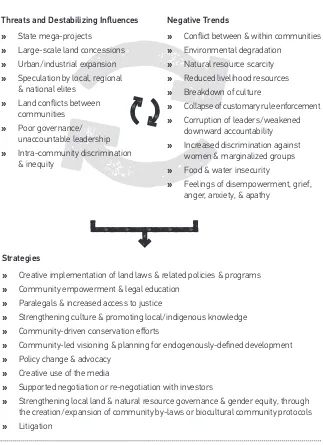
advocates across the world are pioneering new strategies to protect, conserve and safeguard community lands and natural resources. these efforts must be coordinated, sustained, and synchronized.
Millions of rural Africans live precariously between development, conservation, and the law. In recent years, governments across Africa have been granting vast land concessions to national elites and foreign investors for agro-industrial monoculture plantations, logging, and mineral exploitation. Such concessions are exacerbating trends of increasing land scarcity and weakening the land tenure security of rural communities. At the same time, governments are creating national parks and promoting wildlife conservation in ways that exclude and undermine customary rights and local ways of life, contributing to communities’ dispossession from their ancestral lands and undermining local livelihoods and cultural traditions. These dynamics are leading to disenfranchisement, environmental degradation, human rights violations, impoverishment, and growing inequity. Such trends are exacerbated by governments’ lack of effective legal recognition (and implementation) of a range of Indigenous Peoples’ and local communities’ rights, including rights to: 1) self-determination 2) culturally-appropriate forms of governance and associated institutions; 3) land, water, and natural resources, and 4) traditional knowledge.
BuiLding a gLoBaL moVement for community Land Protection
Innovative ways to empower communities in protecting their lands, natural resources, and cultures are urgently needed. Advocates across the world are pioneering new strategies to protect, conserve and safeguard community lands and natural resources, many of which also support communities to leverage the momentum surrounding land protection efforts to create positive intra-community change, such as:
introduction
» Increased downward accountability for local leaders and promotion of good governance in community land and natural resource management;
» Increased community participation in local land and natural resources decision-making; » Establishment of intra-community mechanisms to protect the rights of women
and vulnerable groups;
» Promotion of sustainable natural resource management practices and conservation; » Increased legal awareness and legal empowerment;
» Heightened community capacity to negotiate for and actualize fair partnerships with external investors, such that investment brings authentic local prosperity; and » Increased community capacity to vision, plan for and realize locally-defined
community development.
Yet despite the great potential of these approaches, such pioneering efforts are oſten undertaken in isolation from each other. To be most effective, such efforts must be coordinated, sustained, and synchronized. Many expert practitioners working in human rights law, forest conservation, land tenure security, mineral resource extraction, water rights, Indigenous People’s rights, and environmental law rarely share their experiences and strategies across disciplines. To connect practitioners and support a more integrated approach to community land and natural resource protection, Namati and Natural Justice convened a symposium of 20 expert advocates from across Africa for a three-day symposium in late 2013. The symposium aimed to highlight participants’ expertise and creativity, creating a forum for participants to:
» Share experiences and practical strategies for effectively supporting communities to protect their lands and natural resources;
» Design effective strategies to address commonly-faced challenges; » Brainstorm new and innovative forms of legal empowerment; and
» Strengthen a cross-disciplinary community of practice to foster continued learning and dialogue.
strategies By Practitioners, for Practitioners
Since the symposium in 2013, pressures on community land and natural resource rights have only increased. It is more necessary than ever to share strategies, successes, lessons, and resources across a wide network of local practitioners, legal champions, policy advocates, media allies, and supporters.
This book synthesizes many of the findings and strategies collected at the 2013 symposium. It has been written specifically for practitioners and advocates and takes a practical approach: it avoids abstract, theoretical discussion and focuses instead on concrete experiences of working with communities to protect their lands and resources. The case studies in this book share experiences and reflections directly from local land and natural resource defenders and advocates from across Africa. It has been written by practitioners, for practitioners. The case studies detail a variety of ingenious and creative strategies to proactively confront trends that undermine community land and natural resource tenure security.
Strategies are grouped based on common challenges that communities face concerning their lands and natural resources. Each chapter in this book examines a specific type of challenge, though these oſten overlap and combine in many situations:
» Chapter 1 addresses issues related to state-imposed definitions of “community” and divisive identity politics;
» Chapter 2 discusses strategies for resolving intra- and inter-community land conflicts; » Chapter 3 suggests strategies for strengthening local governance of community land
and natural resources and promoting endogenously-driven community development; » Chapter 4 illustrates strategies for confronting state-driven mega-projects,
exclusionary conservation efforts, and forced resettlement;
» Chapter 5 offers strategies to empower communities when faced with large-scale land concessions and investments.
“a community self-constitutes and organises in relation to its past and its desired future.”– Wilmien WicomB, soutH africa
Defining “community” is a complex endeavor. Processes of community definition must be sensitive to dynamics of geography, identity, history and culture, and must address overlapping definitions of authority, territory and identity. Such processes are oſten further complicated by:
» The nested quality of rural social organization, in which smaller spatial or social units are contained within larger units, which themselves may be part of even larger units; » The structure of decentralized national government, which may not always align
with traditional or locally-recognized social structures;
» Differences between locally-recognized or customary territorial boundaries and the boundaries recognized by the state or government administration; » Historical fracturing and division of social units, oſten based upon intra-
and inter-family conflict or scarcity of resources;
» The existence of common areas shared between populations that identify as separate communities;
» Historical migration patterns, ecological changes, and infrastructure development; and » Competition over valuable or scarce natural resources.
A community’s decision about how to define itself will depend upon various, sometimes conflicting, cultural, political and geo-spatial realities and the preferences of local leaders and community members. A community’s self-definition may also be amorphous or shiſt in response to different contexts or changing internal factors. In certain circumstances, communities may need to define themselves strategically for the purposes of engagement addressing identity Politics & state-imPosed definitions of “community” | 1
1
addressing identity
PoLitics & state-imPosed
definitions of “community”
projects.1Different ethnic groups who have never identified collectively may decide to do so
in the context of an external threat to their use of an area of land or to further a shared interest. For example, traditional healers across South Africa define themselves as a “community” despite their geographical spread and divergent ethnic identities in order to develop a shared code of conduct, catalogue natural resources used in healing, and take action to protect their traditional knowledge. External pressures may also lead to a desire for a clearer collective identity, such as: pressure to differentiate from neighboring communities, dominant ethnic groups, or other outsiders or encroachers; desire to increase political representation or participation in national or regional political decision-making processes; or an attempt to build unity to further a shared goal or struggle that surpasses ethnic, religious, linguistic and livelihood boundaries. Indeed, a given “community” may be defined in myriad ways – perhaps the only overarching definition of a community might be “a group of individuals coalescing around shared aspirations and values.”
Those seeking to weaken or exploit a population may attempt to exacerbate internal divisions and disagreements between community factions to undermine local resistance. Therefore, robust internal definition processes (for the community members themselves) are oſten as important as community definition for external actors. Arriving at a coherent, inclusive community definition for the purposes of defending community land and natural resources claims may help to sooth intra-community tensions, calm internal power struggles and rediscover or create a shared sense of identity. Internal cohesion can then empower the community to address external threats more successfully.
addressing identity Politics & state-imPosed definitions of “community” | 1
driver of conflict and may disrupt or undermine community organizing efforts. Organizations working with communities must make sure that field teams intimately understand the nuanced structure of – and sub-groups within – the communities they work with. Advocates must be alert for exclusionary tendencies and carefully that everyone living in the area, using land or natural resources in the area, or with strong historical or cultural ties to the area, can effectively participatesin community definition processes.
The case studies below illustrate many of the challenges of externally-imposed community definitions and the complexities inherent in supporting communities to define themselves. In South Africa, the Legal Resource Centresupported communities to define themselves outside of the single “community” structure imposed by the national government, who, in its efforts to resettle seven villages that had previously existed separately, created one “community” indifferent to the villages’ different histories and separate identities. In Mozambique, Centro Terra Viva’s efforts to support the Marrúcua community to register its customary lands illustrate the challenges that arise when administrative definitions of the ‘community’ and community members’ own understanding of the community’s definition and limits differ. In Botswana, the Botswana Khwedom Councilis fighting for state recognition of the San’s tribal-based community definitions so as to allow the San to seek rights to use and benefit from their lands under community based natural resource management schemes. In Tanzania, the
Ujaama Community Resource Teamsupported the Hadzabe pastoralists to break away from administrative definitions of “community” to seek a Certificate of Customary Right of Occupancy (CCRO), legitimizing their land and natural resource rights and allowing them to continue to govern their lands and pursue their livelihoods according to custom. And in Liberia, the Sustainable Development Instituteregularly confronts challenges related to ethnic conflict, power struggles between leaders, divergent conceptions of community identity, and logistical and territorial tensions as it supports communities to define themselves for purposes of land documentation and land and natural resource governance.
Emerging from these case studies are several considerations and recommendations relevant to processes of community definition:
» ensure that all potential stakeholders are able to participate in the process of
» When community definitions are contested, support residents, local leaders and
relevant government officials to recount local community “origin stories” and remember shared traditions.Distilling shared ideals and values from community origin stories, traditions, and historical identities (such as those based on family lines, clans, language groups or other shared identities) can help to clarify the evolution of the community and create or revitalize a sense of shared collective identity. Such efforts are particularly important when a valuable resource is discovered or when resources are scarce. Public remembering or recounting of the local “story of origin” – or the variety of sequential stories of how the community came to include different peoples – can be used to address who “belongs” and prevent exclusion of minority groups or less powerful families. Origin stories and shared cultural traditions can be particularly helpful when challenging state-mandated community definitions, as illustrated in the Legal Resource Centercase study:
“Community strength oſten depends on how diverse interest groups join forces. Every community, no matter how small, carries with it the tensions of inherent heterogeneity, asymmetry and diverse interests. Within a community where these divisive factors are countered by the pull of commonality and cohesion based on history, on dynamic interaction, or simply on familiarity, it can provide creative tension and a richness that strengthens the community.”
» consider the advantages and disadvantages of defining a community in different
ways before making decisions.Communities can identify at various points along a
spectrum, ranging from the smallest, “most local” or least diverse level, to the largest, most encompassing, most diverse level. As illustrated in the Sustainable Development Institute’s case study below, the choice of level and scale of “community” can have significant strategic and logistical implications.
» remember that communities define themselves at different speeds.Processes to clarify
community definition are oſten motivated by external factors, which may create pressure to make decisions quickly. When possible, avoid imposing external deadlines on community definition processes, or advocate that communities be given sufficient time to arrive organically at a definition that feels comfortable to all stakeholders. A community’s definition will likely have significant impacts not only on all aspects of local land and natural resources governance but also on all aspects of the community’s socio-cultural and political experiences.
» remember that “communities” are dynamic and fluid.A community self-constitutes,
The Legal Resources Centre (LRC) is a public interest law firm based in South Africa. It uses the law as an instrument of justice for the vulnerable and marginalised, including poor, homeless, and landless people and communities who suffer discrimination by reason of race, class, gender, disability or by reason of social, economic, and historical circumstances. The LRC seeks creative and effective solutions by using a range of strategies. These include impact litigation, law reform, participation in partnerships and development processes, education, and networking within South Africa, the African continent and at the international level.
One focus of the LRC is providing legal support to communities. They specialise in impact litigation, choosing their cases carefully in the hope that the outcome will have an impact on a broader group of people than only the community in question. This can happen through setting of precedents or actual law reform. In South Africa and the other Southern African countries where they work, the statutory frameworks that protect community lands and natural resources (in particular land held under customary tenure) are weak. As a result, they attempt to use customary law as a source of law to counter these weak frameworks and provide better legal protections for communities’ land and resource rights. But there is a second important reason why they regard customary law as a useful tool for protecting community rights. Government or investor consultations with communities are oſten framed in terms that alienate communities. These consultations tend to pertain to complex environmental impact assessments, or assume and impose a single development paradigm (mining as the only road to community prosperity, for example). They also oſten follow the procedural rules of formal Western law (i.e. allowing 30 days for the entire consultation process).
LRC asserts customary law as the legal framework for consultation procedures not only to raise the bar to require community consent, but to ensure decision making according to a community’s customs, and at a community’s pace and timing. The conversation, then, is not about legalistic impact studies, but about the community rules and actual impact.
addressing identity Politics & state-imPosed definitions of “community” | 1
CASE STUDY
1.1
rediscoVering LeVeLs of ‘community’ among
disPLaced PoPuLations in south africa
By Wilmien WicomB,
the chaLLenge of community definition in south africa
The existence of a clearly identifiable, easily defined ‘community’ is almost always a fallacy. Rather – and ideally – a community self-constitutes and organises in relation to its past and its desired future. In defining itself in this way, a community sometimes (a) builds on its history and living customary law and (b) develops out of engagement and struggle, inventing itself as a community different to its neighbour. This invention is a process. The community’s boundary is oſten fluid, depending on changes in the environment.
In South Africa, the identities of ‘communities’ have become deeply contested. This is the case in many African countries that experienced colonial rule. More than a century of imposed and discriminatory statutory regulation by British authorities transformed communities in South Africa from fluid groups bound together through kinship, indigenous governance systems and relationships of reciprocity, to geographically and socio-politically fixed and bounded units based on statutory definition and, more oſten than not, centred around an all-powerful traditional leader. As a result, community identities oſten became artificial and as a result, lacked legitimacy.
This becomes a major problem when outside interests seek to acquire or control lands or natural resources belonging to that ‘community.’ In order to avoid intra-community contestations and time-consuming community engagement, investors and government tend to pick an individual or elite structure, such as the traditional leader or traditional council, to speak on behalf of ‘the community.’ This oſten results in elite capture, corrupt leadership and communities sinking ever deeper into poverty.
These fixed forms of community identity with centralised, unaccountable and all-powerful leadership structures can be countered by smaller communities withinthe community challenging state imposed identities, definitions and representatives. They do this through organising and self-identifying in different ways, for example, around a common issue. The example of the communities of Dwesa-Cwebe is one such case.
the community of dWesa-cWeBe
In the last three hundred years at least, seven communities descended from the royal lineage of the Xhosa lived on the East Coast of South Africa in the area today demarcated as the Dwesa-Cwebe Nature Reserve. The area is on the banks of the Mbashe River, close to where Nelson Mandela was born and raised. It was formally annexed by the British in August 1885. Soon aſter, Mfengu people came to settle on the Dwesa side of the Mbashe River.
addressing identity Politics & state-imPosed definitions of “community” | 1
because of resistance from the local villages. The areas that people were relocated had poor quality soil and lacked the necessary resources for cultivation, so communities kept returning and re-establishing themselves on their former land. These communities were relocated again in the early 1980s as a result of the so-called ‘betterment’ schemes of the apartheid government which again forcefully encouraged ‘villigisation.’ This is where most villages are still located today.
the state re-defines the community
From around 1995, the first democratic government of South Africa identified the Dwesa-Cwebe area as a flagship for its land restitution programme. The sense of euphoria and possibility that came with the promise of a new democratic era inspired this ambitious settlement proposal. It would not be slowed down by unnecessary complexity. The government created new representative structures within the community in order to facilitate the return of the land, despite the fact that various customary governance structures still existed within the community. The Restitution Commission decided to combine all seven villages removed over the previous decades to demarcate the Reserve and create a new community called the ‘Dwesa-Cwebe community.’ This new community was given legal personality and was represented by a Land Trust that in turn represented the seven villages. As part of this structure, each village created a separate communal property association. The creation of the ‘Dwesa-Cwebe community’ glossed over the fact that the only commonality amongst its members was the shared history of dispossession from the same area. The seven villages had previously existed separately and were spread out over a large area, made all the more vast by the inaccessibility of various parts of the ‘community’ by road. The villages have different histories of lineage, of settlement in the area and of dispossession. They also had markedly different histories of reaction to and interaction with the authorities – some exceedingly vigilant and even militant, while others had never produced a single protest.
Lrc’s suPPort for the communities of dWesa-cWeBe
By the time the LRC encountered members of the Dwesa-Cwebe community in 2010, the national government had still not completed the land restitution they had promised. Instead the initial Land Trust structure had been replaced with successive structures and multiple court cases emerged as mistrust and allegations of mismanagement tore the community apart. On the ground, poverty and desperation had only increased.
In 2012, the LRC defended some of these fishers who had been criminally charged with attempting to fish in the Reserve. A concurrent application was launched in 2013 on behalf of the fishers of Hobeni and fishers from other Dwesa-Cwebe villages with the intention of forcing the government to address the complaints of these fishing communities. LRC’s approach to the case relied fundamentally on the customary law system of ‘the various fishing communities’ – which included their local governance systems for managing access to their traditional fishing grounds. Therefore, the case was framed entirely from a community perspective, leading community witnesses in court to recite their history, a local sangoma to explain the significance of the resource to the community’s culture and two expert social scientists to testify to the community’s historical governance of the resource. Given that the defence in the criminal matter was based on the fishers’ customary rights to the resources, the LRC had to develop a deeper understanding of the custom of the fishers as a community, the broader village as a ‘community’ and, ultimately, of the custom of the Xhosa people of the area. This entailed multiple focus group meetings with the men, women and elders of Hobeni – sometimes in one group, sometimes separately – to discuss the customs of the community.
LRC staff sat down with the fishers of Hobeni for the first time on 20 January 2012. None of the houses in Hobeni had electricity, despite power lines running through the village to service the one tourist hotel inside the Reserve. LRC lawyers had to drive their car up to the window of the meeting room and charge their laptops on the car battery. Starting with a list of questions about the history of the community and fishing practices, the elders took turns recounting their childhood days when they learned not only to fish but to fish within the system of that community. Under this management system, rocks had names and belonged to families. Fishing was done by the men and the harvesting of mussels by the women. Access to the sea was regulated by knowledge of the resource and how to utilize it: people only went to sea if they understood the ocean. Above all, no-one would catch more than what they could carry. The sea was also about a lot more than fish and mussels, the elders explained. It was an integral part of their culture and religion: the ancestors live in the sea within the Reserve and must be honored there. Twins must perform specific rituals in the ocean. Traditional healers must go to the sea in order to become fully qualified. The sea water made the women fertile.
addressing identity Politics & state-imPosed definitions of “community” | 1
As community members became more forthcoming with their information, LRC lawyers pushed them further and further to articulate their rights in the words of lawyers, asking questions like “Where did your rights to fish come from?” and “Who gave the rights to you?” The lawyers were leading them to answer that their rights were not given to them by the government, but that their rights belonged to them because of their history and customary practice in the area. They kept pushing, asking the question in different ways. Finally, one of the older men looked at them and said (as translated):
You are using the wrong words. We didn’t have a ‘right’ to fish. Fishing was simply life. What you call ‘rights,’ for us was simply a part of life. It is you who use this language of rights. We don’t know that. We want our life, but if we can’t have that, then maybe at a minimum we can have these rights to fish that you are talking about.
outcomes
This growing confidence of the Hobeni community inevitably meant that the fishers from the neighbouring villages, also part of the greater Dwesa-Cwebe community, took notice and wanted to partake. Multiple ‘communities’ emerged: fishers from neighbouring villages arrived at the court house in support of their Hobeni brothers and united in song. The relationship between the marine resource and the land meant that the land structures became part of the conversation and the community used the struggle around fishing rights to further the greater community’s land rights.
As well, the success of the ‘sub-community’ of Hobeni fishers had ripple effects throughout the larger communities of the Dwesa-Cwebe villages. The Land Trust structure created by the government to represent ‘the community’ became less powerful as community members realised that they could define themselves outside of these ‘official’ structures. It was back to the drawing board for the imposed structure and leaders now faced renewed expectations from their constituencies to be transparent and accountable.
Lessons and recommendations
The divisions and tensions that inevitably exist within communities are oſten used by opponents to further weaken the community position. In the case of the Hobeni fishers and the larger Dwesa-Cwebe villages, litigation provided an opportunity to build community identity and unity. The court case created an opportunity for individuals and sub-communities of resource users to come together to elaborate on the narrative of their history and culture. By working together on a common issue and revitalizing their shared history and customs, the Hobeni fishers and larger Dwesa-Cwebe villages rediscovered and strengthened their sense of community, identity and pride. This process was a means for them to become a clearer and more unified ‘community’ such that they could be recognized by the law and the government. This strategy was successful: the renewed sense of cohesion amongst the fishers significantly strengthened their bargaining position with government.
different structures had more to do with frustration and incoherence than real power grabbing. It was worthwhile engaging everyone in the community as far as reasonably possible. Lawyers are oſten forced to ‘strategically essentialise’ communities for the purposes of litigation. That means that lawyers must speak about ‘the community’ as an entity with a single view all the while knowing that that is not the case. This can only be done once the idealistic notions of ‘community’ as unproblematic and reified entities are discarded; that is, if lawyers learn to live with and learn from the tensions. As lawyers working with claims based on custom, culture and history, the LRC have become used to coping with the tension between the language of law and the language of ‘facts.’ Anthropologists, historians and sociologists also try and understand the history and customs of communities. But in these sciences, researchers are encouraged to avoid essentialism and reductionism and instead unveil the complexity of communities and cultures. But a court is rarely interested in hearing about concepts that are too complex to define. Courts want to work with clear principles. The job of a lawyer representing communities, then, is to make sure that principles are infused with meaning that would benefit the poor and vulnerable – rather than the rich and powerful. The job, as lawyers, is to unashamedly injectmeaning into these legal concepts before the more powerful forces do so – and re-appropriate those terms already conquered. It is important to remember that communities are dynamic, fluid structures. A community self-constitutes and organises in relation to its past and its desired future. In defining itself it builds on its history and living customary law and develops out of engagement and struggle, and invents itself as a community different to its neighbour. This invention is a process and the community boundary is oſten fluid depending on changes in the environment. Significantly, this self-constitution should not be dictated by a few elite interests, but ideally emerges from intra-community interaction. The local community so constituted may emphasise a particular aspect of its identity depending on the nature of the political, organisational or legal engagement, as how the Hobeni community organised around their right to their fishing grounds. The community then gives itself a political and organisational definition and presents its representative structures for the purposes of the particular engagement based on its own experience and strengths.
Centro Terra Viva (CTV) is a Mozambican NGO whose vision is of a national natural resource management policy and practice that is environmentally sound, scientifically-based, economically viable, and institutionally responsible. CTV’s mission is to contribute to improved national policies and legislation and to increase the capacity of civil society to participate in environmental management through informed and relevant contributions. CTV’s approach is to work with rural communities to strengthen their legal protections and rights for community land and natural resources. CTV uses a multi-step, facilitated process to define a community’s lands, negotiate boundaries with neighboring communities, document the boundaries, and develop local land and natural resource management by-laws and governance structures. CTV’s approach is based on empowering and training community members to champion their own community land protection efforts.
WWW.CTV.ORG.MZ
The first step of CTV’s community land protection efforts is to work with the local population to decide how each community wants to define itself for the purpose of protecting its community lands. Mozambican law empowers communities to protect their lands and common interests by seeking formal documentation of their land claims. To leverage these protections, local communities must define themselves and their boundaries.
At first, the question of how to define ‘local community’ in Mozambique may seem to be an easy task because there are several regulatory provisions that define ‘community’ - some simply and others in detail. However, in practice complications can arise that confound official definitions. In particular, documenting and harmonizing boundaries between communities can illustrate ‘grey zones’ in the official definitions that must be resolved at the local level. The result is a balance between the regulatory definitions of ‘community’ and local processes of letting communities define themselves. This case study provides an CASE STUDY
1.2
harmonizing customary Boundaries
& administratiVe Borders in mozamBique
addressing identity Politics & state-imPosed definitions of “community” | 1
the theory of ‘community’ and mozamBican LegaL definitions
In Mozambican law, the term ‘local community’ is defined by either: 1) reference to groups of individuals who share common interests and work together as a unit, or to 2) the idea of a ‘community’ as based within a geographically defined rural area. Mozambigue’s Lei de Terras Article 1, Section 1(Land Law), the Lei de Ordenamento Territorial(Law of Territorial Organization) and the Lei de Florestas e Fauna(Forestry and Wildlife Law) all define a local community as:
“A grouping of families and individuals, living in a territorial area that is at the level of a locality or smaller, which seeks to safeguard their common interests through the protection of areas for habitation or agriculture, whether cultivated or lying fallow, forests, places of cultural importance, pastures, water sources and areas for expansion.”
The self-definition approach aligns with the recommendations of many analyses of community land rights laws. According to research on traditional forms of community participation in natural resource governance in Mozambique, the criteria that many laws use to define the local community is whether or not its members have an awareness of belonging to a community that has interests to defend, both in the present and future.2Other
advocates argue that communities should be able to define themselves and that the self-definition should be allowed to go beyond geographic boundaries to include distant or absent individuals that are considered to be part of the ‘community.’3
Working with rural communities in Mozambique, CTV has also found that when communities define themselves, they are more motivated to complete community land protection activities and that it is easier to reach agreement over community boundaries. However, self-definition can also bring challenges, as the following case study illustrates.
marrúcua: one community, tWo districts
The Lei de Terrasrequires that the area of a community may not exceed that of its localidade
(the administrative areas that divide a District).4However, a community’s traditional or
self-defined boundaries do not always coincide with the state’s administrative boundaries – a self-defined community may cross the borders of several localidadesor even Districts. This is not to say that the area claimed by a community exceeds that of their localidade, but rather that the self-defined and administrative borders do not align.
This is the challenge faced by the community of Marrúcua. For years, the community has been unable to secure legal protections for its customary lands because its self-defined boundaries span an administrative border: the line between the Morrumbene District and the Massinga District. According to the traditional authorities of Marrúcua and Muhaque (the community with which Marrúcua shares the contested boundary), the boundaries between the two communities never coincided with the administrative boundary between the two districts. Despite the District boundary that runs through Marrúcua’s lands, the community members of Marrúcua have always identified as one, united community. However, District officials of Massinga and Morrumbene Districts have refused to endorse changing the official boundaries between the two communities. Instead, they insist that the traditional limits coincide with the administrative boundary between Massinga and Morrumbene Districts. CTV is currently working with Marrúcua to find a way through this administrative impasse by providing legal analysis and negotiating the case with local authorities. It is CTV’s position that the boundary agreement between Marrúcua and Muhaque does not violate the law or any constitutional provisions.5Marrúcua is a local community and an entity with rights and
5 The situation in Marrúcua highlights a gap in the legislation concerning the definition of a local community. Based on CTV’s legal analysis, Marrúcua is caught in a misinterpretation of the law that defines a local community as "... a territorial constituency at the localidade
addressing identity Politics & state-imPosed definitions of “community” | 1
duties in the management of land and natural resources, in accordance with the Lei de Terras, regardless of the opposition from officials in Massinga District. CTV’s legal analysis has not found any reference in the legislation to the need for administrative and traditional boundaries to coincide, and there is no restriction on a community having land at two different locations in two different districts. The CTV field team working with Marrúcua is now building community awareness about the challenges with their boundary claim and identifying strategies to demand respect for their boundaries.
Because the problem in Marrúcua appears to be an issue rooted in political and administrative concerns, CTV is endeavoring to work with the District officials to create space within the administrative system for a community that defines itself contrary to existing administrative boundaries. Through conversations and education sessions with District officials, CTV staff are attempting to increase acceptance of traditional land governance systems and persuade officials that proper interpretation of the Lei de Terras
does not prevent a community’s lands from spanning District borders. Currently, CTV is trying to negotiate a compromise that respects Marrúcua’s customary boundaries but also can be practical within the District administrative system. While Marrúcua could have a strong legal case if it were to take the issue to court, CTV’s experience has been that litigation is not oſten the most effective means to resolving such disputes. Rather, CTV and Marrúcua will continue to advocate their case to decision makers within government.
Lessons and recommendations
While many researchers and practitioners recommend that communities be allowed to define themselves, there can be many obstacles to achieving this in practice. The example of Marrúcua illustrates how complexities of politics, administrative systems and power dynamics can stymie efforts to draw community boundaries using a grassroots-driven, participatory approach.
In its efforts to support communities to define the boundaries of their lands, CTV has learned two critical lessons:
» involve a wide range of local officials in the community self-definition phase of
community land delimitation processes: The case of Marrúcua highlights the challenges that can arise if a powerful authority is leſt out of the community definition processes. The experience has inspired CTV and the leaders and community members of Marrúcua to invite closer involvement and collaboration with local government officials in order to anticipate challenges and work together to resolve issues. Before Marrúcua, CTV would only meet with local officials within the main District that the community was located within according to official records and not any neighboring Districts. Since working with Marrúcua, CTV now extends this initial consultation phase to include neighboring Districts if there seems to be potential that a community’s land will cross administrative boundaries.
» Build relationships with local government officials:CTV has learned that the courts
addressing identity Politics & state-imPosed definitions of “community” | 1
The Government of Botswana defines a ‘community’ as simply a group of people residing in a given locality. This definition is influenced by the government’s philosophy on nationhood that holds that all citizens of Botswana are Batswana and should therefore shed their tribal identity to avoid tribal conflicts. Under this definition, anyone may legally reside wherever he/she wishes (as long as they acquire their land through legal means) and must be included in the ‘community’ of that locality. The government of Botswana has also endorsed community based natural resource management (CBNRM) as a mechanism to grants communities the rights to use and benefit from the natural resources that they have managed for a long time. CBNRM requires communities to establish Community Trusts, which includes the creation of a community constitution that defines the ‘community’ and conditions for membership in the community.
The government’s stance on tribal identity has created challenges for CBNRM practitioners and community activists seeking to protect their community’s lands from encroachment. Certain areas of Botswana are inhabited by homogenous tribal groups with distinct customs and traditions and a shared sense of a distinct ethnic identity, as is the case with San communities. In these areas, communities typically self-identify based on ethnic identity but the government refuses to recognize tribal-based community definitions, including minority tribes like the San. This has created some conflicts between communities seeking CBNRM and the government’s definition of ‘community.’ For example, when the San community of Khwai created their community constitution for CBNRM, they defined their community as San people. The State refused to register Khwai’s constitution arguing that it was discriminatory and exclusive.
In response, community activists have developed a compromise: conditions for how and when newcomers to a community can benefit from CBNRM, such as requiring residency of five consecutive years and participation in community activities. While this approach faced initial opposition from settlers and government officials, activists were ultimately able to convince them that conditions on community membership were necessary to protect resources of the community and the approach was eventually accepted. This compromise allows the government’s stance on national unity to co-exist with communities’ desire to manage the definition of who is a member of the community, at least for the purposes of land and resource management.
BaLancing BetWeen community seLf-definition & nationaL identity in BotsWana
The Ujamaa Community Resource Team (UCRT) has been working for over a decade to address the land rights and related natural resource management issues of roughly 40 pastoralist, agro-pastoralist, and hunter-gatherer communities across northern Tanzania. UCRT assists these indigenous communities to secure rights to their lands in order to access, manage and benefit from their natural resources, while simultaneously conserving their environment for future generations. This effort requires a multi-pronged approach that builds capacity for collective action on multiple levels, from individual households to national policy-makers. Some of the approaches utilized by UCRT include land demarcation and boundary reconciliation processes, mapping, village registration, certifying land occupancy, and facilitating the development of land use plans and community by-laws. UCRT has also played a lead role in enabling local communities to build linkages with external sustainable development, tourism investment, and wildlife conservation interests.
UCRT develops its programs in full collaboration with local communities in order to ensure community ownership and program sustainability. UCRT believes that all members of a community deserve an equal right to participate and make decisions regarding community affairs, and that decisions should not be undermined by elites or vested interests. To achieve this vision, UCRT avoids political involvement and gives communities enough room to interact on agendas and develop joint resolutions before moving forward with any project. In this way UCRT has developed strong and close relationships with target communities.
WWW.UJAMAA-CRT.ORG CASE STUDY
1.3
securing coLLectiVe Land tenure
for hunter-gatherers in tanzania
addressing identity Politics & state-imPosed definitions of “community” | 1
context: PastoraLists in tanzania
Historically, pastoralists and hunter-gatherer communities in northern Tanzania have faced severe encroachment and loss of their traditional lands to a number of external entities. They have lost large portions of their homelands to the creation of national parks and other conservation and tourism interests, to commercial agricultural and ranching schemes developed by the government and investors, and to illegal land-grabbing schemes carried out by local and national elites. As land shortages in Tanzania become increasingly acute, and investor interest rises in sectors such as biofuels and agriculture, threats to indigenous lands and livelihoods are intensifying.
case study: the hadzaBe
The Hadzabe are one of only two hunter-gatherer groups remaining in Tanzania that have not yet lost all of their lands and culture to dominant neighboring agricultural and pastoral communities. They reside in the Lake Eyasi basin of northern Tanzania, adjacent to Serengeti National Park and the Ngorongoro Conservation Area, and number about 1,500 individuals. Because the Hadzabe depend on hunting and gathering for a significant portion of their subsistence needs, they have institutionalized mechanisms within their culture to maintain a healthy natural environment with sustainable land use.
The Hadzabe was one of the first communities that UCRT began work with aſter it was founded in 1998, as the organization’s vision was to assist hunter-gatherers and pastoralists to improve their livelihoods and the Hadzabe were the largest group of hunter-gatherers in Tanzania. At that time, a majority of the community lived in Mongo wa Mono village. The land of the village is traditional Hadza land but it had been encroached upon by agricultural and pastoralist communities from other parts of the country. As mandated by the Village Land Act, a village council was elected to determine the boundaries of village land and control local land use planning. The Hadza did not participate in these local elections because they maintained their own traditional governance structure separate from the village, and neither understood their rights nor realized the full extent of control the Village Council would have over their affairs once elected. Ultimately, this resulted in a lack of Hadza representation within local governance, and subsequent loss of control over their lands to outsiders when the Council designated zones for various land use purposes throughout the area without prioritizing Hadza interests. Without adequate access to hunting and gathering grounds, the Hadzabe were unable to practice their cultural traditions or customary methods of subsistence.
addressing identity Politics & state-imPosed definitions of “community” | 1
ucrt’s roLe
UCRT called a Hadza community gathering and explained the process of obtaining a Certificate of Customary Right of Occupancy (CCRO), the primary means of securing collective rights under the new land laws of Tanzania. The Village Land Act prescribes that an individual or group living on customarily held lands over 250 hectares in size may apply for a CCRO from their local Village Council with the approval of the Commissioner of Lands. The application process requires that the local council define and approve community by-laws, receive a certificate of village land, and agree on boundaries and land use plans through a district-level demarcation and zoning process. Upon approval, the CCRO provides permanent tenure to the holder. The Hadza community agreed via consensus to move forward with this approach because it would mean that the village government would no longer have the power to undermine Hadza land rights.
Left:Hadza men prepare traditional hunting equipment during a cultural event. © ucrt
the hadzaBe ccro Process
The Hadzabe faced several obstacles in attempting to obtain a CCRO. Despite the stated purpose of the legislation, the CCRO process had only been utilized by individuals and corporate entities to obtain land tenure prior to the Hadzabe application, and the central government was unsure how to approach a community-based application for the first time. Additionally, the legislation requires that group applicants either be registered as a legal entity, or be recognized as a formal group under customary law.
The Hadzabe were not interested in registering as a legal entity for two reasons. First, the community wanted their land rights secured as quickly as possible, and the registration process was complex and time-consuming. Second, the process of registration would require the Hadzabe to replace their traditional leadership system with state-mandated institutions and procedures that did not necessarily fit with their modality of life. Additionally, proving that the Hadzabe were a formal group under customary law was difficult, because as mentioned above, hunter-gatherers had never been addressed in Tanzanian legislation, and government officials were largely ignorant of the community’s existence. It was up to UCRT to negotiate a streamlined CCRO process that would allow the Hadzabe to secure their lands while also retaining their unique lifestyle and traditions intact.
UCRT had already been involved for some time in the lengthy process of mapping, zoning and demarcating Hadzabe land with village and district governments. Now UCRT also began holding a series of discussions with the office of the Northern Zone Assistant Commissioner for Lands in Moshi. The negotiations were long and difficult due to the complicated requirements demanded by the Ministry of Lands and the government’s general lack of understanding regarding the customs and institutions of the hunter-gatherer community. For example, it was necessary for UCRT to explain to the government the difference between the community’s practice of hunting on their own lands for subsistence and cultural purposes and poaching for entertainment purposes as practiced by commercial hunters on lands they have no connection to.
addressing identity Politics & state-imPosed definitions of “community” | 1
The turning point finally occurred when the Assistant Commissioner was convinced to visit the Hadzabe in their homeland in order to view their predicament firsthand. The community welcomed her with traditional song, dance and food, followed by public presentations on their experiences and endeavors. They showed her their ancestral lands and explained their cultural and spiritual attachments to various locations and natural resources as well as the hardships Hadzabe have suffered as a result of dispossession. The Commissioner was moved by this experience and committed to assisting the community with their land claim.
outcomes
Aſter several years of negotiations back and forth, the Assistant Commissioner and District government finally acknowledged the Hadzabe for their uniqueness in 2011 and granted the community a Customary Right of Occupancy for as long as they continue to exist. Three certificates of land were issued for an area of 23,000 hectares that includes two villages, Mongo wa Mono and Domanga, and allow Hadzabe from both villages to use any of the areas. Restrictions on land use are based on the zoning previously determined by UCRT, the Hadzabe and the Village Council: certain areas are zoned for settlement and grazing, while a large portion is retained purely for hunting and gathering activities. This is the first legal certification of land granted to a hunter-gatherer community in Tanzania, and creates an opportunity for other indigenous groups to secure their land tenure through the same process.
With support from The Nature Conservancy and Norwegian People’s Aid, UCRT organized a celebratory meeting between Hadzabe from the three villages of Mongo wa Mono, Domanga and Mangola later that year. UCRT invited the Land, Legal and Game Officers from the Mbulu District Council to help facilitate alongside three teams of UCRT staff. The six-day meeting brought together more than 150 participants, 67 women and 83 men, and made it possible for Hadzabe from across the region to discuss a number of issues as a group, including:
» How to mobilize the community to continue to collectively address land tenure and natural resource and governance issues;
» How to increase security over land and natural resources; and » How to build a more unified community and cultural identity.
The Hadza also gained new economic opportunities as a result of obtaining their CCRO. Now that they are the recognized owners of their land and natural resources, they are able to participate in conservation programs with Carbon Tanzania, for example, wherein revenue from the sale of certified carbon offset credits is paid to community members for managing the conservation of their forest areas. A percentage of this revenue has already been paid to the local scouts for enforcing Hadza land use plans.6Other opportunities have
since emerged for the Hadza in collaboration with local eco-tourism initiatives.
anaLysis and recommendations
Securing land tenure for the most vulnerable members of society oſten requires a multi-faceted approach that blends formal legal processes with negotiation strategies. In this scenario, it was necessary for UCRT to broker communication and cultural differences between the Hadzabe community and several layers of government leadership from the Village Council, District Council, and the Ministry of Lands in order to bridge the divide between official decision makers and those whom the decisions affect on the ground. Building relationships with individuals at each of these levels was key to the success of this process. Also essential was creating a sense of personal responsibility amongst government leaders by physically introducing them to the community members involved and showing them the physical and cultural losses at stake.
The Sustainable Development Institute (SDI) works to transform decision-making processes in relation to natural resources and to promote equity in the sharing of benefits derived from natural resource management in Liberia. The organization’s vision is of a Liberia in which natural resource management is guided by principles of sustainability and good governance and benefits all Liberians. Its activities cover a range of crosscutting issues including governance and management, the environment, state and corporate social responsibility, economic and social justice for rural populations and the democratic participation of ordinary people in government management of natural resources. The organization received the Goldman Environmental Prize in 2006. Community Land Protection is one of SDI’s main program areas. SDI works with communities in rural Liberia to strengthen tenure security, improve land use and management, and most importantly, develop transparent and accountable community land governance systems. SDI staff work with communities to facilitate an integrated, multi-step process for community land documentation and governance. Central to SDI’s approach to community land protection is training and supporting a team of community-based paralegals who guide their communities through the process of mapping and documenting community lands and draſting community by-laws and management plans. The program is currently working with 65 rural communities across the counties of River Gee, Maryland, Lofa and Rivercess.
WWW.SDILIBERIA.ORG
addressing identity Politics & state-imPosed definitions of “community” | 1
CASE STUDY
1.4
comPLexities of community
seLf-identification in LiBeria
7By ali kaBa,
context
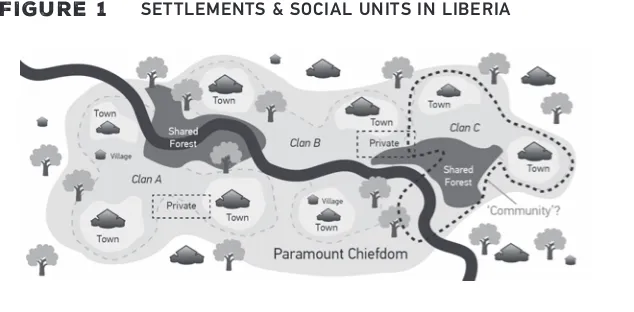
Beginning in the 1950s, statutory laws and regulations systematically eroded customary governance of land and natural resources in Liberia. In 1956, lawmakers passed legislation (The Aborigines Law) that made communities’ undocumented customary lands into state-owned land, turning customary land ownershiprights into mere land userights.8This legal
sleight of hand made communities’ lands vulnerable to state-sanctioned concession grants and facilitated significant dispossession of rural communities from their customary lands. Over the past fiſty years, huge tracts of rural land have been leased or privatized to elites and foreign investors: current records show that over 50% of Liberia’s land has been contracted out or promised to foreign investors, while an additional 20% is claimed as private land by urban and rural elites or churches.9
In recent years, Liberia has developed several laws and policies designed to strengthen communities’ customary tenure security. Taken together, the 2006 Community Rights Law, Liberia’s Land Rights Policy(2013) and the draſt Land Rights Actprovide critical protections for customary land rights.10These protections include communities’ rights to self-identify
their territory and membership, to legally claim their customary lands, and to manage local natural resources according to their own visions and goals.
Specifically, the 2013 Land Rights Policy, allows communities to choose to self-identify in order to secure a deed to their customary lands.11The policy recognizes that “the nature of
communities varies greatly throughout Liberia” and therefore allows that “communities may define themselves and determine how their land is managed, used, and allocated but within a framework of transparency, accountability, inclusiveness, and shared responsibility with the Government of Liberia” (¶6). The policy also commits the government to “provide sufficient resources and undertake the necessary activities to support communities in self-defining, obtaining deeds for their Customary Land, establishing the community as a legal entity, determining community boundaries, and ensuring community governance and management” when communities choose to undertake these activities (¶6.6.1).
Although the Land Rights Policyhas widespread support among civil society organizations and rural communities, the community self-identifica