REINWARDTIA
2018 17 (1)
REINWARDTIA
A JOURNAL ON TAXONOMIC BOTANY, PLANT SOCIOLOGY AND ECOLOGY
Vol. 17 (1): 1 –
85,
June 29, 2018
Chief Editor
Kartini Kramadibrata (Mycologist, Herbarium Bogoriense, Indonesia)
Editors
Dedy Darnaedi (Taxonomist, Herbarium Bogoriense, Indonesia) Tukirin Partomihardjo (Ecologist, Herbarium Bogoriense, Indonesia) Joeni Setijo Rahajoe (Ecologist, Herbarium Bogoriense, Indonesia) Marlina Ardiyani (Taxonomist, Herbarium Bogoriense, Indonesia) Himmah Rustiami (Taxonomist, Herbarium Bogoriense, Indonesia) Lulut Dwi Sulistyaningsih (Taxonomist, Herbarium Bogoriense, Indonesia) Topik Hidayat (Taxonomist, Indonesia University of Education, Indonesia) Eizi Suzuki (Ecologist, Kagoshima University, Japan)
Jun Wen (Taxonomist, Smithsonian Natural History Museum, USA)
Barry J. Conn (Taxonomist, School of Life and Environmental Sciences, The University of Sydney, Australia) David G. Frodin (Taxonomist, Royal Botanic Gardens, Kew, United Kingdom)
Graham Eagleton (Wagstaffe, NSW, Australia)
Secretary Ruslan Bukhori
Layout Liana Astuti
Illustrators Subari
Wahyudi Santoso Anne Kusumawaty
Correspondence on editorial matters and subscriptions for Reinwardtia should be addressed to: HERBARIUM BOGORIENSE, BOTANY DIVISION,
RESEARCH CENTER FOR BIOLOGY– INDONESIAN INSTITUTE OF SCIENCES CIBINONG SCIENCE CENTER, JLN. RAYA JAKARTA – BOGOR KM 46,
CIBINONG 16911, P.O. Box 25 CIBINONG INDONESIA
PHONE (+62) 21 8765066; Fax (+62) 21 8765062 E-MAIL: [email protected]
http://e-journal.biologi.lipi.go.id/index.php/reinwardtia
Cover images: Psydrax undulatifolius K.M.Wong & Mahyuni spec.nov., A. Habit; B. Flower; C. Stigma; D. Flower bud; E. Young fruit; F. Corolla cut open to reveal inside; G. Anther; H. Stipule. A, E, H from H.N.
The Editors would like to thank all reviewers of volume 17(1):
Sylvain Razafimandimbison - Swedish Museum of Natural History, SwediaWong Khoon Meng - Herbarium Singapore, Singapore Botanic Gardens, 1 Cluny Road, Singapore Mien A. Rifai - Akademi Ilmu Pengetahuan Indonesia (AIPI), Jakarta, Indonesia
HarryWiriadinata - Herbarium Bogoriense, Indonesian Institute of Sciences, Bogor, Indonesia Joan Pereira - Sandakan Herbarium Forest Research Centre Sabah Forestry Department, Sabah, Malaysia
Johan Iskandar - Universitas Padjadjaran, Bandung, Indonesia Andrew Powling -University of Portsmouth, Portsmouth, United Kingdom
REINWARDTIA Vol. 17. No 1. pp: 39–53
39
VEGETATION ANALYSIS AND POPULATION STRUCTURE OF PLANTS
AT MOUNT ENDUT FORESTED AREA, GUNUNG HALIMUN SALAK
NATIONAL PARK, BANTEN, JAVA, INDONESIA
Received October 30, 2017; accepted April 30, 2018
EDY NASRIADI SAMBAS
Botany Division, Research Center for Biology – LIPI, Cibinong Science Center, Jln. Raya Jakarta-Bogor Km 46, Cibinong, 16911, Bogor, Indonesia. Email: [email protected]
CECEP KUSMANA & LILIK BUDI PRASETYO
Faculty of Forestry, Bogor Agricultural University (IPB), Dramaga Campus, Bogor 16686, Indonesia. Email: [email protected]; Email: [email protected]
TUKIRIN PARTOMIHARDJO
Herbarium Bogoriense, Botany Division, Research Center for Biology – LIPI, Cibinong Science Center, Jln. Raya
Jakarta-Bogor Km 46, Cibinong, 16911, Bogor, Indonesia. Email: [email protected]
ABSTRACT
SAMBAS, E. N., KUSMANA, C., PRASETYO, L. B. & PARTOMIHARDJO, T. 2018. Vegetation analysis and population structure of plants at Mount Endut forested area, Gunung Halimun Salak National Park, Banten, Java, Indonesia. Reinwardtia 17 (1): 39–53. —Study of vegetation structure and species composition at Mount Endut was carried out by using transect and plot methods. Data of trees, saplings and seedlings were enumerated from four transects measuring 10 m × 2,000 m in four directions of slopes i.e. North, South, East and West. In total there were 180 species of trees and saplings belonging to 105 genera and 51 families. Tree density and basal area indicate the variation and the differences in each of the sampling locations. Density of saplings and abundance of seedlings tend to be low in locations with high density and basal areas at tree level
.
Tree species having higher Importance Value wereCastanopsis acuminatissima, Schima wallichii, C. argentea, Quercus gemelliflora, and Altingia excelsa.
Castanopsis acuminatissima, Garcinia rostrata, S. wallichii, Symplocos cochinchinensis, and Prunus arborea were saplings which had highest density, while Ophiorrhiza marginata, Cyathea contaminans, Pinanga coronata, C. acuminatissima, and G. rostrata
were the most abundant listed seedlings at the study site
.
At least 27 tree species (21.91%) were recorded as relatively rare (presence represented by only 1–2 individuals), thus requiring special attention in the management of the area.Key words: Mount Endut, population structure, species composition, vegetation analysis.
ABSTRAK
SAMBAS, E. N., KUSMANA, C., PRASETYO, L. B. & PARTOMIHARDJO, T. 2018. Analisis vegetasi dan struktur populasi tumbuhan pada hutan Gunung Endut, Taman Nasional Gunung Halimun Salak, Banten, Jawa, Indonesia. Reinwardtia 17 (1): 39–53. — Penelitian mengenai komposisi, diversitas dan struktur populasi jenis tumbuhan penyusun vegetasi Gunung Endut telah dilakukan dengan menggunakan metode transek dan petak. Data pohon, belta dan semai dicacah dari empat transek berukuran 10 m × 2.000 m pada empat arah lereng yakni Utara, Selatan, Timur dan Barat. Secara keseluruhan tercatat 180 jenis pohon dan belta yang tergolong dalam 105 marga dan 51 suku. Kerapatan pohon dan luas bidang dasar tingkat pohon menunjukkan variasi perbedaan pada masing-masing lokasi cuplikan. Kerapatan belta dan kelimpahan semai cenderung rendah pada lokasi dengan kerapatan dan luas bidang dasar pohon yang tinggi. Jenis-jenis pohon yang memiliki Nilai Penting tertinggi adalah Castanopsis
acuminatissima, Schima wallichii, C. argentea, Quercus gemelliflora, dan Altingia excelsa. Castanopsis
acuminatissima, Garcinia rostrata, S. wallichii, Symplocos cochinchinensis, dan Prunus arborea adalah tingkat belta dengan kerapatan paling tinggi, sedangkan Ophiorrhiza marginata, Cyathea contaminans, Pinanga coronata, C. acuminatissima, dan G. rostrata adalah tingkat semai yang tercatat paling melimpah di lokasi penelitian. Tercatat sedikitnya 27 jenis pohon (21,91%) yang relatif langka (kehadirannya hanya diwakili 1–2 individu), sehingga membutuhkan perhatian khusus dalam pengelolaan kawasan.
REINWARDTIA
40 [VOL.17
INTRODUCTION
According to Decree of Minister of Forestry No. 175/Kpts-II/2003, Mount Endut protection forest is included in Gunung Halimun Salak National Park (GHSNP). Although the area of Mount Endut was separated from the center of the ecosystem of Mount Halimun by a public transportation road from Gajrug to Citorek, Lebak Gedong District, Lebak Regency, Banten Province, however it has been connected by a corridor of vegetated area. Mount Endut harbors rich vegetation, both in number as well as species density and diversity (TNGHS, 2007; Sambas, 2012). This area is also known as habitat and home range of several protected endangered species such as Javan panther (Pantherapardus) (Harahap et al., 2005), Javan gibbon (Hylobates moloch) (Rinaldi, pers.com.), and Javan hawk-eagle (Spizaetus bartelsi) (Prawiradilaga,
pers.com.). The study area is close to human settlement and subject to illegal logging both when its status was a protection forest and presently as a part of National Park.
As the part of a National Park, the Mount Endut area is to be managed with appropriate and sound planning. In managing the area, a deep knowledge on the condition of vegetation ecology of the area is needed. So far, the diversity of flora and fauna especially the flora has not been explored thoroughly; the floristic data of Mount Endut is very limited. Several floristic studies within GHSNP were carried out by Rinaldi et al. (2008) on ecology of the Halimun Salak corridor and Wiharto (2009) on vegetation classification at submontane areas of Mount Salak. Studies on diversity and composition of tree species by Po-losakan and Alhamd (2012) and natural regeneration by Mirmanto (2014) were long term replace with: researches to uncover pattern and process of forest ecology and succession within GHSNP. At Mount Endut, Sambas et al. studied vegetation classification (2011) and ecological preferences of dominant species of the area (2013) .
The objectives of the present research was to assess composition, structure, abundance and diversity of the species comprising the vegetation of Mount Endut. In addition, soil samples were taken to investigate correlations between plant species and soil nutrients.
STUDY AREA
The research was carried out at Cisoka and Gunung Bongkok Resorts, Lebak Section, Gunung Halimun Salak National Park. Administratively, the survey area was located at Lebak Gedong District (Lebaksangka and Lebakgedong villages), Sajira District (Pasirhaur and Girilaya villages), Sobang District (Sindanglaya and Citujah
villages), and Muncang District (Cikarang village), Lebak Regency, Banten Province. Geographically, this area is located at 06⁰36’‒06⁰39’ South Latitude, and 106⁰20’‒106⁰23’ East Longitude. Fig. 1 shows the Mount Endut area in the GHSNP.
Mount Endut area is about 2,020 hectares. Before, this area was a protection forest managed by the Perhutani Unit III, West Java and Banten. The land covers in this area include primary, secondary, and plantation forests, mixed garden, bushes, dry cultivation, and ricefields.
Yearly rainfall at Cipanas which has boundary with Lebak Gedong District, Lebak Regency, Banten was measured as 4,242 mm (Berlage, 1941). Data from Nirmala Agung Tea Plantation, about 15 km from the Mount Endut area, during 10 years of measurement (1991‒2000), show the average yearly rainfall was 4,181 mm with the range of 2,873–6,526 mm. Average monthly rainfall ranged from 239 mm (year 1997) to 544 mm (year 1999). The monthly rainfall is usually high, and has a minimum during June-September.
The geology of Mount Endut area is volcanic. The soil in the Mount Endut area is an association of Brown Latosol and Yellowish Latosol. The topography is hilly from the elevation of about 800 m to 1,300 m asl.
Based on the Map of Lebak Regional Development Planning Agency in 2014, the whole area of Gunung Halimun Salak National Park including Mount Endut is an area prone to landslides. Many disaster-prone locations in Lebak District need a disaster mitigation program (Hakim, 2016).
METHOD
We conducted a comprehensive survey on the vegetation of Mount Endut, exploring the four slopes/directions i.e. North, South, East, and West, including the abiotic/environmental components of this area. This produced quantitative data on the flora and ecology of Mount Endut. The area covered was 8 hectares, two hectares on each slope/direction (North, South, East, and West).
buttresses. Basal diameter of saplings and shrubs were measured with vernier-callipers. All trees were grouped into 5 girth classes viz. 10‒19.9, 20‒29.9, 30‒39.9, 40‒50 and > 50 cm.
Vegetation analysis was carried out to calculate Importance Value Indices according to the method described by Kusmana (2017) and Cox (2002).
Species diversity of trees was measured by s
Shannon Index (H) =
-
Σ
pi ln pi,i = 1
Where p is the proportion (n/N) of individuals of one particular species found (n) divided by the total number of individuals found (N), ln is the natural log, Σis the sum of the calculations, and s
is the number of species; and species richness was measured by Menhinick's richness index – the ratio of the number of taxa to the square root of sample size.
Soil samples were taken from a block of 10× 400 m ( 40 sub-plots of 10×10 m ). Soil texture, total organic C, N, P, K and Al contents were
analyzed at the Laboratory of Soil Sciences, Bogor Agricultural University (IPB). Identifica-tion of herbarium collecIdentifica-tions was done at Herbarium Bogoriense LIPI Cibinong, Bogor.
RESULTS
A. Trees
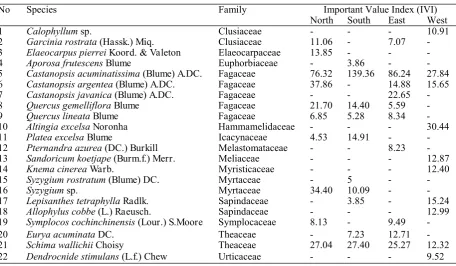
In total within four transects (8 hectares) there were 180 tree and sapling species, belonging to 105 genera and 51 families. The species richness of trees was various within each transect. Table 1. shows ten principal tree species on the four slopes of Mount Endut based on their Importance Values.
Based on the Importance Value Index (IVI), the community types in the study area were
Castanopsis acuminatissima–C. argentea (North slope), Castanopsis acuminatissima–Schima wallichii (South slope), Castanopsis acuminatissima–Schima wallichii (East slope), and Altingia excelsa–Castanopsisacuminatissima
Fig. 1. Map of research location, Gunung Halimun Salak National Park (TNGHS, 2007).
⁰36’‒ ⁰39’
⁰20’‒ ⁰23’
‒ 2,873 6,526
REINWARDTIA
42 [VOL.17
community (West slope), respectively. Species richness and heterogeneity of tree species on the North, South, East, and West slopes are reflected by their frequency class and total of species as presented in Fig. 2.
At North slope, the species richness and heterogeneity of tree species were high, as showed by the frequency class distribution, i.e., as many as 80.35 % of the species have frequency ≤ 10 %. It indicated that although Castanopsis acuminatissima was very dominant, other species still can grow with relatively small values of frequency, density, and basal area. This means that C. acuminatissima tends not to halt the growth of other tree species. Species richness and heterogeneity of the tree species on the South slope were classified as high, as shown by the frequency class distribution, i.e., 95.34 % of the species have frequency ≤ 10 %. Similarly, those of the East slope and West slope were classified as high, as indicated by the distribution of the frequency class, i.e. 86.44 % species and 81.34 % species, respectively had frequency ≤ 10 %.
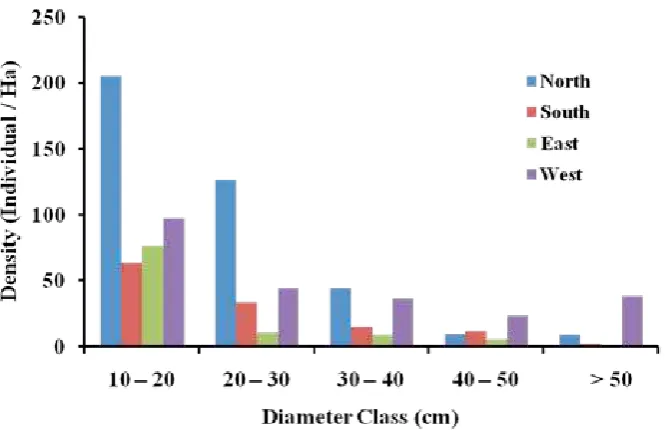
Diameter class distribution of trees on the North, South, East, and West slopes of Mount Endut is presented in Fig. 3. The majority of the trees (84.55 %) on the North slope of Mount Endut had diameter relatively small (dbh < 30 cm), only about 1.93 % of them had diameter > 50 cm (Fig. 3). In general, the number of tree individuals showed a decrease with increasing tree diameter class. Species diversity of trees on the North slope of Mount Endut was moderate i.e.
H’=2.77. The same result was seen from the
Menhinick richness index of 2.0 (i.e. smaller than 3).
The majority of the trees (77.33 %) on the South slope of Mount Endut had relatively small diameter (dbh < 30 cm), only about 1.21 % of them had diameter > 50 cm. Species diversity of trees on the South slope of Mount Endut was moderate i.e. H’=2.44. The same case was for the Menhinick richness value i.e. 2.74 (smaller than 3). The majority of the trees (82.04 %) on the East slope had relatively small diameter (dbh < 30 cm), only about 2.30 % of them had diameter > 50 cm. Species diversity of the trees on the East slope of Mount Endut was categorized as high i.e.
H’=3.1 (Shannon diversity index > 3), but the
species richness was low as indicated by Menhinick richness value i.e. 2.85 (smaller than 3).
The majority of the trees ( 59.42 %) on the West slope of Mount Endut had relatively small diameters (dbh < 30 cm), but about 16.04 % had diameter > 50 cm. The species ‘rasamala’ (Altingia excelsa) had tree individuals with large diameters. Species diversity of trees on the West slope of Mount Endut was categorized as high i.e. H’=3.72 (Shannon diversity index > 3) and rich in species as showed by Menhinick richness value
i.e. 3.45 (higher than 3).
Fagaceae was the plant family which had highest Importance Values on all four slopes of Mount Endut, far above those of other families. Table 2. shows ten plant families having highest Importance Values at Mount Endut.
B. Saplings
In total within four transects (2 hectares), there were 155 sapling species, belonging to 99 genera Table 1. Principal tree species based on ImportantValue Index (IVI) on the four slopes of Mount Endut.
No Species Family Important Value Index (IVI)
North South East West
1 Calophyllum sp. Clusiaceae - - - 10.91
2 Garciniarostrata (Hassk.) Miq. Clusiaceae 11.06 - 7.07 -
3 Elaeocarpuspierrei Koord. & Valeton Elaeocarpaceae 13.85 - - -
4 Aporosafrutescens Blume Euphorbiaceae - 3.86 - -
5 Castanopsisacuminatissima (Blume) A.DC. Fagaceae 76.32 139.36 86.24 27.84
6 Castanopsisargentea (Blume) A.DC. Fagaceae 37.86 - 14.88 15.65
19 Symplocoscochinchinensis (Lour.) S.Moore Symplocaceae 8.13 - 9.49 -
20 Euryaacuminata DC. Theaceae - 7.23 12.71 -
21 Schimawallichii Choisy Theaceae 27.04 27.40 25.27 12.32
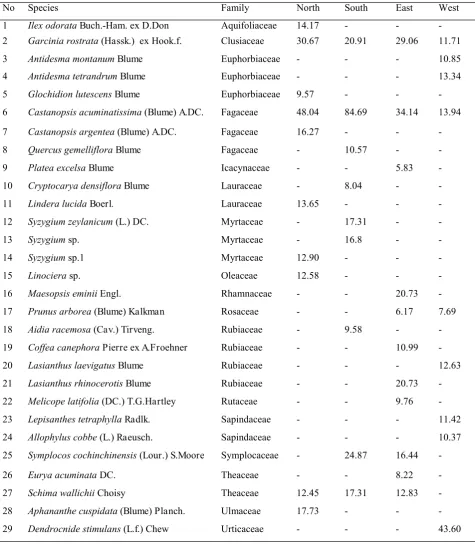
and 50 families. Table 3. shows ten principal sapling species based on their Importance Values.
Based on the Importance Value, the dominant sapling species on North slope were Castanopsis acuminatissima, Garcinia rostrata, Aphananthe cuspidata, C.argentea, and Ilexodorata. From 61
sapling species recorded, Castanopsis
acuminatissima, Garcinia rostrata, C. argentea
and Schima wallichii were important species at tree stage. This means that these four species will become important species in the future. The dominant sapling species based on the Importance Values on the South slope were Castanopsis
acuminatissima, Garcinia rostrata, Syzygium zeylanicum, Schima wallichii, and Syzygium sp. From 64 sapling species recorded, Castanopsis acuminatissima and Schima wallichii were important species at tree stage. This indicates that those two species will become important species in the future. The dominant sapling species based on the Importance Value on East slope were
Castanopsis acuminatissima, Garcinia rostrata,
Maesopsiseminii, Symplocoscochinchinensis, and
Schima wallichii. From 86 sapling species recorded, Castanopsisacuminatissima, Symplocos cochinchinensis, Schima wallichii and Eurya
Fig. 2. Tree species distribution based upon the frequency class on the transects of four different slopes of Mount Endut.
Fig. 3. Diameter class distribution of trees on the four slopes of Mount Endut. ≤ 10 %.
≤ 10 %.
≤ 10 %.
’=2.77.
’=2.44.
’=3.1
‘ ’ (
R
E
INW
AR
DT
IA
44
[VOL
.1
7
Table 2. Family Importance Values (FIV) of ten principal families at tree stage for each of the research transects at Mount Endut.
No Family North South East West
No. Spec
Ind./ ha
BA (cm2/ha)
FIV No.
Spec
Ind./ ha
BA (cm2/ha)
FIV No.
Spec Ind./
ha
BA (cm2/ha)
FIV No.
Spec
Ind./ ha
BA (cm2/ha)
FIV
1 Clusiaceae 4 18 3.02 12.18 1 1 95.5 1.25 1 6 1.05 7.07 4 13 12.37 15.55
2 Elaeocarpaceae 1 22 4.84 13.85 1 1 245 2.59 1 2 387 2.02 1 3 1.6 3.53
3 Euphorbiaceae 6 10 1.36 6.96 4 4 1.01 9.29 5 5 1.45 6.9 8 24 16.81 26.02
4 Fagaceae 8 177 118.4 147.91 4 71 43.78 161.55 7 97 66.33 142.21 9 63 67.31 74.07
5 Hammamelidaceae 1 2 1.03 1.71 1 1 640 3.21 1 1 530 1.61 1 15 48.04 30.44
6 Icacynaceae 2 7 1.19 4.89 1 5 2.48 14.91 2 3 750 3.47 1 5 1.37 4.90
7 Lauraceae 7 16 3.19 11.66 4 3 1.28 6.83 10 16 5.02 20.93 4 12 7.66 13.52
8 Melastomataceae 2 5 730 3.52 3 2 670 5.45 3 7 2.66 9.7 1 3 273 1.98
9 Meliaceae 2 3 900 1.96 0 0 0 0 0 0 0 0 1 9 2.63 12.87
10 Myristicaceae 2 6 1.42 4.77 1 1 138.5 1.32 2 4 1.94 5.94 3 13 10.79 15.97
11 Myrsinaceae 0 0 0 0 1 2 560 4.58 1 2 197.5 1.84 1 1 247 1.07
12 Myrtaceae 3 54 17.11 36.61 2 6 1.64 15.09 3 5 3.16 7.65 4 10 15.53 15.16
13 Rosaceae 0 0 0 0 2 1 540 3.06 1 5 940 5.55 1 2 279 1.56
14 Rubiaceae 4 6 1.38 5.01 2 1 165 2.46 2 6 980 5.41 1 3 1.55 3.03
15 Sapindaceae 2 2 3.98 3.27 1 2 348 3.85 1 1 121 0.67 3 18 33.46 29.38
16 Symplocaceae 1 12 3.42 8.13 2 3 1.22 6.72 1 7 3.37 9.49 1 2 940 2.31
17 Theaceae 3 42 9.42 28.12 3 15 5.4 35.96 3 30 12.41 40.78 3 15 1267 17.82
acuminata were important at tree stage. This shows those four species will be important species in the future. The excotic species, Maesopsis eminii, was planted for greening before this area was included in the National Park. This species was distributed by wildlife (birds and primates), therefore its distribution must be prevented. Based on the important value, the dominant sapling species on West slope were Dendrocnide
stimulans, Castanopsisacuminatissima, Antidesma tetandrum, Lasianthus laevigatus, and Garcinia rostrata. From 75 sapling species recorded,
Castanopsis acuminatissima and Lepisanthes tetraphylla were important species at tree stage. This indicates that those two will become as important species in the future. Dendrocnide stimulans which was abundant is predicted to decrease in number at tree stage.
No Species Family North South East West
1 Ilexodorata Buch.-Ham. ex D.Don Aquifoliaceae 14.17 - - -
2 Garciniarostrata (Hassk.) ex Hook.f. Clusiaceae 30.67 20.91 29.06 11.71
3 Antidesmamontanum Blume Euphorbiaceae - - - 10.85
4 Antidesmatetrandrum Blume Euphorbiaceae - - - 13.34
5 Glochidionlutescens Blume Euphorbiaceae 9.57 - - -
6 Castanopsisacuminatissima (Blume) A.DC. Fagaceae 48.04 84.69 34.14 13.94
7 Castanopsisargentea (Blume) A.DC. Fagaceae 16.27 - - -
8 Quercusgemelliflora Blume Fagaceae - 10.57 - -
9 Plateaexcelsa Blume Icacynaceae - - 5.83 -
10 Cryptocaryadensiflora Blume Lauraceae - 8.04 - -
11 Lindera lucida Boerl. Lauraceae 13.65 - - -
12 Syzygiumzeylanicum (L.) DC. Myrtaceae - 17.31 - -
13 Syzygium sp. Myrtaceae - 16.8 - -
14 Syzygium sp.1 Myrtaceae 12.90 - - -
15 Linociera sp. Oleaceae 12.58 - - -
16 Maesopsiseminii Engl. Rhamnaceae - - 20.73 -
17 Prunusarborea (Blume) Kalkman Rosaceae - - 6.17 7.69
18 Aidiaracemosa (Cav.) Tirveng. Rubiaceae - 9.58 - -
19 Coffeacanephora Pierre ex A.Froehner Rubiaceae - - 10.99 -
20 Lasianthuslaevigatus Blume Rubiaceae - - - 12.63
21 Lasianthusrhinocerotis Blume Rubiaceae - - 20.73 -
22 Melicopelatifolia (DC.) T.G.Hartley Rutaceae - - 9.76 -
23 Lepisanthestetraphylla Radlk. Sapindaceae - - - 11.42
24 Allophyluscobbe (L.) Raeusch. Sapindaceae - - - 10.37
25 Symplocoscochinchinensis (Lour.) S.Moore Symplocaceae - 24.87 16.44 -
26 Euryaacuminata DC. Theaceae - - 8.22 -
27 Schimawallichii Choisy Theaceae 12.45 17.31 12.83 -
28 Aphananthecuspidata (Blume) Planch. Ulmaceae 17.73 - - -
29 Dendrocnidestimulans (L.f.) Chew Urticaceae - - - 43.60
REINWARDTIA
46 [VOL.17
C. Seedlings
In two hundred sub-plots of 2 m×2 m (total area of 800 m² or 0.08 ha) located on the four slopes (North, South, East, and West), we recorded 90 seedling species belonging to 71 genera and 37 families; 88 seedling species belonged to 71 genera and 40 families; 86 seedling species from 65 genera and 35 families; and 76 seedling species of 61 genera and 37 families. Table 4. presents ten principal seedling species in the four slopes of Mount Endut based on their Importance Values.
Based on Important Values, main seedling species on North slope were Cyathea contaminans,
Ophiorrhiza marginata, and Castanopsis
acuminatissima. Those on the South slope were
Pinanga coronata, Ophiorrhiza marginata, and
Cyathea contaminans. The main seedling species on East slope were Cyathea contaminans,
Castanopsis acuminatissima, and Garcinia rostrata. Those of the West slope were
Ophiorrhiza marginata, Dendrocnide stimulans, and Pinanga coronata. In addition, from the four transects established in Mount Endut, 58 herb species have been identified belonging to 48 genera and 35 families. Dominant species of the herbs were Calamus sp., Clidemia hirta,
Dicranopteris linearis, Freycinetia angustifolia,
Etlingeracoccinea, and Musaacuminata.
Table 4. Ten principal seedling species based on Importance Value of each research transect at Mount Endut.
No Species Family North South East West
1 Goniothalamusmacrophyllus (Blume) Hook.f. & Thomson
Annonaceae - - - 4.28
2 Polysciasnodosa (Blume) Seem. Araliaceae - - - 12.49
3 Caryotamitis Lour. Arecaceae - - - 5.24
4 Pinangacoronata (Blume ex Mart.) Blume Arecaceae 6.72 12.68 - 14.93
5 Radermacheragigantea (Blume) Miq. Bignoniaceae - 6.54 - -
6 Garciniarostrata (Hassk.) Miq. Clusiaceae 5.36 6.64 8.36 -
7 Cyatheacontaminans (Wall. ex Hook.) Copel. Cyatheaceae 33.10 10.04 49.96 -
8 Glochidionrubrum Blume Euphorbiaceae - - 3.57 -
9 Castanopsisacuminatissima (Blume) A.DC. Fagaceae 7.58 6.29 9.48 -
10 Melastomamalabathricum L. Melastomataceae 7.22 - 8.29 -
11 Ficusglandulifera (Wall. ex Miq.) King Moraceae - - - 6.21
12 Ardisia sp. Myrsinaceae 4.67 - 3.51 -
13 Rapaneahasseltii (Blume ex Scheff.) Mez Myrsinaceae - 4.79 5.14 -
14 Chassaliablumeana Govaerts Rubiaceae - 4.88 - -
15 Lasianthusrhinocerotis Blume Rubiaceae - - 5.76 -
16 Ophiorrhizamarginata Blume Rubiaceae 11.90 11.76 7.56 20.77
17 Psychotriaviridiflora Reinw. ex Blume Rubiaceae 4.51 - 6.55 -
18 Urophyllumstrigosum (Blume) Korth. Rubiaceae - 5.17 - -
19 Melicopelatifolia (DC.) T.G.Hartley Rutaceae 4.14 - - -
20 Lepisanthestetraphylla Radlk. Sapindaceae - - - 6.12
21 Sterculiacoccinea Roxb. Sterculiaceae - - - 4.53
22 Schimawallichii Choisy Theaceae - 6.15 - -
23 Gironnierasubaequalis Planch. Ulmaceae 4.63 - - -
24 Dendrocnidestimulans (L.f.) Chew Urticaceae - - - 17.60
D. Soil
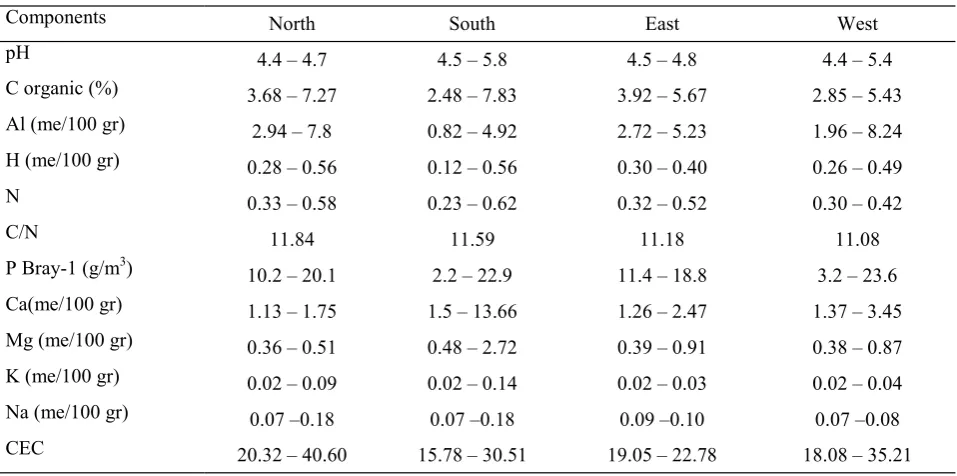
Soil properties on the North, South, East, and West slopes of Mount Endut is presented in Table 5.
Soil on the transect established on the North, South, East, and West slopes of Mount Endut was acid. The C organic and N total contents on all four slopes of Mount Endut tend to get lower towards lower elevation, while that of East slope tends to get higher towards lower elevation. The Al and H contents on the North, East, and West slopes tend to get higher towards lower elevation, while that of South slope tends to vary towards lower elevation. The C/N ratios on the North, South, East, and West slopes were low to moderate.
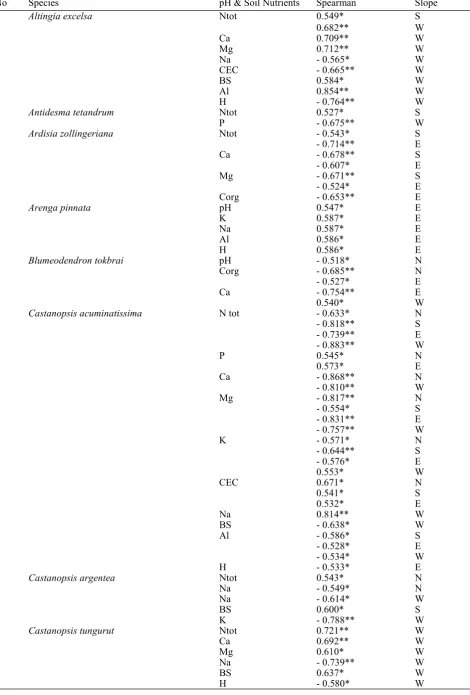
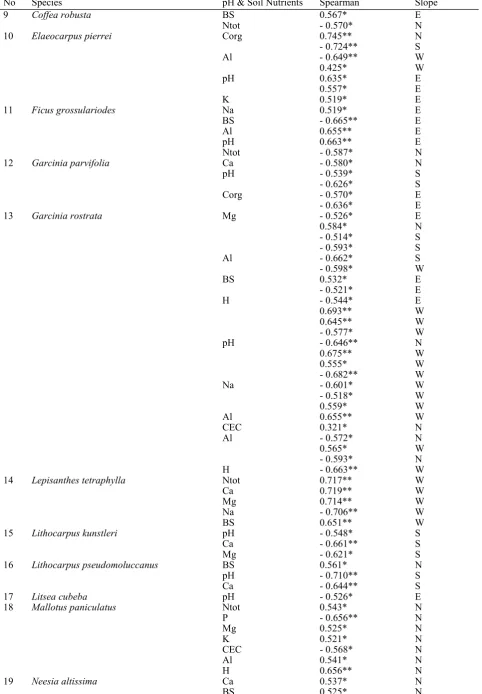
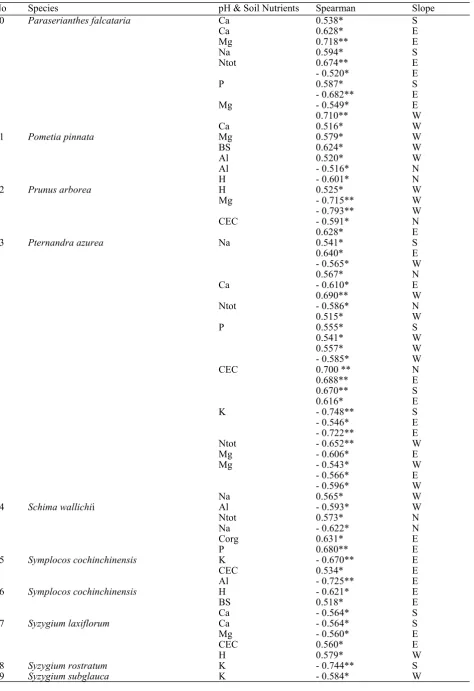
The P, Ca, Mg, K, and Na contents on the North, South, East, and West slopes of Mount Endut all varied with elevation. The cation exchange capacity (CEC) on the North and West was moderate to high. While those of South and East were low to moderate and moderate, respec-tively. Correlation prevalence between tree species and soil nutrients on each transect using Spearman rank correlation test is shown in Table 6.
At North slope, 8 species had correlation with N -tot, 5 species with CEC, 3 species each with Ca, Na, Al, and H; and, 2 species each with pH, C-org, P, Mg, K, and BS. While at South slope, 5 species each had correlation with N-tot, Ca, and K, 3 species each with pH, P, Mg, and Al; 2 species with Na, and 1 species each with CEC and BS. At East slope, 8 species had correlation with Mg, 6 species with CEC, and 5 species each with pH, N-tot, Ca, K, Al, and H; 4 species with C-org, 3 species with P and BS, and 2 species with Na.
Then at West slope, 10 species had correlation with N-tot and Na, 9 species with Ca, 8 species with Mg and BS; 7 species with Al, 5 species with H, 4 species with K and CEC, and 1 species with P.
Tree densities in two hectares on North, South, East, and West slopes were 783, 247, 428 and 474, or ranging of 124 – 392 trees/ha. In general, those tree densities were relatively low. The transect located on South slope at a distance about 1,300‒2,000 m from the peak of Mount Endut was the water stream, so that the trees were not dense.
Sapling densities in 0.5 ha on North, South, East, and West slopes were 592, 790, 523 and 692 or at range of 1,046‒1,580 saplings/ha. The transect located on East slope about 1,000‒2,000 m from the peak of Mount Endut passed a shifting cultivation area and bamboo garden, resulting in decreased sapling number.
Basal area of trees in two hectares on North, South, East, and West slopes were 34.88 m2, 12.68 m2, 21.04 m2 and 51.78 m2 ranging from 6.34‒25.89 m2 per hectare. On West slope, although having less trees than North slope, they have a bigger basal area. This was due to higher diameter trees growing on West slope, such as
Altingia excelsa. Basal area of saplings in 0.5 ha on North, South, East, and West slopes were 1.27 m2, 1.63 m2, 0.68 m2 and 1.49 m2 ranging from 1.36‒3.26 m2 per ha. South slope had highest basal area due to having more individual trees compared to the other slopes.
Crown cover areas of seedlings in 800 m² on North, South, East, and West slopes were 220.48 m²; 269.96 m²; 290.64 m² and 252.36 m². East slope of Mount Endut had the highest seedling
Table 5. Soil properties of Mount Endut.
REINWARDTIA
48 [VOL.17
Table 6. Significance values of the Spearman Test Statistic between Tree Species and Soil Nutrients
No Species pH & Soil Nutrients Spearman Slope
No Species pH & Soil Nutrients Spearman Slope
14 Lepisanthes tetraphylla Ntot 0.717** W
Ca 0.719** W
16 Lithocarpus pseudomoluccanus BS 0.561* N
pH - 0.710** S
REINWARDTIA
50 [VOL.17
No Species pH & Soil Nutrients Spearman Slope
20 Paraserianthes falcataria Ca 0.538* S
Ca 0.628* E
Notes : ** significant at P<0.01 (very significant); * significant at P<0.05 ; ns = non significant
crown cover area. This is assumed to be due to having morning sunlight energy which plays an important role in photosynthesis.
DISCUSSION
Generally speaking the largest number of individual trees were in the small diameter class and decreased with the increase of the diameter class size. According to Ogawa et al. (1965) and Proctor et al. (1983) this is a common phenomenon that is also frequently found in tropical forests that experience dynamic change. Castanopsis acuminatissima was the most dominant species because it had the highest frequency, density and basal area values compared to other species. Castanopsis acuminatissima is the most prevalent tree species in the Citorek forest area, formerly Gunung Halimun National Park, having highest absolute numbers in density, frequency, and basal area (Mirmanto & Simbolon, 1998). Castanopsis acuminatissima was the most important tree species on most transects and showed many significant correlations with soil nutrient variables; positively correlations with P and CEC in North, East, South (CEC only) slopes, and with K and Na in West slope (Table 6.). Table 6. also shows that
Arenga pinnata and Pometia pinnata had positive correlations with all soil nutrients they interacted.
Schima wallichii was another dominant species in the research area. From several studies conducted in the forests of West Java, S. wallichii
is the most common tree found in mountain areas (Yamada, 1975; Siregar et al., 1997). Schima wallichii was found in some mountain wet tropical rainforests in sub mountain zones such as Mount Kerinci, Sumatera (Ohsawa et al., 1985) and in Mount Kinabalu, Malaysia (Kitayama, 1992) as an important component. At tree stage, S. wallichii
had positive correlations with CEC, P, CEC and P, and Na in North, South, East, and West slopes respectively.
According to Miyamoto et al. (2003), plant communities exhibited through their structure and composition a very close interconnection with their habitat, where ecological habitat terms refers to all the physical and chemical factors that influence the plant community. Discovery of associations between species distribution with various variations of soil (edaphics) and topo-graphy is one of the most important keys in under-standing the characteristics of tropical rainforests.
The dominant sapling species were a mixture of native species such as C. acuminatissima and cultivated plants such as Coffea canephora var.
robusta. This is due to the availability of native species from mature trees and community interest in coffee crops. The existence of Maesopsis eminii
which is an exotic and invasive species especially on the East slope needs to be controlled, although it does not seem to interfere with the regeneration
of native plants. This is a pioneer species, quick to germinate (orthodox seeds) and the seedling is shade tolerant.
The dominant seedling species were more diverse than saplings. This is allegedly due to the competition of space and light between the secondary and primary species which were occurring naturally, along with the planting of coffee seeds. The dominant herbs were represent-ed by herb pandans, taro, ginger and grass. The ginger species of Etlingera coccinea was mostly found on steep cliffs, while the grass species
Oplismenus compositus mainly occupied open land and occurred near community gardens.
One of the characteristics of soil in sub mountains and mountains is the acid soil proper-ties (Kappelle, 2004). The acidity of the soil will increase with increasing elevation. This is consistent with the conditions in the study area, where the pH was relatively low with variations between 5.4‒5.8 (in low areas) and 4.4‒4.8 (at mountain tops). Compared to wet tropical lowlands, this area is covered by clouds and the air humidity is much higher. Evapotranspiration reduces very sharply and so does the temperature. This condition causes the process of decomposition of organic material to be slow so that organic materials build up in the soil and cause acidic conditions (Veneklaas, 1991).
The amount of element phosphorus in the research area was very low i.e. < 15 g/m3. The low amount of P in the study area is considered to be an obstacle in the development and growth of forests in the future. The very low availability of P is an obstacle to most tropical rain forest ecosystems (Jordan, 1985). However, in an ecosystem highly deficient in soil P, the soil P will play a significant role in determining net primary productivity and weathering of organic matter either directly or through interaction with N elements (Kitayama et al.,2000).
REINWARDTIA
52 [VOL.17
cadres and communities around the area of Mount Endut.
CONCLUSIONS
North, South, East and West slopes of Mount Endut, Gunung Halimun Salak National Park were
occupied by Castanopsis acuminatissima – C.
argentea, C. acuminatissima – Schima wallichii, and A ltingia excelsa – C. acuminatissima
communities, respectively. C. acuminatissima and
S. wallichii were two most important tree species on most transects and showed many positive correlations with soil nutrients.
Principal sapling species on the four slopes of
Mount Endut were Castanopsis acuminatissima,
Garcinia rostrata, Schima wallichii, Symplocos cochinchinensis and Prunus arborea. With regard to seedlings, the dominant species were Cyathea contaminans, Pinanga coronata, Castanopsis
acuminatissima, Garcinia rostrata, and
Ophiorrhiza marginata.
Plant species diversity at the Mount Endut region was relatively low especially on the North slope. Tree density in the whole of this region was also relatively low. This might be caused by illegal logging and encroachment by cultivation.
The soil of Mount Endut was generally acid. The C/N ratio was low to moderate. The cation exchange capacity ranged from low to moderate and moderate to high. The C organic and N total contents (the case of East slope) tended to get
research field assistants for their contribution to the finishing of this manuscript. We also
COX, G. W. 2002. General Ecology Laboratory
manual. 8th Ed. McGraw-Hill, New York.
HAKIM, N. 2016. Pengelolaan Penggunaan
Lahan di Kawasan Taman Nasional Gunung Halimun Salak, Kabupaten Lebak. Institut Per-tanian Bogor, Bogor. [MSc. Thesis].
HARAHAP, S. A., FAIZIN, N., RACHMADI, R.,
EFENDI, T. & JHONI. 2005. Laporan
Eksplorasi Macan (Panthera pardus Melas) di Wilayah Barat TNGHS (Gunung Barang,
Gunung Endut dan Gunung Tenggek). GHSNP. MP-JICA. Bogor.
JORDAN, C. F. 1985. Nutrient Cycling in
Tropi-cal ecosystems. John Wiley & Sons, New York, Toronto, Singapore.
KAPPELLE, M. 2004. Tropical Mountain Forest.
Regional Forest Type. Elsevier Ltd.,
phophorus use efficiencies of tropical
Rainforests along altitudinal gradients of Mount Kinabalu, Borneo. Oecologia 123: 342–349.
KUSMANA, C. 2017. Metode Survey dan
Interpretasi Data Vegetasi. IPB Press. Bogor. Pp. 33–47.
MIRMANTO, E. 2014. Natural regeneration in Cidahu resort forest area, Gunung Halimun
Salak National Park, West Java. Buletin Kebun
Raya 17 (2): 91–100. Indonesia. Vol. IV. Gunung Halimun: The Last Submontane Tropical Forest in West Java. A
depth and topography in a tropical heath forest of Central Kalimantan, Indonesia. Journal of Tropical Ecology 19: 43–54.
OGAWA, H., YODA, K., OGINO, K., SHIDEI, T., RATANAWONGSE, D. & APASUTAYA, C. 1965. Comparative ecological study on three main types of forest vegetation in Thai-land. I. Structure and floristic composition.
Nature and life in S. E. Asia 4: 13–48.
OHSAWA, M., NAINGGOLAN, P. H. J.,
TANAKA, N. & ANWAR, C. 1985.
Altitudinal zonation of forest vegetation on Mount Kerinci, Sumatera with comparisons to zonation in temperate region of East Asia. Journal of Tropical Ecology 1: 193–216. POLOSAKAN, R. & ALHAMD, L. 2012.
Keanekaragaman dan komposisi jenis pohon di hutan Pameungpeuk Taman Nasional Gunung
Halimun Salak, Kabupaten Sukabumi. Jurnal
Teknologi Lingkungan. Edisi Khusus ”Hari Bumi”. BPPT. Jakarta. Pp. 53–59.
PROCTOR, J., ANDERSON, J. M., CHAI, P. & VALLACK, H. W. 1983. Ecological studies in four contrasting lowland rain forests in Gunung
Mulu National Park, Sarawak. I. Forest environment, structure and floristics. Journal of Ecology 71: 237–260.
RINALDI, D., HARAHAP, S. A., PRAWIRADI-LAGA, D. M., SAMBAS, E., WIRIADINATA, H., PURWANINGSIH, FEBRIANA, I., WIDYANINGRUM, I. K. & FAIZIN, N. 2008. Ekologi Koridor Halimun‒Salak, Taman Nasio-nal Gunung Halimun Salak. GHSNP. MP-JICA. Bogor.
SAMBAS, E. N. 2012. Klasifikasi vegetasi Gunung Endut, Taman Nasional Gunung Halimun Salak, Banten. Institut Pertanian Bogor, Bogor. [PhD. Dissertation].
SAMBAS, E. N., KUSMANA, C., PRASETYO, L. B. & PARTOMIHARDJO, T. 2011. Klasifikasi vegetasi Gunung Endut, Taman Nasional Gunung Halimun Salak, Banten.
Berita Biologi 10(5) : 597–604.
SAMBAS, E. N., KUSMANA, C., PRASETYO, L. B. & PARTOMIHARDJO, T. 2013. Pre-ferensi ekologis jenis-jenis tumbuhan dominan di Gunung Endut, Banten. Jurnal Biologi Indonesia 9(2): 209–218.
SIREGAR, M., SAMBAS, E. N., MIRMANTO, E. & RISWAN, S. 1997. Fitososiologi hutan di daerah hulu aliran Sungai Ciapus, Jawa Barat. In: WARDHANA, W. et al. (Eds.). Prosiding Seminar Biologi XIV & Kongres Nasional Biologi XI: 449‒462.
[TNGHS] TAMAN NASIONAL GUNUNG HALIMUN SALAK. 2007. Rencana Penge-lolaan Taman Nasional Gunung Halimun Salak Periode 2007‒2026. GHSNP Management Project. Sukabumi, Jawa Barat.
VENEKLAAS, E. J. 1991. Litterfall and nutrient fluxes in two montane rain forests, Columbia.
Journal of Tropical Ecology 7: 319–336. WIHARTO, M. 2009. Klasifikasi Vegetasi Zona
Sub Pegunungan Gunung Salak, Bogor, Jawa Barat. Institut Pertanian Bogor, Bogor [PhD. Dissertation].
YAMADA, I. 1975. Forest ecological studies of the montane forest of Mt. Pangrango, West Java. I. Stratification and floristic composition of the montane rain forest near Cibodas. Tonan
REINWARDTIA
INSTRUCTION TO AUTHORS
Scope. Reinwardtia is a scientific regular journal on plant taxonomy, plant ecology and ethnobotany published in June and December. Manuscript intended for a publication should be written in English.
Titles. Titles should be brief, informative and followed by author’s name and mailing address in one-paragraphed.
Abstract. English abstract followed by Indonesian abstract of not more than 250 words. Keywords should be given below each abstract.
Manuscript. Manuscript is original paper and represent an article which has not been published in any other journal or proceedings. The manuscript of no more than 36 pages by using Times New Roman 11, MS Word for Windows of A4 with double spacing, submitted to the editor through <[email protected]>. New paragraph should be indented in by 5 characters. For the style of presentation, authors should follow the latest issue of Reinwardtia very closely. Author(s) should send the preferred running title of the article submitted. Every manuscript will be sent to two blind reviewers.
Identification key. Taxonomic identification key should be prepared using the aligned couplet type. Nomenclature. Strict adherence to the International Code of Nomenclature is observed, so that taxonomic and nomenclatural novelties should be clearly shown. English description for new taxon proposed should be provided and the herbaria where the type specimens area deposited should be presented. Name of
taxon in taxonomic treatment should be presented in the long form that is name of taxon, author’s name, year
of publication, abbreviated journal or book title, volume, number and page.
Map/line drawing illustration/photograph. Map, line drawing illustration, or photograph preferably should be prepared in landscape presentation to occupy two columns. Illustration must be submitted as original art accompanying, but separated from the manuscript. The illustration should be saved in JPG or GIF format at least 350 pixels. Legends or illustration must be submitted separately at the end of the manuscript. References. Bibliography, list of literature cited or references follow the Harvard system as the following examples.
Journal : KRAENZLIN, F. 1913. Cyrtandraceae novae Philippinenses I. Philipp. J. Sci. 8: 163–179.
MAYER, V., MOLLER, M., PERRET, M. & WEBER, A. 2003. Phylogenetic position and generic differentiation of Epithemateae (Gesneriaceae) inferred from plastid DNA sequence data. American J. Bot. 90: 321–329.
Proceedings : TEMU, S. T. 1995. Peranan tumbuhan dan ternak dalam upacara adat “Djoka Dju” pada suku Lio, Ende, Flores, Nusa Tenggara Timur. In: NASUTION, E. (Ed.). Prosiding Seminar dan Lokakarya Nasional Etnobotani II. LIPI & Perpustakaan Nasional: 263–268. (In Indonesian).
SIMBOLON, H. & MIRMANTO, E. 2000. Checklist of plant species in the peat swamp forests of Central Kalimantan, Indonesia. In: IWAKUMA, T. et al. (Eds.) Proceedings of the International Symposium on: Tropical Peatlands. Pp.179 ‒
190.
Book : RIDLEY, H. N. 1923. Flora of the Malay Peninsula 2. L. Reeve & Co. Ltd, London.
Part of Book : BENTHAM, G. 1876. Gesneriaceae. In: BENTHAM, G. & HOOKER, J. D. Genera Plantarum 2. Lovell Reeve & Co., London. Pp. 990–1025.
Thesis : BAIRD, L. 2002. A Grammar of Kéo: An Austronesian language of East Nusantara.
Australian National University, Canberra. [PhD. Thesis].
Website : http://www.nationaalherbarium.nl/fmcollectors/k/KostermansAJGH.html. (Accessed 15 February 2012).
REINWARDTIA
Author Agreement Form
Title of article :
Name of Author(s) :
I/We hereby declare that:
My/Our manuscript was based on my/our original work.
It was not published or submitted to other journal for publication.
I/we agree to publish my/our manuscript and the copyright of this article is owned by Reinwardtia.
We have obtained written permission from copyright owners for any excerpts from copyrighted
works that are included and have credited the sources in our article.
Author signature (s) Date
___________________________________________________________________________________________ Name
Reinwardtia
Published by Herbarium Bogoriense, Botany Division, Research Center for Biology, Indonesian Institute of Sciences
Address: Jln. Raya Jakarta-Bogor Km. 46 Cibinong 16911, P.O. Box 25 Cibinong
REINWARDTIA
Vol. 17. No. 1. 2018
CONTENTSPage
J. F. VELDKAMP. A revision of Isachne in Malesia 2: Sect. Albentes (Gramineae, Isachneae) …………..……….. 1 I PUTU GEDE P. DAMAYANTO. Dinochloa malayana S. Dransf. (Poaceae: Bambusoideae), a new record for
Indonesia .………...……….………...…… 35
EDY NASRIADI SAMBAS, CECEP KUSMANA, LILIK BUDI PRASETYO & TUKIRIN PARTOMIHARDJO. Vegetation analysis and population structure of plants at Mount Endut forested area, Gunung Halimun Salak National
Park, Banten, Java, Indonesia ……….……. 39
IAN M. TURNER. A new combination in Pseuderanthemum (Acanthaceae) .……… 55
YENI RAHAYU, TATIK CHIKMAWATI & ELIZABETH A. WIDJAJA. Nomenclatural study of Tetrastigma leucostaphylum and Tetrastigma rafflesiae (Vitaceae): two common hosts of Rafflesia in Sumatra ………... 59
WAWAN SUJARWO. Bamboo resources, cultural values, and ex-situ conservation in Bali, Indonesia …....………. 67 KHOON MENG WONG & RIDHA MAHYUNI. Flora of Singapore Precursors, 2. A new species and two new
combi-nations in Psydrax (Rubiaceae: Vanguerieae) for West Malesia .……….……… 77
ERRATUM REINWARDTIA Vol. 16(2), 2017 .……….……… 85
Reinwardtia is a LIPI accredited Journal (792/AU3/P2MI-LIPI/04/2016)
http://e-journal.biologi.lipi.go.id/index.php/reinwardtia
Herbarium Bogoriense Botany Division
Research Center for Biology –Indonesian Institute of Sciences Cibinong Science Center