A JOURNAL ON TAXONOMIC BOTANY,
PLANT SOCIOLOGY AND ECOLOGY
REINWARDTIA
A JOURNAL ON TAXONOMIC BOTANY, PLANT SOCIOLOGY AND ECOLOGY
Vol. 12(2): 129-204.22 November 2004
Editors
ELIZABETH A. WIDJAJA, MIEN A. RIFAI, SOEDARSONO RISWAN, JOHANIS P. MOGEA
Correspondence and subscriptions of the journal should be addressed to
REINWARDTIA Vol 12, Part 2, pp: 129 – 133
KEDROSTIS MEDIK. (CUCURBITACEAE) IN ASIA
W.J.J.O. DE WILDE & BRIGITTA E.E. DUYFJES
Nationaal Herbarium Netherlands, Leiden University Branch, Leiden, Netherlands
ABSTRACT
DE WILDE, W.J.J.O. & DUYFJES, BRIGITTA E.E. 2004. Kedrostis Medik. in Asia. Reinwardtia 12(2):129 – 133. — Kedrostis (Cucurbitaceae) occurs in Africa and Madagascar and comprises 4 (5) species in Asia. Of these 2 species are found in India and Sri Lanka and 2 (3) species in western Malesia. One Malesian species is for the first time included in Kedrostis here, Kedrostis bennettii (Miq.) W.J. de Wilde & Duyfjes, and one species is described as new here, Kedrostis hirta W.J. de Wilde & Duyfjes. One more Malesian species is insufficiently known to be formally described.
Keywords:Kedrostis, Cucurbitaceae, SE Asia, taxonomy
ABSTRAK
DE WILDE, W.J.J.O. & DUYFJES, BRIGITTA E.E. 2004. Kedrostis Medik. di Asia. Reinwardtia 12(2):129 – 133. — Kedrostis (Cucurbitaceae) ada di Afrika dan Madagaskar dan terdiri atas 4 (5) jenis ada di Asia. Dua jenis diantaranya ditemukan di India dan Sri Lanka dan 2 (3) jenis ada di Malesia bagian barat. Salah satu jenis dari Malesia yang pertama kali dimasukkan dalam Kedrostis, yaitu Kedrostis bennettii (Miq.) W.J. de Wilde & Duyfjes, dan satu jenis dipertelakan sebagai jenis baru disini, Kedrostis hirta W.J. de Wilde & Duyfjes. Satu jenis lagi dari Malesia yang belum cukup untuk dapat dipertelakan secara resmi.
Kata kunci: Kedrostis, Cucurbitaceae, Asia Tenggara, taksonomi
INTRODUCTION
Kedrostis Medik. is an Old World genus occurring in Africa and Madagascar with c. 20 species and in SE Asia with 5 species. In Asia the distribution is restricted to two separate areas: 2 species (of which K. foetidissima also in Africa) in S India and Sri Lanka and 3 (including one insufficiently known and not formally described species from Peninsular Malaysia) in West Malesia. The genus is notably absent from northern India, China and Indochina. The three West Malesian species are somewhat distinct from the Indian ones; they are stouter in habit, and in the widely distributed (but scattered) K. bennettii (Miq.) W.J. de Wilde & Duyfjes the male inflorescences may grow into long spikes with ebracteate persistent pedicels. In all three species the fruit contains only 1 (or 2) seeds (in other species [of Kedrostis] usually more). Kedrostis bennettiii is offensively smelling when crushed, similar as is known for the Indian K. foetidissima (Jacq.) Cogn.
Most of the older species were originally described in other genera, until Cogniaux (1881, 1916). Later noteworthy treatments redefining the genus are by Jeffrey (1967) for East Africa and Keraudren (1966) for Madagascar. As in many
more Cucurbitaceae, the material available for study is scanty and recent collections are often absent, the neglect possibly due to very local occurrence, destruction of habitat, short flowering period, and inconspicuous caducous flowers.
The notion that the Asian genus Cerasio-carpum is identical with Kedrostis (described from Africa) was brought forward by C. Jeffrey (1962). However, Kedrostis courtallensis (from India and Sri Lanka) and Cerasiocarpum bennettii (from West Malesia) were not regarded as specifically different at the time. Therefore, the combination Kedrostis bennettii (Miq.) W.J. de Wilde & Duyfjes is made on the present occasion.
Of all species concerned, complete material has been studied only for Malesia, and only for the widespread K. bennettii was it sufficient to allow for a full description.
The records of the occurrence of Kedrostis in New Guinea must be regarded as erroneous, as noted under K. bennettii.
KEDROSTIS Medik.
Kedrostis Medik. (1791) 69. — Type: S. Africa,
K. africana (L.) Cogn. (1881: 643).
Rhynchocarpa Endl. (1839) 936. — Type: Africa,
R. foetidissima (Jacq.) Walpers (1843: 197) [
130 REINWARDTIA [VOL.12
santhes foetidissima Jacq. (1789: 341); K. foetidissima
(Jacq.) Cogn. (1881: 634)].
Achmandra Arn. (1840) 49; (1841) 274 ( Aech-mandra); Wight (1842) 267. — Lectotype (Pfeiffer, 1873): S India, A. rostrata (Rottler) Arn. (1841: 274) [Bryonia rostrata Rottler (1803: 212) = K. foetidissima
(Jacq.) Cogn.].
Bryonopsis Arn. (1840) 49; (1841) 274. — Type: S India, B. courtallensis Arn. (1841: 274) [K. courtallensis (Arn.) C. Jeffrey (1962: 353)].
Cerasiocarpum Hook f. (1867) 832; Cogn. (1881) 728; (1919) 238. — Type: Sri Lanka, C. zeylanicum
(Thwaites) C.B. Clarke (1879: 629) [Aechmandra zeylanica Thwaites (1859: 125) = K. foetidissima
(Jacq.) Cogn.].
Herbaceous or woody climbers, (sub)-perennial, with or without rootstock or tubers; glabrous or hairy; monoecious or dioecious (not in Asia?). Leaves simple, subentire or (deeply) lobed; petiole long. Tendrils simple or 2-branched (not in Asia). Probract absent. Flowers yellow or whitish (not in Asia). Male flowers in short or long peduncled racemes. Pedicels short or long, without or with (not in Asia) small bract. Receptacle tube cup-shaped. Sepals 5, small. Petals 5, free or very shortly united (not in Asia), imbricate, glabrescent or short (glandular) hairy. Stamens 3 or 5 (not in Asia), inserted in or close to the mouth of the receptacle tube. Anthers when 3: two 2-thecous, one 1-thecous, when 5 then all 1-thecous; anthers with or without apically produced connective; thecae straight or little (much) curved. Filaments short. Disc minute, basal, unlobed, or carnose but not apparent because it is fused with the base of the receptacle tube. Female flowers single or in a short, few-flowered raceme, sometimes co-axillary with male raceme; perianth resembling male. Ovary ovoid, glabrous or hairy, 2- or 3- (or 4-) locular; ovules few; style distinct; stigma subglobose, consisting of 2 or 3 (or 4) papillose lobes. Staminodes absent or usually 3 or 5, inserted in the mouth of the tube. Disc absent or not apparent. Fruits solitary or few-fascicled, fleshy, glabrous or hairy, subglobose, ovoid or fusiform, rarely dehiscent (not in Asia). Seeds mostly few, tumid, usually smooth.
An Old World genus of c. 25 species, of which 4 (5) species in Asia; not in Australia.
KEY TO THE SPECIES
1. a. Plant usually markedly hairy. [Male raceme up to 10-flowered]. Connective of anthers produced dorsally upwards. Ovary hairy. Fruit ovoid,
rostrate. Seeds 5—7, pyriform, subcompressed. — Africa, S India, Sri Lanka.. 3. K. foetidissima
b. Plant subglabrous or with sparse appressed coarse hairs. Connective swollen but not much produced. Ovary (sub)glabrous. Fruit subglobose, not rostrate. Seeds (sub)globose, not or but little compressed…………...………..… 2 2. a. Male raceme (2--) 5—10-flowered. Stigma lobes
stalked. Seeds 2—6, subglobose, c. 5 mm diameter. — S. India, Sri Lanka….…. 2. K. courtallensis
b. Male raceme (incompletely known in K. hirta &
K. species) 10—40-flowered. Stigma lobes sessile. Seeds 1 or 2, globose, c. 7 mm dia-meter………..……….……… 3
b. Female flowers several in a short (branched) raceme. —Peninsular Malaysia…...5.K. species
1. Kedrostis bennettii (Miq.) W.J. de Wilde & Duyfjes, comb. nov.—Fig. 1.
Bryonopsis bennettii Miq. (1856) 657. —
Cerasiocarpum bennettii (Miq.) Cogn. (1881) 729; (1916) 239, p.p., excl. fig. 55 and material from India and Sri Lanka; Backer (1964) 298. —Type: Java,
Horsfield s.n.(holotype U; isotype K).
2004] DE WILDE & DUYFJES: Kedrostis Medik. In Asia 131
connective broad, ± swollen, split at base and apex to c. ¼ deep, apical lobes broadly rounded, thecae narrow, c. 1 mm long, vertical, straight, ± introrsely opening; disc (or pistillode) absent. Female flowers: 1—4 (sub)fascicled at the node; pedicel 2—5 mm long; ovary ovoid (-oblong), 3—4 by 2—3 mm, glabrous; perianth as in male; throat of receptacle tube densely hairy, hairs whitish, c. 0.5 mm long; staminodes 5, minute, c. 0.5 mm long or larger and broader, petal-like, 1(—1.5) mm long; style columnar, 2.5—3 by 0.5—0.7 mm, glabrous; stigma c. 2.5 mm diam., 2-lobed, lobes sessile, (± woolly) hairy, each shallowly 2 (or 3) lobed; ovary 2- (or 4?) locular, in basal part each locule with 1 ovule. Fruit globose or ± transversely ellipsoid, 1—1.2 by 1— 1.7 cm, shiny yellow, smooth, when dry pale brown, finely wrinkled, dull; fruiting pedicel 5— 10 mm long. Seeds 1 or 2, subglobose, 7—8 mm diam., greyish or brownish, faintly low-margined, smooth.
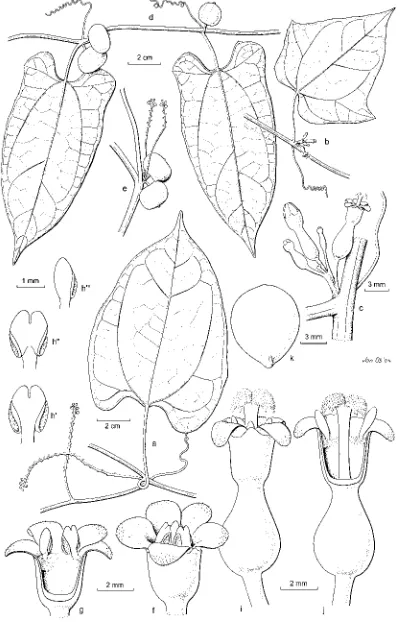
Fig. 1. Kedrostis bennettii (Miq.) W.J. de Wilde & Duyfjes. a. twig with male inflorescences; b. twig with female inflorescence; c. ditto, in detail; d. twig with fruits; e. twig with two male inflorescences and two fruits at the node; f. male flower; g. male flower, opened; h΄, h΄΄, h΄΄΄. anther, seen abaxially, adaxially, and laterally respectively; i. female flower; j. female flower, opened; k. seed.
DISTRIBUTION. West Malesia (see notes): Sumatra, W & C Java:, Borneo (Sabah, E Kalimantan), Sulawesi.
HABITAT & ECOLOGY. A rare species of scattered distribution on damp, rich soil, also known from near limestone; at altitudes (to 1400 m).
NOTES. The records for New Guinea, far away from the species-area in West Malesia, are doubtful. Warburg (1891: 444) mentioned as doubtful a sterile collection from mountainous areas in Papua New Guinea. The same specimen was cited by Schumann & Lauterbach (1900: 590) and by Cogniaux (1916: 239) with the addition of Schlechter 18623, and by Harms (1925: 153) with the additional specimens Ledermann 11855 and 12208b (flowers pale yellow, at high altitudes). We have not seen any of these specimens (probably lost), and the species seems not to have been collected any more in New Guinea. We suspect, however, that the specimens discussed belong to a different genus, possibly Zehneria.
SPECIMENS EXAMINED. Sumatra: Beccari 293, Padang; Forbes 2810, fr., Tandjong Nine; Korthals 30, 31, 1017, s.n. (Aug. 1878), all fr., all Ajer Mantjoer. Java: Amdjah 218, fr., Noesa Kambangan; Bakhuizen van den Brink 835, fr., Gunung Sadong; 1836, fr., Tjampea; 4074, fl., Gunung Pantjari; Beumée6606, fl., Depok; 6067, ♂, fr., Depok; Blume 32, ♂, without locality; Broeder J. D38042, fr., Purwokerto; Den Berger 389, fr., near Tjampea; Horsfield s.n.,
Banjoemas; Koorders 30745 fr., Tjampea; 44080, ♂, Depok; 47946, fr., Noesagedeh; 47947, Preanger; Van Steenis 2701 fr., Tjampea. Borneo: Sabah: De Wilde, Lim & Postar SAN 139452, ♂, fr., Sandakan, near Gomantong Cave; De Wilde, Duyfjes, Postar, Tawadong & Samor SAN 14452, ♂, ♀, fruit; Krispinus SAN 113831, fr., Keningau, Crocker Range; Van Balgooy 7271, ♀, fr., Sandakan, near Gomantong Cave; Kalimantan: Kostermans 21532 fr., Berau. C. Sulawesi: Kjellberg 2472, ♀, fr.
2. KEDROSTIS COURTALLENSIS (Arn.) C. Jeffrey
Kedrostis courtallensis (Arn.) C. Jeffrey (1962) 353; (1980) 792, excl. synonym Bryonopsis bennettii
Miq.; Philcox (1997) 33. –– Bryonopsis courtallensis
Arn. (1841) 274. –– Type: India, Wight 1147
(Holotype K).
Aechmandra zeylanica Thwaites (1859) 125. ––
132 REINWARDTIA [VOL.12
(1879) 629.–– Syntype: Sri Lanka, Thwaites C.P. 3002, 3500 (CAL, K).
Cerasiocarpum bennettii auct. non (Miq.) Cogn.: Cogn. (1881) 729; (1916) 239, fig. 55; Chakravarty (1959) 167, all p.p., for the Indian and Sri Lanka material only.
DISTRIBUTION. S India, Sri Lanka.
NOTES. Kedrostis courtallensis is possibly a montane species, in India recorded at 1000 m, in Sri Lanka between 1000 and 1700 m altitude.
3. KEDROSTIS FOETIDISSIMA (Jacq.) Cogn
.
Kedrostis foetidissima (Jacq.) Cogn. (1881) 634; (1916) 140; C. Jeffrey (1967) 137, fig 23, 11; Matthew (1982) plate 298: 1—4 & 7--14; (1983) 645. ––
Trichosanthes foetidissima Jacq. (1789) 341; (1790) t. 624. –– Rhynchocarpa foetida Schrad., nom. illegit.: C.B. Clarke (1879) 627. –– Type: a plant sent from W Africa, cultivated at Vienna and depicted in Jacq. 1790: t. 624.
Bryonia rostrata Rottler
(
1803) 212; Willd. (1805) 616; Ser. (1828) 304; Wight & Arn. (1834) 346. –– Aechmandra rostrata (Rottler) Arn. (1841) 274. –– Rhynchocarpa rostrata (Rottler) Naudin (1862) 177; Kurz (1877) 105. –– Kedrostis rostrata(Rottler) Cogn. (1881) 636; (1916) 142; Chakrav. (1959) 166, fig. 74: 82. –– Type: India, Nandaradah
Rottler 766, (holotype B-Willd., cat. nr. 18054; isotype K, not seen).
DISTRIBUTION. Africa & Asia: India, east to Myanmar (Chakravarty, 1959; Jeffrey, 1980; from Myanmar we have seen only a photograph of Wallich cat. 6713).
NOTES. 1. In S India and Sri Lanka K. foetidissima may be confused with Solena amplexicaulis, both with rostrate fruit; see De Wilde & Duyfjes (2004).
2. According to Philcox (1997) for Sri Lanka and Matthew (1982, 1983) for S India, the species is markedly hairy, but in the diagnosis of the synonym Bryonia rostrata Rottler it is stated that the plant is glabrous. We examined only a photocopy of the type-specimen in B-WILLD.
4. Kedrostis hirta W.J. de Wilde & Duyfjes, spec. nov.
Kedrostidibennettii similis, planta toto pubescenti, inflorescentiis masculis brevioribus 0.5--2 cm longis floribus paucioribus differt. –– Typus: Sumatra, De Wilde & Duyfjes 19257 (Holotypus L).
Climber, 2—5 m; sparsely (brown-) grey hairy; stem 1.5—5 mm diam., with curved hairs 0.1(–0.2) mm long, cystoliths not obvious; monoecious. Leaves: blade with sparse appressed hairs c 1 mm long at both surfaces, 3- or 5-lobed to 1/3—3/4, subcircular in outline, 9—13 cm diam., lobes narrowly triangular or oblong, 3—9 cm long, base shallowly broadly cordate, apex acute-acuminate, margin with sparse brown-black soft teeth to 1 mm long; petiole 3—4 cm long, with curved hairs c. 0.5 mm long, the lower portion ± twisted on drying. Male raceme with 5—10 flowers in a condensed spike 0.5—1 cm long, peduncle c. 1.5 cm long, co-axillary with female flowers. Male flowers: pedicel c. 1 mm long, bract absent; flowers unknown. Female flowers; solitary or 2—5 fascicled at the node or with (presumably male flowers) arranged in 0.5— 3 cm long short-shoots. Fruit subglobose-ellipsoid, 1—1.3 cm long, dull brown, coarsely wrinkled on drying; fruiting pedicel c. 3 mm long. Seed 1, globose, c. 7 mm diam., dark brown with a faint paler margin, smooth.
DISTRIBUTION. Endemic to Sumatra.
HABITAT & ECOLOGY. Forest edges or open places in forest, to 400 m altitude. Fruiting in July.
NOTE. Kedrostis hirta is similar to K. bennettii, but the latter differs in being totally glabrous and in having a long many-flowered male inflorescence, to 15 cm long.
5. Kedrostis sp.
2004] DE WILDE & DUYFJES: Kedrostis Medik. In Asia 133
DISTRIBUTION, HABITAT & ECOLOGY. Malaya, Pahang, Ulu Krau, G. Benom Game Reserve. Known only from one collection, Rahim Ismail KEP 100114, from primary forest on hillside; fruiting in April.
NOTE. This obviously distinct species is left unnamed because the flowers are unknown and the nature of the male inflorescence remains unclear. It is close to K. bennettii and K. hirta, especially in the similar globose seeds.
ACKNOWLEDGEMENTS
This study has been based on material provided by the herbaria BO, K, L, SAN and SING and we thank the curators for permitting study of their specimens. We are grateful to the staff of the Bogor Herbarium for providing facilities during the time we worked there. The Latin diagnosis of the new species was made by J. F. Veldkamp. The fine drawing was prepared by Jan van Os.
REFERENCES
ARNOTT, G.A.W. 1840. Remarks on the fruit of the natural order Cucurbitaceae. Madras J. Lit. Sci. 12: 48—54.
ARNOTT, G.A.W. 1841. On the Cucurbitaceae. J. Bot. 3: 271—280.
BACKER C.A. & R.C. BAKHUIZEN VAN DEN BRINK Jr. 1964. Flora of Java 1: 292--307. P. Noordhoff, Groningen.
CHAKRAVARTY, H.L. 1959. Monograph on Indian
Cucurbitaceae. Rec. Bot. Surv. India 17: 1—234. CLARKE, C.B. 1879. Cucurbitaceae. In: J.D. Hooker,
Fl. Brit. India 2: 604—635. Reeve & Co. London.
COGNIAUX, C.A. 1881. Cucurbitaceae. In: A. & C. DeCandolle. Monogr. Phan. Prodr. 3: 325—951. S.G. Masson. Paris.
COGNIAUX, C.A. 1916. Cucurbitaceae-Fevilleae et Melothrieae. In: A. Engler. Pflanzenreich 66, IV.275.1: 1—277. W. Engelmann. Leipzig. DE WILDE, W.J.J.O. & B.E.E. DUYFJES. 2004.
Review of the genus Solena (Cucurbitaceae). Blumea 49: 69—81.
ENDLICHER, S.L. 1839. Genera Plantarum: 933--940. Vindobonae.
HARMS, H. 1925. Die Cucurbitaceen Papuasiens. Bot. Jahrb. Syst. 60: 150—161.
HOOKER, J.D. 1867. Cucurbitaceae. In: G. Bentham & J.D. Hooker, Genera Plantarum 1: 816—841. Reeve & Co. London.
JEFFREY, C. 1962. Notes on Cucurbitaceae, including a proposed new classification of the family. Kew Bull. 15(3): 337—371.
JEFFREY, C. 1967. Cucurbitaceae. Fl. Trop. East Africa.
Whitefriars Press Ltd., London and Tonbridge. JEFFREY, C. 1980. Further notes on Cucurbitaceae:
V. The Cucurbitaceae of the Indian subcontinent.
Kew Bull. 34: 789—809.
KERAUDREN, M. 1966. Cucurbitacées. In: H. Humbert, Flore de Madagascar et des Comores, 185e Famille: 1—173. Mus. Nat. Hist. Nat., Paris.
KURZ, S. 1877. Contributions towards a knowledge of the Burmese flora. J. Asiat. Soc. Bengal. 46, 2: 95—106.
MATTHEW, K.M. 1982. Illustrations on the flora of the Tamilnadu Carnatic 2: 291—305. Diocesan Press, Madras.
MATTHEW, K.M. 1983. The flora of the Tamilnadu Carnatic 1: 633—656. Diocesan Press, Madras. MEDIKUS, F.K. 1791. Philosophische Botanik (mit
kritischen Bemerkungen) 2: 69. Mannheim. MIQUEL, F.A.W. 1856. Cucurbitaceae. Fl. Ind. Bat.
1, 1: 652--683. C.G. van der Post. Amsterdam. NAUDIN, C.V. 1862. Espèces et variétés nouvelles de
Cucurbitacées. Ann. Sc. Nat. Bot. 16: 154—199, pl. 1, 2.
PFEIFFER, L.G.K. 1873. Nomenclator botanicus 1, 1: 60. Cassellis.
PHILCOX, D. 1997. Cucurbitaceae. In: M.D. Dassa-nayake (ed.). A revised Handbook to the flora of Ceylon 11: 8—46. A. A. Balkema, Rotterdam. ROTTLER J.P. 1803. Botanische Bemerkungen auf
der Hin-und Rückreise von Trankenbar nach Madras von Herrn Missionair Rottler zu Trankenbar mit Anmerkungen von Herrn Professor C.L. Willdenow. Neue Schrift. Ges. Naturforsch. Freunde Berlin 4: 180--224.
SCHUMANN, K & K. LAUTERBACH. 1900. Die Flora der Deutschen Schutzgebiete in der Südsee: 589—593. Gebrüder Borntraeger, Leipzig. SERINGE, N.C. 1828. Cucurbitaceae. In: A.P. de
Candolle, Prodromus systematis regni vegetabilis naturalis 3: 297—320. Treuttel & Würtz, Paris. THWAITES, G.H.K. 1859. Enumeration plantarum
Zeylaniae: 124—128. Dulau & Co., London. VON JACQUIN, N.J. 1789. Collectanea ad
botanicam, chemiam, et historiam naturalem spectantia 2: 341. Vindobonae.
VON JACQUIN, N.J. 1790. Icones plantarum rariorum. Nicolao Josepho Jacquin, Vindobonae. WALPERS, W.G. 1843. Repertorium botanices
systematicae 2: 197. Lipsiae.
WARBURG, O. 1891. Beiträge zur Kenntnis der papuanischen Flora. Bot. Jahrb. Syst. 13: 442—444. WIGHT, R. 1842. Remarks on the fruit of the natural order Cucurbitaceae. Annals and magazine of natural history. 1. series: 224—281. London. WIGHT, R. & G.A.W. ARNOTT. 1834. Prodromus
florae Peninsulae Indiae Orientalis 1: 340—351. Parbury, Allen & Co., London.
INSTRUCTION TO AUTHORS
Manuscripts intended for publication in
Reinwardtia should be written either in English, French or German, and represent articles which have not been published in any other journal or proceedings. Each manuscript received will be considered and processed further if it is accompanied by signed statements given independently by two reviewers chosen by the author(s) attesting to its merits as well as its scientific suitability for publication in Reinwardtia.
Two printed copies (on A4 paper) of the manuscript of not more than 200 pages should be sent to Editors, together with an electronic copy prepared on Word Processor computer programme using Times New Romance letter type and saved as Rich Text File must be submitted.
For the style of presentation authors should follow the latest issue of Reinwardtia very closely. Title of the article should be followed by author's name and mailing address and a one-paragraphed abstract in English (with French or German abstract for papers in French or German) of not more than 250 words. Keywords should be given below each abstract. On a separate paper author(s) should prepare the preferred running title of the article submitted.
Taxonomic keys should be prepared using the aligned-couplet type.
Strict adherence to the International Code of Botanical Nomenclature is observed, so that taxonomic and nomenclatural novelties should be clearly shown, Latin description for new taxon proposed should be provided, and the herbaria where type specimens are deposited should be indicated. Synonyms should be presented in the long form [name of taxon, author's name, year of publication, abbreviated journal or book title, volume (number): [page].
Maps, line drawing illustrations or photographs preferably should be prepared in landscape presentation to occupy two columns. Illustrations must be submitted as original art accompanying, but separate from, the manuscripts. On electronic copy, the illustrations should be saved in jpg or .gif format. Legends for illustrations must be submitted separately at the end of the manuscript.
Bibliography, list of literature cited or references follow the Harvard System.
ISSN 0034-365 X
REINWARDTIA
Vol. 12. No. 2. 2004CONTENTS
Page
W.J.J.O. DE WILDE & BRIGITTA E.E. DUYFJES. Kedrostis Medik. (Cucurbitaceae) in Asia .'. - 129
J.F. VELDKAMP. Miscellaneous notes on mainly Southeast Asian Gramineae... 135
PITRA AKHRIADI, HERNAWATI AND RUSJDITAMIN. A new species of Nepenthes
(Nepenthaceae) from Sumatra - 141
KUSWATA KARTAWINATA, ISMAYADI SAMSOEDIN, M. HERIYANTO AND J.J. AFRIASTINI. A tree species inventory in a one-hectare plot at the Batang Gadis National
Park, North Sumatra, Indonesia .. 145
E.A.P. ISKANDAR & J.F. VELDKAMP. A revision of Malesian Isachne sect. Isachne
(Gramineae, Panicoideae, Is.ach.neae) ' 159
JOHANIS P. MOGEA. Four new species pf Arenga (Palmae) from Indonesia 181
J.F. VELDKAMP. The correct name for Pyrrosia hastata Ching (Polypodiaceae,
Pteridophyta) ... 191
TRI MULYANINGSIH & COLIN ERNEST RIDSDALE. An additional species of Villaria Rolfe {Rubiaceae') from The Philippines 195
ELIZABETH A. WIDJAJA, INGGIT PUDJI ASTUTI & IDA BAGUS KETUT ARINASA. New species of bamboos (Poaceae-Bambusoideae) from Bali 199
HERBARIUM BOGORIENSE BIDANG BOTANI