Agroforestry Natural and Benefits Stimuli for
Improvement of Kerinci Community at Kerinci Seblat
National Park (KSNP)
Mustofa Marli Batubara (Corresponding author)
Faculty of Agriculture Science, University of Muhammadiyah Palembang
Jl. Jend. A. Yani 13 Ulu Palembang, Indonesia
Tel: 62-711-513022 E-mail: [email protected]
Asvic Helida
Faculty of Agriculture Science, University of Muhammadiyah Palembang
Jl. Jend. A. Yani 13 Ulu Palembang, Indonesia
Tel: 62-711-513022
Received: April 18, 2015 Accepted: May 1, 2015 Published: May 23, 2016
doi:10.5296/jas.v4i3. 9317 URL: http://dx.doi.org/10.5296/jas.v4i3.9317
Abstract
of the plant. While products from agroforestry crops could improve the welfare of farmers thus became the benefit stimuli for the community in conducting Pelak agroforestry farming systems. Natural and benefit stimuli were the factors that caused the farmers to conduct agroforestry activities with cinnamon as the dominant plant species.
Keywords: Natural stimuli, benefit stimuli, agroforestry, Cultural Significance Index (CSI), Index of Importance Value (IIV)
1. Introduction
Maintaining the forest in the form of protected areas such as national parks, nature reserves, and recreation parks is one of the solutions to preserve tropical forest areas rich in biodiversity. As for the people living around and even within the conservation area, the forest is a source of livelihood and parts of the rural region, which boundary is marked traditionally and controlled by the village community ownership, and land-use system outlined by customary law. Stipulation of forest as conservation area restricts public access to utilize the forest products. Forests can no longer be utilized by the community, thus causing a conflict.
Various studies showed that the interaction between people and their environment had been interwoven (Michon et al. 2000, Hariyadi 2008, Anderson 2009; Purwanto 2011). One of such local people was Kerinci community which inhabited the valley of Kerinci. Aumeeruddy (1994) stated that the Kerinci community had long interacted with their environment shown by their farming system called Pelak. Pelak was a form of agroforestry that was the combination of various plants of forestry and agriculture within the forest area. Aumeeruddy (1994) stated that Kerinci community had a specific management of their land. Every village in Kerinci had a particular area that consisted of rice farming and hilly land. Selection of the preferred species determined the success of agroforestry systems in increasing the welfare of the community.
This study aimed to identify the plants species composition of agroforestry of Kerinci communities in hilly land and farmers' revenue levels from the agroforestry activities. Another aim was to analyze whether the choice of plants was already a natural stimuli and the benefits value of the agroforestry had been a benefit stimulus for the Kerinci community.
2. Literature Review
2.1 National Park
National park is a nature conservation area which has a native ecosystem, managed by zoning system and is utilized for the purpose of research, science, education, support cultivation, tourism, and recreation (Act No. 5 of 1990). To achieve the objectives, the park is managed by zoning system that is spatial arrangement based on ecological conditions and function, social, economic and cultural of community that aims to facilitate the management of national park (Regulation of the Minister of Forestry No.: P56 / Menhut-II / 2006).
integration of capabilities and functions in accordance with the purpose of ensuring the sustainability of natural resources and the balance of the ecosystem for the welfare of the community, (2) social and economic functions of the environment embodied and organized by the government in accordance with its carrying capacity, and (3) noticed and recognizedthe rights of indigenous people and their rights over natural resources then regulated it to the extent that does not endanger the natural resources themselves.
2.2 Tri-Stimulus Amar Conservation
Stimulus is a stimulation that causes someone or something to respond to or have a reaction to circumstances (Anwar 2013). The response is known as attitude. Definition of the stimulus in this study was the signals, phenomenon, or symptoms which were shown by the forest ecosystem components and land that could stimulate the community to respond. Signals in this study were informed or indicated by agroforestry activities under taken by the Kerinci community.
Tri stimulus amar conservation is three stimuli that cause a person to take conservation actions. Tri stimulus amar consists of natural, benefit, and religious (willingly) stimuli (Zuhud 2007). Linkage between stimulus and responses in agroforestry system would enable improvement of Kerinci community welfare. This was due to the assumption that bio ecology (natural stimuli) and benefits (benefits stimuli) would be perceived by the community in, ecology, socio-culture, and economic.
This study identified and analyzed the natural and benefits stimuli of agroforestry system that exist in the Kerinci community. Zuhud (2007) stated that establishment of tri-stimulus amar conservation concept need the following prerequisites: (1) it is aimed for a specific and unique local community that have interacted with forest and local natural resources in everyday life for a long time, even already have local knowledge on the biological resources from generation to generation, (2) access rights, ownership, rights to harvest and utilize the biological resources, as in point 1, must be well-defined, and (3) there must be succession of local knowledge from the older generation to the younger.
2.3 Agroforestry
Agroforestry is a land management system that can be applied to agriculture and forests as a result of food insecurity situation in various regions in Indonesia. The vulnerability triggered by deforestation and ecological degradation in tropical regions, energy crisis and high population growth (Kartasubrata 2003). Local community considered agroforestry systems have the ability to fulfill the ecological, economic and socio-cultural function (Suhardjito 2002).
limited due to population growth, expansion of logging concession areas, resettlements, and commercial plantation forestry; the remaining lands are mostly agroforestry.
2.4 Community Income Level
Act No. 16 of 1974 on the Basic Provisions of Social Welfare states that social welfare is a system of social life, material and spiritual, which encompass the sense of safety, decency and inner peace that enables every citizen to conduct efforts to fulfill physical, spiritual and social needs as well as possible for themselves, families and communities by up hold the human rights and obligations in accordance to Pancasila and the 1945 Constitution.
The level of welfare can be measured with a simple indicator which is based on physical and spiritual fulfillment in accordance with the standards of living of each family. A family categorized as prosperous fall the physical and spiritual needs are fulfilled. The powerful variable in describing family welfare is the level of family revenue or income which is affected by wages and productivity (Hidayat 1999).Whereas the level of a country welfare can be determined based on the Gross Domestic Product (GDP) that is the index of a country's overall economic output by calculating the industrial production, farmers crop, retail sales and construction expenditures.
However, GDP has some limitations in describing the level of social welfare, namely (1) when there is a great in equality in society (in terms of income distribution), GDP or other indicators which presented in per capita (per person) cannot describe the actual conditions in society, (2) statistical tools used in calculating GDP also failed to capture phenomenon that can improve the social welfare, and (3) presentation of statistical data often leads to misinterpretation of trends of economic phenomenon, (4) GDP is a unit, so it is inadequate to measure welfare over time, especially with regard to the economic, environmental and social dimensions that cover aspects of sustainability.
3. Materials and Method
3.1 Study Area and Ethnographic Background
The research was conducted in Keluru Village of Keliling Danau District of Kerinci Regency of Jambi Province from February until April 2014 (2 months). Administratively, Keluru Village was part of Keliling Danau District of Kerinci Regency of Jambi Province. North of the village adjacent to the Danau KerinciVillage of Danau Kerinci District, the south by
Lolo Kecil Village of Kerman District, the east by Jujun Village of Keliling Danau District, the west by Pidung Village of Keliling Danau District. The distance from Keluru Village to KSNP approximately 3-4 km, to Sungai Penuh District capital 20 km and to Jambi Province capital 450 km.
3.2 Socio-Cultural of Keluru Community
The population of Keluru Village was of 543 inhabitants, consisted of 263 men and 280 women (180 hauseholds). More than 54% of the population were labor force (18-56 years). Almost all members of the community (90%) were subsistence farmers while 10% were civil workers and other services. About 41% of the community had high school education.
Figure 1. Education Level of Keluru Community
(Source: Village Data 2013)
3.3 Tool and Materials
Voice recorder, digital camera, work map, GPS, equipments for herbarium collections such as scissors, envelopes, mounting paper, plastic bags of various sizes, hanging labels, newsprint, woven bamboo to press leaves, stationery, 70% alcohol.
3.4 Data and Collection Techniques
Data collected included research sites general conditions, social and cultural conditions, composition of Pelak plant species, and community revenues from Pelak production. Data collection was conducted through participatory observation using structured questionnaire. There were 30 respondents randomly selected from the Keluru community.
The data were analyzed qualitatively by constructing cross tabulation. The Index of Cultural Significance (ICS) adoption by Turner (1988) and Index of Importance Value (IIV) were calculated then analyzed whether they had become as stimuli.
4. Findings
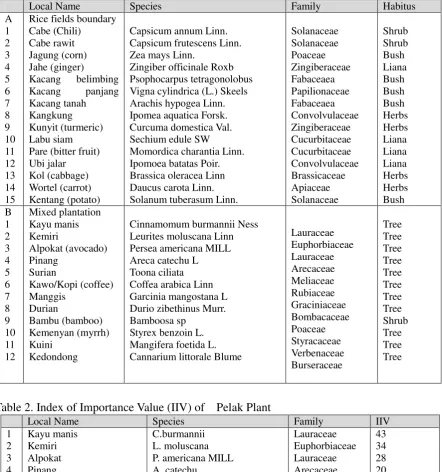
4.1 Plant Composition of Pelak
Convolvulaceae, Cucurbitaceae, Brassicaceae, and Apiaceae. These crops had been planted on rice fields’ boundary. In addition, there were 12 species of plants from 12 families planted in the mixed plantation, namely Lauraceae, Euphorbiacea, Lauraceae, Arecaceae, Meliaceae, Rubiaceae, Graciniaceae, Bombacaceae, Poaceae, Styracaceae, Verbenaceae and Burseraceae (Table 1).
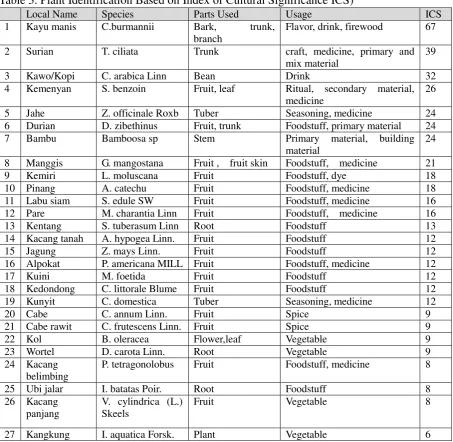
Among those plants, cinnamon (Cinnamomum burmannii) had the highest IIV (43) (Table 2), meaning that the existence of cinnamon in natural ecosystems is still quite a lot marked by high density, dominance and frequency. Cinnamon also had the highest ICS (67) (Table 3) which indicated that cinnamon had a value of exclusivity, high quality and intensity.
Table 1. Plant Composition of Pelak
Local Name Species Family Habitus
A
Table 2. Index of Importance Value (IIV) of Pelak Plant
7
Table 3. Plant Identification Based on Index of Cultural Significance ICS)
Table 4. ICS and IIV of Plants in the Mixed Plantation
Local Name Species ICS IIV
Flavor, drink, firewood 67
2 Surian T. ciliata Trunk craft, medicine, primary and
mix material
39
3 Kawo/Kopi C. arabica Linn Bean Drink 32
4 Kemenyan S. benzoin Fruit, leaf Ritual, secondary material,
medicine
26
5 Jahe Z. officinale Roxb Tuber Seasoning, medicine 24
6 Durian D. zibethinus Fruit, trunk Foodstuff, primary material 24
7 Bambu Bamboosa sp Stem Primary material, building
16 Alpokat P. americana MILL Fruit Foodstuff, medicine 12
17 Kuini M. foetida Fruit Foodstuff 12
18 Kedondong C. littorale Blume Fruit Foodstuff 12
19 Kunyit C. domestica Tuber Seasoning, medicine 12
20 Cabe C. annum Linn. Fruit Spice 9
P. tetragonolobus Fruit Foodstuff, medicine 8
8 9 10 11 12
Durian Bambu Kemenyan Kuini Kedondong
D. zibethinus Bamboosa sp S. benzoin M. foetida C. littorale Blume
24 24 26 12 12
21 17 20 20 17
Table 4 showed that ICS and IIV of cinnamon (Cinnamomun burmanii Nees) were equally the highest (67 and 43), followed by coffee (Coffea arabica Linn.) that had ICS and IIV as high as 32 and 35 (Figure 2).
Figure 2. ICS and IIV of Plants in the Mixed Plantation
Plants with high ICS but low IIV (such as surian, mangosteen, durian, bamboo and myrrh) had many use sand were considered important by the community, but more or less difficult to find. Surian with ICS 39 had many cultural uses (intensity, exclusivity and quality) but not extensively plant eddue to lengthy harvest time.Surian wood harvested at the age of 25 years or more, and provide no direct benefits before harvested.The community prefered plants witha short harvest time.
In contrast, plants with lower ICS but high IIV (such as avocado, kuini and kedondong) were not so important for the community, but their presences are aware plenty. This was because the seeds of these plants grow easily simply by throwing the seeds.
4.2 Income Level
Table 5. Number and Percentage of Households by Land Ownership Categories
Land Ownership Household
Number (%)
1 Small (0.2-0.5 ha) 6 20.00
2 Medium (>0.5-1.0 ha) 19 63.33
3 Large (> 1.0-2.0 ha) 5 16.67
Interviews of 30 respondents showed that the land ownership ranged between 0.2-2.0 ha which divided into three categories: small (0.2 to 0.5 ha), medium (> 0.5 to 1.0 ha), and large (> 1.0 to 2.0 ha) (Table 5). Approximately 80% of Keluru household owned medium to large land and only 20% owned small land. This indicated that the average land ownership was quite large and none of the households was landless. This was because the available land was quite extensive, both obtained by opening new land or from in heritance.
Soentoro (1981) stated that the land is an important as set for rural communities, because it is a natural resource that can be managed into a source of income. The larger the land owner ship, the greater the possibility of the household to obtain a high income. This was particularly true in Keluru community; a household with larger are a ownership had a better standard of living as could be seen in the level of education, health, and their food choices. Families who had high income levels generally sent their children to pursue higher education outside the village. Community revenue was derived from the production of 15 crops and 12 forest plants which were planted in Pelak (Table 6).
Table 6. Pelak Plants Production per Year
Plant Unit Household Production Price
(IDR/unit)
Income (IDR)
1 Cabe Kg 18 25,000 12,000 300,000,000
2 Cabe rawit Kg 10 15,000 15,000 225,000,000
3 Jagung Kg 6 1,200 4,000 4,800,000
4 Jahe Kg 6 80 10,000 800,000
5 Kacang belimbing Kg 10 90 8,000 720,000
6 Kacang tanah Kg 15 200 17,000 3,400,000
7 Kacang panjang Kg 16 100 3,000 300,000
8 Kangkung bundle 7 700 500 350,000
9 Kunyit Kg 20 300 3,000 900,000
10 Labu siam Kg 15 100 4,000 400,000
11 Ubi jalar Kg 11 100 3,000 300,000
12 Pare Kg 17 100 4,000 400,000
13 Kentang Kg 8 80 5,000 400,000
14 Kol Kg 9 50 3,000 150,000
15 Wortel Kg 5 200 4,000 800,000
16 Kayu manis Kg 30 25,000 9,000 225,000,000
17 Kemiri Kg 12 800 8,000 6,400,000
19 Durian Fruit 5 200 5,000 1,000,000
20 Alpokat kg 5 125 4,000 500,000
21 Pinang kg 7 150 4,000 600,000
22 Kawa/kopi kg 14 4,100 9,000 36,900,000
23 Manggis kg 3 90 8,000 720,000
24 Bambu stem 12 130 2,000 260,000
25 Kemenyan kg 20 35 25,000 875,000
26 Kuini kg 5 160 9,000 1,440,000
27 Kedondong kg 6 120 4,000 480,000
Total Revenue 832,895,000
Note: The price was at the time of the study and could be changed at any time
Table 6 showed that the production of cinnamon could reach as high as 25,000 kg per year. Cinnamon bark were cut about 30-50cm, then skinned and dried. Dried bark could be sold or stored. Fresh cinnamon bark could also be sold directly although it must be skinned first. Fresh cinnamon bark was cheaper than the dry. At the time of this study, the price of dry cinnamon bark was IDR9,000 per kg, while fresh bark was only IDR 6,000-7,000. According to respondents, cinnamon prices in previous years were decreased, even fresh bark price as low as IDR 2,500. Table 6 also showed that the total revenue from Pelak was IDR 832,895,000 per year or IDR27,763,167 per household per year.
Sayogyo (1977) stated that the level of welfare can be measured in absolute and relative. Absolute measurement based on the amount of revenue that is converted to the value of rice. There are 3 categories of poverty in absolute measurements, namely (1) poor if the spending is less than 320 kg rice per capita per year, (2) very poor when the spending between 180-240 kg rice per capita per year, and (3) most poor if the spending is less than 180 kg of rice per capita per year.
At the time of the study, the price ofrice was IDR 9.000-10.000 per kg, so that poor people spentless than IDR 2,880,000-3,200,000 percapita per year. If a household consisted of four members, then a poor household spent less than IDR 11,520,000-12,800,000 per year. The average revenue of households from Pelak in the Keluru Village approximately IDR27,763,167, so it could be concluded that no one in Keluru community was below the poverty line. This agreed with the information from the Head of Keluru Village that Keluru community was a prosperous and pre-prosperous community.
4.3 Natural-Benefit Stimuli of Pelak
Cinnamon natural stimulus existed in the Keluru community because it had been passed down from generation to generation. Zuhud (2007) stated that plants, habitats and cultures are unified as a whole in the community life. Cinnamon and Keluru community had unified so that cinnamon planting was driven by willingness and not by obligation. This was in line with the opinion that various and long term relationship between community and their environment tend to make people appreciate the wholeness of the ecosystem in the long term, contrarily with the community whose relationship to the environment is limited to one or two specific objectives. All of their respondents chose to grow cinnamon and they understood its bio ecology (profile, habitat, morphology and benefits).
As for the benefits stimulus, Keluru community was aware of cinnamon benefits, especially its economic value. Cinnamon is a high-value crop because its bark can be harvested when the plant reach the age of 5years up to 25 years. The community considered cinnamon planting investment (savings) because cinnamon bark could be sold whenever they need money.
Zuhud (2007) stated that the stimulus of species biodiversity was unique and specific and addressed to specific subject as well. Natural and benefits stimuli were ideally simultaneously perceived. However, reality in communities showed that the benefits stimulus of biological resources were perceived more rapidly by the community, gave rise to certain responses. This was because information about the benefits was already evolved. However, if other stimuli (natural and religious) were not understood and not became the stimuli of cinnamon planting attitude then there would be unsustainable cinnamon planting.
5. Conclusions
Composition of plant species in Keluru community’s agroforestry (Pelak) consisted of 15 species of crops from 12 families i.e. chili, cabe rawit, corn, ginger, star fruit nuts, long beans, peanuts, kangkung, turmeric, labu siam, bitter fruit, sweet potatoes, cabbage, carrot and potato. Other than crops, the Pelak also cocnsisted of 12 perennial plants species from 12 families i.e. cinnamon (Cinnamomum burmannii), kemiri (Ledtes moluscana), avocado (Persea amaericana), pinang (Areca catechu), surian (Toona cillata), coffee (Coffea arabica), mangosteen (Garcinia mangostama), durian (Durio zibethinus), bamboo (Bamboosa sp), myrrh (Styrex benzoin), kuini (Mangifera foetida) and kedondong (Canarium littorale). Cinnamon had significant values inculture and Pelak ecosystem which indicated by the highest Index of Cultural Significance (ICS) and Index of Importance Value (IIV). Selection of the plants revealed that Keluru community perceived and responded to natural stimulus of the selected plants as shown by community’s understanding of these plants bioecology.
Acknowledgement
The research is financed by Higher Education (DIKTI) through a research competitive grants. Many thanks to Prof Ervizal AM Zuhud, Prof Hardjanto, Prof Y. Purwanto and Dr Agus Hikmat for their help in improving the manuscript. We especially thank of the community’s Keluru who voluntarily shared collected data.
References
Aumeeruddy, Y. (1994). Shifting from simple to complex agroforestry systems: an example for buffer zone management from Kerinci (Sumatra, Indonesia). Systems, 28, 113-141. http://dx.doi.org/10.1007/BF00704825
Kartasubrata, J. (2003). Social forestry dan agroforestry di Indonesia. Lab Politik Ekonomi dan Sosial Kehutanan Fakultas Kehutanan Institut Pertanian Bogor. Buku I
Michon, G. et al. (2000). Ketika kebun berupa hutan : agroforest khas indonesia sebuah sumbangan masyarakat. International Centre For Research in Agroforestry . Bogor Indonesia
Peraturan Menteri Kehutanan No P.56/Menhut-II/2006 tentang Penatazonasian Kawasan Taman Nasional.
Purwanto, Y. (2004). Etnobotani masyarakat tanimbar-kei maluku tenggara sistem pengetahuan dan pemanfaatan keanekaragaman jenis tumbuhan. Perhimpunan Masyarakat Etnobotani Indonesia Bogor Pustaka Penelitian Biologi LIPI
Turner, N. J. (1988). The importance of a rose: evaluating the cultural significant of plants in thompson and lilloet interior salish. American Antropologist , 90(2), 272-29.
Undang-Undang No 5 Tahun 1990 tentang Konservasi Sumberdaya Alam Hayati Beserta Ekosistemnya. Dalam Lampiran Perundangan Negara Kesatuan Republik Indonesia
Wiratno, D. (2004). Berkaca di cermin retak refleksi konservasi dan implikasi bagi pengelolaan taman nasional. The Gibbon Foundation Indonesia Departemen Kehutanan, PILI-NGO Movement
Zuhud, E. A. M. (2007). Sikap masyarakat dan konservasi suatu analisis kedawung (parkia timoriana (dc) merr.) sebagai stimulus tumbuhan obat bagi masyarakat, Kasus di Taman Nasional Meru Betiri. [Disertasi]. Bogor (ID) Sekolah Pasca Sarjana IPB.
Copyright Disclaimer
Copyright for this article is retained by the author(s), with first publication rights granted to the journal.