1
Sveučilište Josipa Jurja Strossmayera u Osijeku Filozofski fakultet u Osijeku
Odsjek za engleski jezik i književnost
Uroš Barjaktarević
Japanese-English Language Contact / Japansko-engleski jezični kontakt Diplomski rad
Kolegij: Engleski jezik u kontaktu
Mentor: doc. dr. sc. Dubravka Vidaković Erdeljić
2 Summary JAPANESE-ENGLISH LANGUAGE CONTACT
The paper examines the language contact between Japanese and English. The first section of the paper defines language contact and the most common contact-induced language phenomena with an emphasis on linguistic borrowing as the dominant contact-induced phenomenon. The classification of linguistic borrowing thereby follows Haugen's distinction between morphemic importation and substitution. The second section of the paper presents the features of the Japanese language in terms of origin, phonology, syntax, morphology, and writing. The third section looks at the history of language contact of the Japanese with the Europeans, starting with the Portuguese and Spaniards, followed by the Dutch, and finally the English. The same section examines three different borrowing routes from English, and contact-induced language phenomena other than linguistic borrowing – bilingualism , code alternation, code-switching, negotiation, and language shift – present in Japanese-English language contact to varying degrees. This section also includes a survey of the motivation and reasons for borrowing from English, as well as the attitudes of native Japanese speakers to these borrowings. The fourth and the central section of the paper looks at the phenomenon of linguistic borrowing, its scope and the various adaptations that occur upon morphemic importation on the phonological, morphological, orthographic, semantic and syntactic levels. The final section of the paper analyzes these data, and reaches the conclusion with regard to the hypothesis of the paper.
Keywords: language contact, Japanese, English, linguistic borrowing, bilingualism
Sažetak JAPANSKO-ENGLESKI JEZIČNI KONTAKT
U radu se istražuje jezični kontakt japanskog i engleskog jezika. U prvom se dijelu rada definira jezični kontakt i najčešće jezične pojave do kojih pritom dolazi s naglaskom na jezičnom posuđivanju kao najistaknutijom jezičnom pojavom izazvanom kontaktom. Klasifikacija jezičnog posuđivanja pritom prati Haugenovo razlikovanje morfemske importacije i substitucije. U drugom se dijelu rada predstavljaju značajke japanskog jezika u odnosu na porijeklo, fonologiju, sintaksu, morfologiju i pismo. U trećem se dijelu promatra povijest jezičnog kontakta Japanaca s Europljanima, počevši s Portugalcima i Španjolcima, zatim Nizozemcima i konačno Englezima. U istom se dijelu istražujuju i tri različita puta posuđivanja iz engleskog te druge jezične pojave izazvane kontaktom pored jezičnog posuđivanja - bilingvizam, izmjenjivanje kodova (tzv. code alternation), prebacivanje kodova (tzv. code-switching), promjena jezika (tzv. language shift) - koji su u različtim mjerama prisutni u japansko-engleskom jezičnom kontaktu. Isti dio sadrži i pregled motivacije i razloga za jezično posuđivanje iz engleskog, kao i stavova izvornih govornika japanskog prema posuđenicama. U četvrtom i središnjem dijelu rada istražuje se pojava jezičnog posuđivanja, njezin raspon i razne prilagodbe do kojih dolazi prilikom morfemske importacije na fonološkoj, morfološkoj, ortografskoj, semantičkoj i sintaktičkoj razini. U posljednjem se poglavlju rada analiziraju ti podaci i donosi zaključak u odnosu na hipotezu rada.
3 CONTENTS
1. Introduction 4
1.1. Aims, methodology and organization of the paper 4
2. Theoretical preliminaries 6
2.1. Language contact 6
2.2. The Japanese Language 12
2.2.1. Origin, Phonology and Grammar 12
2.2.2. Writing 16
3. History of language contact in Japan 19
3.1. Iberian language contact (from ~1550 to ~1650) 19 3.2. Dutch language contact (from ~1650 to ~1850) 20 3.3. English language contact (from ~1850 to today) 21 3. 4. Motivation for borrowing and attitudes to borrowings 30 4. Analysis of linguistic borrowings from English in Japanese 35
4.1. Hypothesis and methodology 35
4.2. General remarks on linguistic borrowing from English 36
4.1. Importation 38
4.2. Importation with substitution 57
4.3. Substitution 59
6. Results and conclusion 61
7. Appendix 65
4
1. Introduction
1.1. Aims, methodology and organization of the paper
The aim of this paper in its broadest sense is to determine whether the general tendencies of contact-induced language phenomena laid out in the following section can be verified in the contact between English and Japanese. My starting hypothesis is that the Japanese-English borrowing situation lends itself to Haugen's (1950) stratification into loanwords, loanblends, and loanshifts like other cases of borrowing situations, that imported elements can be analyzed on at least three levels (morphological, phonological, and semantic) – as well as two additional levels that I posit in the theoretical part (syntactic and orthographic), and that the changes that occur thereon, in the broadest sense, are not unlike those observed in more researched cases of language contact. In addition to testing the hypothesis, one of the aims of the paper is also to attempt to determine the following (and in doing so, to identify whether they also conform to general expectation of contact linguistics):
(1) The type, intensity, period, scope of, and reason for language contact between English and Japanese. These are primarily examined in the chapter titled 'History of language contact in Japan', in 'General remarks on linguistic borrowing from English', and in the section titled 'Motivation for borrowing and attitudes to loanwords'.
(2) The types of contact-induced language phenomena that have occurred in the course of such contact. These are examined throughout the paper, but primarily in the sections 'Analysis of linguistic borrowings from English in Japanese' and 'History of language contact in Japan'. (3) Whether linguistic borrowing is the most common of those phenomena. If yes, whether a distinction can be made between morphemic importation, morphemic substitution with importation, and morphemic substitution. Whether morphological, phonological, semantic, orthographic, and syntactic adaptation strategies upon morphemic importation observed in the cases of well-recorded linguistic borrowing between Indo-European languages can be applied to that contact. Whether a distinction can be made between foreign words and loanwords proper. Whether the types of borrowings fall under the general predictions of borrowability scales. Whether there are any structural innovations in Japanese brought about by language contact. All these are examined under the heading 'Analysis of linguistic borrowings from English in Japanese' which constitutes the bulk of the paper.
5
(4) Whether other contact-induced language phenomena (bilingualism, code-switching, etc.) have occurred during the English-Japanese language contact. These are examined in the section of the paper titled 'History of language contact in Japan'.
(5) The attitudes of Japanese speakers to the influence of the English language on their language. This is examined in the section titled 'Motivation for borrowing and attitudes to loanwords'.
(6) Due to the perhaps esoteric nature of the Japanese language, a section on the features of the Japanese language will also be included. These features are examined in the section titled: 'The Japanese language'.
The sources used in the creation of this paper include two online dictionaries: goo国語
辞書 ('gooJapanese Dictionary'), and EDICT (Electronic Dictionary Research and Development
Group) files hosted on 楽しいJAPANESE ('Pleasant Japanese') site, Halpern's 'Kodansha Kanji Learner's Dictionary' (1999), and the dictionary found in Akiyama (2002). Arakawa's Kadokawa Gairaigo Jiten ('Kadokawa Loanword Dictionary') – the most comprehensive and authoritative Japanese loanword dictionary – and a number of other monolingual dictionaries have been utilised indirectly. More on these, as well as on Japanese-English contact linguistics sources (e.g. Miller (1971), Irwin (2011), Stanlaw (2004) etc.) whose accounts have been analyzed and synthesized can be found under the appropriate heading in the section titled 'Analysis of linguistic borrowings from English in Japanese'.
6
2. Theoretical preliminaries
2.1. Language contact
In the simplest definition, language contact is the use of more than one language in the same place at the same time (Thomason 2001: 1). When such contact occurs, languages tend to influence one another, though generally the socially prestigious language belonging to the dominant culture (also called a superstrate) remains relatively unchanged, and the less prestigious language (a substrate) undergoes certain changes. Major outcomes of such language contact, according to Winford (2003: 22-24) are threefold: language maintenance (subdivided into borrowing situations – with more lexical, and less structural borrowing – and convergence situations – with considerable structural (and lexical) borrowing), language shift (cf. definition below), and language creation (of pidgins and creoles; cf. definition below). Interestingly, Winford (2003: 30-31) considers Japanese-English language contact to be an instance of a casual borrowing situation though I will present evidence which favor the claim that the borrowing situation is moderate or perhaps even intense. On a more specific level, language contact induces a number of phenomena the most basic of which is bilingualism. According to Hermann and Schuchardt (as cited in Filipović (1971: 112-113)), bilingualism is a prerequisite for any contact-induced language phenomenon, though what type of bilingualism is a matter of debate. There are many examples where speakers of the recipient language did not speak or read the source language fluently, and yet language-induced contact phenomena did occur (a contemporary example would be the use of English in what are typically considered non-bilingual countries, owning to the influence of the internet, television or radio) – for that reason, perhaps the best course of action is to use Haugen's minimalist definition of bilingualism: 'Bilingualism ... begin[s] at the point where the speaker of one language can produce complete, meaningful utterances in the other language' (Haugen (1969) as cited in Noguchi (2001: 2)). Other contact-induced phenomena include: linguistic borrowing (the most common result by a wide margin), language shift – a case where people give up their native language, and start speaking another group's language instead – code-switching – the use of material from two (or more) languages by a bilingual speaker with the same people in the same conversation (Thomason 2001: 262), code alternation – the use of one language in one set of environments and another language in a largely different set of environments by a bilingual speaker
7
(Thomason 2001: 261), the creation of pidgins and creoles,1 and the most extreme of all – language death – when a language loses all of its native speakers (could also be considered the end result of a language shift). Of these, as the analysis will show, all but language shift and language death can be identified in the contact between Japanese and English. The pervasiveness of linguistic borrowing as the dominant contact-induced language phenomenon warrants further attention. Borrowing can be defined as 'the attempted reproduction by a bilingual speaker in one language of patterns previously found in another' (Haugen (1950: 212)). In such cases the original pattern in language A (the donor language) is called the model, and the loan in language B (the recipient language) may be more or less similar. Haugen (1950: 212) notes that if the loan is similar enough to the model so that a native speaker would accept it as his own, the borrowing speaker may be said to have imported the model into his language. If the loan is not acceptable to the native speaker of language A as belonging to his language, the model has been reproduced inadequately, and it can be said that the speaker of language B has substituted the model for a similar pattern from his own language. According to Haugen (1950: 213-214) the patterns that can be imported or substituted include: morphemes, phonemes, and meanings (in all cases of the former Haugen takes for granted that semantic importation has taken place). Morphemic importation naturally precludes phonemic substitution (morphemic importation is necessary for phonemic substitution: if all the model morphemes are substituted by native morphemes, then there will be no need for phonemic substitution). There is also the possibility of phonemic importation, though, according to Haugen (1950: 226), it generally does not extend beyond bilingual speakers.
The differences in the borrowability of certain items have urged linguists to set up borrowability scales on which they ranged the patterns according to the freedom with which they were borrowed: nouns are generally believed to be borrowed most easily, followed by verbs, adjectives, adverbs and prepositions, then suffixes, then inflections, and finally phonemes. However, my investigation of literature on language contact has led me to include grammatical (syntactic) patterns in any such scale, even though they might be the least borrowable elements. In fact, Meillet (as cited in Thomason (2001: 63)) held the view that the only borrowable grammatical elements are those that fit well with the typological structure of the recipient language, and, similarly, Jakobson and Sapir (as cited in Thomason (2001: 64)
1 A pidgin is a mixed language that arises in a contact situation involving two or more linguistic groups that have
no share language, but that need to communicate regularly, for limited purposes such as trade. They then do not learn each other's languages, but create a "new" language whose vocabulary comes from one of the languages in contact, with very little grammar. A creole is simply a pidgin language that has become the native language of a speech community (Thomason 2001: 262, 273).
8
argued that 'a language accepts foreign structural elements only when they correspond to its own tendencies of development'. Since any discussion of grammatical borrowing then invokes typological features of a language, the Japanese-English typological relation warrants further examination (given in the section on the Japanese language). However, some linguists (e.g. Thomason herself (2001)) reject any such scale claiming that there are almost no constraints on the borrowability of any elements, and that counter-examples (i.e. cases where there was more structural than lexical borrowing) can easily be found. In this paper, I endorse traditional borrowability scale, as the one mentioned above, when discussing different types of borrowings. Nevertheless, the primacy of morphemic importation / substitution has enabled Haugen (1950: 213-215) to set up the following three groupings of borrowings:
• LOANWORDS which exhibit morphemic importation and varying degrees of phonemic substitution, e.g. Eng. computer → Cro. kompjuter 2 exhibits the importation of two model morphemes into Croatian: kompjut + -er whose morphemes have been phonemically substituted with Croatian approximations;
• LOANBLENDS which exhibit partial morphemic importation and partial morphemic substitution (naturally then only the imported part exhibits phonemic substitution), e.g. Eng. boxer → Cro. boksač where one morpheme was imported (boks) and phonologically adapted (e.g. Eng. /ɑ/ in /bɑks/ was substituted by /o/) while the other morpheme was substituted with a native morpheme (-er → -ač);
• LOANSHIFTS which exhibit only morphemic substitution (and therefore no phonemic
substitution). These include cases of loan translation (also known as calques), e.g. Eng. skyscraper → Cro. neboder (model morphemes substituted and meaning imported to the substitute), and cases where substituting morphemes are already existing in the language (therefore the meaning is imported to an already existing morpheme in the recipient languauge), e.g. Eng. mouse → Cro. miš.3
In cases of morphemic borrowing free morphemes are more easily imported, while bound morphemes are more easily substituted. Nevertheless, both types of morphemic borrowings undergo certain morphological adaptations upon substitution. The phenomenon of morphological adaptations of morphemes has been researched thoroughly with regard to the following areas: how nominal bound morphemes (expressing number, gender, and case), verbal bound morphemes (expressing person, number, tense, aspect, voice), and adjectival and
2All examples from Croatian are mine, unless stated otherwise.
3Pure importation is also called transfer, substition with importation interference, and pure substitution integration
9
adverbial bound morphemes are adapted to the inflectional system of the recipient language, and what happens to bound morphemes when the model language and the recipient language are typologically different (e.g. English – a predominantly analytic language – and German – a synthetic language). The phenomenon of borrowing free (lexical) morphemes – called lexical borrowing or sometimes solely implied by the word borrowing – has received the most attention of all contact-induced language phenomena, especially with regard to the following: the time of (when?), way of (how?) scope of (how many and from which areas?), reason for (why?), and attitude towards borrowing lexemes, as well as the case of creative usage of borrowed lexemes in ways that do not appear in the model language – the so-called lexical pseudo-loans, e.g. Ger. der Goalmann is a German word made of two independent English lexemes: 'goal' and 'man' that do not appear in such a combination in English. Several of these questions warrant explanation before proceeding. Determining the approximate time of any type of contact-induced language phenomenon is necessary to detect possible innovations because any such phenomenon is always a historical fact and can be identified only by historical methods (Haugen, 1950: 227). Determining the way how such phenomena occur comes down to two possibilities: direct cultural and linguistic influence (through auditory contact with the speakers of the model language), and indirect influence (through orthographic contact with the donor language). According to Hock and Joseph (1996: 258) the reason for borrowing is also twofold: either need or prestige. The former applies when the speakers of a language take over new cultural items, new technical or religious concepts, references to foreign locations, fauna, flora, etc. and need the vocabulary to express them. The latter applies in a situation where, for sociolinguistic reasons, a superstrate language impinges on a substrate language. The attitudes toward language changes by speakers of the recipient language can, broadly speaking, either be positive or negative. Finally, determining the scope of changes has mostly to do with ascertaining the number of borrowings and their lexical groupings. Furthermore, within lexical borrowing a distinction can be made between a Fremdwort (foreign word), and a Lehnwort (loanword proper) – though it is unclear where the line between the two lies; generally, foreign words predominantly exhibit importation (on the phonemic and orthographic level), whereas loanwords exhibit substitution on those two levels (Winter-Froemel, 2008: 160-161).
In terms of phonology, as previously mentioned, substitution is the rule, and importation the exception. Every analysis of phonemic adaptation has to determine which model phonemes are substituted with which existing phonemes in the recipient language (this process is also known as transphonemization (Filipović (1990) as cited in Bojčić and Plavša (2012: web)), and, if there are cases of phonemic importation, which phonemes have been imported and how, and
10
why this importation came about. Filipović (1971: 121-122) distinguishes between several conditions for phonemic importation: (1) allophones of that phoneme already exist in the language, (2) the phonemic system of a language has latent phonemes which can be activated under the influence of foreign phonology, (3) the phoneme exists in one of the dialects of the recipient language.
When it comes to semantics, Haugen (1950: 219) does not explicitly distinguish between importation and substitution, but uses the terms loan synonym to roughly refer to semantic importation, and loan homonym4 to refer to semantic substitution. Even though Haugen (1950: 220) states that "there is a lack of any satisfactory method of classifying degrees of semantic similarity [when it comes to semantic importation]", a successful way of doing just that was first proposed by Hope ((1960) as cited in Filipović (1971: 137-142)). He distinguishes between:
• CHANGES IN SEMANTIC EXTENSION which include ZERO SEMANTIC EXTENSION
(where there is no change in the model's meaning upon importation; often occurs in words restricted to fairly specialised fields such as music, food or drinks (Filipović: 1971: 137)), SEMANTIC BROADENING or EXPANSION (where the model is first imported into the language and fills the gap in the lexicon, and then its meaning is expanded (Bojčić, Plavša, 2012: web)), and SEMANTIC NARROWING (where the model is imported with only one specific meaning, disregarding all others it might have; the most common type of semantic change throughout the world, as words are usually borrowed to fill specific gaps (Hatch and Brown (1995) as cited in Daulton (2008: 22)).
• ELLIPSIS where the meaning of the model is transferred to only one part of the model,
e.g. Eng. combine harvester → Cro. kombajn.
• PEJORATION and AMELIORATION where upon importation the model receives additional negative or positive connotation, respectively, both of which often overlap with expansion, and, even more so, narrowing of meaning.
• METAPHORS and TRANSFORMATION OF PROPER NOUNS INTO COMMON NOUNS
In addition to importation and substitution on the morphological, phonological, and semantic levels, I will posit two additional levels: orthographic and syntactic – the former because the dissimilarity of the Japanese writing system warrants a complete substitution of
4 In the case of loan homonyms, the new meaning of the model has nothing in common with the old, e.g. Eng.
11
foreign graphs, and the latter because a syntactic framework is necessary for a discussion of grammatical importation from English in Japanese since there is little to none morphological importation from English (as will be detailed later). Orthographic importation refers to the importation of graphemes from the model language into the recipient language, and substitution refers to the substitution of model graphemes by native approximations, e.g. Ger. die Düsse → Cro. dizna [ü substituted with i], though I would argue that orthographic substitution is sometimes caused by phonemic substitution (rather than the necessity to substitute foreign graphemes) if one is dealing with an auditory loan. With orthographic loans, the reverse argument could be made. When it comes to syntax, it can be taken for granted that syntactic substitution takes place whenever loanwords are integrated into the syntactic structure of the recipient language. However, sometimes languages import whole syntactic patterns from other languages – this, and the importation of bound morphemes, is deemed structural borrowing – in which case, inherently, no substitution occurs, and the recipient language develops new syntactic patterns – this, according to the overview of contact intensity cited below, can be brought about only in very intense borrowing situations. According to Thomason (2001: 70-71), the intensity of language contact determines the extent of lexical and structural borrowing. She distinguishes between four types of contact with regard to intensity:
1. Casual contact – only lexical borrowing (nouns, verbs, adjectives, adverbs) with no structural borrowing at all. Very few to no bilinguals.
2. Slightly more intense contact – lexical borrowing (now including conjunctions and prepositions) with some structural borrowing resulting in new phonemic distributions and new functions of syntactic structures. Some fluent bilinguals, but they constitute a minority.
3. More intense contact – lexical borrowing (now also including basic vocabulary, derivational affixes, and pronouns) with structural borrowing resulting in imported phonemes, changes in syllable structure, morphophonemic rules, and word order, borrowing grammatical categories and bound morphemes. More bilinguals with better attitudes toward borrowing.
4. Intense contact – lexical borrowing (now of all elements of the lexicon) with heavy structural borrowing resulting in extreme changes in syntax (negation, coordination, subordination etc.), loss or addition of agreement patterns, shifts from flexional to agglutinating morphology, etc. Very extensive bilingualism.
12
2.2.1. Origin, Phonology and Grammar
Japanese is a language spoken by virtually the entire population of Japan - around 125 million people - and thus surpassing, in terms of the number of native speakers, some major European languages such as German and French, and ranking sixth among the languages of the world after Chinese, English, Russian, Spanish and Hindi. Despite its status as a major world language and its long literary history (dating back to the eighth century) Japanese is surrounded by numerous myths. There is still little to no consensus on the origin of the language – throughout the last century Japanese has been related to language families as divergent as Hittite, Indo-European, Korean, Altaic, Dravidian, Ainu and Austronesian (Clarke, 2009: 58) – but the most likely candidate, it can be tentatively argued, is Altaic. Altaic language family is one branch of the wider Uro-Altaic language family (in itself a highly debatable proposal) which is made up of the Uralic languages, which comprise the Finno-Ugric group (which includes languages such as Finnish, Estonian and Hungarian), and the Altaic languages which comprise the Turkish, Mongolian, Tungusic, and (arguably) Korean and Japanese languages (the latter two almost certainly being related, but it is still unclear whether this connection is due to common origin – a proto-Korean-Japanese (Miller, 1971:32) – or early borrowing (Clarke, 2009: 58)). The most convincing argument for the Altaic origin of the Japanese language has been given by Miller (1971: 12) by applying the comparative method together with the assumption of regular sound change on the forms of Old Japanese, for which there is a corpus of written records of cosiderable length, dating back to the late seventh and early eighth centuries, against the supposed (phonological) features of an earlier proto-Altaic language which have been summed up by Poppe (1960). Due to the constraints of the comparative method, namely "the lack of techniques for dealing with comparative syntax" (Miller, 1971: 21) and the phonetic brevity and semantic opacity of grammatical inflections, the bulk of his work focuses on examining phonological and lexical (namely, pronouns, interrogatives, numerals, and negation) evidence. Though the question of the origin of the language still remains uncertain, Miller's study has tipped the scales in the favor of its Altaic roots by showing that many similarities between proto-Altaic and Old Japanese are not simply a result of chance or borrowing. On the other hand, the biggest problem in relating Old Japanese to the Altaic family, according to Shibatani (1990: 101), is the discrepancy between the CV (consonant-vowel) syllable structure of Old Japanese, as well as the simplicity of its vowel system, compared to the abundance of closed syllables with syllable-final consonants and the
13
complexity of the vowel system in Altaic languages (although simple Japanese phonology might be due to early mixing with the people of the South Pacific (Shinmura (1908) as cited in Shibatani (1990: 103)). It is also easily plausible that Japanese is simply a language isolate in a manner similar to other isolates observed elsewhere in the world, e.g. Basque in Europe, Etruscan in northwestern Italy (now extinct) or Burushaski in northern Pakistan (Shibatani, 1990: 90).
Still, the Japanese language does exhibit a number of characteristics common to Altaic languages such as: simple phonemic system, simple syllable structure; morphological agglutination, primarily suffixal; rich case system, subject-verb agreement, word order SOV, strictly prespecifying; numerous participial forms (converbs) for conjunction and subordination of clauses (Bussmann, 1996: 47). Japanese is a syllabic language consisting of five pure – monophthongal – vowels: /a/, /i/, /u/, /e/, /o/, and sixteen consonants: /m/, /n/, /p/, /b/, /t/, /d/, /k/, /g/, /s/, /z/, /h/, /w/, /j/, /r/, a mora obstruent sound that will henceforth be represented as /Q/, and the moraic sound /N/. In addition to those phonemes, several allophones are posited, surveyed in Irwin (Irwin, 2011: 71-72) – the most important of which are the following:5
• /h/ is /ɸ/ before the vowel /u/ in which case it is romanised as f(u), e.g. 服 fuku ('clothes') [ɸuku]
• /t/ and /d/ are /c͡ç/ and /d͡ʑ/ before the vowel /i/ in which case they are romanised as ch(i) and j(i), respectively, e.g. 町 machi ('town') [mac͡çi], and 事実 jijitsu ('truth') [d͡ʑid͡ʑitsu]
• /t/ and /d/ are also /ts/ and /z/ before the vowel /u/ in which case they are romanised as ts(u) and z(u), respectively, e.g. 説明setsumei ('explanation') [setsumei], and 狡いzurui ('cunning / sly') [zurui]
• /s/ and /z/ are /ɕ/ and /d͡ʑ/ before the vowel /i/ in which case they are romanised as sh(i) and j(i), e.g. 寿司sushi ('sushi') [suɕi], and 時間 jikan ('time') [d͡ʑikaN]
• /c͡ç/, /ɕ/, and /d͡ʑ/ which then only appear before /i/ – chi, shi, ji – can also appear before /a/, /o/, and /u/ if these vowels are preceded with a glide – ya, yo, yu – in which case they give cha, cho, chu, sha, sho, shu, ja, jo, ju (only combinations with /e/ are unacceptable)
5Examples are mine unless stated otherwise.
14
Every syllable consists of an onset and a nucleus (a vowel), e.g. ka, wo, ri, though a distinction should be made between a syllable and a mora.6 Mora is a "minimal unit of metrical time or weight" (Crystal, 2008: 312), shorter than a syllable. In Japanese specifically each mora corresponds to one graph of the kana syllabary. For example, a word like 新聞 shiNbuN ('newspaper') consists of two syllables – shiN and buN – but a Japanese speaker further subdivides the word into four units – shi, N, bu, N – or four moras, which correspond to four letters of the Japanese syllabary – し(shi),ん(n),ぶ(bu), ん(n) (Shibatani, 1990: 158). In addition to moraic N, there is one more sound that is not in and of itself a syllable – namely, moraic Q that is simply a prolongation of a succeeding obstruent (Irwin, 2011: 112), which in turn creates an additional mora (e.g. 事件 jikeN consists of three moras: ji, ke, N and has the meaning
'incident', as opposed to 実験 jiQkeN which consists of four moras: ji, Q, ke, N, and has the meaning 'experiment').
From the point of view of morphology, Japanese is classified as an agglutinative language, a term introduced by Wilhelm von Humboldt in 1836, because it involves a considerable amount of affixation in its verbal and adjectival morphology (Shibatani, 1990: 91), not uncommonly involving a fair number of suffixes in a row. The order of these verbal / adjectival affixes is generally fixed, though alternate orders can also be observed:
• Verbal stem - causative - passive - aspect - desiderative - negative - tense
All the possibilities are rarely, if ever, used in a single expression, but some fairly lengthy forms such as 歩かせ続けたいarukasetsuzuketai ('want to continue to make X walk') can be observed somewhat commonly (Shibatani, 1990: 307). The typological distance between English and Japanese – English being mostly an analytic language7 and Japanese being mostly a synthetic
6 Mora counting is a feature of languages where there is an opposition between light (or monomoraic) syllables,
and heavy (or bimoraic syllables). (Crystal, 2008: 312). Similarily, in Japanese a distinction can be made between light – monomoraic – syllables (of the form: (C)(G)V where C is an optional consonant, G is an optional glide (approximant) and V is a vowel, e.g. a, ka, kya), heavy – bimoraic – syllables (of the form: (C)(G)VV, (C)(G)VQ, or (C)(G)VN, e.g. kou, koQ – as in the word 国庫koQko 'national treasury' – or koN), and superheavy – trimoraic – syllables (of the form: (C)(G)VVN, (C)(G)VVQ, or (C)(G)VNQ, e.g. donQ as in the word ロンドンっ子rondonkko 'Londoner'). Superheavy syllables occur only in loanwords. (Irwin, 2011: 74).
7Analytic languages are "languages that have the tendency to mark the syntactic relations in the sentence
15
agglutinative language – is especially important because, according to Thomason (2001: 279), the degree of structural diversity between two languages is indicative of linguistic phenomena that can occur during their contact. Structural dissimilarity between languages makes it possible for Thomason (2001: 71) to make two predictions about the outcome of their contact: first, that borrowed elements between typologically different languages closely follow the borrowability scale (nouns, verbs . . . phonemes . . . grammar), and second, that grammatical features that are borrowed tend to be those that are typologically congruent between the two languages. I would argue that the second of these is particularly interesting because it justifies the aforementioned necessity of setting up a syntactic framework (and the inclusion of syntactic patterns in any borrowability scale) for a discussion of grammatical importation from English since that is precisely the level on which the two languages are congruent. That is, since Japanese is agglutinative in inflections, but analytic in other respects, e.g. specifying cases or comparison of adjectives, just like English, I can expect that any grammatical importations will hardly be morphological, but rather syntactic (and perhaps specifically related to parts of speech that have the grammatical category of case). Following Weinreich's ([1953] 1964: 30-31) division of grammatical replication (or interference in his terminology) into three categories – (1) changes in inflectional morphology; (2) changes in word order; (3) changes in grammatical functions or replication of grammatical forms – based on what we have said, we can assume that any grammatical changes will also not be examples of (1), but rather (2) or (3). This interim hypothesis will be analyzed in the chapter 'Analysis of linguistic borrowings from English in Japanese', under the headings 'Morphological importation' and 'Syntactic importation' and commented further in the conclusion.
In terms of syntax Japanese is, unlike English, a typical SOV (Subject-Object-Verb) language, but does allow reordering of preverbal major constituents (a phenomenon referred to as scrambling). The verb, however, must always remain in the sentence-final position, and the strictness of this rule sets off Japanese from other agglutinative languages. Sometimes, though rarely and mostly in colloquial speech, this rule can be violated, though in such cases the falling intonation pattern suggests that the part following the verb is only to be considered as something appended to the end of a sentence as an afterthought (Shibatani, 1990: 258-259). Furthermore, the category of grammatical person does not exist in Japanese, nor does it mark gender or number of nouns (in number constructions, classifiers are employed) (Bussmann, 1996: 606), while cases of nouns are indicated syntactically, not morphologically, by separate particles,
1996: 57). In English, for example, the comparative structure more beautiful would be considered analytic, as opposed to easier which would be considered synthetic.
16
non-conjugating parts of speech that bear an absolute minimum of independent meaning and attach themselves to other parts of speech to indicate case or place them in context (Chino, 2001: 7). Finally, unlike English, which is mostly left-headed (or right-branching), Japanese is consistently right-headed (or left-branching) (Cipris and Hamano, 2002: 84). Thus a left-headed phrase in English such as the name of the university's English professor would look like 大学の
英語の教授の名前 (daigaku no eigo no kyōju no namae 'university's English professor's name')
in Japanese.
2.2.2. Writing
The history of Japanese writing can be traced back roughly to the first or second century AD, though the first written records appear in the eight century – namely, the Nihon Shoki ('Chronicles of Japan', a.d. 720), the Kojiki ('Record of Ancient Matters', a.d. 712), and the Manyōshū ('A Collection of Ten Thousand Leaves' a.d. 759). By the time these records were written, Japan had already borrowed the writing system of the Chinese (a combination of pictograms, logograms and ideograms known as 漢字 kanji, 'Chinese characters'). Before that the Japanese language existed only in spoken form, and Chinese characters were borrowed to enable it to be expressed in writing. These foreign characters were then related to the morphemes of Japanese through two types of readings – the on reading (the Japanese approximation of Chinese reading) and the kun reading(native Japanese reading). For example, when a character such as 海 (with the meaning 'sea' in both Chinese and Japanese) was adopted by the Japanese, they assigned their own native morpheme – in this case, umi – as one of its readings, and that is the kun reading. However, they also borrowed the Chinese pronunciation, or rather an approximation of it – in this case, Chinese hai was adopted as kai (Seeley, 1991: 1). The vast majority of Chinese characters nowadays, therefore, have at least one 音読み onyomi or 'on-reading' (conventionally romanized in upper case) and one 訓読みkunyomi or 'kun-reading' (conventionally romanized in lower case) (Henshall, 1988: xiii). By the time of Kojiki, Nihon Shoki, and Manyōshū, however, the Chinese characters were used almost exclusively as phonograms, i.e. as symbols representing speech sounds, rather than words or ideas (Crystal, 2008: 364). Depending on which reading – kun or on – their sound value was determined, it is possible to distinguish between kun-phonograms and on-phonograms.
Kun-17
phonograms employed the sound value of the native Japanese reading, e.g. 庭(niwa 'garden') was used for a combination of Japanese particles (function words) ni + wa even though such a combination has no relation whatsoever to the meaning of the character, namely 'garden' (Seeley, 1991: 189). On-phonograms, on the other hand, employed the sound value of their on (Sino-Japanese) reading, e.g. 也 (ya 'to be', approximation of the Chinese reading ye) + 魔(ma 'witch/demon', approximation of the Chinese reading ma) for the Japanese word yama 'mountain' (Seeley, 1991: 191) – which clearly has no relation whatsoever to the two characters in terms of their meaning. Since such a way of writing Japanese – namely, by reducing Chinese characters to phonograms – was very cumbersome (every syllable having to be written by a rather complex character, and some sounds being able to be expressed by different characters), a way of abbreviating Chinese characters emerged in the eight century in the form of two syllabaries – hiragana and katakana. Katakana letters retained a squarish shape, while hiragana letters developed by simplifying the cursive style of writing characters, and they retain a roundish shape (Shibatani, 1990: 126). For example, ウ(katakana u) developed from 宇, こ (hiragana ko) developed from 己 , キ (katakana ki) developed from 幾 , チ (katakana chi)
developed from 千, ヒ(katakana hi) developed from 比,etc. (Henshall, 1988: 627-628). When the two syllabaries developed (by about a.d. 800) Japanese could be written down much more easily, and the Chinese characters could again be employed in their more common function as logograms (Seeley, 1991: 90). Originally, then, kana (a joint name for both hiragana and katakana) were used as mnemonic symbols for reading Chinese characters and were written alongside them. Despite this secondary status of kana, they were frequently used by women with literary aspirations, who were discouraged from learning Chinese characters that belonged to men's domain of learning and official writings. Even源氏物語Genji Monogatari ('The Tale of Genji'), one of Japan's greatest literary achievements (written between a.d. 1000 and 1012), was written by Lady Murasaki Shikibu, almost entirely in hiragana (Shibatani, 1990: 127-128). Despite this early separation between Chinese characters and kana, the contemporary practice is to use Chinese characters to denote lexical morphemes, hiragana to denote grammatical morphemes and particles, and katakana to denote loanwords and certain onomatopoeic expressions or for emphasis. It is very common for Japanese sentences to incorporate all three
18
scripts – Chinese characters, hiragana and katakana – and even the Roman alphabet (key:
katakana, hiragana, kanji, Roman alphabet / Arabic numerals):8
• マリアはABC順に一番目です。(Maria wa ēbīshī juN ni ichibaN me desu. 'Maria is first in alphabetical order.')
• 彼はTシャツを着ている。(Kare wa Tīshatsu o kite iru. 'He is wearing a T- shirt.') • クロアチアは2009年にNATOの加盟国になった。(Kuroachia wa niseNkyūneN ni NATO no kameikoku ni naQta. 'Croatia became a member of NATO in 2009.')
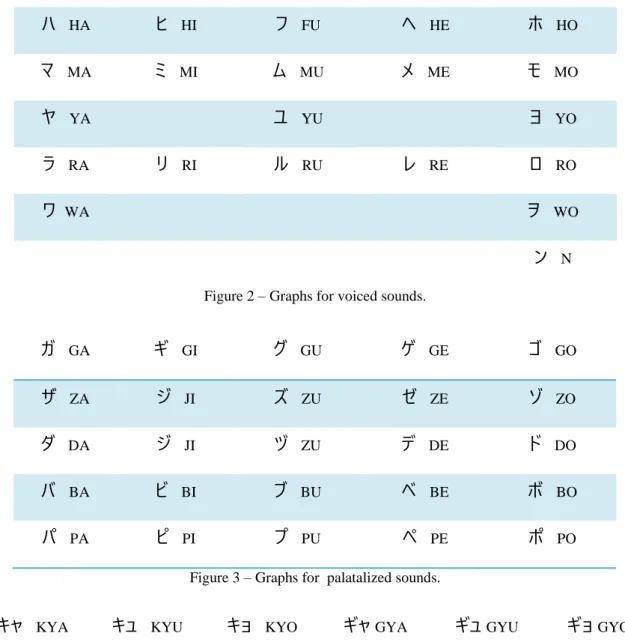
The basic kana syllables – though one of them is not a syllable, but a mora, namely N – are arranged in a table called the五十音図(gojūoNzu - table of 50 sounds, although it only has 46 syllables if we disregard voiced and palatalized sounds).9 Worth mentioning is that syllables
シ(shi), チ(chi), ツ(tsu) フ(fu) and ヲ(wo) are not phonetically uniform with the other syllables
in the same column (Halpern, 2001: 900). Furthermore, voiceless consonants k, s, t, and h can be voiced into g, z, d, and b respectively by adding a diacritical mark called 濁点 (dakuten) to
the right of the kana character. Another diacritical mark called 半濁点(handakuten 'semi-voiced consonant mark') can be used to create the p sound, even though phonetically p is a voiceless consonant. Moreover, combining ヤ (ya), ユ(yu), and ヨ(yo) with syllables ending in i yields
palatalized sounds that are pronounced as single syllables such as キャ(kya) or ピョ(pyo) (Halpern, 2001: 901). However, as we will see later, the necessity to better represent foreign words has produced a number of new katakana letters (as well as new sound combinations). Finally, it is worth mentioning that the traditional way of writing Japanese is vertical, with lines progressing from right to left, and books therefore open from the reverse direction than in English. Today both vertical and horizontal writing are practiced, although the former is more formal, and used in newspaper articles and formal letters (Shibatani, 1990: 130).
8 Examples are mine unless stated otherwise.
9 All the katakana syllables taught in schools can be found in the appendix at the end of the paper (hiragana graphs
19
3. History of Language Contact in Japan
3.1. Iberian language contact (from ~1550 to ~1650)
The Iberian period began in 1543 when Portuguese merchant sailors led by Fernando Mendes Pinto, aboard a Chinese junk (a type of sailing vessel), stepped ashore on the southern island of Kyūshū (Stanlaw, 2004: 46; Elisonas, 2008: 302). Five years later, in 1549, they were followed by three Jesuits led by the future saint, Francis the Xavier, a Navarrese co-founder of the Society of Jesus, who landed in what is now Kagoshima (a city in southern Kyūshū) on another Chinese junk, and were soon followed by Spanish Franciscans and Dominicans (Elisonas, 2008: 303-304). In the ensuing decades, the Japanese started opening their ports to Portuguese (1571), Spanish (1592), Dutch (1609), and English (1613) merchants (Irwin, 2011: 33). By 1640, however, a change in the political climate towards the foreigners (as a result of numerous intrigues between the Christian missionaries and the local Kyūshū government, as well as clashes with the Buddhist clergy) led the son of the first shogun of the Tokugawa shogunate, Tokugawa Hidetada, to ban Christianity, kill all Japanese converts who refused to give up the religion, and expel many of the Europeans (Stanlaw, 2004: 47), which marked the beginning of 鎖国sakoku ('national isolation'). The only foreigners who were allowed to stay were the Dutch who were seen as "unsullied by Christianity" (Irwin, 2011: 33), but were restricted to Dejima, a small, artificial island in Nagasaki Bay, in southwest Kyūshū (more on the Dutch in the following section). In this period of roughly 100 years, the Japanese were acquainted not only with Western ideas and innovations, but also with the Portuguese and Spanish, and Latin languages (English and Dutch influence during this period was minimal).
20
Words borrowed from this period number some 3500 (Irwin, 2011: 31), though only 200 to 400 are still in everyday use (Stanlaw, 2004: 46). Most of the words are related to trade or Christian doctrine; some examples include:10 アニマ anima ('soul') from Latin anima, パン paN ('holy wafer') from Portuguese pãō, ミサmisa ('mass') from Portuguese missa,デウスdeusu ('Deus/God')
from Latin deus, アベマリア abemaria ('Ave Maria') from Latin ave maria, タバコ tabako ('tobacco') from Portuguese tabaco, イギリスigirisu ('Great Britain') from Portuguese ingles, ボ
タン botaN ('button') from Portuguese botāo, オランダ oraNda ('Holland') from Portuguese
Holanda, 南瓜 kabocha ('pumpkin') from Portuguese Cambodia abobora, ゲリラ gerira from Spanish guerrilla etc.11 Some of these words are quite ubiquitous in everyday Japanese: pan (now any bread, not just the holy wafer), tabako, botaN, or igirisu can be encountered at the very basic level of the language. Others have in time been supplanted by Sino-Japanese words or words from the English language (e.g. ナタルnataru, now an obsolete word for Christmas
from the Portuguese word natal, has been replaced by クリスマスkurisumasu) (Irwin, 2011: 33). This was also the period when first bilingual dictionaries, grammars of Japanese, and transcriptions of Japanese literature started to appear, as well as the time when 'some of the processes of nativization that would later be applied to other foreign borrowings began to be seen' (Stanlaw, 2004: 46).
3.2. Dutch language contact (from ~1650 to ~1850)
From the middle of the 17th century to 1853, the Dutch were the only Europeans allowed in Japan. The Dutch living on Dejima were not allowed to learn Japanese, whereas knowledge of Dutch was restricted to interpreters of Dutch, the so-called オランダ通詞oraNda tsūji, which came from hereditary interpreter families living in Nagasaki (Stanlaw. 2004: 47) (since Dejima was an island in Nagasaki Bay). However, since Western books were banned with the imposition of sakoku in the 1630s, the contact between the Dutch and the Japanese was mostly
10Contemporary spelling is used, though many different spellings were attested in the 16th century. 11The examples were taken from several sources: Stanlaw (2004), Irwin (2011), Fresslevig (2010).
21
mercantile in nature. It was only after 1720, when the reigning shogun, Tokugawa Yoshimune, lifted the ban on Western books, that the Japanese started to learn the Dutch language and read Dutch books, and thus acquaint themselves with the Western sciences (especially medicine). This marked the beginning of 蘭学raNgaku ('Dutch studies' or 'Western studies'). Hundreds of books (mostly medical) were translated from Dutch into Japanese between the period from 1720 to 1850, and multiple rangaku schools were founded that taught Dutch, as well as several government institutes which studied Dutch,12 French and English. The latter two languages started being studied when the English ship Phaeton entered Nagasaki harbor flying a Dutch flag and raided the Dutch settlement on Dejima in 1808, which urged the shogun to re-evaluate the foreign language policy of the nation in anticipation of the growing military strength of the English and the French (Stanlaw, 2004: 49-50) since this was the time of the Napoleonic wars. As a result of Dutch studies and numerous translations, many words from Dutch entered the Japanese language during this period – though, as Irwin (2011: 40) notes, many Dutch were in fact, German, so the donor language may have been German, or Portuguese/Spanish in the cases where Dutch and Portuguese/Spanish forms were extremely similar, or English (near the end of this period). Because of this, some scholars have adopted the so-called multiple etymology theory which states that similar forms were borrowed from various languages, and that later borrowings were reinforced by earlier ones (Umegaki (1963) and Ishiwata (2001) as cited in Irwin (2011: 40)). Nevertheless, the amount of words that entered the language in the period is anywhere between 300 and 3000 (Sonoda as cited in Stanlaw (2004: 48)). Some of the borrowings include: レンズ reNzu ('lens') from lens, アルコール arukōru ('alcohol') from alcohol,
ガス gasu ('gas') from gas, メス mesu ('scalpel') from mes, カンフル kaNfuru ('camphor') from
kamfer, コレラkorera ('cholera') from cholera, セメント, semeNto ('cement') from cement, カテーテ
ル katēteru ('catheter') from katheter, アルカリ arukari ('alcali') from alkali, コバルト kobaruto
('cobalt') from kobalt, リチウムrichiumu ('lithium') from lithium, モルヒネmoruhine ('morphine')
from morfine, コーヒー kōhī ('coffee') from koffie, ビール bīru ('beer') from bier, ミルク miruku ('milk') from melk,ドイツ doitsu ('Germany') from Duits, ガラス garasu ('glass) from glas, ハム
hamu ('ham') from ham, ゴムgomu ('gum/rubber') from gom, カカオkakao ('cacao') from cacao,
22
デッキdeQki ('deck') from dek, ドックdoQku ('dock') from dok etc.13 Based on my knowledge of
Japanese, numerous of these words (especially the latter ones) are today indispensible for everyday conversations, such as: kōhī, bīru, hamu, gasu, gomu, miruku etc. Finally, it should be noted that Dutch was used as the language for international negotiations in Japan until 1870 (Irwin, 2011: 37-38), and its huge impact on the Japanese language set the stage for an even more intense contact with the English language.
3.3. English language contact (from ~1850 to today)
The Japanese national policy of 鎖国 sakoku ('national isolation'), which permitted trade only to the Dutch, started to crumble in 1853, when Commodore Matthew C. Perry of the United States Navy entered Edo (Tokyo) Bay and demanded (though under amicable pretense) that Japan opens its ports to American whaling ships where they could replenish with water and coal. The result of this intrusion was a treaty, signed on March 31, 1854, under which Japan opened two of its ports – Shimoda (south of Tokyo) and Hakodate (on the island of Hokkaido) – to American ships for supplies (Beasley, 2008: 270). However, it was not until the Ansei Commercial Treaties of 1858 (with the Dutch, the British, and the Americans) that sakoku officially ended (Stanlaw, 2004: 53). In the ensuing years of the Harris Treaty – signed by the American consul in Japan, Townsend Harris,14 in 1858 – the following ports were opened to the Americans: Yokohama, Nagasaki, Nīgata, Kobe, and trade was allowed in Edo (Tokyo) and Osaka (Beasley: 2008: 280). Many Japanese 大名 daimyo ('feudal lords') saw these agreements as humiliating and unequal, which, coupled with a number of political intricacies of the incumbent government, led to the fall of the Tokugawa shogunate in 1867 (Stanlaw, 2004: 53). In 1868 a new government was established in the name of the Meiji emperor which marked the beginning of the period known as 明治維新 meiji ishiN ('Meiji Restoration') that saw Japan abolish its 幕府 bakufu ('shogunate') system, and begin a large-scale modernization process. Many Americans and Englishmen started pouring into the country and the use of English soon started to be considered fashionable, and daily conversations in Japanese became interspersed with English borrowings, e.g. ちょっとそのブックを 見せてくれんか。ChoQto sono buQku wo misete
13 The examples were taken from several sources: Kay (1995), Stanlaw (2004), Irwin (2011), Fresslevig (2010). 14 The right for Americans to have a consul in Japan was given to them four years prior.
23
kureN ka? ('Can I take a look at that book for a moment?) (a novel from 1875 as cited in Stanlaw (2004: 61)).The English language was held in such high esteem in the 1870s and 1880s that the leading intellectual and Minister for Education, Mori Arinori, suggested that Japanese be abolished in favor of English (Irwin, 2011: 54):
Under the circumstances, our meager language, which can never be of use outside of our small islands, is doomed to yield to the domination of the English tongue, especially when the power of steam and electricity shall have pervaded our land . . . All reason suggests its disuse. (Mori (1873) as cited in Stanlaw (2004))
In the 1880s and 1890s the necessity for some kind of language reform in Japan (as a result of infatuation with the Western script and languages and dissatisfaction with the Japanese script and lexical poverty) was narrowed down to four possibilities (Stanlaw, 2004: 65): (1) replacing Japanese with English –a proposal which was often brought up in theory (again after the Second World War), but never actually put into practice; (2) replacing Chinese characters with the kana syllabary – to this end Maejima Hisoka, Shimizu Usaburō, and the Kana Club published all-kana newspapers, but the proposal eventually reached an impasse due to the very nature of combining the three scripts in written Japanese,15 and the lack of normative kana orthography (the Japanese used historic kana until 1946 when it was replaced by pronunciation-based kana)16; (3) adopting the Roman alphabet to write Japanese – a proposal which gained momentum in 1885 with the formation of the Romanisation Club, but failed to reach consensus on some major issues – such as which romanisation to adopt,17 as well as facing the same issue
15Since there are no word boundaries between words in written Japanese, and since Chinese characters denote
lexical morphemes, locating word boundaries in Japanese is much easier if Chinese characters are employed. However, that is not the only advantage of using Chinese characters. The fact that on-readings of kanji are not quantitatively equally distributed among all kanji (i.e. despite there being about 100 syllables in the Japanese language, some of them are used to a greater extent than the others in reading kanji – e.g. the syllables (on-readings) SHŌ and KŌ cover around 10% of on-readings of all characters used in Japan based on my analysis of the Kanji readings of the characters in the Jōyō kanji list) results in a huge number of homophones (and, if they are written solely in kana, in homographs) so that, for example, the phonetic sequence KŌSHŌis virtually unintelligible if written in kana (こうしょう) because it can mean over 30 different things depending on which characters are used, e.g. 交渉 - negotiation; 公証- authentication; 考証 - investigation; 公称 - nominal / public name; 鉱床 - mineral deposit; 校章 - school badge; 高尚 - noble / refined; 工商 - industry and commerce; 口承 - oral tradition, and many others). Consequently, understanding spoken Japanese is even harder because one cannot simply look at which characters (i.e. lexical morphemes) the speaker had in mind.
16 Historic kana usage is not based on pronunciation, but on historic documents (which, in turn, are based on the
speech of the Kyōto court of the 14th century). Since it does not reflect contemporary pronunciation, such usage is naturally difficult to master, and before 1946 there were multiple variants to spell each word. (Seeley, 1991: 124-125)
17 To this day there are several different ways of romanising Japanese – the Hepburn system (ヘボン式 heboNshiki),
24
with homophones as the previous one – and disbanded; and (4) limiting the number of Chinese characters in use – the only proposal that gained significant support, but did not fully manifest itself until after the Second World War and the introduction of the Tōyō Kanji list in 1946 (which has been replaced by the Jōyō Kanji list in 1981 that is still in use); it was accompanied by a movement to simplify the form of the characters (in order to reduce their stroke-count), and a movement to standardize kana syllables (Seeley, 1991: 138-142).
Some of the borrowings from this early period include words such as: ホテル hoteru
('hotel'), ベースボール bēsubōru ('baseball'), (ワイ)シャツ (wai)shatsu ('shirt'), ブラシ burashi
('brush'), ハンカチhaNkachi ('handkerchief'), キャベツkyabetsu ('cabbage').18 Many more loanwords entered the Japanese language at the start of the 20th century, especially during the Taishō period (1912–1926), and although their number was not overwhelming (such was after the Second World War), the 'Taishō period established patterns of taking, modifying, and creating English vocabulary items and English-language concepts and cognitive schemas which continue to this day' (Stanlaw, 2004: 68). Borrowings from the Taishō period remain to this day some of the most used English loans: ラジオ rajio ('radio'), タクシー takushī ('taxi'), サラリーマン sararīmaN ('office worker'), while others were borrowed from the spheres of sports, music, politics, and fashion: リーグ rīgu ('league'), ファン faN ('fan'), ジャズjazu ('jazz'), ブラウスburausu
('blouse'), スーツsūtsu ('suit'), アナーキスト anākisuto ('anarchist').19 Many of the early borrowings from English, especially those referring to abstract concepts, entered the language as loan translations (or calques) by finding a kanji combination, or coining a new Sino-Japanese compound (vocalized using the Sino-Japanese, i.e. on, reading), that corresponds (loosely) in meaning to the foreign word. Examples include: 社会shakai ('society' = shrine + meeting), 民
主主義 miNshushugi ('democracy' = people + master + rule), 哲学 tetsugaku ('philosophy' =
clear + learning), 電話 denwa ('telephone' = electricity + speak), , 国民kokumiN ('people' =
country + people), 心理学shiNrigaku ('psychology' = mind + reason + study), 摩天楼 mateNrō ('skyscraper' = grind / scrape + heavens + high building) etc.20 Sometimes, the borrowed words
and the Wāpuro system (ワープロ wāpuro). (Halpern, 2001: 903) This paper follows the Hepburn system of romanisation.
18The examples were taken from Irwin (2011). 19The examples were taken from Stanlaw (2004).
25
were written in Chinese characters (which had a similar meaning), but retained their foreign pronunciation, e.g. 食堂now prounounced shokudō, was pronounced as if it were written as ダ
イニングルーム dainiNgu rūmu ('dining room') (Fresslevig, 2010: 409). The intense borrowing during the Taishō period was followed by government propaganda campaigns against the English language which culminated during the Second World War, when many borrowings were de-anglicized and replaced by older or newly-coined Sino–Japanese compounds: サッカー saQkā ('soccer') was replaced by 蹴球shūkyū (kick + ball), アナウンサーanauNsā ('announcer')
was replaced by 放送員hōsōiN (broadcast + person), ニュスnyusu ('news') was replaced by 報
道 hōdō (intelligence, report) etc. (Irwin, 2011: 56-57). However, the end of the War saw a
quick return of English to its former level of prestige. The intake of loanwords in this period was greater than in any period before it, and it was precisely after the War that English attained the monopoly on loanwords that it still has today. This was caused not only by the growing prestige of English on the international level, but also as a result of the US military occupation of Japan. Some of the words borrowed after the War include: プライバシーpuraibashī ('privacy'),
ストレスsutoresu ('stress'), セクシーsekushī ('sexy'), レジャーrejā ('leisure'), ジャンクフードjaNkufūdo
('junk food'), インセンティブ iNsentibu ('incentive'), カルト karuto ('cult'), スポンサー supoNsā ('sponsor') etc (Irwin, 2011: 57).
Intense borrowing from English has continued ever since and has been accompanied by improvements in English education and wider, though limited, bilingualism in Japan, and far greater contact with and access to English, in particular American English (Fresslevig, 2010: 411). Today, English words are pouring into the Japanese language almost unabated which makes it difficult to distinguish between loanwords proper and foreign words which remain unintelligible to the majority of native speakers of Japanese. In fact, the influx of English words into Japanese is currently so overwhelming that in 2003 the National Institute for Japanese Language established a foreign loanwords committee to survey the use of foreign loanwords, issue guidelines and suggest substitutes for difficult or unnecessary borrowings from English (Clarke, 2009: 59).
This brief survey of language contact in Japan illuminates at least two things this paper was set to determine. Firstly, that the contact between English and Japanese has been going on for almost 200 years. And secondly, that of the three borrowing routes (an auditory route which
26
occurs in direct contact with speakers of other languages, and two dictionary routes – one based on the prescribed dictionary pronunciation, and one based on the spelling of the model) the auditory route is the least common. Japan is an isolated country and has never had a huge amount of speakers of foreign languages. According to Irwin (2011: 76-80) throughout most of the contact history, barring the contemporary digital era, contact with the foreigners was made only by trained translators. Loans based on an orthographic source "comprise the bulk of the gairaigo [loanword] stratum" (Irwin, 2011: 78), and depending on whether the loan has been assigned a dictionary pronunciation or not, we can distinguish between a dictionary loan with an assigned pronunciation (the majority of English loanwords are dictionary loans), and a spelling loan where the correct pronunciation has not been assigned, and the words are pronounced 'incorrectly', e.g. 'Wikipedia' has been borrowed as wikipedia instead of the expected wikipidia; further examples include: 'monkey' monkī rather than mankī, 'zero' zero rather than jīro, 'news' nyūsu rather than nyūzu, 'sponge' suponji rather than supanji.21 It is also worthy of mention that English dictionary loans tend to favor Received Pronunciation (RP) rather than General American (GA) pronunciation because when dictionary traditions were formed in the 19th century, Japanese advisors on foreign languages were heavily influenced by British scholars and that has remained since, although secondary and tertiary English education in Japan nowadays greatly favors GA pronunciation (Irwin, 2011: 80). Finally, this summary also sheds some light on contact-induced language phenomena such as limited bilingualism or language shift from a diachronic perspective – in what follows I will treat these phenomena in more detail (synchronically).
BILINGUALISM
Japan is generally believed to be an "English as a Foreign Language" country, where English is used only for international communication, and barely at all outside the school classroom (Matsuda, 2000: 49). Loveday describes the Japanese public as 'distant non-bilingual', and having a low, pidgin-like command of English covering only the most basic of needs – almost no graduate can communicate with foreigners beyond a few formulaic expressions, and English is one of the most unpopular subjects among Japanese students (Loveday, 1996: 95, 99, 153). Most Japanese seldom or never hear spoken English, or talk with a native English speaker, and English doesn't play a meaningful role in their lives. Modern
27
Japanese often experience their country as the very homogeneous nation, ethnically and linguistically, it is commonly portrayed to be (Benjamin (1997) as cited in Noguchi (2001: 2)), and it is still possible to hear statements such as the one made by the Japanese Prime Minister in 1986, who claimed that Japanese homogeneity was the determining factor in educational superiority of Japanese over Americans, since, unlike America, Japan does not have to deal with "minority groups of low intelligence, such as Mexicans and blacks" (Masayo as cited in Noguchi (2001: 24)) or that "in Japan, Japanese is the only language spoken by some 110,000,000 people throughout the country and no bilingual district is found" (Hoshiyama as cited in Matsuda (2000: 49)). A cursory glance at the census report of 1998 shows that perhaps such an opinion is not unjustified as it may initially seem – the number of foreigners in Japan accounted for only 1.2% of the nation's population – of these the overwhelming majority were Asians (~75%), followed by South Americans as the largest group (a report in 'Japan Times' (June 6, 1999) as cited in Noguchi (2001: 267)). According to these same statistics, the number of immigrants from English-speaking countries is between 50,000 and 100,000. However, despite all this, it seems that the Japanese have a positive image of bilinguals, and one study shows that they overwhelmingly associate bilingualism with Japanese who have acquired a high level of proficiency in English (Masayo (2001) as cited in Noguchi (2001: 17)). I would claim that such a finding is particularly interesting since English is one of the least spoken minority languages (Chinese and Korean being the dominant ones), and the Japanese themselves are not very apt to identify themselves as bilingual. The same study showed that less than 7% respondents considered themselves bilingual, while using the strictest definition of bilingualism [a native-like command over two languages] (Masayo, 2001: 37). Masayo (2001: 28) categorizes Japanese-English bilinguals in Japan into four main groups:
(1) Mainstream Japanese studying English – In Japan, English is studied at school for six years, then one or two years more at university. However, the results of those eight years of study are often fairly disappointing, and year after year, Japanese students have some of the lowest scores on the international TOEFL (Test of English as a Foreign Language) test. Hence a very small amount of Japanese from this stratum can be truly called bilingual (Hyde, 2002: 16). However, at least one group of Japanese students can be considered fully bilingual. That group consists of school children between kindergarten and high school age who are attending English-medium international schools in Japan and various English-immersion programs. In 1994 it was estimated that there were about 8500 students in 27 such schools throughout the