• Tidak ada hasil yang ditemukan

Group Annual Reports | Investor Relations | DBS Bank DBS AR17 full

N/A
N/A
Protected

Academic year: 2018

Membagikan "Group Annual Reports | Investor Relations | DBS Bank DBS AR17 full"

Copied!
211
0
0

Teks penuh

(1)

Development

Bank of

(2)

About us

DBS is a leading financial services group in Asia, with over 280 branches across 18 markets. Headquartered and listed in Singapore, we have a growing presence in the three key Asian axes of growth: Greater China, Southeast Asia and South Asia. Our “AA-” and “Aa1” credit ratings are among the highest in the world. We have also been recognised for our leadership in the region, having been named “Asia’s Best Bank” by several publications including The Banker, Global Finance, IFR Asia and Euromoney since 2012. In addition, we have been named “Safest Bank in Asia” by Global Finance for nine consecutive years from 2009 to 2017.

About this report

The Board of Directors is responsible for the preparation of this Annual Report. It is prepared in accordance with the following regulations, frameworks and guidelines: • The Banking (Corporate Governance)

Regulations 2005, and all material aspects of the Guidelines on Corporate Governance for Financial Holding Companies, Banks, Direct Insurers, Reinsurers and Captive Insurers issued in April 2013 by the Monetary Authority of Singapore. • Singapore Exchange Securities Trading

Limited (SGX-ST) Listing Rules 711A and 711B on Sustainability Report; and Practice Note 7.6 Sustainability Reporting Guide issued in July 2016 by SGX.

• The International Integrated Reporting <IR> Framework issued in December 2014 by the International Integrated Reporting Council.

• The Global Reporting Initiative (GRI) Standards issued in October 2016 by the Global Sustainability Standards Board. • The Guidelines on Responsible Financing

issued in October 2015 by the Association of Banks in Singapore.

• The recommendations on enhanced banks’ risk disclosures issued in October 2012 by the Enhanced Disclosure Task Force (EDTF). We have implemented most of the recommendations, including those pertaining to expected credit loss approaches issued in November 2015.

Digital Bank of Singapore

2018 marks DBS’ 50th anniversary. We trace our roots back

to 1968, when as the Development Bank of Singapore we

played a key role in financing the industrialisation of a newly-

independent nation. As Singapore grew, so did we. Today, we

are not only Southeast Asia’s largest bank, but also one of the

safest and best. We are excited about the future. At 50, it is

a coming of age. By reimagining and innovating banking, we

believe banking can be simpler, faster and more effortless for

all. And as the Digital Bank of Singapore, we are committed to

enabling all who deal with us to Live more, Bank less.

(3)

Performance

This section provides information on our financials, 2017 priorities and performance by customer segments.

Overview

This section provides information on who we are and our leadership team. It also contains messages from the Chairman and CEO.

Governance and Risk Management

This section details our commitment

to sound and effective governance, risk management and sustainability.

Business Model

This section discusses our business model and provides details on how we use our resources and distribute value to our stakeholders.

48 Corporate governance 62 Remuneration report 68 CRO statement

71 Risk management

92 Capital management and planning 97 Sustainability

108 Summary of disclosures 108 Corporate governance

112 Enhanced Disclosure Task Force recommendations 117 Global Reporting Initiative Content Index 124 Independent limited assurance report on sustainability information

Financial Reports 126 Financial statements 189 Directors’ statement 193 Independent auditor’s report 200 Five-year summary

Annexure

201 Further information on Board of Directors

206 Further information on Group Management Committee 209 Main subsidiaries and associated companies

210 International banking offices 212 Awards and accolades won

Shareholder Information 214 Share price

215 Financial calendar 216 Shareholding statistics

218 Notice of Annual General Meeting Proxy form

2 Who we are 4 Board of Directors

6 Group Management Committee 8 Letter from the Chairman and CEO

12 Digital Bank of Singapore: Deeper. Broader. Smarter. 18 CEO reflections

20 How we create value – our business model 22 How we use our resources

24 How we distribute value created 25 Material matters

28 What our stakeholders are telling us

30 CFO statement 38 Our 2017 priorities 42 Institutional Banking

(4)

Who we are

DBS is a commercial bank headquartered and listed

in Singapore. As one of Asia’s leading banks, we

understand the intricacies of the region’s markets, and

provide a full range of services in consumer banking,

wealth management and institutional banking. To

continue staying at the forefront of the industry, we are

reimagining banking. We are using digital technology and

innovation to extend our reach, enhance our efficiencies

and create tomorrow’s solutions. We are proud to be

recognised not only as Asia’s Safest and Best Bank,

but also Asia’s Best Digital Bank.

Present in 18 markets globally,

including six priority markets in Asia

Singapore

Indonesia India

Taiwan Mainland

China

Hong Kong

518

billion

11.9

billion

4.39

billion

Total Assets (SGD)

Income (SGD)

Net Profit (SGD)

200,000

Over

Institutional Banking customers

8.8

million

Consumer Banking/ Wealth

Management customers

Over

24,000

Employees

Over

Group Income

Singapore Greater China South, Southeast Asia and Rest of the World 65%

9%

26% DBS Annual Report 2017

(5)

“DBS is perhaps the only bank that does a good job of quantifying

what tech means for profitability. It can dissect to a minute degree the

performance of digital versus traditional customers, on return on equity,

income, frequency of transaction, cost to service and a host of other

metrics.” Euromoney

“DBS presented one of the most comprehensive digital strategies

of any bank in the world, let alone Asia.” Citi

“DBS is rapidly evolving into flagbearer of digital initiatives in ASEAN,

where we believe the bank has been ahead of the curve.” JP Morgan

“For investors who feel banks need a strong grasp of technology, DBS

shows edge.” Bernstein

“This could be one of the first banks to develop a methodology in

measuring digital value creation.” Deutsche Bank

Top of the

Digital Class

Asia’s Safest,

Asia’s Best

Asia’s Best

Digital Bank

Euromoney 2017

Best Bank

in Asia Pacific

IDC Financial Insights 2017

Safest Bank in Asia

Global Finance 2017

(6)

Board of Directors

Board of

Directors

The Board is committed to helping the bank achieve

long-term success. The Board provides direction to

management by setting the Group’s strategy and

overseeing its implementation. It ensures risks and

rewards are appropriately balanced.

Peter Seah

Piyush Gupta

Bart Broadman

Euleen Goh

Ho Tian Yee

Nihal Kaviratne

Olivier Lim

Ow Foong Pheng

Andre Sekulic

Danny Teoh

Best Managed

Board

Singapore Corporate Awards 2017

Gender

diversity

Two of ten directors are female.

Board

independence

A majority of our directors including the Chairman

are non-executive and independent directors.

Deep banking knowledge

and experience

More than two-thirds of the Board are seasoned bankers, while the rest have extensive industry experience ranging from consumer goods to accounting.

DBS Annual Report 2017 5

(7)

Average years of experience of the Group Management Committee.

About one-third of our Group Management Committee members are women.

Group

Management

Committee

The Group Management Committee executes the

stategy and long-term goals of the Group. It drives

business performance and organisational synergies. It

is also responsible for protecting and enhancing our

brand and reputation.

Those marked by * are also in the Group Executive Committee. Those marked by ^ are new members of the Group

Management Committee in 2018. Jimmy stepped down from the Group Management Committee at end 2017 following an appointment to a new role.

Read more about the Group Management Committee on page 206.

Piyush Gupta*

Chief Exective Officer

Pearlyn Phau^

Consumer Banking/ Wealth Management

Sim S Lim*

Singapore

Sebastian Paredes*

Hong Kong

Philip Fernandez^

Corporate Treasury

Tan Su Shan*

Consumer Banking/ Wealth Management

Jerry Chen

Taiwan

Shee Tse Koon

Strategy & Planning

Andrew Ng*

Treasury & Markets

Elbert Pattijn*

Risk Management

Neil Ge

China

Tan Teck Long^

Institutional Banking

Chng Sok Hui*

Finance

Surojit Shome

India

Lam Chee Kin

Legal, Compliance & Secretariat

Jimmy Ng

Audit

David Gledhill*

Technology & Operations

Jeanette Wong*

Institutional Banking

Eng-Kwok Seat Moey

Capital Markets

Paulus Sutisna

Indonesia

Lee Yan Hong

Human Resources

Karen Ngui

Strategic Marketing & Communications

Derrick Goh^

(8)

Letter from the Chairman and CEO

A strong, resilient franchise

2017 was a great year for DBS’ business franchise. However, it was not without challenges. Low crude oil prices stretched into a third year, exerting signiicant stress on a number of our customers in the oil and gas sector. With technology continuing to disrupt the business of banking, the need to stay on top of the digital agenda was keenly felt.

Notwithstanding these pressures, DBS turned in a strong performance. Total income reached a new high of SGD 11.9 billion, while net proit increased 4% to a record SGD 4.39 billion. This is despite an 8% increase in net allowances to SGD 1.54 billion as we accelerated the recognition of residual weak oil and gas support service exposures as non-performing assets.

Our market shares remained robust. In Singapore, our share of housing loans rose from 29% to 31%, and our share of credit card receivables increased from 20% to 25%.

We continued to do well in wealth management. Wealth income grew 25% to SGD 2.11 billion, while assets under management rose by 24% to SGD 206 billion. In the institutional banking space, SME income increased by 11% to SGD 1.71 billion.

Cash management income grew 32% to SGD 1.11 billion while trade loans rose 25% to SGD 45 billion.

In addition, we had some franchise-enhancing developments:

• Completed the integration of ANZ’s retail and wealth franchise across ive markets. The effort spanned Singapore, Hong Kong, China, Indonesia and Taiwan, and took 15 months, in accordance with schedule. In last year’s letter, we shared that the acquisition was expected to be return on equity (ROE) and earnings accretive one year after completion. In fact, we now project that ANZ will contribute net proit in 2018 that is more than initial projections.

• Received approval to establish a wholly-owned subsidiary (WOS) in India. Today, DBS is the largest Singapore bank in India with 12 branches, and the country’s ifth-largest foreign bank by assets. However, to bank certain segments of the economy, such as SMEs, a larger physical presence is required. With WOS status, we will be able to accelerate DBS India’s growth and expand its footprint, to serve a larger customer base.

• Launched digibank, a mobile-only bank, in Indonesia. The groundbreaking proposition is aimed at the large digitally-savvy

population in Asia’s third-most populous nation. It follows the introduction of digibank in India in April 2016, which has enabled us to penetrate India’s retail banking market with over 1.8 million new customers acquired.

We also had a watershed year in our digital transformation.

Transformation 2.0:

making good progress

In last year’s letter, we touched on the importance of digital in delivering simple, fast and contextual banking to customers. This is all-important in our next phase of growth, and involves being digital to the core, embedding ourselves in the customer’s journey and creating a start-up mindset. Good progress has been made on all three fronts.

Being digital to the core

Being truly digital involves a complete transformation of the bank, from front to back end. To be successful, we have to invest in people and skills differently, re-architect our technology infrastructure in the back end to be cloud-native, have systems and ways of working that shorten the release times

11.9

SGD billion

4.39

SGD billion

93

cents

50

cents

+

Letter from the

Chairman and CEO

Total income

Total income reached a new high, bolstered by growth in loans and fee income.

Net profit

Net proit increased 4% to a record SGD 4.39 billion from broad-based growth in business volumes.

Dividend

We proposed a inal dividend of 60 cents per share, bringing the full-year ordinary dividend to 93 cents per share, up 55%.

Special dividend

A 50-cent special dividend has been proposed.

“2017 was a great

year for DBS’

business franchise

and digital

transformation.”

Chairman Peter Seah

of new applications, and enable scalability through ecosystem partnerships.

2017 was a breakthrough year in each of these areas. In 2009, our technology, hardware, data centres, network management and app development were fundamentally outsourced. At the end of 2017, we were 85% insourced. The shift is important because in order to be more digital, it is imperative that we own the technology resources.

At the same time, we moved from legacy technology – big mainframes in large data centres – to cloud-native technology. By the end of 2017, 66% of our applications were cloud-ready. This, coupled with increased usage of microservices and open-source applications, has enabled us to reduce structural infrastructure costs, and at the same time improve resiliency and nimbleness.

Through increased automation, we have been able to increase our release cadence of new applications in the market by close to 10 times, enabling us to constantly learn, test and iterate, the same way big tech does. In addition, we now have a common platform of services and application programming interfaces (APIs) enabling us to integrate best-in-breed technologies and move faster

on the front end. In 2017, we launched the world’s largest API platform for a bank. We now have over 180 APIs for Singapore, with more than 60 partners.

Embedding ourselves in the

customer’s journey

To become more customer-centric, we have continued to embed ourselves in the customer’s journey. In so doing, we have overturned our approach to customer service by starting from their perspective, rather than the logic and limitations imposed by our systems and processes.

A case in point is the DBS Car Marketplace, which we introduced following the Monetary Authority of Singapore’s proposal to allow banks to operate adjacency businesses. Launched in partnership with sgCarMart and Carro, it is not only Singapore’s largest direct seller-to-buyer car marketplace, but also Singapore’s irst online consumer marketplace helmed by a bank.

At launch, the marketplace had some 3,500 direct-owner car listings. An on-site car budget calculator provides the estimated loan amount the buyer is eligible for, and then serves them a list of cars based on their budget. The initiative exempliies how we are

reimagining banking, using digital technology and innovation to seamlessly integrate banking in the lives of customers.

Another example is POSB Smart Buddy, the world’s irst in-school wearable tech savings and payments programme. In developing the initiative, we took input from parents who indicated that they wanted to teach their children the value of saving, but did not want the hassle of handling cash. The result was a groundbreaking solution that creates a contactless payments ecosystem within schools, enabling young students to cultivate sensible savings and spending habits in an engaging manner. An accompanying mobile app allows parents to remotely manage their children’s spending and savings, while empowering students to monitor their own inances. Since its oficial launch in August 2017, more than 30 schools in Singapore have signed up for it.

DBS Annual Report 2017 9

(9)

Creating a start-up mindset

To create a start-up culture and mindset, we have found that learning by doing and learning by partnering are key. We have facilitated this by creating immersion programmes such as sprints, scrums and hackathons. We have also collaborated with schools, universities and start-ups through incubator and accelerator programmes. In the last couple of years, we have conducted over 1,000 experiments in the bank and now have over 15,000 people engaged in innovation programmes.

We have also refurbished our workspaces to encourage collaboration and fresh perspectives, created dedicated areas for design and experimentation, and fostered new project management systems to shorten the trial cycle for new ideas. We have hired user experience professionals and anthropologists, and co-located technology specialists and traditional bankers for better collaboration. Progress has been palpable. Ideas and initiatives are springing up spontaneously from the ground up, generating productivity gains and improving customer experience.

Deeper, Broader and Smarter

Having invested time and resources in digitalising the bank, we have seen visible results in a number of areas:

• Deepened wallet share in the consumer and SME business in our core markets. In Singapore and Hong Kong, where we are a major player, becoming more digital has been key in helping us gain market share and create new income streams. In Singapore, for example, we are the

leader in mortgages, auto loans, cards and bancassurance. Our digital strategy has enabled us to grow income from this segment from SGD 4.14 billion in 2015 to SGD 5.22 billion today.

• Broadened our reach in growth markets. In these large geographies, digital has enabled the creation of new distribution models which reduce dependency on expensive brick and mortar outlets. While our consumer and SME franchise in these markets is still nascent, there is good traction in digital customer acquisition with our investments being a bet on the future. • Improved efficiency of traditionally more

high-touch businesses such as large corporate banking and private banking. Digitalisation has helped our teams work smarter, reducing manual processes and increasing productivity. This has enabled us to support higher business volumes, without a commensurate increase in resources.

Sustainability

Sustainability has been at the core of our purpose-driven DNA. From the time of DBS’ and POSB’s founding as the Development Bank of Singapore and “People’s Bank” respectively, we have believed in the importance of good citizenship.

This involves providing responsible banking, creating social impact by giving back to the community through the bank and DBS Foundation, as well as doing our part for the environment and combating climate change.

In September 2015, the United Nations announced a set of 17 Sustainable Development Goals (SDGs) to end poverty, protect the planet and ensure that all people enjoy peace and prosperity as part of a new sustainable development agenda. DBS has chosen to focus on four of the 17 goals: • SDG 7 – Affordable and Clean Energy • SDG 8 – Decent Work and Economic

Growth

• SDG 12 – Responsible Consumption and Production

• SDG 13 – Climate Action

While we contribute towards the other SDGs, these four have been prioritised because they are where we can make the most positive impact given our heritage, client base, markets, ability to innovate and the strategic business opportunities that are increasingly emerging.

In support of the sustainability agenda, DBS was one of the first Singapore companies to launch a green bond in 2017. In addition, DBS was the first Singapore bank to be included as an index constituent of the FTSE4Good Global Index, a global sustainability index. We were also the first Asian bank and Singapore company to join global renewable energy initiative RE100, and to commit to using 100% renewable energy for our Singapore operations by 2030. The DBS Foundation, which champions social enterprises (SEs) and social innovation, also had an active year. In 2017, the Foundation reached out to more than 4,800 SEs.

Images from left to right:

(1) Refurbished our workspaces to encourage collaboration and fresh perspectives (2) Launched digibank, a mobile-only bank,

in Indonesia

(3) In 2017, we launched the world’s largest API platform for a bank

Dividend

The recent finalisation of the Basel III capital reforms has provided clarity on future regulatory requirements. They have a benign impact on DBS, enabling our capital requirements to be rationalised. In view of this, the Board suspended the scrip dividend with immediate effect. It also determined that the ordinary dividend can be sustained at higher levels and affirmed the policy of increasing it over time in line with earnings growth.

The Board has proposed a final dividend of 60 cents per share for approval at the forthcoming annual general meeting. This will bring the full-year ordinary dividend to 93 cents per share, which represents an increase of 55% over the previous year. In addition, a special dividend of 50 cents per share has been proposed as a one-time return of the capital buffers that had been built up and to mark the 50th anniversary of DBS.

Acknowledgements

We would like to express our gratitude to Bart Broadman, who is stepping down as board member in April 2018, for his invaluable contributions over the years. At the same time, we would like to thank our shareholders and customers for their continued support, and to acknowledge our employees and the Board for their hard work throughout the year.

“Having invested

time and

resources in

digitalising the

bank, we have

seen visible

results.”

CEO Piyush Gupta

Peter Seah Lim Huat Chairman

DBS Group Holdings

Piyush Gupta CEO

DBS Group Holdings

Going forward

Having focused on digital transformation over the last three years, we showcased this work to the investor community in November 2017. We also shared a methodology we developed on measuring digital’s contribution to our income and profitability. The reception to this was highly favourable, with some analysts acknowledging that DBS’ digital strategy is one of the most comprehensive in the world. Our market capitalisation rose 44% in 2017, making DBS the most valuable company in Southeast Asia.

We dare not rest on our laurels. While the global economy is stronger than it has been for a number of years, there are a number of stress points that bear watching. They include continuing geopolitical uncertainty as well as growing trade friction.

In addition, the pace of change in our industry remains relentless, and it is imperative that we continue to further our digital agenda in the coming year. We have good momentum.

(10)

Through our digital strategy, DBS

continues to deepen wallet share of

consumer and institutional customers

in our core markets of Singapore and

Hong Kong.

Our relentless focus on digitalising

the bank is paying off. It has been

instrumental in helping us create new

income streams and gain market share.

In a mature market like Singapore,

this strategy has propelled us to top

position in mortgages, auto loans,

cards and bancassurance.

Digital Bank of Singapore: Deeper. Broader. Smarter.

Deeper.

Broader. Smarter.

SMEs

Consumer Banking/ Wealth Management

DBS PayLah!

DBS PayLah! is Singapore’s

fastest-growing personal mobile wallet with more than 785,000 users. We were the first e-wallet in Singapore to enable QR code payments and now process more than 15,000 peer-to-peer transactions a day.

Acquiring wealth

management

customers online

37% of our new wealth management customers started their relationship with us online.

POSB Smart Buddy

POSB Smart Buddy is the world’s first in-school wearable tech savings and payments programme. Since its official launch in August 2017, more than 30 schools have signed up for it.

DBS Home360

The DBS Home360 app is the first app that introduced the power of virtual reality to the Hong Kong residential property market. It was developed in partnership with Century 21, one of Hong Kong’s largest realtors. Homebuyers are now able to get an affordability assessment on-the-go, while browsing shortlisted properties that DBS Home360 identifies. They can also make use of the virtual reality function and “tour” properties in the comfort of their own home.

SME online

account opening

80% of our new SME customers in Singapore started their relationship with us digitally.

Online payments

We saw a 2.7 times increase in corporate Fast and Secure Transfers payments in 2017.

World’s largest financial

services application

programming interface

(API) platform

With over 180 APIs across more than 20 categories such as funds transfers, rewards, DBS PayLah! and real-time payments, DBS’ API platform counts as the world’s largest in the financial industry. Household names such as AIG, McDonald’s, MSIG and PropertyGuru have already plugged into it to develop solutions that help customers live more, bank less.

DBS iWealth

Our wealth management customers are the first in Singapore to be able to conduct banking transactions, manage their investment portfolio and trade from one single app.

Today, 92% of our equity transactions are done digitally. Of these, in the fourth quarter of 2017, 30% were done via the mobile phone.

DBS Annual Report 2017 13

(11)

Our digital strategy has enabled

us to broaden our footprint in

growth markets. It has made

it possible for us to expand

our reach into new customer

segments without expensive

physical distribution networks.

digibank India

India’s fi rst mobile-only bank – which is branchless, paperless and signatureless – has signed on over 1.8 million customers since its launch.

India

Deeper.

Broader.

Smarter.

Tally partnership

for SME banking

The integration of DBS India’s e-banking platform with Tally, a popular SME accounting software, has improved customers’ ability to access fi nancial information and manage cash fl ow. The value proposition has accelerated the

growth of our SME base in India.

digibank Indonesia

Following the launch of digibank in India, we introduced digibank in Indonesia in 12 months instead of 24.

Indonesia

Onboarding

through WeChat

Customers in China can complete their onboarding process for DBS online banking in just three steps on the WeChat platform. Once done, they can enjoy banking services 24/7.

China

Personal loan

collaboration with

ibon at 7-Eleven

DBS Taiwan collaborated with ibon at 7-Eleven to allow customers to apply for personal loans at 5,000 outlets in Taiwan. The partnership offers greater customer convenience, and accounts for around 15% of new personal loan applications.

(12)

Treasury Prism

With Treasury Prism, the world’s fi rst online treasury and cash management simulation tool, chief fi nancial offi cers and corporate treasurers can manage and project their cash positions at the click of a button.

More than 200 corporate treasurers signed up to use the solution in the fi rst four weeks of launch.

Deeper. Broader.

Smarter.

IDEAL RAPID

The IDEAL RAPID API helps verify and expedite customer payments and claims instantly.

Customers of global insurance fi rms such as AIG, Chubb and MSIG can now get their travel insurance claims verifi ed and paid out instantly.

CYCLE

With the CYCLE tool, our wealth management relationship managers (RMs) have a full view of a customer’s life stage, investment patterns and lifestyle preferences at their fi ngertips. This has resulted in strong gains in RM productivity across all wealth segments.

DBS Annual Report 2017 16

Digitalisation has helped us work

smarter, reduce manual processes,

and increase productivity.

From improving the way

our customers pay for their

everyday coffee to growing

their businesses and wealth, we

understand that our customers

want to live more, bank less.

We improved the way we work so

that we can provide solutions that

are joyful to all our customers

from large corporates to the

man-on-the-street.

Digital Bank of Singapore: Deeper. Broader. Smarter.

Talent management

People are our greatest asset and we want them to have meaningful careers with us.

With this in mind, the human resources team uses predictive data analytics to proactively identify potential employee attrition so that their managers can provide the necessary career guidance.

Audit

Through predictive data analytics, internal audit teams can now better monitor sales processes, trading activities and branch risk profi les. We also

receive early warning of possible credit deterioration.

These insights have led to better risk management through timely alerts to senior management.

@live app

Like other customer centres, ours suffered from high employee attrition and absenteeism. To address this, we worked with our customer service offi cers (CSOs) to develop an app that would enable them to bid for shifts, get instant feedback on their performance, and receive peer compliments.

Since the @live app was introduced, it has imbued the CSOs with a sense of belonging and purpose. Attrition and absenteeism rates have since dropped to one of the lowest among our industry peers.

The higher morale has resulted in a 23 times increase in customer compliments.

(13)

Q1: You recently spoke

about a return on equity

(ROE) target of 13%. It is

a level that DBS has barely

achieved in the past; at the

same time, banks are fi nding

it diffi cult to maintain their

historical returns because

of more stringent capital

requirements. Why would it

be different for DBS?

A: Our ROE since 2010 has been around 11%, similar to the preceding decade.

Normalising for allowances, our 2017 ROE would also have been at that level. However, the underlying returns of our business have been rising since 2010. Wealth management income has quadrupled during the period to SGD 2.11 billion and now accounts for 18% of group income, while cash management income crossed SGD 1 billion this year from almost nothing. Both are low-capital-usage and high-returns businesses. The proportion of capital-intensive trading income has halved to one-tenth of group income. These improvements have been masked by the low interest rate environment and a build-up of our capital, both of which are now being reversed.

Interest rates have been low over the past decade. Three-month Singapore-dollar interbank rates, the benchmark for pricing domestic loans, last peaked in 2006 at 3.5%, declined during the global fi nancial crisis and then stayed below 1% until 2015. Since then they have been hovering around 1%. With refl ation in the global economy well under way, the general view is that interest rates around the world are on a cyclical upturn. Given our balance sheet structure, a one-percentage-point increase in domestic interest rates roughly translates into a one-percentage-point improvement in ROE.

With the publication of Basel regulatory requirements in December, we fi nally have clarity on capital requirements. The impact on us is not signifi cant – risk-weighted assets

rise by only 5% on a pro forma basis when the rules are fully implemented in 2022. The capital we have been building up because of the uncertainty can now be returned. The special dividend of 50 cents per share is the initial step to recalibrate our Common Equity Tier 1 (CET1) ratio closer to our long-term target of 13% compared to the 14% we have been operating on. Barring unforeseen circumstances, we are also raising the annual payout to SGD 1.20 per share. The reduction in CET1 will be another driver for improving ROE.

A third ROE driver is the improvement to the cost-income ratio that digitalisation brings. Digitalisation enables us to increase wallet share at lower marginal costs in developed markets and scale profi tably into the granular SME and mass consumer segments in emerging markets. These gains should reduce the cost-income ratio by at least half a percentage point annually in the near term. Over the intermediate term, the rate of cost-income ratio improvements will pick up if our digital strategy enables emerging markets to contribute more meaningfully to DBS. A fi ve-percentage-point improvement in the cost-income ratio translates into a one-percentage-point improvement in ROE.

These three drivers will contribute to DBS’ ROE at their own pace and cycles, but their combined effect should result in a discernible improvement in our returns over the next few years. We believe a ROE of 13% is readily achievable.

Q2: How do you feel about

DBS at 50?

A: DBS at 50 is an amazing success story. Our story is intertwined with Singapore’s, and our achievement mirrors hers.

In our early years as the Development Bank of Singapore, we anchored Singapore’s development as a manufacturing and fi nancial hub. During our adolescent years, we expanded out of Singapore. While we learnt some lessons along the way, DBS has built a credible regional franchise.

CEO

refl ections

(14)

Today, we are Southeast Asia’s largest bank, with a diversified franchise across businesses and geographies. Our credit ratings are among the highest in the world. In the past few years, we have also been increasingly recognised for our leadership in Asia.

But at 50, DBS is at a crossroads. So, too, is banking. What is clear is that what has got us this far will not take us into the future.

With the digital revolution, banking is being fundamentally redefined. The ubiquity of the mobile phone is rendering the paradigm of going to the bank, or an ATM, or interfacing with the desktop, irrelevant. The explosion of big data means that as we go forward, a huge part of the battle for the customer will be fought along data lines. With the rise of the network economy, there is also no longer a premium on scale.

While the pressure is on, it is not all doom and gloom. Banks have some innate advantages: robust networks and infrastructure, and established risk management frameworks. We are also generally seen as safer and more trustworthy.

To successfully navigate the change, however, banks have to embrace what the big tech companies do. We need to develop new ways of working, and organisational culture has to be more customer-centred and data-driven.

I am optimistic that DBS will make the transition well. With 24,000 people, the bank is of a “Goldilocks size” – big enough to matter but small enough to be nimble. In the last few years, we have made significant strides in advancing the digital agenda. Today, digital innovation in the bank is pervasive and cuts across all units, from front to back.

Few people realise that when DBS was formed in 1968, we were younger than many of our local competitors – a “Johnny-come-lately”. As a latecomer to the scene, our people had to constantly innovate and think out-of-the-box to gain market share. Fifty years on, that same spark which helped finance the development of Singapore is spurring us on to become a future-forward bank.

Q3: DBS, along with its

Singapore peer banks, has

come under the spotlight

for lending to controversial

sectors such as palm oil and

coal. Does DBS have plans to

exit these sectors?

A: Let me say that even though being purpose-driven is becoming a cliché in today’s business world, the truth is that DBS does have this sense of purpose embedded in our DNA. This comes from our roots as a development bank, created for the express purpose of helping Singapore’s industrialisation, as well as our heritage in POSB, where “Neighbours first, bankers second” is more than a tagline. We recognise that not all returns can be found in financial statements. Our responsibility to shareholders is complemented by our responsibility to society at large.

Climate change is one of the biggest challenges facing mankind. We are therefore committed to taking a leadership role in promoting sustainable development, including the transition to a low-carbon economy.

However, it would be foolhardy to assume that the transition can happen overnight.

In ASEAN, 65 million people remain without access to electricity today. While the region has made efforts in adopting low-carbon energy, by 2040, coal will still account for 40% of the generation mix to support the region’s economic and population growth(1). To tackle climate change, developed and developing countries made differentiated pledges based on their respective financial and technological capabilities, levels of economic development, limitations and needs.

Given this reality, we have adopted a framework that allows us to make meaningful impact in a planned and phased way. Our philosophy is anchored on three principles: i. In developed markets, we will actively

finance sustainable alternatives given that factors such as grid capacity, electrification ratio and tariff reform present a relatively mature environment for renewable energy. ii. In developing markets, we will pursue

viable renewable projects, and at a

minimum, direct our financing towards more efficient fossil-fuel-based technologies. We will also work with clients to establish safeguards in line with regulation and best practice.

iii. We will rebalance our portfolio towards sustainable activities by consciously seeking such projects to work on.

In line with this philosophy, we have decided to discontinue financing new greenfield coal-fired power generation projects in developed markets. In developing markets, we will be changing our focus to more efficient technologies. On coal mining, we will cease project financing of greenfield thermal coal mines going forward. Our commitment reflects a balanced approach to the energy trilemma – the trade-off between security, affordability and sustainability of supply.

Similarly, palm oil accounts for the livelihoods of millions of small-scale farmers and the accompanying supply chain in some of the most populous countries in our neighbourhood. It is a highly versatile and productive crop. However, its production, if not conducted properly, can have negative impact on the environment, economy and people.

While our credit exposure to palm oil is not material, we promote sustainable production by being discerning in our lending practices. We now require new lending relationships in the sector to demonstrate alignment with no deforestation, no peat and no exploitation − otherwise known as NDPE, the best-in-class policies that are increasingly being adopted in the palm oil sector. We will also consider new customers who have achieved Roundtable on Sustainable Palm Oil (RSPO) certification or are able to demonstrate that they are working towards achieving RSPO certification within a satisfactory timeframe. These commitments must include a zero-burning policy.

In 2017, we started the systematic integration of environmental, social and governance risk factors into the credit assessment process. This is a milestone for our responsible financing agenda. We do this not only to protect our reputation, but also because it is the right thing to do.

Read more about our responsible financing approach on page 100.

(1) Source: Southeast Asia Energy Outlook 2017, International Energy Agency

(15)

How we create value –

our business model

Our resources

Our strategy

Differentiating ourselves

How we create value

Our strategy

Our strategy is predicated on Asia’s megatrends, including the rising middle class, growing intra-regional trade, urbanisation, and the rapid adoption of technology that is fuelling new innovations.

We seek to intermediate trade and capital flows as well as support wealth creation in Asia. Our established and growing presence in Greater China, South Asia and Southeast Asia makes us a compelling Asian bank of choice.

In Singapore, we traditionally serve all customer segments. Outside Singapore, we have begun to engage individuals and SMEs through a digital strategy as we leverage digital technologies to extend our reach in growth markets.

Making Banking Joyful

Our vision in our next phase of growth is to “Make Banking Joyful” – embedding ourselves seamlessly in our customers’ lives and delivering simple, fast and contextual banking in the digital age. To achieve this, we are building five key capabilities: leveraging digital for customer acquisition, eliminating paper and creating instant fulfilment in transactions, engaging customers digitally, building ecosystem partnerships, and becoming a data-first organisation.

To build these capabilities, we are focused on three execution priorities: transforming the bank to be digital to the core, embedding ourselves in the customer’s journey to be truly customer-centric, and re-wiring the organisation to create a start-up mindset.

Read more about our digital strategy on pages 8 to 11.

We periodically review our strategy, taking into account emerging megatrends, the operating environment and what our stakeholders are telling us. These are material matters that can impact our ability to create value.

Read more about our material matters and stakeholder engagement on pages 25 and 28.

Our businesses

We have three core business segments: • Institutional Banking

• Consumer Banking/ Wealth Management • Treasury Markets

Read more about our businesses on pages 42 to 47 and 180 to 181.

Banking the Asian Way

We marry the professionalism of a best-in-class bank with an understanding of Asia’s cultural nuances.

Asian relationships

We recognise that relationships have swings and roundabouts, and stay by our clients through down cycles.

Asian service

Our service ethos is to be Respectful, Easy to deal with and Dependable.

Asian insights

We know Asia better; we provide unique Asian insights and create bespoke Asian products.

Asian innovation

We constantly innovate new ways of banking as we strive to make banking faster and simpler, while delivering contextualised and relevant Asian products and services.

Asian connectivity

We work in a collaborative manner across geographies and businesses, supporting our customers as they expand across Asia.

Technology and infrastructure

Over the years, we have invested in our people and skills, and re-architected our technological backbone to be cloud-native, resilient and scalable. Today, we have a common platform of microservices and application programming interfaces that enables us to automate for faster releases and better leverage ecosystem partners to shift to a platform model. We have embraced the practices of global technology companies – adopting agile methodology, user interface and human-centred designs to deliver customer-centric front-end applications.

Nimbleness and agility

We are of a “goldilocks” size – big enough to have meaningful scale yet nimble enough to quickly act on opportunities. We are continuing to foster a start-up culture to embed customer centricity and drive internal collaboration by embracing experimentation, entrepreneurship and innovation.

Brand

Customer

relationships

Digital capital

Financial

Employees

Societal

relationships

Physical

infrastructure

Natural

resources

Governing ourselves

Measuring ourselves

Our stakeholders

Competent leadership

A strong, well-informed and fully engaged board provides strategic direction to management. Management executes on strategy and drives performance and organisational synergies. A matrix reporting structure drives joint ownership between regional function heads and local country heads. Read more about our leaders on pages 4 to 7 and 201 to 208.

Effective internal controls

Three lines of defence guard our operational excellence: identification and management of risks by units, corporate oversight exercised by control functions, and independent assurance by Group Audit.

Read more about our internal controls on pages 58 to 60.

Values-led culture

Our PRIDE! values shape the way we do business and work with each other: Purpose-driven, Relationship-led, Innovative, Decisive, Everything Fun!

Rooted in our DNA is a role beyond short-term profit maximisation: doing real things for real people to create social value in the long run, while ensuring that DBS is a joy to deal with. Read more about our sustainability efforts on pages 97 to 107.

Balanced scorecard

We use a balanced scorecard approach to assess our performance, track the progress we have made in executing our strategy and determine remuneration.

The scorecard is divided into three parts and is balanced in the following ways:

• Between financial and non-financial performance indicators. Almost one-quarter of the total weighting is focused on control and compliance metrics. On top of that, in line with our digital agenda of “Making Banking Joyful”, we have key performance indicators (KPIs) to track progress made on our digital transformation and the value created from digitalisation

• Across multiple stakeholders

• Between current year targets and long-term strategic outcomes

The scorecard is updated yearly and approved by the Board before being cascaded throughout the organisation, ensuring that the goals of every business, country and support function are aligned to those of the Group. Performance is assessed against the scorecard to determine remuneration, providing a clear line of sight between employee goals and organisational imperatives. We have achieved a well-established rhythm towards performance monitoring and our rewards are closely linked to scorecard outcomes.

Read more about our balanced scorecard on pages 38 to 41.

Read more about our remuneration policy on pages 62 to 67.

Our business model

seeks to create value

for stakeholders in a

sustainable way.

Our strategy is clear and simple. It defines the businesses that we will do and will not do. We use our resources to build competitive advantages. We have put in place a governance framework to ensure effective execution and risk management. Further,

we have a balanced scorecard to measure our performance and align compensation to desired behaviours.

Read more about how we use our resources on pages 22 to 23.

(16)

How we

use our

resources

Resources Indicators 2016 2017 Key initiatives driving outcomes in 2017

Brand

A strong brand is an important business driver and allows us to compete not just locally, but also regionally.

Brand value according to “Brand Finance Banking 500” report

USD 5.4 bn as at Feb 17

USD 6.5 bn as at Feb 18

DBS was the most valuable bank brand in ASEAN for the sixth consecutive year, and the first ASEAN bank to make it to the top 40 in the global banks ranking.

Our strong and growing brand value reflects our efforts to make banking simple, effortless and seamlessly integrated into our customers’ digital lifestyles.

Read more about this on pages 42 to 47.

Customer

relationships

Putting customers at the heart of what we do helps differentiate ourselves in an industry as commoditised as banking, enabling us to build lasting relationships and deepen wallet share.

Customers

– Institutional Banking – Consumer Banking/ Wealth Management

Customer engagement measures(1)

(1=worst, 5=best) – Wealth Management – Consumer Banking – SME Banking – Large corporates market penetration ranking

> 200,000 > 6.9 m

4.17 4.09 4.10 4th

> 200,000 > 8.8 m

4.22 4.12 4.07 4th

We continued to grow our customer base with digibank in India and Indonesia, the successful integration of ANZ wealth management and retail business across five markets, and through our continued efforts to enhance our “Live more, Bank less” value proposition to customers.

We maintained satisfactory customer scores across segments through our relentless focus on customer journeys and digital innovations. Read more about this on pages 42 to 47.

Digital capital

Our digital transformation is pervasive and

encompasses technology, customer journey thinking and a start-up culture.

Digital customers(2)

Contribution to total income from digital customers

Cost-income ratio from digital customers (vs. traditional customers)

Return on equity (ROE) from digital customers (vs. traditional customers) 2.2 m 55% 35% (vs. 55%) 27% (vs. 19%) 2.5 m 63% 36% (vs. 58%) 27% (vs. 18%)

Our digital transformation has enabled us to gain market share through delivering superior customer experience, and to create new markets through ecosystems.

Refer to “Deeper. Broader. Smarter.” on pages 12 to 17, and “CFO statement” on pages 36 to 37.

Employees

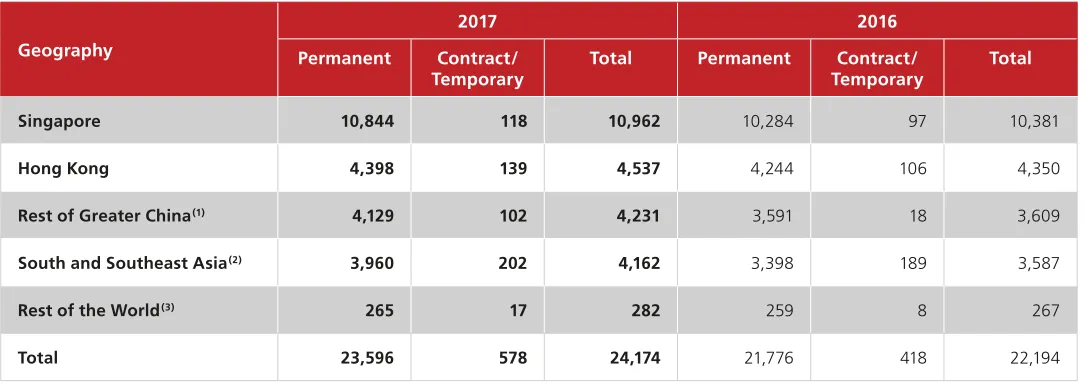
An agile and engaged workforce enables us to be nimble and react quickly to opportunities. Employees Employee engagement score Voluntary attrition rate Training hours per employee 22,194 81% 12% 36.4 24,174 82% 13% 31.5

One of our priorities is to future-proof our people and equip them with the necessary skills and tools to stay ahead of the curve.

In 2017, we launched DigiFY – a platform where our employees can acquire digital skills and knowledge.

Read more about this on page 106.

We utilise or enhance our resources to differentiate

ourselves and maximise value creation for our

stakeholders in the long run. Read more about how

we distribute the value created to our stakeholders

on page 24.

DBS Annual Report 2017 22

Resources Indicators 2016 2017 Key initiatives driving outcomes in 2017

Financial

Our strong capital base and diversified funding sources allow us to support our customers through good and bad times, and enable us to provide banking solutions competitively.

Shareholders’ funds

Customer deposits

Wholesale funding

SGD 45 bn SGD 347 bn

SGD 28 bn

SGD 47 bn SGD 374 bn

SGD 41 bn

We continued to build up shareholders’ funds by retaining a portion of our record net profits. We also grew our customer deposits and continued to widen our investor base as well as diversify wholesale funding sources.

Read more about this on page 30 and page 85.

Physical infrastructure

Our best-in-class technology and physical infrastructure allow us to be nimble and resilient.

Cumulative expenditure in technology – rolling four years

Of which relating to building for digital(3)

Branches

SGD 3.9 bn

SGD 1.4 bn

>280

SGD 4.3 bn

SGD 1.7 bn

>280

Over the past years, we have invested in our technology platforms to become digital to the core.

Read more about this on pages 12 to 17.

Natural resources

We impact the natural environment directly in our operations, as well as indirectly through our customers and suppliers.

Carbon emissions from purchased electricity (tCO2e) Energy

consumption (MWh)

Peak capacity of solar panels installed on premises 45,307 77,612 41,189 68,006 386 kW

We recognise the impact of climate change and are committed to reducing our environmental footprint as well as influencing our customers and suppliers towards more sustainable operations. Refer to “Sustainability” on page 97.

Societal relationships

We recognise that not all returns can be found in the financial statements and our licence to operate comes from society at large.

Customers under Social Enterprise Package

Number of social enterprises awarded grants Volunteer hours 459 12 37,000 490 14 53,000

We rolled out our enhanced responsible financing policies and processes in 2017 and undertook various sustainable finance initiatives, contributing to the Sustainable Development Goals.

Through DBS Foundation, we continue to nurture social enterprises across the region to enable them to scale and enhance their social impact through innovative and sustainable businesses.

Refer to “Sustainability” on page 97.

(1) Based on Ipsos Customer Satisfaction Survey (CSS) for Wealth Management, Scorpio Partnership CSS for Consumer Banking, and Nielsen SME Survey. Large corporates market penetration ranking from Greenwich.

(2) This relates to the consumer and SME businesses in Singapore and Hong Kong.

(3) This relates to technology spend on specific IT initiatives and enhancements, depreciation and new licence costs. Through the enhancement of our resources, value is created. We distribute this value to our stakeholders in several ways.

Read more on page 24.

(17)

How we distribute

value created

We distribute value

to our stakeholders

in several ways. Some

manifest themselves

in financial value while

others bring about

intangible benefits.

We define distributable financial value as net profit before discretionary bonus, taxes (direct and indirect) and community investments. In 2017, the distributable financial value amounted to SGD 5.92 billion (2016: SGD 5.80 billion).

In addition, we distribute non-financial value to our stakeholders in the following ways.

28%

Shareholders

Dividends paid to ordinary and preference shareholders and perpetual capital securities holders

48%

Retained earnings

Retained for reinvestment in our resources and businesses for growth which over time benefits all our stakeholders

11%

Employees

Discretionary bonus paid to employees through variable cash bonus and long-term incentives

Customers

Delivering suitable products in an innovative, easily accessible and responsible way.

Read more about this on pages 42 to 47.

Employees

Training, enhanced learning experiences as well as health and other benefits for our employees. Read more about this on pages 106 to 107.

Society

Supporting social enterprises, promoting financial inclusion, investing in and implementing environmentally-friendly practices. Read more about this on pages 98 to 99.

Regulators

Active engagement with local and global regulators and policy makers on reforms and new initiatives that help to maintain the integrity of the banking industry.

Read more about this on page 29.

13%

Society

Contributions to society through direct and indirect taxes, and community investments including donations, in-kind contributions and associated management costs

SGD 5.92 bn

Distributable

financial value

Distributable financial value

28%

13%

11%

48%

Identify

We identify matters that may impact the execution of our strategy. This is a group-wide effort taking into account input from all business and support units, and incorporating feedback from stakeholders.

Read more about our stakeholder engagement on pages 28 to 29.

Prioritise

From the list of identified matters, we prioritise those that most significantly impact our ability to successfully execute our strategy and deliver long-term value to our stakeholders.

Material

matters

Integrate

Those matters that are material to value creation are integrated into our balanced scorecard, which is used to set objectives, drive behaviours, measure performance and determine the remuneration of our people. Important matters are managed as part of our business and operational processes.

Read more about our balanced scorecard on page 38.

DBS Materiality Matrix

Material matters have the

most impact on our ability

to create long-term value.

These matters influence

how the Board and senior

management steer the bank.

Material environmental and social

matters are denoted with the symbols and respectively, and are further discussed in “Sustainability” on page 97. Governance matters are discussed in “Corporate Governance” on page 48.

E S Digital disruption and changing consumer behaviour Cyber security Financial inclusion Fair dealing Climate change Responsible tax management Sustainable procurement

Managing our environmental footprint

Financial crime

Talent management and retention

Diversity and equal opportunity

Evolving regulatory landscape

Workplace well-being Responsible financing

Im

p

o

rt

ance

t

o

st

ak

eholder

s

Importance for DBS’ value creation

Macroeconomic and demographic trends

(18)

Balanced scorecard indicator Material matters What are the risks? Macroeconomic

and demographic trends

China’s structural changes and multi-year reform agenda, geopolitical events such as rising tensions in North Korea or a step-up in trade barriers between the United States and China, and sociopolitical risks caused by tensions surfacing from the disenfranchised and underprivileged in society, could trigger corrections that adversely impact economic growth.

S

Talent management and retention

Failure to attract and retain talent impedes succession planning and expansion into new areas. Employees risk obsolescence if they are not well-equipped with changing skillsets required in this new digital age.

Digital disruption and changing consumer behaviour

Technology and mobility are increasingly shaping consumer behaviour. Traditional banks risk losing relevance to platform companies and fintechs.

Evolving regulatory and reporting landscape

The evolving regulatory and reporting landscape – including Basel reforms, overhaul of accounting standards, taxation rules around technology/ digital businesses, and extraterritorial application of laws (e.g. Markets in Financial Instruments Directive and General Data Protection Regulation) – may affect banks’ existing business models and give rise to compliance risks.

S

Cyber security

The prevalent threat of cyber attacks on financial institutions remains one of our top concerns.

S

Financial crime

Financial crime risks, including money laundering, sanctions and corruption, give rise to compliance and reputational risks.

S

Fair dealing

Banks are expected to deal honestly, transparently and fairly with customers, concepts which are articulated more explicitly in fair dealing standards. Failure to observe such standards gives rise to compliance and reputational risks, and erodes the trust of stakeholders.

E S Responsible financing

The public demands that banks lend only for appropriate corporate activities. Failure to do so gives rise to reputational and credit risks.

E

Climate change

Climate change poses serious threats to the global economy and can give rise to reputational, credit and operational risks.

S

Financial inclusion

While Asia’s rapid economic growth and development have led to an

improvement in living standards across the region, certain marginalised segments remain underserved in financial services.

Developing niche products for such segments may come at relatively high operating and credit costs for banks and erode shareholder value. Regulators

Enablers

Society Employees Shareholders

Digital transformation DBS Annual Report 2017

26 Material matters

Where do we see the opportunities? What are we doing about it?

Asia megatrends – from growing affluence, increasing urbanisation, surging consumption to huge infrastructure investments – provide massive opportunities for banks to provide financing and financial services, particularly in our growth markets.

Our multiple business lines, nimble execution and strong balance sheet will enable us to mitigate the risks and capture opportunities across the region.

Refer to “CEO statement” on page 18.

We see the opportunity to transform our workforce into an innovative and tech-savvy 24,000-person start-up.

This will enable us to be nimble and agile in responding to changes in our operating environment.

Refer to “Employer of Choice” on page 105.

A successful digital transformation will allow us to respond and innovate quickly to deliver simple, fast and contextual banking to our customers.

This will help us protect our position in core markets as well as extend our reach into emerging markets.

Refer to “Deeper. Broader. Smarter.” on pages 12 to 17.

With capital well above regulatory requirements, we are in a strong position to serve existing and new customers. We also have greater flexibility for capital and liquidity planning.

As a leading bank in our markets, we are well placed to provide appropriate responses to regulators and policy makers on regulatory developments.

Refer to “CFO Statement” on page 30, “CRO statement” on page 68 and “Capital management and planning” on page 92.

See also “Regulators and policy makers” on page 29.

A well-defined cyber security strategy that is well-executed gives confidence to customers and can differentiate us.

Refer to “CRO statement” on page 70 and “Cyber security and data protection” on page 99

A reputation for being clean and trustworthy can help us attract and retain customers and investors.

Refer to “CRO statement” on page 70 and “Preventing financial crime” on page 99.

Customers are more likely to do business with us if they believe that we are fair and transparent.

Refer to “Fair dealing” on page 99.

We have an opportunity to make a positive impact on society and the environment through our lending practices. Investors are increasingly looking to invest in companies engaged in sustainable practices.

Refer to “Responsible financing” and “Sustainable finance” on page 100.

Banks can play an influential role in shaping the transition to a low carbon economy, which in turn brings new opportunities and business growth.

Climate change is a wide topic addressed in various parts of our business, including “Responsible financing”, “Managing our environmental footprint” and “Sustainable sourcing”. Read more about this on pages 97 to 103.

With technological advancements, we see opportunities to drive costs down and develop a more inclusive financial system. This aligns with our digital agenda.

Refer to “Sustainable finance” and “Financial inclusion” on pages 100 to 101.

(19)

What our

stakeholders

are telling us

Shareholders

We provide investors with relevant information to make informed investment decisions about DBS as well as seek their perspectives on our financial performance and strategy.

Customers

We interact with customers to better understand their requirements so that we can propose the right financial solutions for them.

• Quarterly briefings on financial performance

• Regular one-on-one or group meetings with top management and senior business heads

• Investor roadshows

• Participation in investor conferences

• Multiple channels including digital banking, call centres and branches

• One-on-one interactions with relationship managers and senior management • Active interaction and prompt follow-up to

queries/ feedback received via social media such as Facebook, LinkedIn and Twitter • Annual customer engagement and

satisfaction surveys

• Involvement of customers through customer journeys in the redesign of our processes

• Business growth prospects in the face of digital disruption

• Credit risks of our oil and gas sector exposures and asset quality in general • Impact of Basel III capital reforms • Embedding sustainability considerations

in our business practices

• Sustained strong customer satisfaction scores across markets and segments • Positive feedback on how we delivered

our products and services to customers, particularly investment solutions and the relevance of digital channels

• Through customer journeys, customers provided insights on how we could make banking simpler, faster and more intuitive

At DBS Investor Day 2017, we shared our digital transformation strategy and demonstrated how digitalisation has increased the value of each customer relationship.

On asset quality, we sought to remove uncertainty by accelerating the recognition of residual weak oil and gas support service exposures as non-performing.

With clarity around the Basel capital reforms, the Board proposed a special dividend to return the capital buffers that had been built up over the years and determined that ordinary dividends could be sustained at higher levels.

We continue to take proactive steps to embed sustainability in our business model and are committed to transparent disclosures. Refer to “CFO statement” on page 30 and “Sustainability” on page 97.

We continued to incorporate customer feedback obtained as part of our customer journeys in the design of our products and services.

Refer to “Institutional Banking” on page 42, “Consumer Banking/ Wealth Management” on page 44 and “POSB” on page 46.

Dialogue and

collaboration with

our key stakeholders

provide insights

into the matters of

relevance to them.

Our key stakeholders are those who most materially impact our strategy, or are directly impacted by it. They comprise our shareholders, customers, employees, regulators and society at large.

Engagement with stakeholders provides us with an understanding of the matters they are most concerned with. These matters help us define our strategic priorities and guide our initiatives.

H o w d id w e e n g a g e ? W h a t w e re t h

e key t

o p ic s ra is e d a n d f e e d b a ck r e ce iv e d ? H o w d id w e r e sp o n d ? Employees

We communicate with our employees using multiple channels to ensure they are aligned with our strategic priorities. This also allows us to be up to date with their concerns.

Society

We engage the community to better understand the role we can play to address the needs of society.

Regulators and policy makers We strive to be a good corporate citizen and long-term participant in our markets by providing input to and implementing public policies. More broadly, we seek to be a strong representative voice for Asia in industry and global forums.

• “DBS Open” – quarterly group-wide townhalls hosted by CEO Piyush Gupta

• “Tell Piyush” – an online forum where employees can freely share their feedback and post their questions to the CEO • “Yammer” – our digital community platform

where employees across all levels engage and interact

• Regular department townhalls and events held by senior management to engage their teams on business plans, performance goals and other areas of interest

• Annual employee engagement survey

• Active monitoring of mainstream and social media

• In Singapore, staying true to our mission of being the “People’s Bank”, POSB plays an active role in engaging the community within our neighbourhoods and partnering with various agencies such as Community Development Councils and the People’s Association to make a difference in the lives of Singaporeans

• Working with social enterprises (SEs) across our key markets to understand their needs and help them become commercially viable while pursuing their social objectives • Community engagement through staff

volunteerism

• Frequent meetings and consultations with governments, regulators and other public policy agencies, led by our country chief executives and supported by their respective heads of legal and complian

Gambar

Table 1  Total number of employees by contract type and gender

Referensi

Dokumen terkait