election observation:
An external perspective
Introduction ... 5
The Paciic Islands forum mandate for election observation ... 6
Terms of reference ... 7
Principles for international election observation ... 9
Short-term, long-term or medium-term ... 10
Women in the PIF election observation missions ... 12
PIF election observation mission reports ... 13
The PIF election observation and follow-up policies ... 16
How to improve effectiveness of the PIF EOMs ... 18
Prospective role of the PIF in election observation ... 19
Abbreviations ... 23
should be made to: International IDEA SE – 103 34 Stockholm Sweden
Abstract
his paper provides a detailed analysis of PIF involvement in election observation. Its main purpose is to present practical and forward-looking recommendations to improve the efectiveness of the PIF EOMs in supporting electoral processes.
Attention is therefore focused on areas that can beneit the most from changes: namely, strengthening the methodological basis and comprehensiveness of the observation and follow-up activities. Each section examines selected issues and includes examples of best practice and arguments for their introduction.
Generally, more extensive use of the Declaration of Principles for International Election Observation and the Code of Conduct for International Election Observers is suggested. he Declaration can provide valuable guidance on how to conduct observations of the highest standards.
With regard to the Terms of Reference, contents should be modiied to indicate that elections have to be evaluated in relation to local laws, relevant international treaties and regional commitments. his is a more appropriate basis for evaluation than elusive ‘standards’ or ‘environments’. Moreover, provisions to safeguard citizens’ rights to access inal reports in a timely manner should be considered. Additionally, the Terms could underline the obligation to submit feedback on the EOM inal report and recommendations.
However, the key issue is to put greater emphasis on long-term monitoring and to focus attention on areas where problems actually exist. his could place the PIF EOMs, which so far are short-term missions, in a completely diferent league. For this purpose I propose the introduction of long-term observer teams, specialized missions and teams of experts to audit registration of voters and to monitor media or campaign inances. All these options could be used in a variety of lexible conigurations.
Nevertheless, long-term monitoring alone without far reaching changes in follow-up practices will not produce optimal results. Hence it is necessary to strengthen measures aimed at efective implementation of the EOMs’ recommendations. Again, this study suggests practical actions that should be taken to achieve this. hese activities include the need to develop standard follow-up procedures, pre-deployment explanatory visits and post-election feedback reports.
Introduction
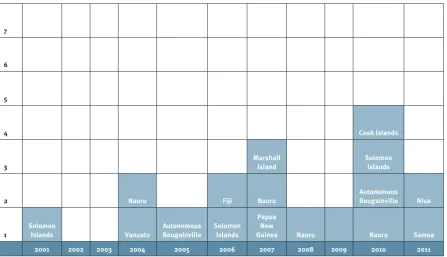
Since 2001 the Paciic Islands Forum (PIF) has deployed 16 Election Observation Missions (EOMs) to nine member states and has inevitably become a leading institution in election monitoring in the region. Indeed at present it is the only inter-governmental organization that is consistently observing elections in Paciic Island countries. his makes PIF activity in this area even more important and worthy of further development.
Coordination Team (UNEOCT). Nevertheless, beginning with the Fiji 2006 election the PIF has more often observed entirely independently. Year 2010 was signiicant as it saw a record number of four EOMs. his is an expression of the growing importance of democratic values and good governance principles among PIF members.
Because this year (2011) will be ten years since the irst PIF election observation mission, it is worthwhile summarizing the PIF’s experiences, and also looking at the methodology used and thinking about the prospective role of the Forum in election observation.
herefore this paper has very practical aims: to serve as a contribution and a modest input to discussion on possible ways forward that will make PIF election observation more proactive and useful as a tool in building democratic institutions and preventing conlict. his will all be considered with respect to established good practices and the speciic circumstances of the region.
The Paciic Islands forum mandate
for election observation
he document that provides the PIF mandate to observe elections in Forum member states is the Biketawa Declaration. he Declaration was adopted in 2000 in the face of escalating civil unrest in the Solomon Islands and the civilian led putsch in Fiji. In the Declaration the Forum Leaders committed themselves to ‘upholding democratic processes and institutions which relect national and local circumstances, including the peaceful transfer of power’ (PIF 2000: point 1.3). he Declaration also gives the Forum Secretary General a number of instruments to address crises, including ‘fact inding or similar missions’ (PIF 2000: point 2.3c). Shortly after the Biketawa Declaration was adopted the irst PIF Observer Group was sent to the 2001 Solomon Islands election.
In 2004 the Forum Leaders adopted the Leaders’ Vision. he Vision principles, such as quality of governance, the full observance of democratic values, and the defence and promotion of human rights (PIF 2004: 10), formulate a basis for the region’s future. To achieve these goals the Paciic Plan was subsequently drawn up and adopted a year later. It gives the PIF Secretariat an overreaching mandate but also tasks it to work on implementing the Plan. At the regional level the Leaders’ Vision made the PIF Secretariat responsible for the Paciic Plan’s implementation ‘in the irst instance’ (PIF 2007: 10).
In light of the PIF Secretariat’s obligations to work on implementation of the Paciic Plan, election observation missions can serve as an important supportive tool. In fact the missions’ reports provide information on how PIF countries fulill their own legal regulations, international human rights treaties and inancial accountability rules which are all main issues of the Paciic Plan. As only a well-diagnosed situation allows for wise action, the EOM reports are invaluable.
Nevertheless, in respect of the principle of non-interference and recognition of a country’s speciic circumstances, before any electoral observation the Terms of Reference are agreed between the PIF Secretariat and the host country authorities. hus the Terms must be considered as a crucial document in which the mandate and the aims of observers are ultimately determined. Details of the documents will be discussed in the next section.
Terms of reference
PIF EOMs reports usually publish only short quotations from the Terms of Reference.1
However, if we read these quotes attentively a few things will attract our attention. Among these are details of the observers’ tasks and information on the publication of the inal reports. For example, the Terms of the EOMs on the elections of the Autonomous Bougainville Government (ABG) states that observers have to ‘help maintain and build mutual conidence and trust during the election by the team’s presence’ and that the teams’ ‘presence, helps to ensure that the elections (…) are peaceful, orderly, free and fair’ (ABG 2005 and 2010: 2).
I see in this quotation a potential problem. Observers by their mere presence should not help to ensure that elections are ‘free and fair’. Observers are primarily there to observe and to assess honestly a process where outcomes cannot be predicted at the very beginning, especially in the case of post-conlict elections. What if an election turns out to be neither free nor fair? hen the observers’ statements should relect the situation. Critical reporting can act only in the opposite direction and contribute to undermining conidence. While I agree that observers can in fact have some impact on the overall atmosphere and enhance accountability, the impact is commonly overestimated. his is particularly the case if observers arrive only a day before voting commences.
he next objective of the Terms only reinforces this rhetoric. We read that observers have to ‘act as a neutral and independent source of assurance and validation that the elections are held in accordance with the principle of democratic good governance and relevant laws, and are free and fair’ (ABG 2010: 2 but also ABG 2005: 2).
Meanwhile, in contrast with the PIF Terms, the Oice for Democratic Institutions and Human Rights of the Organization for Security and Cooperation in Europe (OSCE/ ODIHR), in its Election Observation Handbook, widely praised for methodological
1 he quotations are published in the reports as follow: Solomon Islands 2010—Terms not published;
integrity, states clearly that ‘the mere presence of international observers alone, however, should not be viewed as adding legitimacy or credibility to an election process’ (OSCE/ ODIHR 2007: 11). Furthermore, in certain situations the presence of observers can add legitimacy to lawed processes even ‘regardless of what they said’ (Bjornlund: 127).
As we see, routine catchwords used in the Terms such as ‘acts as a source of assurance’, ‘helps to ensure’ or ‘to gain a broad overview of the environment’ (RMA 2007: 4, Nauru 2004: 2) do not provide observers with precise information on their role and tasks.
he problem is not limited to linguistic nuances. It is much deeper. Lack of precise and common points of reference in the assessment of elections weakens the potential of the PIF EOMs and the prospect for the implementation of recommendations (Meyer-Ohlendorf: 3).
Such universal references exist in the observed countries’ own legislations, in international human rights treaties and in regional commitments such as the Paciic Plan. Hence it is diicult to understand why they are not used in the PIF Terms.
As a positive example, I would like to quote the standard Terms of Reference of the Commonwealth Observers Group (COG) on the 2011 elections in Uganda. he COG Terms indicate that the elections will be assessed according to the ‘standards for democratic elections to which the Uganda has committed itself, with reference to national election-related legislation and relevant regional, Commonwealth and other international commitments’ (Commonwealth 2011a: 1).2
herefore, to realize the full potential of the PIF EOMs, the contents of the current Terms of References should be modiied in this direction. his would give PIF observers and host countries clear information about the kind of standards and legally binding documents against which the particular election will be assessed. he new Terms should indicate, as in the COG example from Uganda, that EOMs have to assess elections in relation to local laws, relevant international treaties (for example, he International Covenant for Civil and Political Rights) and regional commitments. his would empower EOMs and improve the possibility of their recommendations being implemented, because the main problems identiied would relate to the respective legal provisions that have been breached.3
I would like to discuss one more issue related to the current Terms. he published fragments raise questions about who should receive (and read) the inal report. In the texts, usually only the Secretary General of the PIF Secretariat, the governments and election management bodies are listed. Others, such as political parties and civil society organizations, are not.4
Moreover, in the case of recent elections in the Cook Islands (November 2010), Samoa (March 2011) and Niue (May 2011), EOM reports have not yet been published. Although
2 Similar references are applied by the OSCE/ODIHR. In the Election Observation Handbook we
read that the ODIHR ‘election missions assess election processes (…) for their compliance with OSCE commitments, as well as with international standards for democratic elections and with national legislation’ (OSCE/ODIHR 2010: 17).
3 Of course this will require goodwill on the part of the PIF member states and their leaders. As rightly
noted by Michael Meyer-Resende, election observation ‘is the most sensitive part of human rights work’. Basically, ‘while raising human rights concerns ordinarily does not question the legitimacy of one’s interlocutor, serious election concerns do exactly that’ (Meyer-Resende: 9).
elections in the Cook Islands were held twelve months ago, and those in Samoa eight months ago, the EOMs’ conclusions and recommendations remain unknown.
his situation signiicantly undermines observers’ eforts and the possibility of using post-election momentum to plan and carry out necessary reforms. But, most of all, this delay does not respect the rights of citizens, who are the principal owners of electoral processes. Citizens and civil society organizations deinitely have the right to access the EOMs’ reports in a timely manner. After all, ‘international election observation is conducted for the beneit of the people of the country holding the elections’ (Declaration of Principles: point 6).
Unfortunately, in current practice this is not the case. Again, as a solution I would like to propose the already cited Terms of the COG on the 2011 elections in Uganda. hese Terms specify that the inal report will be forwarded ‘to the Government of Uganda, the Electoral Commission, political and civil society organizations’ (Commonwealth 2011a: 1).
As we see, political and social organizations are speciically noted among the recipients of the inal report. In practice, this means public distribution and the possibility for any citizen to read the content. Based on the COG example, in order to protect the rights of citizens to see the PIF EOMs reports, it is necessary to modify the current PIF Terms by introducing a similar provision. Moreover, to make current practice consistent with the Declaration of Principles for International Election Observation, and to realize the full potential of the election observations, all PIF EOMs reports should be published as widely as possible and no later than two months after the election. Furthermore, the practice of publishing the full text of the Terms in the inal reports should be considered.
Principles for international election observation
he Paciic Islands Forum was among the irst organizations to endorse the United Nations Declaration of Principles for International Election Observation and the Code of Conduct for International Election Observers (2005).5 he Principles commit observers to a number
of rules, such as the need for long-term and comprehensive monitoring and the requirement to understand the voting day in its context. Although not legally binding, this document provides valuable guidance on how to conduct an election observation at the highest standard. Hence it is used by almost all international organizations regularly observing elections.
In the Commonwealth Observers Group reports, as an expression of adherence to certain standards, are annotations that election observation is ‘conducted in accordance with the Declaration and Commonwealth Observers undertake their duties in accordance with the Code of Conduct’ (for example Commonwealth 2011b: 44). Similar annotations are included in reports of the Carter Center missions and the European Parliament Election Observation Delegations (EP EOD).6 However, though the PIF is also among the endorsing
organizations, this information does not appear in its electoral reports. In a total of nine
5 It is interesting that among the endorsing organizations the PIF is mentioned as Paciic Island Forum
not Islands.
6 For example, the EP EOD on the parliamentary elections in Tajikistan (EP 2010: 2) or the Carter
published reports, only one has any information in this regard.7 he same is true of the Code
of Conduct. Only two reports reveal that the PIF observers signed the Code.8 Of course
this does not prejudice the observation mission, but in accordance with the Declaration all observers are obliged to state their adherence to the Code (Declaration: point 21e).
It is well to note here that the Political Governance and Security Programme Strategic Plan for the years 2009-2011 expressed the will to conduct election observation with ‘high quality reports produced’ as the performance indicator (PIF 2010: 9-10). In light of this, the PIF Secretariat should consider if it would be valuable to publish in further reports the information that the PIF EOMs are conducting observations in accordance with the Declaration and that all observers have signed the Code of Conduct. In efect, this would prove that observations are in accordance with a practically tested and comprehensive methodology. Moreover, the Declaration should be used as a working tool to enhance the methodological integrity of the PIF EOMs, beginning with deining the Terms of Reference and continuing to the writing of the inal reports.
Short-term, long-term or medium-term
It is hard to imagine a more diverse and challenging region for election observers than the Paciic Islands. We have Nauru, where one pair of observers can visit all polling stations (Nauru 2007: 4), Papua New Guinea (PNG), where voting procedures, due to the ‘logistical delays,’ took 22 days (PNG 2007: 4-5), and Fiji, with its over 106 inhabited islands. his obviously afects the possibility of proper observation. Transportation problems over large territories with dispersed populations make observation diicult.
Yet the PIF EOMs usually arrive only very shortly before voting starts. In the case of ABG elections in 2005, the mission was for three days only, and in 2010 the mission began only one day before the voting. he 2006 mission to Fiji was formed ive days before polling period but spent the irst two days on ‘brieings’ in Suva (Fiji 2006: 1). On this basis we can consider the missions as short-term.
However, the Terms of Reference provide for more comprehensive observation. In the PNG 2007 Terms we read that the mission will ‘observe the preparations for the election, the polling, counting and results process’ (PNG 2007: 3). he Vanuatu 2004, Nauru 2007 and the Republic of the Marshall Islands (RMA) 2007 Terms deine observation in a more compact form as ‘before, during and after’ (pages: 1, 3 and 4). he Nauru 2008 conditions even provide for monitoring ‘formation of government’ and ‘parliamentary and political consequence’ (Nauru 2008: 2).
As we see, the current practice, at least to some extent, contradicts the Terms of Reference. Indeed, according to Walter Rigamoto, who participated in the PIF EOM to Vanuatu
7 ‘Observers were also provided with the Declaration’ (Solomon Islands 2010: point 2.3). But the EOM
operated within the framework of the international mission coordinated by the UNEOCT.
8 hese are the above-mentioned reports from the Solomon Island election (2010: point 2.3) and the
(2004),9 it was ‘short-term election observer missions as opposed to long-term’ (Rigamoto:
1). Observers themselves admit the fact in reports. For example, in the already quoted RMA 2007 report we read that as ‘the Election Observer Team was a short term mission, we were able to observe a limited part of the election campaign’ (RMA 2007: 14).10
Although the PIF EOMs cannot be regarded as long-term missions, due to the often long voting and/or counting procedures observers stay on duty for weeks.11 Two or three weeks
in a particular country actually allow for collecting substantial information, especially when the electoral calendar itself is very short. hus, at least some of the missions can be considered as somewhere between short-term and long-term.
Yet this does not change the fact that Rigamoto is quite right to say that for short-term missions (including those two to three weeks long) it is not ‘always easy to make a proper assessment’ (Rigamoto: 1). his is apparent if we compare some of the PIF EOMs and the Commonwealth Observer Groups reports. Here the Solomon Islands and Fiji 2006 elections can be used as comparative cases because both were observed by organizations that produced their own reports. he Commonwealth missions, however, had an essential advantage in the form of ‘advance observers’ (Commonwealth 2006a, b) who arrived one to two weeks earlier. In this comparison it is evident that lists of voters, electoral campaigns and campaign inancing are areas that require more attention, and for this purpose long-term or specialized missions are deinitely needed.
Perhaps in the light of these issues it would be valuable for the PIF Secretariat to consider changes in current practice. Earlier arrival of teams of long-term observers, the entire mission arriving a week earlier in the country, specialized missions or teams of experts to audit registration of voters or monitor media and campaign inances should be among the options for consideration. hese actions should be supported when necessary by more numerous teams of short-term or medium-term observers.
In this case closer cooperation with the Commonwealth (or other partners) in the framework of joint missions would be invaluable and would enable sharing of costs and experience. It would then be possible to use checklists in a broader form to collect data on voting and counting procedures for statistical analysis.
All these options could be used in diferent lexible conigurations with respect to a particular country’s needs, population or geographical constraints. If used efectively as a tool, they would form the basis for more professional observation, monitoring and assessment of elections in PIF member states.
9 He also held the position of Head of Mission in Vanuatu (2004) and participated in the mission to
Nauru (2010).
10 Similar annotations are in reports PNG (2007: 3); Solomon Islands (2006: 1); Fiji (2006: 2) and ABR
(2010:1).
11 he ABG elections were observed for 17 (2005) and 22 days (2010), the PNG 2007 election for in total
Women in the PIF election observation missions
Extremely low representation of women in parliaments is a constant problem among PIF member states. It is enough to mention that the parliaments of the Federated States of Micronesia, Nauru, Palau and the Solomon Islands12 do not have a single woman member.13
In the case of parliaments in the Republic of the Marshall Islands, Papua New Guinea, Tonga and Tuvalu there is only one woman per parliament.14
he PIF EOMs pay attention to this situation. PIF inal reports usually include a section on women’s participation and make recommendations. Yet there is still a possibility for improvement in the reporting. Instead of using imprecise terms such as ‘encourage the participation of women’ (Solomon Islands 2010: points 6.20-6.21) observers should instead refer to internationally binding treaties such as the CEDAW (Article 7).15 his would
increase leverage and give a common reference point for evaluations.
PIF observers are more than well placed to advocate for change. Having endorsed the Declaration of Principles for International Election Observation, PIF EOMs should examine and report any gender-based discrimination they notice (Declaration: point 5). But primarily the PIF itself should ‘balance gender diversity in the composition of participants and leadership’ of electoral missions (Declaration: point 20).
Signiicantly, in contrast to the missions of other organizations, the PIF EOMs seem to be well balanced in terms of gender. As we see in Table 1, the overall proportion of women among the PIF observers is 38 per cent. Even if we only consider external experts, participation of women still remains at a good level (25 per cent). Moreover, women dominate among the Secretariat oicials sent to observe elections. In this group, they represent 68 per cent.
By comparison, in EP EODs in the years 2004-2009 women constituted 27 per cent of members and 31 per cent of missions heads (Hall: 4). In the case of the Parliamentary Assembly of the OSCE, women represented scarcely 20 per cent of the Assembly observers (dates for the years 2009-2011, OSCE PA: 28).
he only serious deiciency in the gender balance of the PIF EOMs is the fact that Heads of Mission are exclusively men. If the Secretariat wants to adhere fully to the Declaration of Principles for International Election Observation it should give women an opportunity to occupy these positions. In addition, a better gender balance among the external experts and the deployed Secretariat oicials should be considered.
12 Since independence in 1978 only one woman has been elected to the Solomon Islands Parliament. 13 his represents half of all parliaments in the world without women member. Inter-Parliamentary Union
at : http://www.ipu.org/wmn-e/classif.htm
14 All dates are from the Inter-Parliamentary Union website and available at
<http://www.ipu.org/wmn-e/classif.htm>, accessed 4 November 2011.
15 As a good example, see the report of the PIF EOM to Fiji, where we read ‘political participation is a
PIF election observation mission reports
Although the PIF EOMs are not long-term missions, in the inal reports observers try to assess elections in a broader perspective. In this section we look at the reports’ contents. he issue to be explored is the extent to which EOMs, within their own well-acknowledged limits, are able to achieve balanced assessments.
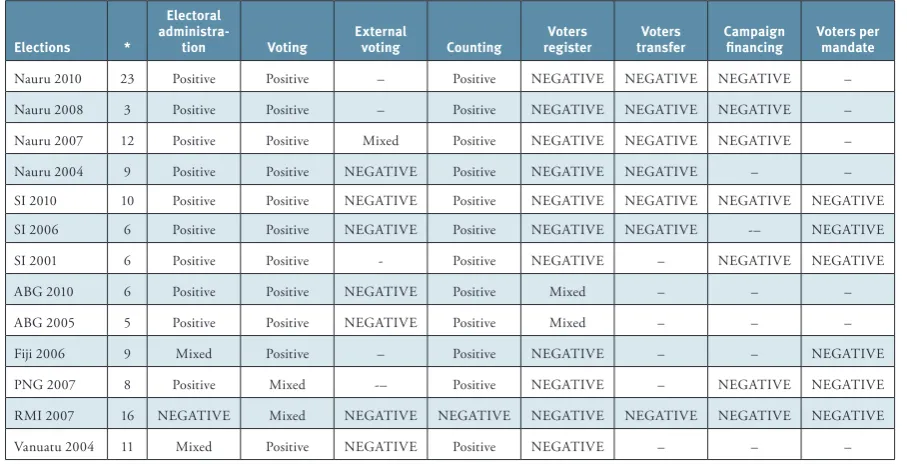
When we read the inal conclusions of these reports, we see that all elections were generally evaluated positively. While numerous shortcomings and problems were noted, none of these separately, or even together, were suiciently serious to place the outcomes in question. Table 2 summarises the key issues examined in the reports and the general conclusions expressed in the texts. If the respective problems were limited to administrative or organisational matters, and not serious enough to undermine the election’s credibility, then the corresponding area is marked as ‘positive’.
As we see, voting and counting were almost always evaluated positively. he procedures can be well covered by short-term observers. By contrast, the most common problems related to electoral rolls, campaign inancing, transfers of voters between constituencies and diferences in the number of voters per constituency. All these problems require long-term or specialist observation. But PIF EOMs are short-term missions. Is this a problem? Does this have any afect on the observers’ conclusions? Would long-term observers be more critical? hese are important questions.
No Elections Men Women’ Chief Observ-ers
1 Solomon Islands 2001 4(2) 3(2) M
2 Vanuatu 2004 2(1) 0 M
3 Nauru 2004 3(1) 0 M
4 ABG 2005 3 2(1) M
5 Solomon Islands 2006 5(1) 4(1) M
6 Fiji 2006 19(3) 6(3) M
7 Papua New Guinea 2007 3(1) 2(2) M
8 Nauru 2007 1 3(2) ?
9 RMI 2007 3(1) 3(2) ?
10 Nauru 2008 0 2(1) ?
11 Nauru 2010 2(1) 1(1) M
Table 1. Gender balance and the PIF oficials in the elections observation teams
(Source: the PIF Election Observation Reports 2001–2011)
Legend
M Man
2 Total number of observers
(1) Number of the PIF Secretariat oicials
Elections in Nauru will serve us as an example to analyse the problem. he PIF EOMs observed a record number of four elections in the country (2004, 2007, 2008 and 2010). his represents one quarter of all elections observed. In the reports, observers constantly return to the same problems of the transfer of voters between districts and of campaign inancing.
Regulations in the Nauru Election Act allow for transfer of voters from one constituency to another, in practice without any obstacle. he situation gives some candidates an incentive to transfer supporters and relatives to the constituency in which they actually compete. Because the total number of voters per constituency remains small (usually some six hundred), the outcome and the composition of parliament is often decided by a few votes. hus the other candidates, regardless of whether they want to or not, are forced to join in the ‘transfers’ competition to diminish the negative efect.
he problem was already noted in the report from the 2004 election (Nauru 2004: 3), although the next report discussed the issue more substantially. In 2007 observers noted as a common theme an ‘increase in the use of cash in election campaigning, with strong allegations of “vote buying” in this election on a scale never before seen in Nauru’ and
Nauru 2010 23 Positive Positive – Positive NEGATIVE NEGATIVE NEGATIVE –
Nauru 2008 3 Positive Positive – Positive NEGATIVE NEGATIVE NEGATIVE –
Nauru 2007 12 Positive Positive Mixed Positive NEGATIVE NEGATIVE NEGATIVE –
Nauru 2004 9 Positive Positive NEGATIVE Positive NEGATIVE NEGATIVE – – SI 2010 10 Positive Positive NEGATIVE Positive NEGATIVE NEGATIVE NEGATIVE NEGATIVE SI 2006 6 Positive Positive NEGATIVE Positive NEGATIVE NEGATIVE -– NEGATIVE
SI 2001 6 Positive Positive - Positive NEGATIVE – NEGATIVE NEGATIVE
ABG 2010 6 Positive Positive NEGATIVE Positive Mixed – – –
ABG 2005 5 Positive Positive NEGATIVE Positive Mixed – – –
Fiji 2006 9 Mixed Positive – Positive NEGATIVE – – NEGATIVE
PNG 2007 8 Positive Mixed -– Positive NEGATIVE – NEGATIVE NEGATIVE
RMI 2007 16 NEGATIVE Mixed NEGATIVE NEGATIVE NEGATIVE NEGATIVE NEGATIVE NEGATIVE
Vanuatu 2004 11 Mixed Positive NEGATIVE Positive NEGATIVE – – –
Table 2. Elections assessments by the PIF EOMs 2001–2010
(Source: PIF Election Observation Reports 2001–2010)
Legend
SI Solomon Islands
* Number of recommendations in the inal report
– Not discussed speciically
were ‘consistently told that cash was being directly handed out to voters by candidates, used by some to pay for voter transfers into the relevant candidate’s districts’. Moreover, we read that allegedly the so call ‘grass-roots’ development funds (granted directly to the parliamentarians) were spent on the campaign, and that several candidates noted that ‘at last some candidates and voters viewed votes as a commodity to be bought and sold’ (Nauru 2007: 10-11). All this took place in the total absence of regulations on inancing.
In efect the EOMs proposed four recommendations in this area. Unfortunately, these recommendations have not been followed (Nauru 2007: 16 - recommendation 2, 3, 5, 6). We can see the result in Table 3. Just a year later, during the next election, 418 voters were transferred in three days and many Naurans openly admitted that the system is used ‘by both voters and candidates to facilitate large-scale buying and selling of votes’ (Nauru 2008: 5). However, this was not observed directly by the PIF observers. Although the Forum has sent four EOMs to this country, it has never observed the transfer procedures. he reason for this is simple. he observers have always been sent too late. In 2007 they arrived 13 days after the closure of the electoral roll, and in 2008 they arrived four days too late.16
he next early election in 2010 brought a record-breaking number of 1228 transfers.17 Over
20 per cent of voters changed their constituencies using a system open to abuse.18 his raises
the essential question of whether these transfers had an impact on the inal results.
Once more the PIF EOM did not observe the problem directly. he missions arrived in Nauru two weeks after the closure of electoral roll, too late to have any opportunity to observe the transfers.
his example primarily shows how important is the extent to which elections are observed. It shows also that although voting and counting can always be assessed positively, more
16 However, the elections were exceptional. he president declared a State of Emergency on 18 April 2008,
dissolved parliament and on the same day issued a writ for an election to be held eight days later (Nauru 2008: 2).
17 As we learn from the report, this igure is somewhat overstated because some voters changed
constituency several times shortly before the electoral roll closure (Nauru 2010: 14). he report, however, does not give us an answer to the question about the cause of this behavior.
18 Already in 2007, observers noted concerns that the ‘system could be easily abused (and some asserted
it was already being abused), with the large-scale transfers of voters by candidates into constituencies with which the voters had no genuine connection’ (Nauru 2007: 8).
Election Registered voters Number of transfers % of registered
2010 5650 1228 22%
2008 – 418 (in three days!) –
2007 5108 782 15%
2004 4588 560 12%
Table 3. Transfers of voters between constituencies before elections in Nauru 2004-2010
systemic problems can have a far-reaching impact on the inal results and on the quality of democracy in general. Hence, when planning observations, observers should particularly take into account problem areas already identiied. To observe efectively they should focus attention and direct observation on the areas where problems actually exist. his is an important issue because, as conirmed by the example of Nauru, during the next elections unresolved problems usually become only more serious.
The PIF election observation and follow-up policies
Election observation is not an end in itself. Information collected and recommendations proposed should serve countries and their citizens. Recommendations represent a chance for follow-up activities and consequently an opportunity to solve the problems identiied, but the necessary actions should be planned promptly after the election.
In practice proper follow-up is a matter of concern for all organizations engaged in election observation in a consistent manner. It is enough to mention that the OSCE/ODIHR in the most recent sixth edition of the Election Observation Handbook acknowledges honestly that ‘due to its limited resources, the ODIHR Election Department has, so far, been unable to sustain broad, systematic follow-up eforts’ (OSCE/ODIHR 2010: 98). Nevertheless, in line with the recently increasing emphasis on the proper use of recommendations, the ‘ODIHR has been exploring ways to intensify follow-up eforts and make the follow-up more meaningful and more systematic’ (OSCE/ODIHR 2010: 98).19
he Paciic Islands Forum is not an exception here. Its Political Governance and Security Programme Strategic Plan for the years 2009-2011 lists among the key performance indicators that the ‘recommendations of observer reports are followed up with countries as required’ (PIF 2010: 9). According to the Plan, this should be done in accordance with the observed country feedback and ‘follow up assistance coordinated e.g. consultancies, reviews’ (PIF 2010: 9). But this should not exhaust the list of possible actions. Indeed there are many more activities that could be undertaken to improve the efectiveness of follow-up. Among them pre-deployment visits to discuss with the host state authorities the follow-up activities that result from the observation would certainly be useful. Better understanding of the EOM role on the inviting side and the need for subsequent action to address identiied weaknesses would also be invaluable. Moreover, there should be a Head of Mission visit to oicially transmit the inal report, and a post-election roundtable of all stakeholders, including civil society organizations, to discuss possible electoral assistance programmes and how the Secretariat could help raise awareness. Roundtable discussions would also help ensure implementation of recommendations.
19 he same is true in the case of the European Parliament. In its Conference of Presidents Decision of
Another step would be to take the indings of the EOMs more fully into consideration in the Peer Reviews and the Paciic Plan Annual Progress Reports.20 Ultimately, the missions
provide information on countries’ adherence to the Paciic Plan commitments and, when more than one election has been observed, on the progress made as well.
Here, however, I would like to pay special attention to one initiative. Recently the OSCE/ ODIHR sent Election Assessment Missions to the general elections in Norway (September 2009) and the United Kingdom (May 2010). As usual in inal reports,21 observers proposed
numerous improvements in areas where legal arrangements or practice were inconsistent with OSCE commitments. A couple of months later both governments responded to the OSCE reports with detailed analysis of the recommendations and information on planned reforms (Norwegian Government 2010a, b and United Kingdom Government 2011). his move established a standard to which any follow-up activities can be compared. In the long run it could lead to the adoption of regular reporting procedures, which would mean a huge improvement in current practice. In fact representatives of both countries expressed the hope that the next OSCE member states will follow suit.22
I cannot see any reason why the PIF Secretariat could not encourage, and the PIF member states adopt, a similar approach. his could be done by including notation in Terms of Reference to state that election observation includes an important follow-up component, and by imposing an obligation to submit formal feedback on the EOM report with information on planned actions in response to identiied irregularities and problems.
he money and efort invested in the EOMs deserve to be efectively used. Ultimately it is an opportunity for member states to strengthen their own electoral systems. his is also an opportunity for the PIF, by adoption of a reporting mechanism, to establish itself as an example for other organizations. But of course this would require a signiicant measure of goodwill and understanding among the governments of the member states.
20 he Paciic Plan 2010 Annual Progress Report mentions the word ‘democracy’ once, in the Secretary
General’s Introduction. he word ‘election’ is also used only once and in relation to assisting Tonga to redraw its electoral boundaries. Although they are more frequent in the 2010 Progress Report Annex, the terms do not appear at all in the 2008 and 2009 Annual Progress Reports. It seems that in all the reports there is nothing on the implementation of the EOMs’ recommendations. All the reports are available on the PIF Secretariat website at: <http://www.forumsec.org/pages.cfm/newsroom/publications/paciic-plan-progress-reports.html>
21 Both reports of the OSCE/ODIHR Election Assessments Missions are available on the ODIHR website
under the links: <http://www.osce.org/odihr/elections/norway/40529>, <http://www.osce.org/odihr/ elections/69072> for Norway and the United Kingdom respectively, accessed 4 November 2011.
22 he ‘United Kingdom calls on all participating States to adopt a similar approach in cooperating
How to improve effectiveness of the PIF EOMs
On the basis of the analyses in the previous sections, a comprehensive summary of proposed changes is presented here. he proposals are divided into sections corresponding to major themes. Some of these are organizational, while others focus on more general matters.
General
1. Detailed and comparative evaluation of current practices should be undertaken to identify necessary improvements on the basis of regional organizational experience and with the Declarations of Principles for International Election Observation as a reference document.
2. he PIF Secretariat should consider strengthening cooperation and exchange of experiences with the Commonwealth and the European Commission in the ield of election observation.
3. Before each EOM a detailed analysis of previous reports, including those prepared by other organizations, and of follow-up activities conducted by the country should be carried out.
4. Final reports should be published and distributed no later than two months after the election.
Terms of reference
1. Terms of Reference should refer to the legally binding commitments to which the country has voluntarily agreed to adhere as reference points for the assessments made by observers.
2. Terms of References should include notation that the inal report also be made available to ordinary citizens as the principal owners of the electoral process.
3. Terms of Reference should include notation that election observation includes an important follow-up component and an obligation on the part of governments to submit formal feedback on the EOM report.
4. Finally, in the name of transparency, the full text of the Terms of Reference should be published in the inal reports.
Observation methodology
1. In general the work time of the EOMs should be extended and some missions should be enlarged to observe the electoral process more comprehensively.
2. he possibility should be considered of sending Expert Team or long-term observers to observe processes that require an earlier presence in the country (especially registration of voters and election campaign inance).
4. Wider use of checklists to collect data on voting and counting procedures should be considered. hese could provide the basis for statistical analysis of the quality of these processes.
Gender equality
1. he PIF should consider appointing women to the position of Head of Mission.
2. he PIF should aim to improve the gender balance among external experts and PIF oicials sent on EOMs.
Final report contents
1. Final reports should state that the PIF endorses the Declarations of Principles for International Election Observation and stress that PIF EOMs are observing in accordance with the Declaration, and that PIF observers have signed the Code of Conduct.
2. Final reports, and especially recommendations, should when possible contain references to local laws, relevant human rights treaties and regional commitments which the country has agreed to abide by.
3. Reports should be more balanced with an emphasis on pre-election day processes.
Follow-up procedures
1. Development of standardized follow-up procedures for implementation after each EOM.
2. Head of Mission to visit in order to oicially transmit inal reports, and roundtables of all stakeholders, including civil society organizations, to discuss possible electoral assistance programmes and how the Secretariat could help ensure realization of recommendations.
3. Subsequently, as a recommended practice, the country whose elections have been observed should develop a report that includes a response to the EOM recommendations and information on planned actions in response to identiied irregularities and problems.
4. he PIF Secretariat should take into consideration more fully the EOMs’ indings in the Paciic Plan Annual Progress and other reports.
Prospective role of the PIF in election observation
he PIF, with 16 EOMs deployed so far, has already established itself among the regional organizations that observe elections in the member states. In fact, at present it is the only organization observing elections in the region on a permanent basis. his is not likely to change in the foreseeable future23 and means that there is a space and a role that can be
illed only by the PIF.
It is worth noting that the Forum has regional expertise and necessary lexibility. hese are signiicant assets in the context of regional diversity where standard, large and structured EOMs in most cases are not needed,24 or even if needed are not feasible due to very high
costs.
Bearing all this in mind, possible improvements have already been discussed in this article. Generally, instead of increasing the number of missions, it would be better to broaden the scope of observation. In particular, three areas require attention. hese are the methodological basis, the comprehensiveness of the observation, and the follow-up activities. he emphasis on long-term monitoring proposed here, and a focus on the most common problems, together with other arrangements, could place the PIF EOMs in a completely diferent league. Yet additional inancial costs would be moderate. Ultimately the extra money spent on election observation will bring tangible beneits. After all, the quality of electoral processes has an impact on governance, corruption and even internal security.25
he world moves forward quickly and election observation is changing too. here are plenty of examples of the ongoing professionalization in this area that can be studied. It is enough to mention that the EP recently revised its Provisions Governing Election Observation Delegations. In the new document, which focuses on long-term observation, we read that ‘no oicial election observation delegation may be organized in countries where no long-term observation mission is present’ (EP 2009a: Article 4).
In the face of these changes the PIF Secretariat and the member states have two possibilities. hey can revise current practices and build on the basis of experience (including the experience of other regional organizations) or, conversely, they can continue observations in the current format. Yet whichever decision is taken, election observation will continue to serve the PIF states and their citizens in better observing fundamental human, civil and political rights. Nevertheless, without changes the unused potential of the EOMs will remain and will grow in following years. his would be greatly detrimental because, despite geographical challenges, the PIF has the potential to observe and monitor elections in a manner that could become an example for other organizations.
23 he European Union has sent to the region one mission and the EP one delegation. his is all in over
20 years of EU involvement in election observation around the world. Only one COG was sent in the years 1990–2000 (Commonwealth 2004a: 89), although in the next decade there were ive more and a further four missions were organized jointly with the PIF. he Carter Center has not observed a single election in the PIF member states.
24 For example, we have countries such as Niue, with little more than a thousand voters, and Nauru, with a
total of 14 polling stations, but also Papua New Guinea, where the 2007 election voting took 21 days.
25 And more broadly ‘the quality of democracy greatly afects the quality of development’ (Rich: 2), quoted
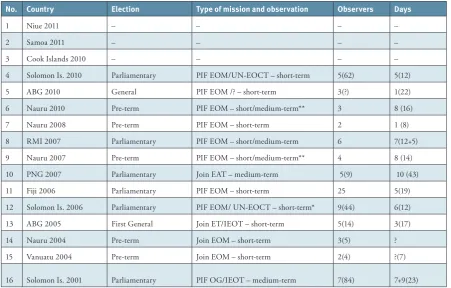
No. Country Election Type of mission and observation Observers Days
1 Niue 2011 – – – –
2 Samoa 2011 – – – –
3 Cook Islands 2010 – – – –
4 Solomon Is. 2010 Parliamentary PIF EOM/UN-EOCT – short-term 5(62) 5(12)
5 ABG 2010 General PIF EOM /? – short-term 3(?) 1(22)
6 Nauru 2010 Pre-term PIF EOM – short/medium-term** 3 8 (16)
7 Nauru 2008 Pre-term PIF EOM – short-term 2 1 (8)
8 RMI 2007 Parliamentary PIF EOM – short/medium-term 6 7(12+5)
9 Nauru 2007 Pre-term PIF EOM – short/medium-term** 4 8 (14)
10 PNG 2007 Parliamentary Join EAT – medium-term 5(9) 10 (43)
11 Fiji 2006 Parliamentary PIF EOM – short-term 25 5(19)
12 Solomon Is. 2006 Parliamentary PIF EOM/ UN-EOCT – short-term* 9(44) 6(12)
13 ABG 2005 First General Join ET/IEOT – short-term 5(14) 3(17)
14 Nauru 2004 Pre-term Join EOM – short-term 3(5) ?
15 Vanuatu 2004 Pre-term Join EOM – short-term 2(4) ?(7)
16 Solomon Is. 2001 Parliamentary PIF OG/IEOT – medium-term 7(84) 7+9(23)
Table 4. PIF Election Observation Missions 2001-2011
(Source: he PIF Election Observation Reports 2001–2010)
Legend
– Dates are lacking because the report has not yet been published. OG Observer Group
Join EOM Join Election Observer Mission together with the Commonwealth Join ET Join Expert Team together with the Commonwealth
Join EAT Join Election Assessment Team with the Commonwealth IEOT International Election Observer Team
PIF EOM Paciic Islands Forum Election Observation Mission/Election Observers Team
UN-EOCT United Nations Elections Observation Coordination Team
? To the EOM joined other ‘international observers’ but the report did not provide any detail on numbers
? he dates of the EOM are not speciied in the report 3 PIF observers
(5) Total number of observers in the framework of the IEOTs or Join Missions 3 Days of observation before polling day
(17) Total number of observation days
* Two ‘advanced’ Commonwealth observers were deployed earlier ** Very short electoral calendar
7(12+5) due to the controversies with counting and re-counts one observer conduct 5 days long follow-up visit
7
6
5
4 Cook Islands
3
Marshall Island
Solomon Islands
2 Nauru Fiji Nauru
Autonomous Bougainville Niue
1
Solomon
Islands Vanuatu
Autonomous Bougainville
Solomon Islands
Papua New
Guinea Nauru Nauru Samoa
2001 2002 2003 2004 2005 2006 2007 2008 2009 2010 2011
Table 5. Number of the PIF Election Observation Missions per year 2001–2011
Abbreviations
ABG Autonomous Bougainville Government
CDI Centre for Democratic Institutions
CEDAW Convention on the Elimination of All Forms of Discrimination against Women
COG Commonwealth Observers Group
EOD Election Observation Delegation
EOM Election Observation Mission
EP European Parliament
ODIHR Oice for Democratic Institutions and Human Rights
OSCE Organization for Security and Co-operation in Europe
PIF Paciic Islands Forum
PIFS Paciic Islands Forum Secretariat
PNG Papua New Guinea
RMI Republic of the Marshall Islands
SI Solomon Islands
UN United Nations
Bibliography
Bjornlund, Eric, Beyond Free and Fair: Monitoring Elections and Building Democracy (Woodrow Wilson Centre Press and the Johns Hopkins University Press, 2004)
Carter Center, Observing Sudan’s 2010 National Elections 11-18 April 2010, Final Report, available at <http://www.cartercenter.org/resources/pdfs/news/peace_ publications/election_reports/FinalReportSudan-Apr2010.pdf>,
accessed 4 November 2011
Chambers, Richard, ‘Election Observation by the European Parliament in the OSCE Area’, EP Publication (Directorate General for External Policies of the Union, Policy Department, 2010) <http://www.europarl.europa.eu/activities/committees/studies/ download.do?language=en&ile=30201#search=%20osce%20>,
accessed 4 November 2011
Convention on the Elimination of all Forms of Discrimination against Women, (United Nations 18 December 1979, entered into force 3 September 1981), available at <http://www.un.org/womenwatch/daw/cedaw/text/econvention.htm>,
accessed 4 November 2011
Commonwealth 2004a, Commonwealth Public Administration Reform: Government and Institutional Development Division, Commonwealth Secretariat (Commonwealth Secretariat 2004)
Commonwealth 2006a, Solomon Island General Election 5 April 2006 Report of the Commonwealth Observers Group Report, available on the Commonwealth Secretariat website at <http://www.thecommonwealth.org/Shared_ASP_Files/UploadedFiles/ C4E1BBD5- 676D-490B-B5ED-6C51F43E0BFE_SolomonIslandsCOGReport2006- amalgamated.pdf>, accessed 4 November 2011
Commonwealth 2006b, Fiji Islands General Election 6-13 May 2006 Commonwealth Observers Group Report <http://www.thecommonwealth.org/Shared_ASP_ Files/UploadedFiles/CA16B913-2D20-4058-874A-52BBDE02BCD2_ FijiGeneralElection2006-ReportoftheCommonwealthObserverGroup.pdf>, accessed 4 November 2011
2011a Report of the Commonwealth Observer Group on Uganda Presidential and Parliamentary Elections 18 February 2011, available at
<http://www.thecommonwealth.org/iles/235815/FileName/Uganda-COG-Final-Report.pdf>, accessed 4 November 2011
Declaration of Principles for International Election Observation and Code of Conduct for International Election Observers (United Nations 24 October 2005), available at<http://www.cartercenter.org/documents/2231.pdf>, accessed 4 November 2011
2010 Election Observation Delegation to the Parliamentary Elections in Tajikistan 28 February 2010, accessed at 4 December 2011 and available at <http://www.europarl. europa.eu/intcoop/election_observation/missions/2009-2014/tajikistan_parli_2010_ ep.pdf>
Hall, Fiona, Report by Fiona Hall on gender mainstreaming in the EP election observation activities (Election Coordination Group of the European Parliament, 2010), available at <http://www.europarl.europa.eu/meetdocs/2009_2014/documents/ femm/dv/election_coordination_group_/election_coordination_group_en.pdf>, accessed 4 November 2011
Meyer-Ohlendorf, Nils, Forget ‘International Standards’: Why Election Observers Should Talk About ‘International Obligations and Commitments’ when Evaluating an Election (Democracy Reporting International, Discussion Paper no 2, November 2010), available at <http://www.democracy-reporting.org/iles/internationalstandards_ discussionpaper_2.pdf>, accessed 4 November 2011
Meyer-Resende, Michael, ‘he Record of the EU Election Observation in the Context of the EU Democracy Support’ (Centre for European Policy Studies, Working Document, no 241, March 2006), available at <http://www.ceps.eu/node/1160>, accessed 4 November 2011
Norwegian Government 2010a Norway Permanent Delegation to the OSCE,
‘Introductory remarks by Ambassador Guttorm Vik on Cooperation with ODIHR’ in Follow-up to the Election Mission Assessment Report on Parliamentary
Elections in Norway in 2009 (Vienna, 8 June 2010), available at
<http://www.regjeringen.no/upload/KRD/Kampanjer/valgportal/valgobservatorer/ Vik_HumanDimensionCommittee.pdf>, accessed 4 November 2011
2010b Norwegian Ministry of Local Government and Regional Development, Response to OSCE’s EAM Report of 27 November 2009 (31 May 2010), available at
<http://www.regjeringen.no/upload/KRD/Kampanjer/valgportal/valgobservatorer/ Report_Follow_Up_EAM_Norway_2010_ENGLISH_FINAL.PDF>,
accessed 4 November 2011
OSCE/ODIHR
2007 Election Observation Handbook: Fifth edition, available at <http://www.osce.org/ odihr/elections/70293>, accessed 4 November 2011
2010 Election Observation Handbook: Sixth edition, available at <http://www.osce.org/ odihr/elections/68439?download=true>, accessed 4 November 2011
OSCE PA Gender Balance Report (OSCE PA, July 2011), report available at <http://www.oscepa.org/images/stories/documents/special_reports/OSCE_PA_ Gender_Report_2011.pdf>, accessed 4 November 2011
2004 he Leaders’ Vision, in he Impact of Democratic Values on Paciic Islands Forum Outcomes: A Policy Overview from the Political Governance and Security Programme of the Paciic Islands Forum Secretariat, page 10, available at <http://www.idea.int/ democracydialog/upload/PIFS-and-Democratic-Values.pdf>,
accessed 4 November 2011
2007 he Paciic Plan for Strengthening Regional Cooperation and Integration, revised version (November 2007), available on the PIF Secretariat website at
<http://www.forumsec.org/resources/uploads/attachments/documents/Paciic_Plan_ Nov_2007_version.pdf>, accessed 4 November 2011
2008 Paciic Plan Good Governance Work Program 2008-2010, available at
<http://paciic.ohchr.org/docs/NHRI/Paciic_Plan_Good_Governance_2008-10.pdf>, accessed 4 November 2011
2010 Political Governance and Security Programme Strategic Plan 2009-2011 (Revised 2010), available on the PIF Secretariat website at <http://www.forumsec.org/resources/ uploads/attachments/documents/2009-2011_PSP_PGS.pdf>,
accessed 4 November 2011
Pacific Islands Forum EOMs Reports
2001 Report of the Paciic Islands Forum Observer Group: Solomon Islands General Elections 5 December 2001 (unpublished)
2004 Report of the Commonwealth Secretary-General’s and the Paciic Islands Forum Secretary-General’s Representatives to the Vanuatu National Assembly Election 6 July 2004 (unpublished)
2004 Report of the Commonwealth Secretary-General’s and the Paciic Islands Forum Secretary-General’s Representatives to the Nauru National Assembly Election 24 October 2004 (unpublished)
2005 Report of the International Election Observer Team: First General Election for the Autonomous Bougainville Government, available on the PIF Secretariat website at <http://forum.forumsec.org/resources/uploads/attachments/documents/Forum%20el ection%20observation%20report%20Bougainville%2020051.pdf>
accessed 4 November 2011
2006 Report of the Paciic Islands Forum Observers Team: Solomon Islands National Elections 5 April 2006, available on the PIF Secretariat website at <http://forum. forumsec.org/resources/uploads/attachments/documents/Forum%20election%20 observation%20report%20Solomon%20Islands%2020061.pdf>,
accessed 4 November 2011
2006 Report of the Paciic Islands Forum Observers Team: Republic of the Fiji Islands National Election, May 2006, available on the PIF Secretariat website at
2007 Report of the Commonwealth-Paciic Islands Forum Election Assessment Team Papua New Guinea National Election, June-August 2007, available on the PIF Secretariat website at <http://forum.forumsec.org/resources/uploads/attachments/ documents/Forum%20election%20observation%20report%20PNG%202007.pdf>, accessed 4 November 2011
2007 Report of the Paciic Islands Forum Election Observers Team to Nauru’s 2007 General Elections, available on the PIF Secretariat website at <http://forum.
forumsec.org/resources/uploads/attachments/documents/Forum%20el ection%20 observation%20report%20Nauru%202007.pdf>, accessed 4 November 2011
2007 Report of the Paciic Islands Forum Election Observer Team to the Republic of the Marshall Islands’ Nitijela (Parliamentary) Elections, 19 November 2007, available at <http://forum.forumsec.org/resources/uploads/attachments/documents/Forum%20el ection%20observation%20report%20RMI%202007.pdf>, accessed 4 November 2011
2008 Report of the Paciic Islands Forum Election Monitoring Mission to Nauru April-May 2008, available on the PIF Secretariat website at <http://www.forumsec.org/ resources/uploads/embeds/ile/nauru_elections_report_inal_1may08(1).pdf>, accessed 4 November 2011
2010 Report of the Paciic Islands Forum Election Observer Mission to the April 2010 Nauru General Elections, available on the PIF Secretariat website at
<http://forum.forumsec.org/resources/uploads/attachments/documents/Forum_ Election_Observer_Report_Nauru_2010.pdf>, accessed 4 November 2011
2010 Report of the Paciic Islands Forum Secretariat’s Election Observer Team to the 2010 General Elections in Autonomous Region of Bougainville, available at <http://forum.forumsec.org/resources/uploads/attachments/documents/Bougainville %20elections%20Report%202010.pdf>, accessed 4 November 2011
2010 Report of the Paciic Islands Forum Secretariat’s Election Observer Team to the 2010 General Elections for the Solomon Islands, available on the PIF Secretariat website at <http://forum.forumsec.org/resources/uploads/attachments/documents/ PIFS%20Election%20Observer%20Report%20Solomon%20Islands%202010.pdf>, accessed 4 November 2011
Rich, Roland, ‘he Quality of Democracy in the Paciic’, Report prepared on the 2002 Roundtable of Heads of Government of Commonwealth Paciic Island Countries on the Challenges of Democracy in the Paciic (Canberra, June 2002), available at <http://www.victoria.ac.nz/nziia/assets/talks/wn/Quality-of-Democracy-in-Paciic- Roland-Rich.pdf>, accessed 4 November 2011
Rigamoto, Walter, ‘Administering Elections and the Media’, Paper presented at the Workshop on Fiji Media and Elections (2006), available on the Paciic Islands Governance Portal <http://www.governance.usp.ac.j/top-menu-29/digital-library-491/>, accessed 4 November 2011