http://dx.doi.org/10.17503/Agrivita-2012-34-1-p014-021
INDONESIAN ROCK-PHOSPHATE EFFECTIVITY FOR MAIZE CROP
ON ULTISOLS SOILS
A.Kasno1*) and M.T. Sutriadi2) 1)
Indonesian Soil Research Institute Jl. Ir. H. Juanda No. 98 Bogor 16123 - West Java 2)
Indonesian Center for Agricultural Land Research and Development Jl. Ir. H. Juanda No. 98 Bogor West Java 16123, Indonesia *) Corresponding author Phone :+62-251-8323012 E-mail : [email protected]
Accepted: February 21, 2011/ Accepted: December 29, 2011
ABSTRACT
Rock phosphate is a slow release phosphate source which can be directly used on acid soils. There are some rock phospahate deposits in Indonesia. Total phosphate and calcium content in rock phosphate vary between 8.79 – 31.88% P2O5, and 0.60 – 57.50% Ca. The objective of these research is to study the Indonesian rock phosphate effectivity for maize on Ultisol soil. The research wasconducted at green house using randomized complete block design, 8 treatments and 5 replications. The treatments consist of 5 kinds of different Indonesian rock phosphate, control, supherphos fertilizer and Tunisia Rock Phosphate as a standard comparison of P fertilizer. Relative Agronomic Effectivenes Analyses was used to see the effectivity of each rock phosphate. The result of these study shows that the effectiveness of Rock Phosphate from Jampang Tengah Sukabumi (DE-1), Brati Kayen Pati (DE-9), Padaherang Ciamis (DE-3), and Karang Mulya Ciamis (DE-5) were aqually the same as Superphos. Indonesian Rock Phosphate’s effectivenesswas almost the same as Tunisian Rock Phosphate. Phosphate fertilizing using rock phosphate obviously increased the soil content of phosphorus, both the available P and the reserved ones, and Superphos did better than the rock phosphate. Rock phosphate effectivity on Typic Plintudults was lower than thaton Typickanhapludults.
Keywords: rock phosphate, effectivity, typicplin-thudults, typickanhapludults, maize
INTRODUCTION
Developing food crops is spreading more widely to out of Java where the lands are dominated by acid and advanced weathering soils. Phosphorus nutrient is one of the limiting factors for plant growth in the advanced weathering soils. The study on Typic Dystropepts in Pauh Menang Sorolangun Bangko Jambi shows that lime treatment and addition of 38 kg P/ha can increase the P content in the soil and increase maize yield (Santoso et al., 2000, Santosoet al., 2001). There are 99.6 millions ha or 69% of Indonesia upland (Hidayat dan Mulyani, 2005) and 51.8 millions ha of the lands are suitable for food and perennial crops (Mulyani et al., 2004).
Rock phosphate is a source P fertilizer and can be used directly for acid soils. The biggest deposits of rock phosphate in the world are those in USA, China, Marocco, Southeast Sahara and Russia which have 41, 31, 22 and 11 million tons of rock phosphate respectively, or they have 72% of the world rock phosphate deposit (FAO, 2004). Moersidi (1999) said that there wererock phosphate deposits in Sumenep, Malang, Tuban, Lamongan, Grobogan, Pati, Ciamis, and Bogor. Their total-P contents varied from 8.79 to 31.88% P2O5, and their Ca contents varied from 0.60 to 57.50%. The range of P2O5 content of Sampang Rock Phosphate was 2.28 to 7.09%, 5.61to 37.79% for Pamekasan, and 6.20 to 44.23% for Sumenep, and their deposits were around 5,000,000 m3, 23,400 m3, and 827,500 m3 respectively (Yusuf, 2000).
Rock phosphate is a source of P fertilizer which slow release and a height of Ca content. Rock phosphate is more effective in acidic soils
with high content of Alluminum, Iron and Mangan. The price of rock phosphate (per element) is cheaper, and its effectivity is just almost the same asthat of SP-36 or TSP, and it can be added all at once for some plant seasons. Research on rock phosphate’seffect onmaize was held on Typic Hapludox in Tanah Laut, South Kalimantan. The result shows that the yield on the second rock phosphate’s residue was higher than that treated with SP-36 fertilizer (Sutriadi et al., 2005).
The optimum dosage of P fertilizer for maize at Ultisols in Lampung was 39 kg P/ha, equal to 90 kg P2O5/ha (Purnomo et al., 2007), and the dosage at Inceptisols in Bogor was 40 kg P/ha (Kasno et al., 2007 and Kasno and Subardja, 2010). The content of available P and the P adsorption of Mucuna Sp. in the plot added by 400 kg TSP and 1 t Rock Phosphate ha-1 (North Carolina and Marroco) made no difference (Adiningsih and Fairhurst, 1996). The dosage of rockphosphate and Superphosphate used in this study was 40 kg P ha-1.
The aim of this research is to study the effectivity of Indoneisian Rock Phosphate Deposits for maize at TypicPlintudults and TypicKanhapludults.
MATERIALS AND METHODS
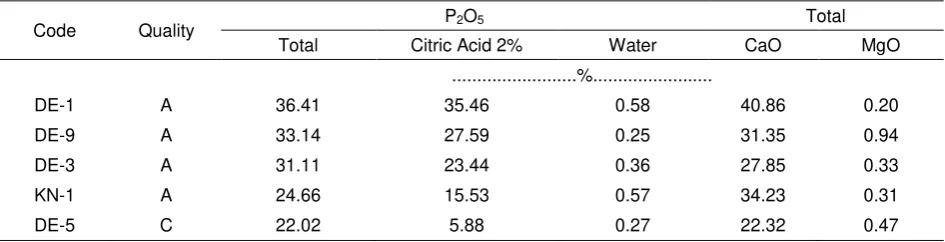
This research used 5 samples of rock phosphate selected from 20 survey samples. The P content of the 5 rock phosphate samples ranged from 22.02 - 36.41% P2O5 and the total of P2O5 and soluble in citric acid was
5.88-35.46% (Table 1). Not only did rock phosphate have P nutrient content but it also contained 22.32 - 40.86% CaO. Rock Phosphate Quality Requirement for agriculture, based on SNI 02-3776-2005 (BSN, 2005), involved 4 kinds of rockphosphate having the A category of quality and the only one having the C category of quality.
Randomized Complete Block Design was used in this green house experiment, with 8 treatment and 5 replication. The treatments comprised 5 selected rockphosphate fertilizer, plus control, Superphos (18% P2O5) and Tunisian Rock Phosphate (28.01% P2O5) as the comparator. The dosage of both rock phosphate and Superphos was 40 kg P/ha. During the treatments, 400 kg Urea, 100 kg KCl and 2 t manure ha-1 as the basicfertilizer were added.
Bulk Soil sample used for this experiment was taken from Typic Plintudults of Buyut Udik village, Central Lampung (04o57’57”S, 105o15’29” E) and Typic Kanhapludults from Taman Bogo, East Lampung (05o00’08” S, 105o29’62” E). TypicPlintudultsdeveloped from acidic tuff parent material which hadbrown color (10 YR 4/3), moderately loose structure,sub angular blocky structure, the red rust at 15-43 cmin depth, a few plinthite starting from 43-76 cmin depth, and more plinthite starting from 76-110 cmin depth.Typic Kanhapludults developed from acidic tuff having grayish dark brown color (10 YR 4/2) and moderately loose structure, sub angular blocky structure, iron and mangan concretion at 65-93 cm in depth.
Table 1.The result of rock phosphate analysis for affectivity experiment at greenhouse
Code Quality P2O5 Total
Total Citric Acid 2% Water CaO MgO
...%...
DE-1 A 36.41 35.46 0.58 40.86 0.20
DE-9 A 33.14 27.59 0.25 31.35 0.94
DE-3 A 31.11 23.44 0.36 27.85 0.33
KN-1 A 24.66 15.53 0.57 34.23 0.31
DE-5 C 22.02 5.88 0.27 22.32 0.47
Soil samples were taken from 0-20 cm in capacity condition wasreached. Superphos fertilizer was evenly spreaded and mixed into the pots 1 day before planting.Urea and KCl were added twice, at 7 and 30 days after planting, as much as half dosage, dibbled beside the plant. Manure wasspreaded upon the soil surface and then puddled with the soil a week before planting.
Variety of maize used in this experiment was Hybrid Pioner 12, one plant in each pot. The soil was analyzed before treatment and after harvesting. Plant height, weight of biomass, and yield were observed. Plant height was extracted with 25% HCl, P extracted with Bray 1 (0.025 NHCl + 0.03 N NH4F), Ca, Mg, K, Na, Then,the samples were mixed, air-dried, sieved using 2 mm, and analyzed to P extracted with IRRISTAT softwareto see the differences among the treatments. By using the Relative Agronomic Effectiveness (RAE) of the each rock phosphates used in this experiment and comparing it with the RAE of Superphosphate and Tunisian rock Phosphate, the affectivity of the rock phosphate can be defined. RAE is a comparison between the yield increase caused by using a kind of fertilizer and the yield increase caused by using the standard fertilizer then
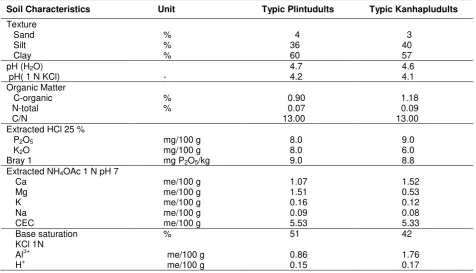
Typic Plintudults soil had clay structure, moderate acid (pH 4.7), low of organic carbon cassava farm usually managed in unbalanced way where the nutrient added was lower than the nutrient harvested. Therefore, P nutrient content would be running out.
Typic Kanhapludults soil had clay structure, moderate acid (pH 4.6), low C-organic and N-total, low P extracted HCl 25% and Bray Ultisols had equal fertility level;however, Typic Kanhapludults had lower CEC and higher Al3+ content, where these two characteristics made the soil less fertile compared with the Typic Plintudults one, and would be more responsive to the P fertilizer.
Rock Phosphate Effectivity for Maize
Two months after planting, the plant height of maize fertilized using rock phosphate (DE-9, DE-3, and DE-5) was obviously more than those fertilized using Superphosphate; while those fertilized using rock phosphate DE-1 and KN-1 are equal to those fertilized using Superphosphate and Tunisian Rock Phosphate.
Based on the plant height of those fertilized using rock phosphate 1, 9, DE-3, DE-5, and KN-1 it can be considered that the rock phosphates mentioned above are more effective for Maize growth than Superphosphate and Tunisian Rock Phosphate.
Table 2. The soil analysisresult of Typic Plintudults and Typic Kanhapludults which used in greenhouse experiment
Soil Characteristics Unit Typic Plintudults Typic Kanhapludults
Texture
Sand % 4 3
Silt % 36 40
Clay % 60 57
pH (H2O) 4.7 4.6
pH( 1 N KCl) - 4.2 4.1
Organic Matter
C-organic % 0.90 1.18
N-total % 0.07 0.09
C/N 13.00 13.00
Extracted HCl 25 %
P2O5 mg/100 g 8.0 9.0
K2O mg/100 g 8.0 6.0
Bray 1 mg P2O5/kg 9.0 8.8
Extracted NH4OAc 1 N pH 7
Ca me/100 g 1.07 1.52
Mg me/100 g 1.51 0.53
K me/100 g 0.16 0.12
Na me/100 g 0.09 0.08
CEC me/100 g 5.53 5.33
Base saturation % 51 42
KCl 1N
Al3+ me/100 g 0.86 1.76
H+ me/100 g 0.15 0.17
Table 3.The effect of rock phosphate to the plant height on Typic Plintudults in greenhouse experiment
Treatments Plant Height (cm)
1 month 2 months
Control 111.7 c 241.6 c
Superphosphate 134.5 a 239.6 c
Rock Phosphate of Tunisia 125.0 ab 246.6 bc
Rock Phosphate DE-1 121.4 b 248.0 bc
Rock Phosphate DE-9 126.2 ab 258.4 ab
Rock Phosphate DE-3 125.8 ab 258.3 ab
Rock Phosphate KN-1 127.5 ab 232.9 c
Rock Phosphate DE-5 118.0 bc 270.4 a
CV. (%) 5.4 4.7
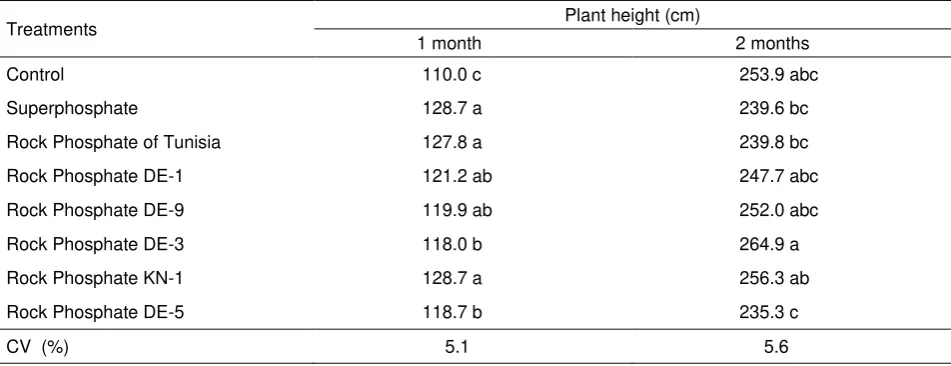
Phosphate fertilizing obviously increased the plant height of maize in 1 month after planting, but not in 2 months after planting (Table 4). In 1 month after planting there was an equal plant height between maize fertilized using rock phosphate KN-1, DE-1 and DE-9 to those fertilized using standard fertilizer (Super-phosphate and Tunisian Rock Phosphate). The plant height ofmaize fertilized using rock phosphate DE-3 and DE-5 was obviously lower than that fertilized using standard fertilizer (Superphosphate and Tunisian Rock Phos-phate).
The plants in 2 months after planting fertilized using rock phosphate DE-3 and KN-1 was obviously higher than that fertilized using Superphosphate. While those fertilized using rock phosphate DE-1, DE-9, and DE-5 were equal to those fertilized using Superphosphate and Tunisian Rock Phosphate. This result shows that the tested rock phosphates siqnificantly increased the maize plant height.
Phosphate fertilizing siqnificant increased the weight of biomass and the yield on Typic Plintudults (Table 5). The P source, added at the plots, shows the equal effects to the maize biomass weight compared with the plots fertilized using Superphosphate and Tunisian
Rock Phosphate. The yield weight of maize fertilized using Superphosphate was obviously higher than those fertilized using other rock phosphates. The yield weight of maize fertilized using Indonesian Rock Phosphate tended to be equal to that fertilized using Tunisian Rock Phosphate. This condition is closely related to the slow release characteristics of rock phosphates in providing the P2O5, so that rock phosphates provide less P2O5 during the first planting season than Superphosphate.
FAO (2004) divided the result of the RAE calculation into 4 categories: RAE >90% (high), 70-90% (moderate), 30-70% (low), and < 30% (very low). The RAE of rock phosphate DE-9, DE-3, KN-1, and DE-5 on Typic Plintudults soil were categorized as high based on the biomass weight. While the RAE of rock phosphate DE-1 and Tunisian was categorized as moderate.
RAE value of all rock phosphates, including the Tunisian Rock Phosphate,was about 30-70% (low) based on the dry yield of maize. This study is linear with those done by Attanandana and Vacharotayan (1994), where RAE value of rice yield of plots added by rock phosphate and TSP in Thailand was about 13-55% (very low - low), while the residue effect was about 83-123%.
Table 4. The effect of rock phosphate on the plant height on Typic Kanhapludults in greenhouse experiment
Treatments Plant height (cm)
1 month 2 months
Control 110.0 c 253.9 abc
Superphosphate 128.7 a 239.6 bc
Rock Phosphate of Tunisia 127.8 a 239.8 bc
Rock Phosphate DE-1 121.2 ab 247.7 abc
Rock Phosphate DE-9 119.9 ab 252.0 abc
Rock Phosphate DE-3 118.0 b 264.9 a
Rock Phosphate KN-1 128.7 a 256.3 ab
Rock Phosphate DE-5 118.7 b 235.3 c
CV (%) 5.1 5.6
The RAE value of rock phosphate was equal to Superphosphate based on the biomass weight. Whereas the RAE value of Tunisian and 5 was categorized as moderate, and the DE-1, DE-9, DE-3 and KN-1 rock phosphate were categorized as low based on the weight of dry yield of maize.
The weight of maize yield of the plots fertilized using Superphosphate on Typic Plintudults was higher that on Typic Kanha-pludults (Table 5 and 6), for the P-available content of the Typic Plintudults soils was higher than that of Typic Kanhapludults (Table 7). This circumstance might have been caused by the lower content of exchangeable Al (Table 1). However, the maize yields of both soils fertilized using rock phosphate were relatively equal, for the soil P-available content of plots fertilized using rock phosphate was also relatively equal.
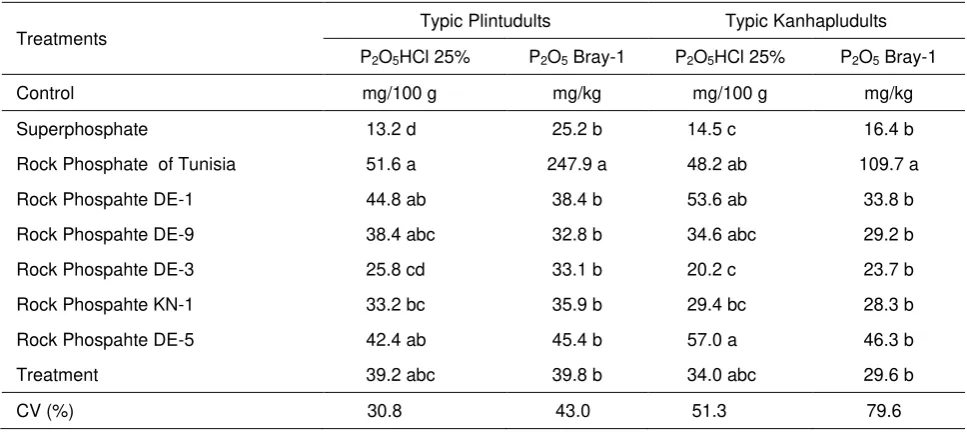
The rock phosphate fertilizing obviously increased the P soil content extracted in HCl 25% (Table 7). The soil P-available contents (extracted Bray-1) both on Typic Plintudults and Typic Kanhapludults were much higher than those fertilized using Superphosphate, for the solubility of P nutrient of Superphosphate was
higher than that of rock phosphate. Super-phosphate fertilizing gave higher weight of dry plant and dry yield of maize than that given by rock phosphate. (Table 5 and 6).
The P fertilizing to Typic Kanhapludults soils obviously increased the weight of biomass and the dry yield of maize. The use of rock phosphate DE-1, DE-5 and KN-1 obviously increased the weight of biomass than the control plots, but not significantly difference to the Tunisian,DE-9, DE-3 rock phosphate, and Superphosphate plot.
Phosphate fertilizing obviously increased the weight of the dry yield of maize, except the KN-1 rock phosphate. The highest yield was reached by the Superphosphate but it differed insignificantly to theplots with DE-1, DE-9, DE-3, and DE-5 rock phosphate. It means that Indonesian rock phosphates effectively increase the maize yield.
The result of this study can be used as the basis ofplanning field experiment and to improve the use of rock phophate deposite from Indonesia which is useable for direct application as source of P fertilizer or as raw material of fertilizer factory.
Table 5.The effectof rock phosphate on the yield of maize on Typic Plintudults in greenhouse experiment
Treatments
Biomass Maize Yield RAE (%)
...g/pot... Biomass Yield
Control 79.5 b 57.3 c - -
Superphosphate 106.2 a 102.5 a 100 100
Rock Phosphate of Tunisia 102.1 a 86.2 ab 85 64
Rock Phosphate DE-1 100.4 a 78.8 b 78 48
Rock Phosphate DE-9 109.5 a 71.0 bc 112 46
Rock Phosphate DE-3 103.7 a 78.0 b 91 30
Rock Phosphate KN-1 110.9 a 82.3 b 118 55
Rock Phosphate DE-5 103.4 a 81.9 b 90 54
CV (%) 11.7 15.9
Table 6.The effect of rock phosphate on the maize yield on Typic Kanhapludultsin green house experiment
Treatments
Biomass Dry yield RAE (%)
...g/pot... Biomass Dry yield
Control 111.5 b 54.6 c - -
Superphosphate 121.7 ab 89.4 a 100 100
Rock Phosphate of Tunisia 121.3 ab 82.2 ab 96 79
Rock Phospahte DE-1 131.5 a 76.3 ab 196 62
Rock Phospahte DE-9 125.9 ab 75.8 ab 141 61
Rock Phospahte DE-3 124.6 ab 75.2 ab 128 59
Rock Phospahte KN-1 130.1 a 69.2 bc 182 42
Rock Phospahte DE-5 127.5 a 79.7 ab 157 72
CV. (%) 8.5 17.1
Remarks: Grade inside the columns followed by the same alphabet means obviously difference at 5% degree of accuracy based on DMRT test
Table 7. The effect of rock phosphate to the content of P2O5 extracted in HCl 25% and Bray 1 on Typic Plintudults and Typic Kanhapludults
Treatments Typic Plintudults Typic Kanhapludults
P2O5HCl 25% P2O5 Bray-1 P2O5HCl 25% P2O5 Bray-1
Control mg/100 g mg/kg mg/100 g mg/kg
Superphosphate 13.2 d 25.2 b 14.5 c 16.4 b
Rock Phosphate of Tunisia 51.6 a 247.9 a 48.2 ab 109.7 a
Rock Phospahte DE-1 44.8 ab 38.4 b 53.6 ab 33.8 b
Rock Phospahte DE-9 38.4 abc 32.8 b 34.6 abc 29.2 b
Rock Phospahte DE-3 25.8 cd 33.1 b 20.2 c 23.7 b
Rock Phospahte KN-1 33.2 bc 35.9 b 29.4 bc 28.3 b
Rock Phospahte DE-5 42.4 ab 45.4 b 57.0 a 46.3 b
Treatment 39.2 abc 39.8 b 34.0 abc 29.6 b
CV (%) 30.8 43.0 51.3 79.6
Remarks: Grade inside the columns followed by the same alphabet means obviously difference at 5% degree of accuracy based on DMRT test
CONCLUSIONS
Superphosphate fertilizing gave more weight of dry maize plant and yield than Indonesian Rock Phosphate. Indonesian rock phosphate effectivity was equal to that of Tunisian
Rock Phosphate but less than that of Super-phosphate.
phosphate on Typic Plintudults was less than that on Typic Kanhapludults.
REFERENCES
Adiningsih, J.S. and T.H. Fairhurst. 1996. The use of reaktive phosphate rock for the rehabilitation of anthropic savannah in Indonesia. in A.E. Johnston and J.K. Syers. Nutrient Management for Sustainable Crop Production in Asia. p. 159-174.
Attanandana, T. and S. Vacharotayan. 1994. Rock phosphate utilization on acid sulphate soil of Thailand. Ecology and Management of Problem Soils in Asia.FFTC Book Series No.27.
Badan Standardisasi Nasional. 2005. Standar Nasional Indonesia: pupuk fosfat alam untuk pertanian. No. SNI 02-3776-2005. Balai Penelitian Tanah. 2005. Petunjuk teknis:
analisis kimia tanah, tanaman, air, dan pupuk.pp. 119.
Chien, S. H. 1996. Evalution of Gafsa (Tunisia) and Djebel Onk (Algeria) phosphate rocks and soil testing of phosphate rock for direct application. In Nutrient management for sustainable crop production in Asia, Bali, Indonesia, 9-12 December 1996, p.175-185. Edited by A.E. Johnston and J.K. Syers.
Food and Agriculture Organization of the United Nations. 2004. Use of phosphate rock for suatainable agriculture. Rome. Fertilizer and Plant Nutrition Bulletin 13. pp.157. Hidayat A., and A. Mulyani. 2005. Lahan kering
untuk pertanian. Dalam Buku teknologi pengelolaan lahan kering, menuju pertanian produktif dan ramah ling-kungan. Penyunting A. Adimihardja dan Mappaona. Pusat Penelitian dan Pengembangan Tanah dan Agroklimat. pp. 246.
Kasno A., D. Setyorini and I.G.P. Wigena. 2007. Aplikasi P-alam berkadar P tinggi pada tanah masam Inceptisol, Bogor untuk tanaman jagung. p.395-409. Dalam Pros. Lokakarya Nasional Inovasi Teknologi Pertanian Mendukung Hari Pangan Sedunia 2007. Bandar Lampung, 25-26 Oktober 2007.
Kasno, A. and D. Subardja. 2010. Soil fertility and nutrient management on spodosol for oil plam. Agrivita 32(3): 285-292 Machay, A. D. J. K. Syers. and P.E.H. Gregg.
1984. Ability of chemical extraction procedures to assess the agronomic effectiveness of phosphate rock material. New Zealand Journal of Agricultural Research 27: 219 – 230.
Moersidi, S. 1999. Fosfat alam sebagai bahan baku dan pupuk fosfat. Pusat Penelitian Tanah dan Agroklimat, Bogor. P: 82. Mulyani, A., Hikmatullah, dan H. Subagyo. 2004.
Karakteristik dan potensi tanah masam lahan kering di Indonesia. Buku 1:1-32 dalam Pros. Simposium Nasional Pendayagunaan Tanah Masam. Bandar Lampung, 29-30 September 2003. Puslittanak, Bogor.
Purnomo J., A. Kasno, dan D. Setyorini. 2007. Pengaruh pemberian pupuk TSP terhadap produksi jagung dan kadar P dalam tanah Ultisol Lampung Utara. Hal. 437-450. Dalam Pros. Lokakarya Nasional Inovasi Teknologi Pertanian Mendukung Hari Pangan Sedunia 2007. Bandar Lampung, 25-26 Oktober 2007. Santoso, D., IG.P. Wigena, J. Purnomo and
R.D.B. Lefroy. 2001. Nutrient balance and economic analyses of P fertilization on an acid upland soil in Sumatra. Jur. Tanah dan Iklim. No. 19: 37-46.
Santoso, D., J. Purnomo, I.G.P. Wigena, Sukristiyonubowo and R.D.B. Lefroy. 2000. Management of phosphorus and fosfat alam untuk perbaikan kesuburan tanah kering masam Typic Hapludox di Kalimantan Selatan. Hal. 143-155. Dalam Pros. Seminar Nasional Inovasi Teknologi Sumber Daya Tanah dan Iklim, Bogor, 14-15 September 2004. Puslittanak, Bogor.
Yusuf, A. F. 2000. Endapan fosfat di Daerah Madura. Kolokium hasil kegiatan lapangan DSM, Sub Dit. Eksplorasi Mineral Industri dan Batuan.