INTRODUCTION
Sweet potato (Ipomoea batatas L.) is one of important commodities in tropical and sub tropical countries. Indonesia is the fourth largest sweet potatoes producer (FAOSTAT, 2013). Cilembu sweet potato is the most popular local sweet potato from specifics areas in Cilembu Village of Sumedang Regency, West Java Province, Indonesia. Waluyo, Rahmannisa, & Karuniawan (2011) revealed that there are 17 varieties of Cilembu sweet potato. Nevertheless, Rancing is the most dominant one in the field. The uniqeness of this commodity comes from its sweet taste (Onggo, 2006). An increasing demand of Cilembu sweet potatoes requires an increase in production through the extension of cultivating areas.
Land suitability evaluation is a very important step in selecting suitable new areas for a commodity
extension, included Cilembu sweet potato. Land suitability evaluation requires criteria as land requirement for optimal growth and production of Cilembu sweet potatoes. Nevertheles, specific land suitability criteria for Cilembu sweet potato is not available yet. The current available land suitability criteria is based on land requirement for common sweet potatoes (Hardjowigeno & Widiatmaka, 2007; Ritung, Nugroho, Mulyani, & Suryani, 2011). A previous research showed that land characteristics related to Cilembu sweet potatoes production based on field data were differ from those in common criteria of sweet potatoes (Solihin, Sitorus, Sutandi, & Widiatmaka, 2016). It is important to develop land suitability criteria for Cilembu sweet potatoes based on actual land condition as well as crops production. Land suitability criteria requires diagnostic criterion (Verheye, Koohafkan, & Nachtergaele, 2009).
Discriminating Land Characteristics of Yield and Total Sugar Content Classes
of Cilembu Sweet Potato (
Ipomoea batatas
L.)
Muhammad Amir Solihin1*), Santun R.P. Sitorus2), Atang Sutandi2) and Widiatmaka2)
1) Soil Science and Land Resources Department, Padjadjaran University Indonesia 2) Soil Science and Land Resources Department, Bogor Agricultural University Indonesia
ARTICLE INFO
Keywords:
Discriminating land characteristic Land suitability criteria
Sugar content Sweet potato Yield
Article History:
Received: November 16, 2016 Accepted: May 30, 2017
*) Corresponding author:
E-mail: [email protected]
ABSTRACT
Cilembu sweet potato is a unique commodity with high demand market due to its sweet taste. The objectives of this study were to investigate the production performance of Cilembu sweet potatoes in term of production classes and critical limit and to determine discriminating land characteristics classes of yield and total sugar content. This study was conducted in Cilembu sweet potatoes production centers in West Java. Sweet potatoes tuber and soil samples were collected by purposive random sampling during harvest. Cilembu sweet potatoes production classes were defined by decreasing yields criteria in land evaluation. Critical limit production was the lowest yield and total sugar content of raw tuber which harvested in Cilembu village. Discriminating land characteristics were decided by discriminant analysis. Results showed that there was a significant different yield between typical and non-typical areas. Critical limit of yield and total sugar content were 10.5 t ha-1 and 2.32 %, respectively. The discriminating land characteristics of yield classes were soil properties (pH, CEC, P, Ca, Mg, ΔT), and monthly rainfall, whereas for total sugar content classes were effective soil depth, clay, sand and monthly rainfall. These variables are proposed as diagnostic criteria in Cilembu sweet potato land suitability criteria.
Diagnostic criterion is a land characteristic that act as limiting factor for optimal crop growth and production and determining classes of land suitability for spesific land use (FAO, 2007). The growth and production of a crops will be controlled by the highest limiting factors of land characteristics, as explained in the law of minimum of Sprengel-Leibig and popular as the law of minimum of Sprengel-Leibig (Gorban, Pokidysheva, Smirnova, & Tyukina, 2011). Ritung, Nugroho, Mulyani, & Suryani (2011) used 25 land characteristic as diagnostic criterion for common sweet potatoes in land suitability criteria, while Hardjowigeno & Widiatmaka (2007) used 27 land characteristics. However, not all these land characteristics may be appropriate as land suitability requirement for certain commodity. In sweet potato, the land suitability criteria may differ depending on the varieties as investigated by Solihin, Sitorus, Sutandi, & Widiatmaka, (2016) on Cilembu sweet potato.
The first step necessary to develop land suitability criteria for Cilembu sweet potato is determining diagnostic criterion that differentiate classes of yield and total sugar content. Generally, land suitability indicator for common sweet potato varieties are based on yield production. In case of Cilembu sweet potatoes, the suitability indicator can be based on both yield production and sweetness degree. So far, the sweetness is the main factor affecting consumer demand on Cilembu sweet potato. FAO (2007) indicated that the suitability indicators of a land use were yield production and/or benefit of its use. One of methods in land evaluation is quantitative approach, based on actual data in the fields (Rossiter, 2009). Antisari, Nobili, Ferronato, Natale Pellegrini, & Vianello (2016) used discriminant analysis to identify soil properties which differentiates soil units. The determination of soil properties as diagnostic criterion which is capable of discriminating classes of crop production should result in representative land suitability criteria. This criteria is expected to be able describe actual production of Cilembu sweet potato in the field.
The objectives of this study were: 1) to investigate the production performance of Cilembu sweet potato in typical and non-typical cultivation areas in order to determine their production performance classification and critical limit, 2) to determine discriminating land characteristics classes of Cilembu sweet potatoes yield as well
as total sugar content. The research is useful in establishing the Cilembu sweet potato land suitability criteria, especially Rancing variety.
MATERIALS AND METHODS
Study Location
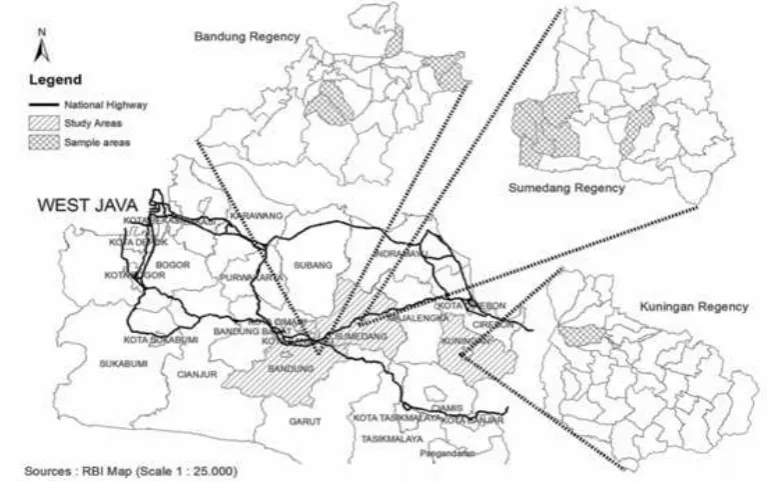
This study was conducted in Cilembu sweet potatoes production centers in West Java Province. These areas include Sumedang Regency (District of Cilembu, Nagarawangi, Sawahlega, Cimasuk, Tanjungsari, Sukasari, Jatinangor, Dangdeur, and Situraja), Bandung Regency (District of Cileunyi, Cicalengka, Nagreg, and Banjaran), and Kuningan Regency (District of Jalaksana). The cultivation areas were categorized into two groups namely typical area and non-typical area. Typical areas include the area of origin of Cilembu sweet potato (Cilembu Village) and the surrounding areas (Rancakalong, Tanjungsari, Sukasari and Pamulihan). Non-typical areas are Cilembu sweet potatoes production centres outside the typical areas (Jatinangor, Dangdeur, Situraja, Cimasuk, Cicalengka, Nagreg, Banjaran, and Jalaksana). All sweet potatoes production centres used in this study were rainfed agriculture areas. Soil order in the areas is Inceptisols (ISRI, 2000), which was formed from volcanic parent material, except for soil in Nagreg which was formed from igneous parent material (Silitonga, 2003). Yearly rainfall in the areas was 2,105.2 mm. Locations of study were shown in Fig. 1.
Soil Sample and Analysis
Variety and Analysis
The sweet potato variety used in this study was Rancing. The same fertilizer input (200 kg NPK ha-1) was applied in all of the study areas. Samples of Cilembu sweet potato were collected from 80 trial plots of cultivation areas, where the soil samples were taken. Cilembu sweet potatoes were harvested at 4.5 month after planting and the yields (in t ha-1) were calculated. To measure sweetness degree, six raw tuber samples (200-300 g tuber-1) free from pest and desease were collected from each plot during harvest. Sweetness degree of sweet potato was determined in the form of total sugar content (%) using Luff Schoorl method according to Indonesian standard measurement of sugar (SNI 01-2892-1992).
Statistical Analysis
Classification of Cilembu sweet potato yield and total sugar content was based on decreasing yields criteria in land evaluation adapted from FAO (1983). The classification levels are high class (80 to 100 %), moderate class (60 to 80 %), low class (20 to 60 %), and very low class (less than 20 % of maximum yield). The upper limit of very low class was determined from sweet potato yield at benefit cost ratio (BCR) equal to one. According to the result of Cilembu farming system analysis, the decreasing
yield at BCR equal to one is 20 % from maximum yield of Cilembu sweet potato.
Critical limit of Cilembu production was determined on the basis of the lowest yield as well as total sugar content of raw tuber which harvested in Cilembu Village. Determination of critical limit border follows method of critical limit determination from Cate and Nelson (Beegle, 2009). If a Cilembu sweet potato from non typical areas have higher yield as well as total sugar content than those of the critical limit, the sweet potato is considered to have similar properties with Cilembu sweet potato from typical areas. The differences of yield and total sugar content between typical and non-typical location were tested by independent samples t test.
Discriminating land characteristics was determined using stepwise multiple discriminant analysis. This analysis aimed to find out discriminating land characteristics only without classifying predictor variables and forecasting member of predicted groups. To meet the assumptions on discriminant analysis, data of land characteristics were tested by normality test of Kolmogorov-Smirnov at α = 0.05. The potential discriminating variables which are suitable to be analyzed with multiple discrimination analysis can be determined by analysis of equality of group means at significance level of α = 0.05. (Hair Jr., Black, Babin, & Anderson, 2010)
Potential discriminating variables were then analyzed by stepwise multiple discriminant analysis with mahalanobis distance method (Hair Jr., Black, Babin, & Anderson, 2010). In each step, predictor variables were entered into analysis at α = 0.05, and removed from analysis at α = 0.1 (Hair Jr., Black, Babin, & Anderson, 2010). Multiple discriminant analysis resulted in discriminant loadings and coefficients of standardized discriminant function. Discriminant loadings are correlation of each predictor variable and Z score for each discriminant function. Potential discriminating land characteristics that are able to distinguish yield and total sugar content classes can be determined from the highest correlation values between each variable and functions.
Another result of discriminant analysis is coefficients of standardized discriminant function which indicates discriminating power of predictor
variables (Hair Jr., Black, Babin, & Anderson, 2010). Discriminating land characteristics of Cilembu sweet potato production resulted from this analysis were strong discriminators and they had significant effect on the differentiate of yield classes as well as total sugar content classes. Each discriminating land characteristic powers can be seen from their coefficient values of standardized discriminant function. The higher of the coefficient values, the stronger the power of discrimination effect of predictor variables. In addition, potential discriminating land characteristics which were not strong discriminator variables considered as weak discriminator variables. Discriminating land characteristics, both strong and weak in distinguishing Cilembu sweet potatoes production, considered as diagnostic criteria in establishing Cilembu sweet potatoes land suitability criteria.
Table 1. Cilembu Sweet Potatoes Yield and Total Sugar Content Performances
Planting Locations City/
Regency
Yield (t ha-1)
Range Average Class
Typical areas of Cilembu
Cilembu Sumedang 10.50-28.00 17.20 Low to High
Nagarawangi Sumedang 10.50-11.94 12.11 Low
Sawahlega Sumedang 14.00-22.40 19.02 Low to Moderate
Sukasari Sumedang 16.32-32.29 22.64 Low to High
Tanjungsari Sumedang 16.00 16.00 Low
Non Typical areas of Cilembu
Situraja Sumedang 17.50-18.00 17.75 Low
Jatinangor Sumedang 11.90-17.50 15.22 Low
Campakamulya Bandung 12.25-17.50 15.05 Low
Cicalengka Bandung 6.65-12.73 9.97 Low
Cimasuk Sumedang 2.56-9.33 6.31 Very Low to Low
Dangdeur Sumedang 14.00-28.29 23.87 Low to High
Jalaksana Kuningan 4.92-11.64 7.72 Very Low to Low
Cinunuk Bandung 6.00-14.40 9.04 Very Low to Low
Nagreg Bandung 4.20-15.00 10.00 Very Low to Low
Total Sugar Content (%) Typical areas of Cilembu
Cilembu Sumedang 2.59 - 2.97 2.84 Moderate to High
Nagarawangi Sumedang 2.16 - 2.65 2.28 Moderate to High
Sawahlega Sumedang 2.46 - 2.70 2.57 Moderate to High
Sukasari Sumedang 2.16 - 2.80 2.40 Moderate to High
Tanjungsari Sumedang 2.66 2.66 High
Non Typical areas of Cilembu
Situraja Sumedang 2.20 2.32 Moderate
Jatinangor Sumedang 2.32 - 2.85 2.66 Moderate to High
Campakamulya Bandung 2.16 - 2.94 2.58 Moderate to High
Cicalengka Bandung 2.21 - 2.86 2.56 Moderate to High
Cimasuk Sumedang 2.04 - 2.69 2.27 Moderate to High
Dangdeur Sumedang 2.21 - 2.76 2.53 Moderate to High
Jalaksana Kuningan 1.81 - 2.67 2.30 Low to High
Cinunuk Bandung 2.59 - 3.19 2.98 High
RESULTS AND DISCUSSION
Performance of Cilembu Sweet Potatoes Production
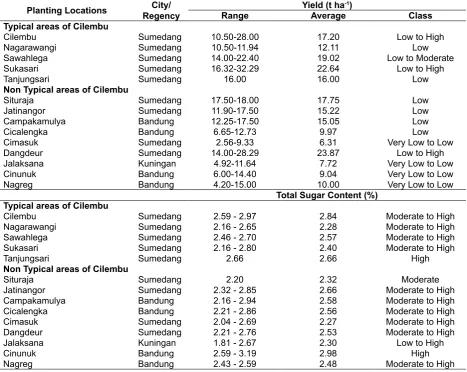
Classifications of performances of yield and total sugar content are presented in Table 1. There were differences in classes of yield in typical and non typical areas. In typical areas, the yield varied from low to high class. High class of yield was found in Cilembu and Sukasari, whereas in non typical areas, the yields of Cilembu sweet potato were generally in classes of very low to low, except in Dangdeur which was low to high class. In average, the yield of Cilembu sweet potato in typical areas was significantly higher than that in non typical areas (Table 2). Average yield in typical areas was 18.26 t ha-1, compared to 12.75 t ha-1 in non typical
areas. These results may indicate that the areas of origin of Cilembu sweet potato are more suitable for cultivating this sweet potato (Rancing variety). This means that the land characteristics in typical areas of Cilembu sweet potato Rancing variety are more
favorable for higher yield than those in non typical areas. Subroto (2010) revealed that high or low yield of Cilembu sweet potato related to soil properties on its cultivation areas.
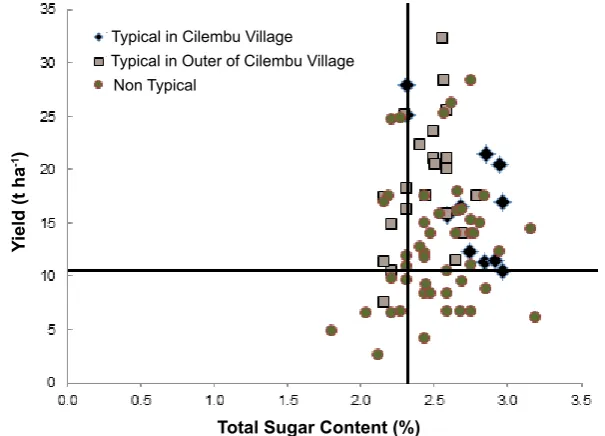
Cilembu sweet potato production performances in terms of critical limit are shown in Fig. 2. Critical limit productions of Cilembu sweet potato were 10.5 t ha-1 for yield and 2.32% for total sugar content. In some non-typical areas, yield and total sugar content were located above critical limit values of those in typical areas, while the others were located below critical limit values. The result of this study may show that Cilembu sweet potatoes productions which were harvested from non-typical areas and above of critical limit values have similar characteristics of raw tuber with those from typical areas. Cilembu sweet potato production related to soil properties on cultivation areas (Subroto, 2010). It can be concluded that to obtain similar yield and total sugar content of Cilembu sweet potatoes, similar land properties with typical areas is required. Table 2. The equality of group means of Cilembu sweet potatoes yield and total sugar content
Variables Planting
areas N Means
Standard Deviation
Mean Difference
Test for Equality of Means
t Test Df Sig.
Yield (t ha-1) Typical 34 18.26 5.70 5.506 4.11 78 0.00
Non-Typical 46 12.75 6.08
Total Sugar Content (%) Typical 34 2.55 0.25 0.025 0.42 78 0.67
Non-Typical 46 2.52 0.28
Remarks: N=Number of samples; Df=Degree of Freedom; Sig.=Significance
Total Sugar Content (%)
Y
ield (t ha
-1)
Fig. 2. Critical limit of typical Cilembu sweet potatoes based on yield and total sugar content
Discriminating Land Characteristics Classes of Cilembu Sweet Potatoes Yield
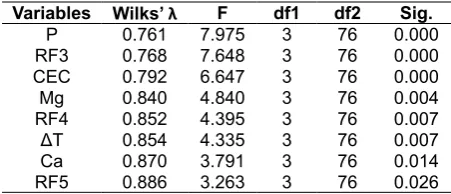
The potential discriminating land characteristics were defined through the test of equality of group means from 21 land characteristics. The result showed 9 of 21 land characteristics had significant difference means of groups (Table 3). These nine-characteristics were phosphorus (P); Magnesium (Mg); calcium (Ca); cation exchange capacity (CEC); difference in maximum and minimum temperature (ΔT); average temperature (T Ave); monthly rainfall during Cilembu growth periods at 3rd (RF3) 4th (RF4), and 5th (RF5) months from planting. The analysis indicated these land characteristics were capable to distinguish classes of yield of Cilembu sweet potatoes.
These potential discriminating land characteristics were then used as inputs in stepwise multiple discriminant analysis (Table 4). The function 1 differentiated high class of yield of Cilembu sweet potato from other classes. This function had strongest correlation with Ca, RF3, Mg, CEC, and P than other functions. The function 2 had lower correlation with any discriminating land characteristics than other functions. Hair Jr., Black, Babin, & Anderson (2010) revealed that correlation above of 0.3 had strong influence to differentiate groups. Therefore, some land characteristics distinguished moderate classes from other classes. These discriminating land characteristics were P, ΔT, RF3 and RF5. The function 3 differentiated low classes from very low classes of yield of Cilembu
sweet potato. This function had strongest correlation with ΔT, RF4 and RF5 than other functions. The result of this analysis may explain that soil properties affect in differentiating high class from the other classes of yield of Cilembu sweet potato, whereas climate conditions distinguish low class from very low class. Climate conditions can also differentiate moderate class from the others in weak influence. This result is congruent with previous studies that soil and climate condition affecting sweet potato production, as has been disclosed by Kotecha & Kadam (1998), Çališkan, Söǧüt, Boydak, Ertürk, & Arioǧlu (2007), Dziedzoave, Graffham, Westby, Otoo, & Komlaga (2010), Nedunchezhiyan, Byju, & Jata (2012), as well as Gajayanake, Reddy, & Shankle (2015).
Coefficients of standardized discriminant function which give explanation in discriminating power of predictor variables are presented in Table 5. The function 1 showed that CEC and RF3 were strong discriminators and had the highest coefficient value compared to all other functions. The discriminating land characteristics differentiated the highest yields class of Cilembu sweet potato from other classes. The function 2 showed that RF5 as strong discriminator differentiated moderate class from low and very low class. The function 3 showed that ΔT as strong discriminator differentiated low class from very low class of yield of Cilembu sweet potato.
Variables Function
1 2 3
Caa 0.669* -0.230 0.003
RF3 0.634* -0.357 0.271
Mga 0.614* -0.083 -0.126
CEC 0.614* 0.132 0.002
P a 0.521* -0.334 0.177
ΔT 0.446 0.341 -0.824*
RF5 0.264 0.609 0.737*
RF4a 0.403 0.034 0.463*
Table 4. Correlation between discriminating land characteristics of classes of Cilembu sweet potato yield and discriminant function
Remarks: a Not include in analysis because indicated
autocorrelation. * Highest absolute correlation from all functions. Ca=Calcium; RF3, RF4, RF5=monthly rainfall during Cilembu growth periods at 3rd, 4th, and 5th months
from planting; Mg=Magnesium; CEC=Cation exchange capacity; P=Phosporus; ΔT=The difference of maximum and minimum temperature
Table 3. Test of equality of group means of single land characteristics
Variables Wilks’ λ F df1 df2 Sig.
P 0.761 7.975 3 76 0.000
RF3 0.768 7.648 3 76 0.000
CEC 0.792 6.647 3 76 0.000
Mg 0.840 4.840 3 76 0.004
RF4 0.852 4.395 3 76 0.007
ΔT 0.854 4.335 3 76 0.007
Ca 0.870 3.791 3 76 0.014
RF5 0.886 3.263 3 76 0.026
Remarks: P=Phosporus; RF3, RF4, RF5=Monthly rainfall during Cilembu growth periods at 3rd, 4th, and 5th months
The land characteristics distinguish classes of yield in different discriminating power. It can be concluded that to achieve high yield of Cilembu sweet potato requires optimum CEC and monthly rainfall at 3rd month of growing period (RF3). The soil in the cultivation areas of Cilembu sweet potatoes were mostly formed from volcanic parent materials, except Nagreg area which was formed from igneous rock. Hardjowigeno (2007) revealed that the volcanic-ash soils produce short-range ordered and easily-decayed minerals, so weathering of volcanic parent material became soils with higher CEC than soils originating from igneous rocks. High yield of Cilembu sweet potato was found in cultivation areas where the soil had high CEC level, whereas the lowest yield was found in Nagreg cultivation area where the soil had the lowest CEC level compared to all other cultivation areas (Table 1). Hardjowigeno (2007) noted that the low level of CEC as one of indicators for soil low fertility. Crops were cultivated in the low fertility soil, its growth will not be optimal and then the yield will be decreased.
In addition, monthly rainfall influence to the optimal soil condition for crops growth at rainfed field. In this case, monthly rainfall at 3rd month of growing periods differentiates the highest class of yield from the others. During the third and fourth months of Rancing sweet potato growing period, it is closely related with the formation and maturing process of tubers and the decrease in leaves growth. The level of rainfall on the rainfed agricultural land related to the ability of absorption solar radiation by leaves for the process of photosynthesis, which affects the yield of sweet potato (Gomes, Carr, & Squire, 2005). Furthermore, the adequacy of soil water during tuber formation periods will support optimal production.
The difference of maximum and minimum temperatures (ΔT) in cultivation areas distinguished low class from very low class of yield of Cilembu sweet potato. According to the decreasing yield defined by FAO,
the class of very low of yield was equal to not suitable class in land suitability evaluation (FAO, 1983). This fact means that the difference of maximum and minimum temperature distinguishes suitable and unsuitable classes in land evaluation. Optimum temperature of sweet potato was at 26.7 oC for leaf area, 26.5 oC for maximum biomass, 24 oC for storage fresh root, and 25.6 oC for dry root weight (Gajayanake, Reddy, & Shankle, 2015). The difference of maximum and minimum temperature related to favourable condition for photosynthesis in sweet potato leaves’ during the day and tuber formation at night, which affecting tuber yield.
Discriminating Land Characteristics Classes of Total Sugar Content
Potential discriminating land characteristics of total sugar content classes of Cilembu sweet potato are presented in Table 6. The test was analyzed using 21 land characteristics (pH, nitrogen, soil organic carbon, phosporus, potassium, calcium, magnesium, cation exchange capacity, base saturation, soil texture, effective soil depth, surface stoninness, soil rockiness, elevation, temperature, and rainfall during growing period), some of them were significantly different of means, such as effective soil depth (eff. depth), monthly rainfall at first month (RF1) and second month (RF2) during growing period, clay and sand texture. The result of this analysis showed that these land characteristics had capability distinguished classes of total sugar content of Cilembu sweet potatoes.
These potential land characteristics thus were used in stepwise discriminant analysis, which resulted in discriminant loading and coefficient of standardized discriminant function. Discriminant loading showed linear correlation between potential discriminating land characteristics of total sugar content and discriminant function coefficient values. The result of this analysis showed that the properties of soil physical (effective soil depth, clay and sand texture) and climate (monthly rainfall at 1st and 2nd month during growing periods) distinguished classes of total sugar content (Table 6). The coefficient value of standardized discriminant function showed that effective soil depths have been satisfied as strong discriminator, whereas the others as weak discriminator. It can be conlcuded that soil physical and climate properties in study location distinguished total sugar content classes of Cilembu sweet potato, although mostly in weak discriminating power. In average, the total sugar content in typical areas tends to higher than those in non-typical areas, although the difference was not significant, as showed in Table 2.
Variables Function
Table 5. Power of discriminating land characteristics of yield classes of Cilembu sweet potato based on standardized discriminant function coefficient
Effective soil depth and soil texture are essential for growth and production of crop, especially potential in distinguishing sweetness classes. The properties of the soil are correlated to suitable rhizosphere condition, in terms of easiness of crops roots through in soil, nutrient availability for crops in soil, as well as water availability. Increasing depth of soils were positive affect on crop growth and yield (Hirzel & Matus, 2013). Sandy soil had stunted growth of crops, due to the lack of water in the soils (Wu, Huang, & Gallichand, 2011). It is suspected that sandy soil has low capacity to exchange the soil nutrient. Suitable soil texture in the root zone may influence the ease of root to penetrate the soil. Therefore, it relates to the ease nutrient and water uptake by crops.
CONCLUSION
The production performances were significant different yield between typical and non-typical areas, whereas critical limit of yield and total sugar content were 10.5 t ha-1 and 2.32 %, respectively. The land
characteristics which distinguish yield classes were pH, CEC, P, Ca, Mg, ΔT, and rainfall (3rd to 5th month), while for total sugar classes were effective soil depth, clay, sand and rainfall (1st to 2nd month). These variables are used as diagnostic criteria in Cilembu sweet potato land suitability criteria.
ACKNOWLEDGEMENT
The authors gratefully thank to the DGHE, Ministry of Research, Technology and Higher Education, Republic of Indonesia for financial support under the BPPS program (2604.E4.4/2012) and doctoral research grant (CN: 431.UN.6.3.1/ PL/2016).
REFERENCES
Antisari, L. V., Nobili, M. D., Ferronato, C., Natale, M., Pellegrini, E., & Vianello, G. (2016). Hydromorphic to subaqueous soils transitions in
the central Grado lagoon (Northern Adriatic Sea,
Italy). Estuarine, Coastal and Shelf Science,
173(2016), 39-48. http://dx.doi.org/10.1016/j.ecs
s.2016.02 .004
Beegle, D. (2009). Chapter 14. Interpretation of soil testing results. In Recommended soil testing procedures for the Northeastern United States (3rd ed.): Northeastern regional publication no. 493. Cooperative Bulletin, 493, 111-118.
Retrieved from http://s3.amazonaws.com/udex tension/lawngarden/files/2012/10/CHAP14.pdf
Çališkan, M. E., Söǧüt, T., Boydak, E., Ertürk, E., & Arioǧlu, H. (2007). Growth, yield, and quality of sweet potato (Ipomoea batatas (L.) Lam.) cultivars in the southeastern Anatolian and East Mediterranean Regions of Turkey. Turkish Journal of Agriculture and Forestry, 31, 213–
227. Retrieved from http://citeseerx.ist.psu.e du/viewdoc/download?doi=10.1.1.333.6116 &rep=rep1&type=pdf
Dziedzoave, N. T., Graffham, A. J., Westby, A., Otoo, J., & Komlaga, G. (2010). Influence of variety and growth environment on β-amylase activity of flour from sweet potato (Ipomea batatas). Food Control, 21(2), 162–165. http://doi.org/10.1016/j.
foodcont.2009.05.005
FAO. (2007). Land evaluation: Towards a revised
framework. Land and Water Discussion Paper 6. Rome, IT: Food and Agriculture Organization of the United Nations.
FAOSTAT. (2013). World commodities production of
sweet potato year 2012. Retrieved from http://
faostat.fao.org/site/339/default.aspx 1/1
Gajayanake, B., Reddy K. R., & Shankle M. W, (2015). Quantifying Growth and Developmental Response of Sweetpotato to Mid and Late
Season Temperature. Agronomy Journal,
107(5),854-862.
Table 6. Test of Equality of Group Means, F Test, and Discriminant Loading of Discriminates Variable of Total Sugar Content Classes
Variables Wilks’λ F df1 df2 Sig. Discriminant loading Function 1
Eff.Depth 0.759 12.233 2 77 0.000 1.000
RF1a 0.855 6.503 2 77 0.002 -0.807
RF2a 0.871 5.680 2 77 0.005 -0.653
Claya 0.873 5.621 2 77 0.005 -0.486
Sanda 0.892 4.639 2 77 0.013 0.465
Remarks: a not include in the analysis because indicated autocorrelation; Eff.depth=Effective soil depth; monthly rainfall at
Gomes, F., Carr, M. K. V., & Squire, G. R. (2005). Effects of water availability and vine harvesting frequency on the productivity of sweet potato in Southern Mozambique. IV. Radiation interception, dry matter production and partitioning. Experimental Agriculture, 41(1), 93-108. https://doi.org/10.101
7/S0014479704002352
Gorban, A. N., Pokidysheva, L. I., Smirnova, E. V., & Tyukina, T. A. (2011). Law of the minimum
paradoxes. Bulletin of Mathematical Biology,
73(9), 2013-2044. https://doi.org/10.1007/s1153
8-010-9597-1
Hair Jr., J. F., Black, W. C., Babin, B. J., & Anderson, R. E. (2010). Multivariate data analysis (7th ed.). New York, USA: Pearson Prentice Hall. Retrieved from https://pdfs.semanticscholar.org/6885/bb9 a29e8a5804a71bf5b6e813f2f966269bc.pdf
Hardjowigeno, S. (2007). Ilmu tanah [Soil science].
Jakarta, ID: Akademika Pressindo.
Hardjowigeno, S., & Widiatmaka. (2007). Evaluasi
kesesuaian lahan dan perencanaan tataguna lahan [Land suitability evaluation and
land-use planning]. Yogyakarta, ID: Gadjah Mada University Press.
Hirzel, J., & Matus, I. (2013). Effect of soil depth and increasing fertilization rate on yield and its components of two durum wheat varieties.
Chilean Journal of Agricultural Research, 73(1), 55-59.
ISRI. (2000). Atlas sumberdaya tanah Indonesia, skala
1:1.000.000 [Atlas of Indonesian soil resources, 1:1.000.000 scale]. Bogor, ID: Indonesian Soil Research Institute.
ISRI. (2009). Petunjuk teknis: Analisis kimia tanah,
tanaman, air, dan pupuk [Technical guidance analysis of soil chemical, plant, water and fertilizers] (2nd ed.). Bogor, ID: Indonesian Soil Research Institute. Retrieved from http:// balittanah.litbang.pertanian.go.id/document. php?folder=ind/dokumentasi/juknis&file name=juknis_kimia2&ext=pdf
Kotecha, P. M., & Kadam, S. S. (1998). 3. Sweet Potato. In Salunkhe, D. K. & Kadam, S. S. (Eds.) Handbook of vegetable science and technology: Production, composition, storage, and processing (pp.
71-97). New York, USA: Marcel Dekker.
Nedunchezhiyan, M., Byju, G., & Jata, S. K. (2012). Sweet potato agronomy. Global Science Books,
6(Special Issue 1 (Fruit, Vegetable and Cereal
Science and Biotechnology)), 1–10. Retrieved from http://www.globalsciencebooks.info/Online/ GSBOnline/images/2012/FVCSB_6(SI1)/ FVCSB_6(SI1)1-10o.pdf
Onggo, T. M. (2006). Perubahan komposisi pati dan gula dua jenis ubi jalar “Cilembu” selama penyimpanan [Changes in starch and sugar composition of two types of Cilembu sweet potato during storage]. Bionatura: Jurnal Ilmu-ilmu Hayati Dan Fisik, 8, 161-170. Retrieved
from https://www.scribd.com/doc/179641987/Pe rubahan-Komposisi-Pati-dan-Gula-Dua-Jenis-Ubi-Jalar-Cilembu-Selama-Penyimpanan
Ritung, S., Nugroho, K., Mulyani, A., & Suryani, E. (2011).
Petunjuk teknis evaluasi lahan untuk komoditas pertanian [Technical guidance for land evaluation of agricultural commodities] (Revision ed.). Bogor, ID: Balai Besar Penelitian dan Pengembangan Sumberdaya Lahan Pertanian.
Rossiter, D. G. (2009). Biophysical Models in Land Evaluation. In W. H. Verheye (Ed.), Encyclopedia of land use, land cover and soil sciences: Land evaluation, Vol. 2: Encyclopedia of life support systems (pp. 181-195). Oxford, UK: EOLSS
Publishers.
Silitonga, P. H. (2003). Peta geologi Indonesia, lembar Bandung, Jawa Barat [Indonesian geological map of the Bandung, West Java]. Bandung, ID: Pusat Penelitian dan Pengembangan Geologi.
Solihin, M. A., Sitorus, S. R. P., Sutandi, A., & Widiatmaka. (2016). Biophysic factors related to a local famous sweet potato variety (Ipomoea batatas L.) production: A study based on local knowledge and field data in Indonesia.
American Journal of Agricultural and Biological Sciences, 11(4), 164-174. http://doi.org/10.3844/
ajabssp.2016.164.174
Subroto, P. S. (2010). Kajian karakteristik tanah bagi ubi Cilembu di Nagarawangi Rancakalong Sumedang [Study of soil characteristics for Cilembu sweet potato in Nagarawangi
Rancakalong Sumedang]. Jurnal Ilmu Tanah
dan Lingkungan, 10(1), 26-34. Retrieved from
Verheye, W. H., Koohafkan, A. P., & Nachtergaele, F. (2009). The FAO guidelines for land evaluation. In W. H. Verheye (Ed.), Encyclopedia of land use, land cover and soil sciences: Land evaluation, Vol. 2: Encyclopedia of life support systems (pp. 78-100). Oxford, UK: EOLSS Publishers
.
Waluyo, B., Rahmannisa, S. L., & Karuniawan, A. (2011).
Diversitas morfologi dan fenologi serta ancaman kepunahan terhadap varietas lokal ubi jalar asal Cilembu [Diversity of morphology and phenology
as well as threat of extinction to local varieties of Cilembu sweet potato]. Paper presented at National Conference of Biodiversity and Ecosystem, Bandung. Bandung, ID: Padjajaran University.
Wu, Y., Huang, M., & Gallichand, J. (2011). Transpirational response to water availability for winter wheatas
affected by soil textures. Agricultural Water
Management, 98, 569–576. http://doi.org/10.101