ISSN: 2339-076X (p); 2502-2458 (e)
,
Volume 3, Number 4 (July 2016): 631-637
DOI:10.15243/jdmlm.2016.034.631
Research Article
Utilization of crops residues as compost and biochar for improving soil
physical properties and upland rice productivity
J. Barus*
Lampung Assessment Institute for Agricultural Technology, Indonesia.
*
corresponding author: [email protected]
Abstract
: The abundance of crops waste in the agricultural field can be converted to organic fertilizer throughout the process of composting or pyrolysis to return back into the soil. The study aimed to elucidate the effect of compost and biochar application on the physical properties and productivity of upland rice at Village of Sukaraja Nuban, Batanghari Nuban Sub district, East Lampung Regency in 2015. The amendment treatments were A. control; B. 10 t rice husk biochar/ ha; C. 10 t maize cob biochar/ha; D. 10 t straw compost/ha; E. 10 t stover compost/ha, F. 10 t rice husk biochar/ha + 10 t straw compost/ha; F. 10 t maize cob biochar/ha + 10 t maize stover compost/ha. The treatments were arranged in randomized block design with four replicates. The plot size for each treatment was 10 x 20 m. After incubation for about one month, undisturbed soil samples were taken using copper ring at 10–20 cm depth for laboratory analyzes. Analyses of soil physical properties included bulk density, particle density, total porosity, drainage porosity, and soil water condition. Plant observations conducted at harvest were plant height, number of panicle, number of grain/panicle, and grain weight/plot. Results of the study showed that biochar and compost improved soil physical properties such as bulk density, total porosity, fast drainage pores, water content, and permeability of soil. The combination of rice husk biochar and straw compost gave better effect than single applications on rice production components (numbers of panicle and grains of rice), and gave the highest yield of 4.875 t/ha.Keywords: biochar, compost, plant waste, soil physical properties
Introduction
The decline in soil fertility in tropical agricultural land is a major problem that causes a decrease in productivity of food crops, high mineral and organic matter weathering rate, soil erosion, and intensively nutrient leaching. Thus, under such circumstance, the efficiency of applied mineral fertilizers is low.
Soil organic matter is essential importance for maintaining soil quality by improving biological, physical and chemical soil conditions; it consists of a variety of simple and complex carbon compounds (Fisher and Glaser, 2012). The role of the organic materials in the soil is very important that as the primary granules soil into a binder in the formation of stable aggregates. To physical soil, organic matter affects the porosity, improved water retention or water content (Evanylo et al.,
2008; Yatno,2011). Drought problems often occur in agriculture in the tropics, especially in the dry season, which affect growth and yields of crops. Badiane et al. (2012) reported that the water stress significantly affects lower grain yields of maize. So, the soil organic matter can modified the soil water dynamic as well as increase water holding capacity (Milla et al., 2013).
improve soil quality. Compost contains significant amounts of valuable plant nutrients including N, P, K, Ca, Mg and S and a variety of essential trace elements (Smith a n d Collins, 2007; Quilty and Cattle, 2011; Fisher and Glaser, 2012). Thus, compost can be defined as an organic multi nutrient fertilizer (Smith and Collins, 2007; Amlinger et al., 2007). Agegnehu et al. (2015) reported that application of 40 g compost/pot as fertilizer significantly increased plant growth, soil nutrient status and plant nutrient content, with shoot biomass (as a ratio of control value).
Biochar is an organic material that is resistant to decomposition process (Hunt et al., 2010), that can be stabilized through chemical interactions and limiting its spatial accessibility to soil microorganisms and their enzymes (Lehmann et al., 2011). Biochar could be used as an alternative liming material in improving acid soil fertility and productivity (Nurhidayati and Mariati, 2014). Biochar application to soil influences various soil physico-chemical properties, due to the high specific surface area of biochar. Significant changes in soil aggregate stability, water retention, and pore size distribution were observed after addition of biochar to a clayey soil (Sun and Lu, 2014).
Application of biochar improves agricultural productivity by reducing soil acidity, pH and base saturation (Major et al., 2010; Masulili et al., 2010). Enhancing CEC and fertilizer-use efficiency (Steiner et al., 2008 ; Chan et al., 2007; Chan and Xu, 2009), and plant-available water content (Laird et al., 2010; Cornelissen et al., 2013; Tammeorg et al., 2014; Agegnehu et al., 2015). Increased available P (Nurhidayati and Mariati, 2014), and soil-water retention, as well as increase soil water-holding capacity (Laird et al., 2010; Novak et al., 2012; Yu et al., 2013; Mila et al., 2013). The optimum application rate for biochar depends on the specific soil type and crop management (Hunt et al., 2010). Dariah et al. (2010) suggested that application of biochar as starting dose 10 t/ha and further continuously dose of 5 t/ha each planting season effectively could be used to improve acid soil quality.
Biochar can be combined with compost to promote positive and synergistic effects for an efficient and optimized management of natural resources including ‘organic wastes’ to create humus and nutrient-rich substrates with beneficial effects for soil amelioration, carbon sequestration for sustainable land use systems and a sustainable material flow management (Fischer and Glaser, 2012). Biochar addition to soil in combination with organic fertilizers has synergistic effect to C
sequestration and plant growth (Schulz and Glaser, 2012). This study aimed to elucidate the effect of compost and biochar application singly and the combination on the physical properties of tropical acid soil and productivity of upland rice in East Lampung.
Material and Methods
Study Site and Soil Characteristics
The experiment that was conducted at upland East Lampung included two crops per y ear in 2015 (soybean and rice). The soil characteristics were as follows: pH (H20) 5.25, Organic- C by Walkley and Black method 1.23 %; total N- Kjeldahl 0.15 %; P2O5(Bray 1) 22 mg/100g; K2O 12 mg/100g, cation exchange capacity 8.94 cmol/kg; sand 10 %; silt 54 %; and clay 36 %.
Biochar and Compost Preparation
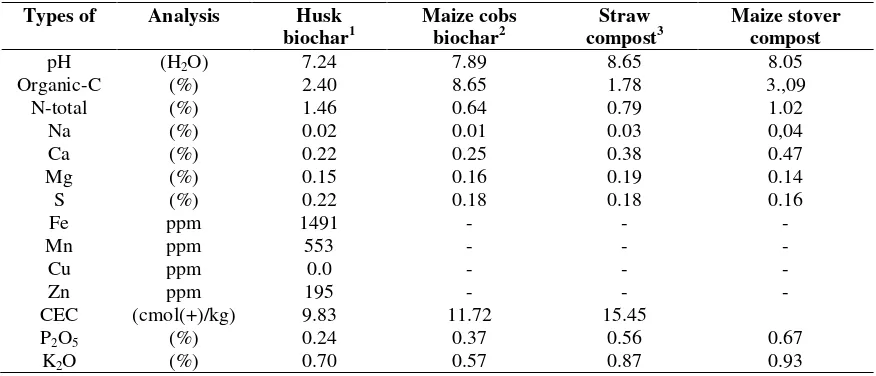
Husks and maize cobs biochar were produced through low temperature by pyrolysis process (burning without oxygen) at 200 – 300˚C using drum oil which on the bottom has been fitted with cavities. Fresh rice straw and maize stover were chopped and composted with effective microorganism (EM) for one month. The characteristics of biochars and composts are presented in the Table 1.
Application of biochar and compost
Table 1. Chemical composition of biochar (rice husk and maize cobs) and straw compost (Barus et al., 2015)
Types of Analysis Husk biochar1
Organic-C (%) 2.40 8.65 1.78 3.,09
N-total (%) 1.46 0.64 0.79 1.02
Na (%) 0.02 0.01 0.03 0,04
CEC (cmol(+)/kg) 9.83 11.72 15.45
P2O5 (%) 0.24 0.37 0.56 0.67
K2O (%) 0.70 0.57 0.87 0.93
1,,2, 3
Barus et al. (2015).
Statistical Analysis
The collected data was statistically analyzed using analysis of variance (F-Test) at level (P ≤ 0.05); Duncan post-hoc test at 5% level was used to compare all treatments with control using SPSS/PASW Statistic 18.
Results and Discussion
Applications of biochar and compost were able to reduce soil bulk density (BD) and particle density (PD) (Table 2). Application compost has potentially given greater impact to soil BD than biochar. The lowest bulk density was observed in straw compost treatment (decrease of 7.5% compared to control). Soil bulk density is affected by soil organic matter content as reported Busscher et al. (2011), that increasing total organic carbon by the addition of organic amendments in soils can significantly decrease BD.
The study micromorphological observations of the amended soils indicated theflocculation of soil microaggregates after the addition of biochar (Jien and Wang, 2013). Compost application generally influences soil structure by lowering soil density due to low density OM than the mineral of soil fraction. This positive effect has been detected in most cases and it is typically associated with an increase in porosity beca.use of the interactions between organic and inorganic fractions (Amlinger et al., 2007). Biochar and compost application improve total porosity and increase fast drainage pores (FDP) of soil (Table 2). Macroaggregate
formation was an important factor in maintaining soil porosity as a result of the increase in microbial activity. Sun and Lu (2014) reported that application of straw biochar (SB) and water-sludge biochar (WSB) significantly enhanced the
formation of 5–2 and 0.25–0.5 mm
macroaggregates in the clayey soil relative to the control treatment, while the < 0.25-cm microaggregate decreased with biochar additions.
Biochar and compost application increase water content at pF 2.54 (field capacity), pF 4.2 (permanent wilting point), and available water for plant (the value among pF 2.54 and pF 4.2) compared to control (Table 3). Compost application increase field capacity, secondary pore structures and improved water retention (Fisher and Glaser, 2012). The same results reported by Bass et al. (2016) showed that application of 10 t biochar/ha and 25 t compost/ha significantly increased soil water content compared to control at trial mid-point.
Application of biochar and compost have synergistic benefits to soil organic matter (SOM) and water holding capacity (WHC) (Liu et al., 2012), and have positively correlation with R2 = 0,7824 (Blazka and Fischer, 2014). Chan et al. (2007) concluded that biochar application improved some physical soil properties, such as: increased soil aggregation, water holding capacity and decreased soil strength.
Table 2. Soil physical characteristic (average and standard deviation) affect of biochar (rice husk and maize cobs) and straw compost after second application at 2015
Treatments Bulk
Density (BD) (g/cm3)
Particle Density (PD) (g/ cm3)
Total Porosity
(% Volume)
Fast drainage
pores (FDP)
Low drainage
pores (LDP) A Control 1.18 ± 0.03 2.17 ± 0.11 43.23 ± 3.81 13.82 ± 4.15 5.13 ± 1.41 B 10 t husk biochar /ha 1.12 ± 0.11 2.12 ± 0.09 46.20 ± 3.77 16.65 ± 3.13 4.95 ± 0.52 C 10 t maize cob
biochar/ha
1.13 ± 0.09 2.14 ± 0.10 46.35 ± 3.21 16.46 ± 2.23 4.68 ± 0.64
D 10 t straw compost /ha 1.07 ± 0.04 2.10 ± 0.14 47.87 ± 1.45 20.38 ± 2.83 5.68 ± 0.38 E 10 t stover compost /ha 1.09 ± 0.03 2.13 ± 0.13 49.05 ± 3.13 18.88 ± 1.62 5.03 ± 0.91 F B + D 1.08 ± 0.03 2.13 ± 0.10 48.35 ± 2.14 20.38 ± 3.38 5.40 ± 0.45 G C + E 1.10 ± 0.04 2.13 ± 0.13 47.63 ± 3.55 19.58 ± 4.35 5.24 ± 0.35
Table 3. Soil water condition (average and standard deviation) after application of biochar (rice husk and maize cobs) and straw compost at the second planting
Treatments Soil Water (% volume) Permeability
(cm/hour) pF 2 pF 2.54 pF 4.2 Available
water
A Control 25.8 ± 3.72 20.63 ± 2.69 11.42 ± 1.93 9.21 ± 1.64 7.35 ± 4.57 B 10 t husk biochar /ha 28.5 ± 0.27 23.60 ± 0.41 12.75 ± 0.66 10.85 ± 0.63 12.54 ± 2.55 C 10 t maize cob
biochar/ha
27.4 ± 1.76 23.01 ± 1.14 12.88 ± 1,31 10.13 ± 0.28 14.67 ± 3.71
D 10 t straw compost /ha 29.98 ± 3.69 24.92 ± 3.44 13.43 ± 3,35 11.49 ± 2.26 10.99 ± 2.35 E 10 t stover compost /ha 27.35 ± 2.47 22.45 ± 2.11 11.48 ± 0,89 10.93 ± 1.29 13.78 ± 3.66 F B + D 28.24 ± 1.17 23.72 ± 1.27 13.36 ± 1,28 11.36 ± 1.31 12.23 ± 2.24 G C + E 27.75 ± 1.86 22.70 ± 1.94 11.60 ± 1,15 10.53 ± 1.64 9.51 ± 1.52
Compost treatments (D and E) and combination of rice husk biochar and straw compost (F) significantly increase numbers of panicle and grains compared to control, but combination of maize cob biochar and stover compost (G) did not significantly increase numbers of panicle and
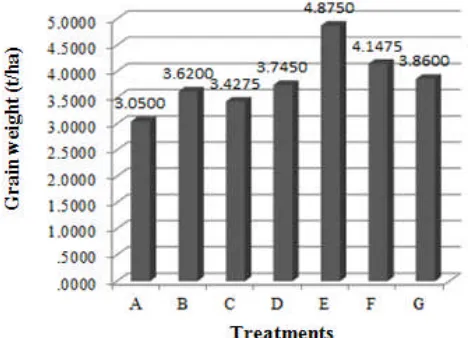
grains compared to control (Table 4). Application biochar or compost did not significantly effect on grain yield, but the treatment combination of husk biochar and straw compost (F) significantly increase grain yield compared to control (Figure 1).
Major et al. (2010) reported that maize grain yield did not increase significantly in the first year following addition of 20 t /ha of biochar, but its effect was significant after the 3 years of application. Addition of manure biochar increased maize yield by 98–150% and water use efficiency by 91–139% (Uzoma et al., 2011). Due to its multiple positive effects on the physical, chemical and biological soil properties, compost and/or biochar contribute to the stabilization and increase of crop productivity and quality (Amlinger et al., 2007; Chan et al., 2007). Soil bulk density values had negative correlation with grain yield (r =
-0.0197), but water available for plant had positive correlation (r = 0.422) (Figure 2).Yu et al. (2013) reported their result study, that the biochar increases water holding capacity of a loamy sand soil 1.7% by mass for each 1% of added biochar, the value of water holding capacity of soil, 16%, is doubled by the addition of 9% by mass of biochar. Another study reported that after incubation of 105 days in a soil classifiedas a Typic Paleudults, the bulk density of the biochar-amended soil significantly decreased from 1.42 g/cm3to 1.15 g/c m3, and rate of decrease was increased with the biochar application rate (Jien and Wang, 2013).
Table 4. Effect of biochar (rice husk and maize cobs) and straw compost on rice production components
Treatments Plant Height (cm)
Numbers of panicle
Numbers of grain/ panicle
A Control 115.9 b 11.5 b 150.3 b
B 10 t husk biochar /ha 120.5 ab 13.1 ab 172.3 ab
C 10 t maize cob biochar/ha
120.1 ab 14.6 ab 176.2 ab
D 10 t straw compost /ha 120.7 ab 15.6 a 204.8 a
E 10 t stover compost /ha 123.4 a 15.8 a 207.9 a
F B + D 123.9 a 15.2 a 211.8 a
G C + E 116.15 b 14.2 ab 174.8 ab
St.Dev. 3.54 1.92 11.66
Figure 2. Correlation soil bulk density and water available for plant with grain yield
Conclusion
Biochar and compost application improved soil physical properties such as bulk density, total porosity, fast drainage pores, water content, and permeability. The combination of rice husk biochar and straw compost gave better effect than single applications on rice production components (numbers of panicle and grains of rice), and gave the highest yield 4.875 t/ha.
Acknowledgements
The author wishes to thank Mr. Tusrimin, Amd as a technician in the field and Mr. Muntalam as a land owner for their valuable assistance in conducting this study.
References
Ferralsol.Soil Research53:1–12.
Amlinger, F., Peyr, S., Geszti, J., Dreher, P., Karlheinz, W. and Nortcliff, S. 2007. Beneficial effects of compost application on fertility and productivity of soils. Literature Study, Federal Ministry for Agriculture and Forestry.Environment and W a t e r Management, Austria. 225 p
Badiane, A., Badiane., Ndour, N.Y., Guèye, F. and Faye, S. 201). Effects of different inputs of organic matter on the response of plant production to a soil water stress in Sahelian region.Natural Science4 (12) : 969-975.
Barus, J., Dermiyati, Lumbanraja, J. and Sudarsono, H. 2015. Effectivity of biochar and compost of plant waste on soil chemical properties and soybean yield.
Journal of Tropical Soil (in press).
Bass, A.M., Bird, M.I., Kay, G. and Muirhead, B. 2016. Soil properties, greenhouse gas emissions and crop yield under compost, biochar and co-composted biochar in two tropical agronomic systems.Science of the Total Environment550 : 459 – 470.
Blažka, P. and Fischer, Z. 2014. Moisture, water holding, drying and wetting in forest soils. Open Journal of Soil Science4 (5): 174 – 184.
Busscher, W., Novak, J.M. and Ahmedna, M. 2011. Physical effects of organic matter amendment of a southeastern US coastal loamy sand. Soil Science
176 : 661–667.
Chan, K.Y. and Xu, Z. 2009. Biochar: Nutrient properties and their enrichment. pp.67-84. In J. Lehmann and S. Joseph (eds.) Biochar for environmental management: Science and Technology. Earthscan, London.
Chan, K.Y., Zwieten, B.L., Van Meszaros, I., Downie, A. and Joseph ,S. 2007. Agronomic values of green waste biochar as a soil amendment. Australian Journal of Soil Research45: 629–634.
Cornelissen, G., Martinsen, V., Shitumbanuma, V., Alling, V., Breedveld, G.D, Rutherford, D.W., Sparrevik, M., Hale, S.E., Obia, A. and Mulder, J. 2013. Biochar effect on maize yield and soil characteristics in five conservation farming sites in Zambia.Agronomy3 (2): 256-274
Dariah, A., Sutono. dan Nurida, N.L. 2010. Penggunaan pembenah tanah organik dan mineral untuk perbaikan kualitas tanah Typic Kanhapludults, Taman Bogo, Lampung.Jurnal Tanah dan Iklim31 : 1 – 10
Eusufzai. M.K. and Fujii, K. 2012. Effect of organic matter amendment on hydraulic and pore characteristics of a clay loam soil.Open Journal of Soil Science2 (4): 372-381.
Evanylo, G., Sherony, C., Spargo, J., Starner, D., Brosius, M., and Haering, K. 2008. Soil and water environmental effects of fertilizer, manure, and compost-based fertility practices in an organic vegetable cropping system.Agriculture, Ecosystems & Environment127: 50-58.
Fischer, D. and Glaser, B. 2012. Synergisms between Compost and Biochar for Sustainable Soil Amelioration. Martin Luther University Halle Wittenberg, Institute of Agricultural and Nutritional Sciences, Soil Biogeochemistry, Halle, Germany,
www.intechhopen.com, Management of Organic Waste 167 - 198.
Hunt, J., DuPonte, M., Sato, D. and Kawabata, A. 2010. The basics of biochar: a natural soil amendment.
Soil and Crop ManagementSCM-30 : 1-6. Jien. S.H. and Wang. C.S. 2013. Effects of biochar on
soil properties and erosion potential in a highly weathered soil.Catena110 : 225 – 233
Laird, D.A., Fleming, P., Davis, D.D., Horton, R., Wang, B. and Karlen, D.L. 2010. Impact of biochar amendments on the quality of a typical midwestern agricultural soil.Geoderma158: 443-449.
Lal, R. 2009. Soils and food sufficiency. A Review.
Agronomy for Sustainable Development 29 :
113-133.
Liu, J., Schulz, H., Brandl, S., Miehtke, H., Huwe, B. and Glaser, B. 2012. Short-term effect of biochar and compost on soil fertility and water status of a Dystric Cambisol in NE Germany under field conditions. Journal of Plant Nutrition and Soil Science175 : 698- 707.
Lehmann, J., Rillig, M.C., Thies, J., Masiello, C.A., Hockaday, W.C. and Crowley, D. 2011. Biochar effects on soil biota – A review.Soil Biology and Biochemistry43 : 1812–1836.
Major, J., Rondon, M., Molina, D., Riha, S. and Lehmann, J. 2010. Maize yield and nutrition during 4 years after biochar application to a colombian savanna oxisol.Plant and Soil 333 :117–128. Masulili, A., Utomo, W.H., Syechfani, M.S. 2010. Rice
husk biochar for rice based cropping system in acid soil 1.The characteristics of rice husk biochar and its influence on the properties of acid sulphate soils and rice growth in West Kalimantan. Indonesia.Journal of Agriculture Science2:39–47.
Milla, O.V, Rivera, E.B., Huang, W.J., Chien, C.C. and Wang, Y.M. 2013. Agronomic properties and characterization of rice husk and wood biochars and their effect on the growth of water spinach in afield test.Journal of Soil Science and Plant Nutrition13 (2) : 251–66.
Novak, J.M., Busscher, W.J., Watts, D.W., Amonette, J.E., Ippolito, J.A, Lima, I.M, Gaskin, J., Das, K.C., Steiner, C., Ahmedna, M., Rehrah, D. and Schomberg, H. 2012. Biochars impact on soil-moisture storage in an Ultisol and two Aridisols.
Soil Scence177 : 310-320.
Nurhidayati and Mariati. 2014.Utilization of maize cob biochar and rice husk charcoal as soil amendments for improving acid soil fertility and productivity.
Journal of Degraded and Mining Lands
Management2 (1) : 223-230.
Quilty, J. and Cattle, S. 2011. Use and understanding of organic amendments in Australian agriculture: a review. Soil Research49: 1–26.
Schulz, H. and Glaser, B. 2012. Effects of biochar compared to organic and inorganic fertilizers on soil quality and plant growth in a greenhouse experiment. Journal of Plant Nutrition and Soil Science175: 410–422
Press, ISBN 0125468075, 9780125468077, Burlington
Steiner, C., Glaser, B., Teixeira, W., Lehmann, J., Blum, W. and Zech, W. 2008. Nitrogen retention and plant uptake on a highly weathered Central Amazonian Ferralsol amended with compost and charcoal.Journal of Plant Nutrition and Soil Science
171 : 893–899.
Sun, F. and Lu, S. 2014. Biochars improve aggregate stability, water retention, and pore-space properties of clayey soil.Journal of Plant Nutrition and Soil Science177 : 26–33
Tammeorg, P., Simojoki, A., Mäkelä, P., Stoddard, F. L., Alakukku., L. and Helenius, J. 2014. Biochar application to a fertile sandy clay loam in boreal conditions: effects on soil properties and yield formation of wheat, turnip rape and faba bean.Plant and Soil374: 89–107.
Uzoma, K.C., Inoue, M., Andry, H., Fujimaki, H., Zahoor, A. and Nishihara, E. 2011. Effect of cow manure biochar on maize productivity under sandy soil condition. Soil Use and Management27 (2) : 205 - 212
Yatno E. 2011. The Role of organic matter in improving soil physical quality and crop production.Jurnal of Land Resources5 (1) : 11 - 23