
481
A Character-based Local Curriculum Development Model in Vocational
High School (A Study of Vocational High School Curriculum Development
in Indonesia)
Dr. Moh. Mahfud Effendi
Mathematics Education Prorgam
University of Muhammadiyah Malang
email: [email protected]
Abstratc.
The goal of operating a Vocational High School (VHS) is to prepare its students to work in their own fields, however in fact most unemployment is from the graduation of this kind of school. Therefore, the curriculum of this school should be developed on the basis of the local potency in order to prepare its students to be able to work, and also to make them able to create locally-based new jobs opportunities and to grow their care, pride, and love of their community and their country. The objective of this present research is to develop a character-based curriculum development model in VHS. So, an R&D method was employed, where the procedures of this model development involved many VHS teachers, from the model design to the feasibility test of the model through the model feasibility test. The model feasibility test was administrated in two VHS with respondents of 20 teachers. On the basis of the test result, the model is feasible with the average level of the ease of implementation at schools of 78.12. This level is based on the respondents’ evaluation ranging the range from 2.41 – 3.97, where 65% stated that this model was easy to implement, and 35%, very easy. However, the stages at the syllabus development and learning design are considered to be more difficult, but the difficulty is insignificant compared with the stages encountered in the orientation, evaluation and implementation. Keywords: Vocational High School, model, local curriculum, character
INTRODUCTION
Vocational High School (VHS) is a vocational education with the main aim at preparing its students to work [32]. In Indonesia, this VHS is an educational institution which is unique and different from Senior High School (SHS) [6]. This uniqueness is caused by the fact that its curriculum development and its learning process combine professional knowledge and work competence aspects [4, 17, 18, 31, 33, 34]. Besides being able to work, its graduates are also expected to be able to continue their study to higher education [32], so that the VHS students are required to join in the national examination [25,26,32]. This gives a great effect: the VHS students have higher learning loads than SHS ones. In the implementation in the field, therefore, overloading and overlapping learning materials occur [10].
482
pride, and cares to their regions, because they feel that the curriculum is part of their lives after they graduate from their school. It is clear that the application of the curriculum development model may produce locally-based excellence VHSs, such in Madura VHSSalt Mining, in Jogjakarta, VHS Batik Industry, in Kalimantan VHS Protected Forest, in Bali VHS Statue Art, in Bandung VHS Angklung, in Malang, VHS Apple Plant, in NTB, VHS Cattle, in NTT Cocoa Agriculture, and also in other regions through Indonesia.
In the structure of the VHS curriculum, there are two groups of obligatory subjects, group A and group B, and one expertise/interest group, that is included into group C [26]. The obligatory subjects in the group B, including the craft and entrepreneurship subject, are local contents of which the curriculum development should be based on the potency and uniqueness of the school or the area. As a result, the objective of the craft and entrepreneurship subjects is to make students able to create new employments in line with each local potency and cultures [18]. So, the learning process of the craft and entrepreneurship subject in VHS should be developed as icons and supported by all expertise programs in the concerned VHSs [13, 22]. The aim of this integrated curriculum is to facilitate students to learn the learning materials and to do meaningful learning activities so that the aim may be effectively reached [1, 6, 10, 17]. The problem is how to develop a character-based local curriculum in VHS through craft and entrepreneurship subject.
METHOD
Research Approach
The centralistic government system adopted in Indonesia causing the school curriculum development model, including in VHS, is top down in nature [10]. This model adheres the sameness and efficiency principle, but it less recognizes any diversities, capability differences, local potencies, creativeness, and tends to result in overloading graduates and unemployment. The centralistic curriculum development less acknowledges any model variations so that up to now a bottom up curriculum development model in VHS,especially a character-based local curriculum development model, has not existed yet.
Based on the research problem and the title above, it is a case study with the objective of producing a character-based local curriculum development model in VHS, especially in Indonesia or other regions possessing similarities with Indonesia. Therefore, in this present research, a Research and Development (R&D) method was employed. In order to fulfill the requirements of a product feasibility, the effectiveness of the character-based local curriculum model in VHS as the result of the R&D should be tested [3, 16, 21, 29] through a model feasibility test at school.
Participant
This R&D procedure consists of three stages. Preliminary stage is an early stage intended to (1) make a literary study, (2) do a field study and (3) determine a research problem dealing with a curriculum development model in VHS. After the problem is determined, the next stage is the development one, consisting of (1) defining and formulating a problem and design research procedures and its instruments; (2) producing a curriculum development model draft; (3) doing a validation test to the model through FGD (Focused Group Discussion), and (4) making an evaluation and improvement so that a hypothetical character-based local curriculum development model is created. The last stage is to test of the hypothetic model appropriateness in VHSs. Teachers of VHSs took part in the FGD activities. The model appropriateness test was made in two VHSs namely VHS Temayang Bojonegoro and VHS Dharmawanita 2 Wajak Malang with respondents of 20 teachers from the concerned schools.
483
Based on the above development procedures, there are three ways or techniques in the data collection, namely documentary, questionnaires, and interviews. The documentary technique is used to obtain data on (1) the prevailing VHS curriculum, (2) the curriculum development model in VHS, and (3) any regulations regarding the development and implementation of education in VHS. The data were used to define and design the research procedures and the instrument. The questionnaire technique is used to get data on the model appropriateness either the internal validation through the FGD or the external validation via the model feasibility test. The interview technique is intended to cross-check or verify the data obtained using either documentary and questionnaire techniques [16, 21]. The data were collected, identified, and analyzed to
answer the research problem: “What is the character-based local curriculum
development model in VHS?” To answer the question, the data were categorized on the basis of the curriculum development stages: orientation, development, implementation and evaluation
Data Analysis
To produce a “character-based local curriculum development model in SMK”,
there are two stages in the analysis: producing the model and the model appropriateness through the feasibility test. In the two stages, a qualitative analysis was made. The result of the questionnaire of the model feasibility test is respondents’ opinion about whether the character-based local curriculum model is easy to implement in VHSs. The respondents completed the questionnaire consisting of 34 items using the four-Liker scale: 1 – is not very easy, 2 = is not easy, 3 = easy, and 4 = very easy. The data from the results of the questionnaire were then qualitatively analyzed and used to describe the levels of the hypothetic development model feasibility, starting from the orientation to the evaluation stages. Then, to calculate and to analyze it, the data were transformed into the quantitative ones in accordance with the weighted scores namely 1, 2, 3, and 4 [24]. After the data were transformed into the quantitative data, in the calculation of the rating scale, the following formula was employed [21,24]:
� =
ℎ
�
�
%
Note :
a) P = number of percentage
b) Ideal score = the highest score of each item x the number of respondents x number of items.
To determine the level of the results of the model feasibility test, the rating scale is grouped into four categories using the following scale:
Table 1: Scale and Category of the Feasibility Level
Scale (%)
Category of Feasiblity
Category of Appropriateness
0 - < 25
Not Very Easy (NVE)
Not Very Appropriate
25 - < 50
Not Easy (NE)
Not Appropriate
50 - < 75
Easy (E)
Appropriate
75 - 100
Very Easy (VE)
Very Appropriate
RESULTS
484
It is a conceptual development model, a model with the characteristics of analyzing the components of the model and of showing the relationships among the components developed [9]. The process of this curriculum development follows the grass root or bottom up model [2], starting from the orientation stage, making a need analysis based on the local potency, strength, and local interest to obtain a curriculum development model as expected. The model was then determined based on the orientation results. The next stage was to develop a curriculum model, especially to organize a curriculum producing syllabus and lesson plan. The goal of this curriculum organization is to map the content or the curriculum standard by paying attention of the scope, the order, and the amount of hours in order to avoid any overloads and overlaps in the implementation [5].
The main goal of this character-based local curriculum development model in VHS is to create and to develop local potency-based jobs so that all fields or expertise programs in the concerned VHS should support to and integrate with the objective of the local curriculum development [6, 10, 19]. Hence, the curriculum organization model is integrated [10, 13]. There is merely one Craft and Entrepreneurship subject for each VHS, instead of each expertise program. If each VHS is merely given one Craft and Entrepreneurship subject, the efforts to create new jobs would be more effective and efficient.
485
Craft and Enterpreneurship
Agribusiness & Agrotechnology
ICT Busines &
Management
Technology & Engineering
2
2
2 2 2
1
1 1 1
1
3
3
3
3
Figure 1: Curriculum Development using a “Pyramid Model”, adapted [11]
486
Gambar 2: Procedures in the Local Curriculum Model Development in VHS, adapted [12]
On the basis of the procedures, there is a series of activities that may be done to get a character-based local curriculum as the content of the craft and entrepreneurship subject. The series of activities are as follows.
1. Orientation stage. It is a preliminary stage that should be done together among the local government, headmasters, the heads of expertise programs, and the concerned parties, the activities made at this stage are as follows:
a. Making coordination and communication with all expertise programs in the concerned VHS.
b. Making a SWOT analysis of the school regarding the development of the local content for the craft and entrepreneurship subject.
c. Stabilizing commitments and synchronizing the perception of the local content development.
d. Analyzing and determining local potencies/cultures as the local contents e. Determining the profile of the graduates of the craft and entrepreneurship
subject.
f. Establishing the learning objectives of the craft and entrepreneurship subject g. Deciding the expertise programs that support the learning objectives of the craft
and entrepreneurship subject.
487
the students, materials organization, time allotment for the subjects, to how to design the learning activities. The detailed activities at this stage are as follows: a. Identifying and determining the GCS from the learning objectives of the craft
and entrepreneurship
b. Identifying and determining the GCS of the expertise program supporting the GCS of craft and entrepreneurship
c. Integrating of GCSs of the expertise programs into the GCS of craft and entrepreneurship
d. Developing a character-based GCS (having pride of the national/local areas, discipline, sincerity, tolerance, positive motivation and interest, and the like) in the craft and entrepreneurship subject.
e. Determining/developing the BC and indicators of success based on the GCS of the craft and entrepreneurship subject.
f. Determining/developing the content standard (learning materials) and the process standard of the craft and entrepreneurship subject.
g. Determining the scope and the order of presenting the learning materials. h. Determining the learning activities and learning experiences for students i. Distributing the learning materials and determining the time allotment per week
n a semester
j. Making syllabus/lesson plan.
3. Implementation stage. It is the stage of implementing the learning process in the classroom based on the lesson plan made. The activities at this stage are made by teachers, therefore they should have both pedagogical and professional competences. The activities are that teachers should:
a. master the learning materials
b. be able to choose learning strategies. c. apply a scientific approach
d. apply character learning
e. provide with learning sources/media in the learning process f. make use of learning sources/media in the learning process g. apply contextual learning
h. involve students in the learning process i. motivate students to learn
j. modify or change learning plan as needed.
4. Evaluation stage. It is an evaluation stage either in the learning process or learning outcomes used to determine the follow-up, and to revise and development the next lesson plans, even the evaluation is made to the craft and entrepreneurship curriculum. The detailed activities at this stage areas follows
a. Making evaluation of the learning process b. Implementing evaluation of the portfolio c. Doing written and oral tests
d. Appraising students’ characters changes
e. Implementing learning follow up and enrichment tasks
f. Giving feedback to the orientation, development, and implementation stages. Model Feasibility Test
488
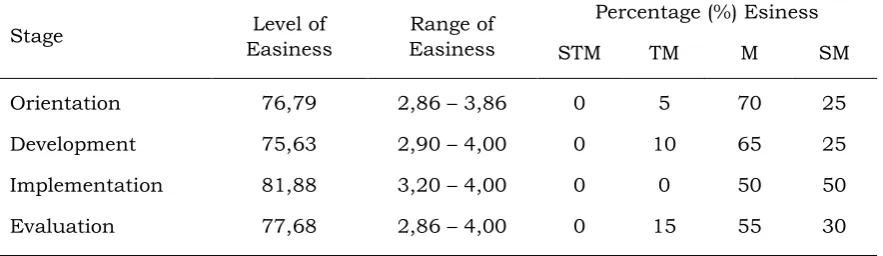
the feasibility of the model development stages. Based on the results of the analysis, it is known that the character –based local curriculum development model was very appropriate with the level of easiness of the implementation at school of 78.12. The level of easiness of the implementation in state VHS Temayang Bojonegoro was 73.16 and in private SMK Dharmawanita 2 Wajak Malang, 88.09. The range of the easiness of the implementation on the bases of the respondents’ evaluation is at the interval of 2.41- 3.97 where 65% respondents stated that it is easy to implement, and the rest 35%, very easy to implement.
The average difference of the easiness level in each stage is maximally 6.25 and minimally 75.63 at the implementation stage, and the highest, 81.88 at the implementation stage. The development stage was at the lowest level in the easiness in the implementation, since this stage requires teachers’ ability in the curriculum development, the syllabus development and the learning plan design. The teachers’ ability in this development was very low because they were never involved in curriculum development [10]. There are some activities in the curriculum development the teachers were difficult to do, so that its level of easiness of the implementation was low. The activities are as follows: (1) identifying, determining, and integrating the GCSs of the expertise programs supporting the BCs, of the craft and entrepreneurship subject, (2) developing the content standard (learning material) and the process standard, (3) determining the coverage and order of presenting the learning materials, and (4) distributing the learning materials and determining the time allotment per week in a semester.
The description of the level, the range and the percentage of easiness from the result of the model feasibility tests based on the stages of the character-based local curriculum model development in the state VHS Temayang Bojonegoro, and the private VHS Dharmawanita 2 Wajak Malang is presented in Table 2.
Table 2: Level, Range, and Percentage of Easiness of the Test Result of the Model
Stage Level of
Easiness
Range of Easiness
Percentage (%) Esiness
STM TM M SM
Orientation 76,79 2,86 – 3,86 0 5 70 25
Development 75,63 2,90 – 4,00 0 10 65 25
Implementation 81,88 3,20 – 4,00 0 0 50 50
Evaluation 77,68 2,86 – 4,00 0 15 55 30
489
DISCUSSION
Thos character-based local curriculum development model in VHS is an integrated curriculum model, of which its development is based the concept develop by James A. Beane on Curriculum Integration[1] and by Fogarty in How to Integrate Curricula [15]. Fogarty states that integrated curriculum is a curriculum that integrates the concepts, topics, and contents in the learning process in order to avoid their overlapping or overloading materials in the implementation. Beane explains that curriculum integration involves four major aspects, namely the integration of experiences, social integration, the integration of knowledge, and integration as a curriculum design. Basen
on the Fogarty’s thought, in such an integrated curriculum, there are three dimensions
that should be paid attention, namely vertical, horizontal, and circling (Figure 3). Spiraling curricula shows levels or the amount of materials integrated. The mastery of materials at certain level may be used as the measure to give materials at the next level. This curriculum integration should proceed during the education. the horizontal arrow represents the depth and the breadth of the learning process from certain discipline subjects. The circle shows the integration of skills, themes, concepts and similar cross-discipline topics.
Breadth and Depth Within Discipline
Grade 12
Kindergarten
Mathematics
Language Art
Science
Social Studies
C
u
rr
ic
u
la
S
p
ir
a
li
n
g
Figure 3: How To Integrate Curricula: Three Dimensions adapted [15]
It is a little different from the Character-based Local Curriculum Development Model in VHS, in terms of the objectives and components of the curriculum integrated (Figure 1). The goal of this model curriculum is that the students are able to create and develop certain locally-based jobs through craft and entrepreneurship subject. To realize it in VHSs, there is one craft and entrepreneurship subject and it should be supported and sustained by some expertise programs existing in the concerned VHS.
490
the importance of the reformation in the vocational education [20]. Lu Hong contends
that bahwa “The meaning of higher vocational education reform is to make teaching
content more suitable for the training aim of higher vocational students, discarding the traditional teaching mode, trying to explore and break traditional teaching material system construction. In order to meet the needs of professional post, the new curriculum content system reform principle should be built, which focuses on core radiation of task and the training of knowledge and ability-oriented”. This reformation is to re-design of the implementation of the curriculum by harmonizing and integrating the learning contents and the instructional system and the expertise programs.
The VHS curriculum should always respond the development of the needs of jobs and development of technology, as a result re-designing curriculum is the best way in developing a sustainable Curriculum development in VHS. Therefore, LIU Deen in the research with the title of Characteristics of Curriculum in Higher Vocational Education” [7] insists that the curriculum development in VHS should possess four features: (1)job-oriented in curriculum objectives, (2) applied technology based curriculum content, (3) work activity-centered curriculum organization, and (4) curriculum implementation through teaching integrated with operation. The four features certainly become the foothold in development a character-based local curriculum model in VHS. This model
is in contradiction with Deen’s opinion, since the craft and entrepreneurship subject is
the final destination of the curriculum integration from some expertise programs in the concerned VHS.
The integrated curriculum should be implemented in the from the integrated learning form in the classroom. This integrated learning is meaningful learning which is effective in reaching the learning goal. The goal of each subject in VHS should be oriented towards the effectiveness of the attainment of the competencies in expertise programs. Up to now what has happened to the learning activities in VHS is that the obligatory subjects and the subjects in the expertise programs are separated [10]. It is also reinforced by the research results of Yi-Hsuan GL and Bella OS, in their ESP curriculum development in VHS. The title of their research is “When Academia Meets Industry: Effective ESP Curriculum Development for Vocational High School Students Delivering Profesional Business Presentations” [17]. Their research results shows that the ITB ESP (Intensive Task-Based English for Special Purposes) program gave a
significant effect on the VHS students’ understanding of concepts and skills in their
business presentation using English.
CONCLUSION
The Character-based Local Curriculum Development Model in VHS is a study of the VHS curriculum development in Indonesia. conceptually, this model may be implemented in VHSs through the craft and entrepreneurship subject. In the VHS curriculum, in each expertise program there is one craft and entrepreneurship subject, therefore, this curriculum should be re-designed by determining that in each VHS, there should be on craft and entrepreneur subject. To make this subject effective, it should be supported and sustained by the expertise programs in the concerned VHS provided with an integrative learning system.
491 REFERENCES
[1]. Beane, James A. (1977). Curriculum Integration; Designing the core of democratic Education. New York and London: Teachers College Press.
[2]. Beaucham, GA. (1975). Curriculum Theory. Illinois: The Kagg press
[3]. Borg WR & Gall M.P. (2003). Educational Research, An Introduction 7th Edition. Pearson Education, Inc.
[4]. Bowers, Helen. (2006). Curriculum Design in Vocational Education. Fully refereed paper for the Australian Association for Research in Education-2006 Conference 26-30 November 2006, Adelaide
[5]. Darling-Hammond, Linda et.al.(2005). Preparing Teachers For A Changing World: What teachers should learn and be able to do?. San Fancisco: John Wiley& Sons, Inc.
[6]. Dayuan, Jiang. (2006). Thoughts on Fundamental Problems of Vocational Education Pedagogy: Journal Vocational and Technical Education; 2006-04. [7]. Deen, LIU. (2001). Characteristics of Curriculum in Higher Vocational
Education: Journal Vocational and Technical Education; 2001-16
[8]. Depdiknas Ditjen Pendasmen. (2009). Surat Edaran Direktur Jenderal Manajemen Pendidikan Dasar dan Menengah Departemen Pendidikan Nasional No. 2669/C.C5/mn/2009 mengenai Langkah-langkah Strategis Untuk
Mendorong Pertumbuhan Jumlah Siswa SMK. Tersedia:
http://www.ditpsmk.net.
[9]. Ditnaga Dirjend Dikti. (2007). Metodologi Penelitian dan Pengembangan Pendidikan: Pelatihan Metodologi PPKP dan PIPS. Tersedia: www.ditnaga-dikti.org.
[10]. Effendi, Moh Mahfud. (2013). Pengembangan Kurikulum Matematika sebagai Mata Pelajaran Adaptif pada Program Keahlian Tata Busana SMKN 3 Probolinggo. Jurnal Penelitian Pendidikan 1412-565X Edisi khusus Februari 2013 hal 43-60 [11]. Effendi, Moh Mahfud. (2014). Alternatif Model Organisasi Kurikulum Matematika
Sekolah Menengah Kejuruan (SMK). Jurnal HIPKIN: Inovasi Kurikulum, ISSN: 1829-6750 Volume 01 Maret 2014; hal 123-135.
[12]. Effendi, Moh Mahfud. (2016). Analisis Pengembangan Bahan Ajar Matematika SMK. Prosiding: Seminar Nasional Pendidikan Matematika 2016; Penguatan Peran Pendidikan Matematika dalam Meningkatkan Kualitas Bangsa; hal 103-106.
[13]. Fang, LI Ju, and Zheng, ZHOU Jian. (2010). The construction and implementation of work-integrated learning "Three Policy" model in the vocational college of mapping class: Journal Science of Surveying and Mapping; 2010-05 [14]. Finch, CR and Crunkilton, JR. (1979). Curriculum Development in Vocational and
Technical Education: Planning, Content, and Implementation. Boston: Allyn and Bacon.
[15]. Fogarty. (1991). How to Integrate The Curricula: The Mindful School. Palatine, Illinois: Skylight Publishing, Inc.
[16]. Gay, L.R, et.al,. (2006). Educational Research: Competencies for Analysis and Applications. New Jersey: Pearson Prentice Hall.
[17]. Gloria Lo, Yi-Hsuan and Sanjaya, Bella Oktaviani. (2015). When Academia Meets Industry: Effective ESP Curriculum Development for Vocational High School Students Delivering Profesional Business Presentations. English as a Global Language Education (EaGLE) Journal: Vol. 1 No. 2; pag. 31-62.
[18]. Karseth, Berit. (20060. Curriculum Restructuring In Higher Education After The Bologna Process: A New Pedagogic Regime?. This article is a revised version for this monograph of a paper presented at The ThirdConference on Knowledge and Politics at the University of Bergen, May 18-20th, 2005.Journal: Revista Española de Educación Comparada, 12 (2006), 255-284
492
[20]. Lu Hong. (20090. Thought and Practice on Curriculum Reform in Higher Vocational Colleges: Journal of Anhui Vocational & Technical College;2009-01, [CateGory Index]: F830-4;F712.3
[21]. McMillan, James H. (2008). Educational Research: Fundamentals for The Consumer, 5th Edition USA: Person Education, Inc.
[22]. McNeil. (2006). Contemporary Curriculum in Thought and Action. USA: John Wiley & Sons.
[23]. Miller & Seller. (1985). Curriculum: Perspectives and Practice. New York & London: Longman.
[24]. Oppenheim, A.N. (1982). Questionare Design and Attitude Measurement. London: Heinemann.
[25]. Peraturan Menteri Pendidikan dan Kebudayaan nomor 70 tahun 2013 Tentang Kerangka Dasar dan Struktur Kurikulum SMK/MAK.
[26]. Peraturan Menteri Pendidikan Dan Kebudayaan Republik Indonesia Nomor 60 Tahun 2014 Tentang Kurikulum 2013 Sekolah Menengah Kejuruan/ Madrasah Aliyah Kejuruan.
[27]. Posner, George J. (1992). Analyzing The Curriculum. USA: McGraw-Hill, Inc. [28]. Schnellert, Gary Loyd. (1993). Development of a Curriculum Model for Vocational/
Technology Education. Retrospective These and Dissertation, Paper 10269. Iowa State University, Digital Repository.
[29]. Sugiyono. (2008). Metode Penelitian Kuantitatif, Kualitatif, dan R&D. Bandung; Alfabeta.
[30]. Suryamin. (2016). Angka Pengangguran SMK Tertinggi di Indonesia, BPS Indonesia.
[31]. Toth, Peter. (2012). Learning Strategies and Styles in Vocational Education. Acta Polytechnica Hungarica: Vol 9, No. 3, 2012
[32]. Undang-Undang Sistim Pendidikan Nasional Nomor 20 Tahun 2013.
[33]. Xin, Zhao. (2007). Vocational Education Curriculum Development Oriented by Working Process Knowledge: Journal of Anhui Vocational & Technical College; 2007-07.
![Figure 1: Curriculum Development using a “Pyramid Model”, adapted [11]](https://thumb-ap.123doks.com/thumbv2/123dok/3523821.1774925/5.595.128.458.94.304/figure-curriculum-development-using-pyramid-model-adapted.webp)
![Gambar 2: Procedures in the Local Curriculum Model Development in VHS, adapted [12]](https://thumb-ap.123doks.com/thumbv2/123dok/3523821.1774925/6.595.93.526.92.402/gambar-procedures-local-curriculum-model-development-vhs-adapted.webp)
![Figure 3: How To Integrate Curricula: Three Dimensions adapted [15]](https://thumb-ap.123doks.com/thumbv2/123dok/3523821.1774925/9.595.181.431.319.542/figure-integrate-curricula-dimensions-adapted.webp)
