© 2018 Faculty of Humanities, Universitas Indonesia
Nurenzia Yannuar is currently working on her PhD in Leiden University Centre for Linguistics (LUCL), The Netherlands. She is also a faculty member in the Department of English, Faculty of Letters, Universitas Negeri Malang, Indonesia. Her interest is mainly on the use of colloquial and youth languages. Her two most recent publications include “Bòsò Walikan Malang’s address practices”, GEMA Online® Journal of Language Studies, 17/1 (2017): 107–123 in collaboration with Emalia Iragiliati and E. Laily Zen, “On the morphosyntax and pragmatics of -in in Colloquial Jakartan Indonesian”, Indonesia and the Malay World, 44/130 (2016): 342–364 as co-author. Nurenzia can be contacted at: [email protected].
Nurenzia Yannuar | DOI: 10.17510/wacana.v19i1.625.
Wòlak-waliké jaman
1Exploring contemporary Walikan in public space
Nurenzia Yannuar
AbstrAct
This article describes the current use of Walikan, a youth language in Malang, Indonesia. Unlike any previously described youth registers in Indonesia, Walikan has been around since as early as the 1940s and has continuously reinvented itself ever since. As will be shown, the speakers of Walikan have certain strategies to keep the practice alive. In addition to the use of Walikan in face-to-face communication, they also use Walikan in songs, local TV news, local newspaper columns as well as in public signs. The analysis focuses on how a youth language which began as an oral practice has been maintained through written and audio-visual media offline and online. The results inform us how a community can work together to shape its identity through linguistic means.
Keywords
Youth language; East Javanese dialect; linguistic landscape; language in public space; Internet slang.
I
ntroductIonOf the existing 707 living languages in Indonesia (Simons and Fennig 2018), there are only a few which dominate the national mass media, among them Standard Indonesian and Javanese (Hoogervorst 2009; Krauße 2017). Javanese is used in a number of printed media (Soeharno et al. 1990), and there are nationally distributed magazines such as Jaya Baya and Panjebar Semangat
which are entirely in Javanese. However, modernization and the country’s language planning has paved the way for Indonesian to gain a more powerful position in the media. Standard Indonesian and Colloquial Indonesian are both considered prestigious within Indonesia‘s language ecology; in contrast local vernaculars are regarded as non-prestigious (Arka 2013: 201; Hoogervorst 2009). The vast majority of esteemed national newspapers and magazines are written in standard Indonesian, whereas youth magazines or chic lit are written in bahasa gaul, the youth register of colloquial Indonesian (Djenar 2014; Sneddon 2006). The same situation can be observed in audio-visual media such as radio and television. In short, the default language in national public space is undoubtedly Standard Indonesian.
Moving from the national situation, the picture changes when we look at the regional or local contexts. We see more roles assigned to other languages and vernaculars. Unlike the national media whose goal is to reach out to people with different mother tongues and therefore must use the national language, the local media have more freedom to use local languages. In doing so, they compete with the national media and attract more local viewers. Surabayan Javanese, for example, has been promoted from being a spoken language into one that is well represented in local television programmes, newspapers, advertisements, and street signs (Hoogervorst 2009). In Malang, the second biggest city in East Java after Surabaya, the most dominant spoken languages are Indonesian and Malangan dialect of East Javanese (Manns 2015). Indonesian is still predominantly used in most mass media, including local newspapers and television channels, but Malangan Javanese and another register called Bòsò Walikan Malangan (hereafter Walikan) are also available.2
This paper examines how Walikan is finding its way into the public media.
It commences with a brief discussion of the forms of Walikan and how its shape and function have developed throughout time. It proceeds by exploring the different platforms on which Walikan appears and can be accessed by a wider community in the city. Further, it analyses the motivation for using Walikan and the groups of speakers who are involved. The paper compares the forms of Walikan used in different media in which locals have participated in the maintenance of a local linguistic practice, a process related to the concept of ‘’latent enfranchisement’’ (Goebel, Jukes, and Morin 2017: 274). “Linguistic enfranchisement“ refers to the process of “how infrastructures, such as schools and the mass media, help to circulate and standardize a language among a certain population“, while “latent enfranchisement“ is a stage in which a language not yet included in school curriculums can be found in the city’s linguistic landscape (Goebel et al. 2017: 274).
s
hApIngAyouthlAnguAgeThis paper centres on Bòsò Walikan Malangan (Walikan), a youth language originating from Malang, East Java. In Javanese Walikan means ‘reversed’, referring to the most salient characteristic of the language, word reversal (Espree-Conaway 2012; Hoogervorst 2014; Yannuar 2018). The locals used to refer to Walikan by a number of inconsistent labels. Older speakers assert that they did not use any label for this word-reversal practice in the past; for them it was only a strategy to manipulate speech and conceal secret information. Some of them mentioned the terms kiwalan, lawikan, which are also distorted forms of the word walikan ‘reversed’. I have chosen the term Walikan because it is one that is used widely by the speakers and the media at present.
In Walikan, language manipulation is mainly achieved by word reversal and semantic change. Walikan is predominantly based on Javanese words, but it also contains reversal of Indonesian words and locally coined words. The reversal only takes place on the lexical level, and it involves a number of predictable strategies (Hoogervorst 2014; Yannuar in Progress). The most productive strategy is total phoneme reversal, in which the order of phonemes is reversed, to form words which comply with the rules of Javanese phonology and phonotactics (Hoogervorst 2014; Yannuar and Kadarisman 2015), as shown in (1-2).
1) maling [ˈma.lɪŋ] > ngilam [ˈŋi.lam] ‘thief’
2) banyu [ˈba.ɲu] > unyab [ˈu.ɲap] ‘water’
This could suggest that Walikan is an oral practice which does not pay attention to written forms. However, example (3) shows that the reversal can also be based on the orthography of the words: the velar nasal is orthographically a digraph “ng”, which is reversed as such.
3) òrang [ˈɔ.raŋ] > gnaró/genaró [ɡə.ˈna.ro] ‘person’
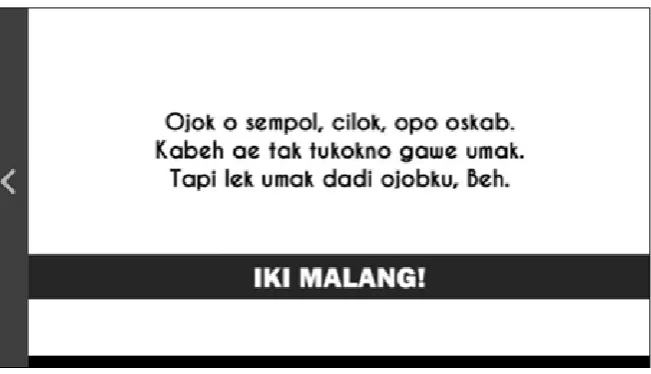
4) Òjòk-ò sempòl, cilòk, òpò òskab. Kabèh aé tak
neg-Imp sempòl cilòk what òskab all just 1sg.procl
tukòk-nò gawé umak. Tapi lèk umak dadi ójób-ku,
buy-cAus for 2sg but if 2sg become spouse-1sg.poss
bèh.
dp
‘Not just sempòl, cilòk, or baksó (local street food). I‘ll buy you anything. Only if you become my wife/husband, mate.’ (from Instagram)
In (4), bèh ‘friendly discourse particle’ is not reversed, but in my corpus I also
find examples in which bèh [ˈbɛh] can be reversed into hèb [ˈhɛp] (the final
/b/ has undergone final devoicing, following a Javanese phonological rule).
The most common error in speaking Walikan is to reverse all the words in the sentence, as doing so will result in an unacceptable type of Walikan. Example (5) is considered wrong or inaccurate because it tries to reverse as many lexical items as possible, including the words which are commonly not reversed; these are starred. In addition, (5) also includes some words which are not from the Malangan Javanese dialect; these are indicated with a double underline. They include Indonesian umak (< kamu) ‘you’ and kadit (< tidak)
‘no’, as well as jal `Central Javanese discourse particle’.
5)* Nyòba umpòmò umak hèbak *ébmògn ipòk kadit ròkòk-é, jal rasa-né *òyòk di *iupat òket *irubm.. isuk-isuk *ènam. (Inaccurate Walikan)
Ny-(c)òba umpòmò kamu kabèh ng-ómbé kòpi tidak
n-try if 2sg all n-drink coffee neg
ròkòk-é, jal rasa-né kòyò di-tapuk-i tekò mburi..
cigarette-def dp feel-def lIKe pAss-slap-Appl from behind
isuk-isuk manè. (Unreversed version)
mornIng~rdp again
‘If you all try to drink coffee without smoking (afterwards), perhaps it will feel like being thumped on the back, especially in the morning.’ (from Facebook)
if not a lower status than Malangan Javanese.
Walikan developed and is predominanty used among younger speakers; they are constantly innovating new words. Pertinently, the older generations prefer to use the forms of Walikan they acquired during their youth and undoubtedly social variables such as gender and age play a role in the use of Walikan (Yannuar 2017). In addition, Walikan is also used as an identity marker for Malang citizens (Hoogervorst 2014; Yannuar 2018). In Yannuar (2018), it is shown how Walikan has developed from a secret code into a kind of an anti-language, then a register mainly associated with criminals
or marginalized members of a community, and finally into an emblematic
language for citizens of Malang at present time.
Here I shall explore how Walikan is used in written and spoken communication. I provide a closer look at how this linguistic practice has been able to stay around for decades, unlike other reversed languages in the area which have been ephemeral, or lasted only a short time only (Dreyfuss 1983; Evans 1917; Gil 2002). In doing so, the paper focuses on how a combination of oral and written forms of Walikan is used by the speakers in publicly assessed media or platforms in order to maintain its status as the identity marker and the language of solidarity of the people. The analysis is based on a number of songs, local TV news, local newspaper columns, and pictures of Walikan
in the public space from which I have collected during my fieldwork.
d
AtAcollectIonThe data discussed in this paper come from two fieldwork trips to Malang in 2015 and 2016. The fieldwork resulted in a corpus comprised of a balanced
mix of spoken and written forms of Walikan. The spoken data include approximately 3 hours of songs, video clips, YouTube videos, recordings of a local TV news and a radio show. I also refer to a total of around 5 hours of interviews in either Indonesian or Malangan Javanese, which I conducted with a number of speakers from different age groups. The spoken data were
first transcribed using ELAN (ELAN, 2015) and then imported into FLEx
(Fieldworks Language Explorer (FLEx), 2015) for glossing. The transcription of
Walikan was later combined with my field notes as well as a data set of written
Walikan data. Altogether the spoken corpus contains 654 Walikan words. My written Walikan data set consists of local newspaper columns, printed texts on t-shirts, and pictures taken around the city’s public spaces. The local newspaper columns are: 1) Osiiii Ae Jes!, published in the Malang Ekspres, a printed newspaper (I used the issues from June to August 2015), and 2)
Paitun Gundul, published in the Malang Voice, an online newspaper (I used the issues from August 2015 to February 2016). I also collected printed texts on t-shirts during encounters in the street or in shops, as well as from pictures on the Internet and also from illustrations in a folder issued by the owner of
Walikan, particularly on Facebook, Twitter, and WhatsApp. From what I saw of Walikan on the Internet, I collected screenshots from August 2014 to October 2017. All in all, my written corpus of Walikan contains approximately 172 Walikan words.
This paper is written as part of my PhD research (Yannuar in Progress), for which I am collecting a corpus of Walikan used in face-to-face contexts such as narratives and conversations. The intended outcome of the PhD research will be a comprehensive description of Walikan, including its phonology and phonotactics, semantics, and sociolinguistics. This article is part of the Chapter 5 which focuses on the use of Walikan in the media and public space.
t
hehIstoryofw
AlIKAnMost people in Malang believe that Walikan was first created as a secret code among guerilla fighters during the war of independence in 1947-1949. While
investigating this urban legend, I collected a story from Nanas (male, 88 years old).3 According to this speaker, word reversal had already been in use in the
1940s, during the Japanese occupation. It was used among makelaar (Dutch for ‘middleman‘) in Kidul Pasar, a kampung located south of the Central Market of Malang. When Nanas served as a soldier in the war of independence against the Dutch in late 1940s, he saw the same word manipulation strategy being
used by the fighters.
Another story was recorded on 7 July 2015, in Malang from Isis (male, 68 years old). In the 1950s, Isis lived in a house in Kampung Gandhèkan. The
kampung4 was located in the heart of Malang city, just few blocks away from
the Alun Alun Pusat ‘central city square’. This area is important as the cradle of Walikan because the language is consistently said to have originated in the centre of the city. In his interview with me, Isis mentioned that he remembered himself speaking Walikan with his peers in the kampung. Although he used
Walikan in order to fit in with his friends, he would never have used that
same style of speaking with his parents because people considered it slang. It was associated with uneducated people, and most of the words used were pejoratives, such as nòlab, a reversed form of balòn ‘prostitute’.
On another occasion, I recorded Toka (male, 62 years old) on 13 July 2015,
in Malang. He described how he first learned Walikan in the 1970s, when he
came to Malang and joined a then-famous youth gang. They were hanging
out on the streets, and were involved in many fights/brawls with other youth
gangs. Toka mentioned that Walikan was very popular among these gangs, and that it was the street slang used at the time.
Toka‘s and Isis’ reports are consistent with other descriptions in which Walikan is seen as a register which was restricted to a particular stigmatized community in the past (thugs, prostitutes, thieves) (Pujileksono and Kartono
3 I was not able to meet him in person, but I sent my interview questions to his great-niece, who later relayed the answer to me in a WhatsApp conversation on June 6, 2017.
2007; Hoogervorst 2009, 2014). Over the years, Walikan’s sociolinguistic
status has changed (Yannuar 2018), and therefore it no longer fits (Halliday
1976) category of an anti-language. Suharto (1983) charts the progress by which Walikan became more widely known and slowly began to shed its covert status in the 1980s. This change seems to have mainly been the work of students, football supporters, and other agents (Pujileksono and Kartono 2007; Hoogervorst 2014).
My own field observations confirm that students have indeed been very
central agents in the process of changing the role of Walikan from a street language to a widely used youth language. On 20 August 2016, I spent a Sunday with a group of elderly Walikan speakers who were having a reunion. They used to study in a popular public senior high school located opposite of the Malang town hall. They sometimes used Walikan words to make jokes, or to refer to past actions. Later in the interview, they shared the knowledge that Walikan was very popular when they were high-school students between 1969-1972, and that everyone at school used Walikan if they wanted to be considered as gaul, kerèn ‘cool, hip’. Walikan users distinguished themselves from other speakers because Walikan was perceived to be both secret code
and slang. Other elderly speakers who are now in their sixties confirmed this.
Armu (female, 65 years old), in an interview conducted on 18 October 2016, recalled how when she was young boys would use Walikan, and girls tried to imitate their style. In order to compete with the boys‘ secret code, the girls developed another form of manipulated language. Instead of reversing the lexical items they wanted to conceal, they inserted an extra syllable -gV- after every syllable, in which the vowel was copied from the previous syllable’s nucleus. Kamu ‘you‘ for instance, would become ka-ga-mu-gu.5 This kind of
word manipulation has been described as a common ludling in Malayic languages (Gil 2002). In fact, it was still popular in the 1990s, but its use was
mainly confined to school students, unlike Walikan which has a wider use.
In the 1970s, a group of musicians from Malang moved to the Bulungan area in Jakarta. They maintained the use of Walikan in their speech among themselves and were eventually able to inspire the students of a nearby school called SMAN 70. I met two graduates of this school on two separate occassions, on 26 June 2016, and on 24 May 2017. They came from different
generations and both confirmed the use of reversed words among the pupils
of that particular school. Words such as tubir (< ribut) ‘fight‘, ngadep (< pedang)
‘sword‘, lèpok (< kòpel) ‘sharp-edged chain‘ are among the lexical items in the Asab Kilab (< Basa Balik) ‘reversed language‘ of SMAN 70 students. They considered it very useful during tawuran ‘school fights’ with students from
other schools. Internally it is also seen as the language of solidarity among themselves. In other words, a Malangan Javanese diaspora community was able to introduce a Malangan linguistic practice to students in the capital city. A second important agent of Walikan has been Aremania, the football-supporters of Arema Football Club (FC). Arema FC is the biggest and most
popular professional club in Malang. It was formed to cultivate the community spirit of the youth in Malang, hence the name, which comes from the popular term Arèk Malang ‘the Malang kids‘ (Pujileksono and Kartono 2007). One of my consultants, Tuge (female, 64 years old), in an interview recorded on 28 October 2016, reported that she used to live very close to the headquarters of Aremania in the 1980s. She overheard the players and the football-supporters speaking in Malangan Javanese with an extensive use of Walikan words. The use of Walikan is still pertinent within the group of supporters at present. I was in town when Aremania celebrated the twenty-ninth anniversary of their beloved football club on 11 August 2016, and witnessed how the whole city was festooned with posters and signs made by Aremania. The signs include a number of Walikan words related to football, such as retropus, a reversed form of supòrter ‘supporter‘.
Moving on from students and football-supporters as important driving forces in the promotion of a street language into becoming a widely used youth language, there is another group of agents who have contributed to the spread of Walikan as the language of solidarity. They are the Malang people who want Walikan to be preserved because it is unique and can differentiate their speech from neighbouring East Javanese dialects. Many of these people go beyond using Walikan in oral communication: as the Internet becomes more accessible and more communication is conducted through this medium, they have begun to use Walikan on Facebook, Twitter, and in Whatsapp conversations, a move which naturally reinforces the viability of the language. Others who want to promote Walikan also turn to alternative platforms to transmit Walikan, for instance, newspaper columns and song lyrics.
w
AlIKAnInthepublIcspAceNowadays Walikan has become a salient characteristic of Malangan Javanese. It is one of the key features which distinguishes the Malangan dialect from the Surabayan dialect of Javanese. As mentioned in the previous section, Walikan has entered the media which facilitate face-to-face interaction, and also public platforms which are able to engage a wider audience. In this section I describe each of them by highlighting the nature of the media and the type of Walikan words being used.
s
poKenw
AlIKAn6) a. walik [ˈwa.lɪʔ] > wòlak-walik [ˈwɔ.laʔ -ˈwa.lɪʔ]
‘to reverse‘ `the other way around; to turn this way and that way‘ through reduplication.
b. wòlak [ˈwɔ.laʔ] > kòwal [ˈkɔ.wal] and
walik [ˈwalɪʔ] > kawil [ˈka.wil] through the repositioning of the consonants. The position of the vowels remains intact.
As the most salient type of reversal in Walikan is total phoneme reversal, the reversal process described in (6) does not represent the most common type of Walikan. In an interview session on 12 August 2015, Sam Ohim, the main anchor of the programme, described the reasons behind the choice. The producers wanted the name to be able to depict the theme of the programme, local crime news. Wòlak-walik in Javanese describes a situation in which everything is not in place/topsy-turvy, and the word walik also refers to the name of the language they use in the show, Walikan. Reversing the word into kalòw-kilaw sounded neither pleasant nor familiar6 and, according to Sam
Ohim, it represents a type of Walikan sing meksò ‘forced Walikan’. Therefore,
kòwal-kawil, which sounds more pleasing, was chosen. Coincidently it also has another meaning in Javanese: ‘to dangle‘. At the beginning of the programme, Sam Ohim, dressed in black with a scarred and swollen face, greets the audience by saying, wòlak-waliké jaman kèr, which can be loosely translated into ‘the world has changed, guys‘ while moving his right arm to the side. In this phrase, only kèr is a reversal (< rèk ‘guys’). The way he dresses and greets is all relevant to the theme of the programme. His choice of presenting the news in Walikan might also be related to the past view of Walikan as an anti-language.
Walikan is also used in songs lyrics performed by local bands. There are three major bands in my data, including the Aradoes Band, Tani Maju, and Youngster City Rockers. Aradoes Band has released three songs in Walikan,
Kadit Sam ‘no brother‘, Uklam-uklam nang Kayutangan ‘walking around Kayutangan‘, and Nòla-nòla ‘city square‘. The lead singer of the band, who is in his sixties, has been uploading video clips of these songs to YouTube since 2010. All the videos were recorded around the city, featuring iconic places in Malang.
The other band, Tani Maju, whose members are in their late thirties, began their career as a popular campus band. They became well known for their catchy pop-contemporary songs with witty lyrics. Their latest single released in 2017 is a song entitled Uklam-uklam ‘walking around‘. As the title suggests, the song is about places and activities in and around Malang. Lastly, unlike the
Aradoes Band and Tani Maju, the Youngster City Rockers is a ska-punk band for a younger audience. Their single, Ugal-ugalan ‘going wild‘ is a ska-punk song whose lyrics are written in Walikan. Although the band never explicitly mentions the meaning of the title, it can be inferred that it is a reversal of (<
lagu-laguan ‘pretend song’) because the song lyrics are full of Walikan words, not familiar to people outside of Malang.
All these bands have uploaded the video clips of the Walikan songs on YouTube. YouTube provides a space for different kinds of channels which upload videos with Walikan themes, among others are Saishoku, PilotProjectIDN, and Bayu Skak. In addition, there are also YouTube videos about a particular religious kyai ‘preacher‘, KH. Abd. Wachid Ghozali, who is very popular locally, both because of the content of his sermons and his habit of using Walikan humourously in them.
w
rIttenw
AlIKAnIn this part I describe an array of written media containing Walikan, which can either be printed or online. A dictionary of Walikan and Malangan Javanese in general was published in 2011 (Soenarno 2011). In newpapers, Walikan is commonly used as cartoons captions or in small columns presenting local jokes or criticisms. Recently, the Malang Ekspres, a relatively new local newpaper, has been publishing a longer column in Walikan entitled Òsiii aé Jès(< Isò aé jès) ‘yeah right, guys‘. The column was published almost daily, and was put on the front page of the newpaper.
The use of Walikan in an online news portal has also been observed. The name of the portal is Malang Voice; it basically reports up-to-date, reliable local news. Malang Voice uses Walikan in one of its columns, Paitun Gundul. Under the sub-category of Wòles ([ˈwɔ.ləs] < [sə.ˈlow])‘slow; relaxed‘, Paitun Gundul narrates the story of an elderly woman who strolls around many
kampungs in the city centre and witnesses different kinds of stories involving the people of Malang. Most of the stories portray Malang in the 1980s, when it was less crowded and the city square was still home to a variety of traditional entertainments such as tandhak bedhès ‘street monkey circus‘. Tandhak bedhès
usually features a man who can order a trained monkey to perform everyday human activities, such as going shopping or going to school, to amuse people, especially children. Apparently, the name of the main character, Paitun Gundul, is inspired by a popular urban legend current in the city during the 1980s. Paitun was a mentally disturbed woman who was often spotted in different areas around Malang carrying a dirty doll, whom she thought was her deceased child. Here the use of Walikan is linked to a nostalgia about the city and its people in the past.
‘Malang Caring Community (Originally Malang)’. Both groups are popular and followed by thousands Facebook users, demonstrating their popularity. Each group has its own administrators, whose job is to post interesting and relevant posts, as well as to moderate the postings. Walikan is used in the postings and in the comment section.
On Twitter, I monitored the use of Walikan only occassionally. One particular account which I observed is @infomalang. It had 171,645 tweets, had been retweeted 353,239 times, and was liked by 1,557 users, when observed in October 2017. The account mainly shares news about Malang, and practical information which might be useful to the people of Malang. It uses Walikan in its posts, and is also occasionally replied to in Walikan by the followers, although most of the time the replies are in either Malangan Javanese or Indonesian. On the information page of the account, it announces that it also moderates an Instagram account of the same name.
The Instagram account which has proved the most enlightening, however, is @ikimalang with 2,911 posts and 186,000 followers in October 2017. The account describes itself as a medium for news on local languages. Its posts are dominated by memes in Walikan and pictures around the city. An example
can be seen in Figure 1 below. The Walikan text in this figure is explained in
example (4) above.
Walikan became more visible in the city‘s linguistic landscape in 2015 and
2016. During both field trips, I noticed that Walikan words were appearing
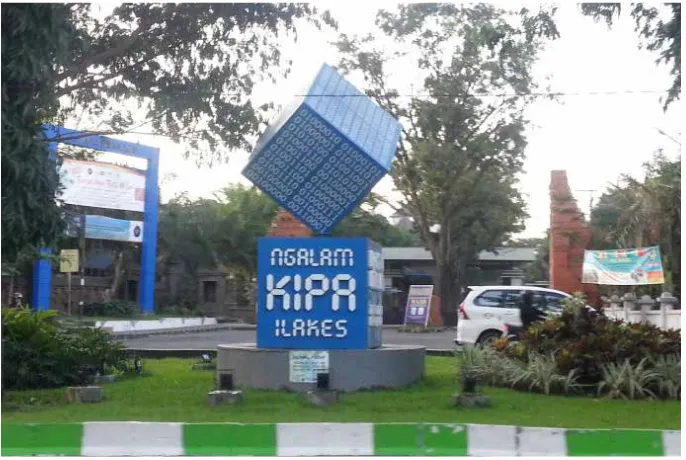
on many business signs, advertising billboards, posters, and even the city landmarks. The rise of Walikan in public signage is a process of latent enfranchisement (Goebel et al. 2017). As described in the previous section, Aremania used Walikan words in its posters for the anniversary of Arema FC. Walikan has also appeared on two new landmarks built in the Veteran Street area; one of them is illustrated in Figure 2. Veteran Street is seen by
the urban-dwellers as the educational centre of Malang, as it connects the Universitas Negeri Malang, the Universitas Brawijaya, and the Institut Teknologi Nasional Malang with a number of nearby primary, junior and senior high schools. A lot of young students and tourists walk along the street everyday, which is probably why the landmarks were put there to catch the eye of these youngsters.
The writing on the landmark reads Ngalam kipa ilakes (< Malang apik sekali) ‘Malang is very beautiful’. Note that, kipa (< apik) ‘good‘ is Malangan Javanese while ilakes (< sekali) ‘very‘ is Indonesian. On the other sides of the cube pictured in Figure 2, are two other messages, the Paris of East Java `city like Paris in East Java‘, and Kòta pendidikan ‘city of education’. All of these messages underline the potential and the positive image of the city.
Strolling around the city, I noticed that some young people were also wearing t-shirts written in Walikan. The bulk of them were produced by two brands: Oyisam and Ongisam. Oyisam is coined from the words òyi (< iyò) ‘yes’ and sam (< mas) ‘older brother’, while Ongisam is a combination of the word
òngis (< singò) ‘lion’ and sam (< mas) ‘older brother’. The word sam ‘older brother’ appears in both brands as their owners are male, and their prime target is male customers. The enterprises produce their t-shirts locally and employ local youths in both the production and in their shops. In an interview with the owner of Oyisam on 16 October 2016, I was given a folder showing their collection, most of which feature Walikan words.
These words are written in big fonts, often depicting the cultural identity of Malangese, such as kèra ngalam (< arèk malang) ‘Malang people‘, or apais kèr (<
siapa rèk) ‘who, guys?‘. According to the owner of Oyisam, the t-shirt business is currently booming and he has been able to open a number of outlets, one in Malang Town Square, one of the hippest malls in Malang, and another one outside the city.
s
peAKers’
motIvAtIonInusIngw
AlIKAnHaving analysed the different media with Walikan contents above, I continue my story by exploring speakers’ motivation in using Walikan on many different platforms and the preferred themes or types of Walikan. The act of
writing a language which is usually confined to the oral domain symbolizes the
“legitimation of an urban language, an urban culture, and an urban identity” (McLaughlin 2001: 155). As Walikan has entered both written and spoken public media, it has undeniably claimed its status as part of the people’s
cultural identity. Reflecting on the contexts of the media and the interview
sessions with several key persons who contributed to the production of Walikan in those media, my purpose is to show that the act of writing and producing Walikan in media is motivated by three factors: to express local pride and solidarity, to sound different from other neighbouring Javanese dialects, and to provide economic opportunities.
Walikan is a linguistic practice which is associated with pride in belonging to the locality of Malang. This can be seen in the messages written on the posters/banners placed by Aremania to celebrate the twenty-ninth anniversary of Arema FC on 11 August 2016. The banners were all over the
city for around a month. Figure 4 shows the phrase Ayas kèra Ngalam (< Saya arèk Malang) ‘I am a Malang kid’ written in a banner as an expression of their pride in being from Malang and having a football club like Arema FC.
Figure 4. Walikan on a banner during Arema FC’s anniversary Ayas kèra Ngalam (< Saya arèk Malang) ‘I am a Malang kid’.
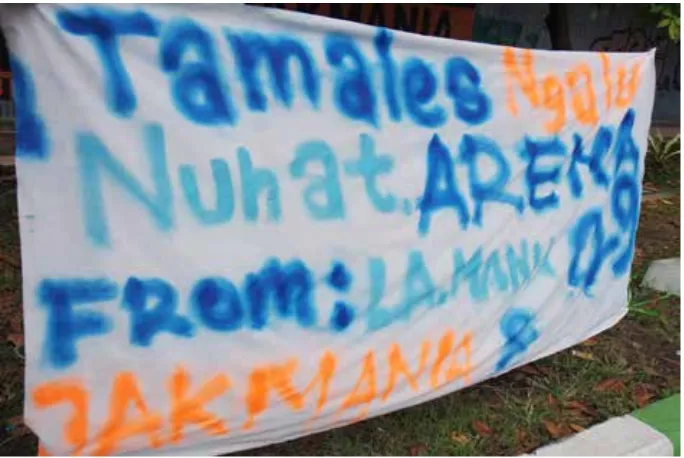
At the same time, the messages also promote solidarity. This can be seen in Figure 5 in which two other football-supporters’ communities wish Arema FC a happy anniversary in Walikan: Tamales ngalu nuhat Arèma (< selamat ulang tahun Arèma) ‘happy birthday/anniversary Arèma’.
Figure 5 shows the English word ‘from’ used in the middle of written Walikan. This indicates how global the Walikan community is or perceives itself to be. It makes use of different languages in one message. A word from a global language such as English is juxtaposed with a local code such as Walikan, indicating the increasing status of Walikan by making the local look more global.
The feeling of pride can also be related to the nostalgic theme of the Walikan lyrics of the songs mentioned above. Uklam-uklam ‘walking around’,
Uklam-uklam nang Kayutangan ‘walking around Kayutangan’, and Nòla-nòla Malang ‘Malang city square’ list different activities to be done in Malang and places to visit around the city. They remind listeners of how beautiful and comfortable life in Malang is.
Walikan is also considered a regional marker, as seen in its use in television programmes, newspaper columns, sermons, and the city’s landmarks. Malang Javanese speakers want their speech to sound different from other neighbouring Javanese dialects, such as Surabayan Javanese, and they use Walikan as a means to emphasize their Malangan dialect. As Sam Ohim from
Kòwal-kawil explained in an interview, a news programme narrated in Walikan is a way to promote the local language and culture. It is worth noting that most of the news in Kòwal-kawil centres on the activities of criminals. Apart from the observation that crime news is sensational and therefore marketable,
in the case of Malang, presenting this sort of news in Walikan also reflects the
historical status of Walikan as a register commonly associated with criminals and stigmatized communities.
On Facebook, the accurate use of Walikan can “give away“ whether a user is genuinely originally from Malang or just a poser. The aforementioned example (5), for instance, is considered inaccurate because of the occurrence of a word from another Javanese dialect. Such inauthentic manifestations of Walikan tend to receive comments expressing disapproval. In the case of (5), most comments referred to the use of certain words from other Javanese dialects which did not correspond to the status of Walikan as a regional marker. Walikan, they insisted, should always be produced using the Malangan Javanese dialect. As previously discussed, although words from other Javanese dialects are clearly ruled out, words from Indonesian are acceptable in Walikan.
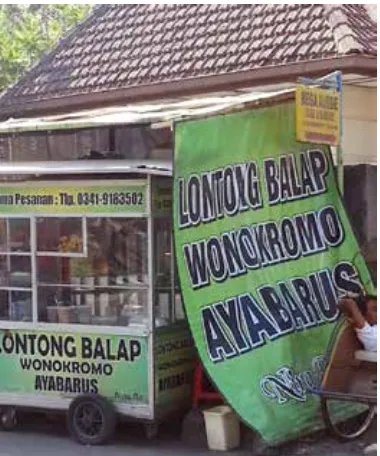
Figure 6 shows a street food vendor who has branded his business Lòntòng Balap Wònòkròmò from Surabaya. Lòntòng Balap is a local Surabaya dish, therefore the act of using Walikan by reversing the word Surabaya into Ayabarus
serves as a motif to capture people‘s attention and to make the business more acceptable in the eyes of the locals of Malang.
w
AlIKAnformsInspoKenAndwrIttenmedIAIn the spoken media, I have observed Walikan forms which are similar to those in my data on narratives or face-to-face interactions. In the Kòwal-kawil news programmes and songs, the Walikan forms used are based on those used in off-aired oral communication. The reversal was based on the reversal of the phoneme as described in the previous section on Walikan’s shape. They are listed in (7-9).
7) lawèt [’la.wɛt] < juwal7 [’ɟu.wal] ‘to sell’
8) leket [’lə.kət] < cekel [’cə.kəl] ‘captured’ 9) naranjep [na.’ra.nɟəp] < penjara [pə.’nɟa.ra] ‘jail’
7
In other words, the Walikan used in the media conforms to Javanese phonology and phonotactics (Hoogervorst 2014; Yannuar and Kadarisman 2015).
This conformity to Javanese phonology and phonotactics has also been
7 Djoewal in the old spelling, hence perhaps the /e/ in the reversed form.
observed in the written domain, although the written nature of the form might have increased the tendency to apply the reversal to the orthography the word rather than on the phonemes used to pronounce it, as in (10)-(11).
10) utujes [u.ˈtu.ɟəs] < setuju [sə.ˈtu.ɟu] ‘agree’ 11) ujutes [u.ˈɟu.təs] < setuju [sə.ˈtu.ɟu] ‘agree’
The form in (10) is commonly used by the speakers of Malang in my data
in spontaneous conversations and narratives. It modifies the strategy of total
phoneme reversal, as the position of /t/ and /ɟ/ are retained in the reversed form. However, in written media, I have found an increasing use of the form
exemplified in (11). In written media, form (11) is preferred because it makes
use of the most salient rule in Walikan, the total phoneme reversal, without
modification (see Yannuar in Progress).
The written media also gives the users more freedom to innovate different types of Walikan. This is shown in the increasing reversal of words which break the phonotactics of Javanese such as talkòc (< còklat) ‘chocolate’ and words with more than two syllables such as agraulek (< keluarga) ‘family’ and
ènarupes (< sepurané)8 ‘sorry’. When writing, users seem to have more time
to consider the form which will be used. However, as words in this type do not occur very often in spontaneous speech, the conclusion has to be that the users of Walikan do not make use of the written medium to change the form of Walikan instantaneously. They still have to refer to the already accepted reversed form of Walikan in order for their message to be well-received by their readers.
d
Ifferentusersofw
AlIKAnOn the basis of the word forms of Walikan in my corpus, Walikan speakers
can be divided into five age categories: elderly; mature adult; adult; youth;
and adolescent (Yannuar 2017). However, in the data presented here, these
five categories are collapsed into two: older speakers (aged forties and older)
and younger speakers (thirties and younger). In this section, I discuss the differences between the older and younger speakers who use Walikan in spoken and written media.
Both generations actively participate in creating and using Walikan in the written media. The author of Paitun Gundul and the creator of Kòwal-kawil are both elderly male speakers of Walikan. Non-marginalized natives of Malang have been using Walikan since the 1970s. The words leket (< cekel) ‘captured’ and lawèt (< juwal) ‘to sell’ can both be found in Paitun Gundul and Kòwal-kawil. The words are predominantly used by older speakers and I have not found them in my younger speaker corpus. The older generation is also involved in creating songs in Walikan. The singer of Aradoes Band is an elderly male,
who uploads videos of their songs on YouTube. As shown in the comment section of his videos, he is very appreciative and always replies to comments in Walikan. The members of the other two bands, Tani Maju and Youngster City Rocker, are mostly younger people. The performance of the latter band is recorded in a video clip in which they sing on stage in front of hundreds of fans. The audience are all dancing in ska style and none of them appears to be older than forty.
The younger generation can be said to be very active when it comes to wearing Walikan t-shirts, listening to songs, creating public signs, and participating in online social media. As discussed in the previous section, the owners of both t-shirt companies are young male speakers of Walikan. Most of their customers are also young people, both from Malang and outside Malang. As for the business signs, the companies usually advertise businesses aimed at the younger market, such as cafes, food establishments, and printing businesses. Public signs are also put up by Aremania who are predominantly younger than thirty.
Younger people in Malang love to use Walikan in social media and do so extensively on Facebook, Instagram, and Twitter. As Facebook and other social media are dominated by younger users (Djenar 2014), it is reasonable to posit that most Walikan users in the social media are of the younger generation.
My sociolinguistic survey reveals that each generation of language users prefers to use Walikan with peers and friends of the same age. The younger generation usually avoid speaking Walikan in front of their seniors, partly because they are afraid of sounding impolite and incurring displeasure. Most older speakers are irritated by the innovative forms of Walikan, such as òjrek
(< kerjò) ‘to work’. They prefer the older term idrek (< kerdi; kerja ròdi) ‘to work’. However, social media – like the Facebook group – does provide a space for older and younger users of Walikan to interact.
The moderator of the AREMA Club (Pencinta Malang and Boso Walikan)
on Facebook confided that he would usually consult with a group of older
speakers to check the form of Walikan words in his posts, as he did not want to have to cope with their harsh criticism if he used the wrong forms. The same strategy has also been adopted by the owner of Oyisam t-shirt. He occasionally asks an older speaker of Walikan to assess the Walikan words in his designs. However, this does not limit the creativity of younger speakers in creating and innovating new words or simply changing the semantics of existing words.
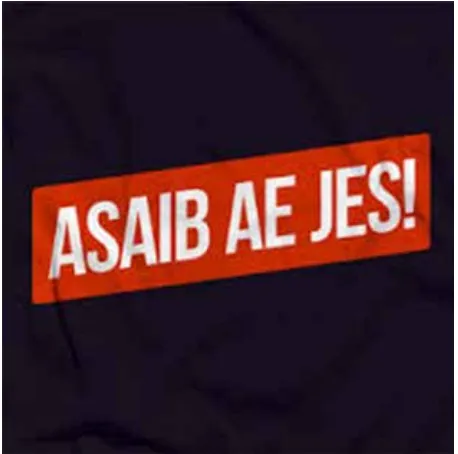
Figure 3 in the previous section shows the use of the word asaib (< biasa) which simply means ‘ordinary’ for younger generation. This will not be accepted by older speakers of Walikan, for them the word means ‘prostitute’. Another example is the word ilakes (< sekali) ‘very’ which is also not well received by a number of older speakers. The most preferred form would be
c
onclusIonThis paper has presented an overview of the ways a spoken language confined
to particular social domains can spread into a wider range of domains. Walikan began as an oral linguistic practice but is currently used in mass media, social media, and on public signs; it is widely used within Malang’s linguistic landscape. Speakers manipulate their speech by reversing and changing the semantics of words in their repertoire, or coining new words. Most of the lexicon of Walikan consists of words from Malangan Javanese, complemented by some words from Indonesian. At present, Walikan is no longer an
anti-language confined to a certain social class. Speakers have proudly facilitated
its dissemination from a spoken to a written media, from in-group interaction
to public communication, and from offline to online platforms.
Several important communities have been actively involved in this metamorphosis. They include students, musicians, and football-supporters. As the language becomes more widespread and more accessible to a wider community in the city, its survival and viability now is in the hands of the general population of urban-dwellers. Their autonomous use of Walikan, unsupervised by the nation’s Language Planning Bureau, has shown us a successful example of how local-level oral language practices can enter different types of public media.
The fact that Walikan has found its way into public spaces gives us an idea of how Indonesia‘s urban languagescapes/linguistic landscape can include local linguistic features. Walikan has brought colour to the linguistic landscape of Malang and, more importantly, it proves that there can be space for local youth languages in the linguistic landscape of Indonesia alongside Standard Indonesian and other established local languages. Walikan is an example of latent enfranchisement, in which a local vernacular which is not only excluded from the school curriculum, but was once also used by a stigmatized community can now appear on public signs.
I have also shown that the changes and developments observed in the domains of Walikan have introduced changes in the nature of the language itself, from a strong conformity to Javanese phonotactics to more innovative and adaptable strategies which allow the chains of phonotactics to be broken. However, the tendency to conform to Javanese phonotactics in the written media remains strong, because users tend to reject sudden changes in form. If a written message is to be well-received by readers, they have to comply with socially accepted Walikan forms. Hence, the standard is not determined by government-sponsored language agencies, but by informal consensus within the speech community.
A
bbrevIAtIonsThe following list describes abbreviations that are used in the word-for-word glosses of the examples:
Appl Applicative
cAus Causative
def Definite
dp Discourse particle
Imp Imperative
n Nasal prefix
neg Negative particle
pAss Passive
poss Possessive
procl Proclitic
rdp Reduplication
sg Singular
1 1st person 2 2nd person
r
eferencesArka, I. W. 2013. “Language management and minority language maintenance in (eastern) Indonesia; Strategic issues”, Language Documentation and Conservation 7: 74–105.
Djenar, D. N. 2014. “Adolescent social media interaction and authorial stance
in Indonesian teen fiction”, Wacana 15(1): 165–179.
Dreyfuss, J. 1983. “The Backwards Language of Jakarta Youth (JYBL); A bird of many language feathers”, NUSA 16: 52–56.
ELAN. 2015. (Version 4.6.1-beta). Nijmegen, The Netherlands: Max Planck Institute for Psycholinguistics, The Language Archive. [Retrieved from: https://tla.mpi.nl/tools/tla-tools/elan/].
Espree-Conaway, D. A. 2012. Language attitudes, acquisition, and usage of Osob Kiwalan Ngalam; An Indo-Javanese language of Malang. Sewanee, TN: Departments of Anthropology and French and French Studies, The University of the South. [Retrieved from: https://cms.sewanee.edu/ media/careers/internships/Espree-Conway,_DeAndre-_Biehl_report. pdf]. [Report.]
Evans, I. H. N. 1917. “Malay back-slang”, Journal of the Federated Malay States Museums 7: 115–116.
Fieldworks Language Explorer (FLEx). 2015. (Version 8.1.4). SIL International.
[Retrieved from: https://software.sil.org/fieldworks/].
Bahasa dan Budaya Atma Jaya Kelima Belas. [Retrieved from: https:// www.researchgate.net/publication/ 27272123_Ludlings_in_Malayic_ Languages_An_Introduction].
Goebel, Z., Anthony Jukes, and Izak Morin. 2017. “Linguistic Enfranchisement”,
Bijdragen Tot de Taal-, Land- En Volkenkunde / Journal of the Humanities and Social Sciences of Southeast Asia, 173(2–3): 273–295. [Retrieved from https:// doi.org/10.1163/22134379-17301006]
Halliday, M. A. K. 1976. Anti-languages. American Anthropologist, 78(3): 570–584. [Retrieved from: https://doi.org/10.1525/aa.1976.78.3.02a00050]. Hoogervorst, T. G. 2009. “Urban dynamics; An impression of Surabaya’s
sociolinguistic setting”, Wacana 11(1): 39–56.
Hoogervorst, T. G. 2014. Youth culture and urban pride; The sociolinguistics of East Javanese slang. Wacana, Journal of the Humanities of Indonesia 15(1): 104–130.
Krauße, D. 2017. “A description of Surabayan Javanese with special reference to its linguistic etiquette”. MPhil thesis, Goethe Universität, Frankfurt am Main. Manns, H. 2015. “Address terms, framing and identity in Indonesian youth
interaction”, NUSA 58: 73–93.
McLaughlin, F. 2001. “Dakar Wolof and the configuration of an urban identity.
Journal of African Cultural Studies 14(2): 153–172. [Retrieved from: https:// doi.org/10.1080/13696810120107104].
Pujileksono, S. and Rinekso Kartono. 2007. Model pelestarian budaya lokal melalui bahasa Walikan Malangan dalam menciptakan integrasi di kota Malang. Malang: Universitas Muhammadiyah Malang. [Report].
Simons, G. F., and Fennig, C. D. 2018. Ethnologue; Languages of the world,
Twenty-first edition. [Retrieved from: https://www.ethnologue.com/
country/ID].
Sneddon, J. N. 2003. The Indonesian language: Its history and role in modern society. Sydney, NSW: UNSW Press.
Sneddon, J. N. 2006. Colloquial Jakartan Indonesian. Canberra, Australia: Pacific
Linguistics, Research School of Pacific and Asian Studies, The Australian
National University.
Soeharno, A. et al. 1990. Pemakaian bahasa Jawa dalam media massa cetak. Jakarta: Departemen Pendidikan dan Kebudayaan.
Soenarno, A. 2011. Kamus bahasa Malangan. Malang: Bayumedia Publishing. Suharto. 1983. “Bahasa Walikan Malang tidak lagi bersifat rahasia”. Sinar
Harapan.
Yannuar, N. and Effendi Kadarisman. 2015. “On the phonetics, phonology, and phonotactics of Basa Walikan Malangan”. [Paper, the Fifth International Symposium on the Languages of Java, Universitas Pendidikan Indonesia, Bandung, 6-7 June 2015.]
Yannuar, N., Emalia Iragiliati, and Evynurul Laily Zen. 2017. “Bòsò Walikan Malang’s Address Practices”, GEMA Online® Journal of Language Studies
Yannuar, N. 2017. “The interplay of social variables in Walikan”. [Paper, the International Seminar on Sociolinguistics and Dialectology; Changes and Development of Language in Social Life, Depok, 23 November. Retrieved
from:
https://linguistik.fib.ui.ac.id/proceeding-international-seminar-on-sociolinguistics-and-dialectology-2017/].
Yannuar, N. 2018. “Walikan; A youth linguistic practice in East Java”, Indonesia, in: A. Ziegler (ed.), Jugendsprachen; Aktuelle perspektiven internationaler forschung (Youth languages; Current perspectives of international research), pp. 559-573. Berlin: De Gruyter.