MANAGEMENT OF HEAVY
METALS IN TROPICAL SOIL
ENVIRONMENT
Abdul Kadir Salam University of Lampung
MANAGEMENT OF HEAVY METALS
IN
TROPICAL SOIL ENVIRONMENT
ABDUL KADIR SALAM
UNIVERSITY OF LAMPUNG
Abdul Kadir Salam – 2017
ii
Management of Heavy Metals in Tropical Soil Environment
MANAGEMENT OF HEAVY METALS IN TROPICAL SOIL ENVIRONMENT
Abdul Kadir Salam
Director of GM Press : Liza Alvia
Cover Design : Sahroni
Copy Right © 2017, Global Madani Press
Jl. Kavling Raya XIV No. 1, Pramuka, Rajabasa, Bandar Lampung 35144, Indonesia
Telephone : (0721) 8011325
Faximile : (0721) 8011329
Website : www.globalmadani.sch.id
E-mail : [email protected]
All rights reserved. No part of this book may be reproduced or transmitted in any form or by any means, electronic or mechanical, including photocopying, recording, or any information storage and retrieval system, without permission in writing from Global Madani Press.
Abdul Kadir Salam
Management of Heavy Metals in Tropical Soil Environment, Bandar Lampung, 2017
xi + 257 pages, 16 x 23 cm
Abdul Kadir Salam – 2017
iii
Management of Heavy Metals in Tropical Soil Environment
Abdul Kadir Salam – 2017
Abdul Kadir Salam – 2017
v
Management of Heavy Metals in Tropical Soil Environment
PREFACE
Management of Heavy Metals in Tropical Soil Environment deals with the behaviors
of heavy metals in tropical soils under the management of some key soil properties. Various parts of discussion are completed with some research results mostly in tropical soils and complemented with those from other parts of the world. The management is mainly related to the manipulation of tropical soil heavy metal retention capacity employing some soil ameliorants like lime, organic composts and other biosolids, and phosphate fertilizers.
This book is organized into 10 chapters. Chapter 1 (Introduction) shows the existence of heavy metals in the environment including their variety,
concentrations, origin, use for and effects on the living things, and their chemistry. Chapter 2 (Behavior of Key Soil Properties) deals with the roles and behaviors of some important soil properties related to the behaviors of heavy metals. These properties may include some physical, chemical, and biological soil properties, among which is the soil adsorptive capacity as influenced by soil ameliorants. Chapter 3 (Behavior of Heavy Metals in Soils) deals with the response of heavy metals to the changes in some key soil properties related to some soil chemical
reactions involved such as complexation – decomplexation, chelation –
dechelation, adsorption – desorption, precipitation – dissolution, oxidation – reduction, and movement as well as translocation. Chapter 4 (Heavy Metal Retention in Soils) deals with the single most important behavior of heavy metals in the environment related to the phenomenon of soil and ground-water contamination. This behavior may include the adsorption and/or precipitation of heavy metals that may immobilize heavy metals in the soil system.
The following Chapters of 5 and 6 include human manipulation on heavy metal retention. Chapter 5 (Heavy Metal Retention in Tropical Soils under Immobilization Capacity Management) deals mainly with the manipulation of soil
adsorptive capacity towards heavy metals by employing ameliorants such as organic matters and other biosolids or phosphate fertilizers. Chapter 6 (Heavy Metal Retention in Tropical Soils under pH-Management) deals with the manipulation of the soil adsorptive capacity towards heavy metals indirectly by pH management through the effect of lime on soil pH.
Abdul Kadir Salam – 2017
vi
Management of Heavy Metals in Tropical Soil Environment
more difficult if the heavy metals are strongly held by soils and/or precipitated. The extracted heavy metals are consequently lower if heavy metals are adsorbed more strongly by soil adsorptive surfaces and/or precipitated. Thus, the strength of heavy metal- soil bonding may determine the movement and translocation of soil heavy metals as well as the extraction of soil heavy metals both by bioaccumulator plants or extracting solution for heavy metal analyses.
This book is completed with 131 illustrations as figures and tables and supported by more than 400 technical papers. This book is a trial and therefore it may contain mistakes. Correction and suggestion from readers, colleagues, and
students are expected. Gratitude is extended to all colleagues and students involved in the research related to heavy metal management in soils I conducted for more than 30 years between 1987 through 2017. Special thanks are also given to my family members for all the supports. I hope that this piece of work is useful in building science and technology on heavy metal behaviors in tropical soils.
Bandar Lampung, August 17, 2017
Abdul Kadir Salam – 2017
vii
Management of Heavy Metals in Tropical Soil Environment
Brief Contents
1.
Introduction,
1
2.
Behaviors of Key Soil Properties,
18
3.
Behaviors of Heavy Metals in Soils,
57
4.
Heavy Metal Retention in Soils,
98
5.
Heavy Metal Retention in Tropical Soils under
Soil-Adsorption Capacity Management,
112
6.
Heavy Metal Retention in Tropical Soils under
pH Management,
127
7.
Heavy Metal Movement and Translocation,
155
8.
Heavy Metal Extraction by Bioaccumulators,
174
9.
Heavy Metal Analysis, 184
10.
Conclusion,
204
References,
216
Glossary,
238
Subject Index,
250
Abdul Kadir Salam – 2017
viii
Management of Heavy Metals in Tropical Soil Environment
Detail Contents
Chapter 1
Introduction
–
1
1.1
Heavy metals in the environment
–
3
1.2
Heavy metals as toxic elements and plant nutrients
–
6
1.3
Heavy metals in the chemistry of soils
–
8
1.4
Scope of Management of Heavy Metals in Tropical Soil
Environment
–
15
Important questions
–
16
Chapter 2
Behaviors of Key Soil Properties
–
18
2.1
Soil is a giant heavy metal adsorber
–
19
2.2
Soil negative charges and chemical properties
–
22
2.3
Soil physical properties
–
34
2.4
Soil biological properties
–
49
Important questions
–
54
Chapter 3
Behaviors of Heavy Metals in Soils
–
57
3.1
The dynamic of heavy metals in soil system
–
58
3.2
Heavy metal adsorption
–
desorption
–
61
Abdul Kadir Salam – 2017
ix
Management of Heavy Metals in Tropical Soil Environment
3.4
Oxidation
–
reduction
–
68
3.5
Heavy metal movement and accumulation
–
74
3.6
Heavy metal leaching and ground-water contamination
–
78
3.7
Heavy metal absorption by plants
–
79
3.8
Heavy metal pollution and deposition
–
82
3.9
Heavy metal effects on soil microoganisms
–
88
3.10
Heavy metal effects on soil enzymes
–
90
Important questions
–
95
Chapter 4
Heavy Metal Retention in Soils
–
98
4.1
Adsorption
–
100
4.2
Precipitation
–
105
4.3
Effect of pH on adsorption and precipitation
–
108
Important questions
–
110
Chapter 5
Heavy Metal Retention in Tropical Soils under
Soil-Adsorption Capacity Management
–
112
5.1
Effects of soil fractions
–
115
5.2
Effect organic matters
–
118
5.3
Effect of phosphates
–
123
Abdul Kadir Salam – 2017
x
Management of Heavy Metals in Tropical Soil Environment
Chapter 6
Heavy Metal Retention in Tropical Soils under pH
Management
–
127
6.1 Changes in soil pH
–
129
6.2
Effect of pH
–
136
6.3
Effect of P-fertilizers
–
149
Important questions
–
153
Chapter 7
Heavy Metal Movement and Translocation
–
155
7.1
Mechanisms of heavy metal movement in soils
–
157
7.2
Translocation of heavy metals in soils
–
162
7.3
Retardation of heavy metal movement in soils
–
169
Important questions
–
173
Chapter 8
Heavy Metal Extraction by Bioaccumulators
–
174
8.1
Absorption of heavy metals by plants
–
176
8.2
Phyto- (bio-) remediations
–
177
8.3
Heavy metal bioaccumulating plants
–
179
Important questions
–
183
Chapter 9
Abdul Kadir Salam – 2017
xi
Management of Heavy Metals in Tropical Soil Environment
9.1
Dissolved heavy metals
–
186
9.2
Free ionic heavy metals
–
190
9.3
Exchangeable heavy metals
–
193
9.4
Plant available heavy metals
–
196
9.5
Total elemental heavy metals
–
202
Important questions
–
203
Chapter 10
Conclusions
–
204
10.1
Uncontrolled heavy metals concentrations in soils
–
207
10.2
Mechanisms for controlling of heavy metal concentration
–
208
10.3
Important factors for heavy metal management
–
211
Important questions
–
215
References,
216
Glossary,
238
Subject Index,
250
Chapter I
Introduction
1.5 Heavy metals in the Environment 1.6 Heavy Metals as Toxic Elements and Plant Nutrients 1.7 Heavy Metals in the Chemistry of Soils 1.8 Scope of Management of Heavy Metals in Tropical Soil Environment
Important Questions
eavy metals are in general well-known for their dangers to the living things. A great deal of research reports related to heavy metals in the environment
is found in current literature. Interesting reports may include those containing findings on their toxicities (Lagerwerff, 1982; Bohn et al., 1985; Tiller, 1989; Alloway, 1990d; Baker, 1990; Steinnes, 1990; Kabata-Pendias and Pendias,
1992; Daoust et al., 2006; Oporto, 2007; and Widowati et al., 2008), their sources
(Lagerwerff, 1982; Kardoz et al., 1986; Leung, 1988; Hegstrom and West, 1989; Alloway, 1990c; Davies, 1990; Kiekens, 1990; Rivai, 1990; Dowdy et al., 1991; Boon and Soltanpour, 1992; Jing and Logan, 1992; Wang et al., 1992; Herrero and Martin, 1993; Sweet et al., 1993; Tsoumbaris and Tsoukali-Papadopoulou, 1994;
Abdul Kadir Salam – 2017
2
Management of Heavy Metals in Tropical Soil Environment
Schuhmacher et al., 1994; Cabrera et al., 1994; Nicholson et al., 1994; Bilski and Alva, 1995; Flegal and Smith, 1995; Vile et al., 1995; Gimeno-Garcia et al., 1996; Salam et al., 1996; Yeh et al., 1996; Salam et al., 1997a; Juracek and Ziegler, 2006; Biasioli et al., 2007; Benke et al., 2008; Berenguer et al., 2008; Lin et al., 2008; Hobara et al., 2009; Benn et al., 2010; Cakmak et al., 2010; Kien et al., 2010; Wang et al., 2010; Alloway, 2012; and Tu et al., 2012), their emission into the environment (Leung, 1988; Akhter and Madany, 1992; Flegal and Smith, 1992; Gimeno-Garcia et al., 1996; Hellmann et al., 1997; Pagotto et al., 2001; Juracek and Ziegler, 2006; Lin et al., 2008; Guo et al., 2009; Kien et al., 2010; and Hu et al.,
2013), their effects on soil-water-air contamination and pollution (Dowdy et al., 1991; Wang et al., 1992; Markus and McBratney, 1996; Bendfieldt et al., 2001; Benke et al., 2008; Cakmak et al., 2010; Smolders et al., 2012; and Kargar et al., 2013), their vegetation intakes (Allaway, 1986; Boon et al., 1992; He and Singh, 1994; Brown et al., 1995; Sriyani and Salam, 1998; Salam et al., 1999c; Berenguer et al., 2008; Opporto et al., 2010; Kukier et al., 2010; and Adams et al., 2014), their
human intakes (Allaway, 1986 and Flegal and Smith, 1995), and their effect on soil microorganisms and enzymes (Baath, 1989; Landmeyer et al., 1993; Hiroki, 1994; Huysman et al., 1994; Witter et al., 1994; Hellmann et al., 1997; Juma and Tabatabai, 1997; Kuperman and Carreiro, 1997; Salam et al., 1997n; Geiger et al., 1998b; Gutser and Erdogan, 2008; Luo et al., 2010; and Zhou et al., 2011). We can
find also research reports on the science and technology developed to detect the
degree of heavy metal existence in the environment (Yeh et al., 1996; Wang et al., 2010; and Adams et al., 2014) and to ameliorate their increasing concentrations and effects to the living things (Salam et al., 1997k; 2000; Salam, 2000; Tokunaga et al., 2003; Moseley et al., 2008; Brown et al., 2004; 2009; Ippolito et al., 2011;
Richards et al., 2011; Buss et al., 2012; Guo et al., 2013; and Kambhampati and Vu, 2013). There are also research reports focusing on various heavy metals emitted by modern industries present at increasing quantities in the environment.
Abdul Kadir Salam – 2017
3
Management of Heavy Metals in Tropical Soil Environment
lower the concentrations of heavy metals to the levels not dangerous to the living things, while concerning the plant nutrient management is objected to maintain the availability of micronutrient metals. However, the similarity is to control the soluble heavy metals directly in contact with the living things.
The management of heavy metals in the soil environment is of utmost importance, in particular related to the more polluted environment with heavy metals in the last few decades. Several understandings must be fulfilled to perfectly successful in managing the heavy metals in the environment. The first is the knowledge on the environmentally safe levels of particular heavy metals. The
second is the knowledge on the important potential sources of heavy metals and their emission into the soil environment. The third is the knowledge on the chemistry of heavy metals in the soil environment. This may include the major chemical reactions controlling the levels of heavy metals in the soil environment. The fourth is the knowledge and skill of using and developing computer program or incorporating all the chemical principles and relationships to perfectly manage heavy metals in the soil environment. These four knowledge and skill are very important to perfectly manage heavy metals in the soil environment based on science and technology in soil chemistry.
1.1
Heavy metals in the environment
Heavy metals exist in the environment. Their existence and magnitude are more significant for the last few decades. Heavy metals have silently accumulated in the environment from two different sources: natural or lithogenic sources, particularly from particular minerals containing high amounts of particular heavy metals, and anthropogenic sources, related to the production and uses of heavy metals in modern industries. The estimates of worldwide natural and anthropogenic emissions of some heavy metals are listed in Table 1.1.
The anthropogenic sources have now been the most important origin of heavy metals accumulating in the environment, particularly in urban areas where modern industries are established. However, both sources need more serious attention to avoid heavy metal related disasters like Minamata disease caused by Hg pollution, Itai-itai disease caused by Cd pollution, both occurred Japan in the late 50s, and Wilson disease caused by Cu (Alloway, 1990d; Steinnes, 1990; Baker, 1990). Similar disasters may happen in other areas like Indonesia where the
Abdul Kadir Salam – 2017
4
Management of Heavy Metals in Tropical Soil Environment
disaster is higher due to the fact that the awareness to this problem and law enforcement on environmental destruction is quite low.
Table 1.1. The estimates of worldwide natural and anthropogenic emission of some heavy metals1).
lithogenic Anthropogenic
Cd 0.83 7.3
Cu 18 56
Ni 26 47
Pb 24 450
Zn 44 310
1)
Adapted from Nriagu (1979) as cited by Tiller (1989); in x 103 ton year-1
Heavy metals are in general environmentally mobile. Therefore, once emitted to the environment, heavy metals may spread into soil, water, and air
systems. Part of heavy metals may dissolve in soil water and, thereby, may spread easily. Heavy metals may enter the food chain, may directly enter the animal or human bodies through drinking water, or indirectly through soils which are, together with those already in the soil system, finally absorbed by growing plants. Similarly, heavy metals may also be emitted to the air by factories. These heavy metals may spread widely and may deposit somewhere due to rainfalls or gravitation. In soils, these heavy metals may also finally enter food chain. The estimate of global emission of heavy metals into soil, water, and air system are listed in Table 1.2. Table 1.2 clearly shows that the amounts of Cr and Ni emission are higher in the soil system and lowest in the air system.
There are differences in the behaviors of heavy metals in soil, water, and air systems. Heavy metals are more mobile in air than are in water, and in water are more mobile that are in soil. Therefore, the management of heavy metals is easier to conduct in soil systems than in the other two systems. This means that polluting heavy metals must be hindered to not entering the air and water system. Wastes to be disposed in the water and air system must be managed so that it contains
insignificant amounts of heavy metals.
Abdul Kadir Salam – 2017
5
Management of Heavy Metals in Tropical Soil Environment
the environment1).
Environment Component
Cr Ni
…… 103 ton year-1 …….
Air 30 56
Water 142 113
Soil 896 325
1)
Adapted from Nriagu (1979) as cited by Tiller (1989)
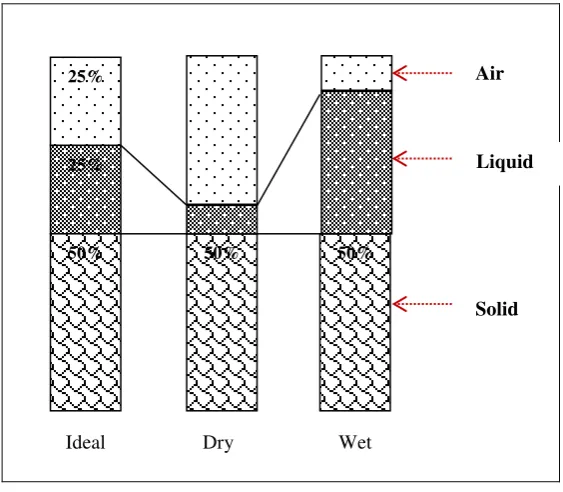
Soil system is principally similar to water and air systems. All these systems contain three similar phases, i.e. solids, liquids, and gases. However, as seen from
Fig. 1.1, the soil system has more solid that water and air systems. Solid shows property to adsorb heavy metal cations due to their negative charges developed from different sources and by different mechanisms. Because containing more solids, soil system is expected to be able to immobilize more heavy metals than is water or air system. Therefore, soil system may act as an environmental sink for heavy metals. Heavy metals from different sources can be immobilized in soil system. By this means, it is expected that parts of heavy metals do not move freely and cause problem in the environment. It is obvious that the soil system may act as
a sink for heavy metals.
However, the immobilization of heavy metals in soil solids is not permanent that can make heavy metal stay-still in the soil solid. In fact, the immobilization of heavy metals in soils is controlled by equilibrium constants. As long as the concentrations of the related species satisfy the equilibrium constants, heavy metals may be stayed adsorbed or precipitated, giving no danger to the environment. However, once the equilibrium constant is not satisfied, the immobilized heavy metals may release to the environment. Leak of heavy metals from sink is then probable. Keeping the concentrations of the related species in the soil environment at particular levels is expected to suffice the equilibrium constant.
Abdul Kadir Salam – 2017
6
Management of Heavy Metals in Tropical Soil Environment
Fig. 1.1. The relative composition of soil, water, and air in the environment.
1.2
Heavy metals as toxic elements and plant nutrients
As mentioned previously, heavy metals are well-known for their toxicities to the living things. The toxicities of heavy metals to the living things including human beings have been documented in current literature (Alloway, 1990d; Baker, 1990; Steinnes, 1990; Daoust et al., 2006; Oporto, 2007). The toxicity levels of heavy metals are various (Lagerwerff, 1982; Bohn et al., 1985; Tiller, 1989; Alloway,
1990d; Steinnes, 1990; Widowati et al., 2008). Among heavy metals with high toxicities are Hg, Cd, Cu, and Zn; those with moderate toxicities are Cr, Ni, and Co; and those with low toxicities are Mn and Fe. However, there is a fact that different living thing shows different tolerance to toxic heavy metals; particular living things may show higher or lower tolerance.
The toxicities of some heavy metals on some living things are listed in Table 1.3. Heavy metals on the right side are less toxic than those on the left side; therefore, the heavy metals on the left side are toxic at lower concentrations than those located on the right side. This means that for algae, for example, Hg is more toxic than Cd and Cr, which are toxic at lower concentrations than Zn and Mn. Simlarly, for phytoplankton Hg is more toxic than Cu, Cd, Zn , and Pb; meaning that Hg is toxic at lower concentrations than the other heavy metals.
Liquid Solid
Abdul Kadir Salam – 2017
7
Management of Heavy Metals in Tropical Soil Environment
Table 1.3. Heavy metal toxicities1).
No. Organisms Order of Toxicity
1 Algae Hg > Cu > Cd > Fe > Cr > Zn > Co > Mn
2 Flower Plants Hg > Pb > Cu > Cd > Cr > Ni > Zn
3 Fungi Ag > Hg > Cu > Cd > Cr > Ni > Pb > Co > Zn >Fe
4 Phytoplankton Hg > Cu > Cd > Zn > Pb
1)
Adapted from Sposito (1989)
As mentioned previously, there are numerous heavy metal related disasters
documented in literature. (Alloway, 1990d; Baker, 1990; Steinnes, 1990). Alloway
(1990d) mentions the health disorder caused by an accumulation of Cd in human tissues, caused by the pollution of river and paddy field water in Jintsu Valley, Toyama, Japan in 1940s. The accumulation of Cd caused a fatal health problem called Itai-itai. In 1940s a similar case caused by Hg pollution was observed in Minamata Bay of Japan. The Hg was initially accumulated in the form of methyl mercury in fish consumed by Japanese (Steinnes, 1990). Baker (1990) also reports that accumulated Cu may cause heredity disease called Wilson disease.
However, as long as their concentrations are below the toxic levels, heavy metals are perceived safe for the living thing. For example, the total dissolved Cu in soil may not exceed 60 mg kg-1, total dissolved Zn in soil may not exceed 70 mg kg-1,
and total dissolved Cd and Pb may not exceed 9 and 100 mg kg-1, respectively (Ross, 1994). However, in fact the concentrations of heavy metals are affected by numerous input factors, both natural and anthropogenic (Juracek and Ziegler,
Abdul Kadir Salam – 2017
8
Management of Heavy Metals in Tropical Soil Environment
metal input from external sources may increase heavy metal concentrations above the toxic levels so that heavy metals are dangerous to the living things.
Some of the metal elements such as Cu and Zn, and also Fe and Mn, may be used as micronutrients for plants if managed at lower concentrations. Particular industrial wastes with heavy metal concentrations relatively low are possible to be used as fertilizer precursor to enhance soil fertility (Salam et al., 2000). Pereira et al. (2012) reports that the irrigation with reclaimed waste water increases the availabilities and total concentrations of nutrients and non-essential elements in soils, and also soil salinity and sodicity by two to three times compared to that the irrigated with well water. The major parts of nutrients in reclaimed waste water were free ionic species readily available for plant absorption such as: NH4
+
, NO3−,
K+, Ca2+, Mg2+, SO42−, H3BO3, Cl−, Fe 2+
, Mn2+, Zn2+, Co2+, and Ni2+. More than 80% of Cu, Cr, Pb, and Al were complexed with CO3
2-, OH−, and/or organic matters.
1.3
Heavy metals in the chemistry of soils
As mentioned previously, heavy metals are abundant in the environment and one way to effectively manage their existence is to immobilize them in the soil environment. Soils are unique due to the fact that they comprise of solids and
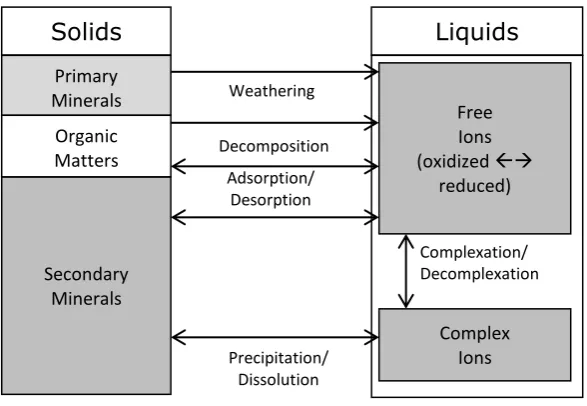
liquids that show complex and complicated chemistry caused by the interaction of substances in the liquids and those in the liquids with those on the surfaces and in the structure of solids. The most important substances in the liquids are the free ionic and complexed ions and those on and in the solids are the adsorbed cations and structural elements in minerals, both primary minerals such as feldspars and secondary minerals such 1:1 silicate minerals like kaolinite and 2:1 silicate minerals like montmorillonite, and organic matters. The relationship among these substances is shown in Fig. 1.2.
Shown in Fig. 1.2 is that the central of the chemistry of heavy metals in soils is the free ion, which has been reported to be directly related to the plant root absorption and heavy metals toxicity. Free ionic heavy metals are controlled by equilibrium and non-equilibrium reactions. The equilibrium reactions controlling the free ions of heavy metals may include oxidation –reduction (Redox reaction),
complexation-decomplexation, chelation-dechelation, precipitation–dissolution,
Abdul Kadir Salam – 2017
9
Management of Heavy Metals in Tropical Soil Environment
Fig. 1.2. The relationship between substances in the soil solids and liquids.
Oxidation–reduction (redox reaction) is related to the changes in the increase and decrease in heavy metal oxidation number. A very good example of this is the change in the oxidation number of Fe from Fe2+ to Fe3+ or from Fe 3+ to Fe2+ due to the flooding and draining of paddy soils as shown in Table 1.4. When paddy soils are flooded, the redox potential decreases and, thereby, the system becomes reductive and causes the reduction of Fe. On the other hand, when paddy soils are drained, the redox potential increases and the system becomes oxidative which finally causes the oxidation of Fe. Therefore, the oxidation number of Fe can be manipulated by flooding and draining the soil environment.
Abdul Kadir Salam – 2017
10
Management of Heavy Metals in Tropical Soil Environment
When the concentrations of their components are low, the reverse reaction may release the free ions back to the initial condition.
Fe2+ + A- FeA+ ……. Eq. 1.1.
K =
……. Eq. 1.2
Table 1.4. The effect of flooding and draining on the oxidation number of Fe element in paddy soils.
Condition Oxidation
Number Reaction
Flooding + 2 Fe3+ + e Fe2+
Draining + 3 Fe2+ Fe3+ + e
Some of the free and complex ions common in soil water are listed in Table
1.5. Free ions of heavy metals do not exist at differing pH. For example Free Cu2+ only exists at acid condition. At higher pH, Cu2+ exists as complexes and chelates. On the other hand, Cd2+ and Fe2+ exist both at acid and alkaline conditions. This indicates that Cu2+ is more strongly bonded by anions and ligands. Ellis and Knezek (1982) has previously reports that the free Cu2+ in soil solution comprises only 2% of the total dissolved Cu, lower than other free ionic heavy metal such as Zn2+, which comprises 40% of the total dissolved Zn. The reactions of free ionic heavy metals in soil solution are stronger than those of major cations like Na+, K+, Ca2+, and Mg2+, which comprises about 70-90% of their total dissolved elements in soil solution.
Abdul Kadir Salam – 2017
11
Management of Heavy Metals in Tropical Soil Environment
Heavy
Metals Acid Condition Alkaline Condition
Cu Cu2+ Org*, particularly when the concentration of free ions and complexing ions are relatively high following Eq. 1.3. For example, when the paddy soils are flooded and, thereby, the condition is reductive, Fe3+ and SO42- in soil water are reduced to
produce Fe2+ and S2- ions, respectively. These chemical species may then react to produce FeS precipitate, which makes Fe and S are both not available to plants. believed that complexation and chelating processes by organic matters can also precipitate heavy metals if the molecular weights of the organic matters are relatively high (Keeney and Wildung, 1986; Kabata-Pendias and Pendias, 1992). The process of precipitation-dissolution in soil system controls several metals and the abundance of precipitating agents like OH-, H2PO4
-Some experimental researches on the precipitation-dissolution of heavy metals have been reported (Lindsay, 1979; Brummer et al., 1983; Ma and Lindsay, 1990; 1995; Workman and Lindsay, 1990; El-Falaky et al., 1991; Stahl and James, 1991; and Salam, 2000). Some soil workers also report the use of this precipitating agent to immobilize heavy metals in soils (Ma and Lindsay, 1990; 1995; Workman and Lindsay, 1990; El-Falaky et al., 1991).
M2+ + A- MA2 ……. Eq. 1.3.
Abdul Kadir Salam – 2017
12
Management of Heavy Metals in Tropical Soil Environment
In addition to oxidation–reduction, complexation-decomplexation, and
precipitation–dissolution, free ions of heavy metals are also controlled by adsorption–desorption reactions. Some researchers suggest that this reaction dominates at low concentrations of heavy metals or low concentrations of precipitating agent. At high concentrations of free ions and high pH, precipitation– dissolution may dominate the controlling of free ion concentrations. Due to the fact that most soils contain low concentrations of heavy metals and the soil pH is
generally acidic, the adsorption–desorption of heavy metals may dominate in most
soils. This reaction, like all other reactions discussed previously, is important in
controlling the free ion concentration in soil solution.
The concentrations of free ions in soil water are also affected by non-equilibrium chemical reaction i.e. mineral weathering and organic matter decomposition. These reactions may be significant when the contents of heavy metals in minerals and organic matters are high. Other factors that are very important in controlling the free ions of heavy metals are the easiness of minerals and organic matters to weather or decompose. Some minerals are easily weathered and some are not. Some of minerals such as Olivine, Apatite, and Albite are among the more easily weathered, while Titanite and Magnetite are among the more difficult to weather (Bohn et al., 1985). Some minerals containing heavy metals found in the environment are listed in Table 1.6. Likewise, not all organic matters are easily decomposed. Some organic matters such as soybean leaf and cassava leaf are among the more easily decomposed, while leaves of weed
Imperata cylindrica is among the most difficult to decompose.
The weathering of minerals may occur usually in the presence of water and H+ ions. The absence of enough water and lack of H+ ions may inhibit the
weathering process of minerals, and thus, the release of all structural elements. An example is the weathering of olivine shown by Eq. 1.5, the rate of which increases with the increase in water content and in H+ ion concentration. The heavy metal
ion Fe2+ may encounter several fates: absorbed by plant roots, complexed or chelated by any anions/ligands, precipitated, adsorbed by soil surfaces, etc. Any case may lower the concentration of Fe2+, which may eventually speed up the weathering of Olivine.
(Mg,Fe)2SiO4 + H2O + 5 H +
2 Mg2+ + 2 Fe2+ + Si(OH)4 + OH
…… Eq. 1.5
Abdul Kadir Salam – 2017
13
Management of Heavy Metals in Tropical Soil Environment
Minerals Heavy Metals
Olivine Ni, Co, Mn, Li, Zn, Cu, Mo Hornblende Ni, Co, Mn, Zn, Cu Augite Ni, Co, Mn, Zn, Pb, Cu Biotite Ni, Co, Mn, Zn, Cu Apatite Pb, Cd
Anortite Cu, Mn Andesin Cu, Mn Oligoclase Cu
Albite Cu
Garnet Cr, Mn Orthoclase Cu Muscovite Cu Titanite Sn Ilmonit Co, Ni Magnetit Zn, Co, Ni Tourmaline -
Zirkon -
Quartz -
1)
Adapted from Alloway (1990c)
For weathering, the presence of H+ ion is very important because H+ ion is an attacking agent that may destruct the mineral structures. Higher H+ ion concentration, which means lower pH, may cause more intensive weathering and higher free ions released into the soil water. This phenomenon is shown by weathering of soil minerals of an Oxisols from West Java and a Mollisols from Wisconsin, the United States of America (Salam, 1989, as shown in Table 1.7). The released Ca, Mg, K, and Zn increase with the decrease in soil pH buffered using resin method.
As previously mentioned, the concentration of free ionic heavy metals in soil water is also affected by the decomposition of organic matter, particularly those
Abdul Kadir Salam – 2017
14
Management of Heavy Metals in Tropical Soil Environment
adsorption-desorption. The easiness of organic matters to decompose also controls the amount of heavy metals released by organic matter decomposition.
Table 1.7. The release of some elements from Mollisol and Oxisol as affected by buffered soil pH1).
pH
Mollisols2) Oxisols3)
Ca Mg K Zn Ca Mg K Zn
... mg kg-1 ...
4 594 271 96 11 26 27 85 6.5
5 540 250 60 10 19 9 50 6.0
6 315 105 48 8.5 12 0 45 5.5
7 204 49 47 7.4 3.0 0 30 4.0
1)
Adapted from Salam (1989); 2)from Wisconsin USA, 3)from West Java Indonesia
Organic matter decomposition is soil enzyme specific. The following are two examples of organic matter decomposition. The first is organic P that decomposes catalyzed by phosphatase (Eq. 1.6) and organic S that decomposes catalyzed by arylsulphatase (Eq. 1.7). As shown by Eq. 1.6 and Eq. 1.7, the decomposition of organic matters needs water. Without water it is impossible for the process to happen. These reactions convert organic elements (elements bounded in the structures of organic matters) into inorganic elements as free ions of HPO42- and
SO42-. The decomposition of organic matters may also release small amounts of
heavy metals bound in the structure of or contained in organic matters.
RO—PO3
+ H2O R—OH + HO-PO3
……. Eq. 1.6
Abdul Kadir Salam – 2017
15
Management of Heavy Metals in Tropical Soil Environment
1.4
Scope of
Management of Heavy Metals in Tropical
Soil Environment
This book is organized into 10 chapters. Chapter 1 (Introduction) shows the existence of heavy metals in the environment including their variety, concentrations, origin, use for and effects on the living things, and their chemistry.
Chapter 2 (Behaviors of Key Soil Properties) deals with the roles and behaviors of some important soil properties, that are related to the behaviors of heavy metals. These properties may include some physical, chemical, and biological soil properties, among which is the soil adsorptive capacity as influenced by soil ameliorants. Chapter 3 (Behaviors of Heavy Metals in Soils) deals with the response of heavy metals to the changes in some soil properties related to some soil chemical reactions involved such as adsorption–desorption, precipitation– dissolution, oxidation– reduction, and movement as well as translocation. Chapter 4 (Heavy Metal Retention in Soils) deals with the single most important behavior of heavy metals in the environment related to the phenomenon of soil and ground water contamination. This behavior may include the adsorption and/or precipitation of heavy metals that may immobilize heavy metals in the soil system.
The following Chapters of 5 and 6 include human manipulation on heavy metal retention. Chapter 5 (Heavy Metal Retention in Tropical Soils under Soil-Adsorption Capacity Management) deals mainly with the manipulation of soil adsorptive capacity towards heavy metals by employing ameliorants such as
organic matters and other biosolids or phosphatic fertilizers. Chapter 6 (Heavy Metal Retention in Tropical Soils under pH Management) deals with the manipulation of the soil adsorptive capacity towards heavy metals indirectly by pH management through the effect of lime on soil pH.
Abdul Kadir Salam – 2017
16
Management of Heavy Metals in Tropical Soil Environment
by bio-accumulator plant of by extracting solution for heavy metal analyses. Chapter 10 includes impotant conclusions and practical cosequences related to the behaviors of soils and heavy metals that controls heavy metal retention in the soil environment.
Important questions
1. How important is to manage heavy metal pollutants in the soil environment?
Explain!
2. Explain why the management of heavy metal pollutants is better to be
conducted in the soil system than in water system and air system!
3. What are the differences in the management of heavy metals as toxic
elements and as plant nutrients?
4. Explain the lithogenic and the anthropogenic sources of heavy metals in the soil environment!
5. Explain the heavy-metal related disease disasters that ever happened in the
environment!
6. Explain the pathways of heavy metal emission from their sources to reach the
living things!
7. What are the similarities and differences of soil, water, and air system? Explain!
8. Explain the worldwide emission of heavy metals into the environment!
Compare the relative amounts accumulated heavy metals in the soil, water, and air!
9. Explain the immobilization and release of heavy metals in the environment and
their effects on the living things!
10. Explain the toxicity of heavy metas to the living things! What are the allowable limits of heavy metals?
11. Explain the various forms of heavy metals in the soil environment!
12. Explain the interactions of the various forms of heavy metals through equilibrium and non-equilibrium chemical reactions!
13. Explain the importance and occurrence of heavy metal oxidation-reduction
reactions in the soil environment!
14. Explain the importance and occurrence of heavy metal
Abdul Kadir Salam – 2017
17
Management of Heavy Metals in Tropical Soil Environment
15. Explain the importance and occurrence of heavy metal
precipitation-dissolution reactions in the soil environment!
16. Explain the importance and occurrence of heavy metal adsorption-desorption
reactions in the soil environment!
17. Explain the importance and occurrence of heavy metal containing mineral weathering in the soil environment!
18. Explain the importance and occurrence of heavy metal containing organic matter decomposition reactions in the soil environment!
19. Explain some factors affecting all chemical reactions controlling the chemical
forms of heavy metals in the soil environment!
Abdul Kadir Salam – 2017
18
Management of Heavy Metals in Tropical Soil Environment
Chapter 2
Behaviors of Key Soil Properties
2.1 Soil is a Giant Heavy Metal Adsorber 2.2 Soil Negative Charges and Chemical Properties 2.3 Soil Physical Properties 2.4 Soil Biological Properties Important Questions
eavy metals are mobile. Once released to the environment, they will move from one place to another and endanger the living things. Therefore, one way or another is needed to immobilize heavy metals in the environment so that their existence does not interact directly with the living things. This way may be safe for the short run and the long run and may accommodate the everlasting heavy metal pollution occurring in the environment for the last few decades.
Even though containing solids, it is not possible for air and water systems to immobilize heavy metals. The air solids and water solids may actually immobilize heavy metals by adsorption processes, but these may not avoid the heavy metals to
Abdul Kadir Salam – 2017
19
Management of Heavy Metals in Tropical Soil Environment
be in contact with the living things. The percentages of air solids and water solids are relatively small and are not adequate to immobilize huge amounts of heavy metals emitted to the environment. Air and water themselves are contained in mobile systems that may move easily from one place to another. The immobilized heavy metals in air and water solids may eventually be deposited somewhere and may directly or indirectly pollute the environment.
The only way to conduct the heavy metal immobilization is to use soil solids as “reservoir” for heavy metals. As previously shown, soil, water, and air are principally similar. They contain solids, liquids, and gases. However, different from
water and air systems, soil system contains much higher solids. The huge part of solids in soils may enable soils to accumulate high amounts of heavy metals. Unlike water and air, soil is relatively stationary, may not easily move from one place to another. Therefore, soil system may then act as a heavy metal adsorber. Using soil to immobilize heavy metals may partially solve the problem of heavy metals in the environment.
2.1
Soil is a giant heavy metal adsorber
Soils are giant heavy metal adsorbers. They may adsorb huge amounts of drained heavy metals into the soil environment. This phenomenon is attributed to the fact that soils contain huge amount of various solids with two important properties: significantly large surface areas and huge amounts of surface negative charges contributed by colloids comprising secondary silicate clay minerals, non-silicate clay minerals (oxides and hydroxides), and organic matters. The existence of the huge amounts of negative charges on the very large areas of adsorptive solid surfaces may become a huge attracting force for positively charged cations including those of heavy metals. For secondary 1:1 silicate clay minerals, non-silicate clay minerals (oxides and hydroxides), and organic matters, the amounts of negative charges are higher at higher pH (Helling et al., 1964; Trehan and Sekhon, 1977; Elliott, 1983; Tan and Dowling, 1984; McGrath et al., 1988; Alloway 1990b; Parfitt et al., 1995; Rodella et al., 1995; Medonca and Rowel, 1996; Tack et al., 1996; Suryanto and Susetyo, 1997; Choi et al., 1999; Gagnon et al., 2013; Tokunaga et al., 2003; Quaghebour et al., 2005; and Schroder et al., 2008). As described in
Abdul Kadir Salam – 2017
20
Management of Heavy Metals in Tropical Soil Environment
organic matters, respectively. To a lower extent, similar phenomenon must be observed by oxides and hydroxides (non-silicate clay minerals).
Fig. 2.1. The adsorption of heavy metal cation on a negatively charged 1:1 secondary clay mineral.
Fig. 2.2. The adsorption of heavy metal cation on a negatively charged organic matter.
+2
O
S
i
O
OH
S
i
- 1
-½
-½
M
M M
+2 +2
+2
1:1 Clay Mineral Metal Cation
O
C
O R
M
Abdul Kadir Salam – 2017
21
Management of Heavy Metals in Tropical Soil Environment
Soils have not only solid negative charges that may immobilize heavy metal cations through attraction forces called adsorption, but also chemical species that might complex and precipitate heavy metal cations called precipitation. Adsorption immobilizes heavy metals from mobile fraction in soil solution so that they cannot move in and with water in the soil system. Precipitation is another probability of heavy metal immobilization mechanism in soil system particularly at high concentrations of heavy metals and precipitating agents. Some reports also mention that this reaction dominates the immobilization at high pH (Udo et al., 1970; Lindsay, 1979; Brummer et al., 1983; Ma and Lindsay, 1990; 1995; Workman
and Lindsay, 1990; El-Falaky et al., 1991; Stahl and James, 1991; Salam, 2000). The precipitation reaction may occur as shown in Fig. 2.3, in which one heavy metal cation in soil water is initially complexed by any anion or complexing agent. If the concentration of heavy metal cation and anion are high enough, they will saturate the soil water and will finally precipitate forming a solid mineral. As a solid, both the heavy metal cation and anion are immobilized and cannot move in or with water.
Fig. 2.3. Immobilization of heavy metal cation through precipitation reaction.
M M
A A M
M
M M
A
A
A
A Soil
Water
Abdul Kadir Salam – 2017
22
Management of Heavy Metals in Tropical Soil Environment
The above illustration suggests that the soil system possesses a power to immobilize heavy metal through two important chemical reactions i.e. adsorption reaction and precipitation reaction. By manipulating some important soil variable controlling these reactions, one may manage the immobilization of heavy metals emitted to the environment in the soil environment.
2.2
Soil negative charges and chemical properties
Soil negative charge is the single most important chemical properties. This soil property is responsible for the retention of cations of several origins in soils. Some of these cations are needed as essential nutrients for plants, that include macronutrients like Ca2+, Mg2+, and K+ as well as micronutrients like Cu2+, Fe2+, Mn2+, Zn2+, and Co2+. These nutrients may come from fertilizers such as KCl (K+) as well as dolomite and calcite (Ca2+ and Mg2+) and from primary minerals such as K+ and Fe2+. All these elements are temporary or permanently attached onto the soil surface charges. The rule is that when the concentrations of these elements in soil water are high, part of these elements may be adsorbed onto the soil negative charges. Conversely, when the concentrations in soil water are low, the adsorbed elements may dissolve from soil solids into soil water and become more mobile and
ready for plant root absorption and other soil processes like leaching. Therefore, it is clear that the soil negative charges are very important in accumulating heavy metal cations in soil environment and must be increased. One way to accumulate more heavy metals is to increase the amount of the negative charges in the soil environment.
The soil negative charges are originated from the structure of the soil solids. These may include soil oxides and hydroxides, soil organic matters, 1:1 silicate clay minerals, and 2:1 silicate clay minerals. The first three solid structures are found abundant while the last is rarely found in tropical soils. Oxides and hydroxides are old mineral in the soil environment and, therefore, show low negative charges. The 1:1 silicate clay minerals also show low negative charges but higher than those of oxides and hydroxides and lower than those of the 2:1 silicate clay minerals. The 2:1 silicate clay minerals also show differences in CEC, generally the younger minerals show higher CEC. Vermiculite is younger that smectite and Illit. Therefore, to restore old soils with old soil minerals, organic matters are usually employed. Addition of organic matters has been repeatedly reported to increase
Abdul Kadir Salam – 2017
23
Management of Heavy Metals in Tropical Soil Environment
soil systems to increase the soil CEC. The negative charges as expressed as cation exchange capacity (CEC) are listed in Table 2.1.
Table 2.1. The soil solid negative charges as expressed by CEC1).
No. Soil Solids Type CEC
(cmolc kg-1)
1 Oxides of Fe and Al (pH 8) 0.5 – 1.0
2 Kaolinit 1:1 3 – 20
3 Illit 2:1 10 – 40
4 Smectite 2:1 60 – 100
5 Vermiculite 2:1 100 – 200
6 Allophane 50 – 100
7 Organic Matters/Humus 150 – 200
8 Humic Substances
Fulvic Acids Humic Acids
Humin
200 – 750
500 – 750 300 – 500
300 1)
Adapted from Thomas and Hargrove (1984), Burns (1986)
Differences in CEC among soil solids (Table 2.1) indicate that the negative charges of every soil are dependent of the types and quantity of particular soil solids. Those containing higher organic matters may have higher CEC. Old soils with high quantity of oxides of Fe and Al may have lower CEC than those containing high amount of humic and fulvic acids. Most of the tropical soils like those in Indonesia may have low CEC because the soil solids are dominated by oxides and 1:1 silicate clay minerals, which possess low CECs. Therefore, tropical soils need proper CEC management to make them be able to accommodate high treatment with cationic elements.
However, soils with old soil solids may have higher CEC if treated with high CEC materials like organic matters. A good example is the old soils planted with
Abdul Kadir Salam – 2017
24
Management of Heavy Metals in Tropical Soil Environment
with grasses are significantly higher than those planted with food plants. This phenomenon is also related to the higher N in soils planted with grasses that those with food plants. Salam et al. (2001) also report that soils in coffee plantation planted with Paspalum conjugatum show much higher organic C than the control only planted with coffee plants. Similarly, the organic C in coffee plantation with natural grasses is also significantly higher than those without grasses, even though lower that those with P. conjugatum. This trend is consistently observed for 4 years since 1996 – 1999. This effect is shown in Table 2.2.
Table 2.2. The effect of grasses on soil organic C in coffee plantation1).
Control Natural Grasses Paspalum
conjugatum
……. g kg-1
…….
1996 22.3 28.8 34.7
1997 14.7 17.1 29.1
1998 16.4 18.9 28.9
1999 21.1 23.0 50.0
1)
Adapted from Salam et al. (2001)
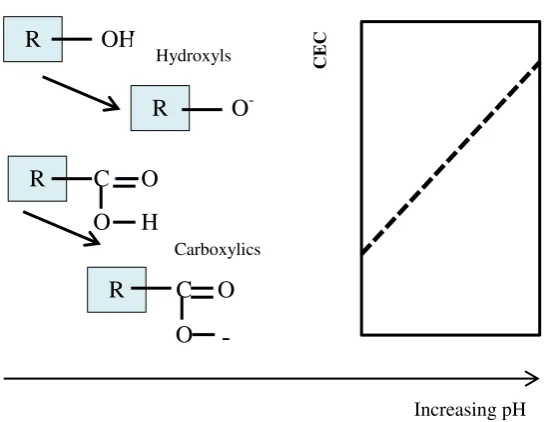
The negative charges on the surface of organic matter colloids is originated from the dehydrogenation of some organic matter functional groups, such as hydroxyls (R – OH), phenolics (g – OH or C6H5OH), and carboxylics (R – COOH).
These functional groups may lose their H to form R – O-, C6H5O
-, and CH3COO
-, respectively. The negative charges from organic matter functional groups increase with the increase in soil pH due to the more OH- ion present in soils. This OH- ion
may attract more H+ forming H2O molecules. This process dan its dependence on
soil pH is shown in Fig. 2.4.
Abdul Kadir Salam – 2017
25
Management of Heavy Metals in Tropical Soil Environment
Fig. 2.4. The development of negative charges of organic matters origin with phenolic functional groups.
Fig. 2.5. The development of negative charges of organic matter origin with hydroxylic and carboxylic functional groups.
OH
O
-Increasing pH
CEC
Increasing pH
R
R
OH
O
-R
C
O
O
H
R
C O
O
-
CEC
Increasing pH Hydroxyls
Abdul Kadir Salam – 2017
26
Management of Heavy Metals in Tropical Soil Environment
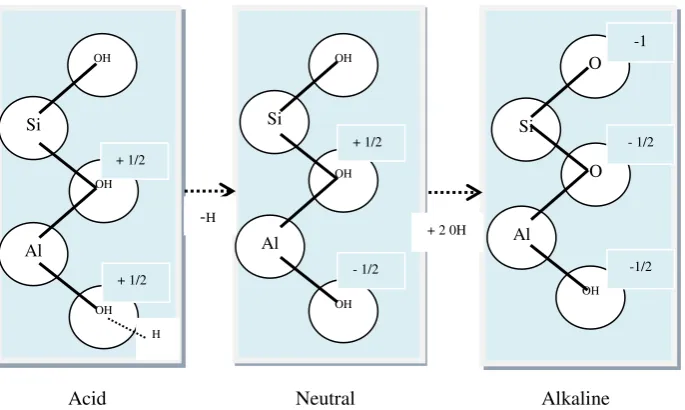
The negative charges developed on the surfaces of soil minerals are about the same with that occurs on the surface of organic colloids. The development of the negative charges of 1:1 silicate clay minerals occur on the edges of mineral surfaces by hydrogenation and dehydrogenation affected by the changes in soil pH (Fig. 2.6). When the pH is low, H+ ions are attached on the edges of tetrahedral or octahedral structure causing the decrease in soil CEC. Conversely, the increase in soil pH may detach the attached H+ ions and thus increase the negative charges of the CEC. As that of the organic matter, the negative charges are fairly pH dependent. In other words, the soil negative charges of soisl dominated by 1:1
silicate clay mineral can be manipulated by changing the soil pH.
Fig. 2.6. The development of negative charges of 1:1 silicate clay minerals (Bohn et al., 1985).
Similarly, the negative charges of the non-silicate clay minerals such as Hematite (Fe2O3), Goethite (FeOOH), Buhmite (AlOOH), and Gibbsite (Al(OH)3
Abdul Kadir Salam – 2017
27
Management of Heavy Metals in Tropical Soil Environment
with the increase in soil pH. In this case, H is dehydrogenized from the hematite surface and then combines with OH- ions forming H2O molecules. The reverse
reaction or hydrogenation due to low pH may decrease the soil negative charges or CEC. As shown in Table 2.1, the difference of oxides with 1:1 silicate clay minerals and organic matters is the magnitude of the negative charges, those on organic matters are the highest and then followed by the 1:1 silicate clay minerals and non-silicate clay minerals (oxides). The 1:1 non-silicate clay minerals and non-non-silicate clay minerals are both old minerals and, therefore, they show low negative charges. Using soils dominated by these minerals might consider the addition of organic
matters to increase the soil negative charges and thus the soil CEC.
Fig. 2.7. The development of negative charges of oxides of Hematite (Fe2O3) (Bohn et al., 1985).
While the development of the negative charges on the surface of organic matter, 1:1 silicate clay minerals, and non-silicate clay minerals are pH dependent, the development of the negative charges on the surface of 2:1 silicate clay minerals is not pH dependent. The negative charges of these minerals arise from the
H
2 AcidThe surface of Hematit
-1/2
Fe3+
O
O
O
O
O
O
-1/2
-1/2
-1/2 -1/2
-1/2
-1/2
Abdul Kadir Salam – 2017
28
Management of Heavy Metals in Tropical Soil Environment
substitution of metal elements in tetrahedral and/or octahedral structure of the minerals. The process called isomorphic substitution is described in Fig. 1.8, in which Al3+ in the aluminum octahedral is substituted by a similar size cation Fe2+. Al3+ which have 6 coordination numbers each possessing charge + 0.5 is substituted by Fe2+ which have 4 coordination number each possessing charge +0.5. This process may fill only 4 positions each with charge – 0.5 previously filled by positive charges of Al3+ and leave 2 positions each with charge – 0.5. All together, the substitution of Al3+ by Fe2+ causes a net charge of 2 x -0.5 or -1 for each element. This process is not controlled by soil pH.
The type and amount of the emerging charges are dependent on the oxidation number of the substituting and substituted elements. Some of the possibility is listed in Table 2.3. The type of the net charge may be negative just like when Fe2+ substituting Al3+ in octahedral structure or when Mg2+ substituting Si4+ in the tetrahedral structure of silicate minerals. The type may be positive like when Al3+ substitutes Mg2+. The amount of the negative charges can be found by subtracting the valence of the substituting element by the valence of the substituted element. For example, when Al3+ substitutes Mg2+, the emerging net charge is the valence of the substituting element (3+ of Al) subtracted by the valence of the substituted element (2+ of Mg) or equals to + 1 (Table 2.3). Among the soil minerals, the 2:1 silicate clay minerals show the highest negative charges, as high as that of allophane, the amorphous primary minerals (Table 2.1).
Table 2.3. The development of surface charges on 2:1 silicate clay minerals.
Substituting
Element
Substituted
Element
Net
Charges
Fe2+ Al3+ -1
Mg2+ Si4+ -2
Al3+ Mg2+ +1
The above explanations suggest that the negative charges in the soil environment are determined by the types and the amounts of soil solids. Soil
Abdul Kadir Salam – 2017
29
Management of Heavy Metals in Tropical Soil Environment
amounts of negative charges. However, old soils with high proportion of 1:1 silicate clay minerals and/or oxides and hydroxides may have low CEC. The presence organic matters may raise the soil negative charges. Therefore, to enhance the CEC of old soils like Oxisols and Ultisols that have low CEC, organic matter is usually employed.
Fig. 2.8. The development of the negative charges of 2:1 silicate clay minerals through isomorphic substitution (Bohn et al., 1985).
The quantity orthophosphates added into the soil environment may also increase the soil negative charges. In addition to non-specific adsorption, phosphates in soil environment are specifically adsorbed by soil solids, particularly oxides. The phosphate ion may displace the structural element and cause the emergence of negative charges. This process is shown in Fig. 2.9. The OH position in the structure of oxides is displaced by H2PO4
Abdul Kadir Salam – 2017
30
Management of Heavy Metals in Tropical Soil Environment
In addition to soil CEC, that indicates the total soil negative charges, some other important soil chemical properties may include: soil organic C and organic matter contents, soil total N contents, activities of soil enzymes, soil pH, soil redox potential, and concentrations of competing cations and complexing/precipitating agents.. These soil chemical properties are directly or indirectly related to the process of adsorption and/or precipitation of heavy metals. These relationships are important to understand heavy metal retainment in the soil environment.
Fig. 2.9. The specific adsorption of phosphate by oxide in the soil environment (Bohn et al., 1985).
As previously explained, the total C is related closely to the content of organic matter content. It is well-known that the total organic matter content is related to the content of organic C by a factor of 1.5 – 2.0. Organic matter is one of the most important soil solids that have high negative charges. Organic matter content indicates not only the level of soil fertility but also the capability of the soil to adsorb cations. High contents of organic maters are expected to effectively immobilize metal cations in the soil environment. There are efforts have been made to increase the capacity of soils to adsorb heavy metal cations by organic matter incorporation into the soils system (Kukier et al., 2010). Some report show that the immobilization of heavy metals is enhanced by organic matter addition (Salam et al., 1997k; 1998f; Salam, 2000; 2001).
Organic matters in soils are originated from residues of plants and animals and dead as well as decaying plant roots. Organic matter decomposition changes their physical, chemical, and biochemical properties and also affects the soil physical, chemical, and biochemical properties and behaviors. The decay processes are accelerated by the presence of soil enzymes produced by soil microorganisms,
OH
−0.5OH
−0.5-1
Na + NaH2PO4-
𝑃𝑂
4𝐻
−0.5OH
−0.5-2
Abdul Kadir Salam – 2017
31
Management of Heavy Metals in Tropical Soil Environment
soil macroorganisms, and plant roots, which function as biocatalysators. These processes release some inorganic constituents that can be absorbed by plants. These processes continue until the soil organic matters reach a stable form called humus, that cannot decay further.
In addition to by the presence of soil enzymes, organic matter decomposition is also controlled by the organic matters C/N ratios. Organic C is needed by soil microorganisms as energy sources (% Organic Matter Content = 1.5 – 2.0 times % C), while N is needed to build proteins required for the growth of soil microorganisms. By this reason, organic matters with high C and high N or low C/N
ratios will decay more easily. Organic matter with low N or high C/N ratios will decompose more difficult because the available N will be used to build proteins for microorganisms. Therefore, low N organic matters must be enriched with Urea-N to decay faster.
Organic matters and humus in soils originated from decaying animal and plant residues are parts of soil solids. Structurally and chemically, organic matters and humus are different from mineral matters. Soil organic matters and humus are mostly composed of C chains completed with H and O atoms and possess functional sites. Mineral matters are mostly composed of Si, Al, and O. Organic matters are different from humus in the point of view that organic matters are the accumulation of animal and plant residues which are partially decomposed, while humus is organic matters that have been transformed by soil microorganisms to be more stable forms.
The contents of soil organic matters are different from one soil to other soils. The contents of organic matters in Peat and Muck were in general > 50%. The contents of organic matters in mineral soils range from 0% in desert soils to >
10% in forest soils. The general values of organic matter contents range from 1 –
3%, decreases with soil depth. Some reports showed that organic C of tropical soils ranges in values of 1.06 – 1.55% (Alfisols), 0.8 – 1.61% (Ultisols), 2.01 – 2.07% (Oxisols), and 2.44% (Mollisols) (Salam, 2014). The contents of soil organic matters are 1.5 – 2.0 times Organic C. According to Amelung et al. (1998), soil organic matter is related to the soil texture. Soil clay fraction is associated with 43% total Organic C, 56% of total N, and 62% or total S. The percentage decreases with the increase in soil temperature and the decrease in precipitation.