Series Editors Charles Bernstein
Hank Lazer
Series Advisory Board Maria Damon Rachel Blau DuPlessis
Alan Golding Susan Howe Nathaniel Mackey
Jerome McGann Harryette Mullen
Aldon Nielsen Marjorie Perloff
Joan Retallack Ron Silliman Lorenzo Thomas
Prehistoric Digital Poetry
An Archaeology of Forms, 1959–1995
C. T. F U N K HOUSER
The University of Alabama Press Tuscaloosa, Alabama 35487-0380
All rights reserved
Manufactured in the United States of America
Typeface: Minion
∞
The paper on which this book is printed meets the minimum requirements of American National Standard for Information Sciences-Permanence of Paper for Printed Library
Materials, ANSI Z39.48-1984.
Library of Congress Cataloging-in-Publication Data
Funkhouser, Chris.
Prehistoric digital poetry : an archaeology of forms, 1959–1995 / C. T. Funkhouser. p. cm. — (Modern and contemporary poetics)
Includes bibliographical references and index. ISBN-13: 978-0-8173-1562-7 (cloth : alk. paper) ISBN-10: 0-8173-1562-4 (cloth : alk. paper) ISBN-13: 978-0-8173-5422-0 (pbk. : alk. paper)
ISBN-10: 0-8173-5422-0 (pbk. : alk. paper)
1. Computer poetry—History and criticism. 2. Computer poetry—Technique. 3. Interactive multimedia. 4. Hypertext systems. I. Title.
PN1059.C6F86 2007 808.10285—dc22
2006037512
Portions of I-VI by John Cage have been reprinted by permission of Harvard University Press, Cambridge, Mass, pp. 1, 2, 5, 103, 435. Copyright © 1990 by the President and
Or at least I’m having it built, because I want something big and impressive and automatic.
You see, people will stand in front of it and insert money, dimes or quarters, depending upon the poem’s locus.
Yes the whole thing will clank and hum and light up and issue a string of words on colored ticker-tape.
Or maybe the customers will wear ear-phones and turn small knobs so the experience will be more audile-tactile than old fashioned visual. In any case they will only get one line at a time,
This being the most important feature of my design which is based on the principle that,
In poetry, “one perception must immediately and directly lead to a further perception,”
And therefore the audience will be compelled to feed in coin after coin.
Now I admit that the prototype model that you see on display is something of a compromise, as it has a live poet concealed inside.
But I assure you that this crudity will eventually be eliminated Because each machine, I mean each poem, is to be fully computerized And so able to stand on its own feet.
List of Illustrations xi Foreword xv
A Chronology of Works in Digital Poetry, 1959–1995 xix Introduction: Evolving Circuits of Digital Poetry 1
1. Origination: Text Generation 31 2. Visual and Kinetic Digital Poems 85
3. Hypertext and Hypermedia 150
4. Alternative Arrangements for Digital Poetry 199 5. Techniques Enabled:
(Pro)Fusions after Poetry Computerized 221 Appendix A: Codeworks 257
Appendix B: Holography 265 Acknowledgments 271
Notes 275 Bibliography 325
1.1. “Computerized Japanese Haiku,” by Margaret Masterman and Robin McKinnon Wood 57
1.2. Excerpt from “II,” by John Cage 66
1.3. Screenshot from PataLiterator, by mIEKAL aND 73 1.4. Detail from MERZ poems,
by Randolph Valentine and Doug Rogers 76
2.1. Illustration from “Computer Texts,” by Marc Adrian 96 2.2. Detail of the Boolean Image/Conceptual Typewriter,
by Carl Fernbach-Flarsheim 98
2.3. Illustration by Leslie Mezei, from untitled series 100 2.4. Illustration by Adele Aldridge 103
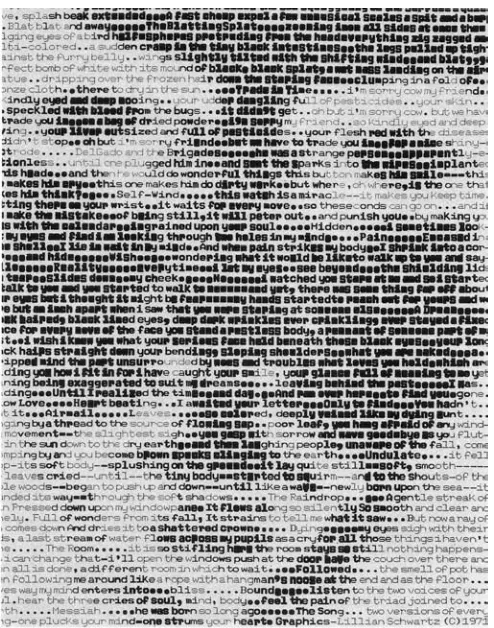
2.5. “Observances,” by Lillian F. Schwartz and Ken Knowlton 104 2.6. “The Flying High Tail Longhorn Gate,” by David Daniels 105 2.7. “Ninho de Metralhadoras,” by Erthos Albino de Souza 106
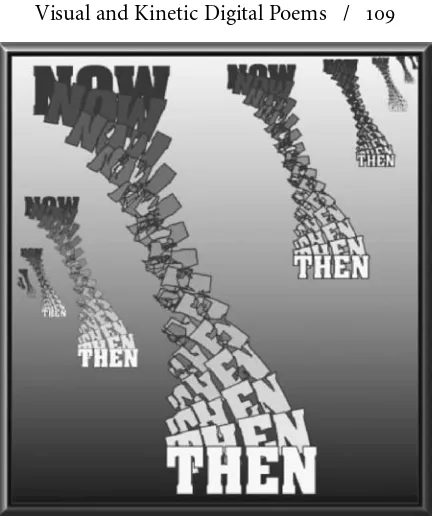
2.8. “Automatergon 72-1,” by Greta Monach 107 2.9. “Stability” (1992), by Clemente Padín 108 2.10. “The Collected Sayings of Time,” by Jim Andrews 109
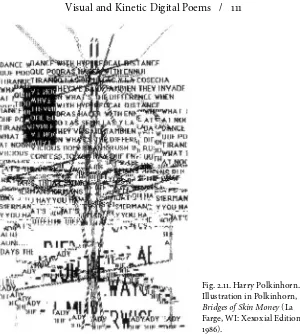
2.11. Illustration in Polkinhorn, Bridges of Skin Money 111 2.12. Storyboard diagram for Roda Lume, by E. M. Melo e Castro,
2.13. Roda Lume diagrams, by E. M. Melo e Castro, illustrated in Antologia Efémera 121
2.14. Povo-Ovo, by Silvestre Pestana 125 2.15. “INSTANCENCE,” by Geof Huth 127 2.16. Screenshot from “Amour,” by Philippe Bootz 129
2.17. Stills from “Le mange-texte [The Text Eater],” by Jean-Marie Dutey 130
2.18. Illustration from “4320,” by Alan Sondheim 140 2.19. Still from “Voies de faits,” by Jean-Marie Dutey 142
2.20. Illustration from “IO,” by André Vallias 144 3.1. Screenshot of main interface from “Les mots et les images,”
by Jean-Marie Dutey 159
3.2. Detail of screenshot of graphical overlay from “Les mots et les images,” by Jean-Marie Dutey 160
3.3. Screenshot from “Autobiographie,” by Jean-Pierre Balpe 161 3.4. Screenshot from “Autobiographie,” by Jean-Pierre Balpe 162 3.5. Screenshot from A Life Set for Two, by Robert Kendall 164 3.6. Detail from introduction to Intergrams, by Jim Rosenberg 166
3.7. Screenshot from “Intergram 10,” by Jim Rosenberg 166 3.8. Screenshot from “Intergram 10,” by Jim Rosenberg 168
3.9. Screenshot of frame from “Intergram 10,” by Jim Rosenberg 169
3.10. Screenshot from Virtual Poem 12, by Ladislao Pablo Györi 174 3.11. Screenshot from Virtual Poem 12, by Ladislao Pablo Györi 174
3.12. Screenshot from “Les trois petits cochons,” by Jean-Marie Dutey 176
3.13. Screenshot from “Les trois petits cochons,” by Jean-Marie Dutey 177
3.16. “Writing Instructions,” screenshot from Marble Springs, by Deena Larsen 193
5.1. Screenshot from the arrival of the beeBox, by Aya Karpinska 230
5.2. Detail of screenshot from the arrival of the beeBox, by Aya Karpinska 231
5.3. Screenshot from “New Word Order,” by Sandy Baldwin 246 5.4. Screenshot from “ceci n’est pas un nike,” by
Giselle Beiguelman 247
5.5. Screenshot from Birds Singing Other Birds Songs, by Maria Mencia 249
A.1. “Birth of God/uniVerse,” by Lionel Kearns 258 A.2. “Timesharing: Conditional Jump,” by Archie Donald 260
A.3. Illustration from “The Verse,” by André Vallias 262 B.1. Six points of view of the holopoem Adhuc, by
Eduardo Kac 266
A basic statement about literature might be that any statement is possible: literature means I can say anything. At the same time, certain statements are already subject to regulations and distributions. A basic statement on poet-ics might be that it deals with the possibilities for statements at a given mo-ment: poetics means what is possible for me to say now. (Of course, I may still say what remains impossible.) However provisional and contested these basic statements may be, they open onto the problem of de¤ning digital etry, which is no more and no less than the problem of contemporary po-etics. The de¤nition of digital poetry remains up for grabs. For the true skeptics—and they do exist—digital poetry is an impossibility. In this view the computer is intrinsically unsuited for the creative act of writing poetry for a variety of reasons, ranging from the fact of its strict programming to the inverse fact of its lack of a structure for invention. A milder version of this position sees no real poetry yet written in digital media—all ®ash and no creativity, at least so far.
Even the enthusiasts of digital poetry, those in the know, cannot agree on the de¤nition of digital poetry. Of course, this is all for the best, a necessary debate in an emerging ¤eld. What is most interesting is the reemergence of basic aesthetic questions from the speci¤c problem of de¤ning digital po-etry. The question of de¤ning digital poetry devolves to the question of po-etry itself, of distinguishing what makes a poem a poem and not something else. If this is a very old question, it is also one that is more or less muted in the broad normalization of avant-garde poetry. In what might be seen as the segmented contemporary institution of poetry, especially in academic settings, it is perfectly possible to earn a PhD or tenure as a student and
scholar of innovative poetry. Of course, this is also all for the best, but given such friendly conditions for innovative work, where we know the answer to basic questions of poetics, we too quickly cease to ask the questions. These questions are immediate in digital poetry. Digital poetry is the contempo-rary site of intense concern with poetics.
Loss Pequeño Glazier’s Digital Poetics: The Making of E-Poetries was the ¤rst book-length work on digital poetry and remains the benchmark. Gla-zier led the way for the critical assessment of digital poetry as a subject of academic study. His work cogently argued for the innovative literary signi¤-cance of digital poems. His method is critical in the most fundamental sense: he makes distinction. To convince that possibilities of invention and creation in digital poetry parallel those in other media, Glazier isolates spe-ci¤c examples of innovative practice through parallel sequences of innova-tive poets: Williams, Creeley, and Mac Low, for example, and in digital po-etry Cayley, Rosenberg, and Glazier himself. Make no mistake, Glazier’s list is extendable and ®exible, and it potentially includes diverse and contradic-tory voices. Nevertheless, the point is to exemplify and to show innovative relations to language within each list. Both the ¤rst group and the sec-ond group engage language as an active medium of discovery. Through the resulting analogical relation Glazier convinces us of a continuity of inno-vation. “The making” of Glazier’s title is as much about how e-poetry is made as it is the basic evaluation of e-poetry as focused on innovation and making.
The result is persuasive, and this is part of the lasting value of Glazier’s book. Of course, the exemplary force of the persuasion narrows the ¤eld. Glazier’s approach requires making critical distinctions within poetry, and the critical view necessarily includes some works and excludes others. In turn, a generation of critics and readers follow Glazier’s lead. For example, Brian Kim Stefans’s Fashionable Noise: On Digital Poetics primarily de¤nes digital poetry in the negative, as distinct from printed poetry. Some texts count, and others do not. My point is not to question the value of this sort of critical work. The grounds of appreciation and reading of digital poetry rely on Glazier, Stefans, and others.
He maintains continuities between earlier media (print, orality, etc.) and with an enormous range of poetic experimentation. Prehistoric Digital Po-etry is not concerned with criticism but with the historical conditions of possibility. Rather than start from the current production of digital poetry and justify its value for academic study, as Glazier does, Prehistoric Digital Poetry turns to disparate and subterranean experiments and innovations that combined, in often startling and contingent ways, to make it possible to speak of digital poetry at all in the ¤rst place.
Prehistoric Digital Poetry expands the ¤eld of what might be considered digital poetry, not in the least by showing that poetic experimentation was happening from the ¤rst invention of digital technology. Funkhouser traces the ¤rst digital poetry to a random text generator written on a Zuse Z22 computer by Theo Lutz and described in a 1959 article. The early date is striking, considerably earlier than allowed by any other recent discussion of digital literature, yet it is perfectly possible to hold that this was not digital poetry at all. In widening the dating of digital poetry well beyond the ho-rizons of contemporary debates, Funkhouser insists on the margin between experimentation and the formalization of a discourse. We might say that Lutz’s piece is not digital poetry but something like a poem experimenting with digital technology. The difference is signi¤cant and not simply seman-tic. The experiment occurs at a preconceptual point in a discourse where nothing could be said in or of digital poetry. In this sense the poem is sin-gular and, in a strict sense, prehistoric. We might say that digital poetry did not yet exist as a “positivity,” in Michel Foucault’s sense. There was no ar-chive of digital poetry. As a result, Funkhouser offers an important resitua-tion of the recent emphasis on materiality in poetics. While Glazier insists on materiality as a quali¤cation of innovative poetry, a quali¤cation carried over to digital poetry, Funkhouser’s history shows that this materiality is no immutable ground but must be accumulated and formed. Materiality for poetics is a historical achievement, an aggregation of possibilities for con-sistent and renewable ¤gural relations between forms and materials. In a ¤eld that is often characterized by debates over materiality versus immate-riality (or virtuality), I think this emphasis is timely and necessary.
study of digital poetry and to theoretical concerns with contemporary lit-erary production. By outlining the institutional emergence and possibility of digital poetry, Funkhouser models a certain kind of literary history. To emphasize this point, let me conclude by invoking Harold A. Innis, Marshall McLuhan’s sadly overlooked mentor, who was recently revived in the Ger-man mediawissenschaft or “media science” of Friedrich Kittler and his stu-dents as a supplement to Foucauldian discourse analysis. In particular, In-nis’s Empire and Communications assessed the stability of historical empires in terms of their ability to balance light, transportable, and spatial media, on the one hand, and heavy, durable, temporal media on the other. This ap-proach led Innis to resituate all available history in terms of communica-tions media. If it is true that many good and timely reasons make us go against Innis’s intentions and seek the destabilization of political empires, it is equally true that the force of his analysis remains useful despite the problems of his aims. If empires are dependent variables of media, the very empiricity of what we experience as history becomes a function of the work on media by communities of makers. Empire and communication are con-ditioned by the poetics of media. Funkhouser’s archaeology shows poetics conditioning the emergence into the history of digital poetry. Without a doubt digital poetry today is an empire, part of a growing institution of new media studies, and tied to academic departments, industry funding, and government grant cycles. It becomes so, however, through the actual prac-tices of communities of writers and readers. In the end this is the vital, pre-historic truth that Funkhouser’s book presents.
Sandy Baldwin
This chronology provides the initial works done by poets (or publishers) and the ¤rst developments in particular areas of digital poetry. Many (but not all) of these events are discussed in the following chapters. As a record of advancements that occurred within the genre, this document aims to be encompassing and inclusive though not complete. Every work by every art-ist is not highlighted, and undoubtedly more works will be brought to my attention upon the publication of this book.
1959
• First programs of computer poems, “Stochastische Texte” (a text
genera-tor) by Theo Lutz
1960
• Oulipo founded
• Brion Gysin’s permutation poem “I am that I am” programmed by Ian
Somerville
1961
• Nanni Balestrini’s “Tape Mark I” created with code and punched cards
on an IBM 7070
• Rul Gunzenhäuser, “Weinachtgedicht” (automatic poems)
1962
• “Auto-Beatnik” (Time, May 25)
1963
• Balestrini, “Tape Mark II”
• Clair Philippy, ¤ve poems published in Electronic Age (“blank verse at
the rate of 150 words a minute”)
1964
• Jean Baudot, La machine a écrire (text generator)
• Phillipy creates strophes using a vocabulary with one hundred words
with the assistance of computer
• L. Couf¤gnal and A. Ducrocq create “Un doute agréable couleur de
lotus endormi . . . ,” an imitation surrealist poem created on Calliope hardware system
1965
• Emmett Williams uses 101 most used words from Dante’s Divine
Comedy to create “Music,” a computer poem
• Lionel Kearns, “Birth of God/uniVerse” (visual poem)
1966
• Williams, “The IBM Poem”
• Gerhard Stickel, “Autopoeme,” “Monte-Carlo-Texte”
1967
• Baudot, “Rephrase”
1968
• “The Computer and the Arts” exhibition, Institute of Contemporary
Art, London
• E. M. de Melo e Castro, Roda Lume (videopoem) • Alison Knowles and James Tenney, “A House of Dust”
• Tenney, “Hank and Mary, a love story, a chorale”
• Douglas Englebart, “Augment”
1969
• Jackson Mac Low, “PFR-3 Poems”
1970
• Alan Sondheim, “4320”
• Carl Fernbach-Flarsheim, The Boolean Image/Conceptual Typewriter
• Dick Higgins, Computers for the Arts
1971
• Louis Milic, “Returner”
• Gerrit Krol: APPI: Automatic Poetry by Pointed Information • Waldemar Cordeiro, “Arteônica” (exhibit of computer art)
1972
• Aaron Marcus, “The City Sleeps but Someone Is Watching”
• Erthos Albino de Souza, “Le tombeau de Mallarmé”
1973
• Richard W. Bailey edits Computer Poems anthology
1974
• rjs, Energy Crisis Poems
1975
• Richard Kostelanetz, 3 Prose Pieces (video)
• “Europalia” event in Brussels
• Albino de Souza, “Ninho de Metralhadoras”
• Cordeiro, “Gente”
1976
• Angel Carmona, “Poemas V2: Poesía compuesta por una computadora”
1979
• Philippe Bootz, combinatory poems on minicomputer
• Sondheim, “TI59 Poems,” “Iceland” (generators)
• Csaba Tubak, “Electronic Game and Tool for Writers”
1980
• Jean-Pierre Balpe, “Poèmes d’amour”
1981
• Silvestre Pestana, “Povo-Ovo”
• Charles O. Hartman, poetry composer (the Scansion Machine)
1982
• Eduardo Kac, “Não” (animated poem)
• A.L.A.M.O. (workshop of mathematics and computer-assisted
literature)
• Roger Laufer and Michel Bret, Deux mots • Julio Plaza, “luzazul”
• Augusto de Campos, “pluvial . . . ®uvial”
• Alice Ruiz, “acende apaga . . . apaga acende . . . vagalume”
1983
• Kac, “Holopoems”
• John Cayley, “wine ®ying”
1984
• Hugh Kenner and Joseph O’Rourke, TRAVESTY software
• Swift Current (online magazine)
• bpNichol, First Screening (animated poems in Apple BASIC) • THE ALCHEMIST (diskette magazine)
1985
• Les Immatériaux (A.L.A.M.O.) exhibit at Pompidou Center, Paris
• John Cage, “Mesostics” (published on the WELL)
• Art Access, online (Minitel) publication, France • Fred Truck, Art Com Electronic Network on the WELL • Lenora de Barros, “Entes . . . Entes . . . ”
• Kostelanetz, Antitheses • Joao Coehlo, Universo
1986
• Bootz, telematic poems, “Metamorphose”
• Michael Newman, The Poetry Processor
• Geof Huth, “Inchworms” (Apple BASIC)
• Enzo Minarelli, “Volto Pagina” (video)
• Kac, Tesão (videotext)
1987
• mIEKAL aND, Zaum Gadget, PataLiterator
• Xexoxial Endarchy, Internalational Dictionary of Neologisms
(Hyper-Card version)
• Huth founds dbqp press
• Judith Kerman, Interactive Poem Demo Animated Picture Poems • Albertus Marques, Chuva
1988
• Jim Rosenberg, Intergrams
• Cayley, “wine ®ying” converted to diskette
• Your Personal Poet, Computer Poet Corporation (generator)
• Andrew Stone, Haiku Master • William Dickey, HyperCard poems
• Louis Crew, Poetease (program)
1989
• Alire produced on diskette (multiple authors) • Melo e Castro, Signagens (digital videopoems) • Hartman, DIASTEXT
• Rod Willmot, “Everglade” (hypertext poem published by Hyperion
SoftWord)
• Clemente Padín, “AIRE” (video)
1990
• André Vallias, “Nous n’avons pas compris Descartes”
• Robert Kendall, kinetic poems created for DOS
• Jim Andrews, And Yet magazine • Minarelli, Polypoesia
1991
• Cayley’s Indra’s Net (HyperCard)
• AWOPBOP founded (University at Albany)
• “PoetryStar” (instructional program, Chat¤eld Software)
1992
• “p0esíe-digitale dichtkunst” exhibition curated by Vallias, with
Friedrich Block
• Action Poétique published with disk
• A. de Campos, “Poema-Bomba” (computerized)
• Pestana, “Ego II”
• Fritz Lichtenauer, “Computertextgra¤k”
1993
• Eastgate Quarterly Review of Hypertext 1.1, Rosenberg’s Intergrams • Patrick-Henri Burgaud (with Jean-Marie Dutey), La mer
• online publications: GRIST,RIF/T,We Magazine Issue 17 • POETICS listserv, SUNY-Buffalo
• Judith Malloy, Its Name Was Penelope (Eastgate, HyperCard) • Deena Larsen, Marble Springs
• Arnaldo Antunes, NOME, Cultura (video) • Chris Funkhouser, MOO poems
• “(Pré)texte à voir” poetry-video exhibition Art 3000 (Paris)
1994
• A:\LITTÉRATURE interactive publication
• Electronic Poetry Center founded (SUNY-Buffalo)
• Balpe, Génération
• Kathryn Cramer, In Small & Large Pieces • HiPitched Voices (MOO)
• Barros, A cidade e seus ®uxos (CD-ROM) • GRIST Online
• Fabio Doctorovich, Bribage cartooniano
1995
• The Little Magazine, vol. 21 (CD-ROM) • Kenner and Hartman, Sentences
• Andrews, Vispo and Webartery (WWW discussion group) • Laurie Anderson, Puppet Motel (CD-ROM)
• Truck, Bottega (CD-ROM)
• Doctorovich, “Chatgattcat (o rotaciones)”
Digital poetry is a new genre of literary, visual, and sonic art launched by poets who began to experiment with computers in the late 1950s. Prehis-toric Digital Poetry: An Archaeology of Forms, 1959–1995 provides an analysis of relevant works and examines encounters between poetry and comput-ers prior to the advent of the World Wide Web (WWW). This history of literary/technological expression—an array of poetry directly in®uenced by computer processing and manipulation—follows a more or less temporal continuum, while retaining distinct stylistic groupings. Aside from a few es-says that skim the surface of its history, digital poetry produced before the advent of the WWW has not been introduced to a larger audience in a prob-ing, concerted way. My study seeks to reveal the development, range, and construction of digital poetry, as well as what constitutes the genre.
Most signi¤cant, this book demonstrates that digital poetry’s founda-tions, mechanically and conceptually built in the decades before personal computers, were ¤rmly established by the 1990s—before the WWW came into existence. This observation is signi¤cant, and this present study is im-portant, because the early history of this burgeoning genre is almost com-pletely unknown, and the present state of digital poetry cannot be fully un-derstood without a sense of its origins. I wish to provide, then, some deeper idea of what digital poetry has been about.
As explained in detail in the section “Discussion of Genre” below, digital poetry is not a singular genre or “form” but rather a conglomeration of forms that now constitutes a genre even though the creative activity itself— in terms of its media, methods, and expressive intent—contains heteroge-neous components. Digital poetry is an evolving process, employing various
Introduction
techniques that began to form well before the advent of the personal com-puter and continues to re¤ne itself in today’s WWW environment. Poets continue to explore a variety of computerized techniques, from interactive installations to randomized and visual attributes. Despite the technologi-cal advancement and popularization of computers, my research shows that most approaches to the production of digital poetry realized in the wake of the WWW’s emergence were at least roughly cultivated before the advent of the global network.
Poets initially used computer programs by synthesizing a database and a series of instructions to establish a work’s content and shape. By the mid-1960s, graphical and kinetic components emerged, rendering shaped lan-guage as poems on screens and as printouts. Since then, videographic and other types of kinetic poems have been produced using digital tools and techniques. Beginning in the 1980s, hypertext (nonlinear texts that are trinsically, mechanically interconnected) developed in sync with the in-creasing availability of the personal computer. A few other experimental forms, like audio poetry, appeared along with new technical advancements. When the WWW emerged, multimedia, transcontinental, hyperlinking po-ets began to spark expression through interconnected motherboards; the status of the art form has risen with the increasing affordability of comput-ing and capabilities of network technologies. Only a few works of digital poetry titles are now circulated of®ine (few people are publishing digital po-etry on diskette or even CD-ROM). The copious amount of material deliv-ered to readers through the WWW is strong evidence that computers and telecommunications networks heighten the audibility and visibility of this strand of contemporary poetry.
computer has only been used to copy aesthetic effects easily obtained with the use of conventional media, although the computer does its work with phenomenal speed and eliminated considerable drudgery” (111).1
Could it be true that digital poetry is, in fact, a simulation of poetry? In many re-gards the purpose of my book is to investigate what sorts of “newness” are brought about by digital technology and—to a lesser degree—what associa-tions or relaassocia-tionships exist between these “new” formaassocia-tions of poetry and those that have existed previously.
Mechanically, it is true that a contemporary poet has novel technology at her or his disposal, but, as this study will show, many poems available on the WWW cannot be classi¤ed as “new” because the digital techniques used to present them were cultivated in the decades prior to the WWW. Likewise—as noted by investigations such as Loss Pequeño Glazier’s Digi-tal Poetics: The Making of E-Poetries (2002)—digital poets conceived these works with the same poetic and theoretical practices used by artists who worked with nothing more than paper and ink. The high-tech composition and presentation of poetry, using the latest available means, has, of course, re®ected a sense that something innovative was underway, and many artists working in the pre-WWW period can rightfully claim that they were doing something mechanically original. This is obviously true in terms of surface aesthetics—particularly the development of kinetic works—but nothing particularly new has emerged since the initiation of the WWW. Indeed, contemporary digital poetry merely re¤nes earlier types of production and disseminates works to a wider audience via the network.
artist often seeks to expose, and sometimes subvert, the various binary op-positions that support our dominant ways of thinking about literature (and, perhaps, about communication in general). The deconstructive contention that texts intrinsically contain points of “undecidability,” which betray any stable meaning that an author might seek to impose on a text, is certainly a feature of many digital poems.
In The Postmodern Condition: A Report on Knowledge, Jean-François Lyo-tard proposes that contemporary discourse can make no claim to ¤nality, even if it does not seek to put an end to narration. He argues that the com-puterization of society, which shifts emphasis from the ends of actions to their means, has made metanarratives (as a means of legitimizing knowl-edge) unnecessary and intolerable because technology is self-legitimating (108). Cultural transformations (especially the growth of technology) have altered the historical tenets of science, literature, and art. His pluralistic, relativist views suggest that art is no longer required to seek or produce truth and knowledge, and may abandon standards and categories. The text’s identity as a computer form, containing expanded semiotic operations, of-ten subjects the reader to an unfamiliar type of reading. In negotiating the interface, a reader’s experience involves thoughtfully participating in the textual activity and thereby experiencing the poem on compounded visceral and cognitive levels.
As William S. Wilson writes in the essay “And/Or: One or the Other, or Both,” postmodernism “was invented when language looked like a game, or like several games with resemblances among them, and when the rules for words, or the rules for playing games with words, required that uses of a word be arranged in an array that has a lot of play—to-and-fro movement— within it. These oscillations might not look as serious as some more stable older thought, and the vacillations that accompany undecidability can re-semble mere decisiveness. But undecidability is not an incapacity, it is a con-dition of mathematical logic” (11–12). Because literature has now joined forces with mathematics and computer science, as well as other art forms, it foists an entirely different set of circumstances on the reader, which will be made clear by the works discussed below.
audio, and video formats. My activities in this area expanded when I was exposed to (and began to practice) nondigital multimedia performance during a summer of study under the tutelage of Allen Ginsberg and Anne Waldman at Naropa Institute in 1986. When I arrived at the University at Albany in 1992, Don Byrd gave me a single order: to continue what I had been doing, but use computers and the Internet to produce poetry instead of Xerox machines and recording studios, and then write about it. This shift to a more technologized approach to creativity had a strange allure, and I believed that making use of new equipment could be rationalized by the fact that poets throughout history have always made use of whatever tech-nology they have at their disposal. I began to investigate how poets had used digital technology, and this book is largely the result of my research and musings over the last ten years on the subject of digital poetry and the po-etics of that form. Time and helpful feedback from mentors and colleagues have enabled me to establish a more determined agenda and focus, as well as conduct research that I was not able to undertake as a graduate student. Today digital technology advances poetry into dynamic areas that were at least partially available in the prehistoric and even pretechnologic era. Attaining randomized effects with technological components and processes, digital poets reprogrammed unconventional analog prototypes—like hand-made Dada poems—as well as more orthodox forms such as sonnets and haiku. Digital poems can be enormously complicated (containing video, layered images, and so forth) or very simple. Sophisticated productions can be technically demanding or use elementary computers and techniques. This book aspires to discover, discuss, and present a history of poems cre-ated through or because of the computer, and to a lesser degree it seeks to link that history with precomputerized poetry.
Discussion of Prehistoric Theme
Designating the literature under investigation as prehistoric imparts a cul-tural and an aesthetic suggestion rather than a literal or absolute theoretical assignation. This study examines the material contents of digital poems from their emergence until the point they coalesced into a genre—or at least until a more widely practiced art of multiple forms after the WWW brought disparate types of work into one network.
ana-lyzing selected ¤ndings proposes that these precursors to contemporary works fundamentally delineate parameters of the genre. The work discussed here is prehistoric because no masterpieces or “works for the ages” emerged to lodge the genre in the imagination of a larger audience. In fact, only a small audience became interested in or knew of most of the productions I will discuss. Digital poems made in this period were part of a substratum of contemporary art, overshadowed by the abundance of dynamic works pro-duced by writers and artists whose more accessible surfaces (such as books and galleries) gained much broader exposure. Only a few of the works dis-cussed below were strong enough to garner temporary attention at that level, usually in events that focused on computer art. Even if most of the world did not notice, these poems are important because they established the foundations of the genre.
This research is a type of archaeological excavation because technologi-cally based works become outdated very quickly and are often dif¤cult to obtain or operate. Exploring works produced with obsolete programs and platforms involves more than clinical scholarly research; my archaeology re-quired that I not only ferret out obscure written texts but also search for old programs, hardware, and software. In some instances I had to consult with experienced programmers who helped me understand what the programs had done (and had not been able to do) by examining the code. This book is an archaeological study because my research was such; on ¤nding a refer-ence to a work, I would attempt to locate it, consult with its author or some-one familiar with it if possible, read the poetry, then ¤nd a way to ¤t it into a context with other works uncovered in the process. Initially, my primary interest was hypertext (and the recognition that hypertextual dynamics share common ground with poetry’s intertextuality, whereby texts exist in open relations with other texts), so I acquired as many publications as pos-sible and set out to sift through them to ¤nd elements or expressions that contained poetic value. I then proceeded to do the same thing for each of the other major modes of digital poetry (text generation, visual works, and hypermedia).
genre’s foundations, either via direct experience with the materials them-selves or by reliable ¤rst- or secondhand accounts of the works.
The dawning of the WWW (launched in 1991 but not used creatively until 1995) is a signi¤cant point of demarcation, as it signals a profound and historical shift in the way digital poems were made available for view-ers.2
Prior to this moment multimedia, hypertext, and computer-generated works had been discretely produced “of®ine.” The massive growth of the Internet and WWW introduced artists to each other’s work. Search engines, browsers that enable hearty multimedia capabilities, archival Web sites, list-servs, and even chat rooms have increased the visibility, consumption, and knowledge of the form—a global community has become possible.
Growth of the WWW undoubtedly bene¤ts and increases the visibility of digital poetry, which had been a remote satellite of literary and/or artistic culture. Today many more people are involved with the composition of ma-terials on the WWW, so the form has grown and works have been re¤ned. Nonetheless, the initial endeavors represented in my study are important be-cause they allow us a clear-eyed look at the basic elements, procedures, and historical approaches to the composition of digital poetry. The works pre-sented here, which are in many ways at risk of extinction, will give anyone a sense of the earliest constructions and the ongoing mechanics of a devel-oping technological literature and, more broadly, a culture.
Structure of This Book
con-tinuum of production, possibilities, and problems within digital poetry. Organized broadly, this surgical explication is arranged chronologically. I select several works from within each period as pertinent examples and ref-erence every work I encountered in my research.
The ¤rst section of the book examines text generation. Exploration and discussion of graphical works (both kinetic and static), hypertext/hypermedia, and alternative forms follow, set into subsections by the poet-programmer’s type of production. The methods, programs, or software used to develop works are introduced as each style of production is addressed. I have devised general typologies for each style to delineate the general areas of investiga-tion and explain and analyze how titles of digital poetry made use of suc-cessive digital technologies as the means became available. These works rep-resent the beginning of this gradually developing area of textuality. The re®ective, yet speculative, concluding chapter deliberates on the range of ef-fects, conditions, limitations, and potentials of early digital poems. I further discuss digital poetry’s impact, effectiveness, and interactive possibilities and offer a context for future works.
To maintain the book’s focus on computer-enabled poems, I have ap-pended two essays—one on “code” poetry and one on holographic poetry— that address mediated poetry’s emergence alongside digital poetry. These forms not only use computer techniques but essentially share the same ex-perimental motivations as digital poems. Thus, all the works appearing in the book proper stem from computer operations, and those discussed in the appendices are closely related but not presented on computer screens.
de¤ning and re¤ning their craft, and offer them a sense of a larger creative history.
By giving these obscure works more exposure, making them known to a larger audience, I do not mean to suggest that they are masterful. While many works emit the effects Pound declares as the bases for poetry (phano-poeia, melo(phano-poeia, logopoeia), only a few approach “great literature” by the standard he advances in How to Read and ABC of Reading: “language charged with meaning to the utmost possible degree” (28). I wish neither to argue for the popularization of these digital poems nor to promote exclusively their authors—although I do consider these experiments relevant steps in the growth of digital writing because they establish the aesthetic foundations for many subsequent works. Today’s wildly animated, WWW-based titles possibly offer more to viewers in search of dynamic text and are better ap-plications of the technology that was previously available. Even if this is the case, my purpose is to establish the common and concise foundations for digital poetry. Unveiling these texts intends to contribute to the further un-derstanding and development of the form. Describing how each work op-erates, and how the different types of work may be seen to form (or “¤t” into) a poetics, allows me to elaborate on a range of approaches to expres-sion attempted and achieved by digital poets. Thus, the dominant aspects and dynamics of digital poetry are introduced and discussed.
Speculation about the poetics of digital poetry has overshadowed de-tailed readings of the works, which are in themselves fully capable of con-veying the evidence for literary and other historical foundations. In general, I remain determined to ®esh out the actual works in order to demonstrate the formal and technological roots of contemporary productions. At the same time, I realize the value of establishing a literary framework and of bringing into the study the historical associations of these works, which—in addition to being outlined immediately below—are referenced and incorpo-rated into the narrative of the chapters that follow.
Relationship between Poetry and Digital Poetry
In his preface to the anthology Computer Poems (1973) Richard Bailey iden-ti¤es four poetic tendencies that in®uenced the works included in the col-lection: “concrete poetry,” “poetry of sound in verbal orchestrations,” “im-agistic poetry in the juxtaposition of the unfamiliar,” and “haiku.”3
poems in the anthology reasonably support his (somewhat) dated view-point, but there is a correspondence between poetry and digital poetry.
Making connections between digital and historical (i.e., printed or purely oral) poetry is helpful for those unaware of recent developments in the me-dium, and at this early juncture of the digital era, critics necessarily use frameworks derived from past movements as a foundation.4
For instance, Glazier’s volume, Digital Poetics—the ¤rst full-length study of the genre—is largely dedicated to this pursuit.5
Glazier outlines a history and infrastruc-ture of “e-poetry” as it is situated within a lineage of innovative literainfrastruc-ture written in the past century (Guillaume Apollinaire is the earliest cited ar-tistic marker). Digital Poetics, “an introduction to the making of the new digital poetries,” introduces the experimental domain and general attributes of the genre, which in Glazier’s view directly follows Language poetry in the line of inventive verbal arts of the twentieth century (1). He does not ana-lyze work that has actually been produced thus far but rather intimates the capabilities of the digital poem and shares his observations as a producer of such works, often connecting them to other forms of literary production. In Fashionable Noise: On Digital Poetics (2003) Brian Kim Stefans extends lively considerations regarding numerous literary and artistic ¤gures he sees as precursors of cyberpoetry (a classi¤cation he uses throughout his book), including the concrete poets, Walter Benjamin, Ian Hamilton Finlay, members of the Toronto Research Group, and many others. Stefans, like Glazier, primarily uses examples of his own work (which appears in frag-ments, accompanied by dozens of footnotes that adorn his ornate perspec-tive). In contrast to these respectable authors, I prioritize the examina-tion of the textual and technological particulars by introducing completed works and illustrating their properties, once I have established a historical literary context.
a wider net into this critical sea). Each stylistic phase of the genre’s prehis-toric era contributes different dimensions and requires explication in order to locate digital poetry on the continuum of literary history.
It is not dif¤cult to build a context for digital poetry using works and discourse from the modern era, although it is clear that digital poetry’s stylistic foundation is ¤rst established by premodernist literary beacons. French symbolist writing, particularly Stéphane Mallarmé’s late-nineteenth-century poem “A Throw of the Dice Never Will Abolish Chance” (1897), is unquestionably an artistic antecedent that directly impresses upon the dis-ruption of textual space and syntax found in digital poetry. The variations in typography, incorporation of blank space, and the liberal scattering of lines often found in digital poems can be discerned as having roots in Mal-larmé’s work (which also strongly in®uenced the development of concrete poetry in the 1950s). Such patterning has been extended by the addition of interactive and kinetic components. Mallarmé’s importance was previously acknowledged (albeit brie®y) from a different perspective in Bailey’s preface to Computer Poems, which largely featured randomized poetry created by computer programs: “Mallarmé published a slogan for modernism: A throw of the dice will never abolish chance. Chance is not abolished by the com-puter’s randomizing power but is re-created in different terms. The poet-programmer ¤nds this power a tool to create a new set of dice, multi-faceted and marked with elements of his own choosing.” Here Bailey privileges the power of Mallarmé’s thematic content, although I would assert that the aes-thetic properties of “A Throw of the Dice,” particularly its visual attributes and the fact that it requires readers to make decisions about how to read the poem, are equally important, if not more so.
German Language,” seventeenth century), and other works are capably pre-sented on the Permutations site, illustrating how the mechanics of contem-porary (and prehistoric) digital poems have roots in works produced several centuries ago.
The ¤rst works of digital poetry, text-generating programs written in BASIC, TRAC [Text Reckoning and Compiling] Language, APL [A Pro-gramming Language], FORTRAN, and other now-ancient proPro-gramming languages, predominantly re®ect the modernist propensity to synthesize disparate voices and cultural details.6
Pound’s Cantos and T. S. Eliot’s The Waste Land achieve this effect, as Jay David Bolter observes in the ¤rst edi-tion of Writing Space, by replacing poetry’s narrative element with “frag-mented anecdotes or mythical paradigms” (131). For example, the early “Tape Mark” poems by Nanni Balestrini (1961) appropriate texts by Lao Tzu (Tao Te Ching), Paul Goldwin (The Mystery of the Elevator), and Michihito Hachiya (Hiroshima Diary); such reinscription is a common trait of digital poetry. These poetical collage techniques are reminiscent of The Cantos and William Carlos Williams’s Paterson, which juxtaposes poetry, the language of the people and natural world of his locale, and correspondence with other writers into a sequence of writing encompassed in the poem. Like Williams, Pound, and Eliot were in their era, digital poets are confronted with social and artistic fragmentation in the world around them and— whether consciously or not—use the atomization and hybridization of texts to both subvert and re®ect the complex of cultural information. Authors working on the page and screen in the postatomic era use fragmentation to legitimize fragmentation and challenge the stability of language as a point of meaning; this process of reassembling disparate pieces via technology offers the means to impart a sense of coherence.
Early works in Computer Poems and elsewhere show great effort (in terms of preparing code and selection database material) to give digital poems a sense of cohesion.7
his “readymade” artworks. The principles involved with the poesis of such works—especially in works that regenerate themselves—move away from creating singular artifacts; such models of expression are, as Peter Bürger has remarked, “not works of art but manifestations” (Perloff 5).
Modernist poets also imparted visual attributes to their work, although adding visual components to poetry was not new (see, e.g., William Blake). The most glaring examples of this trend are Pound’s interest in (and imple-mentation of ) ideograms (which also asserts the applicability of scienti¤c method to literature), Apollinaire’s “Calligrames” (which shape language into discernible images), Charles Olson’s “Projective Verse” (“composition by ¤eld” with attention to breath and the extension of perception), as well as various methods used by concrete, constructivist, Dadaist, and futurist poets.8
While visual design is a characteristic of many digital poems, the relationship between graphical digital poems and the aforementioned mod-els often exists on the surface but is not intrinsically supported by shared ideologies or methods, especially in contemporary forms where elements are not always ¤xed into place. Fragmentation and disruption of sensibility through the images produced—attributes generally associated with post-modern productions—were practiced from the very beginning. Graphical digital poems—which use many different approaches and take on many dif-ferent forms—emerged in the 1960s and have appeared steadily ever since. This advancement, which overtly and visually foregrounds material aspects of language, represented signi¤cant aesthetic growth in the development of digital poetry.
Poems by artists preoccupied with visual elements are reminiscent of certain concrete poems, in that they use atypical and oversized lettering, but the connection is closer in graphical philosophy to earlier shaped poems by Apollinaire in the “Calligrammes” or George Herbert in “Easter Wings,” where the shaping of the poem is an embodiment of its content. The “ten-sion of things-words in space-time”—which is one of the theoretical and artistic objectives of concretism stated by Augusto de Campos in the “Pilot Plan for Concrete Poetry” (referred to in Emmett Williams’s An Anthology of Concrete Poetry [n.p.])—is sometimes but not always perceived in digital works. Materials that directly associate object and meaning do not foster the same level of “tension” in the reader as the more oblique communication strategy of concretism.
poetry was not literally put into motion, probably because of a lack of access and the expense of ¤lm equipment and processing, as well as a set precon-ception of what ¤lm as a medium entailed. Videographic works and devices used to make animated poems have gradually become available during the past two decades. These techniques have galvanized a synthesis of media in the construction of poetry, in which meaning is produced through the rec-ognition of differences between instances in the chain of preprogrammed sequences. Poems in this style thus impart a type of deconstruction through their shifting, activated rhetorical structure. As E. M. de Melo e Castro writes in his essay “Videopoetry,” “Poetry is always on the limit of things. On the limit of what can be said, of what can be written, of what can be seen, even of what can be thought, felt, and understood. To be on the limit means often for the poet to be beyond the frontier of what we are pre-pared to accept as being possible” (140). Building a context for digital poetry within a broader historical spectrum, Melo e Castro outlines the central ele-ments of this neoteric form, which emphasizes, as poets have throughout the ages, “the importance of phonetic values in oral poetry, of scriptural values in written poetry, of visual values in visual poetry and of technologi-cal values with computer use and video for the production of poetry, and not only for simple repetitive and non-creative tasks” (141). Melo e Castro sees videopoetry as an inevitable response to the challenge of new techno-logical means for producing text and image. In some instances messages are succinctly and directly transmitted, but more often the combination of words, symbols, and images requires viewers to decide what this con®ation or concatenation of elements means. As Marjorie Perloff notes, such condi-tions for textuality, which often blur the boundaries between poetry and prose, or literature and art, have been described by Richard Lanham as “digital equivalency,” meaning that, “we can no longer pursue literary study by itself: the other arts will form part of literary study in an essential way” (Perloff 17). In the essay “The Electronic Word” (1989) Lanham writes that “the personal computer itself constitutes the ultimate postmodern work of art. It focuses all the rhetorical themes advanced by the arts from Futurism onward” (Perloff 17). These convincing observations, as well as other theo-ries stated above, make it dif¤cult to consider most digital poetry as any-thing but postmodern, although debates on the matter continued through-out the 1990s.
sug-gested above, however, hypertext and hypermedia poems (mechanically nonlinear texts) can be critically identi¤ed as adopting both modern and postmodern elements, depending on how the author structurally organizes the texts. In Hypertext: The Convergence of Contemporary Critical Theory and Technology Landow adopts Roland Barthes’ concept of “lexia,” or blocks of text, as a model for hypertext in the ¤rst major study on the dynamics of literary computing and claims that such a “galaxy of signi¤ers” and decen-tralization of text signi¤cantly alters the act of reading (3). Hypertexts, however, are often self-contained, despite the fact that they consist of many fragments. The links embedded, and maps of texts provided, are not used expansively but rather referentially (toward building overall coherence), de-spite the narrative and thematic rupture brought on by the linking mecha-nism. In some instances, such as in Jim Rosenberg’s Intergrams, the combi-nation of atypical, fragmented language and an original approach to syntax effectively blurs the distinction between author and reader, but in most cases the reader is still more a consumer of the text than a producer (even if he or she has to make cognitive connections in order to determine mean-ing). The often disorienting attributes of nonlinear texts, which do not al-ways cohere, at the very least ®irt with conceptual paradigms put forth in both modern and postmodern poems.
In other writings that conceptualize and promote historical models for hypertext and hypermedia Landow further considers the logic and thinking of modernist literature and hypertextual modalities, arguing that hyper-text blurs the distinction between what is “inside” and “outside” a hyper-text in a manner comparable to The Waste Land (63). Critics have cited hyper-text’s disorienting properties as a form of aesthetic pleasure and propose that discovery, invention, and interpretation often begin with a sense of confusion, aesthetic experiences that are common to both modernism and postmodernism. In “Hypertext Heaven,” an essay included in his book The Metaphysics of Virtual Reality, Michael Heim, who has criticized hypertext’s disorientation and cognitive overload as a disadvantage, likens the herme-neutic structures (“nets of allusions”) used in hypertext to those embodied in James Joyce’s Finnegans Wake, which he calls, “the ne plus ultra of non-linear and associational style, a mess of hidden links and a tangle of recur-ring motifs” (31). The connection between digital poetry and modernist technique is by now clear, though the merits of such an embodiment are not beyond question.
opera-tions of digital poetry. For instance, in the essay “Modernism and Postmod-ernism: Approaching the Present in American Poetry,” David Antin writes that “it was the speci¤c claim of ‘modernism’ to be ¤nally and forever open, but now that its future has receded into the past, it can be had as a sealed package whose contents have the exotic look of something released from a time capsule” (99). Some of the negative criticism levied at postmodern techniques is equally useful in determining what sorts of pursuits digital poets may ¤nd most effective. For instance, toward developing a dialectic in Radical Arti¤ce, Perloff reiterates Fredric Jameson’s observation that con-temporary pastiche methods are appropriate because “in a world in which stylistic innovation is no longer possible, all that is left is to imitate dead styles, to speak through masks and with the voices of the styles in the imagi-nary museum” (9). Thus, one of digital poetry’s major challenges—which has not always been embraced, especially in the prehistoric era—is to cir-cumvent historical approaches to expression. Other artistic in®uences and models can be developed to cultivate frameworks that advance discourse be-yond ordinary historical paradigms. In my view most hypertexts possess a sealed (or contained) tendency, which is likely rooted in the form’s relative newness. We cannot, however, presume this will be the ultimate condition for digital poetry, given possibilities for the “open” structuring of texts using new media and networks. If it has not yet reached its full potential, the openness to which discursive writers aspired in print may very well be digitally accentuated in the future.
that some critics accused him of being little more than a plagiarist. The modernist poets, for Slatin, rede¤ne poetry in their direct challenge to “the strict linearity of print” (114); he describes how Pound develops his con-cept of vorticism in Gaudier-Brzeska: A Memoir by devising an aesthetic strikingly appropriate to hypertext based on the unconventional juxtaposi-tions of discrete images into “a radiant node or cluster . . . from which, and through which, and into which, ideas are constantly rushing” (114–15). Digital poetry (and other forms that use multiple texts) embody the con-cept of intertextuality and show that any text has the potential to be a “col-lectivity of texts . . . composed of and by other texts,” which makes de-mands on the reader (115). Slatin’s essay describes his treatment of Marianne Moore’s poem “Poetry” as a hyperdocument in order to illustrate the span of the poem’s associations. The electronic version of Moore’s poem con-tained links to previous drafts, notations from Moore’s notebook entries, and other texts embedded within the poem, all of which reveals that the poem is not as direct as a naive reader might presume, even though on the surface it appears to be much more straightforward and direct than Pound’s and Eliot’s poetry. Slatin writes, “The ¤t between the methods of the poet and the capabilities of hypertext is very close,” meaning not only that hy-pertext is a useful tool for revealing the intertextuality of poetry but that negotiating and producing hyperdocuments are complex processes (120).
Developments since the appearance of computer networks, such as col-laborative activities, the establishment of archives, as well as online com-munities and publishing, also hearken back to earlier historical practices or efforts put forth by poets as analog artists. For instance, the “Mail Art” movement, surrealist “exquisite corpse” writings, organizations (such as Po-ets House or the Poetry Project in New York City), and small press publish-ing taken up in previous periods, which may (or may not) have operated on a smaller scale, all served purposes similar to network initiatives. The atten-tion given to creating innovative audio works recalls both the earliest itera-tions of poetry, in which language was exclusively oral, and performance poetry that has been practiced since Dadaism.
sense, certain artists, like John Cage and Jackson Mac Low, employ narrative strategies that are intentionally un¤xed or utterly fragmented as a result of the media implemented in composition.9
Randomization, patterning, and repetition of words, along with discursive leaps and quirky, unusual seman-tic connections, are almost always found in digital poetry, though some-times these effects are so ampli¤ed that the poems would not be considered poetry by someone using traditional de¤nitions.
Many modernist methods resonate closely with digital projects, espe-cially those involving text generation and ergodic works (those to which a viewer is able to contribute her or his own language).10
Positing contempo-rary endeavors as a progression of modernist pursuits is reasonable, but sub-sequent critical developments and modes of understanding are also rele-vant, particularly the postmodern practice of deconstruction, in which a text often challenges intelligibility. Modernist works are meant to cohere in the end—and although one can ¤nd similar authorial or programmatic in-tent in some digital poems, I will introduce other examples that completely disregard such intent, focusing more on illustrating a theoretical proposi-tion. Digital poetry is not a ¤xed object; its circuitry perpetuates a conver-sation. Ideally, as in the case of many text generators and other forms of interactive work, the poems can perpetuate themselves. Poetry is a socially constructed art form, always situated within other texts (not limited only to poems) and extended by readers. Technology allows, as Slatin writes in the essay “Is There a Class in This Text?,” a “new set of relations . . . between all members of the group and the body of material whose meaning, it now becomes apparent, we are all there to construct. Knowledge ceases to be an artifact (or to be embodied in artifacts) and becomes instead a process; it is dynamic rather than static, not to be confused with mere information” (33– 34). Meaning and signi¤cance are not completely dependent on the verbal material itself; they are formed in the mind of the reader, who synthesizes various tiers of in®uence (inputs) and, potentially, extends them (outputs). As Eric Vos writes, in new media poetry “communication becomes negotia-tion. . . . The merging activities of poet and reader ful¤ll poetic communi-cation, and in that process a poetic text is created” (227).11
Vos’s view echoes the sentiments of Landow and others who have already determined that both the reader’s and writer’s approach to literary composition has evolved in contemporary society.
to include within itself and to transcend technologically a whole series of poetic manifestations which started out with the avant-garde movements of the twentieth century, such as visual poetry, phonetic poetry, perfor-mance poetry, etc. Interactivity allows a work to be modi¤ed according to internal criteria (those de¤ned in the programming language) and also ac-cording to the repertoire and interests of the reader; it opens up a ¤eld of unlimited dimensions for poetic research, and provokes an irreversible sub-version of the traditional relationship between author, work, and reader” (157). In this passage Vallias provides a useful summary of the enterprise of digital poetry in relation to historical forms, simultaneously advancing views on its most potent characteristics.
Vos’s essay “New Media Poetry—Theory and Strategies” also illustrates the dynamics common to poetry in its archetypal form and poetry created through digital means. Vos quotes a passage from William Dickey’s essay “Poem Descending a Staircase: Hypertext and the Simultaneity of Experi-ence,” in which Dickey celebrates the “tentative, ®uid, changeable” elements of hypertext and quali¤es the shared mechanics and rami¤cations of poetry united with digital media (Vos 218). In Dickey’s view these are “multiplicity of perspective, variability of the structures and vocabulary of language, in-cluding the extension of the idea of language to non-linguistic elements . . . , rejection of a single rhetorical authority and of linear causative organiza-tions as providing the appropriate pattern for a work of literary art, admis-sion of aleatory organizations and relationships as more accurate represen-tations of experience, and at least an effective illusion of the simultaneity of experience” (218; ellipses Vos’s). The other main attribute of any digital writing, as insinuated by Michael Joyce and made obvious in viewing any digital poem, is its release from a ¤xed format. A dramatic break from shar-ing real physical space occurs, whereby the signs that constitute the poetic text are immaterial. Toward developing a fully unifying approach with the multiple dimensions of digital poetry, Vos uses Bolter’s phrase “writing space” in urging authors to maximize the dynamics of the computer screen (218). Contemporary modes challenge authors to avoid looking at any part of these systems—audible, alphabetized, imagistic—as discrete or indepen-dent units. Building a widely conceived philosophy of text is the responsi-bility of authors working with fully integrated (audio/video/alphanumeric) and layered (linked and coded) texts. According to Vos, exploring the inter-relationships between these aspects is the quest of new media poetry.
meth-ods to handle computer coding, the (usually) unseen language responsible for formulating a digital poem. As yet, however, methods of creating digital works are dwarfed by the number of forms of written poetry. For example, more than seventy-¤ve unique forms of poetry are discussed in Ron Pad-gett’s Handbook of Poetic Forms, a useful guidebook for students of poetry, and many more are reviewed in Alex Preminger and T. V. F. Brogan’s New Princeton Encyclopedia of Poetry and Poetics. This coverage is unsurprising, considering that these books address poetry across centuries, whereas digital poetry is (mechanically) not yet ¤fty years old. Though many different variations of digital poems are available, the overall number of general classi¤cations of forms remains relatively small. Computerized literature and arti¤ce are still in their early stages, not long past the prehistoric era, and will become enriched at a gradual pace. The complexities handled by poets using written language, the challenges met despite perceived limits to alphanumeric forms, have just begun to be broached by digital poets. The ¤rst decades of the craft established a few models, which may be ultimately regarded as rudimentary efforts when contextualized within any overall his-tory of computerized writing.
Programmed works literally assemble language (if not other media com-ponents) to the speci¤cation of the programmer; formal, precise program-ming commands are written to perform particular tasks. The earliest works of digital poetry strictly involved coding because there were no other pos-sibilities, although software increasingly shouldered the burden as the genre progressed, facilitating the poet’s conceptual application and aesthetic.12
As code, the task of handling language is used more often than not to order, rather than disorder, poetry. Even if the poet-programmer wishes to instill disorder, the process calls for prescribed stylistic elements. Alternatively, with software the programming generally involves establishing frameworks in which disparate elements—whether the different elements of a visual sce-nario or ¤les that contain different verbal passages—negotiate with one an-other or are negotiated by the viewer. As is always the case with its written counterpart, digital poetry relies on the author’s senses, thoughts (or inspi-rations), and vocabulary to form words (which can be accompanied by other media) into expression. As always, the poet enacts language amidst a range of possible treatments.
re¤ned as a result of this condition. Any work that exists in digital form is temporary, not only in the sense that it can always be repurposed or edited if the proper programs or software are available, or because of the fact that electronic texts have the tendency to incessantly “replace” themselves (as Joyce observes in Of Two Minds [236]). Longevity is not one of the genre’s de¤ning characteristics. Programming languages and machines used to produce early works, not to mention the programs themselves, have all but disappeared. Works created on early Apple/Macintosh computers, which were state-of-the-art just two decades ago, require emulation programs to be viewed—if it is even possible to load the media (usually a diskette) onto the machine (beginning in the late 1990s, most computers were no longer shipped with diskette drives, since USB and CD-ROM technology became status quo). Author(s) or programmer(s) of such works presumably have a different sense of authorial control, from which a different sort of result and artistic expectation would arise; consequently, the purpose and production would veer from the historical norm. Because of this shift in psychology and practice, digital poetry’s formal qualities (made through programming, software, and database operations) are not as uniquely pointed and do not compare to highly crafted, singular exhortations composed by historic po-ets. Some will rightfully hold that code and databases or manipulated pools of words (or other media) are more limiting than a powerful mind or that the freedom and capabilities of the mind, and skills that result from re¤ned poetic practice are greater than anything programmed or loaded into a ma-chine (or, for that matter, captured in traditional verse).13
Discussion of Genre
Although I use the term digital poetry with purpose and conviction, a brief deliberation regarding the issue of genre is nevertheless obligatory since digital poetry has yet to become a speci¤cally codi¤ed or de¤ned form. Un-like hypertext, which has been speci¤cally classi¤ed since Theodor Nelson invented it (“non-sequential writing” [Computer Lib/Dream Machines 44]), digital poetry, as a uni¤ed literary concept, tends to defy precise de¤nition.14
Labels such as “e-poetry,” “cyberpoetry,” and “computer poetry” have been used to describe creative work in this area; the titles of both Glazier’s and Stefans’s books contain the phrase “digital poetics.” Both of these collec-tions discuss and question the various labels, and neither book argues for a singular nomenclature. A digital poetics would seem to insinuate the proba-bility of a digital poetry. It is also true, however, that a “digital poetics” nei-ther presumes a digital poetry nor legitimates one. Just as it is conceivable that one could write about the “poetics of virtual reality,” only the most rudimentary manifestations of the actual thing are remotely available.
Perhaps the strongest attempt at de¤ning the genre is found in the intro-duction to p0es1s: The Aesthetics of Digital Poetry, which proclaims that digi-tal poetry “applies to artistic projects that deal with the medial changes in language and language-based communication in computers and digital net-works. Digital poetry thus refers to creative, experimental, playful and also critical language art involving programming, multimedia, animation, inter-activity, and net communication” (13). The authors of this essay further identify the form as being derived from “installations of interactive media art,” “computer- and net-based art,” and “explicitly from literary tradi-tions” (15–17). In any case digital poetry is, for now, a logical label to use in describing forms of literary work that are presented on screens with the as-sistance of computers and/or computer programming. Digital poetry is—to my senses—an evident, if not abundant, genre, but that does not mean that is what it should be called or that digital poetry is what every digital poet is going to label what he or she does. A poem is a digital poem if computer programming or processes (software) are distinctively used in the compo-sition, generation, or presentation of the text (or combinations of texts). The genre combines poetic formations with computer processing or pro-cesses.